Have a personal or library account? Click to login
The influence of Whole-cluster pressing and cold maceration on the content of selected polyphenolic components during wine production Cover

The influence of Whole-cluster pressing and cold maceration on the content of selected polyphenolic components during wine production

Open Access
|Jan 2026

Figures & Tables

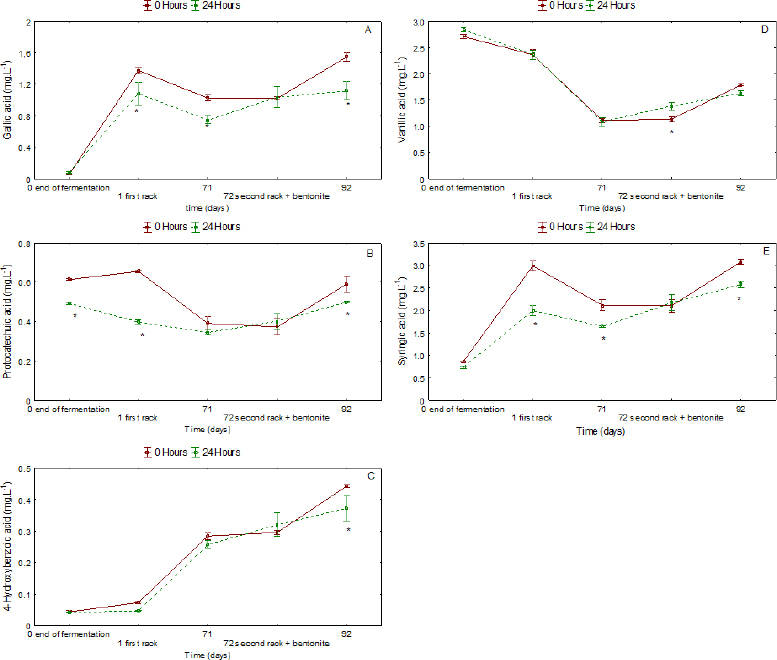
Figure 1.

Hydroxybenzoic acid concentration during the winemaking process: (A) protocatechuic acid, (B) 4-hydroxybenzoic acid, (C) vanillic acid, (D) syringic acid, (E) gallic acid. The red line represents the whole-cluster pressing (0-hour) variant, and the green line represents the 24-hour maceration (the 24-hour) variant. Data are presented as means ± the sd of three replicates. Data were analysed using oneway ANOVA (each time point separately). The average values (n = 3) were combined by contribution to homogeneous groups according to Fisher’s Least Significant Difference test, where * indicates significant differences between variants (p = 0.05).
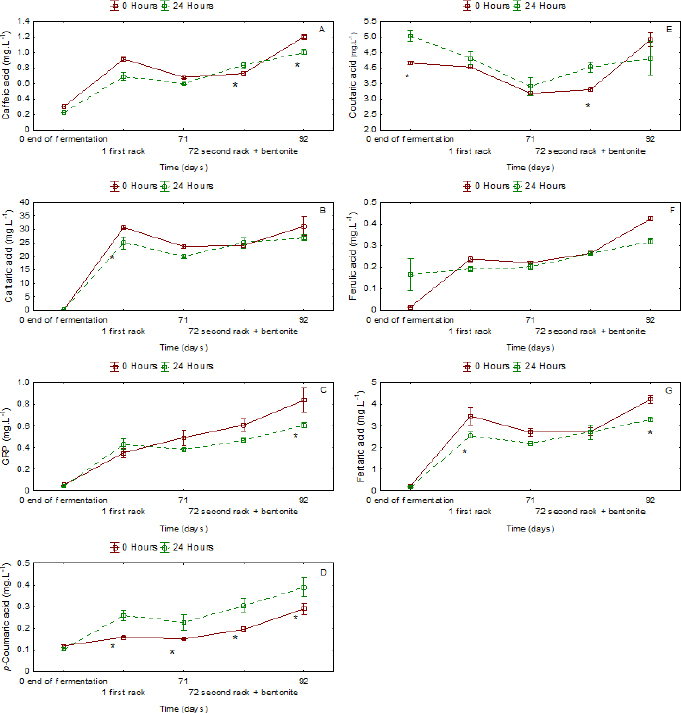
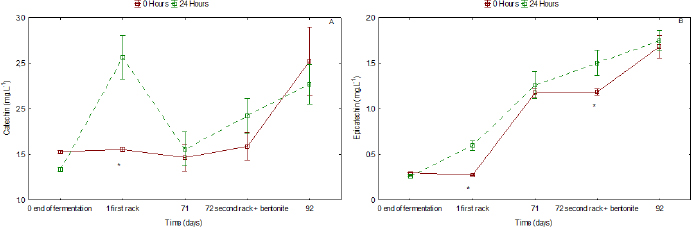
Figure 2.

Hydroxycinnamic acid concentrations during the winemaking process: (A) caffeic acid, (B) caftaric acid, (C) GRP, (D) p-coumaric acid, (E) coutaric acid, (F) ferulic acid, (G) fertaric acid. The red line represents the whole-cluster pressing (0-hour) variant, and the green line represents the 24-hour maceration (24-hour) variant. Data are presented as means ± the sd of three replicates. Data were analysed using one-way analysis of variance (each time point separately). The average values (n = 3) were combined by contribution to homogeneous groups according to Fisher’s Least Significant Difference test, where * indicates significant differences between variants (p = 0.05).

Figure 3.

Flavan-3-ol concentration during the winemaking process: (A) catechin, (B) epicatechin. The red line represents the whole-cluster pressing (0-hour) variant, and the green line represents the 24-hour maceration (24-hour) variant. Data are presented as means ± the sd of three replicates. Data were analysed using one-way analysis of variance (each time point separately). The average values (n = 3) were combined by contribution to homogeneous groups according to Fisher’s Least Significant Difference test, where * indicates significant differences between variants (p = 0.05).
DOI: https://doi.org/10.2478/mittklbg-2023-0008 | Journal eISSN: 3061-063X | Journal ISSN: 3061-0621
Language: English
Page range: 126 - 135
Published on: Jan 8, 2026
In partnership with: Paradigm Publishing Services
Publication frequency: 4 issues per year

© 2026 Zdenek Rihák, Jiri Sochor, Vladimir Skrabek, Mojmir Baron, Tunde Jurikova, published by High School and Federal Office of Viticulture and Pomology
This work is licensed under the Creative Commons Attribution-NonCommercial-NoDerivatives 4.0 License.