
Introduction
Grapevines are cultivated in many regions of the world for different purposes including table grapes, raisins, wine, grape juice, and for locally consumed products such as kofter, vinegar, grape molasses (boiled concentrate juice) (Keskin et al., 2021). They are also known as one of the most commonly consumed fruits, and about 50 % of them are used in winemaking, while one-third is consumed as fresh fruit, the other amount being dried, used as grape juice or must (Ates et al., 2022; Keskin et al., 2022; Kalkan et al., 2022a). Considering the production amount of Turkey, which has an important place in the world market, 1.6 million tons (39 %) of 4.1 million tons of grapes are dried, 2.1 million tons (50 %) are consumed as fresh fruit, and 451 thousand tons (%) 11) are used for wine, must and grape juice (Kaya, 2019; Kalkan et al., 2022b). Turkey is also one of the world’s leading grape producing and exporting countries, where valuable raisins (Sultani Çe-kirdeksiz, Besni, Gök Üzüm etc.), table (Mevlana, Karaerik, Ata Sarısı etc.) and wine grape (Kalecik Karası, Öküzgözü, Hamburg Misketi etc.) varieties are grown. Although these grape varieties are cultivated in many regions of the country, some of them come to the fore only in the regions where they are grown and show their unique taste and aroma characteristics when compared to other regions. The local grape variety of Vitis vinifera, grown only in Hadim region of Konya in Turkey, Gök Üzüm, is one of the high-quality raisin varieties that preserves its distinctive green color when dried (Akın, 2011). After harvest, berries are dried in the shade on the rooftops of the houses, and thanks to this method, the raisins have both a good taste and color, as they retain their original green color. The drying process is completed in about 3-4 weeks under these conditions (Akın, 2011).
On the other hand, organic acids (acetic, tartaric, malic, citric, lactic, and succinic acids), sugars (fructose and glucose), amino acids (alanine, proline, arginine, ammonium, glutamic acid, cystathionine, and g-aminobutyric acid), proteins, peptides, carotenoids (β-carotene, lutein, flavoxanthin, neochrome, violaxanthin, luteoxanthin, neoxanthin, and zeaxanthin), vitamins (riboflavin, niacin, thiamine, α-tocopherol, pyridoxine, folate, choline, and ascorbic acid), flavor components (β-damascenone, furaneol, β-ionone, and 2-phenylethanol), and phenolic compounds (stilbenes [resveratrol {RSV}], proanthocyanidins, flavanols, flavonols [quercetin], hydroxycinnamic and hydroxybenzoic acids, coumarines, lignoids, catechin, epicatechin, and anthocyanins) form the chemical composition of grapes (Tabeshpour et al., 2018). They have also been reported to act as chelators of metal ions, which can catalyze lipid peroxidation, along with various biological activities (anticardiovascular diseases, antimutagenic, antiestrogens, antiulcer, antimicrobial, anticancer, and anti-inflammatory) (Lago-Vanzela et al., 2011). Several recent studies have been conducted on various nutritional and metabolic aspects of wine, table grape and raisins. In these studies, it has been reported that raisins reduce insulinemia, glycemia, and cardiovascular disease risk factors, and also, that nuts consumed with raisins have a synergistic effect on human health (Anderson et al., 2013; Carughi et al., 2016). However, it has been stated that the quantitative and qualitative composition of grapes may show significant differences, depending on many factors, including climatic conditions, the varietal of the grapes, geographical location of cultures, seasonal effects, soil, maturity, viticulture techniques, the drying process, and winemaking procedures (Kallithraka et al., 2001; Subramani et al., 2002; Kaya, 2020). Some studies have, indeed, shown that changes occur in grape composition, such as increased sugar concentration due to grape dehydration during the drying process (Franco et al., 2004). It is also known that as a result of this concentration, there is a significant increase in fiber content, nutrient density, total energy, and generally antioxidant activity as compared to fresh fruit (Sério et al., 2014). There are generally three types of drying methods for grapes such as shade drying, sun drying, and mechanical drying. Since no technical or mechanical means are used to initiate or accelerate the process, both shade drying and direct sun drying are natural drying methods (Vasilopoulou & Trichopoulou, 2014). Grapes are, however, subjected to a pre-treatment process before drying to ensure an increased water removal rate during the drying process (Esmaiili, 2007). In ancient times, dipping solutions were developed for dipping bunches of grapes to accelerate the drying of grapes in the Mediterranean region, especially in Asia Minor. At that time, the solutions contained olive oil and wood ash, and later, specially formulated potassium carbonate (K2CO3) with olive oil was used instead of wood ash. Although most commercial cold dips today use a combination of ethyl esters of fatty acids and potassium carbonate as active ingredients in unheated water, wood ash is still preferred as that dip solution because it is organic. A technique called ‘Hot Dipping Technique’ is widely used in Hadim, Konya. In this technique, grapes are dipped in dipping solutions prepared of both potassium carbonate-olive oil mixture and oak ash solution (the clusters are dipped in these solutions reaching 70-90 °C for 5-10 sec), and thus, under shade conditions, the grapes dried in a way that does not allow browning reactions have a distinctive emerald green color. Theoretically, shade drying in raisins can be expected to result in better quality products in terms of their many biochemical component contents such as organic acids, amino acids, sugars, and minerals, but to the best of our knowledge, there has yet to be a relevant study that scientifically proves such behaviour in Gök Üzüm raisin. Besides, these components of Gök Üzüm have been investigated and reliable nutritional information about this valuable raisin has been tried to be given for the first time here.
Materials and Methods
Plant Materials
A postharvest study was performed on cultivar Gök Üzüm grapes, which were planted at 3 × 3 m in a commercial vineyard in the Konya province, Turkey. The vineyard was managed using commonly used irrigation, fertilization, disease, and pruning management. Vines were 15-20 years old with a planting density between 110 and 115 vines da-1 and vines grafted on 5 BB rootstock and were grown with the Goble system. The experiment was performed with four treatments in a randomized complete block design with four replications. A total of 5 kg of grape samples were taken from each replication (20 kg for a total of 24 vines). Grapes were collected from the bottom, the middle, and the top part of the cluster region of each vine. Each grape batch was divided into two parts, and then each sub-batch was assigned for dipping in one of two different drying solutions.
Pre-treatments before drying
In order to, both, accelerate the drying of fresh grapes and preserve their fresh green color, the clusters were dipped in a solution of potassium carbonate or a solution of oak ash reaching 7090 °C for 5-10 sec. The potassium carbonate solution contained 5-6 % K2CO3 + 0.5-1 % natural olive oil and water, while the oak ash solution contained 1v oak ash + 1v water and no other chemicals. Under these conditions, the drying process was completed in about 3-4 weeks, and grapes were removed from the attics when their moisture content had reached about 15 %. A total of 30 clusters (10 clusters per replication) dried by dipping in potassium solution and the corresponding 30 clusters (10 clusters per replication) dried by dipping in oak ash solution were evaluated. After the drying process, samples were placed in polyethylene bags and stored at 20 °C until the time of analysis.
Organic acid analysis in raisin
The method of Bevilacqua and Califano (1989) was utilized to extract organic acids. Mixtures containing 5 mL raisin sample and 20 mL 0.009 NH2SO4 were combined. The mixture of samples was blended by a shaker for 1 h and then were centrifuged at 15 000 rpm for 15 min. The supernatant of samples was filtered first through filter paper and then twice through a 0.45 μm membrane filter before being passed through a SEP-PAK C18 cartridge. An aminex column (HPX-87 H, 300 mm × 7.8 mm) was utilized in the HPLC system, and the instrument was controlled by a PC with Agilent software. The DAD detector in the system (Agilent, USA) was set at wavelengths of 214 and 280 nm. The mobile phase was 0.009 NH2SO4 that had been filtered through a 0.45 μm membrane filter.
Analysis of free amino acids
In order to determine the free amino acid analysis in raisin, 0.1 N HCl was added to 1 g sample, and then the samples were homogenized with Ultra Turraks (Ika, T-25) and incubated at 4 °C for 12 h. After the samples had been centrifuged at 1200 rpm for 50 min, the supernatant of the samples was filtered with 0.22 μm` (Millex Millipore). The resulting supernatants were then transferred to vials for free amino acid analysis in HPLC as described by Aristoy and Toldra (1991). Readings were recorded at 254 nm in samples using Zorbax Eclipse-AAA 4.6 × 150 mm, 3.5 μm columns (Agilent 1200 HPLC), and standards for free amino acids were determined by comparison with O-phthaldialdehyde (OPA), fluorenylmethyl-chloroformate (FMOC) chemicals. The following were utilized for the mobile phase chromatography system: mobile phase A: 40mM NaH2PO4 (pH: 7.8) and mobile phase B: Methanol/Acetoni-trile/Water (45/45/10, v/v/v) solutions. The column temperature of the mobile phase was 40°C and its flow rate moved through the system in 2 mL min-1. Aspartate, glutamate, leucine, glutamine, lysine, phenylalanine, sarcosine asparagine, tryptophan, histidine, glycine, thionine, serine, alanine, arginine, tyrosine, valine, cysteine, methionine, hydroxyproline, isoleucine and proline contents in raisin samples were detected as pmol μL-1 DW after 26 min derivation process in HPLC.
Sugar analysis
The analysis of sugars in raisin samples was performed using the modified method of Ma et al. (2014). Arabinose, fructose, galactose, glucose, rhamnose, sucrose and xylose sugars in raisins were determined using the high-performance liquid chromatography (HPLC) evaporative light scattering detection (ELSD) method. HPLC analysis of samples was determined on a Waters 2695 separation module equipped with an Alltech 3300 ESLD detector. Separation of extraction samples was performed using an X-Bridge-TM Amide column [4.5 μm particle size, 4.6mm x 250mm i.d.]. Then, samples and standards were filtered through 0.45μm Millipore filters and 10μL samples were loaded into the device. The HPLC-ELSD conditions were optimized, as described by Ma et al. (2014), with a solvent ratio of 85 acetonitrile a flow rate of 1mL/min, 15 water (v/v), drift tube, and the column temperatures set at 82 and 45°C, respectively, and the nebulizer gas flow rate set at 2 L/min. Peaks from readings were detected using calibration standards of HPLC grade sugars (Sigma-Aldrich, Shanghai, China).
Statistical Analysis
Descriptive statistics for the studied variables (characteristics) were presented as mean and standard deviation. Kolmogorov-Smirnov normality test was performed to test for normality of the variables. After the normality test, Mann-Whit-ney-U-Test was used to compare two groups due to violation of the normality assumption. Nonlinear principal component analysis was performed to determine the association between the groups and characteristics. Statistical significance level was considered as 5 % and SPSS (ver: 21) statistical program was used for all statistical computations.
Results & Discussion
Organic acids
Raisin of Gök Üzüm grape cultivar available in the farmer vineyard in Hadim of Konya province had been evaluated to detect organic acids including butyric, citric, fumaric, lactic, maleic, tartaric, malonic, oxalic, malic, succinic, and propionic acids at the harvest time. The dipping solutions significantly affected levels of organic acids (p<0.01), except for fumaric acid, implying that the solutions were a very significant source of the variation on the organic acids. The total acidity quantified in the samples of raisin ranged from 17.98 to 164.72 ng/μL DW for the oak ash dipping solution, while they ranged from 20.30 to 117.08 ng/μL DW for the potassium dipping solution. Butyric acid was the main acid present in raisin for both dipping solutions, with values of 164.72 to 117.08 ng/μL DW, whereas fumaric acid lagged behind the other amino acids with a value of 17.98 to 20.30 ng/μL DW (Tab. 1).
Tab. 1:
Organic acid contents of Gök Üzüm dried after dipping in different solutions (mean ± SD)
| Organic acids (ng/μL DW) | Oak Ash | Dipping solutions Potassium Carbonate | P-value |
|---|---|---|---|
| Oxalic acid | 111.31 ± 9.77 | 76.32 ± 3.57 | 0.004 |
| Propionic acid | 100.96 ± 15.32 | 65.61 ± 5.22 | 0.019 |
| Tartaric acid | 104.17 ± 13.21 | 56.57 ± 8.26 | 0.006 |
| Butyric acid | 164.72 ± 21.61 | 117.08 ± 5.12 | 0.021 |
| Malonic acid | 94.80 ± 7.12 | 67.35 ± 19.77 | 0.086 |
| Malic acid | 87.50 ± 21.22 | 57.13 ± 0.87 | 0.068 |
| Lactic acid | 123.93 ± 14.44 | 82.67 ± 4.37 | 0.009 |
| Citric acid | 75.54 ± 15.52 | 44.69 ± 11.28 | 0.050 |
| Maleic acid | 160.98 ± 15.52 | 54.71 ± 27.76 | 0.014 |
| Fumaric acid | 17.98 ± 2.43 | 20.30 ± 1.77 | 0.253 |
| Succinic acid | 148.33 ± 31.57 | 90.10 ± 4.28 | 0.034 |
Unlike our results, some studies have stated that the main acid found in grape juices and wines is tartaric acid, with concentrations ranging from 0.95 to 6.50 g L-1 for wines and 0.80 to 12.7 g L-1 for juices (Soyer et al., 2003; Ehling & Cole, 2011). Tartaric and malic acids may represent more than 80 % of the total acid content in grapes and fruit juices, but their concentrations vary depending on the grape variety, maturation, climate, and processing factors. In our findings, it may be that, since the grapes were both raisins and that they were dried after having been dipped in different dipping solutions, this may have caused changes in their organic acid content. Samples dried after being dipped in oak ash solution had a higher organic acid content than grape dried after dipping in potassium carbonate solution when considering other amino acids, excluding fumaric acid among the organic acids. Ranked from high to low by content, the organic acids for oak ash solution samples were the following: butyric, maleic, succinic, lactic, oxalic, tartaric, propionic, malonic, malic, citric and fumaric acids. This order changed with the potassium carbonate solution samples and ranked from largest to smallest amounts there were butyric, succinic, lactic, oxalic, malonic, propionic, malic, tartaric, maleic, citric and fumaric acids (Tab. 1). These results are very difficult to compare with others as very little data are reported on the qualities and amounts of organic acids in raisins after dipping in different dipping solutions. Therefore, the origin of the phenomenon as to why amino acids in samples soaked in oak ash solution are higher than in samples soaked in potassium carbonate solution is unknown. However, since oak ash is a natural substance, it may contain organic acid or different chemical reactions may have occurred in the dried samples after being dipped into this solution. This hypothesis may be verified taking into account the analysis of organic acids in oak ash solution, but it was not determined in the current study.
Principal component analysis (PCA) was applied to the combined dataset for organic acid data of raisins treated with different dipping solutions to facilitate the interpretation of the data. The distribution of raisin for dipping solutions along the PC1 and PC2 axes explains 89.5 % of the data variance and is shown in Fig 1.
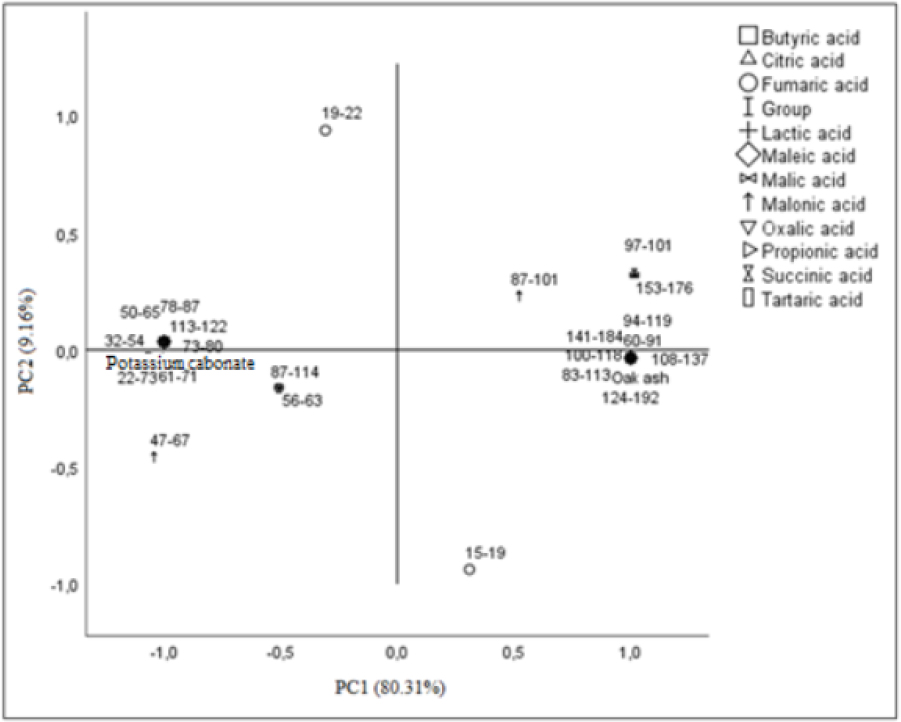
Fig 1.
Two-dimensional projection and values of organic acids in the first two principal components of Gök Üzüm, which were dried after being dipped in different solutions. (Potas; Potassium carbonate)
PC1 was the first main component responsible for the largest variance (80.34 %) of the data, and it is apparent that most of the organic acids showed high levels with the dipping solution applications, grouping in PC1. Tartaric, malonic, malic, citric, fumaric were the ones that showed the highest negative factor loadings in PC1 for both dipping solution samples (Fig. 1). There were differences in raisin organic acid profiles between samples dried by dipping in both solutions, indicating that dipping solutions affected the synthesis of organic acids in raisins. However, oak ash dipping solution can be considered to increase the biosynthesis of organic acid compounds more than potassium solution. It seems quite difficult to explain this hypothesis because no research has been found in the literature on the effect of dipping solutions on the organic acid content of raisins. On the other hand, analysis of possible relationships between different organic acids revealed a marked positive correlation with all organic acids, except for fumaric acid. Most of the variance was collected in dimension 1, and there was a positive association between malonic and succinic acids, between malic and butyric acid, and between oxalic, propionic, and tartaric acids. However, there was a negative correlation between dip solutions (group) and organic acids, except for fumaric acid (Fig. 2).
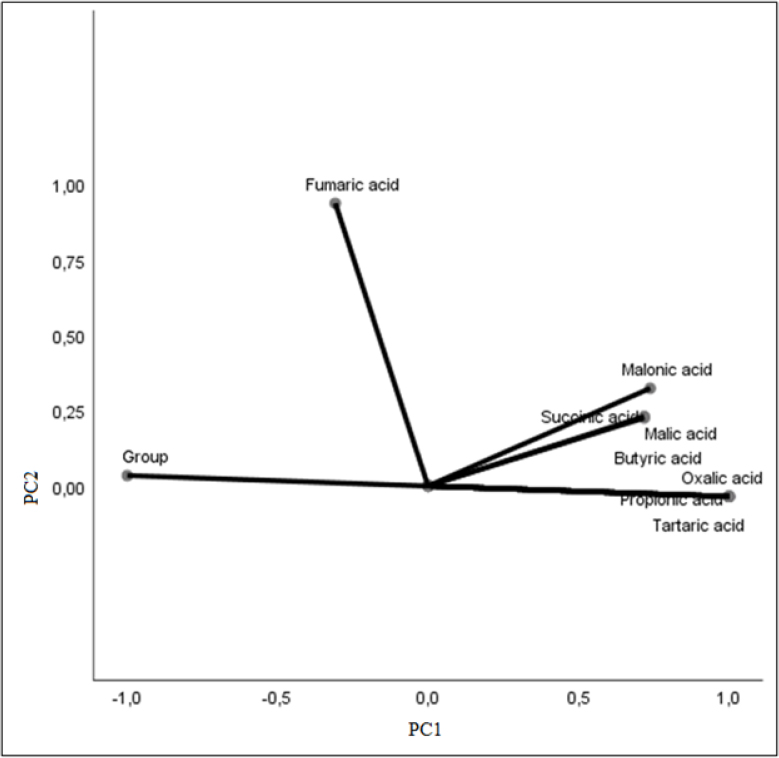
Fig 2.
The relationship between two-dimensional projection and organic acids in the first two main components of the Gök Üzüm, which were dried after being dipped in different solutions
To be truly meaningful and valuable to the scientific community, it should be considered that the presence of organic acids in raisins is affected by these solutions. The profile and concentration of organic acids play a key role in assessing the processing and chemical composition of grape juices and wines, because when these compounds are present a reduction in the pH of the product occurs (Coelho et al., 2018). This improves color stability as anthocyanins retain their red color at low pH and balance between acid and sweet flavors (Silva et al., 2015). However, since our study consisted of grapes left to dry in the shade after being exposed to different dipping solutions, it is quite difficult to compare the organic acid concentration for raisin with wine and grape juice values in the literature.
Free Amino Acids
In this study, twenty-two free amino acids named serine, aspartate, asparagine, glutamate, glutamine, thionine, histidine, arginine, glycine, tyrosine, alanine, sistine, methionine, valine, leucine, tryptophan, isoleucine, phenylalanine, lysine, sarcosine, hydroxyproline and proline were identified and quantified. The analyses of free amino acid content showed a significant difference (p<0.05) between dipping solutions, excluding threonine and glycine. Samples dried after dipping in oak ash solution had a higher free amino acid content than samples dried after being dipped in potassium carbonate solution when considering other amino acids excluding glycine, threonine, and arginine among the amino acids (Tab. 2).
Tab. 2:
Free amino acid contents of Gök Üzüm dried after dipping in different solutions (mean ± SD)
| Free Amino acids (pmol μL−1 DW) | Oak Ash | Dipping solutions Potassium Carbonate | P-value |
|---|---|---|---|
| Aspartate | 23565.57 ± 639.02 | 14345.47 ± 597.11 | 0.001 |
| Glutamate | 17778.93 ± 857.19 | 14333.38 ± 1655.18 | 0.033 |
| Asparagine | 41016.75 ± 2787.54 | 20019.94 ± 626.68 | 0.001 |
| Serine | 60760.28 ± 7044.79 | 31870.28 ± 1630.90 | 0.002 |
| Glutamine | 24194.20 ± 1924.13 | 16127.29 ± 1186.68 | 0.003 |
| Histidine | 1465.48 ± 141.74 | 729.98 ± 33.08 | 0.001 |
| Glycine | 166.03 ± 7.35 | 181.19 ± 9.80 | 0.099 |
| Thionine | 2734.36 ± 252.71 | 3043.48 ± 310.51 | 0.269 |
| Arginine | 350.38 ± 11.77 | 383.64 ± 12.91 | 0.030 |
| Alanine | 38498.50 ± 1472.62 | 23598.31 ± 2090.56 | 0.001 |
| Tyrosine | 2464.64 ± 157.51 | 1749.56 ± 112.59 | 0.003 |
| Sistine | 5801.13 ± 389.76 | 2999.39 ± 126.98 | 0.001 |
| Valine | 2979.94 ± 401.64 | 880.08 ± 18.01 | 0.001 |
| Methionine | 10987.84 ± 860.05 | 5249.12 ± 408.21 | 0.001 |
| Tryptophan | 9913.82 ± 527.09 | 4193.01 ± 199.41 | 0.001 |
| Phenylalanine | 10624.81 ± 1148.11 | 7169.93 ± 355.66 | 0.008 |
| Isoleucine | 8063.18 ± 779.85 | 4016.40 ± 182.05 | 0.001 |
| Leucine | 18437.12 ± 1749.16 | 8126.17 ± 435.38 | 0.001 |
| Lysine | 14512.93 ± 1003.12 | 4293.12 ± 206.02 | 0.001 |
| Hydroxyproline | 14350.66 ± 1128.36 | 3742.57 ± 399.98 | 0.001 |
| Sarcosine | 19827.60 ± 1996.62 | 9194.46 ± 517.23 | 0.001 |
| Proline | 461.48 ± 36.44 | 246.41 ± 19.90 | 0.001 |
As no data are available concerning the composition of the amino acids of dried grapes after dipping in different solutions, the origin of the phenomenon of amino acids being high in samples dipped in oak ash solution remains unknown. However, we hypothesize that the amino acid compounds present in the oak ash solution may be incorporated into the raisins after dipping.The presence of amino acids in the natural composition of oak ash and the increase in amino acids in raisins after dipping in this solution may confirm this hypothesis. This hypothesis may be verified taking into account the analysis of amino acids in oak ash solution, but it was not determined in the current study. On the other hand, the samples from both dipping solutions showed a very high value of serine and, of the remaining amino acids, alanine, asparagine, glutamine, aspartate, sarcosine, glutamate, and leucine were the most predominant. Among the amino acids of dried samples glycine was the lowest amino acid, followed by arginine, proline, histidine, and valine (Tab. 2). Although there is published evidence of the alteration of amino acids in wine and table grape products, there have been no studies investigating changes in specific free amino acids for grapes dried after using different solutions. In general, arginine, glutamic acid, proline, and alanine have been reported to be the major free amino acids in many V. vinifera table grapes (Kliewer, 1969; Huang and Ough, 1991; Sarimento et al., 1992). Our study reveals that these amino acids, except for alanine, were not dominant after either of the dipping solution applications. This reduction in the variables glycine, arginine, proline, histidine, valine, and increase in other amino acids could possibly be explained by a decrease in the proportion of these amino acids during the drying process.
Principal component analysis (PCA) was applied to the combined data set for amino acid data of samples treated with different dipping solutions to simplify the interpretation of the data. The distribution of samples for dipping solutions along the PC1 and PC2 axes explains 97.10 % of the data variance and is shown in Fig 3.
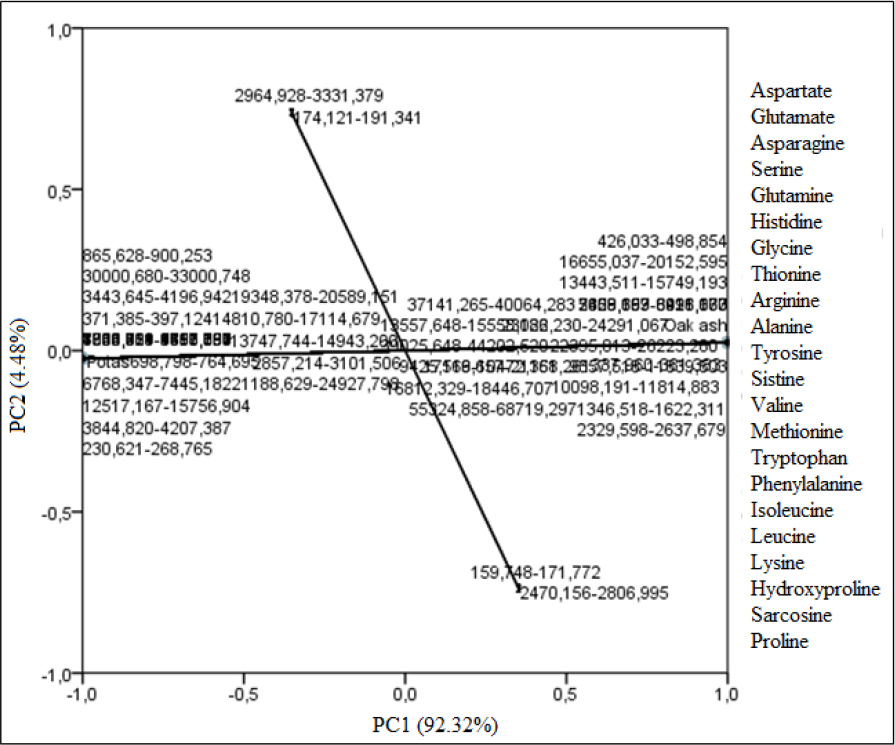
Fig 3.
Two-dimensional projection and values of free amino acids in the first two principal components of Gök Üzüm, which were dried after being dipped in different solutions.
PC1 was the first main component responsible for the largest variance (92.32 %) of the data, and it is apparent that most of the amines showed high levels with the dipping solution applications, grouping in PC1. The variables serine, aspartate, asparagine, glutamate, glutamine, histidine, arginine, tyrosine, alanine, sistine, methionine, valine, leucine, tryptophan, isoleucine, phenylalanine, lysine, sarcosine, hydroxyproline, and proline were the ones that presented the highest positive factor loadings in PC1, except for thionine and glycine for both dipping solution samples (Fig. 3). It is obvious from the results presented that although there is a general tendency of increasing amino acid content with dipping solutions, these dipping solutions do not affect the individual amino acid metabolism uniformly or similarly. Overall, there were differences in the raisin amino acid profiles between samples dried after dipping in potassium carbonate solution and samples dried after dipping in oak ash solution, demonstrating that dipping solutions affected the synthesis of amino acids in raisin. Therefore, both dipping solutions could be argued to enhance the biosynthesis of free amino acid-related compounds, excluding glycine, arginine, proline. No information on the difference between these two dipping solutions in raisin has ever been given anywhere, and so, it is worth noting that this difference between dipping solutions is quite difficult to interpret. On the other hand, analyzing possible relationships between different free amino acids revealed a marked positive correlation between thionine and glycine, as well as serine, aspartate, asparagine, glutamate (Fig. 4).
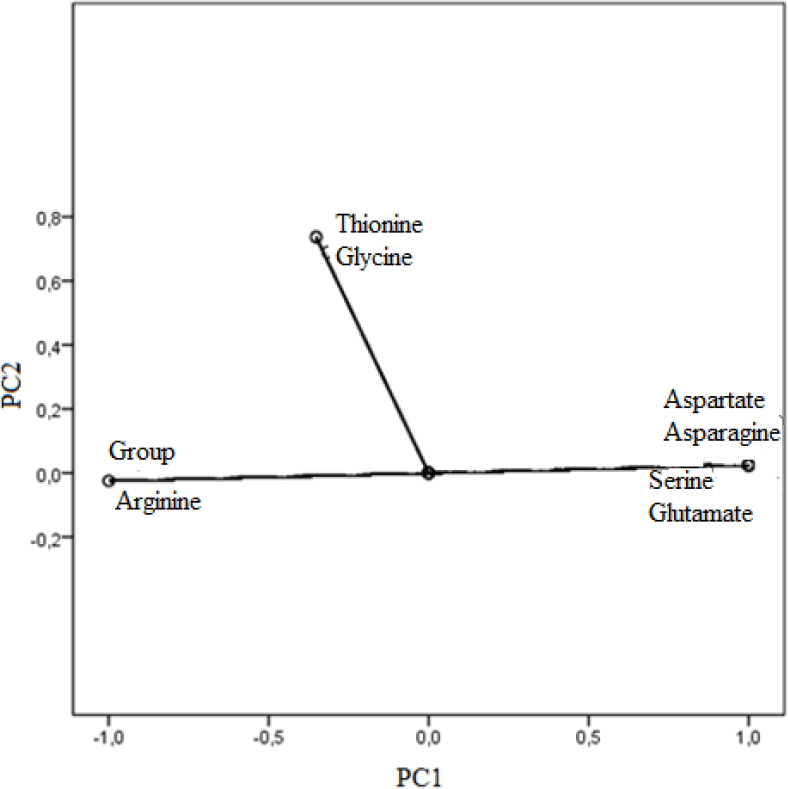
Fig 4.
The relationship between two-dimensional projection and free amino acids in the first two main components of the Gök Üzüm, which were dried after being dipped in different solutions
Aspartate and glutamate are known as acidic amino acids and they have a net negatively charged R group at pH 7 with second carboxyl groups. It is known that aspartate and glutamate are the main compounds of asparagine and glutamine, and this may explain the reason for the relationship between aspartate, glutamate, and asparagine in our results. Regarding the relationship between amino acids, arginine exhibited a quite different profile from other amino acids. Lysine, arginine, and histidine have been reported to be basic amino acids (Young, 1974), and so, the main reason why it is in a different group from other amino acids in our study may be due to its basic amino acid structure.
Sugars
Analysis results of data showed that sugars were significantly (p<0.01) affected by dipping solution, except for sucrose and fructose. In the examined samples, fructose was the most abundant sugar, whereas sugars with the lowest amounts in raisins were xylose for oak ash application and galactose for potassium carbonate application. There was wide variation in the sugar profiles for both variants, with values ranging from 30.43 mg/100 g DW (fructose in the samples dipped in potassium carbonate solution) to 0.71 g/100 g DW (galactose in the samples dipped in oak ash solution) (Tab. 3).
Tab. 3:
Sugar contents of Gök Üzüm dried after dipping in different solutions (mean ± SD)
| Sugar (mg/100 g DW) | Oak Ash | Potassium Carbonate | P-value |
|---|---|---|---|
| Saccharose | 6.97 ± 2.40 | 0.89 ± 0.10 | 0.121 |
| Glucose | 16.03 ± 1.35 | 18.19 ± 1.81 | 0.099 |
| Fructose | 27.46 ± 2.71 | 30.43 ± 3.51 | 0.269 |
| Rhamnose | 3.50± 1.77 | 3.83± 1.91 | 0.030 |
| Galactose | 7.25 ± 0.31 | 0.72 ± 0.06 | 0.001 |
| Xylose | 5.70 ± 0.32 | 4.40 ± 0.36 | 0.011 |
| Arabinose | 6.86 ± 0.29 | 4.91 ± 0.27 | 0.001 |
To our knowledge, this is the first study of the effects of different dipping solutions on Gök Üzüm raisin, and it is interesting to note that sugar values of raisns dipped in oak ash were much higher per gram than those dipped in potassium carbonate solution. In general, dipping solution treatments caused an increase in fructose, glucose, and rhamnose, these sugars were probably more affected by the potassium carbonate solution, whereas galactose content decreased. The effect of high temperatures during dipping or drying may have caused hydrolysis in the sucrose contents of raisins. The sucrose content of the grapes treated with potassium carbonate solution was similar for the different samples (Carranza-Concha et al., 2012), reaching about 0.84 g sucrose/100 g of dry matter. However, the results showed a high dispersion of the glucose and fructose values, indicating some heterogeneity in the raisins obtained. For both of our variants these values are higher than 8.2 g glucose/100 g and 9.1 g fructose/100 g of dry matter obtained by Carranza-Concha et al. (2012) for a variety of commercial raisins. The results of Ghrairi et al. (2013) consistent with our results indicate that the predominant sugar in the different varieties of raisins was fructose from 26.13 % (Karkni) to 31.21 % (Chrina) and glucose from 32.37 % (Meski) to 37.33 % (Chriha). There was also a significant difference in contents of rhamnose, glucose, and fructose for raisins obtained after the two different treatments (Tab. 3). Additionally, in order to visualize the similarities and differences between the raisin sugar content of the Gök Üzüm cultivar studied, a PCA was performed considering all of the mean values of the sugar compounds analyzed after the application of two different dipping solutions. The first two principal components (PCs) accounted for just 86.35 % of the variance as a result of sugars studied (Fig. 5).
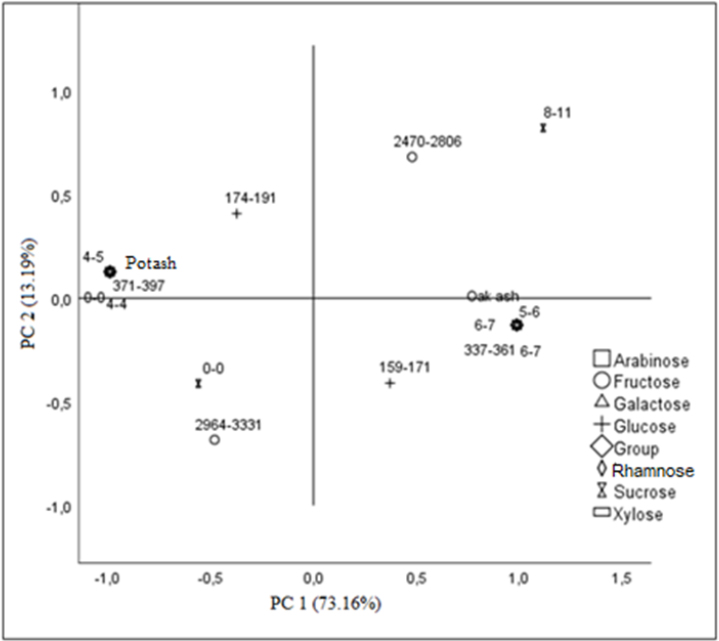
Fig 5.
Two-dimensional projection and values of sugar contents in the first two principal components of Gök Üzüm, which were dried after being dipped in different solutions.
Other sugars, except fructose and sucrose, were found on the positive side of PC1 and PC2, which was associated with both dipping solutions. Rhamnose, xylose, and arabinose were found on the positive side of PC1, associated with high concentrations of both dipping solution applications. Interestingly, the fructose and sucrose were separated from the other sugars as a result of dipping solutions having different contents, as described above (Fig. 3). When Fig 4 is examined, on the other hand, rhamnose, glucose (on the positive side for PC2), and fructose (on the negative side for PC1) showed a strong correlation with raisins of both variants. There was also a very strong negative association of arabinose, xylose, galactose (on the negative side for PC1) and a weaker negative association with sucrose (on the positive side for PC2) in raisins of both variants (Fig. 6).
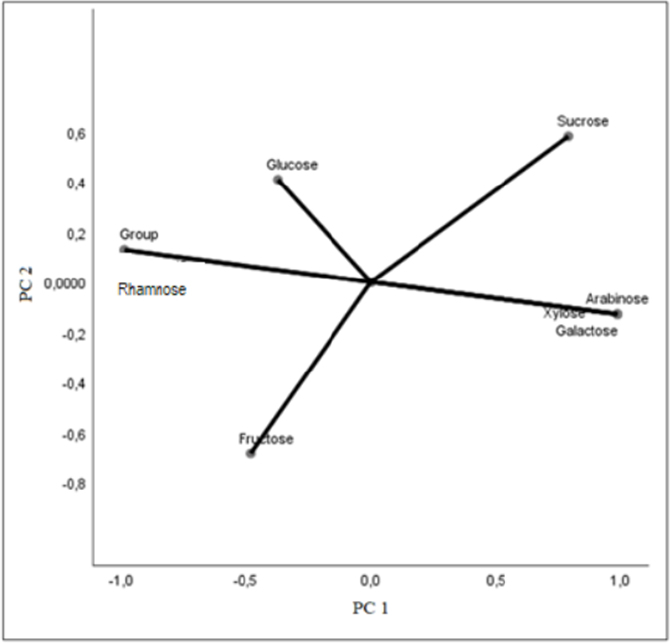
Fig 6.
The relationship between two-dimensional projection and sugar contents in the first two main components of the Gök Üzüm, which were dried after being dipped in different solutions
This confirms that after drying in the samples treated with high temperature, sucrose decomposes to a large extent and converts to hexoses (i.e. glucose and fructose) (Ghrairi et al., 2013). Our results were different from the findings of some authors (Lee et al., 1970; Simsek et al., 2004; Gary & Arianna, 2010), and these differences may be explained by the effects of factors such as cultivars, different environmental and experimental conditions, drying conditions or effects of drying methods on sugar changes in raisins. On the other hand, rhamnose was interestingly the second-most dominant sugar in raisins pretreated with either solution. The overall range of the rhamnose for a raisin in our results does not conform to literature results revealed by previous studies using different grape varieties, but our current knowledge does not allow for interpreting the reason for this effect.
Conclusions
Considering that the grapes dried in the shade after being dipped into the oak ash solution have higher concentrations of beneficial organic, free amino acids and sugar components than the samples with potassium carbonate pretreatment, it can be reasoned that raisins obtained from the Gök Üzüm variety, which is dried after being exposed to this pre-treatment, may be beneficial for human consumption. Samples dried after being dipped in oak ash solution had a higher organic acid content than grapes dried after being dipped in potassium carbonate solution when considering other amino acids, except for fumaric acid, among the organic acids. Fructose was the most abundant sugar, whereas the lowest sugars in raisins were xylose for oak ash application and galactose for potassium carbonate application. Drying the Gök Üzüm in the shade after dipping it in the oak ash solution increased contents of the organic acids, free amino acids and sugar components, and thus appeared as an advantageous form of processing due to its natural structure, low cost and ease of application.
Acknowledgments
The authors are grateful to Orhan Çoruh and Ramazan Yiğit for their support in providing samples for the study.
Notes
[1] Contributed by Author contribution
OK and FA designed the study. FA, SK and NK were responsible for the performance of the research and collection. OK interpreted the results, analyzed data and wrote the manuscript. MT provided biochemical analysis. All authors have read and agreed to the published version of the manuscript.
[2] Data Availability
The authors declare that the data supporting the findings of this study are available within the article.
[3] Compliance with Ethical Standards
Ethical Approval: This paper does not contain any studies with animals or human participants performed by any of the authors.
Informed Consent: Not applicable.
Conflict of Interest: Authors declare that they have no conflict of interest.