

Table 1:
Self-reported sociodemographic characteristics of LIFE students (n=116 respondents).
| Variable | N | Percent | Mean | SD |
|---|---|---|---|---|
| Age (years) | 24.65 | 5.45 | ||
| Years in College | 5.09 | 2.64 | ||
| Sex | ||||
| Female | 85 | 73.3% | ||
| Male | 25 | 21.6% | ||
| Missing | 6 | 5.2% | ||
| Race/Ethnicity | ||||
| White | 66 | 56.9% | ||
| Asian | 28 | 24.1% | ||
| Black or African American | 6 | 5.2% | ||
| Hispanic or Latino | 6 | 5.2% | ||
| American Indian or Alaska Native | 1 | 0.9% | ||
| Other, not listed | 3 | 2.6% | ||
| Missing | 6 | 5.2% | ||
| Profession | ||||
| Public Health/Dietetics | 48 | 41.7% | ||
| Physical Therapy | 33 | 28.0% | ||
| Social Work | 13 | 11.0% | ||
| Kinesiology | 10 | 8.5% | ||
| Medicine | 6 | 5.1% | ||
| Pharmacy | 3 | 2.5% | ||
| Health Information Technology | 2 | 1.7% | ||
| Nursing | 2 | 1.7% | ||
| Public Health | 1 | 1.0% | ||
| Education Level | ||||
| Graduate | 101 | 87.1% | ||
| Undergraduate | 13 | 11.2% | ||
| Missing | 2 | 1.7% |
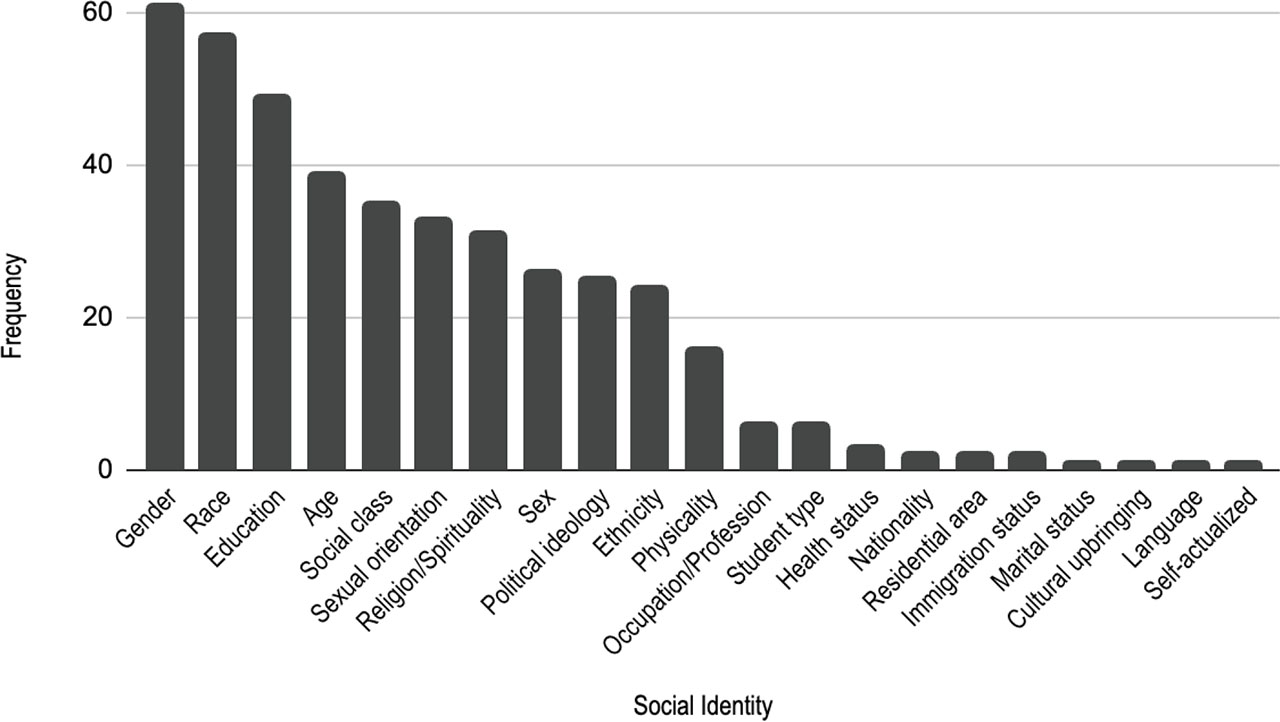
Figure 1.
Students’ social identities that they identified with during the kick-off session (n=87 respondents), January 2024
Notes: “Student type” refers to level of student's education like graduate vs undergraduate; “Self-actualized” indicates that a respondent feels they have the ability to reach their full potential.
Table 2:
Perceived effects of social identities on peer interactions prior to teamwork and patient interviews (n=87 respondents), January 2024.
| Theme | Frequency (Percent of Respondents) | Representative Quote (Social Identities of Respondent) |
|---|---|---|
| Social identity advantages | 54 (62%) | I think that being a Black woman who is consciously aware how socioeconomic factors play a huge role in the healthcare received will be helpful in the interaction with my peers. Understanding that some minorities may have to advocate more will be helpful for others to hear and understand. (Physical Therapy, Black, Heterosexual, Middle Class, Able-Bodied, Liberal, Woman) |
| Diverse perspectives and skills | 39 (45%) | I think with the LIFE team, I want to be open to acknowledge others’ identities as well, and I will be able to bring in my perspectives as a child of immigrants. I have also done quite a bit of cultural psychology research and I would bring those perspectives to the team. (Social Work, Asian, Woman, Child of Immigrants) |
| Social identity biases | 35 (40%) | I feel that many people have linked my faith to certain stereotypes and I worry that I may be labeled based on these misconceptions (Public Health, Christian Polish-American, Woman) |
| Social identity disadvantages | 13 (15%) | I am the only male in the team, and English is not my first language so the communication sometimes is not very smooth (Kinesiology, Young, Chinese, Male) |
Table 3:
Perceived effects of social identities on patient interactions prior to patient interviews (n=87 respondents), January 2024.
| Theme | Frequency (Percent of Sample) | Representative Quote (Social Identities of Respondent) |
|---|---|---|
| Cultural or identity awareness/sensitivity | 66 (76%) | We will likely have different identities which bring different viewpoints. We need to respect our patient’s views. We may need to alter the way we are teaching and/or helping our patients based on their identities. (Physical Therapy, Able-Bodied, Middle-Class, Straight, White, Female) |
| Identity biases | 33 (38%) | Even though I am a Masters student, when I enter the room with a licensed social worker, because I am older, white and male, the patients defer to me. This is unfortunate in many ways. (Social Work, Middle-Aged, Straight, White, Male) |
| Identity and relatability | 21 (24%) | My identities will help me relate to some of my patients, however, based on their identities, may make it difficult for me to relate to them and require me to think from their perspective. I think for Spanish speaking patients, I will provide comfort being able to communicate to them in Spanish. (Medicine, Latina, Woman) |
| Patient-centered care | 10 (11%) | Due to where I am at right now at this stage of medical training, I strongly believe that the patient really knows best and I’m here to support them in what they need (Medicine, Young, Liberal, Student) |
| No influence/unawareness | 2 (2%) | They won’t. (Social Work, No Other Identities Listed) |
Table 4:
Students’ perceptions of how LIFE helped them navigate their social identities while interacting with peers or patients (n=82 respondents), April 2024.
| Theme | Frequency (Percent of Sample) | Representative Quote (Profession) |
|---|---|---|
| Social identity awareness | 52 (63%) | It made me check my biases and also how I may present to a patient. It made me check my privilege and acknowledge how that could impact a patient. (Public Health) |
| Value of interprofessional collaboration | 29 (35%) | LIFE helped me better understand the perspectives of some of the other peers I may and will be working with in the future. Understanding their thought processes and goals ultimately helped refine how I communicate with the people around me to lead them towards better health outcomes. (Physical Therapy) |
| Social determinants of health and health inequity | 5 (6%) | LIFE has helped me gain a more comprehensive and complex perspectives from the patient in navigating the healthcare system in the US. As an international student from a very different culture, I got to learn about the needs and real obstacles of patients in this culture. I also think about the possible obstacles that immigrants or international students like me would encounter in this system and how we can make it more inclusive and accessible for them. (Public Health) |