

INTRODUCTION
Interprofessional education (IPE) is instituted as a competency across most health professional degree programs (Collaborative, 2023). Engagement in IPE provides students with opportunities to consider the impact of effective interprofessional collaboration on patient outcomes, health equity, and provider satisfaction. When students train solely within their own professions, stereotypes and biases may develop towards other allied health professionals (Khalili et al., 2013; Price et al., 2014). Training within health professional silos is counter to a core goal of IPE, which centers on students learning with and about one another to develop skills for effective collaboration by utilizing each other’s unique roles and strengths to provide excellent patient care (North et al., 2023). The process of socializing beyond one’s own profession and in an interprofessional team fosters positive attitudes towards collaboration and appropriate team-based care behaviors among health professional students (Farris et al., 2023; Khalili & Orchard, 2020; Normandin et al., 2023; Rulli et al., 2022).
When health professional students engage in IPE, they are challenging the phenomenon of the social identity theory which postulates that one would favor those within their same group, in this case the same health profession (Tajfel & Turner, 2003). The social identities that learners form before entering a health professional training program may also impact team socialization. Social identities are the individual perceptions of oneself in social contexts and as a member of that social group, such as race, political affiliation, gender, or socioeconomic status, and can shape one’s experiences in educational and training environments (Howard, 2000). For example, Indigenous learners in medical school reported feeling lonely and without a sense of belonging among their peers (Burm et al., 2023).
Further, the social identity model of identity change (Jetten et al., 2012) postulates that major transitions in life, such as entering a new degree program, may be difficult for an individual to endure as it disrupts self-continuity, but such transitions may also provide opportunities to form new identities. As health professional students transition to study within their respective fields, they are challenged with understanding how their pre-existing identities might fit within these new professional roles. This can be especially complex when their social identities are an underrepresented minority (Autiero, 2015; Lett et al., 2023). Being part of an interprofessional team is an additional identity students are expected to develop, adding to this “layering” of identity and socialization challenges students must learn to navigate.
It is a complex process for a health professional student to successfully socialize in an interprofessional team. Acknowledging and reflecting upon the various identities that one brings to their profession and interprofessional team has been under-recognized and under-explored in IPE. The objective of this qualitative study was to describe how health professional students considered their individual social identities while interacting as a member of an interprofessional team and engaging with patients in experiential patient-centered learning.
METHODS
Experiential learning overview: Longitudinal interprofessional family-based experience (LIFE)
The Longitudinal Interprofessional Family-Based Experience (LIFE) is an experiential interprofessional learning opportunity that spans an 11-week period. Students are enrolled in LIFE for either an optional non-credit extra-curricular activity or an embedded assignment within a course of their respective program. Students were assigned to an interprofessional student team, and each team conducted two interviews with a patient living with a chronic illness, such as spina bifida or multiple sclerosis. The didactic content is delivered asynchronously via Canvas and interviews are virtual on Zoom. The virtual approach enabled broader participation from health professional degree programs across three university campuses and made it more accessible for patients to engage with student learners.
LIFE was developed using the socio-ecological model (SEM) and social determinants of health (SDH) as its framework (Mattison et al., 2021). We used SEM in the context of it being a theory-based framework often used in the health sciences fields for understanding the multilevel effects of personal and environmental factors that determine an individual’s health-related behaviors (Kilanowski J. F., 2017). To prepare for patient interviews, students engaged in the following: 1) synchronous kick-off session including discussion and reflection on the SEM, the SDH, team norms, and social identities; 2) asynchronous pre-work such as readings; 3) team preparation for interview #1 including readings, assignment of team role, and development of interview questions; 4) patient interview #1 focusing on patients’ experiences living with a chronic illness; 5) team debrief #1 including students’ reflections on roles and team functioning; 6) team preparation for interview #2; 7) patient interview #2 focusing on experiences with healthcare teams, systems, and community resources; 8) team debrief #2; and 9) synchronous closing session reinforcing SEM, SDH, team norms, and social identities. A Canvas Learning Management System site provided modules that guided students through each activity.
Participants
Students from 11 health professional schools across three university campuses were eligible for LIFE. Staff at the institution’s Center for Interprofessional Education assigned student participants to their interprofessional team to ensure professions were distributed evenly across the teams. Trained patient advisor volunteers were recruited from the institution’s Office of Patient Experience and were assigned to an interprofessional student team.
Intervention and data collection
During the kick-off session, the following script was used to introduce students to the concept of social identities: “A social identity is an example of a type of social determinant of health. As humans, we are socially putting ourselves in categories by how we see ourselves in the world, but also by how others see us. Social identities play a role in how we are perceived and how we perceive ourselves in work and personal life. Characteristics of social identities can be obvious (e.g., color of skin can be an indication of race) or sometimes not (e.g., sexual orientation). Some people are proud of these social identities and self-proclaim them, while others may not take pride in some of them. Social identities can impact how people treat you in the health care system.” In addition to this definition, we provided students with some examples of social identities including gender, sexual orientation, race, ethnicity, class, religion, (dis) ability, age, politics, and education.
Following the kick-off presentation about social identities, students were prompted to reflect individually on their own social identities and to record all of them via an anonymous Google Form. They were prompted to refer to the list of examples and to include any they could think of on their own that they also identified with. Following this reflection they were asked to answer two questions: “How might these social identities affect your interactions with your peers (i.e., interprofessional team)?” and “How might these social identities affect your interactions with a patient or client?” The responses to these prompts were collected anonymously in the same Google Form.
During the closing session of the LIFE program, students were re-exposed to the general definition of social identities. They were prompted to individually reflect on their experiences during LIFE and answer the following question: “How has your experience in LIFE helped you to navigate your own social identities as you interact with peers or patients?” The responses to this prompt were collected anonymously in a Google Form. Of note, we did not record their social identities within this post-prompt.
Data analysis
A data-led content analysis approach was used to analyze the responses from the kick-off and closing sessions’ prompts. First, codes (i.e., a single word or short phrase reflecting an opinion, thought, or feeling in response to the survey question) were derived from the responses a posteriori by one investigator who was assigned to segment the responses according to the codes (Cho & Lee, 2014). Next, a different investigator reviewed the codes and made suggestions to add new codes or edit existing codes according to the data. Once the codes were agreed upon and completed, the first investigator derived themes by combining co-occurring or overlapping codes (Peel, 2020). Finally, the second investigator reviewed the themes and made suggestions, if needed.
After the initial analyses of the responses for each prompt, discrepancies across codes or themes were discussed amongst the entire research team until a consensus was reached. Themes were summarized and tallied to provide an overall picture of the respondents’ perceptions of how their social identities may affect (pre-LIFE) or did affect (post-LIFE) their interactions. Investigators reviewed participant responses to identify quotes that were representative of each theme. The responses that fit within each theme were tallied for frequencies.
The students’ demographics, specifically age, sex, race/ethnicity, health profession, and education level were summarized for their average or frequencies. This project was exempted by the authors’ University Institutional Review Board (HUM00175525).
Researcher characteristics and reflexivity
The researchers are all health professionals holding a license and/or a higher degree. We have all worked in interprofessional teams and have had formal diversity, equity, and inclusion training. Our purpose with the open-ended nature of the response collection was to see how reflection about social identities may influence health professional students to approach teamwork and interactions with patients. Our analysis methods utilizing multiple reviewers will minimize bias in the interpretation.
RESULTS
Overview of student respondents
118 students representing nine health professional schools were assigned to an interprofessional student team. One patient was assigned to each student team. 116 students responded to the demographic survey. The mean age of respondents was about 25 years, and mean time spent in higher education was five years (Table 1). Most respondents identified as female (73%) and white (57%). The most represented health professions were public health/dietetics (42%) and physical therapy (28%). Most respondents were in graduate-level programs (87%).
Table 1:
Self-reported sociodemographic characteristics of LIFE students (n=116 respondents).
| Variable | N | Percent | Mean | SD |
|---|---|---|---|---|
| Age (years) | 24.65 | 5.45 | ||
| Years in College | 5.09 | 2.64 | ||
| Sex | ||||
| Female | 85 | 73.3% | ||
| Male | 25 | 21.6% | ||
| Missing | 6 | 5.2% | ||
| Race/Ethnicity | ||||
| White | 66 | 56.9% | ||
| Asian | 28 | 24.1% | ||
| Black or African American | 6 | 5.2% | ||
| Hispanic or Latino | 6 | 5.2% | ||
| American Indian or Alaska Native | 1 | 0.9% | ||
| Other, not listed | 3 | 2.6% | ||
| Missing | 6 | 5.2% | ||
| Profession | ||||
| Public Health/Dietetics | 48 | 41.7% | ||
| Physical Therapy | 33 | 28.0% | ||
| Social Work | 13 | 11.0% | ||
| Kinesiology | 10 | 8.5% | ||
| Medicine | 6 | 5.1% | ||
| Pharmacy | 3 | 2.5% | ||
| Health Information Technology | 2 | 1.7% | ||
| Nursing | 2 | 1.7% | ||
| Public Health | 1 | 1.0% | ||
| Education Level | ||||
| Graduate | 101 | 87.1% | ||
| Undergraduate | 13 | 11.2% | ||
| Missing | 2 | 1.7% |
When students reflected upon the social identities that they most identified with during the kick-off session, most students (57% or more) indicated gender, race, and education (Figure 1). One-third or more of the students (range 36%–45%) identified with their age, social class, sexual orientation, or religious or spiritual beliefs. Of note, most students (>50%) reported more than one social identity.
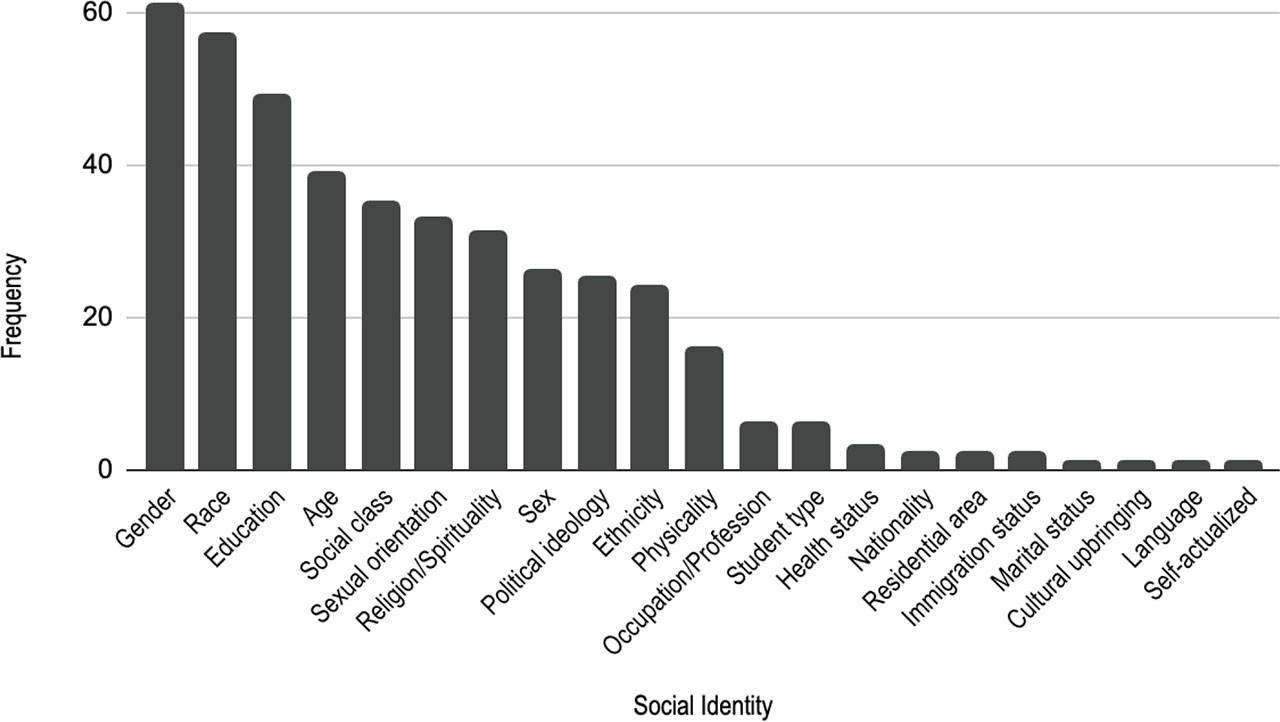
Figure 1.
Students’ social identities that they identified with during the kick-off session (n=87 respondents), January 2024
Notes: “Student type” refers to level of student's education like graduate vs undergraduate; “Self-actualized” indicates that a respondent feels they have the ability to reach their full potential.
Reflections about social identities: Pre-life
Eighty-seven of the 139 enrolled learners (63% response rate) completed the prompts from the kick-off session.
Peer interactions
Most students reported that their social identities would create advantages as they interacted with peers (Table 2). Students described advantages such as the development of cultural awareness across their team members, as represented by this Native American physical therapy student: “I might have different experiences culturally and personally that give me compassion and understanding to others and the ability to know that cultural differences gives us the ability to understand and learn from others.” Some students described advantages referring to “white privilege,” as a medical student who identified as male and queer reported, “Being white comes with unearned respect in many situations”. Another example of an advantage that was described included empathy, as illustrated by a student who identified as a liberal woman and grew up in poverty: “I think in some ways the way I was raised allowed me to experience many things that made me more empathetic, open, and accepting of differences.”
Table 2:
Perceived effects of social identities on peer interactions prior to teamwork and patient interviews (n=87 respondents), January 2024.
| Theme | Frequency (Percent of Respondents) | Representative Quote (Social Identities of Respondent) |
|---|---|---|
| Social identity advantages | 54 (62%) | I think that being a Black woman who is consciously aware how socioeconomic factors play a huge role in the healthcare received will be helpful in the interaction with my peers. Understanding that some minorities may have to advocate more will be helpful for others to hear and understand. (Physical Therapy, Black, Heterosexual, Middle Class, Able-Bodied, Liberal, Woman) |
| Diverse perspectives and skills | 39 (45%) | I think with the LIFE team, I want to be open to acknowledge others’ identities as well, and I will be able to bring in my perspectives as a child of immigrants. I have also done quite a bit of cultural psychology research and I would bring those perspectives to the team. (Social Work, Asian, Woman, Child of Immigrants) |
| Social identity biases | 35 (40%) | I feel that many people have linked my faith to certain stereotypes and I worry that I may be labeled based on these misconceptions (Public Health, Christian Polish-American, Woman) |
| Social identity disadvantages | 13 (15%) | I am the only male in the team, and English is not my first language so the communication sometimes is not very smooth (Kinesiology, Young, Chinese, Male) |
Another common theme that was identified from the responses was around learning diverse perspectives and skills from peers of various social identities, as a physical therapy student who identified as young, conservative, and male stated, “Since we come from different school programs we can all have a different skill set we provide to the team.” Social identity bias was another theme that arose and was reported as potentially affecting peer interactions. Some examples of anticipated biases reported by the students included age, race, religion, and political affiliations. Some students also reported that their social identities might bring disadvantages (rather than advantages) to their team, such as being a non-native English speaker, in relation to communication.
Patient interactions
Over three quarters of the students described that their social identities might create cultural awareness or sensitivity among their patient interactions (Table 3). As a public health student who identified as white, catholic, middle-class, and able-bodied stated, “I may have cultural perspectives and background that influence my thoughts and solutions. It is important to consider the patient’s cultural perspectives in caregiving and making sure I am creating sustainable approaches tailored to them.” Similar to peer interactions, a theme that arose relating to patient interactions was that biases may occur. Examples of anticipated biases related to social identities and patient interactions included age, race, gender, religion, and experience-level (professional status). About a quarter of students provided responses that related their social identities as being useful to relate to their patients. To illustrate this theme a physical therapy student who identified as Black, liberal, and able-bodied reported, “A patient seeing someone that visibly looks like them, and can understand where they are coming from, builds trust and rapport.” A few students reported that their identities may foster patient-centered care, as described by this public health student who identified as a minority of race and gender: “Our different identities might affect the way I understand my client so I will have to work with them to solve their health problem.”
Table 3:
Perceived effects of social identities on patient interactions prior to patient interviews (n=87 respondents), January 2024.
| Theme | Frequency (Percent of Sample) | Representative Quote (Social Identities of Respondent) |
|---|---|---|
| Cultural or identity awareness/sensitivity | 66 (76%) | We will likely have different identities which bring different viewpoints. We need to respect our patient’s views. We may need to alter the way we are teaching and/or helping our patients based on their identities. (Physical Therapy, Able-Bodied, Middle-Class, Straight, White, Female) |
| Identity biases | 33 (38%) | Even though I am a Masters student, when I enter the room with a licensed social worker, because I am older, white and male, the patients defer to me. This is unfortunate in many ways. (Social Work, Middle-Aged, Straight, White, Male) |
| Identity and relatability | 21 (24%) | My identities will help me relate to some of my patients, however, based on their identities, may make it difficult for me to relate to them and require me to think from their perspective. I think for Spanish speaking patients, I will provide comfort being able to communicate to them in Spanish. (Medicine, Latina, Woman) |
| Patient-centered care | 10 (11%) | Due to where I am at right now at this stage of medical training, I strongly believe that the patient really knows best and I’m here to support them in what they need (Medicine, Young, Liberal, Student) |
| No influence/unawareness | 2 (2%) | They won’t. (Social Work, No Other Identities Listed) |
Reflection about social identities: Post-life
82 students of the 139 enrolled learners (59% response rate) completed the closing session prompt.
A main theme that arose from the responses suggested that students became more aware of their social identities as well as their peers and patients after engaging in LIFE, as represented by a public health student: “I believe that my experiences have helped better understand the lived experiences of my patients by being able to extend empathy and understanding while recognizing my own biases, perhaps stemming from my social identities” (Table 4). Another theme that was discovered included students valuing interprofessional collaboration, represented by a social work student: “I have found that as I embrace my role as a social worker and share my expertise with my team of peers, I feel more confident in my ability to work with others of different capacities that often feel more powerful than my own.” This theme also encapsulated the importance of the patient’s voice in collaboration, represented by another social work student: “I recognized the importance of the patient’s voice on the team.” Some students referred to broader understanding of social determinants of health after engaging in LIFE. For example, a physical therapy student wrote, “LIFE provided an opportunity to speak with and engage with someone who is an advocate for fair treatment for people of diverse backgrounds in the healthcare setting. This provided me insight into how the healthcare industry can be discriminatory and how that really affects a person’s quality of care.”
Table 4:
Students’ perceptions of how LIFE helped them navigate their social identities while interacting with peers or patients (n=82 respondents), April 2024.
| Theme | Frequency (Percent of Sample) | Representative Quote (Profession) |
|---|---|---|
| Social identity awareness | 52 (63%) | It made me check my biases and also how I may present to a patient. It made me check my privilege and acknowledge how that could impact a patient. (Public Health) |
| Value of interprofessional collaboration | 29 (35%) | LIFE helped me better understand the perspectives of some of the other peers I may and will be working with in the future. Understanding their thought processes and goals ultimately helped refine how I communicate with the people around me to lead them towards better health outcomes. (Physical Therapy) |
| Social determinants of health and health inequity | 5 (6%) | LIFE has helped me gain a more comprehensive and complex perspectives from the patient in navigating the healthcare system in the US. As an international student from a very different culture, I got to learn about the needs and real obstacles of patients in this culture. I also think about the possible obstacles that immigrants or international students like me would encounter in this system and how we can make it more inclusive and accessible for them. (Public Health) |
DISCUSSION
Encouraging opportunities for intentional reflection on students’ social identities and how those may impact interactions with peers and patients revealed that such identities played a role in students’ interprofessional socialization. Before interacting with their team or patient, students conveyed that some social identities may bring potential advantages or disadvantages. They acknowledged that working with peers and patients can bring diverse skills and perspectives to the team. Thinking of their own social identities, students indicated that it would raise their cultural awareness as well as provide relatability when working with patients. Students anticipated biases that may arise from collaborators or stemming from their own experiences. Following the patient interviews, students reported increased awareness of their own, their peers’, and patients’ social identities and how those may affect determinants of health. Overall, as students engaged in LIFE they began to appreciate the value of collaboration with individuals from diverse backgrounds.
Inadequate exposure to IPE while training is an indicative determinant of the uniprofessional workplace culture among healthcare professionals (Keshmiri, 2022). In their exploration of factors that impact interprofessional socialization, Keshmiri interviewed physicians and nurses who worked on an interprofessional healthcare team for at least six months. They found that teamwork and collaboration in healthcare are lacking due to the professionals’ poor understanding of interprofessional competencies, negative attitudes, and preference for individualism. IPE programs in health profession schools provide a fertile ground for early exposure to interprofessional socialization and building of interprofessional competencies for health professional students, allowing students to develop both professional and interprofessional identities (Khalili & Price, 2022). Our study further supports consideration of social identities as an important part of the socialization process to better understand their team and patients. Considering social, professional, and interprofessional identities through IPE experiences may best equip students to appreciate the significance of interprofessional versus uniprofessional workplace cultures (Khalili & Orchard, 2020)
As health professional programs aim to recruit and retain diverse students (Gonzalez & De Leon, 2023), learners will find themselves interacting with peers who identify with visible and invisible identities and with different social categories. The intentional inclusion of an educational space to deliberately and deeply reflect on how such identities could affect collaboration is crucial for socialization. Students’ reflections on their social identities prior to and during the interprofessional team and patient interactions resulted in increased self-awareness, cultural awareness, and appreciation of diverse skills and perspectives. A scoping review evaluating cultural considerations in IPE (Dowell et al., 2022) identified four themes: cultural awareness and training begins with education, harmonizing and respecting individual perspectives strengthens the interprofessional team, inclusivity and belonging are fundamental to IPE, and identifying and acknowledging personal bias is critical for cultural humility in IPE. This work further solidifies that exposure to social identities through intentional reflections while engaging in IPE will better prepare students to work in diverse teams while treating patients from various backgrounds.
Limitations
LIFE was not a required course for all participants; thus, it is likely that individuals with a strong interest in IPE would have contributed to the positive findings. The results may have limited generalizability because this work was done in one university with a relatively small number of students and faculty.
CONCLUSIONS
This study is an excellent representation of both the need for and potential positive impact of educational opportunities for students to intentionally reflect on social identities in IPE curriculum and training. Health professional training is complex as students socialize in both their own professions and in interprofessional teams. This process occurs in the context of expected socialization norms and the students’ diverse levels of understanding their own socially constructed identities and how they may affect interprofessional collaboration, including patient interactions.