
Introduction
The adoption of new technologies in teaching is a complex process with both professional and emotional implications. Research indicates that integrating educational technology into teaching practices is associated with increased levels of anxiety and stress among teachers, particularly when adequate training and support are lacking, which may lead to exhaustion, depression, and negative effects on mental well-being (Fernández-Batanero et al., 2021; McGehee, 2024). Following the accelerated digitalization processes triggered by the COVID-19 pandemic, recent reviews continue to document the complexity of technology adoption among teachers, highlighting phenomena such as techno-stress and digital fatigue resulting from constant adaptation to new tools (Nang et al., 2022; Yang et al., 2025). Beyond emotional aspects, commonly reported barriers include time constraints, limited confidence due to insufficient training and support, and resistance to change when technology challenges established pedagogical beliefs (Hu et al., 2003; Tondeur et al., 2017). Taken together, these findings underscore that technology adoption in education is a multidimensional process encompassing cognitive, emotional, pedagogical, and organizational dimensions.
Against this backdrop, examining the perceptions of pre-service teachers is particularly valuable. As future educators who are still forming their professional identities and pedagogical beliefs, pre-service teachers have not yet developed stable instructional routines or fully encountered institutional constraints. Their perceptions may therefore reflect initial readiness and expectations toward educational technologies. Accordingly, the present study examines pre-service teachers’ attitudes toward and intentions to integrate GenAI-based chatbots in teaching, drawing on the Technology Acceptance Model (TAM) to explore the roles of perceived usefulness and perceived ease of use at the stage of initial teacher education.
Literature review
GenAI chatbots in education
A GenAI chatbot is a digital system capable of communicating through natural language via voice or text-based interfaces in a manner that simulates a human conversation partner, while the interaction itself is conducted automatically (Wollny et al., 2021). Recent advancements in machine learning and natural language processing have enabled the unique use of GenAI chatbots to achieve various complex and meaningful educational goals, such as enhancing learning processes through administrative assistance, providing scaffolding in teaching, increasing student motivation and engagement, developing learning skills, and improving academic achievement (Ait Baha et al., 2023; Chang et al., 2022; Deng & Yu, 2023; Klímová & Ibna Seraj, 2023; Xu et al., 2024; Zou & Huang, 2025). These benefits are made possible both by the GenAI chatbots’ contribution to creating a personalized learning experience for students and by the resources it provides for teachers (Deng & Yu, 2023; Nee et al., 2023).
Perceptions of K-12 in-service teachers and pre-service teachers
Given the significant potential of integrating GenAI chatbots into teaching, it is crucial to deepen our understanding of teachers’ perceptions regarding the adoption of this technology. A widely used theoretical framework in this context is the Technology Acceptance Model (TAM) (Davis, 1989; Granic, 2022), which includes components such as Perceived Usefulness (PU), Perceived Ease of Use (PEU), Attitude Towards Use (ATT), and Behavioral Intention (BI). These components directly or indirectly predict the intention to adopt the technology in practice (Figure 1). Moreover, Studies that have applied this model in the context of technology adoption among teachers have also found that Perceived Usefulness and Attitudes Toward Technology (as included in the TAM model) were the strongest predictors of the intention to use technology in teaching (Sadaf & Gezer, 2020). Furthermore, studies utilizing more extended models focusing on the adoption of AI-based technologies in education have similarly shown that perceptions of usefulness or expected performance had the greatest impact on teachers’ behavioral intentions (An et al., 2023; Molefi et al., 2024).
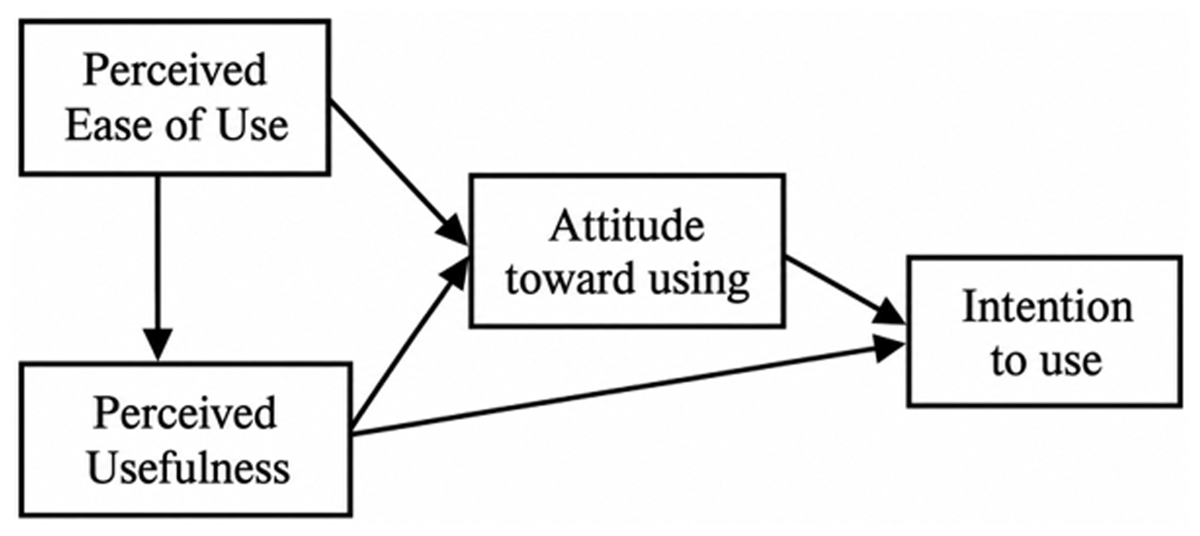
Figure 1
The relationship structure in the TAM model (Weng et al., 2018).
Despite the growing scholarly interest in artificial intelligence in education, empirical research examining the adoption of generative artificial intelligence (GenAI) from a teacher-centered perspective remains limited, particularly in K-12 contexts. Several studies explicitly note that research on pre-service teachers’ acceptance of AI technologies is still sparse and fragmented, with most empirical work focusing either on in-service teachers or on higher education students more broadly (Alvarez et al., 2024; Sun et al., 2025; Zhang et al., 2023). Moreover, even studies that do address pre-service teachers emphasize the early and exploratory nature of this research field and highlight significant gaps in understanding how future teachers perceive the pedagogical role of GenAI tools in classroom practice (Bui et al., 2025; Zhang et al., 2023). Given that pre-service teachers are future K–12 educators and considering evidence suggesting limited experience and knowledge of GenAI-based chatbots among this population (Belda-Medina & Calvo-Ferrer, 2022), there is a clear need for further investigation into their perceptions of GenAI adoption in teaching. Addressing this gap is essential for informing teacher education curricula and designing professional preparation programs that meaningfully support future teachers’ engagement with GenAI technologies.
Research Aims and Research Questions
Research aims
The primary aim of the present study is to examine pre-service teachers’ perceptions of integrating GenAI based chatbots into teaching and learning processes. Specifically, the study seeks to identify how pre-service teachers conceptualize the potential benefits, challenges, and implications of using GenAI based chatbots in educational contexts.
Grounded in the TAM, the study further aims to explore how core perceptual components of the model, namely perceived ease of use, perceived usefulness, and attitudes toward use, are related to pre-service teachers’ intention to integrate GenAI based chatbots into their future teaching practice. By focusing on pre-service teachers, the study addresses early-stage evaluative processes that take place during initial teacher education, before stable instructional routines and institutional constraints are fully established.
Importantly, the study does not assume that the adoption of GenAI based chatbots is inherently desirable. Rather, it seeks to understand how future teachers evaluate, negotiate, and condition their intentions toward the use of an emerging and pedagogically contested technology. The findings are intended to contribute to research on technology adoption in education and to inform the design of teacher education programs that address both pedagogical value and critical engagement with GenAI technologies.
Research questions
In line with these aims, the study addresses the following research questions:
How do pre-service teachers perceive the potential integration of GenAI based chatbots in future teaching, and how do these perceptions cluster into underlying perceptual dimensions?
How are pre-service teachers’ perceptions related to their intention to integrate GenAI based chatbots into future teaching practice, and to what extent can these perceptions explain this intention?
Methodology
Research design
The present study adopts a quantitative research design grounded in the TAM in order to examine pre-service teachers’ perceptions of the potential integration of GenAI based chatbots into future teaching practice. The design is exploratory and explanatory in nature. It is exploratory insofar as it seeks to identify how pre-service teachers’ perceptions of GenAI based chatbots are structured and organized, without imposing a predefined factor structure. It is explanatory as it seeks to examine how these perceptions are related to, and may explain, pre-service teachers’ intention to integrate such tools into their future teaching.
This design is appropriate given the novelty of GenAI based chatbots in education and the limited empirical evidence regarding how pre-service teachers conceptualize and evaluate their use. This study focuses on intentions rather than actual use, as participants are at the stage of initial teacher education and have not yet established stable teaching routines.
Participants
The study was conducted among pre-service teachers enrolled in an academic teacher education course leading to a teaching certificate in non-STEM subject areas at a higher education institution. A total of 78 students participated in the course, of whom 50 agreed to take part in the research and completed the questionnaire (N = 50). Participation in the study was voluntary. Approximately twenty percent of the participants were not native speakers of the language of instruction.
The sample included 36 female and 14 male participants. With respect to prior teaching experience, 23 participants reported having some teaching experience, while 27 reported no prior teaching experience. Focusing on pre-service teachers in non-STEM teacher education programs allows the study to examine perceptions and intentions toward the potential integration of GenAI based chatbots at an early stage of professional development, prior to the establishment of stable instructional routines and full institutional constraints.
Research instrument
To address the research questions, a self-report questionnaire was developed to assess pre-service teachers’ perceptions regarding the potential adoption of GenAI based chatbots in teaching. The instrument was grounded in the Technology Acceptance Model and was based on established and validated self-report questionnaires commonly used in research on technology adoption in educational contexts (Belda-Medina and Calvo-Ferrer, 2022; Sadaf and Gezer, 2020; Weng et al., 2018). These instruments served as a conceptual and methodological foundation, while items were adapted to reflect the specific context of GenAI based chatbots and future teaching practice.
An initial pool of items was adapted and reviewed to ensure conceptual relevance and clarity. Content validation was conducted by a panel of five practitioners and four experts in educational technology, teacher education, and research methodology. Based on their feedback, items were refined to improve wording, relevance, and alignment with the study aims. This process ensured adequate representation of the core constructs of the Technology Acceptance Model while maintaining appropriateness for the context of pre-service teachers and emerging GenAI technologies.
The final version of the questionnaire consisted of 48 items rated on a five-point Likert scale ranging from 1 (strongly disagree) to 5 (strongly agree). The instrument included four sections. Perceived ease of use was measured using 10 items addressing the expected effort required to integrate GenAI based chatbots into teaching. Perceived usefulness was measured using 22 items referring to a range of potential pedagogical benefits and implications of chatbot integration. Attitudes toward use were assessed through nine items capturing participants’ overall affective evaluations of using GenAI based chatbots in teaching. Behavioral intention was measured using seven items examining participants’ intention to integrate GenAI based chatbots into their future teaching practice.
Data collection procedure
Data were collected during May and June 2024 at the beginning of the participants’ academic course. The questionnaire was administered online using Google Forms. Participants completed the questionnaire individually and anonymously. No identifying information was collected, and responses could not be linked to individual participants. Prior to data collection, ethical approval was obtained from the relevant institutional Ethics Committee. All participants were provided with information regarding the purpose of the study, the voluntary nature of participation, and their right to withdraw at any time without penalty. Informed consent was obtained from all participants before they completed the questionnaire.
Data analysis
Data analysis followed a quantitative approach and was conducted in several stages, each corresponding directly to one of the research questions. To answer the research question examining how pre-service teachers perceive the potential integration of GenAI based chatbots in future teaching and how these perceptions are structured (RQ1), an exploratory analytical procedure was first applied. A factor analysis was conducted on the questionnaire items referring to perceptions of GenAI based chatbot integration in teaching. Principal Components Analysis with Varimax rotation was used in order to explore how the items cluster into underlying perceptual dimensions, without imposing a predefined factor structure. Criteria for factor retention included loadings exceeding 0.4, while missing data were addressed through pairwise exclusion. This exploratory approach served to uncover latent dimensions within the dataset and simplify complex interrelationships, thereby maximizing the informative value of the gathered data. Following the factor analysis, composite scores were calculated for each resulting perceptual dimension, and internal consistency reliability was assessed using Cronbach’s alpha coefficients. The validated constructs then served as the basis for the study’s primary variables. Finaly, descriptive statistics, including means and standard deviations, were computed for each dimension.
To answer the research question examining how pre-service teachers’ perceptions are related to their intention to integrate GenAI based chatbots into future teaching practice and the extent to which these perceptions explain such intention (RQ2), inferential statistical analyses were conducted using the composite scores derived from the factor analysis and the behavioral intention scale. First, Pearson correlation coefficients were calculated to examine the strength and direction of associations between each perceptual dimension and intention to integrate GenAI based chatbots into teaching. These correlations provided an initial assessment of the relationships between perceptions and future oriented intention. This was followed by a series of linear regression analyses designed to determine if the theoretical pathways established in prior research were replicated within the current instrument. Specifically, drawing upon existing literature, separate regression models were utilized to investigate the interplay between perceived ease of use (PEOU), perceived usefulness (PU), attitude toward use (ATT), and behavioral intention (BI). These analyses focused on three critical trajectories: the impact of PEOU on PU; the joint influence of PEOU and PU on ATT; and the predictive power of PU and ATT on BI. Given the theoretical framework, all associations were presumed to be positive, leading to the formulation of directional hypotheses (Sadaf & Gezer, 2020; Weng et al., 2018).
Results
In this section, the descriptive and inferential statistics are presented in relation to each research question.
Pre-Service teachers’ perceptions of GenAI chatbots integration in teaching (RQ1)
Factor structure and construct definition
To examine pre-service teachers’ perceptions regarding the integration of GenAI-based chatbots in teaching, an exploratory factor analysis was conducted using the Principal Component Analysis (PCA) extraction method with Varimax rotation and Kaiser normalization. The analysis yielded an eight-factor solution representing distinct dimensions of pre-service teachers’ perceptions of GenAI chatbot integration.
Factor 1: Positive attitudes and intention to use—This factor captures enthusiasm, perceived benefits, and the intention to use GenAI chatbots in teaching. It includes statements such as: ‘I have a positive feeling about using a GenAI chatbot in teaching’ and ‘I plan to integrate a GenAI chatbot into my teaching methods.’
Factor 2: Perceived effort and challenges in implementation—This factor reflects the perceived effort, frustrations, and resource requirements for integrating GenAI chatbots into educational settings. It includes statements such as: ‘I will need to put in a great deal of effort to integrate the GenAI chatbot into my classroom teaching’; ‘External resources are required to integrate the GenAI chatbot into my classroom teaching’; ‘It is easy for me to integrate a GenAI chatbot into my classroom teaching.’
Factor 3: Impact on students’ skills and engagement—This factor focuses on how GenAI chatbots enhance students’ skills, engagement, and readiness for future challenges. It includes statements such as: ‘Integrating a GenAI chatbot into my classroom will enhance student engagement’; ‘Integrating a GenAI chatbot into my classroom will enhance students’ 21st-century skills.’
Factor 4: Facilitating innovation and personalization—This factor highlights the role of GenAI chatbots in promoting innovative teaching practices and identifying individual student needs. It includes statements such as: ‘Using a GenAI chatbot in my classroom makes it easier to identify each student’s needs’; ‘A GenAI chatbot facilitates the implementation of innovation in teaching’; ‘Integrating a GenAI chatbot into teaching makes it easier for me as a teacher in a heterogeneous classroom.’
Factor 5: Negative impacts on teacher-student dynamics—This factor addresses concerns regarding how GenAI chatbots may affect teacher-student relationships and teacher authority in the classroom. It includes statements such as: ‘Using a GenAI chatbot in my classroom will undermine my status as a teacher in the eyes of my students’; ‘Using a GenAI chatbot in my classroom will harm my relationship with my students.’
Factor 6: Extending learning beyond the classroom—This factor emphasizes the potential of GenAI chatbots to support learning outside traditional educational settings. It includes statements such as ‘Integrating a GenAI chatbot into my classroom will enable students to learn outside the classroom as well.’
Factor 7: Real-world application and classroom management—This factor deals with GenAI chatbots’ effectiveness in simulating real-world scenarios and managing teaching processes. It includes statements such as ‘Integrating a GenAI chatbot into my classroom is effective for interactions in events similar to real-life situations.’
Factor 8: Enhancing learning efficiency—This factor focuses on the role of GenAI chatbots in accelerating and simplifying the learning process. It includes statements such as: ‘A GenAI chatbot enables faster learning’; ‘Integrating a GenAI chatbot into my classroom will make learning easier.’
As a result of the factor analysis, the research variables were identified, aligning with the variables defined in literature as part of the model, although some were adapted or modified. Factor 1 represents attitudes and intention to use, while Factor 2 reflects perceived effort, which indicates Ease of Use. Factors 3 through 8 capture various aspects of Perceived Usefulness. These variables explain behavioral intentions to use technology through multiple pathways, both directly and indirectly, within a complex network of relationships. This structure is reflected in literature through its definition across three levels.
The first level includes independent variables. The second level consists of variables that serve as both independent and dependent variables. The third level includes dependent variables. This hierarchical structure helps illustrate how different factors interact to shape behavioral intentions (Figure 2; Sadaf & Gezer, 2020). In the current study, the independent variables are PGEU and PAEU; the variables serving as both dependent and independent are ATT, PUIA, PULTS, and PUTSR; and the primary dependent variable is BI.
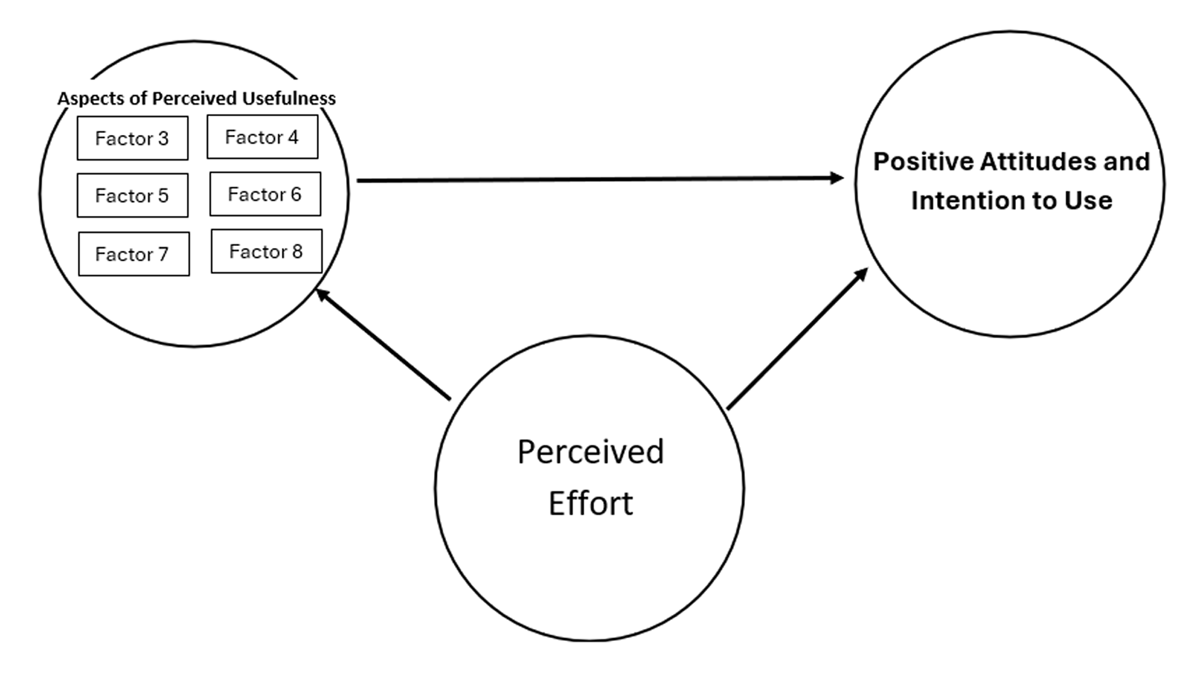
Figure 2
The research model.
Descriptive statistics of the extracted factors
To further characterize pre-service teachers’ perceptions of integrating GenAI-based chatbots in teaching, descriptive statistics were calculated for each of the extracted factors. Mean scores and standard deviations were calculated for each factor separately, as described in Table 1. It can be observed that the score for Factor 1, which reflects attitudes and the intention to integrate GenAI chatbots into teaching, is moderate to low (M = 2.97, SD = 0.84). The highest score was for Factor 6 (M = 3.47, SD = 0.77), while the lowest score was for Factor 7 (M = 3.06, SD = 0.96), noting that Factor 5 is a reversed factor. This indicates that participants’ perceptions of the benefits of integrating GenAI chatbots in teaching, particularly in terms of expanding learning beyond the classroom, were the most positive. In contrast, their perceptions regarding the practical implementation of this teaching method were the most negative.
Table 1
Descriptive statistics for perceptions regarding GenAI chatbots implementation in classrooms (n = 50)—Factors score.
| FACTOR 1 POSITIVE ATTITUDES TOWARD GENAI CHATBOTS INTEGRATION | FACTOR 2 PERCEIVED EFFORT AND CHALLENGES IN IMPLEMENTATION | FACTOR 3 IMPACT ON STUDENTS’ SKILLS AND ENGAGEMENT | FACTOR 4 FACILITATING INNOVATION AND PERSONALIZATION | FACTOR 5 NEGATIVE IMPACTS ON TEACHER-STUDENT DYNAMICS | FACTOR 6 EXTENDING LEARNING BEYOND THE CLASSROOM | FACTOR 7 REAL-WORLD APPLICATION AND CLASSROOM MANAGEMENT | FACTOR 8 ENHANCING LEARNING EFFICIENCY | |
|---|---|---|---|---|---|---|---|---|
| Mean | 2.97 | 3.15 | 3.35 | 3.10 | 2.80 | 3.47 | 3.06 | 3.19 |
| SD | 0.84 | 0.53 | 0.72 | 0.74 | 0.92 | 0.77 | 0.96 | 0.89 |
Relationships and predictors of intention to integrate GenAI-based chatbots (RQ2)
To examine how pre-service teachers’ perceptions of GenAI-based chatbots are related to their intention to integrate such tools into future teaching practice, and to identify which perceptual factors contribute to explaining and predict this intention (RQ2), a series of inferential statistical analyses were conducted. These analyses included correlation analyses to examine associative relationships among the perceptual factors and regression analyses to examine direct and indirect predictive relationships, in accordance with the Technology Acceptance Model.
Correlations among study variables
In order to obtain an initial picture of the pattern of relationships between the extracted variables, correlations were calculated, with Factor 1 serving as the dependent variable in this context, while the scores of the other factors served as independent variables (Sadaf & Gezer, 2020). The correlations between the independent variables and the dependent variable were examined, as well as the relationships among the independent variables themselves. Most of the computed correlations were found to be statistically significant and of medium-to-high strength (see Table 2). For the dependent variable, correlations were found with all variables reflecting perceived usefulness (except for Factor 5), with the strongest correlation (r = 0.62, p < 0.001) observed with Factor 3. Regarding the relationships among the independent variables, significant, positive, and medium-to-strong correlations were identified among all variables reflecting aspects of usefulness (except for Factor 5). Finally, medium-strength correlations were found between Factor 2 and Factors 4 and 8.
Table 2
Correlations between variables.
| FACTOR | 1 | 2 | 3 | 4 | 5 | 6 | 7 | 8 |
|---|---|---|---|---|---|---|---|---|
| 1. Attitudes and intention | — | |||||||
| 2. Perceived effort | 0.14 | — | ||||||
| 3. Impact on students’ skills and engagement | 0.62*** | 0.28 | — | |||||
| 4. Facilitating innovation and personalization | 0.41** | 0.50*** | 0.52*** | — | ||||
| 5. Negative impacts on teacher–student dynamics | –0.26 | 0.22 | –0.12 | 0.24 | — | |||
| 6. Extending learning beyond the classroom | 0.27 | 0.22 | 0.58*** | 0.29* | 0.09 | — | ||
| 7. Real-world application and classroom management | 0.49*** | 0.22 | 0.53*** | 0.48*** | –0.04 | 0.39** | — | |
| 8. Enhancing learning efficiency | 0.59*** | 0.32* | 0.65*** | 0.44** | –0.15 | 0.52*** | 0.43** | — |
[i] *p < .05, **p < .01, **p < .001.
Regression analyses: Direct and indirect predictors of intention to integrate GenAI chatbots
To examine the predictive validity of the proposed model, a two-stage regression analysis was conducted. First, the extent to which perceived effort predicts different dimensions of perceived usefulness was examined. Second, the combined effects of perceived effort and perceived usefulness on attitudes toward and intention to integrate GenAI chatbots in teaching were analyzed. All analyses were conducted using linear regression procedures consistent with prior TAM-based studies (Sadaf & Gezer, 2020; Weng et al., 2018).
A. Predicting perceived usefulness through perceived effort—In the present study, perceived effort was operationalized as Factor 2, whereas perceived usefulness was represented by six distinct factors (Factors 3–8), reflecting different pedagogical and instructional affordances of GenAI chatbots. To examine whether perceived effort predicts perceived usefulness, six separate simple linear regression analyses were conducted. In each analysis, perceived effort (Factor 2) served as the independent variable, and one perceived usefulness factor served as the dependent variable. The results indicated that perceived effort significantly predicted two dimensions of perceived usefulness: Factor 4—Facilitating innovation and personalization, and Factor 8—Enhancing learning efficiency. In contrast, perceived effort did not emerge as a significant predictor for the remaining perceived usefulness factors (Factors 3, 5, 6, and 7).
Perceived effort as a predictor of facilitating innovation and personalization (Factor 4)—As presented in Table 3, perceived effort was found to be a significant positive predictor of perceived promotion of innovation and personalization. The regression model was statistically significant, F(1, 48) = 16.10, p < 0.001, explaining approximately 25.1% of the variance in Factor 4 (R² = 0.251, adjusted R² = 0.236). Perceived effort demonstrated a moderate-to-strong standardized effect on this dimension of perceived usefulness (β = 0.501). The unstandardized regression coefficient indicated that higher perceived ease of use was associated with higher perceived innovation and personalization (B = 0.704, SE = 0.175, t = 4.01, p < 0.001).
Table 3
Linear regression: Predicting the effect of perceived effort on perceived promotion of innovation and personalization.
| LINEAR REGRESSION | ||||||||||
|---|---|---|---|---|---|---|---|---|---|---|
| MODEL SUMMARY – FACTOR4 | ||||||||||
| MODEL | R | R2 | ADJUSTED R2 | RMSE | R2 CHANGE | F CHANGE | df1 | df2 | P | |
| H0 | 0.000 | 0.000 | 0.000 | 0.739 | 0.000 | 0 | 49 | |||
| H1 | 0.501 | 0.251 | 0.236 | 0.646 | 0.251 | 16.096 | 1 | 48 | < .001 | |
| ANOVA | ||||||||||
| MODEL | SUM OF SQUARES | df | MEAN SQUARE | F | p | |||||
| H1 | Regression | 6.720 | 1 | 6.720 | 16.096 | < .001 | ||||
| Residual | 20.041 | 48 | 0.418 | |||||||
| Total | 26.761 | 49 | ||||||||
| Note. The intercept model is omitted, as no meaningful information can be shown. | ||||||||||
| COEFFICIENTS | ||||||||||
| MODEL | UNSTANDARDIZED | STANDARD ERROR | STANDARDIZED | t | p | 95% CI | COLLINEARITY STATISTICS | |||
| LOWER | UPPER | TOLERANCE | VIF | |||||||
| H0 | (Intercept) | 3.105 | 0.105 | 29.709 | < .001 | 2.895 | 3.315 | |||
| H1 | (Intercept) | 0.884 | 0.561 | 1.576 | 0.122 | –0.244 | 2.012 | |||
| Factor 2 | 0.704 | 0.175 | 0.501 | 4.012 | < .001 | 0.351 | 1.056 | 1.000 | 1.000 | |
| DESCRIPTIVES | ||||||||||
| N | MEAN | SD | SE | |||||||
| Factor 4 | 50 | 3.105 | 0.739 | 0.105 | ||||||
| Factor 2 | 50 | 3.157 | 0.526 | 0.074 | ||||||
Perceived effort as a predictor of enhancing learning efficiency (Factor 8)—As shown in Table 4, perceived effort also significantly predicted perceived enhancement of learning efficiency. The regression model was statistically significant, F(1, 48) = 5.45, p = 0.024, accounting for 10.2% of the variance in Factor 8 (R² = 0.102, adjusted R² = 0.083). The standardized regression coefficient indicated a small-to-moderate positive effect of perceived effort on learning efficiency perceptions (β = 0.319). The unstandardized coefficient further showed that greater perceived ease of use was associated with stronger perceptions of improved learning efficiency (B = 0.541, SE = 0.232, t = 2.34, p = 0.024).
Table 4
Linear regression: Predicting the effect of perceived effort on perceived improvement of learning efficiency.
| LINEAR REGRESSION | ||||||||||
|---|---|---|---|---|---|---|---|---|---|---|
| MODEL SUMMARY – FACTOR8 | ||||||||||
| MODEL | R | R2 | ADJUSTED R2 | RMSE | R2 CHANGE | F CHANGE | df1 | df2 | P | |
| H0 | 0.000 | 0.000 | 0.000 | 0.892 | 0.000 | 0 | 49 | |||
| H1 | 0.319 | 0.102 | 0.083 | 0.854 | 0.102 | 5.453 | 1 | 48 | 0.024 | |
| ANOVA | ||||||||||
| MODEL | SUM OF SQUARES | df | MEAN SQUARE | F | p | |||||
| H1 | Regression | 3.973 | 1 | 3.973 | 5.453 | 0.024 | ||||
| Residual | 34.972 | 48 | 0.729 | |||||||
| Total | 38.945 | 49 | ||||||||
| Note. The intercept model is omitted, as no meaningful information can be shown. | ||||||||||
| COEFFICIENTS | ||||||||||
| MODEL | UNSTANDARDIZED | STANDARD ERROR | STANDARDIZED | t | p | 95% CI | COLLINEARITY STATISTICS | |||
| LOWER | UPPER | TOLERANCE | VIF | |||||||
| H0 | (Intercept) | 3.190 | 0.126 | 25.302 | < .001 | 2.937 | 3.443 | |||
| H1 | (Intercept) | 1.482 | 0.741 | 2.000 | 0.051 | –0.008 | 2.973 | |||
| Factor 2 | 0.541 | 0.232 | 0.319 | 2.335 | 0.024 | 0.075 | 1.007 | 1.000 | 1.000 | |
| DESCRIPTIVES | ||||||||||
| N | MEAN | SD | SE | |||||||
| Factor 8 | 50 | 3.190 | 0.892 | 0.126 | ||||||
| Factor 2 | 50 | 3.157 | 0.526 | 0.074 | ||||||
Overall, the findings indicate that perceived effort does not uniformly predict all dimensions of perceived usefulness; Rather, it predicted only two perceived usefulness dimensions: facilitating innovation and personalization and enhancing learning efficiency.
B. Predicting attitudes and intention to use—To examine the combined contribution of perceived effort and perceived usefulness to attitudes toward and intention to integrate GenAI chatbots in teaching, a multiple linear regression analysis was conducted. The dependent variable was Factor 1 (attitudes and intention to use), and the independent variables included perceived effort (Factor 2) and all perceived usefulness dimensions (Factors 3–8).
As presented in Table 5, the overall regression model was statistically significant, F(7, 42) = 6.89, p < 0.001. The model explained a substantial proportion of the variance in attitudes and intention to use, accounting for 53.5% of the total variance (R² = 0.535; adjusted R² = 0.457). Examination of the individual predictors revealed that two perceived usefulness factors made significant unique contributions to explaining attitudes and intention to use. Specifically, Factor 3 (Impact on students’ skills and engagement) was a significant positive predictor (B = 0.413, SE = 0.194, β = 0.357, t = 2.13, p = 0.039), indicating that higher perceptions of GenAI chatbots’ contribution to students’ skills and engagement were associated with more positive attitudes and stronger intention to use.
Table 5
Linear regression: Predicting the effect of all independent variables on attitudes and intention to use GenAI chatbots in teaching.
| LINEAR REGRESSION | ||||||||
|---|---|---|---|---|---|---|---|---|
| MODEL SUMMARY – FACTOR1 | ||||||||
| MODEL | R | R2 | ADJUSTED R2 | RMSE | ||||
| H0 | 0.000 | 0.000 | 0.000 | 0.837 | ||||
| H1 | 0.731 | 0.535 | 0.457 | 0.616 | ||||
| ANOVA | ||||||||
| MODEL | SUM OF SQUARES | df | MEAN SQUARE | F | p | |||
| H1 | Regression | 18.339 | 7 | 2.620 | 6.894 | < .001 | ||
| Residual | 15.960 | 42 | 0.380 | |||||
| Total | 34.299 | 49 | ||||||
| Note. The intercept model is omitted, as no meaningful information can be shown. | ||||||||
| COEFFICIENTS | ||||||||
| MODEL | UNSTANDARDIZED | STANDARD ERROR | STANDARDIZED | t | p | 95% CI | ||
| LOWER | UPPER | |||||||
| H0 | (Intercept) | 2.971 | 0.118 | 25.110 | < .001 | 2.733 | 3.209 | |
| H1 | (Intercept) | 1.243 | 0.654 | 1.902 | 0.064 | –0.076 | 2.562 | |
| Factor 2 | –0.155 | 0.198 | –0.098 | –0.784 | 0.437 | –0.554 | 0.244 | |
| Factor 3 | 0.413 | 0.194 | 0.357 | 2.125 | 0.039 | 0.021 | 0.804 | |
| Factor 4 | 0.152 | 0.171 | 0.134 | 0.889 | 0.379 | –0.193 | 0.497 | |
| Factor 5 | –0.145 | 0.110 | –0.159 | –1.320 | 0.194 | –0.366 | 0.077 | |
| Factor 6 | –0.193 | 0.152 | –0.177 | –1.272 | 0.210 | –0.499 | 0.113 | |
| Factor 7 | 0.157 | 0.114 | 0.180 | 1.372 | 0.177 | –0.074 | 0.388 | |
| Factor 8 | 0.301 | 0.141 | 0.321 | 2.139 | 0.038 | 0.017 | 0.585 | |
In addition, Factor 8 (Enhancing learning efficiency) also emerged as a significant positive predictor (B = 0.301, SE = 0.141, β = 0.321, t = 2.14, p = 0.038). This result suggests that perceptions of improved learning efficiency uniquely contributed to explaining teachers’ attitudes and intention to integrate GenAI chatbots in teaching. In contrast, perceived effort (Factor 2) did not significantly predict attitudes and intention to use when included alongside perceived usefulness factors (β = –0.098, t = –0.78, p = 0.437). Similarly, the remaining perceived usefulness dimensions (Factors 4, 5, 6, and 7) did not show statistically significant unique contributions to the model (p > 0.05).
Overall, the findings indicate that attitudes toward and intention to integrate GenAI chatbots in teaching were primarily predicted by specific perceived usefulness dimensions, rather than by perceived effort. Among the factors examined, only Factors 3 and 8 contributed significantly to explaining variance in attitudes and intention to use.
Summary of results
This chapter presented the main descriptive and inferential findings of the study. Factor analysis identified eight distinct factors representing pre-service teachers’ perceptions regarding the integration of GenAI chatbots in teaching, corresponding to key constructs commonly described in technology acceptance models. Descriptive statistics indicated moderate levels of positive attitudes and intention to integrate GenAI chatbots, alongside variation across perceived usefulness dimensions.
Correlation analyses revealed significant associations between attitudes and intention to integrate GenAI chatbots and most perceived usefulness dimensions, as well as moderate correlations between perceived effort and selected usefulness factors. Building on these associations, regression analyses demonstrated that perceived effort significantly predicted only two perceived usefulness dimensions—facilitating innovation and personalization and enhancing learning efficiency.
Finally, multiple regression analysis showed that attitudes toward and intention to integrate GenAI chatbots in teaching were significantly predicted by specific perceived usefulness dimensions, particularly those related to students’ skills and engagement and learning efficiency, whereas perceived effort did not contribute significantly to the model when perceived usefulness factors were taken into account.
Discussion
The present study is theoretically grounded in the Technology Acceptance Model (TAM), which emphasizes the role of perceived ease of use and perceived usefulness in shaping users’ attitudes toward technology and predicting their intention to use it (Davis, 1989; Venkatesh & Davis, 2000). In educational contexts, and particularly in the adoption of innovative technologies based on artificial intelligence, these variables have been shown to play a central role in shaping teachers’ willingness to integrate digital tools into teaching (Al Darayseh, 2023; Weng et al., 2018).
Pre-service teachers’ perceptions of integrating GenAI-based chatbots in teaching
To address the first research question, which examined how pre-service teachers perceive the potential integration of GenAI-based chatbots in teaching, the findings reveal that these perceptions are not organized as a single, unified construct. Instead, perceived usefulness emerged as a multidimensional concept encompassing several distinct pedagogical aspects, including students’ skills and engagement, learning efficiency, innovation and personalization, learning beyond the classroom, and classroom management considerations. This differentiated structure expands prior TAM-based research, in which perceived usefulness is often treated as a relatively homogeneous construct.
The descriptive findings further indicate that pre-service teachers expressed cautious optimism toward GenAI-based chatbots. Perceptions were most positive with respect to broader pedagogical affordances, particularly the potential to extend learning beyond the classroom and to enhance students’ skills and engagement. In contrast, perceptions related to real-world classroom application and classroom management were less favorable. Attitudes and intention to use were moderate to low overall, suggesting that while pre-service teachers recognize the pedagogical promise of GenAI-based chatbots, they have not yet formed strong commitments toward future integration.
These findings align with patterns reported in recent literature, which similarly portray a complex and non-uniform picture regarding the adoption of GenAI among pre-service teachers. Findings indicate that pre-service teachers’ perceptions of adopting GenAI-based chatbots vary considerably, ranging from moderate-low to moderate-high levels (Alvarez et al., 2024; Wang et al., 2025; Zhang et al., 2023). Beyond examining overall levels of perceptions, there is a growing need to also consider pre-service teachers’ personal usage patterns in order to further clarify the research landscape. For example, a study conducted among Finnish pre-service teachers found that although participants perceived GenAI-based chatbots as useful for content creation and idea generation, most reported only occasional use, with more than a quarter indicating that they had never used such tools at all (Bui et al., 2025). These personal usage patterns are educationally significant, as research has identified a positive association between pre-service teachers’ actual use of GenAI tools and their intentions to integrate this technology into future educational practice.
Taken together, these findings suggest that pre-service teachers distinguish between the conceptual pedagogical potential of GenAI-based chatbots and the challenges associated with their practical implementation. Within the context of initial teacher education, GenAI tools tend to be evaluated more readily as pedagogical resources in principle than as technologies that can be seamlessly integrated into everyday classroom practice.
Predicting pre-service teachers’ intentions to use GenAI-based chatbots
The current findings contribute to the growing body of research on technology adoption in teacher education by highlighting the differentiated roles of perceived usefulness and perceived ease of use in predicting pre-service teachers’ intentions to integrate GenAI-based chatbots into teaching. Consistent with prior TAM-based research, perceived usefulness emerged as a central predictor of intention to use; however, the present study extends this line of work by demonstrating that not all usefulness dimensions exert equal predictive power. Specifically, pedagogically proximal benefits—such as supporting students’ skills and engagement and enhancing learning efficiency—were more influential than broader or less tangible affordances. In contrast, perceived ease of use did not function as a direct predictor of intention, echoing findings from recent studies on GenAI adoption among pre-service teachers, which suggest that effort-related considerations increasingly play a secondary or indirect role in shaping behavioral intentions (Alvarez et al., 2024; Sun et al., 2025). This pattern may reflect the relative accessibility and low entry barrier of contemporary GenAI tools, rendering usability less salient than the anticipated instructional value when pre-service teachers evaluate their relevance for teaching.
Importantly, the predictive structure observed in this study also aligns with emerging evidence indicating that determinants of adoption vary depending on the context of use and the professional stage of the user. While perceived ease of use has been shown to be a stronger predictor in studies examining teachers’ adoption of AI tools for routine or personal purposes, or among in-service teachers operating within concrete institutional constraints (Choi et al., 2023; Zhang et al., 2023), its diminished role in the present findings suggests that pre-service teachers approach GenAI primarily through a pedagogical and future-oriented lens (see Figure 3). As aspiring professionals, they appear to prioritize questions of instructional relevance and educational impact over immediate practical concerns. This distinction resonates with research showing that pre-service teachers’ personal experiences with GenAI—often centered on ideation and content generation—do not automatically translate into strong intentions for classroom integration unless pedagogical value is clearly articulated (Bui et al., 2025). Taken together, these findings underscore the importance of situating technology acceptance models within specific professional trajectories, as the mechanisms predicting adoption may differ substantially between personal use, educational use, and between pre-service and in-service teaching contexts.
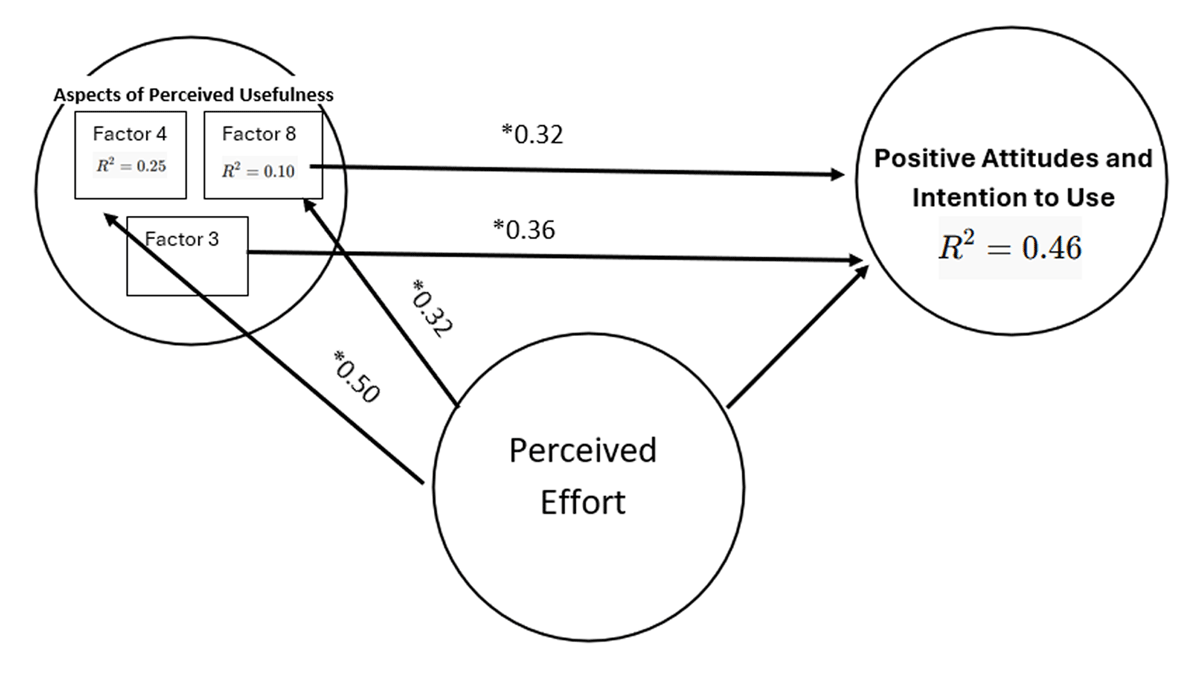
Figure 3
The prediction system in the TAM model in the current study.
Implications for pre-service teacher education in light of the UNESCO AI Competency Framework
The findings of the present study can be further interpreted in light of the UNESCO AI Competency Framework for Teachers, which conceptualizes teachers’ AI readiness through five interrelated competency dimensions (UNESCO, 2024). Recent studies emphasize the need for structured AI literacy and AI competence training in teacher education to ensure the effective, responsible, and pedagogically meaningful adoption of the technology (Bui et al., 2025). Although the current study did not directly assess AI competencies, its focus on pre-service teachers’ perceived usefulness and intention to integrate GenAI chatbots offers important insights into how AI competencies may be meaningfully addressed already at the stage of initial teacher education.
Given that attitudes and intention to integrate GenAI chatbots were primarily predicted by specific perceived usefulness dimensions—namely, contributions to students’ skills and engagement and enhancements in learning efficiency—the results suggest that effective AI-related teacher education should be grounded in pedagogically salient benefits, rather than focusing exclusively on technical proficiency or abstract principles. From this perspective, each of the UNESCO competency dimensions may be operationalized in teacher education programs through an explicit connection to the perceived benefits that were found to motivate adoption intentions in the current study (See Table 6).
Table 6
Aligning empirical findings with the UNESCO AI Competency Framework: Implications for pre-service teacher education.
| EMPIRICAL FINDINGS FROM THE STUDY | PERCEIVED USEFULNESS DIMENSION(S) PREDICTING ADOPTION | UNESCO AI COMPETENCY DIMENSION | IMPLICATIONS FOR PRE-SERVICE TEACHER EDUCATION |
|---|---|---|---|
| Adoption intentions were primarily predicted by pedagogically meaningful benefits rather than by usability alone | Contribution to students’ skills and engagement (Factor 3); Enhancing learning efficiency (Factor 8) | Human-centered mindset | Frame GenAI as a tool that supports meaningful learning, student engagement, and skill development, reinforcing the role of teachers’ pedagogical judgment and agency rather than technological substitution. |
| Ethical and relational considerations did not emerge as direct predictors of adoption intentions | Indirectly linked to benefit-oriented perceptions (Factors 3 & 8) | Ethics of AI | Integrate ethical reflection into concrete pedagogical scenarios that highlight efficiency, learning outcomes, and student engagement, rather than addressing ethics as an abstract or standalone topic. |
| Perceived ease of use influenced adoption intentions only indirectly, through selected usefulness dimensions | Facilitating innovation and personalization (Factor 4); Enhancing learning efficiency (Factor 8) | AI foundations and applications | Emphasize operational understanding of GenAI tools as a means to enable pedagogical flexibility and instructional efficiency, rather than focusing on technical knowledge as an end in itself. |
| Pedagogical usefulness related to learning processes was central to adoption intentions | Students’ skills and engagement (Factor 3); Innovation and personalization (Factor 4); Learning efficiency (Factor 8) | AI pedagogy | Provide hands-on, pedagogically grounded experiences in which pre-service teachers design and reflect on AI-supported learning activities that directly address engagement, skills, personalization, and efficiency. |
| Learning efficiency emerged as a consistent predictor of positive attitudes and intention to use | Enhancing learning efficiency (Factor 8) | AI for professional development | Introduce GenAI as a resource for teachers’ professional learning, including lesson planning, instructional reflection, and adaptive teaching, highlighting its role in supporting sustainable professional practice. |
Human-centered mindset
The UNESCO framework emphasizes a human-centered approach to AI, positioning technology as a tool that supports human agency, learning, and well-being. The present findings indicate that pre-service teachers are more inclined to adopt GenAI tools when these are perceived as enhancing students’ skills and engagement. This suggests that fostering a human-centered mindset in teacher education may be most effective when AI is presented as a means for promoting active learning, learner engagement, and meaningful skill development, rather than as an autonomous or replacement technology. Embedding AI use within pedagogical scenarios that highlight its contribution to student-centered learning may therefore strengthen both competency development and adoption readiness.
Ethics of AI
While ethical considerations were not examined directly in the current study, the findings of the present study suggest that AI ethics competencies may be more effectively developed when ethical reflection is embedded within concrete pedagogical contexts that emphasize perceived usefulness. These contexts may include efficiency, learning outcomes, and student engagement, rather than addressing ethical issues in isolation. This approach aligns with UNESCO’s emphasis on responsible and accountable AI use grounded in real educational practice.
AI foundations and applications
The results showed that perceived ease of use contributed indirectly to adoption intentions by predicting specific usefulness dimensions related to innovation and learning efficiency. This finding supports the view that foundational knowledge about AI tools should not be treated as an end in itself, but rather as a means for enabling meaningful pedagogical application. In pre-service teacher education, this implies that instruction on AI foundations and applications should focus on helping future teachers understand how operational familiarity with GenAI tools can support efficient instructional design and flexible classroom implementation.
AI pedagogy
The strongest alignment between the study’s findings and the UNESCO framework emerges in the domain of AI pedagogy. The central role of perceived usefulness related to student engagement, skill development, and instructional efficiency underscores the importance of pedagogical competencies that integrate GenAI into teaching and learning processes. Teacher education programs may therefore benefit from emphasizing hands-on, pedagogically grounded experiences in which pre-service teachers design, implement, and reflect on AI-supported learning activities that directly address these outcomes.
AI for professional development
Finally, the prominence of learning efficiency as a predictor of adoption intentions suggests that GenAI tools may also be meaningfully introduced as resources for teachers’ ongoing professional development. For pre-service teachers, early exposure to GenAI as a tool for lesson planning, instructional reflection, and adaptive teaching may help frame AI not only as a classroom technology, but also as a professional support mechanism. Such framing is consistent with UNESCO’s emphasis on AI as a lifelong professional learning resource for educators.
Taken together, the findings of the present study suggest that integrating AI competencies into pre-service teacher education may be most effective when these competencies are explicitly connected to the pedagogical benefits that motivate adoption, as identified in the empirical results. Aligning teacher education with the UNESCO AI Competency Framework through a benefit-oriented lens may therefore support both competency development and readiness for responsible GenAI integration in teaching.
Conclusion
This study examined pre-service teachers’ perceptions of integrating GenAI-based chatbots in teaching, drawing on the TAM as a guiding theoretical framework. The findings indicate that pre-service teachers’ attitudes toward GenAI chatbots integration were moderate to low, and that adoption intentions were primarily shaped by specific dimensions of perceived usefulness, rather than by perceived ease of use. In particular, perceptions related to students’ skills and engagement and to learning efficiency emerged as significant predictors of attitudes and behavioral intentions, whereas perceived effort did not exert a direct effect.
These results highlight the differentiated role of perceived usefulness in the adoption of emerging educational technologies. Rather than functioning as a uniform construct, perceived usefulness appears to operate through distinct pedagogical dimensions, only some of which motivate adoption intentions among pre-service teachers. In contrast, perceived ease of use played a more limited and indirect role, influencing adoption intentions only through selected usefulness dimensions. This pattern suggests that, at the stage of initial teacher education, usability alone may be insufficient to drive adoption unless it is clearly linked to meaningful pedagogical outcomes.
The findings carry important implications for teacher education and educational policy. Given the centrality of perceived pedagogical benefits, teacher preparation programs should emphasize concrete instructional applications of GenAI chatbots that demonstrably support student engagement, skill development, and instructional efficiency. Aligning AI-related training with these benefit-oriented perceptions may enhance pre-service teachers’ readiness to integrate GenAI tools into their future classrooms. At the policy level, incorporating structured, pedagogically grounded GenAI experiences into teacher education curricula may support more informed and purposeful adoption.
Several limitations should be acknowledged. First, the study relied on self-reported questionnaire data, which may be subject to social desirability bias and may not fully capture teachers’ actual classroom practices. Future research could employ mixed-method approaches, including qualitative interviews and classroom-based observations, to deepen understanding of how perceptions translate into practice. Second, the sample consisted exclusively of pre-service teachers; in-service teachers may demonstrate different adoption patterns shaped by practical experience and institutional constraints. Comparative studies across career stages would provide a more comprehensive picture of GenAI adoption in education.
Despite these limitations, the study makes a meaningful contribution to the growing literature on GenAI integration in education. By demonstrating that only specific perceived usefulness dimensions predict adoption intentions, and by revealing the indirect role of perceived ease of use, the findings extend existing TAM-based research and underscore the need for a more nuanced understanding of technology acceptance in teacher education. Moreover, situating these findings within the context of pre-service teacher preparation offers actionable insights for designing AI-related training that is pedagogically grounded, developmentally appropriate, and aligned with contemporary educational frameworks. Together, these insights may support more effective and responsible integration of GenAI chatbots in teaching.
Acknowledgements
This research is supported by the Science and Technology Education Center (SATEC) at Tel-Aviv University and the European Union.