
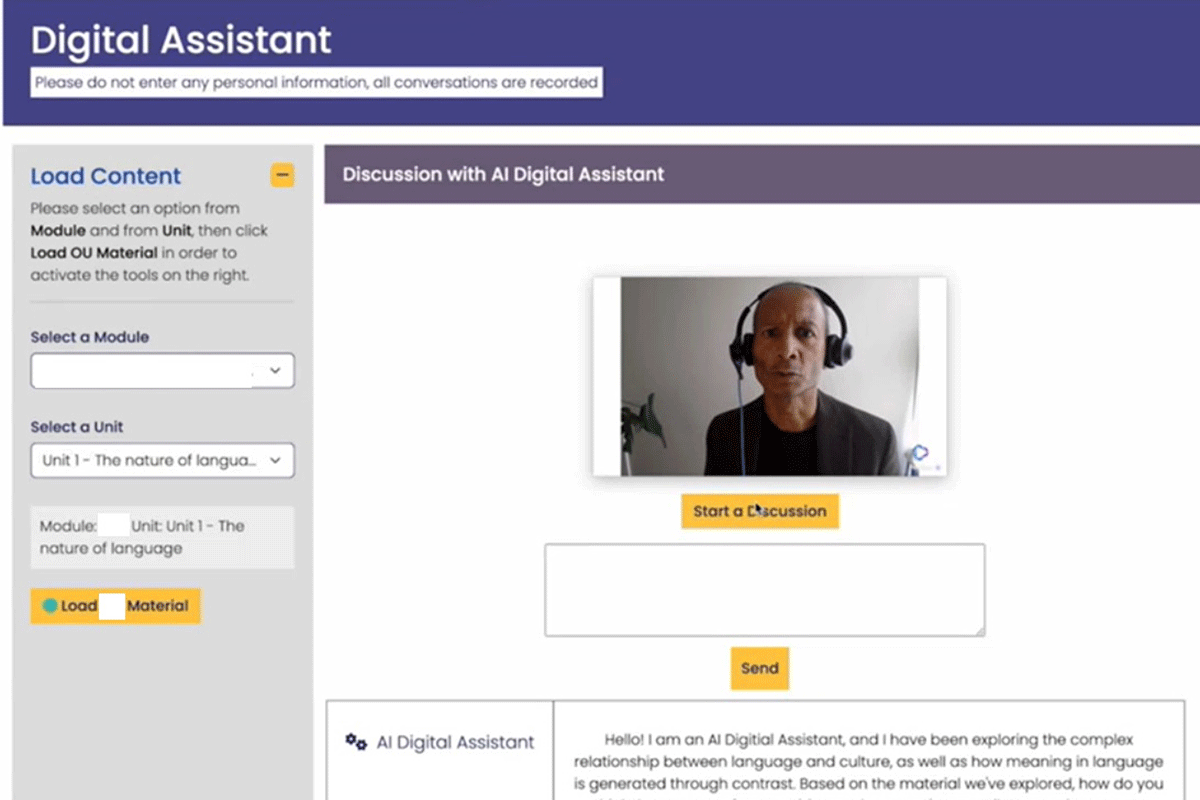
Figure 1
Screenshot of possible Institutional AI Digital Assistant.
Table 1
Positive/mixed/negative sentiments towards i-AIDA (per participant) relative to p-AIDA.
| THEME | POSITIVE | MIXED | NEGATIVE |
|---|---|---|---|
| Personalisation and Relevance: provide personalised responses, tailored to my academic needs and context, differentiating it from generic AI tools | 6 | 0 | 1 |
| Accuracy and Specificity: based upon institutional curated content that not only provides relevant answers but also directs students to specific institutional resources for further learning | 6 | 0 | 1 |
| Language and Accessibility: multi-lingual and accessible, catering to a diverse student body | 5 | 0 | 0 |
| 24/7 Availability and Immediate Feedback: available round-the-clock for immediate feedback and support in their academic setting. | 4 | 0 | 1 |
| User Experience and Interface Design: ease of use, user-friendly, and integrated (e.g., in the OU module website) | 2 | 0 | 0 |
| Future Orientation and Career Planning: provide guidance for future modules and career planning | 2 | 0 | 0 |
| Academic Integrity and Plagiarism: potential misuse of AI for completing assignments, potential plagiarism, and academic integrity | 0 | 1 | 2 |
| Data Privacy and Ethical Use: how student data and inputs to the AI are used, stored, and potentially shared, emphasising the need for transparency and consent | 0 | 1 | 1 |
[i] Note: Not all participants contributed to each and every theme during the interviews.
Table 2
Reasons for preferring i-AIDA over p-AIDA (ordered by preference: Study 2).
| ITEMS | STUDY 1 | STUDY 2 | F-VALUE | ETA | ||||
|---|---|---|---|---|---|---|---|---|
| M | SD | % AGREE | M | SD | % AGREE | |||
| 24/7 Availability and Immediate Feedback: i-AIDA would be available round-the-clock for immediate feedback and support in an academic setting. | 4.00 | 1.07 | 75% | 3.85 | 1.15 | 73% | 1.338 | .013 |
| User Experience and Interface Design: i-AIDA would be easy to use, user-friendly, and integrated (e.g., in OU module website). | 4.25 | 1.04 | 86% | 3.81 | 1.19 | 71% | 1.027 | .010 |
| Language and Accessibility: i-AIDA would be multi-lingual and accessible, catering to a diverse student body. | 4.43 | 0.79 | 86% | 3.77 | 1.18 | 65% | 2.111 | .021 |
| Accuracy and Specificity: value the accuracy in responses as it is based upon institutional curated content. It not only provides relevant answers but also directs students to specific resources for further learning. | 4.13 | 0.99 | 86% | 3.72 | 1.27 | 67% | .764 | .008 |
| Personalisation and Relevance: i-AIDA would provide personalised responses, tailored to my academic needs and context, differentiating it from generic AI tools. | 3.75 | 1.49 | 75% | 3.69 | 1.2 | 70% | .017 | .000 |
| Future Orientation and Career Planning: i-AIDA would provide guidance for future modules and career planning. | 3.88 | 0.99 | 75% | 3.69 | 1.21 | 65% | .167 | .002 |
[i] N Study 1 = 8, N Study 2 = 96.
Table 3
Concerns about (i-)AIDA across Study 1 and Study 2.
| ITEMS | STUDY 1 | STUDY 2 | F-VALUE | ETA | ||||
|---|---|---|---|---|---|---|---|---|
| M | SD | % AGREE | M | SD | % AGREE | |||
| Academic Integrity: potential misuse of AI for completing assignments, potential plagiarism, and academic integrity. | 4.38 | 0.74 | 86% | 4.16 | 1.08 | 80% | .315 | .003 |
| Ethical and Social Implications: the potential impact of AI on learning processes and the necessity of balancing technological advancement with human-centric educational practices, keeping the human in the process, being able to talk to a human. | 4.13 | 0.84 | 75% | 4.13 | 1.05 | 76% | .000 | .000 |
| Data Privacy and Use: how student data and inputs to the AI are used, stored, and potentially shared, emphasising the need for transparency and consent. | 4.13 | 0.84 | 75% | 4.11 | 1.05 | 71% | .002 | .000 |
| Operational Challenges: how AI might inadvertently affect learning outcomes and student interactions, and the importance of ensuring that AI tools are accurate and reliable. | 4.25 | 0.71 | 86% | 4.03 | 0.99 | 77% | .374 | .004 |
| Future of education: how AI integration might change the nature of education and assessments, necessitating a shift in teaching methods and learning expectations. | 4.00 | 0.76 | 75% | 4.03 | 1.1 | 75% | .006 | .000 |
[i] N Study 1 = 8, N Study 2 = 96.
Table 4
Thematic analysis of student comments.
| THEME | COUNT | EXAMPLES FROM PARTICIPANTS |
|---|---|---|
| Personalisation and Relevance: provide personalised responses, tailored to my academic needs and context, differentiating it from generic AI tools. | 51 |
|
| 24/7 Availability and Immediate Feedback: available round-the-clock for immediate feedback and support in their academic setting. | 28 |
|
| Language and Accessibility: multilingual and accessible, catering to a diverse student body. | 28 |
|
| Accuracy and Specificity: based upon institutional curated content that not only provides relevant answers but also directs students to specific institutional resources for further learning. | 22 |
|
| Ethical Use: What and how the use of AI might have implications on individuals, groups, and society. | 14 |
|
| User Experience and Interface Design: user-friendly and integrated (e.g., into the OU module website). | 14 |
|
| Academic Integrity and Plagiarism: potential misuse of AI for completing assignments, potential plagiarism, and academic integrity. | 12 |
|
| Data Privacy: how student data and inputs to the AI are used, stored, and potentially shared, emphasising the need for transparency and consent. | 5 |
|
| Future Orientation and Career Planning: provide guidance for future modules and career planning. | 3 |
|