
Introduction
There is enthusiasm in terms of using Generative Artificial Intelligence (Gen AI) in teaching and learning (Darvishi et al., 2024; Giannakos et al., 2024; Kasneci et al., 2023). For example, in our first Design-Based Research (DBR) study with 10 Open University students (Rienties et al., 2024a) we found that all students agreed upon the potential usefulness of receiving Gen AI support while studying. Reported benefits included real-time assistance and query resolution, support for academic tasks, personalisation and accessibility, and emotional and social support.
With the rapid evolution of Generative AI (Giannakos et al., 2024; Kasneci et al., 2023; Strzelecki, 2023; Yan et al., 2024) and applications such as ChatGPT, higher education institutions (HEIs) are required to critically review their overall approach to teaching and learning. Emerging statistics show that more than half (53%) of 1,250 UK students who participated in an online survey consulted AI for marked work (Freeman, 2024). Such studies indicate that whether (or not) HEIs want their students to use Gen AI, in practice many students use Gen AI whilst studying, and some students use Gen AI for preparing and making assessments (Richards et al., 2024).
At the same time, there are some scholars who are concerned about Gen AI tools in terms of what the long-term impact might be on the quality of assessment and feedback, and on the role of institutions and educators (Giannakos et al., 2024; Hamilton et al., 2023; Shibani et al., 2024). For example, in a study of 49 graduate students in an Australian data science course, Shibani et al. (2024), during an authentic writing task, found mostly shallow levels of engagement with ChatGPT, with the notable exception of when students were asked to self-reflect. Furthermore, there is some emerging evidence that students, educators, and senior management are worried about what happens to their data and intellectual property (IP) when using publicly available Gen AI tools such as ChatGPT (Bozkurt & Sharma, 2023; Chung et al., 2024; Ravšelj et al., 2025). Indeed, the students we studied expressed concerns around the ethical and social implications of implementing Gen AI, data privacy and data use, and academic integrity and misuse (Rienties et al., 2024a).
One way to potentially address some of these concerns is for institutions to create their own institutional AI Digital Assistant (i-AIDA) using the concept of a ‘walled garden’ (Rienties et al., 2024b). This would allow students and educators to securely use, trust, and share their data and IP (e.g., course materials, assessments, marking criteria) (Bektik et al., 2024; Rienties et al., 2024b), thereby potentially limiting prior concerns regarding the quality of i-AIDA responses and related privacy issues. At the same time, given the speed of developments of Generative AI platforms and the breadth of data they can access, one could wonder whether institutions should even consider investing money in developing their own Gen AI approaches (Giannakos et al., 2024). Alternatively, it is possible for institutions to create their own ‘tuned’ models based on their own materials and curriculum content (Bektik et al., 2024; Mikroyannidis et al., 2024). These models could be smaller than the generic versions and run on their own machines or own cloud space. See for example, Apple’s recent announcement on Apple Intelligence which will run on iPhones rather than the cloud.1
With this range of possible futures in mind, we developed a DBR approach (Anderson & Shattuck, 2012; Hoadley, 2004; Hoadley & Campos, 2022; Rienties & Townsend, 2012) to explore the affordances and limitations of developing an i-AIDA as opposed to using a publicly available AIDA (p-AIDA) by asking a total of 106 students in two distinct studies about their perspectives, given that many students actively use ChatGPT. Like many universities, the Open University (OU), which is the largest distance learning university in Europe, is currently experimenting and exploring possible usages and design approaches of Gen AI with students and staff (e.g., Bektik et al., 2024; Giannakos et al., 2024; Mikroyannidis et al., 2024; Rienties et al., 2024a; Rienties et al., 2024b).
In Study 1 we designed a mixed method sequential design in which we aimed to examine the initial perceptions of ten distance learning students from diverse disciplines regarding the design of a hypothetical demo i-AIDA (Rienties et al., 2024a; Rienties et al., 2024b). In the first step, we captured students’ perceptions via interviews in December 2023 – January 2024, while the second step supported the triangulation of data by enabling students to share, compare, and contrast perceptions with those of peers to specifically to explore the following research question:
RQ1: What are the students’ perspectives of i-AIDA relative to using a p-AIDA?
In Study 2 we wanted to verify the initial findings from Study 1 with a larger and more representative group of learners. Obviously Study 1 was an in-depth qualitative study focussed on demoing a possible i-AIDA with a relatively small group of distance learners. In Study 2 using an online survey in May – June 2024 we aimed to explore whether the key concepts from Study 1 were supported by a larger group of distance learners from disciplines across the OU, and whether any new perspectives should be taken into consideration when designing an i-AIDA.
RQ2: To what extent are the reported findings from Study 1 generalisable across a larger cohort in Study 2?
Methods
Study 1
Setting and participants
Both studies were conducted at the OU. As described previously by Rienties et al. (2024a), in Study 1 a random sample of 400 students studying at a range of levels and disciplines were extracted from an OU database. A personalised email was sent to these students on 13 December 2023, followed by two reminders. Potential participants could select one out of twelve possible timeslots to join an interview. In total 16 participants selected a time slot, 11 completed the informed consent form, and 10 participants joined one of the online interviews. Students were shown a possible i-AIDA at the start of their interview (see Figure 1) in December 2023 – February 2024, after which a range of semi-structured questions were asked. In the second stage, students completed an online quantitative survey that was constructed based upon their interview data. In total, 10 participants (six female and four male) from the four OU Faculties, STEM (n = 5), Business and Law (n = 2), Education (n = 2), and Arts and Social Sciences (n = 1) joined one of the online interviews. The majority of students were in full time employment whilst studying; the population contained a diverse set of educational backgrounds (See Rienties et al., 2024a).
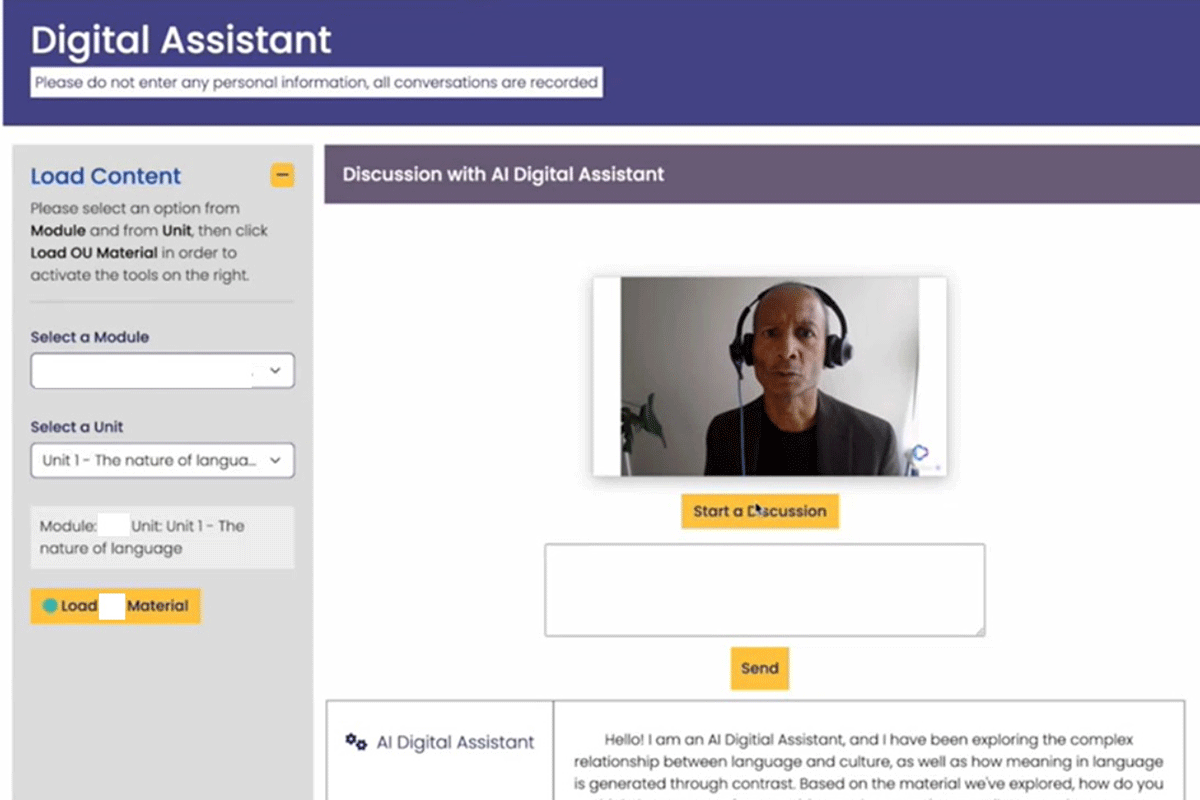
Figure 1
Screenshot of possible Institutional AI Digital Assistant.
Instruments
Online interviews: A five-minute recording of a possible i-AIDA was screenshared including three potential examples (e.g., automatic feedback on a set of open assessment quizzes of a particular unit in a module, AI generated flash cards for revision, i-AIDA responding in real-time to student academic questions). The primary reason for sharing this demo i-AIDA was to allow participants to activate any prior knowledge or experience with AI, and if participants had no experience with AI to prompt some initial thoughts and ideas of how an i-AIDA might support their studies.
Online follow-up survey: Interview results were shared with study’s participants aiming to gather feedback on whether (or not) results resonated with them. Eight out of ten participants responded to this follow-up survey.
Procedure
Following Morgan (2023), emergent thematic analysis within ChatGPT4 was initially used to generate separate analyses for each of the interview questions. These themes were sense-checked, and subsequently coded independently by two authors (FT, BR) as positive, mixed or negative sentiments. This research received Human Ethics Research Approval (HREC/2023–0183–4).
Study 2
Setting and participants
Study 2 was conducted with a different cohort than Study 1 in the period 15 May – 15 June 2024. We primarily wanted to validate the initial findings from Study 1 with a wider cohort of students. In total 2000 students were sampled, and received two reminders to complete the survey, like in Study 1. Altogether, 96 students participated in this study (5% response rate). The majority of respondents were female (n = 50, 52%), which is representative of student gender ratio across the institution. In terms of age, the average age was 52.30 (SD = 16.61, with a range of 18–70+), which was also broadly representative of the OU student body but slightly older than Study 1. Subsequent analysis of variance (ANOVA) statistical analyses using the initially sampled panel indicated no significant differences for those who responded and those who did not in terms of demographics and study programmes, indicating that the included participant sample was comparable on these variables to the wider institutional database.
Instruments
Online survey: An online survey was developed based upon the responses from Study 1 and the instrument of Freeman (2024). The survey consisted of 25 Likert-response questions (1 = Totally disagree to 5 = Totally agree) and 15 check-box items for Gen AI usage, as well as five open questions. Participants were first asked about their experiences with using AI tools in general, and Gen AI tools in their education in particular. Afterwards, participants were briefly informed about Study 1 and how four main services were identified by OU students in terms of an i-AIDA (but not their relative ratings by students from Study 1). Subsequently participants were asked about six potential reasons why the provision of such an i-AIDA relative to publicly available AI systems might be beneficial for studying at the OU. Afterwards, five broad concerns of an i-AIDA that were raised in Study 1 were shared.
Procedure
We used the same procedure as in Study 1. ChatGPT4 was used to generate separate thematic analyses for each of the open comment questions, which were then sense-checked, and subsequently coded independently by three human educational technology experts (FT, BR, TC) into the eight themes for i-AIDA from Study 1. FT independently coded all data, after which half of the data was independently coded by BR, and the other half by TC. Following discussions between the coders on the students’ responses linked to theme ‘Data Privacy and Ethical’ the coders agreed to split the codes into two separate themes given the distinct responses by participants. The Cohen’s Kappas between the two coders and FT on the nine themes ranged between .659 to 1 respectively, indicated good to perfect reliability. This research received Human Ethics Research Approval (HREC/2023–0183–4).
Results
Study 1
In terms of RQ1, nine of ten participants indicated that an i-AIDA would be useful for their studies, while one participant could see it being used by students with support needs. In Table 1, eight themes were identified by participants that would either favour an in-house development of such an i-AIDA relative to a p-AIDA like ChatGPT, or perhaps hamper such an in-house development.
Table 1
Positive/mixed/negative sentiments towards i-AIDA (per participant) relative to p-AIDA.
| THEME | POSITIVE | MIXED | NEGATIVE |
|---|---|---|---|
| Personalisation and Relevance: provide personalised responses, tailored to my academic needs and context, differentiating it from generic AI tools | 6 | 0 | 1 |
| Accuracy and Specificity: based upon institutional curated content that not only provides relevant answers but also directs students to specific institutional resources for further learning | 6 | 0 | 1 |
| Language and Accessibility: multi-lingual and accessible, catering to a diverse student body | 5 | 0 | 0 |
| 24/7 Availability and Immediate Feedback: available round-the-clock for immediate feedback and support in their academic setting. | 4 | 0 | 1 |
| User Experience and Interface Design: ease of use, user-friendly, and integrated (e.g., in the OU module website) | 2 | 0 | 0 |
| Future Orientation and Career Planning: provide guidance for future modules and career planning | 2 | 0 | 0 |
| Academic Integrity and Plagiarism: potential misuse of AI for completing assignments, potential plagiarism, and academic integrity | 0 | 1 | 2 |
| Data Privacy and Ethical Use: how student data and inputs to the AI are used, stored, and potentially shared, emphasising the need for transparency and consent | 0 | 1 | 1 |
[i] Note: Not all participants contributed to each and every theme during the interviews.
Two themes were specifically addressed by at least six participants: personalisation and relevance, and accuracy and specificity. As explained:
I think one positive to having a specific [i-AIDA] would be that the information you’re getting from it would be pertinent to what you’re studying as opposed to random answers. (S1_5, Female, Arts, 34:10)
In terms of accuracy and specificity, participants indicated that an i-AIDA should be based on the OU’s academic materials and approaches rather than on generic materials, such as those used by ChatGPT.
Specific to our Institution is a very important point, because it seems more protective of the students, and therefore I think that’s of more value. I think that may be a key thing. It’s like a sort of enclosed AI rather than something that’s just out there for anyone or anything. (S1_2, Male, Geography, 41:08)
What I think should be different than publicly available tools such as Open AI. Open AI is kind of based on everything; I do not want this [i-AIDA] to be based on everything. I want [i-AIDA] to be based on academic sources … it is an academic AI. (S1_3, Female, Psychology, 34:50)
Five participants were positive about an i-AIDA in terms of language and accessibility.
Multi language provision is a very good use actually. Especially with the OU being so diverse and I think this is a real key aspect, […] this is something that could probably be done quite easy. (S1_8, Male, Computing, 38:02)
S1_3 argued that it would also allow for a broader range of academic resources to be included.
Very often I feel academic publications kind of forget papers that are outside of the group United States/Europe. There are some really amazing papers in Portuguese that are not being used just because they’re in Portuguese. Using these also to feed the AI, I think is more important even than multiple language provision. (S1_3, 38:45)
In terms of 24/7 Availability and Immediate Feedback, S1_5 suggested that responses from AI should be based on what she was studying in her course.
Because I do agree with the 24/7 availability. The instant feedback and I like the tailored if it can produce tailored responses based on the OU material because the course that I’m doing is OU material, it’s not outside sources. So, like the other AI are no use to me because it might pull from different websites. (S1_5, 55:17)
S1_9 indicated that she wanted the i-AIDA to provide discipline-specific suggestions on academic questions she might have, but not to give the answers to assignments.
As long as it is that walled garden idea, because you’ve seen all the other AI sites just because people are uploading their essays on to them doesn’t mean the essays are any good. The information that I would want from this kind of service is information by OU that I can use, and I don’t want OU to write an assignment for me, I want to be able to ask questions and get to know my subject more, but what I wouldn’t like is you can go on loads sites and people upload nonsense. I don’t want someone else’s garbage. (S1_9, Female, Undisclosed, 45:26)
Two participants saw i-AIDA as potentially being helpful in providing guidance for future modules and career planning, suggesting a broader application beyond immediate academic assistance.
I’m finding the careers emails that are coming through very useful because I am looking for a career change. That sort of thing would be good. (S1_5, 39:37)
Finally, participants indicated that a main benefit of having the i-AIDA integrated in the OU infrastructure would be a more seamless user experience and interface design:
Having it embedded into the OU website so it’s easily accessible for everyone. If we’re directing students off somewhere else, that could increase the feeling of this OU tool, is it slightly external tool? Where is my data going? I think it needs to be embedded [in] the module websites or the OU website.
Nonetheless, three participants raised concerns about how to maintain academic integrity, and how an i-AIDA could be used for plagiarism checks, ensuring originality in student work:
The other thing I wonder about is the capacity in relation to plagiarism, because this would be a really good tool for plagiarism checking. How a student doesn’t then get accused of plagiarism? (S1_2, 42:27)
Finally, two participants were worried about data privacy and ethical use.
The AI would just learn what certain academics and stuff thinks the best writing style and philosophy [are]? And it would refine that just in the same way that if the OU just used stuff from the staff and the students to develop this AI, how is that not going to be biased? (S1_10, Female, STEM, 44:58)
To sense check participants’ own answers and those of their peers, in the follow-up survey participants reflected on the results from interviews with participants. Six out of eight thought that an i-AIDA would be easy to use based upon what was demoed, while five out of eight indicated that they would use an i-AIDA frequently if it would be available to them. Perhaps because of the walled garden approach suggested during the interviews, only two participants were worried that their data would be shared by others, or used for external sources, such as training a p-AIDA ChatGPT.
Study 2
In Study 2, 51% of participants indicated that they wanted to have an i-AIDA, relative to 50% of Study 1 participants. To address RQ2—whether the reported findings from Study 1 could be generalised in a wider cohort of OU students—we conducted ANOVAs in Table 2. As indicated in Table 2, the majority of respondents in Study 2 agreed with the six possible reasons identified by participants in Study 1 as to why they prefer an institutionally developed i-AIDA over a publicly available p-AIDA, such as ChatGPT. While Study 1 participants were slightly more positive relative to Study 2 participants, similar trends emerged. The most common reason for Study 2 participants to prefer an i_AIDA was that an i-AIDA would be available 24/7 and would provide immediate feedback in the academic setting of the learner, rather than providing generic content. The second most important reason would be that an i-AIDA would be integrated within the students’ learning experience, rather than being hosted elsewhere. The personalisation and relevance for students was the third most agreed reason, as it would provide personalised responses based on the learners’ needs and their respective journey into the learning materials. As indicated in Table 2, using ANOVAs no significant differences were present across the two studies, indicating that participants in both studies had similar preferences in terms of the reasons for preferring an i-AIDA over a p-AIDA.
Table 2
Reasons for preferring i-AIDA over p-AIDA (ordered by preference: Study 2).
| ITEMS | STUDY 1 | STUDY 2 | F-VALUE | ETA | ||||
|---|---|---|---|---|---|---|---|---|
| M | SD | % AGREE | M | SD | % AGREE | |||
| 24/7 Availability and Immediate Feedback: i-AIDA would be available round-the-clock for immediate feedback and support in an academic setting. | 4.00 | 1.07 | 75% | 3.85 | 1.15 | 73% | 1.338 | .013 |
| User Experience and Interface Design: i-AIDA would be easy to use, user-friendly, and integrated (e.g., in OU module website). | 4.25 | 1.04 | 86% | 3.81 | 1.19 | 71% | 1.027 | .010 |
| Language and Accessibility: i-AIDA would be multi-lingual and accessible, catering to a diverse student body. | 4.43 | 0.79 | 86% | 3.77 | 1.18 | 65% | 2.111 | .021 |
| Accuracy and Specificity: value the accuracy in responses as it is based upon institutional curated content. It not only provides relevant answers but also directs students to specific resources for further learning. | 4.13 | 0.99 | 86% | 3.72 | 1.27 | 67% | .764 | .008 |
| Personalisation and Relevance: i-AIDA would provide personalised responses, tailored to my academic needs and context, differentiating it from generic AI tools. | 3.75 | 1.49 | 75% | 3.69 | 1.2 | 70% | .017 | .000 |
| Future Orientation and Career Planning: i-AIDA would provide guidance for future modules and career planning. | 3.88 | 0.99 | 75% | 3.69 | 1.21 | 65% | .167 | .002 |
[i] N Study 1 = 8, N Study 2 = 96.
Several students in Study 2 indicated the potential of an i-AIDA in terms of practicing and counselling, as well as to keep up to date with latest developments in society.
I see AI as a potential benefit for tuition and practicing study skills. I think counselling students regarding their personal problems should be left to human beings. (S2_44, Male, Year 2, Languages)
AI is a reality and will only become more prominent in future. The OU and students have a duty to embrace new technologies otherwise they will be at a disadvantage in contemporary society. (S2_52, Male, Year 1, Law)
While there was support for an i-AIDA, as indicated in Table 3 there were also substantial concerns raised by learners in both Studies, in particular related to concerns around academic integrity, ethical and social challenges, and data privacy. However, as before there were no significant differences between the two studies in terms of these concerns using ANOVAs, indicating that the concerns raised by participants in Study 1 were comparable and generalisable across participants in Study 2.
Table 3
Concerns about (i-)AIDA across Study 1 and Study 2.
| ITEMS | STUDY 1 | STUDY 2 | F-VALUE | ETA | ||||
|---|---|---|---|---|---|---|---|---|
| M | SD | % AGREE | M | SD | % AGREE | |||
| Academic Integrity: potential misuse of AI for completing assignments, potential plagiarism, and academic integrity. | 4.38 | 0.74 | 86% | 4.16 | 1.08 | 80% | .315 | .003 |
| Ethical and Social Implications: the potential impact of AI on learning processes and the necessity of balancing technological advancement with human-centric educational practices, keeping the human in the process, being able to talk to a human. | 4.13 | 0.84 | 75% | 4.13 | 1.05 | 76% | .000 | .000 |
| Data Privacy and Use: how student data and inputs to the AI are used, stored, and potentially shared, emphasising the need for transparency and consent. | 4.13 | 0.84 | 75% | 4.11 | 1.05 | 71% | .002 | .000 |
| Operational Challenges: how AI might inadvertently affect learning outcomes and student interactions, and the importance of ensuring that AI tools are accurate and reliable. | 4.25 | 0.71 | 86% | 4.03 | 0.99 | 77% | .374 | .004 |
| Future of education: how AI integration might change the nature of education and assessments, necessitating a shift in teaching methods and learning expectations. | 4.00 | 0.76 | 75% | 4.03 | 1.1 | 75% | .006 | .000 |
[i] N Study 1 = 8, N Study 2 = 96.
For example, one student expressed concerns about which data would be used and captured to build such an i-AIDA, and for whom.
I think there should be a continual discussion about not just how the OU will or will not use the data, but also if and how any services you use might harvest the data. (S2_28, Female, Year 1, Arts)
I don’t believe incorporation of AI is a good idea for it takes away the skills that were deemed important in independent study. We might end up with a society where everyone has a degree but hardly anybody has got a common sense, reasoning, and logical and critical thinking skills. We are what makes us “us”. Also, it would not be fair if some people would be using AI and others would not, by choice or otherwise. (S2_08, Female, Year 1, unspecified discipline)
Other students were worried that this would lead to further dumbing down of education, and the credibility of the educational provided.
The further reductive dumbing down and homogenisation of education, and the loss of individuality, nuance, originality, imagination, subjective judgement and general humanity. (S2_20, Male, Year 1, unspecified discipline)
I think if AI is allowed to be used to support studies it weakens the credibility and worth of the qualification obtained. (S2_47, Male, level 1, Computing)
In total, 249 comments were added in the five open comment boxes by participants. Subsequent thematic analysis of these comments—first by ChatGPT and afterwards by the three coders—indicated that most comments related to the potential for personalisation and relevance of i-AIDA relative to p-AIDA as illustrated in Table 4. As an i-AIDA would know what a student is studying and what their learning preferences might be, participants indicated that an i-AIDA could help with providing additional materials and conversational practices, and could also provide project management support. Twenty-eight comments related to having 24/7 availability and immediate feedback while engaging the OU learning environment, such as having opportunities to ask questions, request guidance, and provide connections with human educators. Twenty-eight comments were themed with language and accessibility in terms of helping students to write, and to provide accessibility support for learners. Twenty-two comments related to an i-AIDA being more accurate and specific relative to a p-AIDA as it would ‘know’ the learner, and might provide more specific recommendations in terms of appropriate materials, support, and guidance. Language and accessibility support might be more appropriate for an i-AIDA, as the OU attracts a large number of students with accessibility needs (Iniesto et al., 2023), as well as international students and students from culturally diverse backgrounds (Nguyen et al., 2020; Rienties & Ramanau, 2025).
Table 4
Thematic analysis of student comments.
| THEME | COUNT | EXAMPLES FROM PARTICIPANTS |
|---|---|---|
| Personalisation and Relevance: provide personalised responses, tailored to my academic needs and context, differentiating it from generic AI tools. | 51 |
|
| 24/7 Availability and Immediate Feedback: available round-the-clock for immediate feedback and support in their academic setting. | 28 |
|
| Language and Accessibility: multilingual and accessible, catering to a diverse student body. | 28 |
|
| Accuracy and Specificity: based upon institutional curated content that not only provides relevant answers but also directs students to specific institutional resources for further learning. | 22 |
|
| Ethical Use: What and how the use of AI might have implications on individuals, groups, and society. | 14 |
|
| User Experience and Interface Design: user-friendly and integrated (e.g., into the OU module website). | 14 |
|
| Academic Integrity and Plagiarism: potential misuse of AI for completing assignments, potential plagiarism, and academic integrity. | 12 |
|
| Data Privacy: how student data and inputs to the AI are used, stored, and potentially shared, emphasising the need for transparency and consent. | 5 |
|
| Future Orientation and Career Planning: provide guidance for future modules and career planning. | 3 |
|
Several suggestions for user experience and interface design were proposed, in particular how and when an i-AIDA should be used. This also related to ethical use, academic integrity and plagiarism, whereby participants indicated a need for further clarifications as to when and how Gen AI would be appropriate to use. Several participants indicated data privacy concerns—which could be addressed by allowing students to opt-out—and how the OU would use this data, including for third parties.
Discussion
Many HEIs across the globe (Bozkurt & Sharma, 2023; Darvishi et al., 2024; Freeman, 2024; Giannakos et al., 2024; Hamilton et al., 2023; Kasneci et al., 2023; Shibani et al., 2024) are grappling with the questions of how, when, and whether to use a publicly available AI digital assistant (p-AIDA) such as ChatGPT in their teaching and learning, and whether to develop their own unique institutional approach (i-AIDA). We therefore explored the perspectives of Gen AI usage with 106 students in two consecutive studies using a DBR approach (Hoadley & Campos, 2022; Rienties et al., 2024b; Rienties & Townsend, 2012). Study 1 explored the lived experiences of a demoed prototype of i-AIDA with ten distance learning students at the Open University (Rienties et al., 2024a; Rienties et al., 2024b). Building on these findings, in Study 2 the preliminary results were validated with a cohort of 96 students using an online survey.
In terms of Research Question 1, both studies indicate that students have nuanced perspectives on the role of Gen AI in teaching and learning. There was consensus amongst most students in the two independent studies about the utility of Gen AI in potentially enhancing their learning experiences, with particular emphasis on personalised and relevant educational experiences when these are embedded in their specific learning journeys. However, it simultaneously underscores the critical concerns surrounding broader ethical issues, academic integrity, data privacy, and the potential depersonalisation of education through generalised AI solutions. While p-AIDA systems, such as ChatGPT, have a lot of AI power, there are obviously limits in terms of a deep understanding of the learning needs of students, and their journeys into the curriculum. This is where i-AIDA approaches might have a comparative advantage (Rienties et al., 2024b).
In terms of Research Question 2, there were no significant differences in the key concepts (i.e., Personalisation and Relevance, 24/7 Availability and Immediate Feedback, Language and Accessibility, Accuracy and Specificity, Ethical Use, User Experience and Interface Design, Academic Integrity and Plagiarism, Data Privacy, Future Orientation and Career Planning) between the two studies. This suggests that the initial findings from Study 1 (Rienties et al., 2024a; Rienties et al., 2024b) could be generalised using a wider group of participants in Study 2. Subsequent thematic analyses of the 249 open comments of students by three independent coders identified similar themes as found in Study 1. The theme Data Privacy and Ethical Use was split into two distinct themes based on the responses by participants into Ethical use (i.e., What and how the use of AI might have implications on individuals, groups, and society) and Data Privacy (i.e., how student data and inputs to the AI are used, stored, and potentially shared, emphasising the need for transparency and consent). This nuance has also been highlighted in recent studies an ethical use of AI (Adelana et al., 2024; Bond et al., 2024; Yan et al., 2024). Indeed, two recent large-scale quantitative survey studies (Chung et al., 2024; Ravšelj et al., 2025) suggest that students continue to have substantial concerns around Gen AI. For example, in a study of 8028 students in four Australian Universities, Chung et al. (2024) found that a majority of students are sceptical (56%) or even worried about using Gen AI (47%). A large-scale global study with 23,218 students in over 100 countries by Ravšelj et al. (2025) suggests that while students found (self-reported usage of) ChatGPT useful for some educational tasks, concerns remained around academic integrity, social isolation, and use of their data.
Perhaps a new feature of Study 2 was the explicit desire for personalisation and relevance, combined with accuracy and the specificity of an i-AIDA ‘knowing’ the student and where they might want to go next. Another new feature was the desire for an i-AIDA to include multiple languages and have accessibility features. As the OU attracts a diverse range of students from various accessibility, cultural and socio-economic backgrounds (Iniesto et al., 2023; Nguyen et al., 2020; Rienties & Ramanau, 2025), this might have been more pronounced relative to other Gen AI studies in ‘traditional’ higher education settings (Bond et al., 2024; Darvishi et al., 2024; Giannakos et al., 2024). Finally, students indicated that the user experience and interface design of an i-AIDA should be easy to use, user-friendly, and integrated into the learning platform and modules that students were studying, rather than a stand-alone tool.
Nonetheless, while around half of the students in both studies indicated to want use such an i-AIDA, whether the educators and senior management at the OU would agree would depend on the feasibility and cost-effectiveness of developing such bespoke solutions (Bektik et al., 2024; Giannakos et al., 2024; Mikroyannidis et al., 2024), especially given the rapid advancement and broad availability of p-AIDAs. This DBR study contributes to the ongoing discourse on whether (or not) institutions should use p-AIDA or i-AIDA in their curriculum, advocating for a cautious yet proactive approach to discuss with relevant stakeholders.
Limitations and future research
An obvious limitation of this DBR study was the self-reported nature of both studies, whereby students were reflecting on a possible i-AIDA rather than actually using such an approach in their teaching and learning practice. Whether or not the key constructs identified by students are indeed the most relevant, the question as to when an institution would implement an i-AIDA, and whether indeed only half of the students would actually use such a tool will need further research. Given the validation of the initial results from Study 1 in Study 2, there seems to be consensus amongst most participants in terms of the expected services and potential concerns of an i-AIDA relative to a p-AIDA. In future research, in line with DBR principles, we would like to explore how initial pilots of i-AIDAs are perceived by both students, educators, and managers. This approach will aid us as we develop inclusive and transparent mechanisms and policies with all stakeholders to ensure that a future i-AIDA approach is appropriate for the diverse range of students at the OU.
Notes
Acknowledgements
We are grateful for the support from all the students in Study 1 and Study 2 who participated in this research. We would also like to thank our colleagues at Knowledge Media Institute and the Institute of Education Technology who are currently working on implementing an i-AIDA.
Competing Interests
The authors have no competing interests to declare.