
Table 1
Background of the authors.
| AUTHOR | BACKGROUND |
|---|---|
| DW | GP in final stages of training PhD student in medical education |
| MN | Health policy PhD student in patient participation |
| MM | GP Medical educator/Assistant Professor in HPE |
| ND | Professor in medical education Dean of HPE faculty |
| MB | Assistant Professor in communication studies Language specialist |
| JB | GP Professor in general practice |
| MV | Senior researcher in Medical Education Cognitive psychologist & Quality expert |
Table 2
Participant characteristics.
| CHARACTERISTIC | DETAILS |
|---|---|
| Number of participants | 7 |
| Profession | 6 GPs; 1 resident |
| Type of practice | 4 duo practices; 2 solo practices; 1 group practice |
| Years of experience as a GP | 2–25 years; 3rd year resident |
| Time participating in the group | First time – 5 years |
Table 3
Quotes 1 and 2: Deepening of reflection.
| 1. | ‘On the other hand, there are topics where you can have strong opinions, and as a group, you might be able to question each other, so that you get to a deeper layer of “Oh, what are actually my assumptions about this, and what effect does that have?”’ | Participant 1 |
| 2. | “Yes, on your own, you look at things in a certain way. I do my medicine the way I always do it, so I also think I look at those numbers (i.e. the A&F report) the way I would usually look at them. But when others say something about it, you do hear things from outside your normal way of working.” | Participant 3 |
Table 4
Quote 3: Inducing individual and collective learning.
| 3. | “So, by grappling with the material, by discussing or questioning each other, I understand it… Yes, or ‘understand it,’ I do, but it also makes me remember it better. It also offers me pleasure to go do something with it again.” | Participant 7 |
Table 5
Quote 4: Collective action.
| 4. | “…but then a second goal of such a community health group is democratization. If something is felt in the field, it must be communicated to hierarchies above this group, so that it is actually addressed there. … So now you need to try to generate enough volume for the issue and then push it forcefully to the right place. Yes, that then becomes a bit of a political piece. That can also be the outcome of the [group discussion of AF] session. Yes.” | Participant 1 |
Table 6
Quotes 5–11: Qualification, Socialization and Subjectification.
| 5. | ‘Most of them are really experienced doctors, and they’ve been working in a certain way for twenty years, but they also have an exceptionally good clinical eye and a lot of experience. Look, working the same way for twenty years isn’t good, of course. You must keep up with the times, and you need to be flexible. That’s definitely what’s being discussed properly here.’ | Participant 3 |
| 6. | ‘It’s really about searching together for “how do we do this now?” … It’s definitely about searching together for “what motivates us to do it the way we’re doing it?”’ | Participant 2 |
| 7. | ‘Of course, there are topics where there is much more of a norm. Sometimes, it’s like everyone is deviating from the norm, like with oxycodone, and you can still learn from each other in how you deal with it and the solutions you’re going to look for, talking about it together, like “who would know more about this, who could we possibly refer to, how do we prevent this exactly, what’s our first choice pain relief,” giving that some structure. Then you’re searching together, and you have consensus on the norm…’ | Participant 1 |
| 8. | ‘What do you do in that consultation room? You must think about that. And then you need to think further; the next step is “how do you want to do it?”’ | Participant 2 |
| 9. | ‘I practise medicine the way I always do, so I suppose I look at those numbers the way I normally would. But when others comment on them, you start hearing things from outside your usual way of working. It pulls you a bit out of your comfort zone — and that’s actually a good thing.’ | Participant 3 |
| 10. | ‘You’re expected to respond right away and have an opinion, even while you’re still thinking, ‘What’s actually going on here, what am I supposed to do with this?’ What I do know is that I want to pay more attention, be more aware of it, really listen to these complaints. But at the same time I’m also thinking, ‘Hang on, wait a second.’ I don’t see it as something black-and-white. That’s something I try to bring into the conversation too. Is it really that wrong?’ | Participant 3 |
| 11. | ‘Well, it does make you think. ‘How come I pay so little attention to these menopausal symptoms?’ And then I wonder, ‘Is that something about me?’ I’ve always been the type to say, ‘Come on, don’t make a fuss.’ And I think I carry that attitude into my consultations as well. Which is fine, in a way — some things aren’t good or bad, they’re just different. But it does make me wonder, ‘Am I maybe short-changing some women because of that?’ And that really gets you thinking.’ | Participant 3 |
Table 7
Quotes 12 and 13: Safety of the learning environment.
| 12. | ‘At some point, there were names of practices involved . Yes, then you have no choice but to expose yourself. But even then, there’s an atmosphere of “there’s no right or wrong”.’ | Participant 5 |
| 13. | ‘You asked: ‘What’s it like, being in such a group?’ The fact that I don’t mind Ma. asking me that… It’s also a very safe group. That absolutely helps.’ | Participant 2 |
Table 8
Quote 13: Enjoyment.
| 14. | ‘Everyone should enjoy it a bit and has to want to come, because I have no other leverage, so I just have to make it fun.’ | Participant 1 |
Table 9
Conflicting purposes.
| 15. | ‘Well, the woman who knew the most about it came across as very definite about a lot of things she said. And that… yeah, I would’ve liked a bit more nuance there. But at the same time, it does stick with you.’ | Participant 7 |
| 16. | “Well, I can tell you my goal — and I’ve already told you that… I just automatically assume that everyone has the same goal. But yeah, you’re making me realise that there are fifteen people sitting at that table, each with their own agenda.” | Participant 4 |
| 17. | ‘…and that’s also generally the flaw of bringing in an expert, because it’s much easier to just pick up those pieces of knowledge again than to reflect.’ | Participant 1 |
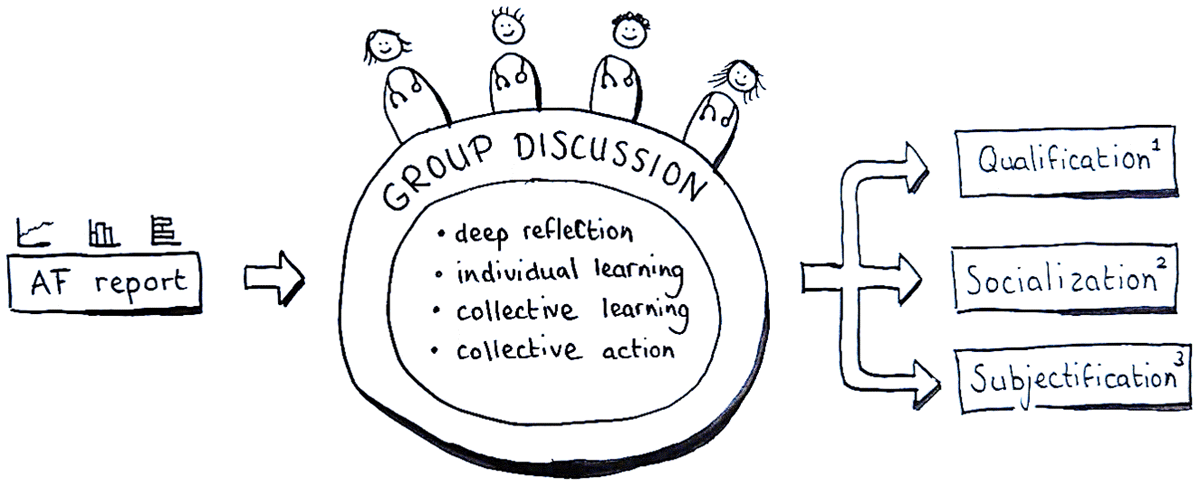
Figure 1
Visual summary of results; 1. Qualification, understood as: transition of knowledge and skills; 2. Socialization, understood as: understanding and internalizing the values of the profession; 3. Subjectification, understood as: relating oneself to the profession and finding your own position.