
Introduction
This work focuses on how we can understand and overcome barriers to learning in light of opportunities for innovation. With advances in assistive technology and online learning, there is greater potential than ever for disabled people to study equitably. Restricting this, however, are factors including a lack of support for the use of assistive technology (WHO & UNICEF 2022) and the administrative burden placed on disabled people to gain support and adjustments for study (Coughlan & Lister 2018).
This paper explores aspects of the process of capturing and mapping information from students about their disabilities, and the support that works for individual disabled students. This knowledge can represent a base of data that can then be used to make recommendations to others through dialogue. The context of this exploratory research is The Open University, a public distance university with the largest body of students declaring disabilities in the United Kingdom (Open University 2020).
Literature review
As a foundation for this paper, we review the landscape of research in three areas: how disabilities are described and understood, current challenges around supporting disabled students to succeed, and trends and opportunities for innovation in relation to these challenges.
Describing and understanding disabilities
The diversity of views on definition and language, and relationships between how disability is understood and managed, are the subject of decades of research and debate. Before approaching technologies and solutions, it is important to recognise that disability can be described in very different ways, that these communications form an essential part of overcoming barriers to study, and that they reflect underlying conceptions which impact individuals, organisations, and society.
Descriptions of disability can focus on explaining how functioning in life activities is somehow limited or difficult (Leonardi et al. 2006). Or on the barriers experienced due to the design of environments or other people’s actions (Oliver 2013). In many cases, however, disability is expressed in terms of medical diagnoses and conditions (Dirth & Branscombe 2017). Disability is an umbrella term for a diverse range of challenges, including mental health and cognitive differences which can require quite different understanding of physical disabilities or long-term health conditions. Many individuals can be characterised as having multiple categories of disabilities, impacting further their chances of success in their study (Richardson 2010).
While there are commonalities in the experiences of diverse disabled people, negative perspectives towards disability often discourage any desire to identify in this way (Finkelstein 1993). Many people who do not consider themselves disabled or feel uncomfortable or angry about being labelled as such, are however bound up with this term if they wish to gain support that they are legally entitled to (Thomas & Woods 2003). Several studies provide evidence that disabled people have varied preferences as to how to describe themselves. What is meant by disability is interpreted and expressed differently between individuals, and their preferences around this can change according to the context of the communication (Lister, Coughlan & Owen 2020).
Different conceptions of disability impact the understanding of support needs. A focus on identifying barriers, rather than on individuals and their medical conditions, is argued to shift the emphasis towards institutional and social responsibility for removing barriers, rather than viewing disability support only in terms of individual diagnosis and response (Oliver 2013). Despite the increased adoption of approaches that aim to enhance the general accessibility of web content and learning, most prominently through the Web Content Accessibility Guidelines (WCAG) and Universal Design for Learning (UDL), there remains the recognition of the need to understand, support and adjust according to individuals, and technology may make this easier (Iniesto, Rodrigo & Hillaire 2023).
A functional perspective that focuses on the difficulty or inability to achieve specific tasks promotes the consideration that people with very different conditions may benefit from similar tools or support. For example, difficulties in reading text, related to either dyslexia or visual impairment could be overcome by spoken versions of learning material. The functional perspective also helps to explain how mainstream technologies can be repurposed as assistive tools, as they support a task to be done in a way that is relevant to all people, but particularly valuable in overcoming barriers. For example a voice recorder or smart pen is a useful memory aid for many people, but more essential for people who find memorising information in the moment more challenging (Bouck et al. 2012). This applies regardless of any medical reason for their memory challenges.
While medical diagnoses remain central to disability support processes in education and everyday life, approaches have been established which aim to standardise a functional perspective, such as The World Health Organisation Disability Assessment Schedule (WHODAS) survey instrument (WHO 2012), and the development of defined functional needs to underpin further development of WCAG (W3C 2021). Other work in healthcare has focused specifically on structuring the process of matching persons to suitable assistive technology (e.g. Scherer & Craddock 2002), and guidance for conducting assistive technology assessments has been developed in specific education contexts such as US schools (e.g. ASNAT). This highlights multiple elements to understand before identifying solutions, including a detailed analysis of the student and their past and present assistive technology use, the current barriers faced, and aspects of the school environment and learning tasks (Gierach 2009).
While there have been efforts to standardise functional needs as a basis to support online and digital learning (explored further in later sections), this is not widespread. Also, while assistive technology is an important element, there is a wider space of human support, adjustments and strategies that can be just as important to overcoming the barriers student face. Processes to identify appropriate support for students, such as the needs assessment conducted as part of the Disabled Students’ Allowance in the UK, still require a medical diagnosis of disabilities, but consider the functional needs of the student and the potential support, technology or adjustments that could meet this.
Current challenges
While there appear reasons to be optimistic about the potential to overcome barriers to learning for disabled people, there remain persistent gaps in access to education and employment. Worldwide, disabled people get an average of 2.2 years less schooling. Large gaps in adult literacy exist in almost every country with underrepresentation in tertiary education and employment even in richer nations. Disabilities compound other inequalities, with disabled women less likely to complete education (UNESCO 2018). However, as noted already, treating disabled students as a homogeneous group is problematic, and more detailed analyses within The Open University highlight how completion and pass rates vary significantly according to the categories of disability a student discloses (e.g. Richardson 2015a, 2015b, 2015c; Open University 2020). Analysis of feedback survey data according to these categories also evidences that their experiences and the barriers they face are different (Coughlan, Ullmann & Lister 2017). Therefore, there is a need to increase awareness of the diversity of barriers and take approaches that help to address this diversity.
The diversity of disabilities, the wide range of interactions expected in learning activities, and the changing technological landscape, all present a messy and multifaceted space. Worldwide, there is a lack of support for the use of assistive technology, inhibiting the potential of this to overcome barriers (WHO & UNICEF 2022). Despite the wider appreciation of the social model in legislation and in institutional rhetoric, responsibilities are often unclear. Educators, technologists and institutional decision-makers often lack an understanding of disability and accessibility (Bong & Chen 2021; Lister et al. 2022) and with other competing demands, create barriers which disabled students then need to overcome.
Further challenge arises from the wide range of learning tasks that students could face barriers with. Erdem (2017) uses a literature review to summarise the range of uses of assistive technologies, finding categories of communication; reading; writing; mathematics; support for seeing and hearing; seating, positioning, and mobility; social skills and leisure; daily living; organisation; and computer access. Features of the learning and the environment also change the need for technologies. For example, Fichten et al. (2009) found that diverse disabled students made use of scanners and Optical Character Recognition (OCR) tools, which could enable text from books or images to be read digitally. Such technologies can be a lifeline where materials are inaccessible but these tools could be redundant if materials are all provided in accessible web pages or digital documents.
A common approach is therefore for persons with knowledge of disability, assistive technology and study to assess the needs of students on an individual basis. Depending on the context of these conversations, personalised adjustments may be made to teaching and assessment, or technology, training and mentoring activities could be prescribed, with any costs of these covered either by the institution, third parties, or the individual. But the required expertise is limited and access to support is not evenly distributed. There are calls and initiatives to further develop the profession of Assistive Technologist, to create a larger, more effective workforce to work with disabled people in this capacity (Norrie, Waller & Hannah 2021; Slaughter & Waller 2022).
The responsibilities and capacity of educational institutions, governments and third-party organisations to support disabled students vary around the world and are changing. In the UK for example, changes to the Disabled Students’ Allowance aim to move more responsibility away from government-funded support towards the institution and individual. For the individual, there is a substantial administrative burden around explaining their disabilities and gaining support (Disabled Students UK 2022; Policy Connect & Higher Education Commission 2020). This burden produces negative impacts on students, including on their mental health and wellbeing, and their time and ability to study (Coughlan & Lister 2018).
While it is challenging for any single intervention to untangle the complex socio-technical phenomena and bureaucracy that lead to administrative burden, conversational agents and AI do present some compelling potential to address these challenges. For example, administrative burden is commonly increased by having only limited, or inaccessible, channels for completing a process (e.g. a paper-based form or phone call). Conversational user interfaces can offer a more flexible and accessible means of communication, particularly where systems can interpret input and bridge the gap between how the person wants to communicate and the often-rigid requirements of the administrative process. These interfaces also offer an alternative to the negative affective responses which arise from repeatedly filling in complex forms and repeatedly explaining sensitive personal information to other people. With further development and integration, such systems could complete multiple administrative processes and requests through one conversation, and could offer guidance and answer questions at the same time (Iniesto et al. 2023).
In a varied and shifting landscape of responsibilities, one aspect that is unlikely to change is that disabled students who are able to explain their disabilities and are knowledgeable about adjustments, strategies and tools that can help them study should be more likely to succeed. This is particularly important when we recognise that personal development involves transitions, such as between schools, universities and jobs, or at a lower granularity, between courses, teachers or environments. Disabled people benefit from a greater ability to self-advocate effectively and solve problems they face due to these changes (Bremer, Kachgal & Schoeller 2003). A further finding across multiple studies and contexts is that simply providing students with assistive technology is not sufficient – issues such as inadequate training or support for them to use these technologies present further barriers to study (McNicholl et al. 2021; Seale et al. 2015).
Providing relevant and useful information and supporting disabled students to develop in this way is not trivial. Research has highlighted their concerns, such as that recommendations for technology are made based on ‘labels’ rather than individual needs and preferences, and that support needs to be timely and built on existing digital literacies (Seale, Draffan & Wald 2008). As such, further research and development needs to be underpinned by greater understanding of how disability, barriers and solutions are communicated, as well as how innovations offer ways to overcome these barriers.
Opportunities for innovation to overcome barriers
There is a history of research that has explored the potential of new technologies to represent and overcome barriers caused by disability. The breadth of work done to develop assistive technologies and design for accessibility is beyond the scope of this article, but a particular thread of work has focused on the processes by which barriers are understood and support is offered. This has highlighted possibilities such as adapting learning content according to identified needs and preferences, crowdsourcing and connecting people to overcome barriers regardless of distance and using artificial intelligence (AI) to understand the person or assist in a specific situation (Iniesto & Rodrigo 2016).
Boticario et al. (2012) describe how an adaptive learning approach underpinned the EU4ALL project and framework. While following standards and guidelines to support access to systems and content is important, they highlight that it is not sufficient, as this does not consider how diverse learners get to a position of having suitable individualised study experiences. To achieve this, elements such as a user model, representing goals, needs and preferences, a recommender system, highlighting appropriate actions, and a metadata repository, containing information about the accessibility and nature of a learning resource, were devised and evaluated. While successful in illustrating the potential, the sustainability of such an approach is noted to be reliant on continued interoperability and following of standards by all actors involved and is challenged by the breadth and scope of learning management systems and courses.
Making recommendations based on profiling learners and capturing the accessibility features of Open Educational Resources (OERs) was more recently explored by Elias et al. (2020). Their system asks users about aspects such as which assistive technology they use, and whether they have requirements for alternative media, such as text versions of audio content, alongside other questions such as their goals and educational level. Alongside this, they assess and score OERs based on their metadata. A small-scale evaluation with accessibility experts suggested value in this approach.
While this literature suggests promise for the idea of automatically adjusting learning based on created profiles of accessibility needs, McAndrew, Farrow and Cooper (2012) note the difficulty of students providing adequate self-description, and consider that such systems should support information flow, keeping humans in the loop, rather than complete automation. Neither would making a Virtual Learning Environment (VLE) adaptive and accessible remove all the barriers students can face. Learning occurs across a number of platforms, and students use a changing plethora of technologies across multiple spaces to support their learning, including mainstream web and mobile apps as well as assistive technologies (Seale et al. 2021).
Outside of education, there are various examples where researchers have developed socio-technical approaches to overcoming disability-related barriers. These include crowdsourcing approaches, for example, Liu et al. (2017) present a project where they engaged wheelchair users to identify the types of barriers they faced in navigating routes through urban environments, and then provide a mobile application where such barriers can be captured by members of the public and then included in map-based route planning. Lasecki et al. (2013) describe the development and enhancement of Remote Sighted Assistance systems that provide crowdsourced support at a distance to blind people, in their case by sharing a video stream from the person’s device and supporting sequences of questions to be asked and answered to share visual understanding from sighted to blind persons. While the potential of artificial intelligence in this space is recognised, human involvement is considered essential, not least because AI is not considered reliable in the visual recognition of objects in complex environments. Exploring this further, Lee et al. (2022) speculate that challenges in remote-sighted assistance could be best resolved by building new models of human-AI collaboration.
Other research looks specifically at the potential of AI in understanding the person and providing guidance and support. Again, there is diversity in the contexts and populations this aims to support, from systems using games and assessment techniques to guide people with cognitive disabilities towards assistive technologies appropriate for them (Heumader, Murillo-Morales & Miesenberger 2022), to a virtual assistant that supports disclosure and profiling for disabled students in higher education. Evidence from a trial of one virtual assistant ‘Taylor’, suggests that disabled students preferred a conversation with a virtual assistant to complete forms when disclosing their disabilities and that they would like to be able to use such a system to receive personalised guidance and to complete other support-related processes (Iniesto et al. 2023). Researchers highlight that offering appropriate recommendations based on individuals and their contexts, simplifying language and supporting alternative communications, are areas of particular opportunity for AI in assistive technology (Draffan & Heumader 2020).
Bringing these threads together, in order to address challenges of educational access and equity, there is a need to improve access to guidance and information sharing. AI and crowdsourcing technologies present opportunities in this space, but would benefit from a clearer understanding of the information needed to understand disability in the context of learning, and the types of guidance that disabled students could find useful and relevant to them.
Methodology
The methodology included in this research is constructivist, oriented towards looking for modes of participation in a sociotechnical system (Bada & Olusegun 2015). For that exploratory purpose, a qualitative approach using an open-ended online survey was used and thematic analysis was the selected analysis method.
Research questions and method
Placing the focus on students, the research questions are as follows:
RQ1: How do students describe their disabilities?
RQ2: What types of suggestions do students share about the support that works for them?
The objective was to obtain information that is not currently gathered by The Open University on suggestions to inform an AI virtual assistant with knowledge base. The limitations of university processes included the inability to use existing institutional data without considering potential data protection barriers and ethical aspects related to personal information in students’ profile. Therefore, to explore the research questions an open-ended online survey was designed. The survey was designed by the research team to capture how students at The Open University describe and understand their disabilities, as well as to assimilate different types of suggestions for student support. The questionnaire is available in the Appendix. To reduce concerns about privacy and the handling of sensitive personal information, the survey was completely anonymous, with students not asked for any identifiable details in the questions. Ethical clearance for this research was approved by the University’s Human Research Ethics Committee (HREC/4455/Coughlan) and Student Research Project Panel (SRPP/2022/2235).
This paper focuses on a thematic analysis of the free text disability descriptions and the suggestions made by students. Following the approach described by Braun and Clarke (2019), familiarisation with data led to an initial set of codes, which were then organised and developed under themes, then defined and summarised. Two members of the research team were involved in the coding, one taking a primary role with the descriptive analysis and the other with the analysis of the suggestions, with each of these then being reviewed with the other. NVIVO software was used to support the analysis.
Sample
An email invitation to the survey was sent to 3,000 current students who had disclosed disabilities to The Open University. For that original sample and following Sapsford & Jupp (2006) we used a quota sampling approach, which is a non-probability sampling method that divides the population into non-overlapping profiles to keep the sample balanced among different types of declared disabilities. 143 responses in total were received, where consent was fully given in 138 and so these were taken forward to the analysis stage. Of these, all 138 had answered the free text disability description question, and 108 provided one or more free text suggestions of what supported them in their studies. The response rate was lower than those found in literature in similar cases (Bessaha et al. 2020; Murphy, 2021). However, even though the response rate was lower than expected and we could not control the balance between types of disabilities in the final sample, the class size can be considered valid and reliable following Nulty (2008) and with the lens of the constructivist perspective acknowledged in this research (Bada & Olusegun 2015).
The respondent population comprised 99 females (72%), 38 males (28%) and 1 who preferred not to say. Most participants were between 26-45 years (38.1%), and the more representative subject areas were Psychology (34, 24.8%), Arts and Humanities (30, 21.9%), Social Sciences (16, 11.7%) and Computing (14, 10.2%). The numbers who stated that they fitted with each of the formal university categories of disability are shown in Table 1. Other disabilities reported included fibromyalgia, brain injury and heart disease. Note that participants can choose more than one of these categories if they have multiple disabilities.
Table 1
Proportions of respondents reporting each formal disability category.
| DISABILITY CATEGORY | NUMBER OF RESPONDENTS |
|---|---|
| Mental health issues, such as depression, anxiety, bipolar or PTSD | 77 (56.2%) |
| Fatigue | 67 (48.9%) |
| Unseen disability, for example diabetes, epilepsy or asthma | 55 (40.1%) |
| Mobility is restricted | 54 (39.4%) |
| Manual skills | 35 (25.5%) |
| Specific learning difficulties (such as dyslexia or dyspraxia) | 34 (24.8%) |
| Autism | 33 (24.1%) |
| Deaf or hard of hearing | 21 (15.3%) |
| Other | 12 (8.8%) |
| Blind or partially sighted | 11 (8%) |
| Speech impairment | 4 (2.9%) |
Results
Analysis of both research questions is provided including the thematic map and representative quotes.
RQ1: How do students describe their disabilities?
The thematic analysis of question 5 (see the Appendix) led to the themes and codes in the thematic map included in Figure 1 having two levels of depth.
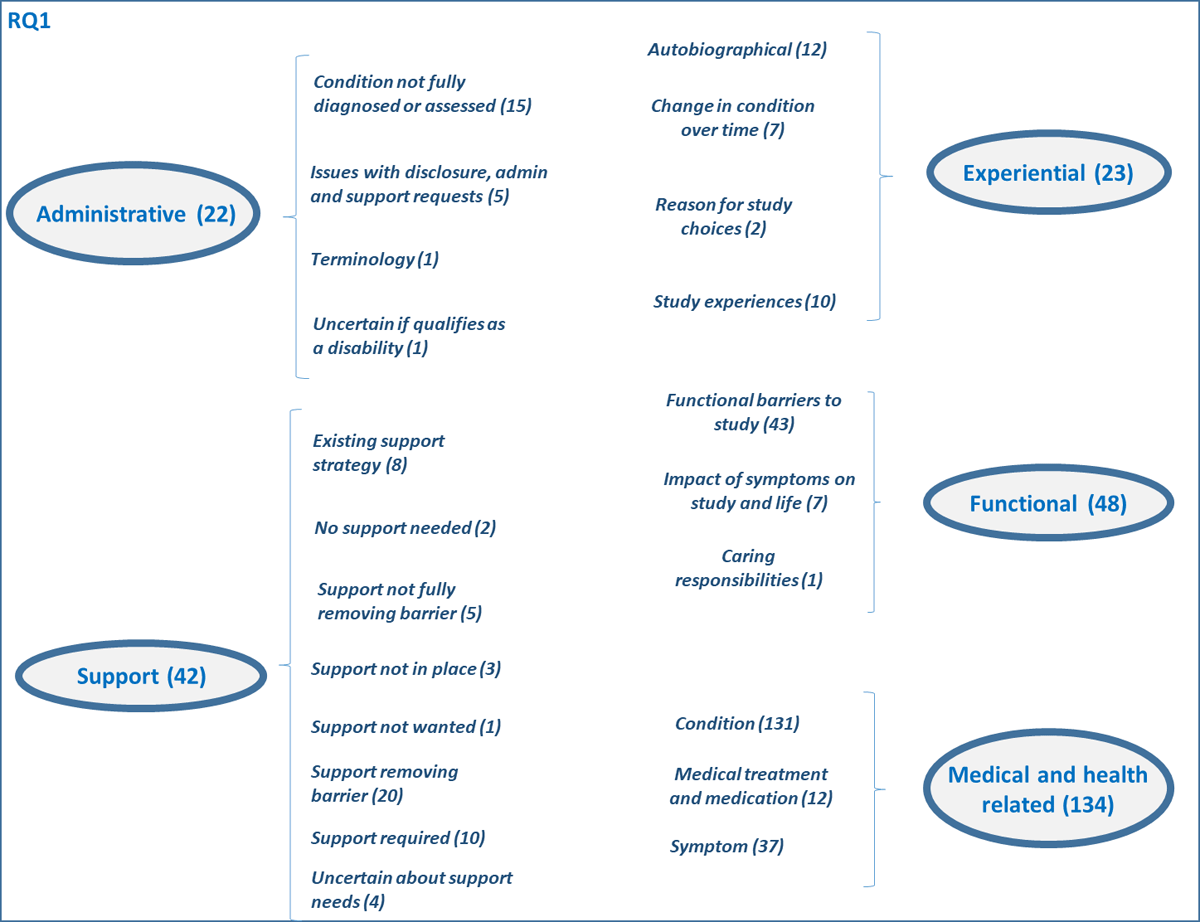
Figure 1
Themes identified in students’ disability descriptions and the number of cases.
The analysis identified five different ways in which disability was discussed in the responses. Medical and health related ways of describing disability were most frequent, but descriptions of functional barriers and limitations, and of forms of support to overcome barriers, were also commonly provided. Experiential elements, such as explaining past events, and administrative aspects of disability such as diagnosis or disclosure processes, were also described. In the remainder of this section, we describe these five themes with examples of the codes found within them.
Medical and health related
Almost all descriptions of disability included codes describing medical conditions. Medical-related topics of symptoms and treatments were also described by a smaller group of respondents.
Descriptions of medical conditions vary substantially in length, from single terms (“ADHD”, “I am asthmatic”) to detailed descriptions of multiple conditions alongside symptoms and treatments, for example
“I am post-stroke with reduced physical mobility of leg and arm. I am severely sight impaired (no peripheral vision, early-stage cataracts). I have two cerebral aneurysms on the left optic nerve causing further vision impairment. I have two historical breaks in my neck and am in severe constant pain and pressure.” (Female, blind or partially sighted, restricted mobility, manual skills, speech impairment, fatigue and unseen disability)
Some more complex descriptions such as this combine conditions and symptoms with experiential aspects, for example, the narrative of how the condition came about or the variability found in it.
Functional
The next most common set of codes describes functional barriers, such as an inability or reduced capacity to do a task. For example:
“I have difficulties with spelling and require more time and effort than ‘average’ to express myself in writing.” (Female, specific learning difficulty)
Further examples show how descriptions often combine conditions and symptoms with functional barriers as a means of explaining issues and impacts.
“I can fall behind with my studies because the disabilities I suffer from prevent me from getting a good night’s sleep. When I have migraine attacks it is very hard for me to work on the course website or even to read the module reading materials.” (Female, restricted mobility, mental health and fatigue)
Functional descriptions appear particularly useful in terms of explaining aspects of disability in a practical way that leads towards an understanding of the next category – support.
Support
Even though separate survey questions were asked about support, descriptions of disability often included aspects of the support that students have in place, may require, or that is not removing a barrier, or not wanted. These aspects of support include a variety of adjustments or accommodations that can remove barriers to learning, and also assistive technologies, features that make study accessible, human non-medical support such as mentoring or note-taking, or strategies that aid learning. A common example of this is the requirement for extra time:
“I often need to have extensions on my assignments as I have days, even weeks when I’m poorly (predominately infections) & can’t do any university work due to fatigue, discomfort, lack of concentration/brain fog etc.” (Female, restricted mobility, manual skills, speech impairment, mental health, fatigue and unseen disability)
As in the above example, respondents often describe their disabilities in terms of support that they have in place or know works from experience:
“I have the help of scribe and mentor both are great.” (Female, restricted mobility, manual skills, mental health issue and fatigue)
While others feel it is important to communicate what is limited or unwanted:
“I don’t use a hearing aid. I’m afraid of making my hearing lazy if that makes sense. I firmly believe in ‘use it or lose it.’” (Female, deaf or hard of hearing and unseen disability)
Experiential
A further approach, used in conjunction with descriptions of support, conditions and functional barriers faced, is to provide descriptions of prior life experiences and events. This is used to give background and narrative to these other themes. For example, in explaining support needs one respondent explains:
“At Sixth Form I was allowed timed breaks during exams and to be seated in a smaller room rather than the main exam hall.” (Female, fatigue and unseen disability)
Others give some history behind conditions:
“I have ongoing injuries from a near-fatal accident some 15 years ago…” (Male, deaf or hard of hearing, fatigue and unseen disability)
While these self-narratives can also give the background to support and administrative issues:
“I was diagnosed at 44, so part of my conundrum is, having had no support up to age 44 because I didn’t know I had an actual “problem”, I don’t know what my additional study needs are, or what has worked for others who have similar diagnoses as myself.” (Female, autism)
Administrative
This theme described a variety of issues of engagement with administrative processes and formalities around disability. The most common code within this was that a person’s condition was not fully diagnosed or assessed, for example:
“I am currently undergoing an assessment for ADHD to gain more support and understanding.” (Female, specific learning difficulties, fatigue and autism)
“I think I am dyslexic but undiagnosed as I am unsure how to get diagnosed. And also unable to afford it.” (Female, specific learning difficulties)
A further code within this theme was to express issues with processes such as information sharing, e.g.:
“If I request an extension, it can be for many different things always based around my health and it’s exhausting having to go over it every time.” (Female, restricted mobility and fatigue)
Codes also demonstrate awareness of process (e.g. that certain terminology is officially correct) or uncertainty as to whether they qualified as disabled.
RQ2: What types of suggestions do students share about the support that works for them?
The thematic analysis of questions 8-20 (see the Appendix) led to the themes and codes in the thematic map included in Figure 2 having in this case three levels of depth. The analysis produced three main themes.
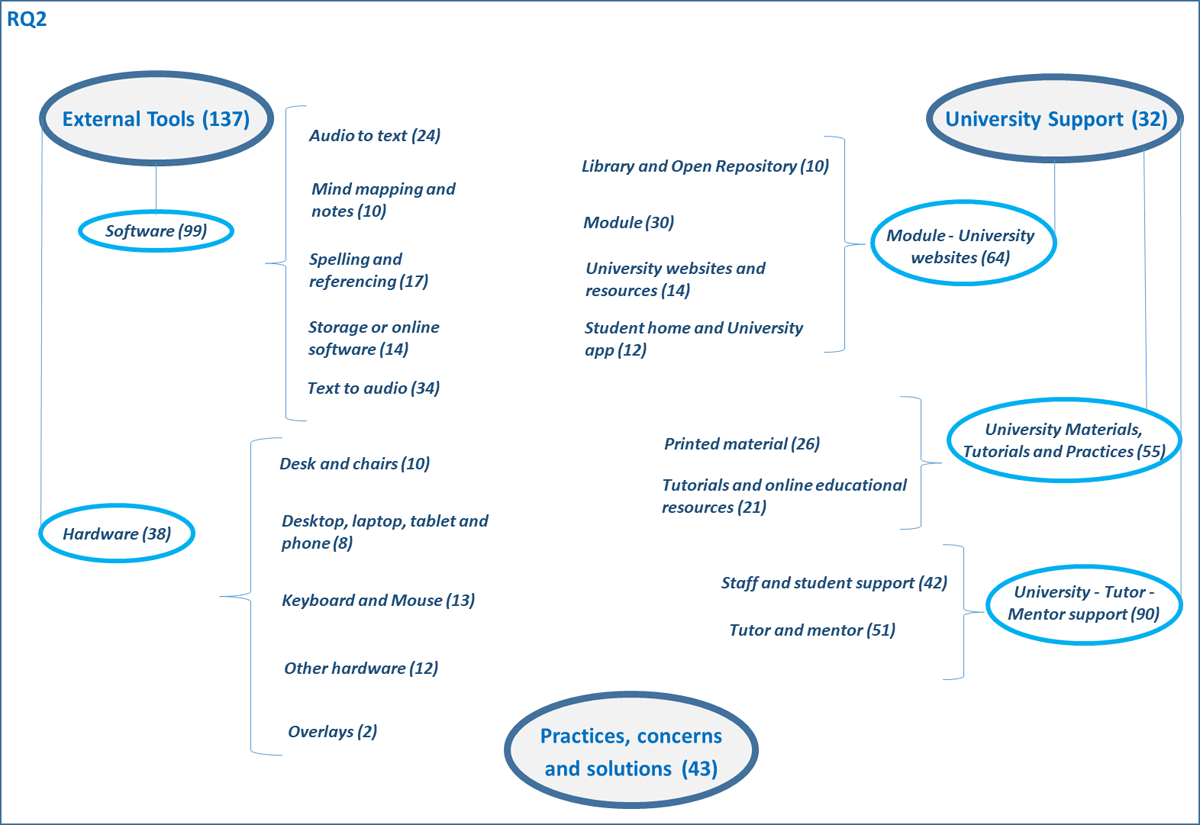
Figure 2
Themes identified in students’ suggestions and the number of cases.
External tools
This theme includes tools provided externally to the university including software. Most tools identified were: Global Autocorrect (intelligently correcting spelling), Claro Read, read-aloud feature in Word or Natural Reader plugin in the browser (text to speech), Dragon Naturally Speaking or Voice dictation integrated into the operative system (speech to text), Read&Write Gold (both), MindView, Pro Study or Glean (for tagging and mind mapping), Talon or Voice (to control the computer or phone with voice commands) and Colour Overlay plugin in the browser (to read using contrast). From those, some were not working or were not designed originally to address student special needs (such as Grammarly or Zotero):
“I was given Dragon to use but could not manage with it as it always put down things I did not want and would not respond to verbal commands rite due to a Scottish accent (..) Grammarly is great to use when doing assignments.” (Female, manual skills, mental health and fatigue)
Students in many cases report the use of more than one tool at the same time:
“Read to me software, this again is helpful when I’m struggling with focus. I tend to use it but reading along the visual and auditory combined helps it to sink in (…). Study notes, for example, maths is not my greatest strength however study notes clearly explain calculations from start to finish which I can then practice myself.” (Female, mental health)
Hardware is usually related to day-to-day study tasks such as office furniture or assistive technologies.
“Ergonomic Equipment, i.e. special chair, rising desk, special mouse and keyboard. Uprising desk allows me to continue to study standing up when sitting becomes too difficult.” (Male, manual skills and unseen disability)
“Padded over-the-ear noise-cancelling headphones preferably with a microphone would help me focus on my studies. It would mean that I could reduce background noise that does cause a distraction.“ (Male, mental health and autism)
University support
This theme includes the different websites provided by the university, those educational resources facilitated to students and human support. Students in general suggest using the module (course) weekly planner to organise themselves:
“Module weekly planner breaks down what is coming up, this helps when I know I have a busy period at work so I can move bits around if needed.” (Female, specific learning difficulties)
Participants also made suggestions related to the Student Home page that acts as an entry point or dashboard for them. This is seen as valuable, but it takes some time to get used to and is potentially overwhelming at first:
“Click on the Student Home scroll down to the bottom of the page (…) spend some time familiarising yourself with the information (…) Ensure you have the IT team on speed dial it is quite easy to become overwhelmed with the hyperlinks that direct you around the program which can become confusing.“ (Male, manual skills, fatigue and unseen disabilities)
A common suggestion that is appreciated is keeping the recording of tutorials since students may not be able to attend:
“Recordings of tutorials are very useful for going over a second time and you can view comments and interactions. Some tutorials are hard to follow at the time and there can be connection issues, as I have always tried to do a different tutorial date to the recorded ones I can go over them again.” (Female, deaf or hard of hearing)
One important suggestion is to keep the possibility for learners to participate online in several formats, not all students enjoy talking in a tutorial or having educational resources in several formats:
“Part of my hearing difficulties involve my inability to work out if I’m speaking loudly or quietly, and being able to write my questions during tutorials has been invaluable as I don’t need to worry about whether or not my voice will be understood by my tutor or other students.” (Female, deaf or hard of hearing and speech impairment)
“Audio materials help by being able to access materials both visually and audibly. Being able to hear and see the information takes away the need to hold heavy textbooks and turn pages and relieves pain in my neck. This also helps with the retention of information through multi-sensory learning.” (Female, manual skills, mental health and fatigue)
In general, the support from staff is appreciated and several students suggested getting in touch with them:
“I at first contacted my Tutors when I had problems, but I then contacted Student Support who were very helpful and supportive. My Tutors have been very supportive, when I explained my issues with some activities, in particular with mandatory forum work, which, at times, have resulted in panic attacks.“ (Female, mental health)
Practices, concerns and solutions
This theme proposes common practices of students, their concerns and what solutions they provide to potential barriers to learning. Students, in general, suggest how important is planning in advance for their studies:
“Planning! I plan everything, time, essays, notes. It takes me longer to process and do everything. It means that you don’t get behind, and it means that you don’t have a final panic. Seriously planning is the way forward.” (Female, specific learning difficulties)
Support from others is welcomed, as well as printing the materials which provides an alternative format:
“I can’t tell when spellings are wrong and I can’t always tell when the spell checker gives a list of which one is right. Getting someone else means you have a fresh pair of eyes and also means you won’t lose marks.” (Male, deaf or hard of hearing, specific learning difficulties and unseen disability)
“Due to the nature of my conditions, the reader (so I can listen from headphones) and printed module content make a massive difference.” (Female, fatigue)
Having more time for particular tasks such as assignments and exams can be very supportive for some students:
“Extra time in exams – an extra 40% duration to allow for downtime due to fatigue. It has allowed me to complete most questions before fatigue takes over.” (Male, manual skills, fatigue and unseen disability)
Discussion and conclusions
Socio-technical approaches to knowledge sharing, combining approaches such as conversational user interfaces, recommendation engines, and crowdsourcing, appear to offer the potential to enhance understanding and improve processes around disability (Iniesto et al. 2023; Liu et al. 2017; Lasecki et al. 2013). This in turn could help to overcome the gaps in awareness and knowledge (WHO & UNICEF 2022) and the administrative burden put upon disabled students to access support (Policy Connect & Higher Education Commission 2020; Coughlan & Lister 2018). To start at the foundation of these issues, we focused here on the student’s perspective, gathering and analysing survey data from participants who have disclosed disabilities, to explore features of communicating disability and examples of the suggestions that could be made.
While conversational user interfaces have existed in various forms for many years, and the potential of AI-based systems in education has been researched for decades (Zawacki-Richter et al. 2019) Large Language Models such as Open AI’s GPT have demonstrated an increased ability to interpret and supply information in scenarios such as healthcare (Kung et al. 2023). This opens up the potential for more complex interactions of the kind required to effectively understand disability-related information and guide disabled students to individual recommendations. However, these need effective prompting to provide good responses and do not inherently support a conversation that is useful unless designed with an understanding of how to achieve this.
This study further evidences the complexity of descriptions of disability, which are not only medical in nature. We have identified a range of different ways that students describe disabilities, often used in combination and chosen by the student to communicate their disabilities in ways they consider effective. Ideally, a system or approach to providing relevant support would be able to distinguish these and interpret them according to particular logic or criteria, in order to reach the right conclusions about relevant guidance and support.
While respondents’ descriptions of their disabilities did usually include medical conditions and symptoms, it can be argued that functional, support, experiential and administrative elements of disability descriptions offer more useful, or at least supplementary, information (e.g. W3C 2021; Coughlan & Lister 2018; Coughlan, Ullmann & Lister 2017). There is a danger that AI-based systems may focus solely on medical conditions in their assessment of disability, or be biased towards this by the extent to which such descriptions are in the majority. This limited view would limit the extent of understanding and the personal and contextual relevance of any outcomes based on these interpretations. It would also instantiate medical or deficit models of thinking which raise barriers for disabled people. Alternatively, by recognising different perceptions of disability, perhaps by prompting and interpreting these dimensions more proactively in the design of conversational, crowdsourcing and recommendation systems, we could more fully realise the potential of AI to overcome disability-related barriers. While there is not an existing framework designed for structuring this in the context of post-secondary education or online learning, there are frameworks and manuals for functional assessment and decision making around assistive technology (World Health Organisation 2012; Gierach 2009) that could be starting points to use in conjunction with the understanding of how students discuss disabilities and what support they find useful that is generated by datasets such as the one analysed in this study. Fundamentally, the complexity of this space, and the pressing need to better support disabled learners, means that conversational interfaces are only a potential part of the solution, working to enhance understanding across stakeholders and in conjunction with more human expertise. Such expertise requires collation of insights and feedback from disabled students to be effective, which could be a further function and benefit of such systems.
Suggestions identified in this research include a set of assistive software tools such as audio-to-text, text-to-audio, mind mapping, spelling and referencing, and hardware including furniture, desktop computer, laptop, tablet and mobile phones. The results also highlighted university support from different stakeholders (i.e. mentors, tutors or peer students), content included in the university webpages (including library, open repositories or mobile app), modules, educational resources, tutorials, and their practices when facing barriers to learning. These findings are aligned with previous research (Iniesto et al. 2023) indicating the variety of student engagement with peers and staff, educational resources, and the devices they feel more comfortable studying with.
Limitations of this exploratory research include the low response rate and limited representation of people with some types of disabilities. However, this research has shown in principle that a range of suggestions that could be usefully shared with others can be gathered via a survey or other structured mechanism. The themes identified in the analysis of this data can then be utilised, alongside machine learning approaches, to guide the process of recommending tools to students based on the suggestions of others with similar barriers to learning. The benefit of these suggestions could be widespread, including to help relieve the administrative burden for students in gaining access to advice and support, as using data such as this, systems can offer more immediate guidance to students struggling from similar barriers.
This analysis shows that suggestions made by students about what helped them relate to elements beyond a simple category of disability, such as the context of their study, specific functional barriers, and previous experiences with study or assistive technologies. It is therefore complex, but feasible, to factor these elements into a structured approach to mapping information about individual students to relevant strategies, tools and resources that would be potentially beneficial to them. The work discussed in this paper contributes to a foundation through which we can explore the benefits and possibilities of using such forms of artificial intelligence to assist and advise disabled students. In our current and future work, we aim to collect more data of this kind, conduct further analysis into the patterns of tool suggestions according to disability descriptions and other relevant information, and design and trial prototypes where this data is used to make personalised suggestions to students that can aid their learning.
Appendices
Appendix
Questionnaire
About you
1. What is your age? (Under 25 years/26-35 years/36-45 years/46-55 years/56-65 years/over 65 years)
2. What is your gender? (Male/Female/Prefer not to say/Other)
3. Please tell us where you live, from the following options. (England/Northern Ireland or Republic of Ireland/Scotland/Wales/Outside of the United Kingdom)
Study and disabilities
4. Please select the subject areas that you have studied or are currently studying with the Open University.
5. Please describe, in your own words, any disabilities, health conditions, and additional study needs that you have.
6. Do you receive Disabled Students Allowance (DSA) or similar funded support? (Yes/No/ Not sure)
7. Please indicate which of the categories below, used by the Open University to group disabilities, you consider yourself to fit with. Select as many as are relevant. (HESA classification)
Tools, accessibility features and assistive technologies
We would now like you to tell us about any tools, assistive technologies, or accessibility features that have helped you with your studies. In the questions that follow, please describe these one at a time, and then briefly say what benefits each one has to you. You can do this up to three times to describe three different tools or features. If you cannot think of three, you can just describe one or two.
8. When you started study with the OU, what one thing helped you the most?
9. Please describe a first tool, feature or assistive technology that has helped you overcome challenges in study. If you can, please write this description as if you were suggesting this to a student who is just starting their studies.
10. Please briefly describe why this has been beneficial to you.
11. Please describe a second tool, feature or assistive technology that has helped you overcome challenges in study. Again, please write this as if you were suggesting this to a student who is just starting their studies.
12. Please briefly describe why this has been beneficial to you.
13. Please describe a third tool, feature or assistive technology that has helped you overcome challenges in study. Again, write this as if you were suggesting this to a student who is just starting their studies.
14. Please briefly describe why this has been beneficial to you.
Resources and guidance
We would now like you to tell us about any resources (for example a website, book, help page or guidance) that have helped you in your studies. In the next section, please describe these one at a time, and then briefly say what benefits each one has to you. In the boxes below, you can do this up to three times to describe three different resources. If you cannot think of three, you can just describe one or two.
15. Please describe a first resource that has helped you in your studies. If you can, please write this as if you were suggesting it to a student who is just starting their studies.
16. Please briefly describe why this has been beneficial to you.
17. Please describe a second resource that has helped you in your studies. Again, write this as if you were suggesting it to a student who is just starting their studies.
18. Please briefly describe why this has been beneficial to you.
19. Please describe a third resource that has helped you in your studies. Again, write this as if you were suggesting it to a student who is just starting their studies.
20. Please briefly describe why this has been beneficial to you.
21. Do you have any other suggestions or comments that you would like to provide?
Funding Information
The Open University’s Open Societal Challenges and Test and Learn initiatives have supported the data collection and analysis described in this paper. Previous research leading to this investigation was funded by Microsoft through an AI for Accessibility grant.
Competing Interests
The authors have no competing interests to declare.