
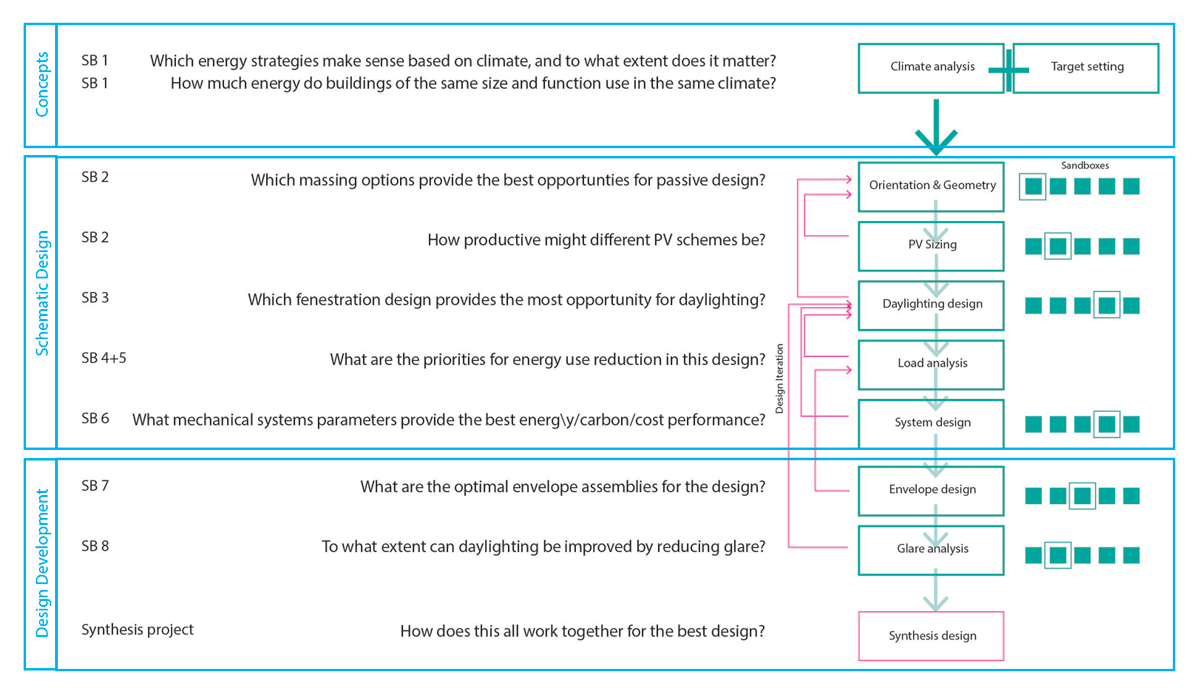
Figure 1
Course organization: topically driven questions are tied to specific types of analysis.
Note: Prescriptive, self-audited baseline analyses are followed by open-ended explorations.
Table 1
Thematic results and illustrative quotations.
| STUDENT CONSTRUCTIONS OF THEMSELVES AND THEIR KNOWLEDGE | |
| New insight into buildings and energy | |
| What ‘shocked me the most’ […] I always knew that elements of a building consumed a lot of energy, but I never knew how much | |
| I realized this and several other things wrong with my old design which claimed to be ‘sustainable’ which makes me want to face-palm myself | |
| I ‘did not understand the units of measurement as well as I thought I did’ | |
| Deepened consciousness of buildings and energy through building performance simulation (BPS) | |
| Of specific elements/systems | I never realized how drastic something as simple as the material of the façade on a building can have. I think I am now concerned about mechanical systems, where windows are placed, and also what material goes on where. I now realize that a little bit up front can go a very long way in the long run when it comes to energy consumption. Especially heating and cooling systems! |
| Understanding through attentional focus | Thermal loads, lighting quality and quantity were not something I often considered, let alone understood |
| Understanding expressed as a language | Energy consumption is now ‘easy to talk about in my own words’ |
| Understanding attributed to visual/graphic outputs | The visuals of data helped for a greater understanding of what the lectures were discussing, as well as the direct impact on a site-specific structure |
| Situating knowledge in a broader context | I feel like I have a better understanding of what environmentally conscious design can look like |
| More sophisticated understanding of design with energy-related factors through BPS | |
| Understanding interrelationships and trade-offs | The small edits in one place can work against changes in another, it is all a delicate balancing act |
| I learned that increasing performance of a building can have a negative impact on the user’s comfort level and overall experience in the building, which shows that there must be some give and take when trying to design a sustainable building | |
| Understanding part–whole relationships | It was interesting seeing how you can alter a few minor things and get a lower results in energy consumption |
| I see how they all work together to achieve the goal of saving energy and operating costs. I also do see how energy efficient windows can make such impact. I think I have achieved this because now I look at these components both individually and as a whole | |
| Recognizing the development of intuition | I’ve also grown to understand that energy, lighting, comfort and building geometry are all related to one another when designing a building. I believe I understood this prior to this class, but our final project really hammered this idea home. We performed tests and made decisions in the composition of our final project that positively impacted daylighting and visual comfort while sacrificing energy efficiency and vice versa. Now on top of understanding this concept, I actually have experience and a feeling for the degree to which this is the case |
| I was ‘able to test the things we as students hear in lecture about what good passive system design is. A lot of these rules are stated but being able to test them and see the numbers go up or down was a great way to reinforce intuitive understanding what certain design moves will do’ | |
| STUDENT CONSTRUCTIONS OF BPS AS A DESIGN TOOL | |
| BPS produces useful visual information | |
| I was able to compare different design options by visually seeing the analysis results | |
| By showing accurate charts and data it allows me to be more confident in having specific reasons why certain designs work better than others | |
| Seeing charts and graphs and data spreads that reinforce my design concepts feels great. It’s a validation that goes above just aesthetics in my opinion | |
| BPS yields quantitative outputs | |
| Being able to put a metric value on something that has come from my head and seeing how it performs has been so fascinating. These are things that I always thought about but never quite understood how to assign a value to | |
| I feel I was certainly able to do this prior to the class, but only through qualitative means. I could explain why something would likely be either an improvement or detriment, but was unable to definitively prove it, or back it up with quantitative measurements | |
| BPS ‘allowed us to provide quantitative results for theoretical scenarios for our designs that would otherwise be impossible’ | |
| Distinctions between the BPS model and the ‘truth’ | |
| Understood that output is a clue but not the truth | My original idea of simulation was that they were concrete and ‘right’ but I have come to realize they are just a tool to take advantage of to get a better understanding |
| The digital model may not be perfectly accurate | |
| Simulations may not be an exact correlation to reality, but they are still representative of reality enough to inform our design decisions | |
| The natures of testing with BPS | |
| Open-ended testing | Previously when designing, I would always use whatever option seemed best and go with the first choice, but I now understand how simple it can be to run a few tests |
| Frequently used terms: ‘test,’ ‘explore,’ ‘play with,’ ‘experiment’ | |
| There is no single optimal solution | |
| Semi-structured testing | Frequently used terms: ‘design choices,’ ‘options,’ ‘iterations,’ ‘combinations,’ ‘comparative,’ ‘endless simulations,’ ‘constantly adjusting different design aspects’ |
| STUDENT CONCEPTUALIZATIONS OF FUTURE BPS USE | |
| BPS as a tool for broader change | |
| Understanding of architects’ roles in impacting energy use with BPS | I felt reassured that I was an architecture major because I thought that this meant I would be able to be a part of the step towards building sustainably |
| I feel more empowered to factor in the energy demands of a design early on and to think through the consequences of design decisions in real time | |
| BPS for decision-making and argumentation in future design | |
| A way of developing understanding | I was able to execute different analyses that helped me better understand what factors impact a building more than others |
| I had no idea how powerful simulation could be towards making design decisions | |
| BPS ‘allowed me to make design decisions based off of more than just common sense and aesthetic quality as I had done before’ | |
| Tool to justify/rationalize decisions | I also enjoyed the ability to justify my design by the performance simulations. The form was designed to improve performance, but the performance [data] also gave merit to the design |
| Having sufficient data to support your claims can only help solidify why you made those decisions and how to further improve upon them | |
| BPS ‘transforms my opinions into arguments’ | |
| Tool to shift decisions | Simulations can help to either support or contradict your proposal |
| A great tool to nudge you in the right direction | |