
1. Introduction
Teachers' self-efficacy beliefs substantially impact their teaching practices. They are strongly related to the effectiveness of their teaching performance (Klassen, Tze, 2014) and are prerequisites for undertaking and persevering with challenges in an innovative and creative manner (Schwarzer, Jerusalem, 2002). As a part of teachers' professional competence (Baumert, Kunter, 2006, 2013), positive self-efficacy beliefs are an indispensable prerequisite for the successful implementation of inclusive geography lessons. Teachers will only be willing to create an environment that is appropriate for all learners in a heterogeneous group if they feel that they can effectively implement inclusive teaching practices. It is crucial to prepare (prospective) teachers adequately to ensure that they feel confident in effectively meeting the requirements of inclusive teaching in specific subjects, for example geography. However, it is unclear whether the promotion of general self-efficacy beliefs related to teaching and inclusion is sufficient, or whether specific subject-related beliefs need to be promoted.
Lessons in general schools must reflect the diversity of learners, facilitating both social participation as a member of the learning group and subject-related learning processes for all students. It is therefore necessary to consider inclusive education from the perspective of subject teaching to provide an appropriate learning environment for all students, taking into account their individual strengths and weaknesses within an inclusive classroom. Against this background, the training of (prospective) teachers is of particular importance (Forlin, 2010; UNESCO, 2019), especially in relation to inclusive subject teaching. Each subject has particular requirements due to its specific characteristics. Geography, for instance, is a subject that offers a wide range of methods due to its position between the natural and social sciences. This methodological diversity provides great potential, but also notable challenges, as it encompasses approaches ranging from scientific experimentation to social science methods, such as interviews. In addition, maps represent a central medium within the field of geography. Moreover, geographical content varies considerably, encompassing topics that enable direct experiential engagement (e.g., weather, water, soil) as well as those that are more abstract in nature (e.g., economic locations, population change, migration). However, subject-specific requirements need to be broadened to support students with special educational needs. A variety of requirements can exist depending on to the individual impairments of the students each necessitating a response at the subject level. For example, a markedly divergent approach to using maps in geography lessons is needed in situations where students have a learning or visual impairment (Winklmaier, Schubert, 2024). Against this background, inclusive geography teaching is conceived as geography teaching that encompasses all students, without exception (Schubert, Winklmaier, 2023). Adapting lessons to the specific needs of the learners is the only way to ensure that all learners can meet their learning objectives. To plan and implement lessons based on the individual learning requirements of their students, teachers need the confidence to organise inclusive (geography) lessons in an effective manner. Therefore, the focus of this study is on the self-efficacy beliefs about inclusive geography teaching held by prospective teachers as an action-oriented construct. We aimed to elucidate the relationships between these beliefs and other pertinent constructs within the context of inclusive education and, in particular, inclusive geography teaching. In addition, we investigated how these connections vary in relation to subject-specificity or non-subject-specificity.
2. Theoretical and empirical background
Teacher self-efficacy beliefs about inclusive geography teaching
The concept of self-efficacy beliefs can be traced back to Bandura (1977), who developed it as part of his social cognitive theory. He defines self-efficacy as a belief in an individual's ability to successfully complete an action and thus achieve a defined goal (Bandura, 1997). Consequently, individual self-efficacy beliefs are of central importance in the planning and execution of actions (Urton, Wilbert, & Hennemann, 2015). In relation to teachers, their self-efficacy beliefs can be defined as the conviction that one can positively influence student learning outcomes or that one can effectively design and manage teaching (Schwarzer, Jerusalem, 2002; Yada et al., 2022). The current literature on inclusive education indicates that teachers with high self-efficacy beliefs are more likely to assume that students with special educational needs can be effectively included in general school lessons than teachers with low self-efficacy beliefs (Sharma, Jacobs, 2016; Sharma, Loreman, & Forlin, 2012). Furthermore, Chow (2024) showed that teachers' self-efficacy beliefs exert a considerable influence on their intentions to adopt inclusive practices. Woodcock et al. (2022) found that teachers with a high level of self-efficacy beliefs focus on the success of learners in inclusive lessons, modifying learning goals to align with the specific learning needs of their students.
Within the context of teachers' self-efficacy beliefs and the implementation of inclusive teaching, Bosse, Henke and Jäntsch (2016) indicated a tendency towards positive characteristics among primary school teachers. Kopp (2009) likewise reported comparable findings in a survey of prospective primary school teachers. The studies conducted by Savolainen et al. (2012) and Chow (2024) showed positive teacher self-efficacy beliefs in relation to inclusive practices. The findings of Hecht, Niedermair and Feyerer (2016) are consistent with this conclusion, as evidenced by their study of both students and in-service teachers regarding their inclusion-related self-efficacy beliefs. Furthermore, empirical studies have found that the self-efficacy beliefs of (prospective) teachers regarding inclusive education can be modified, for example, participation in courses or advanced training on inclusion can positively influence these beliefs (e.g., Hecht et al., 2016; Kopp, 2009). At this stage, no results are available on the self-efficacy beliefs of (prospective) geography teachers regarding inclusive education, particularly in connection with teaching geography in classes that include students with special educational needs.
Teachers' self-efficacy beliefs (about inclusive education) as part of a belief system
There is no consensus regarding a precise definition of the construct of teachers' beliefs (Fives, Buehl, 2012; Pajares, 1992). In terms of the overlap between existing definitions, Richardson (1996, p. 103) characterizes beliefs as “[…] psychologically held understandings, premises, or propositions about the world that are felt to be true”. Teachers hold beliefs about specific topics or constructs (Gill, Fives, 2015; Pajares, 1992), such as self-efficacy beliefs as beliefs “about confidence to perform specific tasks” (Pajares, 1992, p. 316). Based on various studies on teachers' beliefs, Fives and Buehl (2012) identified six categories according to their content. These categories are “[…] beliefs about (a) self, (b) context or environment, (c) content or knowledge, (d) specific teaching practices, (e) teaching approach, and (f) students” (Fives, Buehl, 2012, p. 480). Moreover, various types of (teachers') beliefs – and consequently also teachers' self-efficacy beliefs about inclusive education – are closely interrelated and form what are known as belief systems (Fives, Buehl, 2012; Pajares, 1992; Rokeach, 1963). In such a belief system, self-conceptions or beliefs about self are at the centre (Grube, Mayton, & Ball-Rokeach, 1994) and attitudes at the periphery (Grube et al., 1994; Pajares, 1992). In addition, different beliefs within a belief system have the potential to serve as a filter, frame, or guide (Fives, Buehl, 2012). Given that “[…] different types of beliefs may serve different functions in different situations” (Fives, Buehl, 2012, p. 480), their role within the belief system therefore depends on the context.
In addition to teachers' self-efficacy beliefs, various authors have examined other belief constructs related to inclusive education. A topic of investigation within this field has been, for example, the potential for implementing inclusive teaching practices with learners who have special educational needs (Kopp, 2009; Miesera, Gebhardt, 2018). In the context of empirical research regarding inclusive education and the implementation of inclusive school systems, attitudes are also of significant interest (e.g., Bosse et al., 2016; Woodcock et al., 2023). Based on Pajares (1992), they can be assigned to the belief substructures as a periphery component of a belief system. In relation to inclusive education, it is posited that teachers' attitudes and teachers' self-efficacy beliefs exert a considerable positive influence on their intention to teach in inclusive classrooms (Sharma, Jacobs, 2016). A positive relationship between teacher self-efficacy beliefs about inclusion and teacher attitudes towards inclusion has been shown in a substantial body of empirical studies (e.g., Bosse et al., 2016; Miesera, Gebhardt, 2018; Sharma et al., 2012; Urton et al., 2015; Woodcock et al., 2023; Yada et al., 2022).
3. Aims of the study
As outlined above, (prospective) teachers' self-efficacy beliefs are particularly relevant to the actual implementation of inclusive teaching. In most cases, general constructs without specific reference to individual subjects are considered, which consequently do not address subject-related challenges. In relation to inclusive education, teaching requirements for specific subjects can vary widely. For example, in an inclusive geography class, maps need to be made accessible to all students in the heterogeneous learning group. This can only be done using subject-specific knowledge. With this in mind and given that self-efficacy beliefs are context-specific (Bandura, 1997), we examined beliefs (including self-efficacy beliefs) within the context of inclusive geography.
There is currently a lack of empirical findings on the self-efficacy beliefs of (prospective) geography teachers in inclusive geography teaching – both in terms of their characteristics and in terms of their interaction with other constructs in a belief system. Against this background, we focused on prospective teachers' self-efficacy beliefs about inclusive geography teaching (SEB-IGT) as a particularly action-oriented construct in relation to the implementation of inclusive geography teaching. In line with Fives and Buehl (2012), we categorise them as beliefs about self. Furthermore, we assume that the SEB-IGT is part of a belief system in conjunction with other belief constructs in the context of inclusive education and inclusive teaching. We suggest a link between the SEB-IGT and the beliefs about inclusive geography teaching (B-IGT), as the B-IGT scale focuses on teaching geography to children with and without special educational needs in the same classroom. Consequently, the B-IGT scale has great similarities with the SEB-IGT in terms of content through the reference to geography and the reference to inclusion. According to Fives and Buehl (2012), these teacher beliefs touch on both beliefs about specific teaching practices and beliefs about students.
We assume a further potential link between the SEB-IGT and the self-efficacy beliefs in teaching (SEB-T) as beliefs about self. As the SEB-T refers to teaching in general, they have a content-related connection to the SEB-IGT. However, as the only overlap is in terms of content – they have no connection to the subject of geography or inclusion – we locate the SEB-T further away from the centre of the belief system than the B-IGT. As a possible component of the periphery part of the belief system around SEB-IGT, we also look at the attitudes towards inclusive education (A-IE). Because of its reference to inclusion, A-IE overlaps with SEB-IGT in terms of content. Since the B-IGT also has this reference to inclusion, we additionally expect a link between the A-IE and the B-IGT.
Considering the above, we formulated two guiding hypotheses. Our first hypothesis was that within a belief system, B-IGT, SEB-T and A-IE explain part of SEB-IGT. Thus, SEB-IGT is expected to be related to the other three constructs examined: B-IGT, SEB-T and A-IE. Given the proximity of B-IGT and A-IE, we also suspected that there is a connection between these two constructs. In addition to the question of whether the hypothesized correlations can be shown in the form of the theoretically derived model (Figure 1), the strength of these correlations is of particular interest to us. Therefore, against the background of inclusive education in different school subjects, our second hypothesis was that the subject-specific B-IGT is more closely related to the SEB-IGT than the more general SEB-T and A-IE.
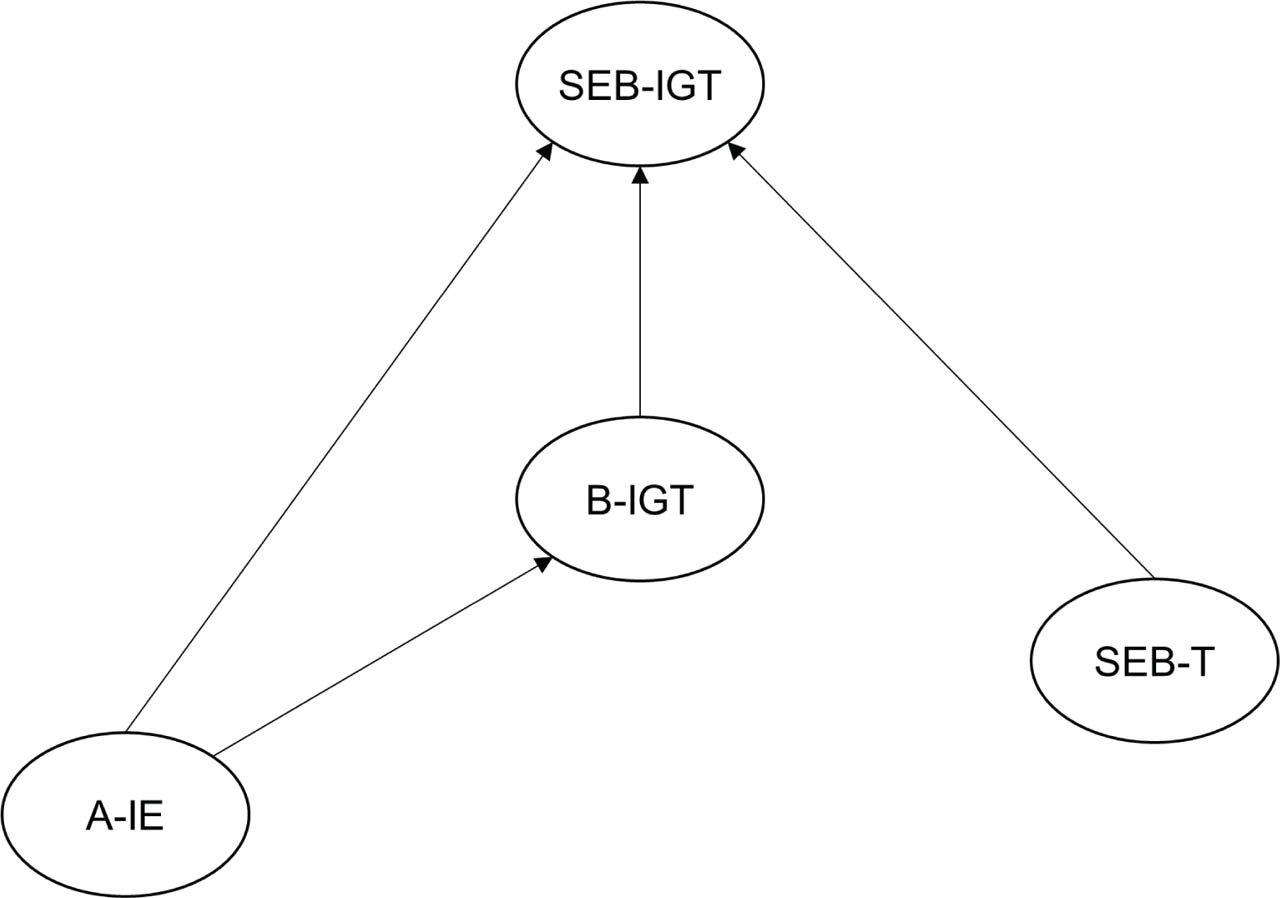
Fig. 1:
Theoretical model around the SEB-IGT
4. Methods
4.1. Data collection, sample description and scales
Data were collected as part of the GeoLInk project, utilizing an item-based questionnaire (Thieroff et al., 2021) in the form of an anonymous paper-and-pencil survey at six universities in Bavaria and Saxony. Student geography teachers were surveyed (N = 295). Of these, just under two-thirds were pursuing a degree in primary school teaching (Grundschule: n = 180). The remaining cohort were pursuing a degree in secondary school teaching (Mittelschule: n = 39, Realschule: n = 22, Gymnasium: n = 32), with 22 cases lacking information regarding the school type. The participants were enrolled in a range of academic levels, from the first to the ninth semester, with the majority being in their third or fifth semester (M = 4.27, SD = 1.69). In terms of gender, approximately three-quarters (n = 210) of respondents identified as female, while just under a quarter (n = 61) identified as male (missing cases: n = 24). Furthermore, only about one-fifth of the students (n = 58) indicated that they had previously participated in a course on the subject of inclusive education at the time of the survey. The participants were invited to take part in the survey as part of their courses. They were informed about the aims of the survey and were made aware that their participation was voluntary, that their responses would be anonymous, and that they would not be disadvantaged in any way if they chose not to take part. The constructs were evaluated utilizing four distinct measurement scales (see Table 1). We measured them on a six-point Likert scale, with values ranging from 1 (strongly disagree) to 6 (strongly agree).
Tab. 1:
Scales, examples of items, scale parameters, manifest (below the diagonal) and latent (above the diagonal) bivariate standardized correlations of the scales (standard errors in parentheses)
| Scalea | Items | Origin | Examples of itemsc | M | SD | α | ρC | Correlation Matrix | |||
|---|---|---|---|---|---|---|---|---|---|---|---|
| (1) | (2) | (3) | (4) | ||||||||
| (1) Self-efficacy beliefs towards inclusive geography teaching (SEB-IGT) | 9 | Kopp, 2009, b | I am sure that I can provide an appropriate learning opportunity for every child in geography lessons, even with the greatest differences in performance. | 3.28 | 0.93 | 0.91 | 0.90 | - | 0.35*** (0.05) | 0.14 (0.05) | 0.25*** (0.05) |
| (2) Beliefs about inclusive geography teaching (B-IGT) | 5 | Kopp, 2009, b | In principle, geography lessons can be designed in such a way that they are suitable for all children. | 4.27 | 0.91 | 0.81 | 0.79 | 0.30*** (0.05) | - | 0.02 (0.04) | 0.79*** (0.06) |
| (3) Self-efficacy beliefs in teaching (SEB-T) | 8 | Schulte, 2008 | Regardless of the topic, I know how to involve students in the lesson. | 3.73 | 0.87 | 0.90 | 0.91 | 0.13* (0.05) | 0.02 (0.05) | - | −0.01 (0.05) |
| (4) Attitudes towards inclusive education (A-IE) | 14 | Lüke, Grosche, 2017 | I suspect that an inclusive school system could improve teaching for all children. | 4.16 | 0.91 | 0.92 | 0.93 | 0.23*** (0.05) | 0.69*** (0.06) | −0.01 (0.05) | - |
4.2. Data input and preparation
The data were entered and processed using SPSS Statistics 29. The raw dataset (Gölitz et al., 2021) and accompanying documentation (Schubert, Winklmaier, & Gölitz, 2021) are openly available. Given that less than five percent of the data were missing at random, it can be posited that the same results can be expected regardless of the method employed to address missing data (Tabachnick, Fidell, 2019). To obtain the maximum sample size, the missing data were supplemented using the Expectation-Maximization method.
4.3. Data analysis
The aim of the data analysis was to test the theoretical model (Figure 1) using structural equation modelling. For this purpose, descriptive analyses (mean scores and standard deviations) were conducted utilising SPSS Statistics (Version 29.0.2.0). All subsequent analyses were conducted using RStudio (Version 2024.09.1) with the packages lavaan (Rosseel, 2012), MVN (Korkmaz, Göksülük, & Zararsiz, 2021) and semTools (Jorgensen et al., 2022).
Preliminary examination
The four original scales from which the items were derived had already been validated as unidimensional constructs (SEB-IGT-scale: Kopp, 2009; B-IGT-scale: Kopp, 2009; SEB-T-scale: Schulte, 2008; A-IE-scale: Lüke, Grosche, 2018). To ascertain the validity of these constructs in the present sample, comprising prospective Bavarian and Saxon geography teachers, they were subjected to a confirmatory factor analysis (CFA) to determine the fit of the model to the data (cutoff values: χ2/df < 2, CFI/TLI ≥ 0.95, RMSEA ≤ 0.06 and SRMR ≤ 0.08; Brown, 2015; Hu, Bentler, 1999).
For the structural equation modelling, we initially evaluated the indicator reliability (indicator loadings > 0.40; Hair et al., 2021), internal consistency reliability (cutoff: a ≥ 0.80; pC ≥ 0.60; Bühner, 2011; Hair et al., 2021), distribution of the indicators with regard to normality (Mardia's multivariate skewness and kurtosis; cutoff: skewness < 3, kurtosis < 10; Kline, 2023), convergent validity (AVE ≥ 0.50; Hair et al., 2021; Hair et al., 2024) and discriminant validity (upper limits of 95% CIs > 0.8; Rönkkö, Cho, 2022). We conducted an analysis of discriminant validity to confirm that the measured scales are empirically distinct by using the recommended CICFA (sys) (Rönkkö, Cho, 2022). Therefore, we estimated a CFA model including all scales and scaled the latent variables by fixing their variances to 1 (Rönkkö, Cho, 2022). Furthermore, we assessed whether there is a linear relationship between the measured variables following a visual inspection of the scatterplots with LOESS smoothing.
Correlations
As a preliminary indication of the relationships between the scales employed, we examined the manifest and latent correlations according to Pearson's correlation. In line with the recommendations set out by Brown (2015) and Bühner (2011), we adhered to a threshold value of r < 0.80 / r < 0.85 in relation to the latent correlations. We categorized 0.1 ≤ r < 0.3 as a weak correlation, 0.3 ≤ r < 0.5 as a medium correlation, 0.5 ≤ r < 0.7 as a strong correlation, and 0.7 ≤ r < 1 as a very strong correlation (Kuckartz et al., 2013). Nevertheless, as no causal relationship can be inferred from correlations, we proceeded to examine the constructs within a structural equation model.
Structural equation modelling
To examine the presumed relationships between the constructs surrounding SEB-IGT, the theoretically derived model (see Figure 1) was tested using structural equation modelling (SEM). Given the nonnormality of the measured variables, the WLSMV estimator (robust weighted least squares) was employed to conduct the evaluation. According to Li (2014), the WLSMV estimator is more accurate than ML and MLR in estimating regression coefficients for slight to moderate asymmetric distributions. Additionally, it is robust to floor and ceiling effects (Brown, 2015).
Given the unidimensional structure of the constructs, we were able to summarise the items within the scales in parcels for calculating the structural equation model. Parceling facilitates an improvement in the ratio of variables to be estimated to sample size (Rhemtulla, 2016); therefore, it enabled the analyses to be conducted with the present sample. The parceling strategy chosen was the balancing approach, assuming the one-dimensionality of the constructs (Little et al., 2013).
To estimate the quality of the structural equation model, we drew upon the insights provided by Brown (2015). In addition to the χ2 value (cutoff: χ2/df < 2) for the global model fit, we assessed the local fit indices CFI (Comparative fit index), TLI (Tucker-Lewis Index), RMSEA (root mean square error of approximation) and SRMR (standardised root mean square residual). To ascertain the local fit indices, the limit values proposed by Hu and Bentler (1999) were employed (CFI/TLI ≥ 0.95, RMSEA ≤ 0.06 and SRMR ≤ 0.08). The standardised path coefficients were deemed to be meaningful if they were statistically significant (p ≤ 0.05) and, in accordance with Chin (1998), if they exceeded 0.2 or fall below −0.2.
5. Results
Preliminary examination
In terms of indicator reliability, all items demonstrated loadings exceeding the 0.40 threshold (0.41 ≤ λ ≤ 0.83). Given that the AVE for all measured constructs exceeded 0.50 (0.57 ≤ AVE ≤ 0.80), the items with loadings between 0.40 and 0.708 were retained (Hair et al., 2021). Moreover, the scales employed demonstrated satisfactory to excellent internal consistency reliability values (0.81 ≤ α ≤ 0.92, 0.79 ≤ ρC ≤ 0.93; Table 1). The results of both the skewness and kurtosis tests were statistically significant (p < 0.001), indicating that a multivariate normal distribution could not be assumed. The examination of the data structure of the variables indicated that all variables exhibited a slight divergence from normality (skewness ranged between −0.88 and 0.51; kurtosis ranged between −1.12 and 0.61). However, the values were markedly below the threshold values documented in the literature (Kline, 2023). Additionally, all upper limits of the 95% CIs of the estimated factor correlations showed values below 0.8 (0.11 ≤ UL ≤ 0.77). Since the A-IE and the SEB-T showed a negative correlation, the lower limit of the 95% CI was inspected (−0.14). Following the visual inspection of the scatterplots with LOESS smoothing, it was determined that the relationship between the variables was approximately linear. Thus, the measured constructs showed satisfactory results regarding the internal consistency reliability, distribution of the indicators with regard to normality, convergent validity and discriminant validity. The confirmatory factor analysis (one factor) for the four scales used also demonstrated adequate approximate fit values (χ2/df < 2, CFI/TLI ≥ 0.95, RMSEA ≤ 0.06 and SRMR ≤ 0.08; Hu, Bentler, 1999). The results showed an appropriate alignment between the measurement models and the data.
Descriptive statistics and correlations
Table 1 presents the mean values and standard deviations (3.28 ≤ M ≤ 4.27; 0.87 ≤ SD ≤ 0.93), along with the manifest and latent correlations of the four scales. The prospective geography teachers surveyed displayed clear positive general attitudes (A-IE) as well as geography-related beliefs (B-IGT) in the context of inclusive education. In contrast, the self-efficacy beliefs observed (SEB-T and SEB-IGT) exhibited a slight positive to slight negative trend.
The values of the latent correlations were found to fall below the recommended threshold values. The SEB-IGT exhibited statistically significant correlations of varying strength with the constructs under consideration. The B-IGT displayed the strongest statistically significant correlation with the SEB-IGT, while the SEB-T exhibited the weakest correlation, which was also only significant at the manifest level.
Structural equation modelling
The calculated model around the SEB-IGT (Figure 2) demonstrated good approximate fit values (χ2 = 81.29, p = 0.003, df = 49; CFI = 0.99; TLI = 0.99; RMSEA = 0.04, 90% C.I. [0.02, 0.05]; SRMR = 0.04). B-IGT had a direct statistically significant effect on SEB-IGT (β = 0.41, S.E. = 0.16, p = 0.006). This indicates that a positive subject-related B-IGT results in higher levels of SEB-IGT. The path between the SEB-T and the SEB-IGT (β = 0.14, S.E. = 0.08, p = 0.062) was not statistically significant. This indicates that the more general SEB-T does not exert any influence on SEB-IGT. Similarly, the A-IE did not have a direct predictive effect on the SEB-IGT (β = −0.07, S.E. = 0.15, p = 0.611), despite the bivariate correlation indicating a direct effect of the A-IE on the SEB-IGT. Nevertheless, there was a strong effect between the A-IE and the B-IGT (β = 0.79, S.E. = 0.06, p < 0.001, R2B-IGT = 0.63). As the A-IE was significantly related to the B-IGT, and the B-IGT was significantly related to the SEB-IGT (Table 1), and as the relationship between A-IE and SEB-IGT was diminished when B-IGT was included in the model, the theoretical conditions for mediation (Little et al., 2007) were met. This indicates that the effect of the A-IE on the SEB-IGT is fully mediated by the B-IGT. The indirect effect of the A-IE on the SEB-IGT (β = 0.32, S.E. = 0.12, p = 0.005) and the total effect (β = 0.25, S.E. = 0.07, p < 0.001) were statistically significant. Consequently, it can be concluded that the general A-IE exerts an indirect effect on the SEB-IGT. A total of 15% of the variance in the SEB-IGT was accounted for by the model (R2SEB-IGT = 0.15).
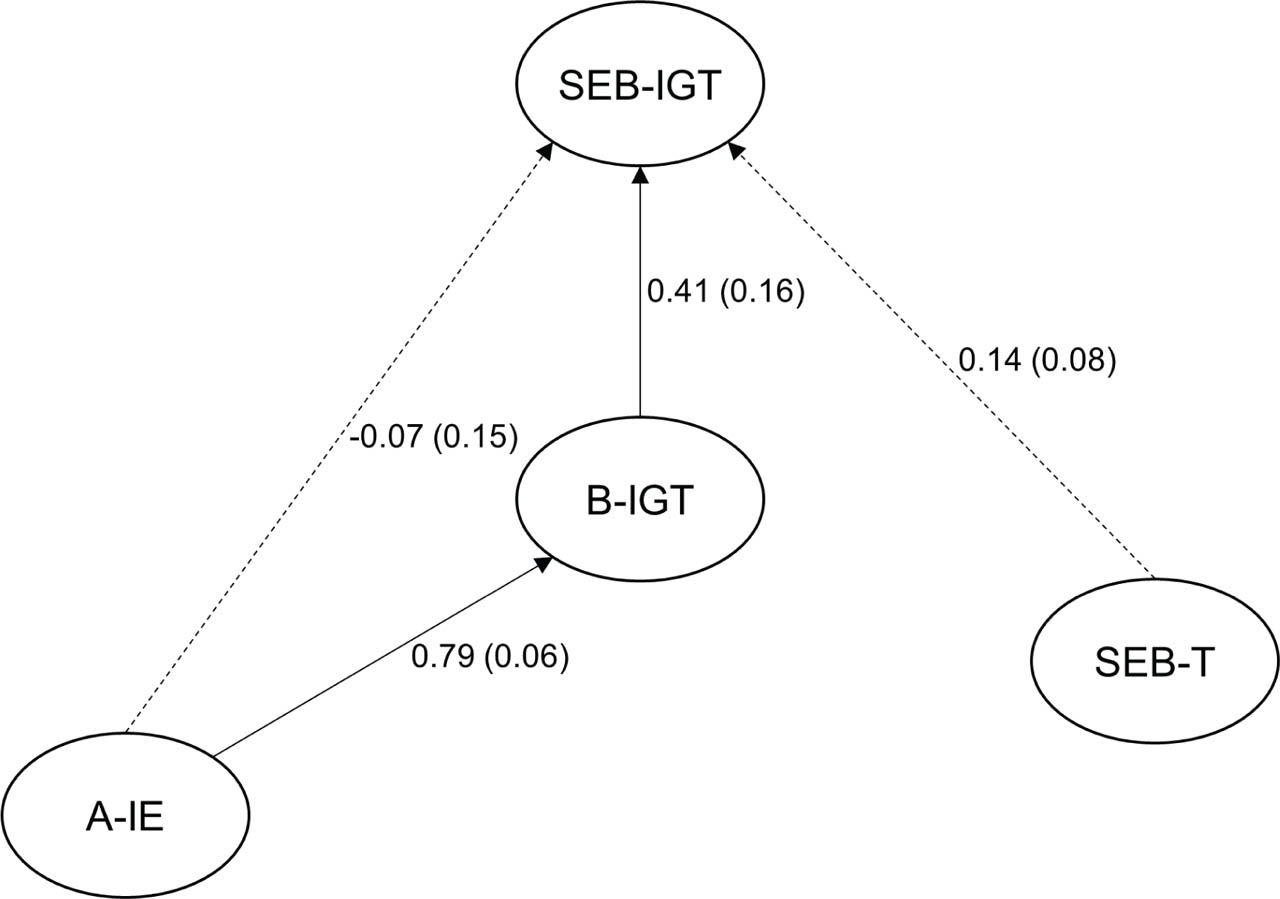
Fig. 2:
Structural equation model around the SEB-IGT (N = 295; standardized results; p < 0.01 for all solid paths, non-significant paths dashed; standard errors in parentheses)
These results support our first hypothesis that within a belief system, the B-IGT, SEB-T and A-IE explain a proportion of the SEB-IGT with constraints. Although the SEB-T had no noteworthy influence on the SEB-IGT, the two other constructs under consideration did exert a significant (indirect) effect on the SEB-IGT. The B-IGT, as a geography-specific construct, exerted the strongest direct influence on the SEB-IGT. This supports our second hypothesis: the subject-specific B-IGT was more closely related to the SEB-IGT than the more general SEB-T and A-IE.
6. Discussion
This study's findings provide substantial evidence for the existence of a belief system surrounding the SEB-IGT among prospective geography teachers. The theoretical model (Figure 1) appears appropriate in its basic structure and can be retained. However, our results indicate that the non-specific SEB-T is not a component of this belief system (Figure 2), while the B-IGT exerts the most significant influence on the SEB-IGT. Consequently, we also consider the spatial proximity to the SEB-IGT within the model to be a plausible proposition. Given the indirect impact of the A-IE on the SEB-IGT, we categorize it as a peripheral component of the belief system.
We demonstrated that teachers who hold positive beliefs about inclusive geography teaching tend to rate themselves as effective in implementing geography lessons. Furthermore, educators who perceive inclusive geography teaching to be both feasible and effective exhibit markedly positive attitudes towards inclusion. However, general self-efficacy beliefs about teaching are not sufficient for teachers to consider themselves effective with regard to the requirements of inclusive geography teaching.
Practical implications
We derive the following practical implications: To promote the action-oriented SEB-IGT, which is slightly negative in the present sample, it is necessary to consider the subject-related and inclusion-related B-IGT in particular against the background of inclusive geography teaching. It seems that the promotion of SEB-T, which is not subject-specific or inclusion-related, is inadequate for preparing prospective teachers for the requirements of teaching inclusive lessons. While the A-IE, which relates to inclusion but is not subject-specific, does not directly affect the SEB-IGT, it represents a central framework condition for the promotion of the SEB-IGT due to its indirect effect via B-IGT. Based on these findings, we conclude that a subject-specific qualification for (prospective) geography teachers in the field of inclusive teaching is necessary for them to feel efficacious. It thus follows that qualifying (prospective) geography teachers to teach inclusively is a subject-specific task.
At this point, we would like to emphasize that in addition to the traditional objectives of teacher training, such as knowledge acquisition, there is a need to address (subject-related) beliefs and attitudes. Prospective teachers should be shown best practice examples of inclusive (geography) lessons, for example, ways in which individualization can be incorporated into geography lessons. This may be achieved by encouraging prospective teachers to consider practical challenges in exemplary scenarios. Combining the specific learning needs of students with a particular geographical topic or method can help to meaningfully link the two dimensions: learner perspective and content. The aim is to derive practical solutions for supporting students with special educational needs by bringing these two perspectives together. When teaching with maps, this may mean using tactile or Braille maps for students with visual impairments, whereas in lessons on weather for students with cognitive disabilities, it may require reducing the content to its essential elements. Collaborative analysis and discussion of these scenarios is particularly valuable, as it allows prospective teachers to critically evaluate multiple options and jointly identify suitable strategies. Incorporating such specific scenarios of inclusive education into teacher training may contribute to strengthening teachers' self-efficacy. Although inclusion poses subject-specific challenges, the outlined approach also holds potential for other subjects. Connecting learner needs with subject content may similarly foster the development of inclusive teaching practices and strengthen subject-specific self-efficacy beliefs about inclusion.
Notes
[5] Limitations and future suggestions
The study is subject to certain limitations: firstly, the cross-sectional design limits the ability to establish causal relationships, secondly, the account of variance for the SEB-IGT is comparatively low, and thirdly, there is a possibility of overestimation of capabilities (Woolfolk Hoy, Spero, 2005) due to the self-assessment scales. Future work should examine whether the SEB-IGT of prospective geography teachers can be modified or enhanced. Moreover, given the strong relationship between the B-IGT and the SEB-IGT, and the non-negligible indirect impact of the A-IE on the SEB-IGT, the potential for modifying the B-IGT as well as the A-IE also warrants further investigation.