
Subject didactics intends to answer questions about which knowledge teachers need for successful teaching (Bayrhuber & Frederking, 2024). In their typology, Bayrhuber and Frederking (2024) describe three types of subject didactic knowledge. Type one is the knowledge teachers develop from their university studies as well as their experiences from classroom. Type two is the subject didactic knowledge generated by scientific studies of teaching and learning. Type three is about subject didactic knowledge on a general level where the research is conducted either as comparison or as meta-theoretical considerations: “at the level of general subject didactics (type 3), basic principles of didactic modelling are systematically examined, e.g. the analysis of subject-specific objectives, subject-specific competencies, knowledge in subject-related basic research” (Bayrhuber & Frederking, 2024, p 252). In this article, a diverse group of researchers from different subject didactic traditions, approach subject didactic knowledge type 3, namely how subject-specific objectives, and subject-specific teacher competencies is enacted in teaching by teachers from different school subjects. In line with an interest to both compare and make meta-theoretical considerations, our specific interest is to explore how this is constituted in the details of interaction between teacher and students. Previous work (Osbeck, Ingerman & Claesson, 2018) has indicated how dialogues that make room for new directions and understandings of the topic can start by a student question to which the teacher responds. In such key situations, how the teacher captures students' questions, directs further communication and deepens conversation and learning is essential. In these dialogues, teachers and students can create a culture of curiosity and practice where the teacher may expand the students' frames of reference. We call this situational subject teaching, how teaching is enacted in the interactional moment.
Research with the aim of characterising teaching and teachers' actions that have a positive impact on students' learning is extensive and covers many different perspectives. However, three recurring overall features can be identified (Praetorius et al., 2018): focusing on the task, motivating students and challenging students' understanding. Successful teaching is not only teaching where students' contributions are encouraged and expected but also teaching and communication where students' contributions are extended (Rahm, 2025). In teaching, the student-teacher relationship itself is drawn on, and to be beneficial, this relationship needs to be one where the communication is facilitated by genuine rather than instrumental interest (Black, 2007). When teachers and students together shape a culture of curiosity, teachers reinterpret and rephrase students' points so that the language used and their common frames of references will be expanded (Myhill, 2006). There are plenty of studies describing the importance of students' engagement for achieving educational aims (e.g. Fredricks et al., 2004). Fewer studies, however, show how teachers in fact consider and draw on the contributions from students in situ and how, by doing so, they create communication based in students' understanding of the topic, and thus facilitate topical progression. Research that has explored the type of questions students ask has shown how the nature of the questions gives teachers different opportunities for taking their teaching further and how this affects the nature of the teaching and classroom discourse (Aguiar et al., 2010). Communication in the classroom is not only shaped/constrained by the knowledge goals prescribed by the curriculum, but also by a curriculum interpreted by the teacher. When students are invited to speak in classroom they perform largely from the perspective of the teacher (Vestergaard Louw & Højmark Jensen, 2014). When provided with spaces of negotiation, students are given opportunities, within the framework of the teaching conditions, to perform actively in a way that they can initiate dialogic sequences or ask authentic questions (Mortimer & Wertsch, 2003; Hammond & Gibbons, 2005; Östman & Wickman, 2014). In classroom practice, there can be a tension between teachers' statements about what counts as knowledge and what constitutes appropriate ways of acquiring this knowledge, and students' statements of what constitutes relevant knowledge and relevant ways of acquiring it (cf. Östman & Wickman, 2014). When teaching, a teacher makes use of the three types of subject didactic knowledge described by Bayrhuber and Frederking (2024). What is less known is how the teacher, captures students' questions, directs further communication and deepens conversation and learning, hence what characterises these key situations in different school subjects.
The present study is situated in a Swedish environment combining researchers based in mother tongue didactics (Swedish), biology and religious education (ethics) and a compulsory school context, recognised by curricular and teaching traditions emphasising student engagement and participation, i.e. highly interactive and inclusive. The study aspires to illustrate how situational subject teaching is constructed in these different classroom settings where the didactic question of “what” differ in its character, and how student-teacher interactions might impact students' opportunities for learning. The research group consists of educational scientists and teacher educators with a commitment to developing ways of seeing shared competences that student teachers and teachers can cultivate as part of their subject-specific competences. To empirically and theoretically explore situational subject teaching in this article, we study and compare three situations in different school subjects focusing on teachers' follow-up moves, i.e. how the teacher responds to students' questions, directs further communication and provide(?) opportunities for learning.
The aim of the article is to participate in the research conversation about general subject didactics and contribute to a characterisation of what situational subject teaching can mean by comparing teaching situations in three different school subjects: religious education, biology and Swedish. To reach said aim, we jointly approach available empirical data representing the three subjects in a re-analysis specifically interested in answering two questions:
What objects of learning are constructed in the interaction between teacher and students in the different subjects?
How are these objects of learning constructed through the interaction between teachers and students across different subjects?
a. Which interactional moves do teachers make when students respond to questions?
b. Which interactional moves do teachers make when students ask questions?
Method and materials
To empirically and theoretically explore the concept situational subject teaching, we used observations from three different classroom settings. The shared commonalities of these situations are that all are whole-class settings where teachers lead a whole-class conversation on a certain subject specific content. The selected situations include for example students posing a question or making a comment to which the teacher must respond immediately.
The three classroom situations differ as three school subjects with students of different ages from the later part of compulsory school are represented: one sequence on ethics, one on biological evolution and one on comparing narrative texts. In Table 1, the material used in the three examples in the analysis is presented.
Tab 1:
Summary of the classroom situations
| social studies | science | Swedish |
|---|---|---|
| Subject: religious education | Subject: biology | Subject: Swedish |
| Core content/syllabus area: ethics | Core content/syllabus area: evolution | Core content/syllabus area: narrative texts |
| Lesson: The topic for the lesson was relationships. The starting point for the discussions was the novel The Boy in the Striped Pyjamas by John Boyne. 1 | Lesson: The topic for the lesson was the beginning of life on earth named “From dead to living matter”. | Lesson: The topic for the lesson was comparisons of narrative texts/fiction stories. 2 3 |
| Selection: A whole-class discussion that lasted for 14 minutes at the end of a lesson. | Selection: A whole-class discussion that lasted for 8 minutes. | Selection: A whole-class literary text talk that lasted for 15 minutes (excluding the reading of one of the texts) at the beginning of the lesson. |
| School year 8 (14-year-olds) | School year 9 (15-year-olds) | School year 6 (12-year-olds) |
Empirical contexts
Below, the three different subject settings and the classrooms in which our observations were made are presented.
Social studies — religious education (RE) — ethics
Social studies in Sweden consist of four subjects, of which religious education (RE) is one. Within RE, there are three themes of core content given for Years 4–9: religions and other outlooks on life, religion and society, and ethics and existential questions (Skolverket, 2022). In ethics and existential questions, which is in focus for this study, the central content is to learn about the principles of some ethical perspectives and to be able to analyse and reflect on ethical issues based on the students' own arguments and on interpretations within religions and other views of life.
The analysed situation in ethics was from one of nine fiction-based lessons planned by teachers and researchers in the research project, EthiCo II—Refining the Ethical Eye and Ethical Voice—The Possibilities and Challenges of a Fiction-based Approach to Ethics Education. 4 The aim of the project was to investigate how fiction-based ethics education can develop students' multidimensional ethical competence (Lilja et al., 2023; Lillja et al., 2025).
The teaching was carried out in Year 8. The lesson being analysed started with the teacher reading a fiction story aloud to the students. The teaching then continued with an activity that served to deepen the students' reflections about the ethical topic for the lesson. This was followed by group discussions and finally, there was a whole-class discussion where the groups shared their reflections. This final part of the lesson was selected for analysis.
Science — biology — evolution
Science in Sweden consists of three subjects, of which biology is one. In the current syllabus for biology in Sweden, evolution is highlighted as a basic way to gain insight into the world view of science (Skolverket, 2022). One of the central topics for Years 7–9 is formulated as follows: “Scientific theories about the origins of life, the development of life and diversity from evolutionary theory perspectives”. 5
The data collection included video and audio recordings and was performed in a larger project, see (Rocksén, 2015). The analysed situation in biology is from the eighth lesson of eleven in a curricular unit about evolution in Year 9. In the previous lessons, adaptation, biodiversity and genetics had been in focus, and in this lesson, the evolution of early life on earth was addressed. The lesson covered 4 billion years in 40 minutes. During the lesson, the teacher regularly wrote notes on the whiteboard which became a “map” illustrating, from left to right, the chronological presentation of topics that emerged during the lesson. The teacher referred to the notes while lecturing, recurrently highlighting them by pointing and adding to them. Twenty-five minutes into the lesson, the students were given a question to discuss in small groups: Does every cell cluster in the primordial soup survive in their environment? During the discussion, the students were expected to answer the question, to draw conclusions and make claims about the survival of early bacteria in the primordial soup and to use arguments to back up their standpoint. The small-group discussion was followed by a whole-class discussion which is selected here for analysis.
Swedish — literature and language — comparing narrative texts
Traditionally, the subject of Swedish has two strands of content: literature and language, most often both intertwined and realised as different abilities. One example of this is that core content might include interpretation, distinguishing between explicit and implicit messages, being able to identify different aspects of narrative texts and being able to take part in different discussions. One aim in the syllabus is that “Students are to be given the opportunity to read, analyse and reason about literary work in different genres”, which is in focus in this study (Skolverket, 2022).
The analysed situation in Swedish is from upper primary school, Year 6, collected within the research project “Developing multilingual students' disciplinary literacy though genre-based teaching”. The project collected data from history, chemistry and Swedish lessons in 2020–2021. The selected lesson for this study is a lesson during which students and teacher discuss their shared reading and understanding of two narrative texts. The lesson began with the teacher informing the students that they were going to compare two narrative texts; The Ballad of a Broken Nose (Svingen, 2017), which they had recently finished reading together and had written a review of, and Fantastic Mr Fox (Dahl, 2016), which they just had started reading.
Method of analysis
As a group of researchers, we represent several didactical traditions and the process of identifying which tools to use for analyses has been abductive (Thornberg, 2022, p. 247) and recognised as deliberative(?), reflective, collaborative, inclusive and can, in retrospect, be described as consisting of four steps, once the teaching situations had been selected.
First, the selected situations were transcribed and analysed using a framework of analytical questions (Table 2) which had been identified as part of a systematic literature review exploring conditions for and characteristics of situational teaching and patterns of classroom communication.
Tab. 2:
Analytical questions (stage 1 of analyses)
| How is what the students are supposed to learn/understand/show made visible in the communication? |
|---|
|
These analytical questions were tried and tested on the material and found to be useful for further analyses. The questions and early results were also presented at a mini symposium with international participation as part of the ongoing analytical discussion.
Second, we identified what objects of learning were constructed in the interaction between teacher and students in the different subjects. How to identify these objects of learning entailed a lengthy discussion in the research group as to how strongly classified and framed school subjects are as analyses suggested both clear “freedom” on some teachers' parts as to identify these objects of learning as part of a “larger whole” or more steered by the syllabus.
Third, we analysed how objects of learning were constructed through interaction in the teachers' follow-up moves, i.e. how the teachers dealt with the students' comments or questions. This process entailed several re-readings of early classroom interaction studies, presentations of research from the group's research and school subject traditions. In this process, certain subject specific traditions (e.g. praxeological approach, linguistic analyses, conceptual change) have had to give way for others, where a shared commonality could be found between the traditions.
In the negotiations within the research group, we discussed teacher responses from the perspective of epistemological norms and epistemological moves such as confirming, re-constructing, instructional, generative and re-orienting (Lidar et al., 2006). These moves have been found in studies of classroom interaction in science education but were found applicable in this study. Also, the IRE and IRF model of classroom interaction (Sinclair & Coulthard, 1975; Cazden, 1988) was applied as the evaluation or feedback phase is of interest in this study. Aguiar et al. (2010), highlights three different explanatory structures for the Evaluation phase, continuation, extrapolation and contestation. Each of these are essential in their own way for advancing understanding and facilitating knowledge development and were part of the ongoing exploration of an analytical model for this study. A third communication pattern the research groups trialled, shows how shared meaning is achieved in the classroom by focus, build and summarise (Jarvis & Robinson, 1997). To build provides the teacher with the opportunity to further develop student contributions. It is further suggested that the teacher can use a related question (extend/guide) or offer a comment (extend/bridge) as a response. Jarvis and Robinson (1997) also identifies six pedagogic functions in classroom discourse which share aspects of our initial framework presented in Table 2: to show acceptance of students' utterances, to model language (for example by rephrasing), to give clues, to develop by building up the discourse, to clarify the students' understanding and finally to disconfirm students' utterances.
By discussing the empirical material together in the research group, several times, in different constellations, with different foci and based in different research traditions, we have striven to reach the most reasonable interpretation of how situational subject teaching can be understood in our group. In our final stage of analyses (fourth), we examined and discussed our analyses, utterance by utterance, again in different constellations and in the whole research group to compare results and interpretations.
The analysis revealed two teacher moves in how objects of learning are constructed in interaction and six sub-types (Table 3): re-phrasing, which consists of three sub-types, confirmation, conceptual re-phrasing and selective re-phrasing, and bridging, which consists of three sub-types, bridging between meanings, bridging between modalities and bridging between models of reasoning.
Tab. 3:
Teacher moves and subtypes
| teacher moves | definition | sub-types |
|---|---|---|
| re-phrasing | when the teacher portrays both content and form | confirmation |
| conceptual re-phrasing | ||
| selective re-phrasing | ||
| bridging | when the teacher connects parts to build an explanation of a whole | bridging between meanings |
| bridging between modalities | ||
| bridging between models of reasoning |
Results
The results from the analysis of teachers' situational subject teaching are presented in two parts. First, we present what objects of learning could be identified as being constructed through the teachers' follow-up moves in the different subjects. Second, we present how these constructions take place as either re-phrasing or bridging. All quotations are translated from Swedish into English by the authors.
What objects of learning are constructed
Ethics
In the ethics lesson, the aim was to work towards the development of a multidimensional ethical competence. The analyses of teacher-student interaction in relation to the teacher's follow-up moves, showed that objects of learning directly related to the aims of the research project of which the lesson was part, such as identifying and judging ethical situations in the text and justifying decisions in relation to the students' experiences. However, objects of learning that went beyond these aims and the syllabus goals were also constructed, for example, knowledge that students are expected to have in the specific teaching situations, e.g. being able to select, summarise and report relevant reflections based on the group discussions and the texts the students had read. The teacher's follow-up moves also demonstrated how it can be important to be able to learn from history, another constructed object of learning “beyond” the syllabus in RE:
S: That yes, you know how terrible it was and it really must not happen again, you have sort of learned a lesson, yes. That, should not happen again.
S: Yes.
T: What else did you talk about? Because I thought, the author is ironic these last comments: “Of course this was so long ago, it will never happen again.” What do you think, since you just talked about it?
In relation to the text used for the lesson some of the constructed objects of learning concern relationships, which was the topic for the lesson, yet they can also be understood as contributing to an expanded moral discourse, which is a part of the syllabus goals.
Evolution
In the biology classroom, the purpose of the lesson was to develop knowledge on the biological evolution of early life on Earth. The teacher's follow-up moves directed the students towards more specific knowledge on the subject by focusing on the process of photosynthesising bacteria developing in the “primordial soup”, which led to oxygen-dependent life developing on land.
Evolution is an abstract phenomenon that is central to understanding the history of life and how species interact with each other and their environment. As it occurs in many contexts, it needs to be unpacked by both teachers and students in relation to the context in which it is used. Teaching is therefore based on concepts which in turn are based on further concepts:
T: Life is a struggle. Not everyone survives. Some traits are beneficial and passed on to the next generation.
These seemingly simple sentences include several key ideas of biological evolution such as natural selection, adaptation, genetic traits and inheritance.
Comparing narrative texts
In the Swedish classroom, the teachers and the students focused on comparing two narrative texts. Central, in relation to narrative texts, is to be able to compare texts and to identify the typical structures and linguistic characteristics of narratives, and to be able to read between the lines. The teacher informs the students about the activity without specifying any connection to the syllabus and reassures them that it is not a high-stakes situation:
S: /What are we doing?/
T: If you notice any resemblance or difference between The Ballad of a Broken Nose and Fantastic Mr Fox.
S: L, what happens if you don't notice anything?
T: If you don't notice anything? Then nothing happens. Nothing happens, how nice.
This syllabus-related content is constructed as an object of learning because of the teacher's follow-up moves. Furthermore, the students are also expected to be able to provide reasons for their interpretations, and in this instance, they give their arguments orally. Thus, comparing the two texts, provides the students with an opportunity to practise several aspects of the subject Swedish and provides the teacher with an insight into their abilities to do so.
After reading the texts, the teacher invites students to provide examples of differences and similarities, and the negotiation is characterised by teacher-initiated questions or prompts to which the students respond. The teacher continually writes the students' suggestions in an ad hoc table on the whiteboard. During the 15 minutes, different aspects of comparisons are brought up by the students, ranging from descriptions of characters to the presence of violence.
How objects of learning are constructed
The results in this section come from an overall analysis of the three classroom observations. We identified two main types of teacher follow-up moves in the construction of objects of learning: re-phrasing, which consists of three sub-types—confirmation, conceptual re-phrasing and selective re-phrasing — and bridging, which consists of three sub-types — bridging between meanings, bridging between modalities and bridging between models of reasoning.
Re-phrasing
Re-phrasing entails the teacher's follow-up moves making something of a student response or question. Re-phrasing can be recognised as the teacher portraying both content and form at the same time. When re-phrasing, the teacher seems to try to move the learning object towards the explicit goals, and towards insights of general nature.
A central form of teacher follow-up moves that contribute to the construction of objects of learning in the interaction between teachers and students is confirmation, where the teacher picks up on an aspect of the student's contribution, often signalling approval or praising, as in the following example from the ethics lesson.
S: That it is, this interpretation then, that before we read this book like this, then maybe we, I mean we weren't very into-, I mean we didn't understand how horrible and so, but we kind of knew, but not the same perspective before then as when we read the book, so we got more a little more [inaudible] when we read about Shmul.
T: So this has increased your understanding, and S: Yes! T: Very good!
The teacher confirms by re-phrasing how the students express their understanding and also by praising them.
These re-phrasings are initiated as a confirmation of a student contribution but lead into different more specific types of re-phrasing. In another example from the ethics classroom, the teacher uses conceptual re-phrasing. The teacher's follow-up moves confirm the student's reflections on one of the characters being a victim in the story, despite running a concentration camp:
S: No, no, so I think that, yes, I think that, like deep down, he is still a good person, so he cares a lot about his family and like that, he doesn't understand [inaudible] is so good for, especially Bruno and Gretel and growing up there, but once he gets into this like, like he's working on it, it's hard to get out of there, so he has to keep going because otherwise he will get, yes, the Führer then, against him, and you don't want that. He and his family themselves would be exposed.
T: Is he also a victim?
The teacher qualifies the student's statement by rephrasing. She brings the discussion further by offering a more condensed and content-specific conceptual discourse where individuals on either side of a conflict may be victims.
Similarly, in the Swedish lesson, the teacher's follow-up moves are also conceptual re-phrasings which provide both semantically and syntactically correct language. They can also be seen as models of metalanguage that could be used for literary interpretation:
S1: This one it's more fairy tale
T: A little more fairy-tale-like
S2: Story.
Fantastic Mr Fox is not a fairy tale by definition, which is why the teacher makes a conceptual re-phrasing to “more fairy-tale-like” which a second student conceptually re-phrases yet again as a “story”.
Another kind of re-phrasing carried out by the teachers as a follow-up move is what we have identified as selective re-phrasing. In such a follow-up move, the teacher makes a selection from a student response, to either broaden, deepen or highlight what is correct and important from the student's contribution.
One example from the ethics lesson illustrates this selective re-phrasing, by means of how the teacher recognises parts of the students' comments, yet simultaneously ignores other parts:
S1: Would be more difficult today as if it would happen. But now we are so widely educated and as if nobody wants [inaudible] because it was like that, it affects the whole world, you don't know who will be the victims this time, now it may be the other way around that the Jews will get back at the Nazis like back then. Exactly then the Nazis don't want to be the ones exposed, and so on.
S2: But also that it will be more difficult, as it was said in the book, it will be more difficult to make it happen now, because now we have more like, a more accepting society, at that time it was it's not okay...
T: It shouldn't be able to happen today, you're getting into what S1 said, this shouldn't be able to happen today.
The teacher confirms both students' statements, by selectively re-phrasing them, recognising the reflection as general, the comparison of time/era and the conclusion about the unlikelihood of repetition, but ignores the suggestion of a reversed Nazi—Jew relationship.
Bridging
When the teacher follow-up moves are categorised as bridging, we see the constructed learning objects being expanded by what the teacher does. When bridging, the teacher may connect the many parts that complement one another to build an explanation of a whole or to make sure that a concept is clear to the student group.
We identified three types of bridging: when the teachers bridge between subject-specific and everyday understandings or meanings of words, when the teacher bridges using a combination of different modalities, such as speech, drawings/illustrations and writing, and when the teacher models how to reason as a bridge between, for example, the lesson and broader applications of reasoning.
In the biology lesson, the teacher checks the students' understanding of the concept of “generation turnovers”, and upon finding out that they do not know it, the teacher uses bridging between meanings, namely, connecting the subject-specific vocabulary to the students' everyday understanding:
T: Life is a struggle; not everyone survives. Some traits are beneficial and passed on to the next generation. Bacteria, bacteria, they have very rapid alternation of generations. Do you understand that word?
SSS: No.
T: So, what is a generation in terms of a human, [name]? What is the lifespan of a human?
In the Swedish lesson, the teacher continuously collects the students' comparisons in a table on the whiteboard. At the end of the lesson, the collection is summarised and each item on the whiteboard is pointed at as an example of bridging between modalities:
T: You think that, so what separates the books is, among other things, the narration [points]. In this one [points], it's a different narration, here it's the first-person [points].
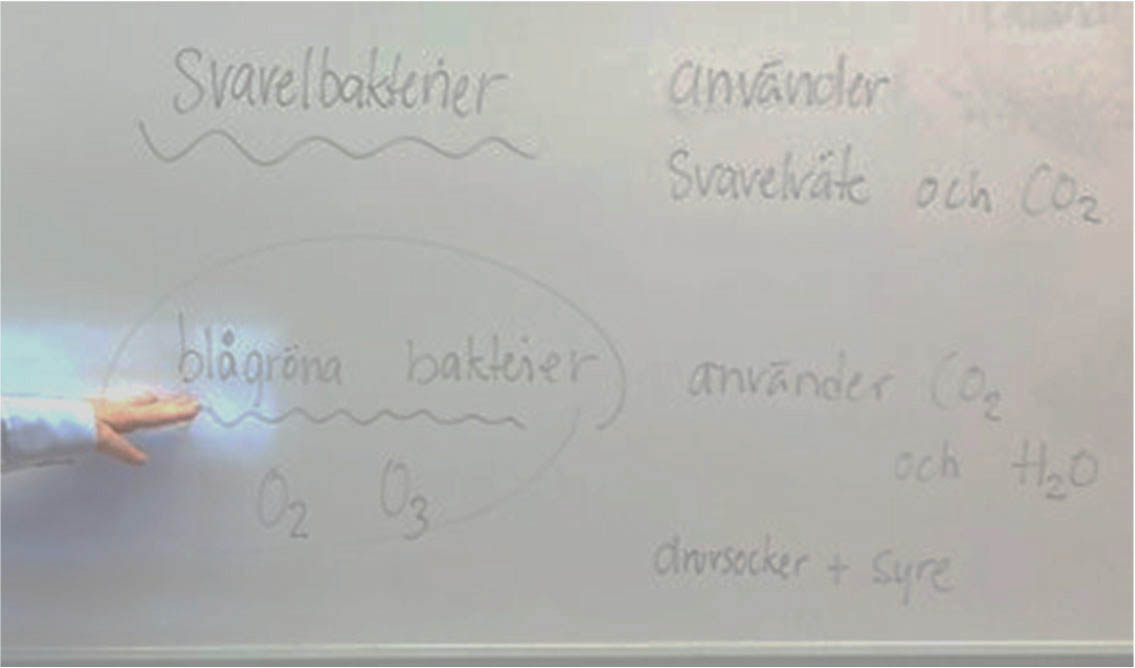
Fig. 1
In biology, the modality bridging is of a different kind, when the teacher uses two different modalities whilst constructing the object of learning in the interaction. The discussion is on bacteria and generations, and the concept of generation is highlighted yet again:
T: For a bacterium I don't know if we are talking about an hour or half an hour or fifteen minutes or something it is really quick quick quick quick quick so in an hour one would have got [refers to bacteria]
S: For them to reproduce?
T: Many generations then yes
S: No, but for them to die or for reproduction or sort of?
T: Yes, although I might be stretching the truth here, but it's about what happens to the new and old bacteria when they divide into new ones. We at least get a new generation quickly; I can answer that. [Points at the board] They succeed in something that has never happened before in history. Why do you think that is?
S: How do they come then?
T: I think it happened about 3–3.5 billion years ago, if this is correct. So, it must have been a bit less than 3 billion years, as this is at the 3-billion-year mark. Take this with a grain of salt all the time. They not only use carbon dioxide [writes equation on the board] but they also use water and they use sunlight. Do you recognise this? What kind of special process is it, [name]?
S: Glucose.
T: Glucose, yes, exactly. They produce glucose and they produce oxygen, and this is crucial. They can produce [continues to write equation on the board] both glucose, but most importantly, this oxygen.
The science teacher uses modality bridging to connect the parts that together build the explanation of evolution, combining deictic gestures such as pointing to representations (text and symbolic chemical language) with the evolving spoken explanation. The teacher does not always make all the connections between parts and whole explicit in the talk, instead, the representation on the board becomes a resource to map the chain of concepts.
The teacher's follow-up moves in Swedish are recurrently in the form of bridging between models, meaning that the teacher provides models for the students, e.g. a student's response to a teacher's question is followed by a new question to help students discover ideas of how to ask questions to identify the narrative's perspective:
S1: The Ballad of a Broken Nose was more in the first person.
T: [Writing on board] So The Ballad was more in the first person?
S1: Yes
T: Yes. That's exactly how it was. How is this written then? [Holding up Fantastic Mr Fox] The Fox? It's not really I-form, is it? You think, who is telling, who is telling, the narrator?
S2: You!
S3: he he
The student introduces the perspective of the storyteller, and the teacher asks the group to identify who the storyteller is in Fantastic Mr Fox by bringing in the question of voice: “who is telling, the narrator”.
Another type of model bridging in Swedish is the when the teacher's follow-up moves scaffold the students in being able to show their thinking, by giving examples. This way, students are provided with a way to ask literary questions that apply to any literary comparison:
S1: He's rich
T: The fox is rich. In what way is the fox rich? How do we know that the fox is rich?
S1: Because it said so.
T: [Writes] Rich, poor.
S2: Fantastic Mr Fox it's kind of more personal descriptions.
T: Excuse me. Yes, that was interesting because I really thought. Because it's also that descriptions of people are different in these two books. In what way would you say, how do they describe the people in The Fox?
S2: That is, they describe how people, how they smell, their personality.
The model bridging by the teacher both provides models for the students on how to ask questions about a text, both literally and between the lines.
By re-analysing classroom communication, we have studied the constructed objects of learning, and the teacher follow-up moves in social studies, science and Swedish. The constructed objects of learning differed between the three classrooms. The results also show that two main types of teacher follow-up moves were used in the situational subject teaching by the teachers in the study, that is re-phrasing what the students say in different ways and bridging between different parts that complement one another to build an explanation of a whole, giving the student opportunities to expand their understanding of the phenomenon. It was observed that during the lesson in ethics, the follow-up moves are characterised by re-phrasing, in the lesson about evolution, they are characterised by bridging and in the lesson comparing narrative texts, both re-phrasing and bridging are used as teacher follow-up moves to the students' comments and questions.
Discussion
Our results show, not surprisingly, that the nature of the explicit learning objects differs when it comes to the three analysed lessons. In the biology lesson, the learning object is a specific concept, generation turnovers, while in the Swedish lesson, it is identifying differences and similarities in ways of writing, and in the ethics lesson, it is expanding moral discourses. The different learning objects, in turn, lead to different types of questions and comments from the students, which affects the nature of the teaching and the classroom discourse as a whole (c.f. Aguiar et al., 2010).
We also identified differences between the three classrooms in relation to the teacher follow-up moves. The follow-up moves arise in the classroom communication between teacher and students when the teacher draws on opportunities to deepen the students' understanding of the subject. To be able to do this, the teacher needs to know when these moments might arise and be prepared but also have enough content knowledge to offer in these situations (Haug, 2014). This means, among other things, that the teacher can make use of the students' comments to teach, for example, concepts that expand the students' frames of reference (Myhill, 2006) and can navigate in relation to the students' understanding of what counts as knowledge and appropriate ways of acquiring knowledge (Lidar et al., 2006).
While the follow-up moves in the ethics lessons were characterised by rephrasing and those in the biology lesson were characterised by bridging, both rephrasing and bridging were used in the Swedish lesson on comparing narrative texts. Regarding this aspect of the subject Swedish, literary interpretation, we see from our analyses that being able to express one's own opinions is not something that is taught explicitly, but instead is something that is encouraged by means of re-phrasing and bridging by the teacher in response to each contribution involving interpretation by students. This is quite likely a choice by the teacher to give all students the opportunity to speak Swedish and to express their interpretations. Their contributions are recognised and valued regardless of their correctness as literary interpretations.
Situational subject teaching implies that a negotiation between teacher and students is going on about what counts as relevant knowledge and how knowledge is acquired (Östman & Wickman, 2014). The comparative findings in this article, even though it is a small study, makes the didactic what question interesting in a new way. Different kinds of learning objects may trigger different kinds of situational subject teaching to a different degree. General forms of praise and confirmation are more frequent when it is not that clear what must be understood, and the process is a goal in itself, i.e. that many voices are heard. When the learning object is more specific and can clearly be described in a correct or in incorrect way, the way of driving the process forward with directed questions and drawing on the whiteboard becomes more central.
In the ethics education example, selective and conceptual re-phrasing are used in order to clarify learning objects that the teacher considers to be important, but the concepts are closer to everyday language in comparison to the biology example, even if the ethics teacher in her re-phrasing can be interpreted as trying to bring in less context-specific concepts (becoming a victim) or skills (being able to compare and judge taking historical conditions into account). Neither of these competencies that the teacher stresses here are explicitly stated in the national curriculum in RE. It is a decision on the teacher's part in the situation to deal with them in this way. The teaching task becomes different when the learning object is distinct, and one that clearly can be described in correct or in non-correct way, than when the learning object is more open.
Which of these tasks that are easier or harder for the teacher to address in the situations that arises is difficult to say. Our comparative findings can be seen as an illustration of the three types of subject didactic knowledge described by Bayrhuber and Frederking (2024). The empirical material is from three classrooms where teachers carry out their teaching, built on the theories from their education and experiences of teaching and their students. Our theorizing of the teaching has resulted in an understanding that certain situations in teaching where teachers and students are in communication about the content of the teaching are unplanned and that how the teacher takes on the students' comments and questions is crucial for what the students have the opportunity to learn. Finally, type three, is here about a comparison between three school subjects and there we see how the what-question affects teachers' follow-up moves.
This study is a first step. Next, the goal for the research group it to work on collected material from one context where the three school subjects are involved, again trying and testing the questions to the data and the process.