
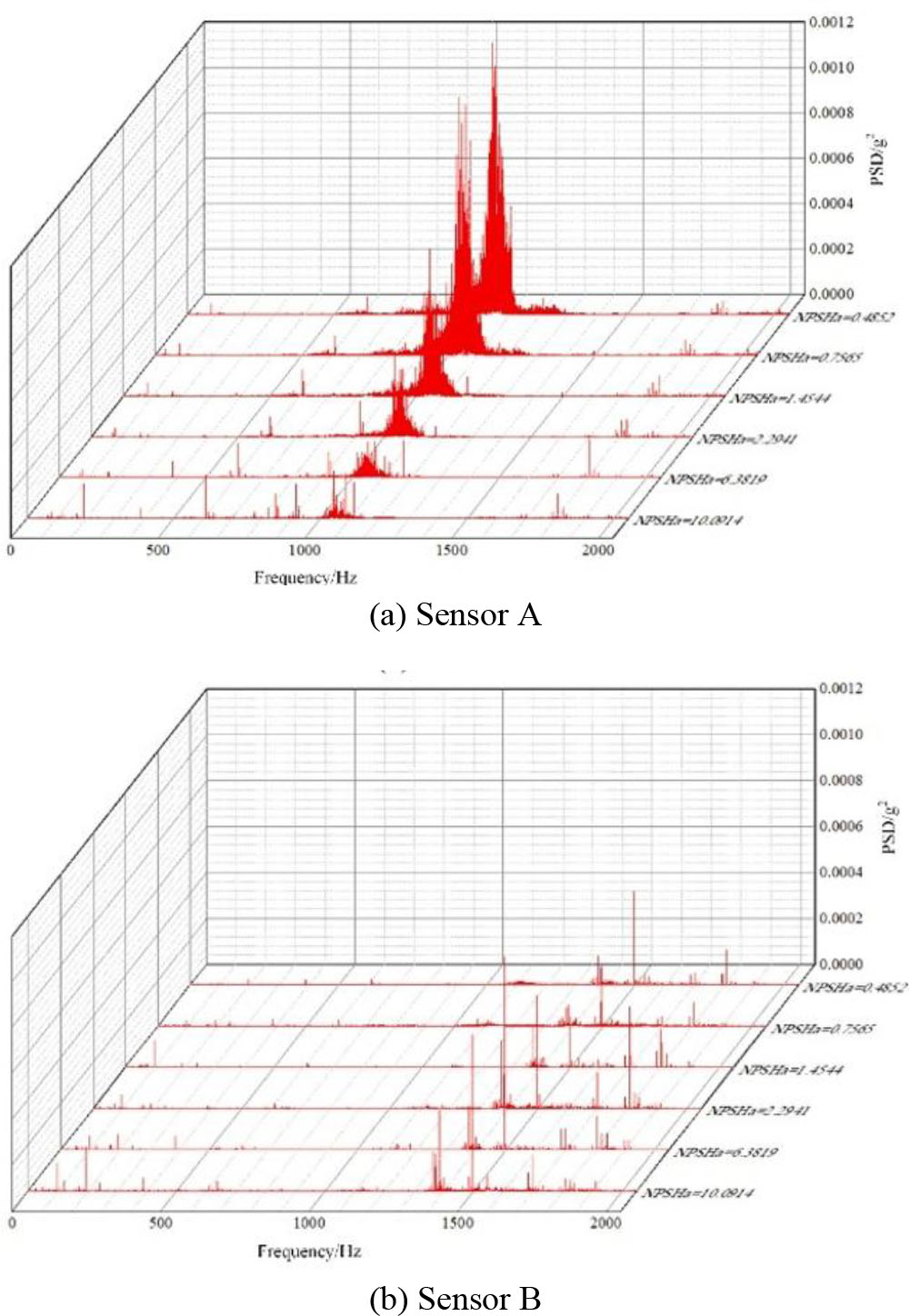
Fig. 1.
Power spectral density (PSD) of vibration signals [11].
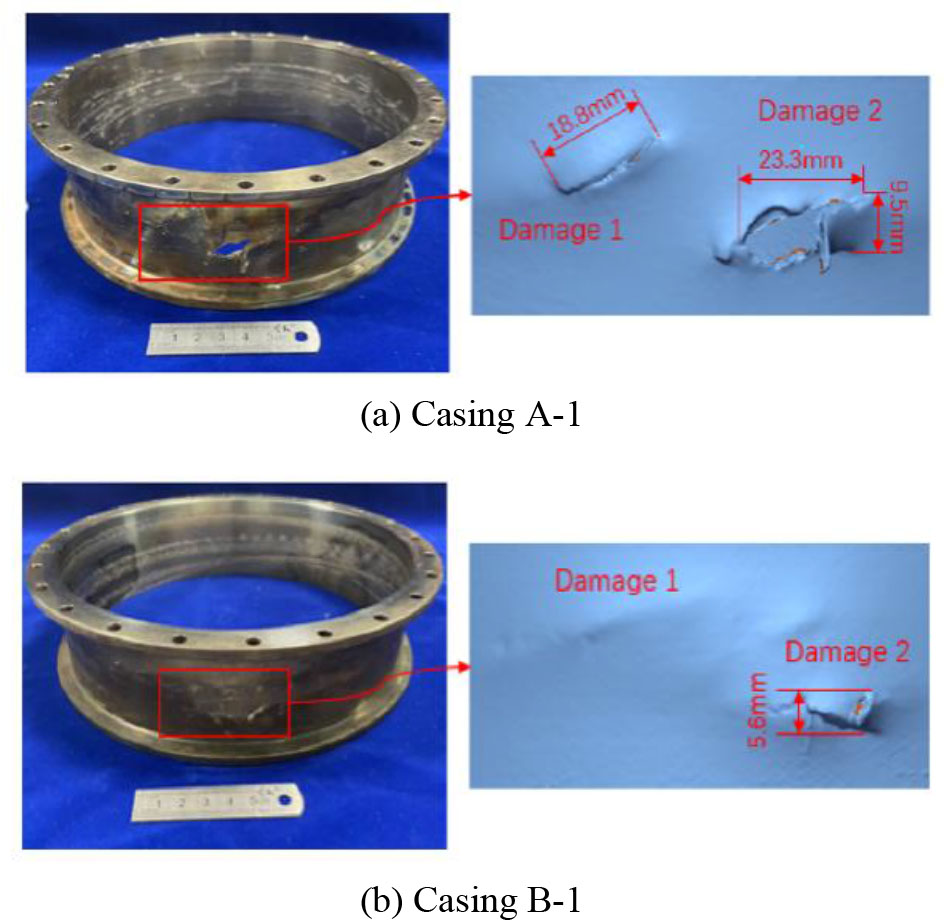
Fig. 2.
Example of damage to the blade containment [15].
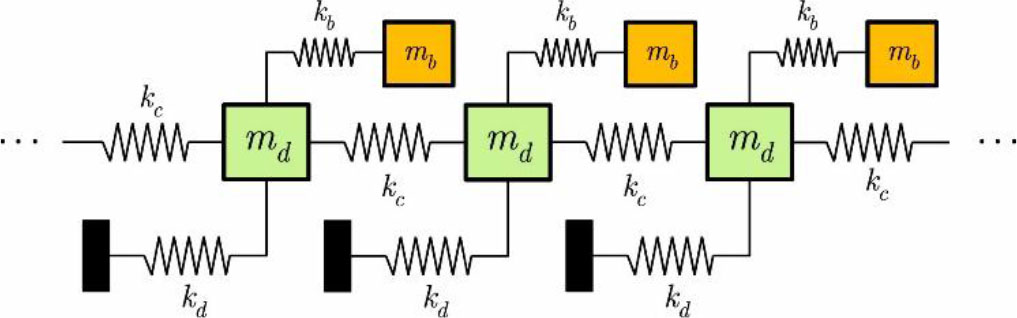
Fig. 3.
Lumped mass model of the bladed disk assembly [18]. kb, kc and kd are the stiffness of the blades, the stiffness of the connections between adjacent sectors, and the stiffness of the disk, respectively. mb and md are the mass of the blade and the disk.
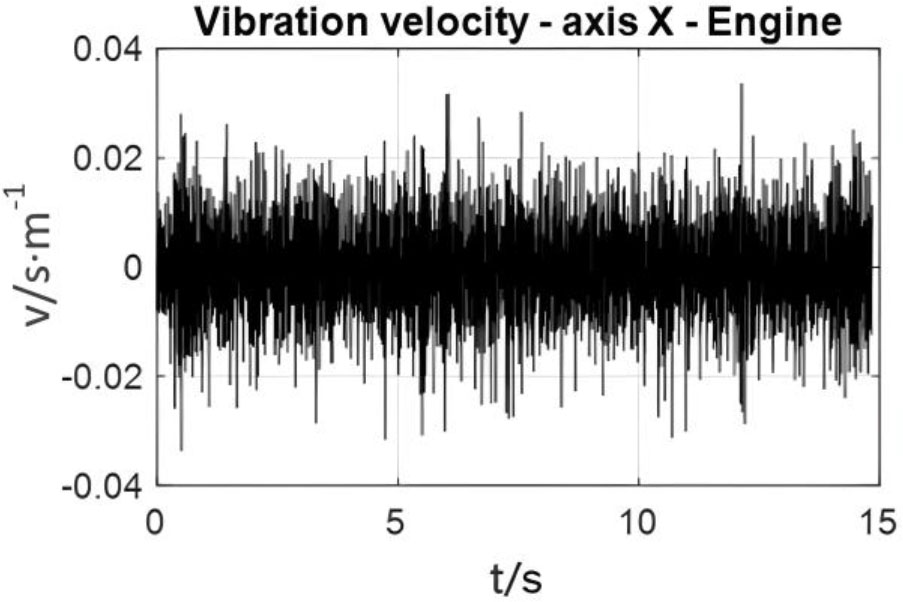
Fig. 4.
The time history of the vibration speed in the X-direction [20].
Table 1.
Summaries of some typical research work on acceleration sensors with detail information.
| Type | Sensitivity | Frequency range | Temperature | Range | Relative error | Nonlinearity | Response time | Refs |
|---|---|---|---|---|---|---|---|---|
| Piezoelectric | 5.9 pC/g | < 350 Hz | 1000 °C | [24] | ||||
| Piezoelectric | 0.001 Hz to 2 GHz | 120 °C | several ns | [25] | ||||
| Piezoelectric | 80 to 130 Hz | 0.041 % | [30] | |||||
| Piezoelectric | 1000 pC/MPa | > 200 kHz | −20–180 °C | < 0.5 % (linear error) | [31] | |||
| Resistance | 10–100 °C | [34] | ||||||
| Resistance | 2.56–5.67/kPa | < 30 ms | [35] | |||||
| Capacitive | 0.24 V/g | 0.29 % | [43] | |||||
| Capacitive | 18 mV/g | 100 g | 3 % | [44] | ||||
| Capacitive | ±160 g | 1 % | [51] | |||||
| Capacitive | ±4 g | 1 % | [49] | |||||
| Capacitive | 0–80 °C | ±10 g for x, y +12/−7.5 g for z | 0.34 %, 0.28 %, 0.41 % | [106] | ||||
| Fiber | 450 pm/g | [56] | ||||||
| Fiber | 19 pm/g | 1 kHz | 0.1–15 g | [64] | ||||
| Fiber | 1296 pm/g | 0 to 25 Hz | 20–115 °C | 0.5 to 5.5 g | 2 % | [66] | ||
| Fiber | 41.2/34.5 pm/g | 20 to 800 Hz | [67] | |||||
| Fiber | 2430 pm/g | 0 to 20 Hz | [107] | |||||
| Fiber | 19 pm/g | 10 to 1000 Hz | [65] |
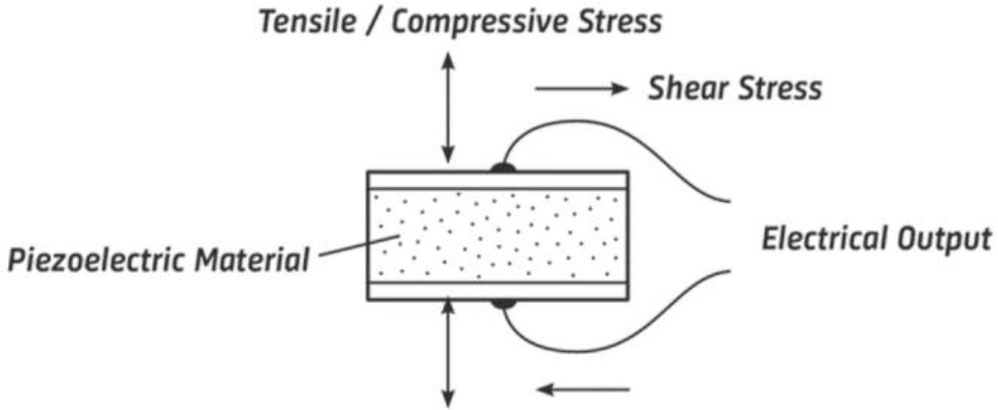
Fig. 5.
Piezoelectric accelerometer schematic [22].
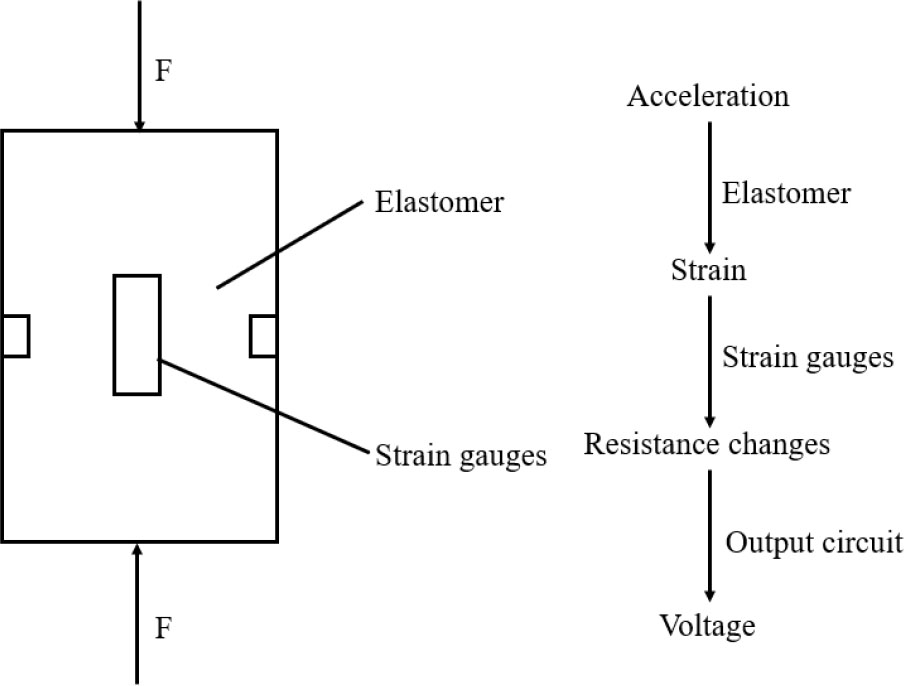
Fig. 6.
Schematic of a resistance accelerometer.
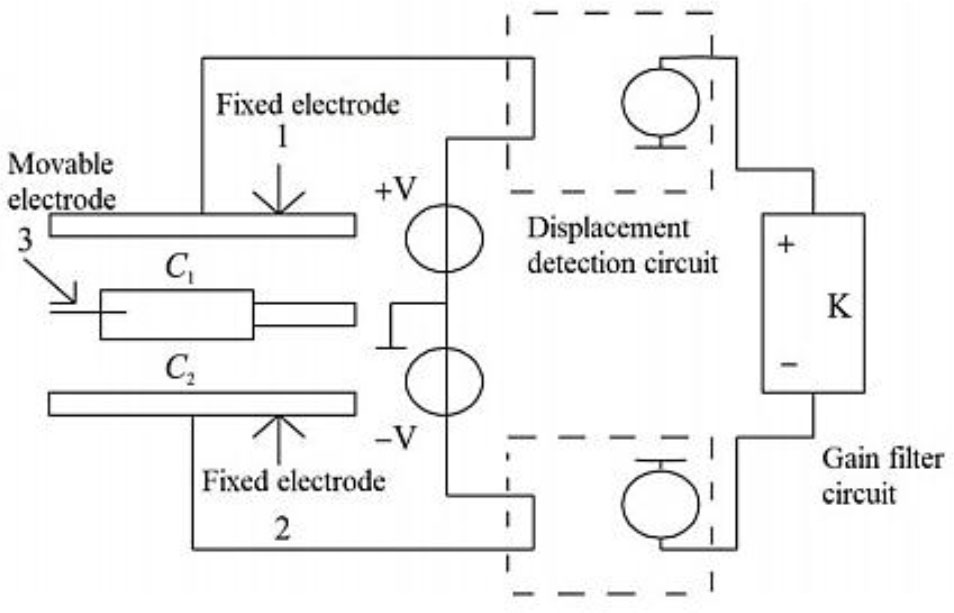
Fig. 7.
Basic structure of a capacitive accelerometer [41].
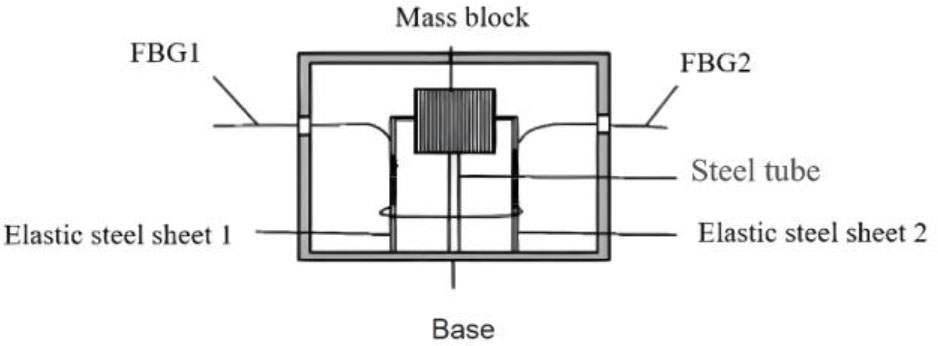
Fig. 8.
Schematic diagram of a fiber Bragg grating vibration sensor [53].
Table 2.
The accuracy of the calibration methods in the previous literature.
| Description | Accuracy | Refs |
|---|---|---|
| 10 % cost of reference (DAQ NI 9775) | Vibration measurement system was working adequately | [76] |
| A closed loop calibration system | U1, U2, and S2 do not need to be measured again; the standard deviation of sensitivity is 0.0003 mV/ms−2 | [77] |
| A phase-locked resonance tracking control method based on the phase resonance principle | Acceleration stability control index of less than 0.5 % and a resonance tracking time of less than 0.1 s | [78] |
| Rapid vibration-level-adjustment for ultralow-frequency vibration exciters | Requires less vibration-level-adjustment time and improves the adjustment efficiency | [80] |
| Improved control of the linear motor | Maintaining amplitude stability over the frequency range from 0.1 to 160 Hz; the standard deviation is less than 0.01 mV/ms−2 | [84] |
| A simple but powerful method is presented | Accurate absolute calibrations with an error of 0.1 % | [88] |
| Introducing the accelerometer nonlinear scale factor | Calibration methods outperform the traditional calibration methods without high-precision orientation control | [94] |
| A low-frequency vibration generator that overcome small acceleration amplitudes and a high level of total harmonic distortion | Relative expanded uncertainty is 2.6 % at a confidence level of 95 % | [85] |