
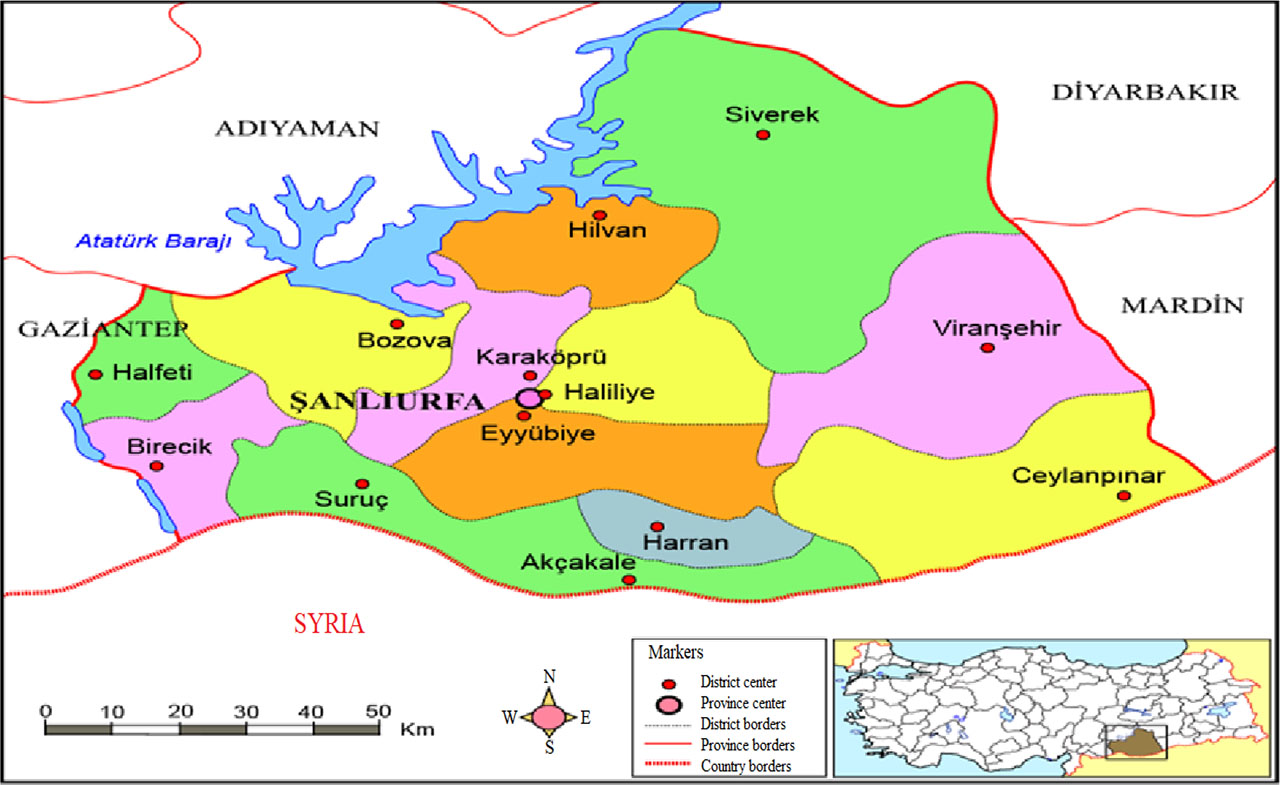
Fig. 1:
The map of Şanlıurfa province illustrates the locations of collection sites. In the bottom right corner, a map of Türkiye shows the location of Şanlıurfa province.
Tab. 1:
Geographic coordinates and altitudes of promising walnut genotypes.
| Genotype No | Coordinate | Altitude |
|---|---|---|
| 8 | 37°20′41″N 38°58′10″E | 631 m |
| 15 | 37°05′05″N 39°02′57″E | 420 m |
| 18 | 37°02′17″N 39°37′17″E | 518 m |
| 26 | 37°02′13″N 39°37′21″E | 526 m |
| 27 | 37°06′05″N 38°48′13″E | 515 m |
| 29 | 37°20′46″N 38°58′16″E | 656 m |
| 30 | 37°17′19″N 39°00′18″E | 584 m |
| 31 | 37°02′17″N 39°37′24″E | 527 m |
| 36 | 37°18′31″N 38°50′09″E | 742 m |
| 45 | 37°08′34″N 38°32′45″E | 796 m |
| 48 | 37°00′15″N 39°00′26″E | 390 m |
| 61 | 37°18′26″N 38°36′03″E | 746 m |
| 73 | 37°18′31″N 38°50′11″E | 741 m |
| 75 | 37°16′20″N 38°41′14″E | 714 m |
| 76 | 37°18′28″N 38°36′01″E | 748 m |
| 89 | 37°18′29″N 38°50′13″E | 738 m |
| 90 | 37°13′44″N 38°42′55″E | 754 m |
| 94 | 36°48′22″N 39°29′00″E | 470 m |
| 103 | 37°02′19″N 39°37′24″E | 511 m |
| 118 | 37°16′24″N 38°41′15″E | 710 m |
Tab. 2:
The information of RAPR, ISSR, and iPBS markers used to evaluate walnut genotypes
| Primer ID | Primer sequences (5′–3′) | Tm | GC (%) | TB | PB | PPB | PIC | RP | |
|---|---|---|---|---|---|---|---|---|---|
| RAPD | OPF10 | GGAAGCTTGG | 36.0 | 60.0 | 10 | 7 | 70.00 | 0.24 | 3.50 |
| OPA18 | AGGTGACCGT | 36.0 | 60.00 | 14 | 10 | 71.43 | 0.30 | 6.70 | |
| OPAZ04 | CCAGCCTCAG | 36.0 | 70.00 | 7 | 6 | 85.71 | 0.40 | 4.60 | |
| Total | 31 | 23 | - | - | - | ||||
| Mean | 10.33 | 7.77 | 75.53 | 0.31 | 4.93 | ||||
| ISSR | HR08 | GAGAGAGAGAGAGAGAYC | 52.0 | 52.8 | 9 | 6 | 66.67 | 0.22 | 3.00 |
| SDo7 (CT)8RG | CTCTCTCTCTCTCTCTRG | 54.0 | 52.8 | 13 | 11 | 84.62 | 0.27 | 4.80 | |
| Total | 22 | 17 | - | - | - | ||||
| Mean | 11.00 | 8.50 | 75.65 | 0.25 | 3.90 | ||||
| iPBS | 2376 | TAGATGGCACCA | 43.1 | 50.0 | 17 | 13 | 76.47 | 0.22 | 5.30 |
| 2238 | ACCTAGCTCATGATGCCA | 55.5 | 50.0 | 18 | 12 | 66.67 | 0.21 | 5.30 | |
| 2394 | GAGCCTAGGCCA | 48.5 | 66.7 | 14 | 10 | 71.43 | 0.21 | 4.00 | |
| 2415 | CATCGTAGGTGGGCGCCA | 62.5 | 66.7 | 16 | 12 | 75.00 | 0.22 | 4.60 | |
| Total | 65 | 47 | - | - | - | ||||
| Mean | 16.25 | 11.75 | 72.39 | 0.22 | 4.80 | ||||
Tab. 3:
Diversity parameters obtained by different molecular markers utilized on walnuts.
| N | Na | Ne | I | He | uHe | ||
|---|---|---|---|---|---|---|---|
| iPBS | Mean | 20.000 | 1.723 | 1.256 | 0.275 | 0.170 | 0.174 |
| Std. Err. | 0.000 | 0.056 | 0.034 | 0.029 | 0.020 | 0.020 | |
| ISSR | Mean | 20.000 | 1.773 | 1.460 | 0.392 | 0.263 | 0.270 |
| Std. Err. | 0.000 | 0.091 | 0.085 | 0.059 | 0.043 | 0.044 | |
| RAPD | Mean | 20.000 | 1.742 | 1.440 | 0.391 | 0.261 | 0.268 |
| Std. Err. | 0.000 | 0.080 | 0.064 | 0.048 | 0.034 | 0.035 | |
| Combined | Mean | 20.000 | 1.737 | 1.342 | 0.327 | 0.211 | 0.217 |
| Std. Err. | 0.000 | 0.041 | 0.031 | 0.023 | 0.017 | 0.017 |
Tab. 4:
Mantel test correlation coefficient between studied molecular markers based on RAPD, ISSR, iPBS, and combined data
| RAPD | ISSR | iPBS | |
|---|---|---|---|
| ISSR | 0.277 | ||
| iPBS | 0.006 | 0.068 | |
| Combined | 0.541 | 0.469 | 0.786 |
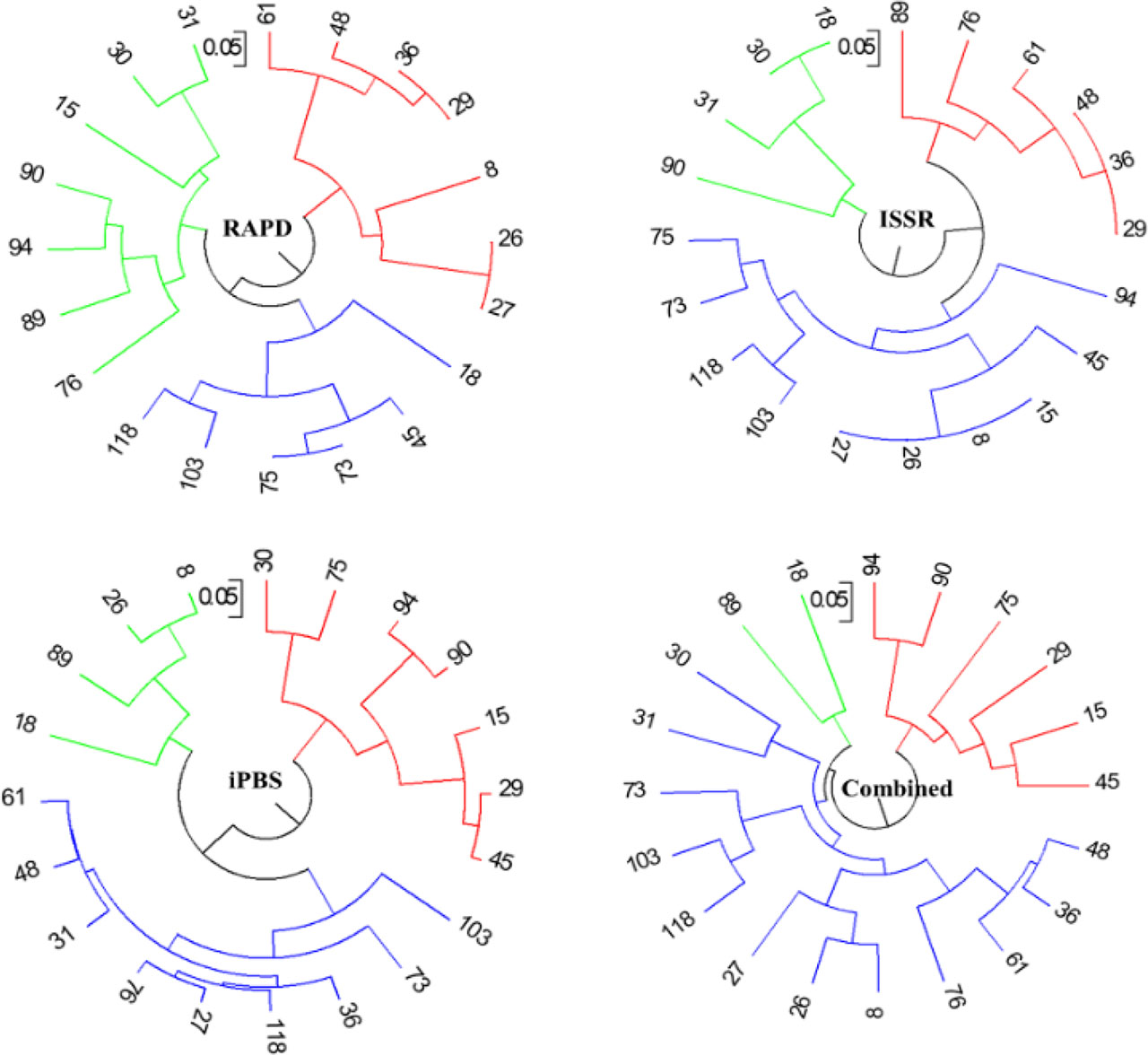
Fig. 2:
Dendrogram of 20 promising walnut genotypes using UPGMA method based on RAPD, ISSR, iPBS, and combined data.
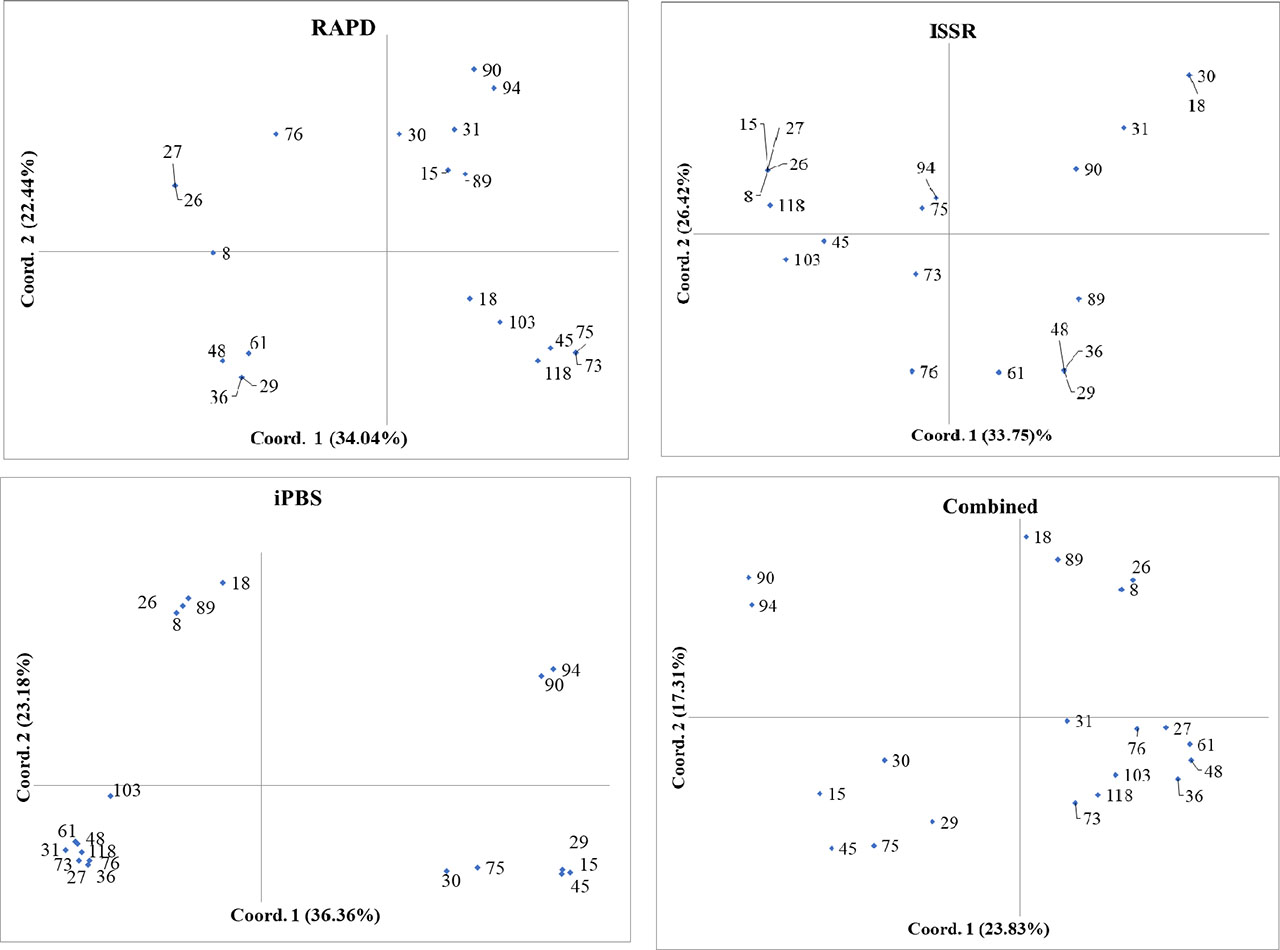
Fig. 3:
The principal coordinates of the analyzed twenty promising walnut genotypes depend on the applied molecular markers. Each point on the graph represents a specific genotype, with the positioning revealing the similarity or divergence among them based on the molecular data applied in the analysis.
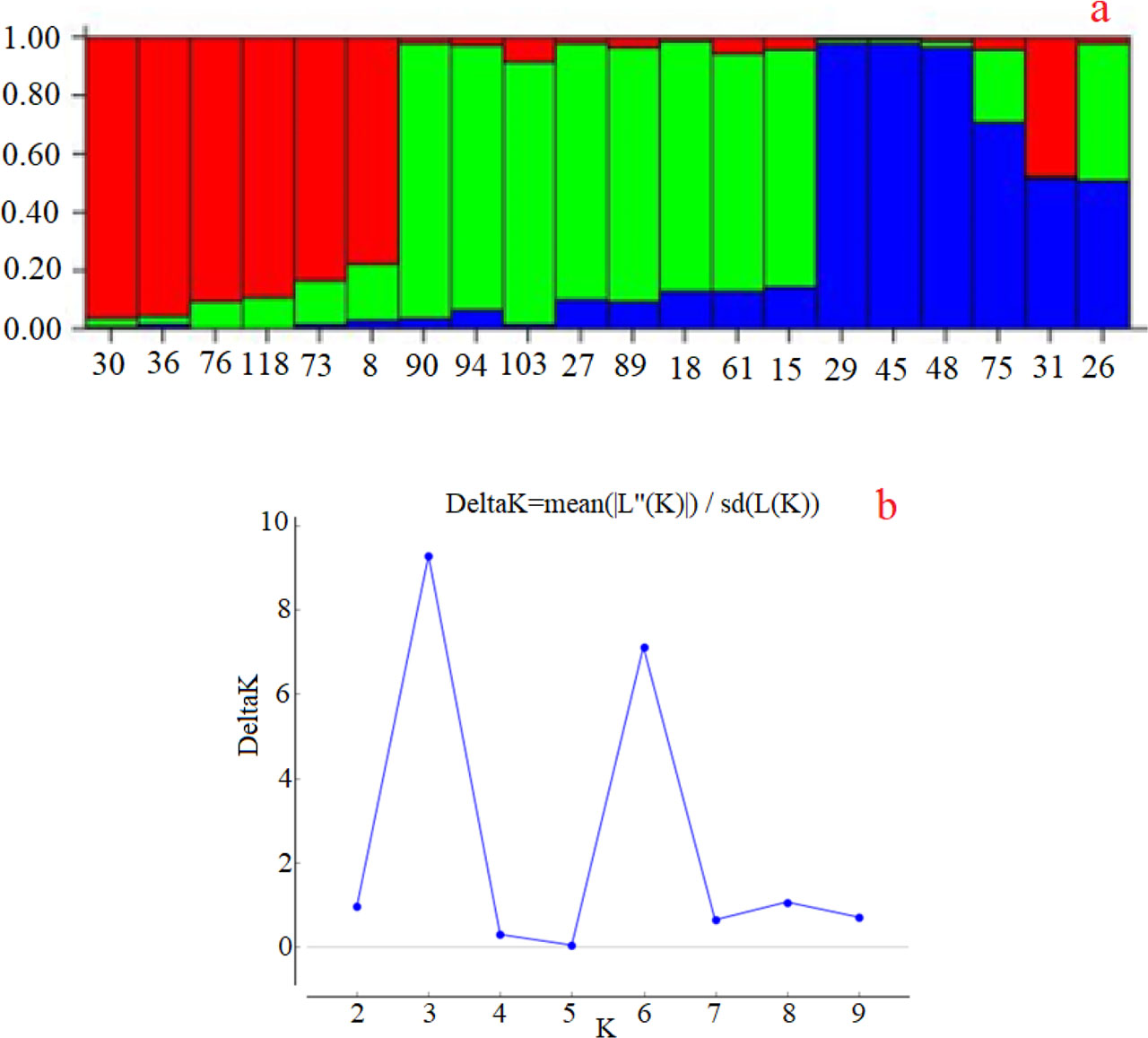
Fig. 4:
The genetic structure of walnut genotype populations carried out using STRUCTURE HARVESTER. The proportions of gene contributions (a) and Delta K values according to the Evanno test (b). Different colors represent the genetic participation ratio for each relevant group.