
Introduction
Arabis mosaic virus (ArMV) is a member of the Secoviridae family (genus: Nepovirus), and infects a wide range of plant species, for example cherry, grapevine, lily, narcissus, strawberry, and rhubarb (Gao et al., 2016; Komorowska et al., 2021). In the case of grapevine, ArMV is one of the viral agents causing infectious degeneration, and is mainly transmitted by nematodes and grafting (Digiaro et al., 2017).
Chemotherapy is a widely used virus elimination technique (Chauhan et al., 2019), and ribavirin (RBV), despite of its phytotoxicity, is one of the most effectively used antiviral drugs in case of plants (Panattoni et al., 2013; Magyar-Tábori et al., 2021). RBV was successfully applied earlier for ArMV eradication on rose (Modarresi et al., 2016), against e.g. grapevine fleck virus (GFKV), grapevine leafroll-associated virus-1 (GLRaV-1), grapevine rupestris stem pitting-associated virus (GRSPaV) on grapevine (Eichmeier et al. 2019, Hu et al., 2018), or apple scar skin viroid in apple (Hu et al., 2022). In addition, its use in combination with thermotherapy has proven to be effective in many cases (Wang et al., 2018).
‘Csókaszőlő’ is a traditional and lately rediscovered Hungarian grapevine cultivar (Galbacs et al., 2009), from which a mother plant was selected and tested by RT-PCR for different viruses; such as ArMV, grapevine fanleaf virus, grapevine leafroll-associated virus-1-3, grapevine rupestris stem pitting-associated virus, and grapevine virus A and B. The selected mother plant proved to be free of most tested viruses (data not shown) except for ArMV. For the sanitation, in-vitro shoot cultures were established and maintained on media free of plant growth regulators (PGRs), but the rooting of the excised shoot-segments was very slow and weak on RBV containing medium limiting the shoot development and the effectivity of the sanitation. Therefore, pre-rooted shoot segments were used on RBV media, and the effectiveness of this method on ArMV eradication was analysed.
Materials and Methods
Production of in-vitro shoot cultures and rooting experiments
An ArMV infected Vitis vinifera ‘Csókaszőlő’ mother plant was used, in which ArMV was detected with RT-PCR. Ca. 1 cm long shoot tips were prepared from the mother plant and following surface sterilization (70% ethanol 30 s, ca. 0.6% NaOCl 10 min, steril water 3x rinsing), the explants were placed on plant growth regulator (PGR)-free Murashige and Skoog (MS) based medium which contained MS macroelements in half, MS microelements and vitamins in full concentration supplemented with 10 g/l sucrose and 3 g/l gelrite (pH 5.8) (½ MS). The rooted shoots were tested with RT-PCR and one selected ArMV positive in-vitro mother plant was propagated on the same medium. ArMV infection of the micropropagated mother plants used for rooting experiments and RBV treatment was regularly checked by RT-PCR (10 in-vitro plants/month). The 1 cm long shoot tips of these in-vitro mother plants were either used directly for RBV experiments as a control, or these shoot tips were rooted prior to RBV treatments (Fig. 1). To obtain rooted shootsegments for the RBV treatments we tested the effectivity of indole-3-acetic acid (IAA); indole-3-butyric acid (IBA) and 1-naphthaleneacetic acid (NAA) in different concentrations (Tab. 1). The ½MS culture medium described above supplemented with 0.5, 0.8 and 1 mg/l IAA, or 0.5 mg/l IBA, or 0.5 mg/l NAA was compared to the same PGR-free medium containing 10 or 20 g/l sucrose. For the evaluation, the number of appearing 1 mm long roots and rooting time (days) were measured. Shoots were growing between 1 and 2 cm on the media with different PGR supplementation, but these data were not evaluated in this experiment. The best PGR combination for rooting was used to produce pre-rooted shoots for RBV treatments.
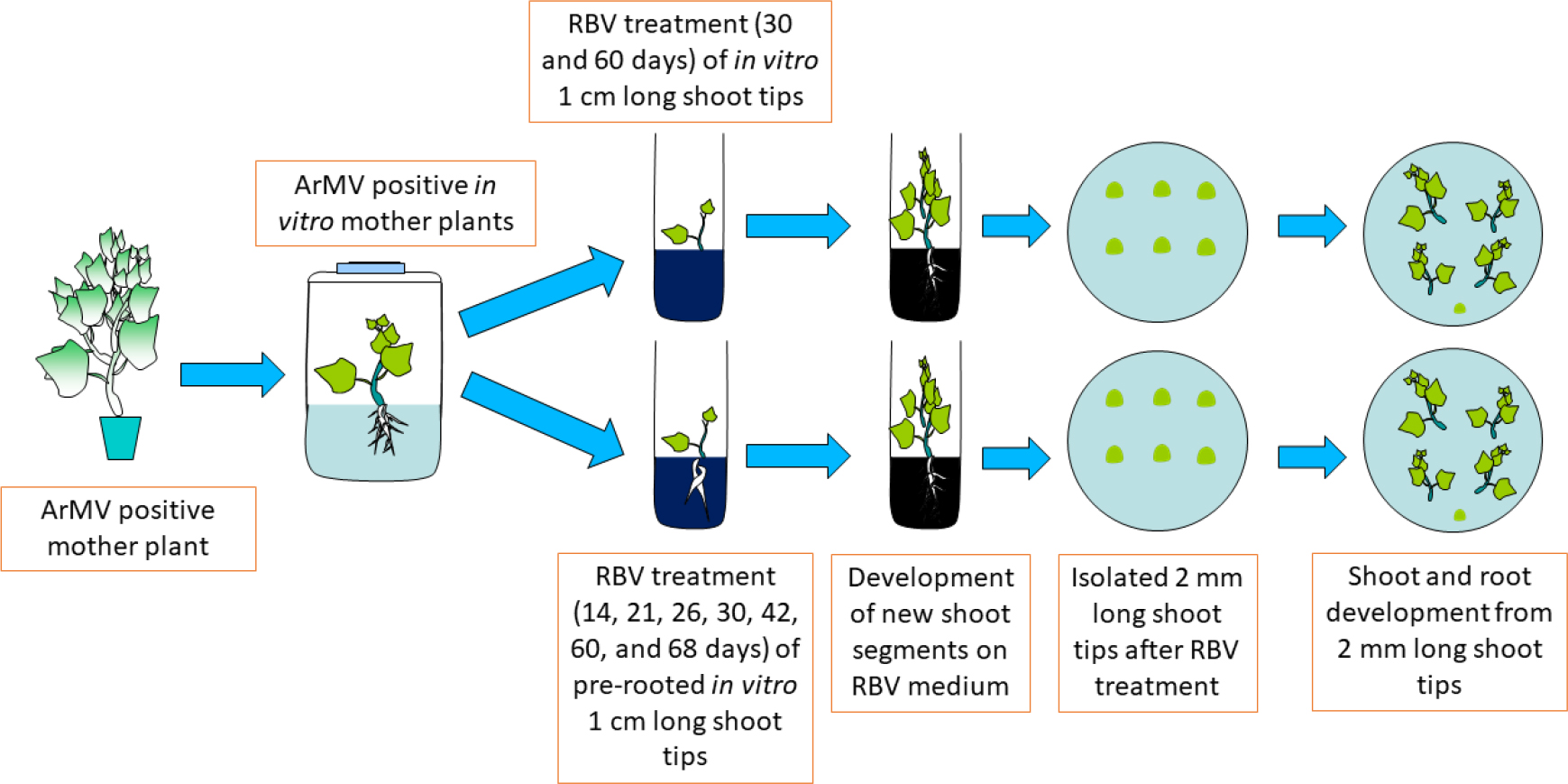
Fig. 1:
Main steps of RBV treatment on ‘normal’ and pre-rooted 1 cm long shoot tips
Tab. 1:
The effect of the applied PGRs and sucrose concentration on rooting of the 1 cm long ‘Csókaszőlő’ shoot segments. Number of samples: IAA (0.5 mg/l)=28, IAA (0.8 mg/l)=62, IAA (1 mg/l)=15, IBA (0.5 mg/l)=30, IBA (0.8 mg/l)=33, NAA (0.5 mg/l)=5, NULL=30
| PGR | PGR concentration mg/l | Sucrose g/l | Number of shoots on the rooting medium | Average number of days until the appearance of 1 mm long roots | Ratio of rooted shoots % (rooted shoots/all shoots) | Average number of roots/shoot |
|---|---|---|---|---|---|---|
| - | - | 20 | 15 | 34.66 | 78,9 (19/15) | 1.7 |
| - | - | 10 | 15 | 33.73 | 83,3 (15/18) | 1.9 |
| IAA | 0,5 | 20 | 4 | 20 | 100 (4/4) | 2.5 |
| IAA | 0,5 | 10 | 24 | 18 | 100 (24/24) | 2.8 |
| IAA | 0,8 | 10 | 62 | 14.63 | 100 (62/62) | 2.98 |
| IAA | 1 | 20 | 6 | 21.5 | 100 (6/6) | 2 |
| IAA | 1 | 10 | 9 | 13.66 | 100 (9/9) | 3.44 |
| IBA | 0,5 | 20 | 7 | 26.57 | 100 (7/7) | 7.1 |
| IBA | 0,5 | 10 | 23 | 25 | 95,8 (24/23) | 5.1 |
| IBA | 0,8 | 10 | 33 | 22.8 | 91,6 (36/33) | 6.6 |
| NAA | 0,5 | 20 | 5 | 25 | 100 (5/5) | 3.6 |
Ribavirin treatment of pre-rooted shoots
1 cm long shoot tips with roots were placed on PGR-free solid ½MS medium containing 25 mg/l RBV (10 g/l sucrose). At 7 different points in time (between 14-68 days after treatment initiation; Tab. 2) 2 mm long shoot tips were excised from the shoots and cultivated on solid ½MS medium supplemented with 0.02 mg/l BA, 0.01 mg/l NAA and 30 g/l sucrose for a month. After one month micro shoots were placed on PGR-free ½MS medium (10 g/l sucrose) for two weeks, followed by 0.01 mg/l IAA and 1 mg/l kinetin containing MS medium (10 g/l sucrose) for a month. Developed shoots were rooted in the same way as the shoot segments prior to RBV treatment.
Tab. 2:
RT-PCR test results of regenerated plants from 2 mm long shoot tips of pre-rooted and RBV-treated shoots.
| Length of RBV treatment (day) | Number of isolated 2 mm long shoot tips from the RBV-treated shoots | Number of PCR-tested plants | Ratio of ArMV negative plants (%) |
|---|---|---|---|
| 14 | 14 | 8 | 12.5 |
| 21 | 11 | 5 | 40 |
| 26 | 25 | 10 | 30 |
| 30 | 32 | 13 | 61.5 |
| 42 | 24 | 18 | 55 |
| 60 | 35 | 26 | 54 |
| 68 | 31 | 22 | 82 |
As control, 1 cm long unrooted shoot tips were treated in the same way, but 2 mm long shoot tips were excised only at two points in time: 30 and 60 days after treatment initiation (17 and 33 shoot tips, respectively).
Virus detection using RT-PCR
For isolation of total nucleic acid, a modified CTAB method was used (Xu et al., 2004). Briefly: ca. 50 mg plant material from in-vitro leaves was lysed in 1 ml extraction buffer (the washing step of the original protocol was omitted). Chloroform:isoamyl alcohol extraction was applied two times, and 0.8 volumes of isopropanol was used for nucleic acid precipitation (30 min at room temperature). The pellet was finally dissolved in 30 μl sterile water. After isolation, nucleic acid concentration was measured by NanoPhotomter®N60 (Implen GmbH, Germany). For cDNA synthesis Revert Aid First Strand cDNA kit was used (Thermo Scientific, #K1622) with random hexamer primers, according to the protocol provided by the manufacturer. For reverse transcription 0.2-0.4 μg template was applied in a final reaction volume of 10 μl. For PCR reactions 1 μl 2-fold diluted cDNA was added to 9 μl reaction mix. Success of DNA synthesis was confirmed with tub-fw2/tub-rev2 primers (Szegedi et al., 2018). ArMV specific PCR amplification applying ArFw and ArRev primers (Gambino and Gribaudo, 2006) and DreamTaq™ (Thermo Scentific, #EP0701) polymerase enzyme was carried out according to the protocol provided by the manufacturer with the following parameters: 94 °C 30 s denaturation, 58 °C 30 s primer annealing, 72 °C 60 s elongation). PCR products were separated in 1,5 (w/v) % agarose gel, and stained with ethidium bromide. The number of samples is shown in Tab. 2.
Statistical analysis
For the evaluation of the obtained data of in-vitro shoot cultures we used ART ANOVA (Wobbrock et al., 2011; Elkin et al., 2021). For the estimation of the correlation between the length of ribavirin treatment and the ratio of ArMV-free plants Pearson’s product-moment correlation was used in R (R Core Team R; Data Visualization with R and Ggplot2).
Results
Rooted in-vitro plants obtained from the shoot tips of the ArMV positive mother plant were tested with RT-PCR using ArMV specific primers (Fig. 2), and PCR amplification using ArMV specific primers was successful in the case of 9 in-vitro plants (9/10). A single ArMV positive in-vitro mother plant was selected for further micropropagation.
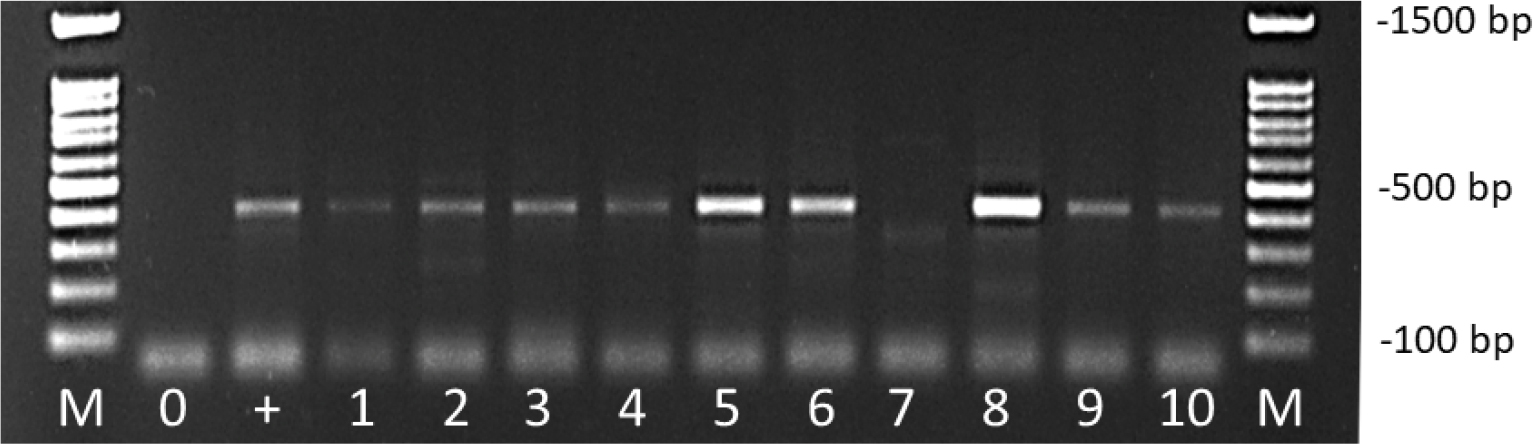
Fig. 2:
Amplification of the 402 bp long fragments of the ArMV genome with PCR test from the first obtained in-vitro plants. One in-vitro plant (line 8) was selected for further experiments. M: H3 RTU DNA ladder (NIPPON Genetics Europe GmbH, Cat. no.: MWD 100). 0: Nucleic acid-free control. +: Positive control. Lanes 1 to 10 are PCR products from cDNAs of Vitis vinifera ‘Csókaszőlő’
All of the tested PGRs were appropriate for the rooting of the isolated shoot tips based on the number of roots and rooting time (Tab. 1.), however, the application of NAA caused callus formation in addition to rooting, roots induced by IBA were abnormally thick, while in case of IAA new roots showed normal development. Based on the effects on root development, 0.8 mg/l IAA with 10 g/l sucrose was chosen for the propagation of in-vitro plantlets. The variance analysis shows a significant difference (p < 0.001) for all PGR treatments regarding the number of rooting days except between NAA and IBA (Tab. 1). The effect of applied PGRs on root number per shoots was significant (p < 0.001) for all PGR relative to the null control, and the difference between IAA and IBA was significant as well (Fig. 3). Our results match the rooting results of Shatnawi and coworkers (Shatnawi et al., 2011) with the same PGRs on ‘Salty Kodary’ cultivar. 2 mm long shoot tips were isolated at different time points from the pre-rooted and RBV-treated shoots. After regeneration, the presence of ArMV content in the in-vitro plants was tested by RT-PCR (Fig. 4, Tab. 2). After 30 days of treatment over 50% of the plants were free from ArMV. The ratio of ArMV-free plants and the length of RBV treatment shows strong linear correlation based on Pearson’s product-moment correlation method (95 percent confidence interval, cor = 0.8261759).
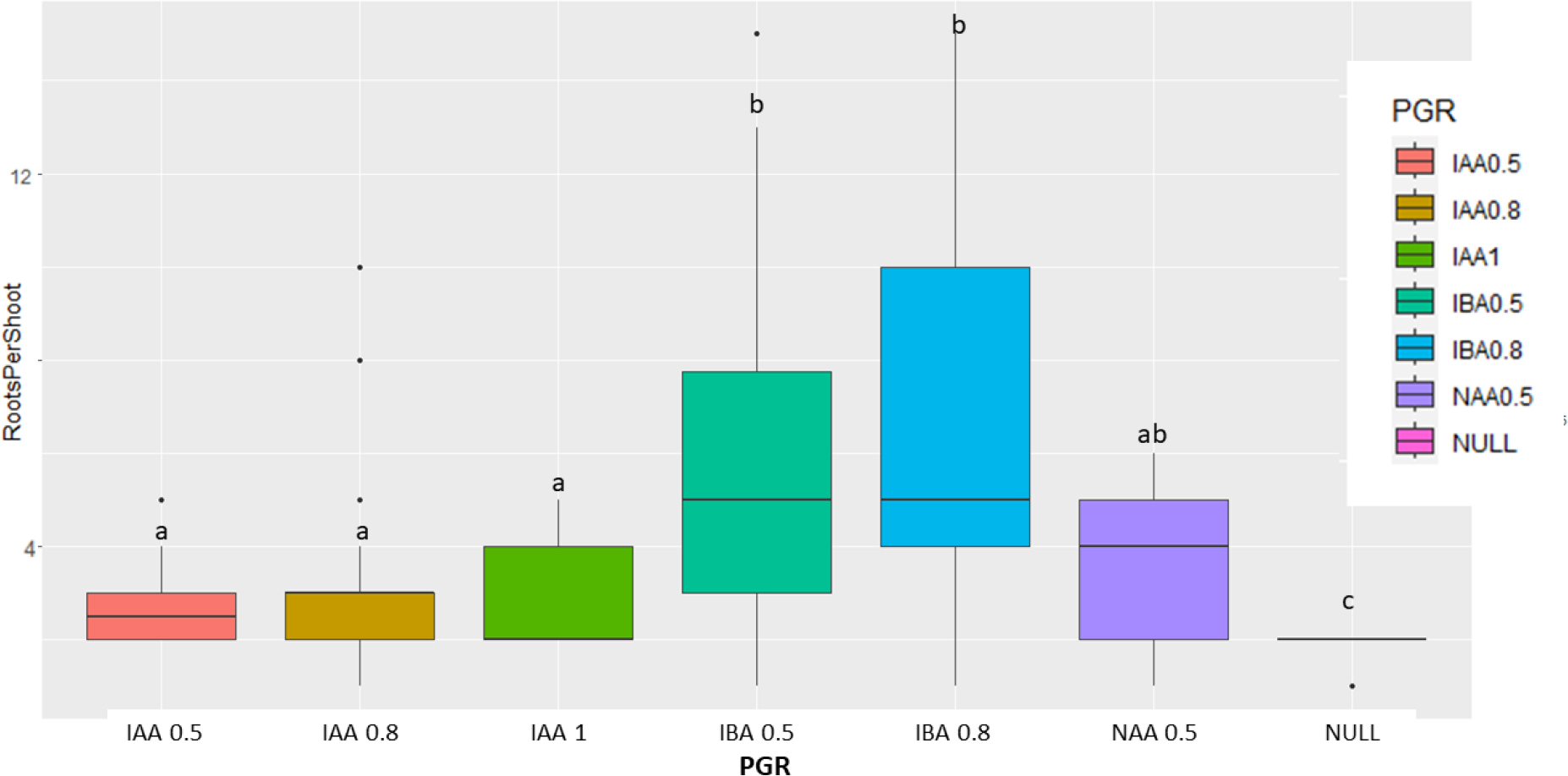
Fig. 3:
The effect of PGRs on root number per shoots. Letters (a-c) show the groups of the post-hoc test

Fig. 4:
Amplification of the 402 bp long fragments of ArMV with RT-PCR test from in-vitro plants regenerated from the 2 mm long shoot tips of RBV-treated plants. M: H3 RTU DNA ladder (NIPPON Genetics Europe GmbH, Cat. no.: MWD 100). 0: Nucleic acid-free control. +: Positive control. Lanes 1 to 9 are PCR products from cDNAs of Vitis vinifera ‘Csókaszőlő’.
If 1 cm long non-rooted shoot tips were treated for 30 or 60 days (Fig. 1) on the same RBV containing medium, then 50% or 69% of the regenerated plants were ArMV-free respectively. Our results show that RBV treatment of pre-rooted shoots proved to be successful in ArMV elimination, and pre-rooting of the shoots did not change substantially the effectiveness of sanitation in case of ‘Csókaszőlő’ cultivar.
Conclusions
Pre-rooting of in-vitro shoot segments for RBV treatment is a possible solution to limit the adverse effects of chemotherapy. Using of 0.8 mg/l IAA reduced the rooting time of the shoot segments and increased the average number of roots. At the same time the application of pre-rooted shoot segments did not reduce the efficiency of RBV treatment, but this method decreased the ratio of dead or non-developing shoots from 73% to 14% (after 30 days of RBV treatment). This method could help in the development of the different chemotherapy treatments by increasing chance of survival of treated shoot segments. ArMV elimination effectiveness with pre-rooted shoot segments in our experiments is comparable to the results obtained on rose in-vitro shoot segments (Modarresi et al. 2016). In the case of grapevine, somatic embryogenesis proved to be 100% successful for ArMV removal (Olah et al., 2022), but to the best of our knowledge this is the first report about ArMV elimination with chemotherapy in grapevine. On the other hand, RBV was effective against some grapevine viruses, such as GFKV, grapevine fanleaf virus (GFLV), and grapevine Pinot gris virus (GPGV) (Komínek et al., 2016; Weiland et al., 2004), but lower efficiency was experienced in the case of GLRaV-1, GRSPaV, and grapevine virus A (GVA) (Gutá and Buciumeanu, 2011; Hu et al., 2018; Komínek et al., 2016; Skiada et al., 2013). The efficiency of RBV treatment depends on the virus, on the cultivar and on experimental setting (Komínek et al., 2016), and our method (pre-rooting, 25 mg/l RBV, min. 30 day) proved to be reliable and effective for ArMV elimination in ‘Csókaszőlő’.
Acknowledgments
M.T. is PhD student at Hungarian University of Agriculture and Life Sciences at the Doctoral School of Horticultural Sciences. This research was funded by National Research, Development and Innovation Office (NKFIH) grant number: K131679.