
Table 1.
Scholarly definitions and treatments (canon and evolution).
| Source | Short wording | Key concept | Operational consequence |
|---|---|---|---|
| Shane (2004) | Spin-off as a new firm created to exploit IP developed within a university; formal license/assignment assumed | IP-centric definition; formal transfer of rights | Narrows samples to ventures with licensable/assigned university IP; excludes tacit/know-how-only cases; high comparability with AUTM-style reporting |
| Pirnay et al. (2003) | University spin-offs as new firms commercializing knowledge/technology or research results developed at the university | Inclusion of tacit knowledge; emphasis on knowledge origin and founder status | Broadens the population; requires additional selection criteria to manage heterogeneity and ensure comparability |
| Nicolaou & Birley (2003) | Classification of university spin-outs by founder roles and ties to the university (e.g., orthodox, hybrid, technology) | Founder configuration and coupling mechanisms with the HEI | Enables operationalization via founder affiliation/equity/governance “flags”; supports sampling by relational form |
| Clarysse & Moray (2004) | Process view of entrepreneurial team formation and varying autonomy vs. university support | Institutional relationship and team dynamics | Suggests measuring intensity of HEI support and degree of coupling; cautions against pooling cases with different autonomy levels |
| Heirman & Clarysse (2004) | Taxonomy by technology/product maturity at founding | Initial resource bundle and readiness (deep-tech vs. service/software) | Segments capital needs and risk; warns against performance comparisons across maturity classes without controls |
| Perkmann et al. (2013; 2021) | Separation of & #x201C;academic engagement” from commercialization (licensing, spin-offs) | Definitional filter distinguishing collaboration from commercialization | Improves sample boundary clarity by excluding engagement-only cases; increases cross-study comparability |
| Dabić et al. (2022) | Synthesis of university spinoffs with explicit inclusion of software/data and hybrid pathways | “Intellectual assets” beyond formal IP; IP-light trajectories | Encourages inclusion of software/data-driven cases; implies need for new metrics and institutional tracking beyond patent/license proxies |
Table 2.
Institutional (operational) definitions.
| Source | Short wording | Key concept | Operational consequence |
|---|---|---|---|
| Council of the European Union, Council Recommendation on the guiding principles for knowledge valorization (2022) | Spin-off/spin-out recognized as one route of “knowledge valorization”; emphasis on a broad spectrum of intellectual assets and transfer channels | Shift from “IP” to “intellectual assets” (including software and data) | Opens the way to include software-/data-driven ventures in universities’ operational definitions and public policy metrics |
| European Commission, Code of Practice on the management of intellectual assets for knowledge valorization (2023) | Guidance for intellectual-asset management strategies in research organizations (decision rights, value sharing, tools) | “Intellectual assets” > formal IP; emphasis on institutional practices | Encourages diversification of commercialization models beyond patent-license pathways |
| AUTM, definitions used in annual Licensing Survey (2021–2024) | “Startup company”: firm formed specifically to develop technology licensed from the university | University license as an inclusion requirement | High data comparability; low inclusiveness for know-how/software cases without a formal license |
Table 3.
Translation in three lenses: from definitions to data windows.
| Theoretical anchors | Minimum inclusion rule | Typical “blind spot” | Minimum descriptors to record | Best suited for… |
|---|---|---|---|---|
| IP-centric, license-based (Shane, 2004; AUTM, 2021–2024) | Formal transfer or license of university IP to the venture | Software/data and tacit know-how without a formal license; founder-led firms with weak legal ties | Asset type (patent/prototype/software/data); license yes/no and date; HEI equity stake | TTO dashboards; inter-institutional benchmarking where legal clarity is paramount |
| Knowledge-/founder-linked (Pirnay et al., 2003; Nicolaou & Birley, 2003; Clarysse & Moray, 2004) | Academic provenance of knowledge and identifiable founder affiliation/relational coupling to the HEI, regardless of formal IP | Alumni entrepreneurship unrelated to research; corporate spin-offs without academic roots | Founder roles/affiliation; linkage form (equity/access to resources); use of HEI infrastructure | Mechanism-focused studies (teams, coupling, support); founder-friendly policy design |
| Maturity / resource-based (Heirman & Clarysse, 2004; Mustar et al., 2006) | HEI-origin ventures stratified by technology/product maturity at founding | Cross-class comparisons without controls; strength of HEI-venture governance link | Technology readiness, product stage, capital intensity | Stage-conditioned performance and financing analyses; deep-tech vs software policy tools |
1 Note: The EU’s knowledge-valorization guidance (2022-2023) broadens the IP-centric lens to “intellectual assets,” explicitly legitimizing software/data and thus reducing the main blind spot of the first row; the UK spin-out review (Tracey & Williamson, 2023) primarily sharpens equity and coupling practices within the second lens.
1 Source: Pirnay et al. (2003); Nicolaou & Birley (2003); Shane (2004); Clarysse & Moray (2004); Heirman & Clarysse (2004); Mustar et al. (2006); Ulrichsen et al. (2022); Tracey & Williamson (2023); Council of the European Union (2022); AUTM Licensing Survey definitions/instructions (2021-2024); European Commission (2023).
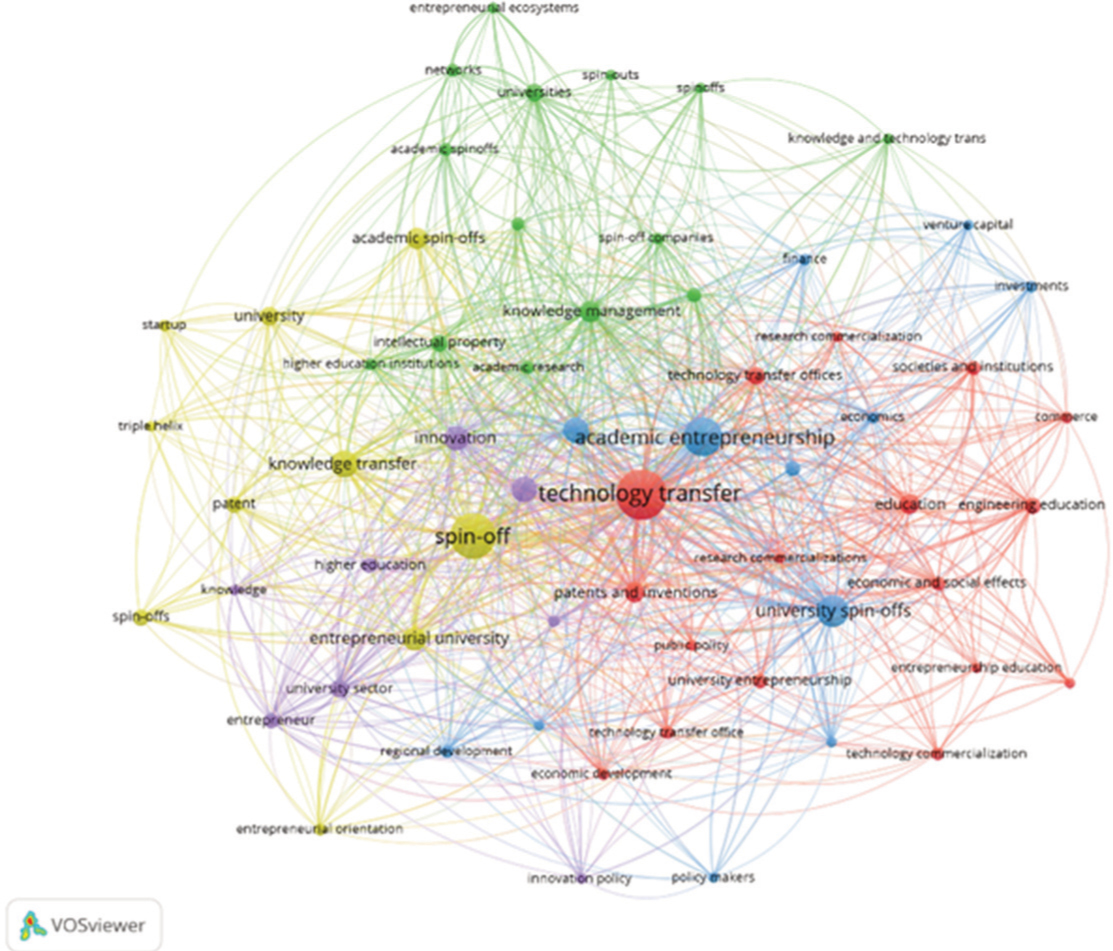
Figure 1a.
Co-occurrence network of keywords in recent scholarship on university spin-offs/spin-outs (2015–2025).
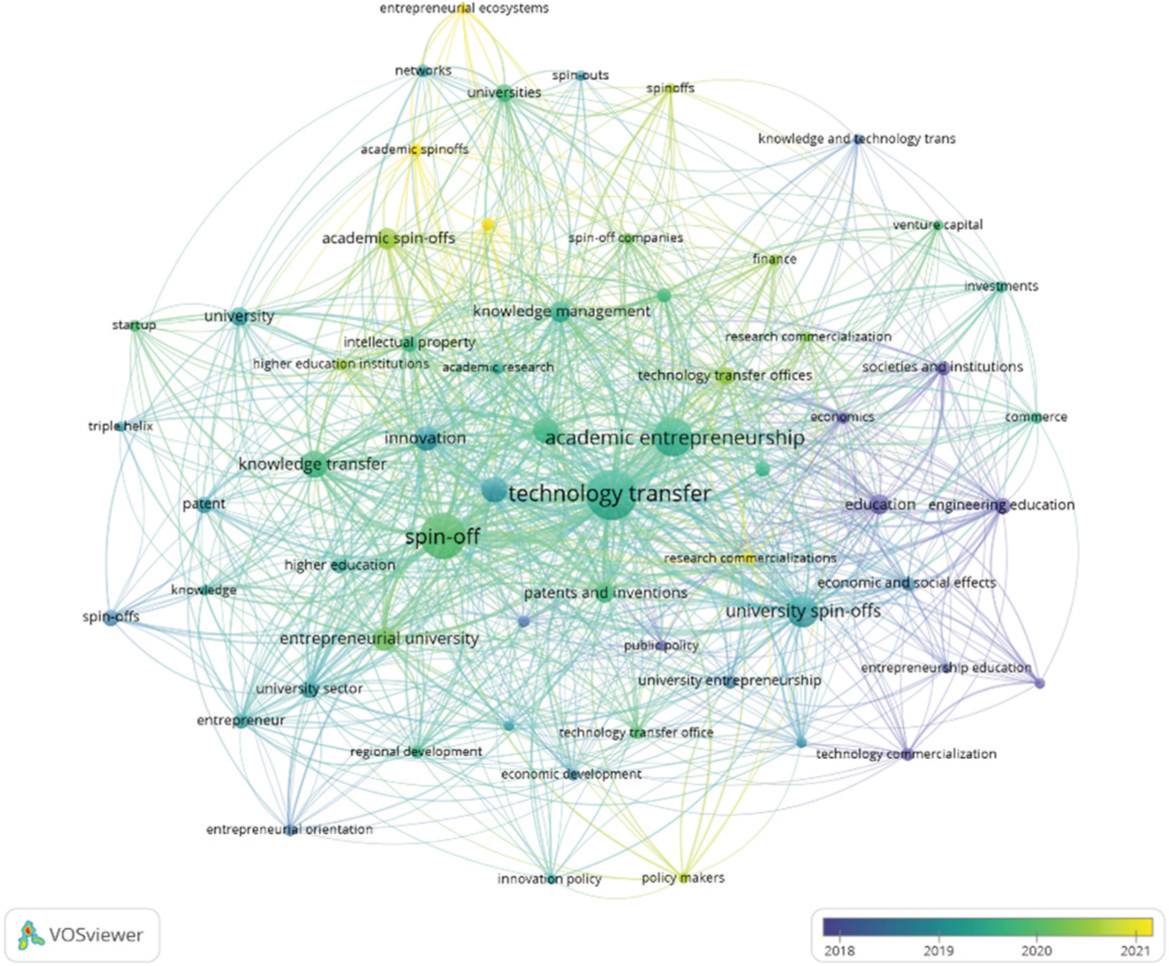
Figure 1b.
Overlay visualization (average publication year) of the co-occurrence network in Figure 1a.
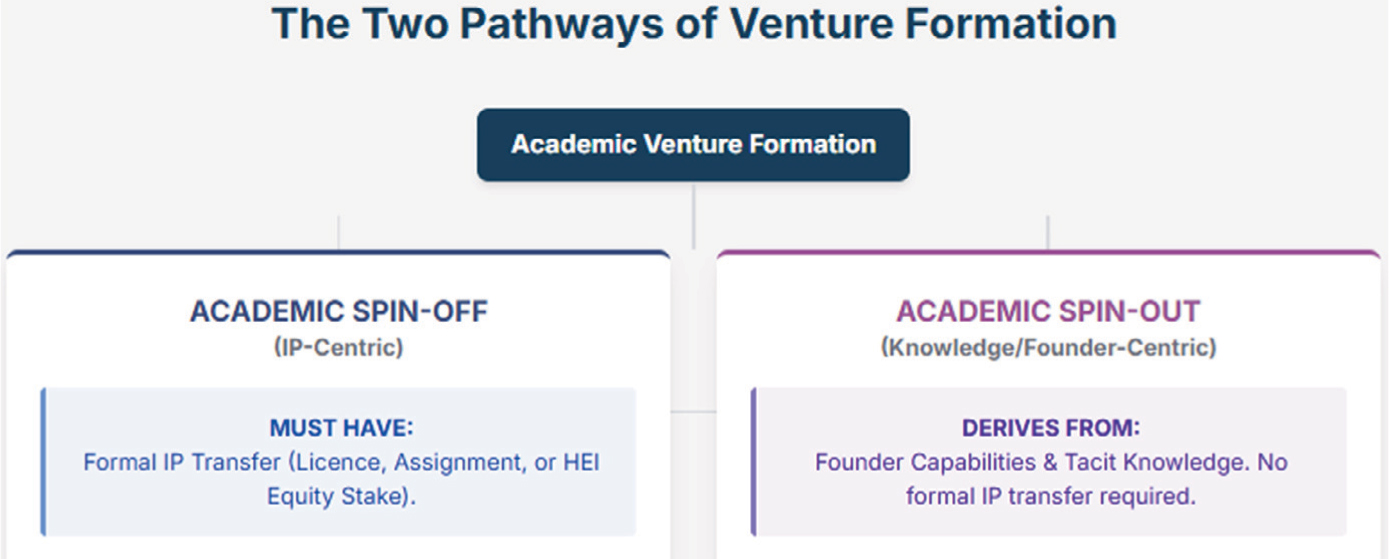
Figure 2.
Operational distinction: the two pathways of academic venture formation. Source: original proposal.
| Variable | Cluster | M | SD | n | η2 | Tukey results |
|---|---|---|---|---|---|---|
| CNCEXC_W99 | Skeptics | 2.65 | 0.52 | 2951 | .29 | Skeptics > Cautious > Optimists |
| Cautious | 2.21 | 0.63 | 4336 | |||
| Optimists | 1.62 | 0.66 | 2639 | |||
| ALGFAIR_W99 | Skeptics | 2.35 | 0.69 | 2928 | .14 | Skeptics > Cautious > Optimists |
| Cautious | 2.06 | 0.73 | 4309 | |||
| Optimists | 1.58 | 0.72 | 2621 | |||
| TECH1_W99 | Skeptics | 1.87 | 0.68 | 1541 | .11 | Skeptics > Cautious > Optimists |
| Cautious | 1.55 | 0.62 | 2157 | |||
| Optimists | 1.29 | 0.52 | 1289 | |||
| SC1_W99 | Skeptics | 1.57 | 0.67 | 1403 | .08 | Skeptics > Cautious > Optimists |
| Cautious | 1.29 | 0.53 | 2175 | |||
| Optimists | 1.15 | 0.43 | 1348 |
1 Source: original compilation, based on data from Pew Research Center (2021).