
1. Introduction
University-affiliated new ventures, commonly labelled “spin-offs” or “spin-outs,” have long been one of the salient channels through which knowledge travels from higher education institutions (HEIs) and public research organizations (PROs) into markets. Historically, the co-evolution of science, technology, and economic development has repeatedly hinged on such translation mechanisms, from early industrialization to the contemporary knowledge economy (Smith, 1776; Landes, 1969; Soete & Freeman, 1997; Mokyr, 2002). In the modern era, the “third mission” of universities has elevated knowledge transfer and commercialization alongside education and research, embedding entrepreneurial roles within the institutional fabric of HEIs (e.g. Perkmann et al., 2021; Audretsch, 2014). This evolution is reflected in the literature on the entrepreneurial university and regional innovation systems, which documents how universities, firms, and government agencies co-produce innovation outcomes (e.g., Etzkowitz & Leydesdorff, 1997; Secundo et al., 2017; Compagnucci & Spigarelli, 2020; Guerrero et al., 2024). Within this landscape, university spin-offs and spin-outs constitute a visible and often contested bridge between laboratory and market.
Despite their prominence, terminology and operational practice remain heterogeneous. Labels such as “spin-off,” “spin-out,” “academic start-up,” or “university-based new technology firm” are used inconsistently across scholarly, legal and institutional contexts (Pirnay et al., 2003; Hogan & Zhou, 2010; Miranda et al., 2018). The definitional ambiguity is not merely semantic. When different studies count different underlying populations, some focusing on ventures that license or receive assignments of university intellectual property (IP), others on ventures whose advantage rests on academic human capital and tacit knowledge, empirical results become difficult to cumulate, and policy evaluations can be misleading (Pirnay et al., 2003; Rubini et al., 2021; Dabić et al., 2022). Bibliometric overviews likewise show a fragmented discourse spanning technology transfer, entrepreneurial teams, regional development, and institutional design, with shifting emphases after 2015, and particularly after 2020, as software- and data-intensive ventures gained salience (Perkmann et al., 2021).
Heterogeneity is reinforced by divergent operational standards. In the United States, the post-Bayh–Dole regime (1980) institutionalized university IP ownership and spurred technology transfer structures, shaping what is counted and reported (Mowery, 2005; Berman, 2008; O’Shea et al., 2008; Kenney & Patton, 2011). The Association of University Technology Managers (AUTM) has, for reporting purposes, defined “startup company” narrowly as a firm formed specifically to develop university-licensed technology – a convention that enhances comparability but excludes IP-light trajectories (Bray & Lee, 2000; AUTM, 2024). In Europe, the Organization for Economic Co-operation and Development (OECD) and the European Commission (EC) have promoted measurement frameworks historically centered on formal IP channels; more recent EU guidance broadens the focus from “IP” to “intelleCouncil of the European Union, 2022; European Commission, 2023). The UK’s Independent Review of University Spin-outs and the UK government’s response highlight standard-setting pressures around equity, licensing, and transaction speed, with implications for how universities identify and support ventures (Ulrichsen et al., 2022; Tracey & Williamson, 2023). These institutional choices shape samples, metrics, and incentives, and thus indirectly the evidence base in scholarship (Colombo et al., 2010; Clarysse et al., 2011; Algieri et al., 2013; O’Reilly et al., 2018).
Context matters as well. In Poland and other Central and Eastern European (CEE) systems, legal-institutional architectures differ from Anglo-American practice, including the prominent role of special-purpose vehicles (SPVs) for indirect commercialization and specific provisions of national higher-education law (Polish Law on Higher Education and Science, 2018; Konopka-Cupiał, 2020). Such arrangements can blur the operational boundary between the university and the venture, complicating both institutional reporting and cross-country benchmarking. Comparative research has shown that university strategies, technology transfer offices (TTOs), and local entrepreneurial infrastructures condition the incidence and trajectories of university-related ventures (Mustar et al., 2006; Colombo et al., 2010; Bigliardi et al., 2013). Recent reviews stress the need to align operational definitions with these institutional realities, particularly for software- and data-driven venture paths (Perkmann et al., 2021; Dabić et al., 2022; Tracey & Williamson, 2023).
Against this background, the article pursues two tightly defined aims. First, it reconstructs the definitional landscape across management scholarship, international organizations – the Organization for Economic Co-operation and Development (OECD) and the European Commission (EC) – and university policies, with particular weight given to post-2020 contributions alongside canonical sources (Pirnay et al., 2003; Shane, 2004; Clarysse & Moray, 2004; Perkmann et al., 2013; Cerver Romero et al., 2021). Second, it proposes clear operational definitions of “spin-offs” and “spin-outs” suitable for use in management and technology transfer research and in institutional practice, with attention to the realities of Central and Eastern Europe (CEE).
The article addresses the following research questions (RQs):
RQ1: Which definitional choices and operational criteria permit a consistent distinction to be drawn between spin-offs and spin-outs in management research and in institutional statistics?
RQ2: How do international standards and national regulatory arrangements (OECD/EC/AUTM; Bayh–Dole-type provisions; country-specific solutions in CEE) influence those definitions and the ways universities and intermediaries identify and report university-related ventures?
RQ3: Which thematic structures dominate in recent literature (post-2015/2020), and how do they relate to definitional and operational choices identified in the review?
RQ4: What implications follow for measurement, university practice (including the design of TTO processes and decision rights), and public policy, with a focus on Poland and the wider CEE region?
The contribution is threefold. Conceptually, the article consolidates disparate definitional families into a usable map that clarifies what is counted under each label and why (Miranda et al., 2018; Dabić et al., 2022). Operationally, it specifies a classification protocol – comprising decision rules and documentation flags – that researchers and institutions can apply when assembling datasets, thereby improving comparability without erasing legitimate diversity across contexts (Colombo et al., 2010; O’Reilly et al., 2018; European Commission, 2023). Empirically, it anchors these proposals in an up-to- date view of the field by means of a VOSviewer co-occurrence analysis of Scopus-indexed publications, aligning the operational treatment with contemporary research themes (Perkmann et al., 2021).
The remainder of the article proceeds in three steps. The next section reviews scholarly and institutional sources, tracing how definitions have been formulated and operationalized in research and reporting, and what consequences follow for sampling, metrics and inference. The following section then presents the design and results of the VOSviewer analysis (data source, query, inclusion criteria, normalization, visualization), used here to locate the study’s operational proposals within recent thematic structures. The discussion then integrates insights from both streams to advance operational definitions of “spin-off” / “spin-out” and to elaborate their implications for measurement, university practice and policy, especially in Poland and the broader CEE context. The article concludes by summarizing the contribution and outlining directions for future research.
This structure has two ambitions. First, to increase the clarity and usefulness of definitions so that research on spin-offs and spin-outs yields results that are comparable across countries, disciplines and time periods. Second, to anchor definitional choices in the post-2020 empirical map of the field, showing where scholarly attention concentrates, which themes are expanding and which are receding, and how these dynamics should inform university practices and the design of policy instruments.
2. Literature review: definitions, operational practice, and recent shifts
The definitional landscape revolves around three well-established families that adopt different “entry points” into what counts as a university spin-off/spin-out. An IP-centric tradition defines the category through codified intellectual property and formal transfer (license or assignment), with Shane’s (2004) definition: “a new firm created to exploit IP developed within a university” providing the sharpest operational pivot and travelling well to performance studies (Nerkar & Shane, 2003). A broader, knowledge-based tradition includes ventures whose advantage originates in university research and teams even without formal IP conveyance; it emphasizes founder roles and relational coupling to the higher education institution (HEI) (Pirnay et al., 2003; Nicolaou & Birley, 2003; Clarysse & Moray, 2004). A third line differentiates ventures by initial resource bundles and technology/product maturity at founding, anticipating systematic differences in capital needs and risk across deep-tech versus service/software paths (Heirman & Clarysse, 2004; Mustar et al., 2006). Table 1 consolidates these canonical treatments in a uniform format, pairing each concise formulation with its key construct and the implied consequences for inclusion and exclusion in the empirical samples.
Table 1.
Scholarly definitions and treatments (canon and evolution).
| Source | Short wording | Key concept | Operational consequence |
|---|---|---|---|
| Shane (2004) | Spin-off as a new firm created to exploit IP developed within a university; formal license/assignment assumed | IP-centric definition; formal transfer of rights | Narrows samples to ventures with licensable/assigned university IP; excludes tacit/know-how-only cases; high comparability with AUTM-style reporting |
| Pirnay et al. (2003) | University spin-offs as new firms commercializing knowledge/technology or research results developed at the university | Inclusion of tacit knowledge; emphasis on knowledge origin and founder status | Broadens the population; requires additional selection criteria to manage heterogeneity and ensure comparability |
| Nicolaou & Birley (2003) | Classification of university spin-outs by founder roles and ties to the university (e.g., orthodox, hybrid, technology) | Founder configuration and coupling mechanisms with the HEI | Enables operationalization via founder affiliation/equity/governance “flags”; supports sampling by relational form |
| Clarysse & Moray (2004) | Process view of entrepreneurial team formation and varying autonomy vs. university support | Institutional relationship and team dynamics | Suggests measuring intensity of HEI support and degree of coupling; cautions against pooling cases with different autonomy levels |
| Heirman & Clarysse (2004) | Taxonomy by technology/product maturity at founding | Initial resource bundle and readiness (deep-tech vs. service/software) | Segments capital needs and risk; warns against performance comparisons across maturity classes without controls |
| Perkmann et al. (2013; 2021) | Separation of & #x201C;academic engagement” from commercialization (licensing, spin-offs) | Definitional filter distinguishing collaboration from commercialization | Improves sample boundary clarity by excluding engagement-only cases; increases cross-study comparability |
| Dabić et al. (2022) | Synthesis of university spinoffs with explicit inclusion of software/data and hybrid pathways | “Intellectual assets” beyond formal IP; IP-light trajectories | Encourages inclusion of software/data-driven cases; implies need for new metrics and institutional tracking beyond patent/license proxies |
Read horizontally, Table 1 reveals three regularities that matter for inference. First, IP-centric sharpness increases comparability by constraining heterogeneity, but it does so by design at the cost of excluding tacit-knowledge and software/data trajectories that leave a weaker IP trail. Second, relational typologies centered on founder roles and the strength of HEI-venture coupling furnish natural descriptors for case characterization and help explain divergent growth paths; yet they require explicit boundary choices to avoid pooling non-comparable populations. Third, maturity-based taxonomies imply that outcomes commonly analyzed in the literature – time-to-market, survival, and financing – are sensitive to mixing classes with fundamentally different capital intensity and technological uncertainty. Taken together, the very constructs that give explanatory traction – asset type, institutional linkage, and founder configuration – also shift the operational meaning of “spin-off” / “spin-out,” which is why nominally similar studies often observe different populations (Perkmann et al., 2013, 2021; Dabić et al., 2022). This observation provides the hinge for the next step: how scholarly categories are filtered, codified, and sometimes narrowed by reporting conventions.
The post-Bayh–Dole architecture in the United States institutionalized university IP ownership, structured TTO activity, and shaped what gets counted (Stevens, 2004; Mowery, 2005; Berman, 2008; O’Shea et al., 2008). For reporting, AUTM defines a “startup company” narrowly as a firm formed specifically to develop university-licensed technology, an inclusion rule that produces high internal consistency but systematically excludes IP-light trajectories (Bray & Lee, 2000; AUTM, 2024). Nevertheless, the definitional problem is global: systematic literature reviews reveal similar tensions between formal IP-centric definitions and knowledge-based deep-tech pathways in diverse international contexts (Verma et al., 2022). In Europe, OECD and EC frameworks historically privileged formal IP channels for comparability; however, the 2022 Council Recommendation on knowledge valorization and the 2023 EC Code of Practice on intellectual assets broaden the object from “IP” to “intellectual assets,” explicitly recognizing software and data (Council of the European Union, 2022; European Commission, 2023). In the UK, the Independent Review of University Spin-outs and the government response push for more transparent equity, licensing norms and faster transactions, effectively reshaping operational practice at the university–investor interface (Ulrichsen et al., 2022; Tracey & Williamson, 2023). Table 2 assembles these contemporary institutional anchors and, crucially, specifies how their wording translates into inclusion and exclusion at scale (Council of the European Union, 2022; Ulrichsen et al., 2022; European Commission, 2023; Tracey & Williamson, 2023).
Table 2.
Institutional (operational) definitions.
| Source | Short wording | Key concept | Operational consequence |
|---|---|---|---|
| Council of the European Union, Council Recommendation on the guiding principles for knowledge valorization (2022) | Spin-off/spin-out recognized as one route of “knowledge valorization”; emphasis on a broad spectrum of intellectual assets and transfer channels | Shift from “IP” to “intellectual assets” (including software and data) | Opens the way to include software-/data-driven ventures in universities’ operational definitions and public policy metrics |
| European Commission, Code of Practice on the management of intellectual assets for knowledge valorization (2023) | Guidance for intellectual-asset management strategies in research organizations (decision rights, value sharing, tools) | “Intellectual assets” > formal IP; emphasis on institutional practices | Encourages diversification of commercialization models beyond patent-license pathways |
| AUTM, definitions used in annual Licensing Survey (2021–2024) | “Startup company”: firm formed specifically to develop technology licensed from the university | University license as an inclusion requirement | High data comparability; low inclusiveness for know-how/software cases without a formal license |
Read against the scholarly families, Table 2 makes clear that operational regimes do not merely reflect definitions; they actively shape the population that is rendered visible. The AUTM convention, counting as “startup company” only firms formed to develop licensed university technology, maximizes internal consistency yet structurally under-represents software/data and know-how trajectories without a formal license, even when their knowledge base is unmistakably academic. The recent EU shift from “intellectual property” to “intellectual assets” widens the object of valorization to include software and data, thereby legitimizing a broader set of university-related ventures for institutional tracking. The UK review, by pressing for transparent equity norms and faster deals, alters incentives at the university-investor interface and is likely to affect not only deal flow but also how universities label and count ventures.
These institutional anchors therefore generate distinct measurement windows. A narrow license-based window is well suited to TTO performance dashboards and inter-institutional benchmarking where legal clarity is paramount; a broader intellectual-assets window is better aligned with the evolving economics of research commercialization, where software, data and hybrid channels have become first-class objects. For cross-national research – particularly when comparing the United States with Europe, or generalizing to Central and Eastern Europe (CEE) – recognizing which window is in use is a prerequisite for meaningful inference. Otherwise, studies labelled “spin-off” may, in practice, be sampling dissimilar, non-comparable populations, with predictable divergence in outcomes, funding paths, and timelines.
Research on mechanisms complements definitional work by explaining why ventures unfold differently across contexts. University strategy and TTO human capital correlate with spin-off propensity and quality (Colombo et al., 2010; Clarysse et al., 2011), while incubation and science parks have mixed, lifecycle-contingent effects (Mian, 1997; McAdam & McAdam, 2008; Schwartz, 2011; Pauwels et al., 2016). Entrepreneurial teams and role configurations matter for speed and survival (Clarysse & Moray, 2004; Ensley & Hmieleski, 2005; Walter et al., 2006; Iacobucci et al., 2011). Finance and contracting structures shape selection and growth under risk (Kaplan & Strömberg, 2003; Gilson & Schizer, 2003; Lockett & Wright, 2005). Importantly, these mechanisms interact with definitional filters: an AUTM-compatible sample, by construction, tends to over-represent ventures with licensable IP, different TTO touchpoints, and often different financing trajectories, compared with samples centered on academic founder affiliation.
Performance evidence is heterogeneous by design because samples are heterogeneous. Some studies link university reputation and networks to venture performance (Goethner et al., 2012), others document productivity differences between spin-offs and other NTBFs (Ortín-Ángel & Vendrell-Herrero, 2014), and meta-reviews caution against naive benchmarking when definitions diverge (Bigliardi et al., 2013; Rodríguez-Gulías et al., 2016). Regional development effects vary with institutional thickness and prior industry-science ties (Benneworth & Charles, 2005; Vincett, 2010; Pinheiro et al., 2015). Again, what is “in sample” depends on the definitional window.
The most consequential evolution in the last decade is the recognition of software- and data-intensive ventures as first-class objects of commercialization and of hybrid channels beyond license-then-incorporate. Scholarly reviews register this broadening (Perkmann et al., 2021; Dabić et al., 2022), bibliometric analyses map a dispersion of themes from IP/licensing to ecosystems, and finance and policy documents codify the language of “intellectual assets,” encouraging institutions to adapt support and metrics (Council of the European Union, 2022; European Commission, 2023; Tracey & Williamson, 2023). This shift is particularly important for CEE systems, where indirect commercialization via special-purpose vehicles (SPVs) and national legal solutions (e.g., Poland’s higher-education law) blur simple license-based categories (Konopka-Cupiał, 2020), and where software-driven ventures may lack the IP “footprint” required by narrow reporting conventions despite strong academic provenance.
Placing scholarly families (Table 1) alongside institutional definitions (Table 2) clarifies two persistent but tractable tensions. First, the reporting logic seeks crisp inclusion rules for accountability, whereas the explanatory logic seeks constructs that capture real heterogeneity in origins, resources, and governance. Second, post-2020 changes have opened a gap – now acknowledged in EU guidance – between patent-centric windows and the reality of software/data assets. The way forward is not to choose one logic over the other but to translate between them in transparent ways.
For analytical clarity, the matrix is reduced to three definitional lenses that dominate the literature, with the institutional anchors mapping onto them (AUTM aligns with the IP-centric lens; the EU’s “intellectual assets” shift partially bridges to the knowledge-based lens; recent UK guidance tunes equity/coupling within the knowledge-based logic).
A concise reading of Table 3 shows that the field revolves around three complementary lenses rather than competing definitions. The IP-centric, license-based lens delivers the sharpest boundary conditions and the highest internal consistency, because inclusion hinges on a verifiable legal act. Its strength is precisely its weakness: by privileging patentable outputs and formal transfers, it systematically blindsides software- and data-intensive ventures and tacit-knowledge trajectories that now account for a growing share of university-related entrepreneurship. The knowledge- or founder-linked lens restores that missing breadth by anchoring the category in academic provenance and the relational coupling between founders and the higher education institution. As a result, it captures the organizational and behavioral mechanisms emphasized in the literature: team composition, autonomy, and the intensity of university support, but at the price of greater heterogeneity unless boundary conditions are made explicit. The maturity and resource-based lens cuts the phenomenon along a third axis: technology and product readiness, highlighting why financing patterns, time-to-market and survival rates are not directly comparable across deep-tech and software or service subclasses.
Table 3.
Translation in three lenses: from definitions to data windows.
| Theoretical anchors | Minimum inclusion rule | Typical “blind spot” | Minimum descriptors to record | Best suited for… |
|---|---|---|---|---|
| IP-centric, license-based (Shane, 2004; AUTM, 2021–2024) | Formal transfer or license of university IP to the venture | Software/data and tacit know-how without a formal license; founder-led firms with weak legal ties | Asset type (patent/prototype/software/data); license yes/no and date; HEI equity stake | TTO dashboards; inter-institutional benchmarking where legal clarity is paramount |
| Knowledge-/founder-linked (Pirnay et al., 2003; Nicolaou & Birley, 2003; Clarysse & Moray, 2004) | Academic provenance of knowledge and identifiable founder affiliation/relational coupling to the HEI, regardless of formal IP | Alumni entrepreneurship unrelated to research; corporate spin-offs without academic roots | Founder roles/affiliation; linkage form (equity/access to resources); use of HEI infrastructure | Mechanism-focused studies (teams, coupling, support); founder-friendly policy design |
| Maturity / resource-based (Heirman & Clarysse, 2004; Mustar et al., 2006) | HEI-origin ventures stratified by technology/product maturity at founding | Cross-class comparisons without controls; strength of HEI-venture governance link | Technology readiness, product stage, capital intensity | Stage-conditioned performance and financing analyses; deep-tech vs software policy tools |
1 Note: The EU’s knowledge-valorization guidance (2022-2023) broadens the IP-centric lens to “intellectual assets,” explicitly legitimizing software/data and thus reducing the main blind spot of the first row; the UK spin-out review (Tracey & Williamson, 2023) primarily sharpens equity and coupling practices within the second lens.
1 Source: Pirnay et al. (2003); Nicolaou & Birley (2003); Shane (2004); Clarysse & Moray (2004); Heirman & Clarysse (2004); Mustar et al. (2006); Ulrichsen et al. (2022); Tracey & Williamson (2023); Council of the European Union (2022); AUTM Licensing Survey definitions/instructions (2021-2024); European Commission (2023).
Seen together, the three lenses map directly onto current governance shifts. The EU’s move from “intellectual property” to “intellectual assets” reduces the principal blind spot of the first lens by legitimizing software and data as first-class commercialization objects, while the UK spin-out review primarily sharpens equity and relational practices within the second lens. None of the lenses is sufficient on its own: the license-based window is optimal for accountability and benchmarking; the founder-linked window is better aligned with explanatory work on emergence and growth; and the maturity lens is indispensable whenever outcomes hinge on capital intensity and technological uncertainty. For cross-national analyses, particularly where Central and Eastern European arrangements (e.g., indirect commercialization via special-purpose vehicles) complicate straightforward license-based tests, the matrix clarifies which “measurement window” is in play and what it leaves out.
This synthesis also provides a bridge to the empirical parts of the paper. It explains why co-occurrence structures in recent literature are expected to cluster around IP/licensing, founder coupling and resources/maturity, and it frames the proposed operational definitions: they should be explicit about which lens they instantiate and which exclusions they imply, so that findings remain interpretable and comparable across institutional contexts.
Taken together, the three lenses clarify what each definition renders visible and where blind spots remain. They also generate concrete expectations about the structure of current scholarship: a license/IP cluster anchored by patents, research commercialization and TTOs; a founder-HEI coupling cluster organized around academic entrepreneurship and relational ties; a resources/maturity cluster that shades into deep-tech versus software trajectories; and adjacent clusters reflecting finance/policy and ecosystem governance. The next section tests these expectations with an exploratory co-occurrence mapping of recent publications indexed in Scopus (articles and reviews, 2015–2025; n = 322), using VOSviewer to identify clusters and an overlay to trace temporal emphasis.
Throughout the bibliometric analysis, the term “spin-off/spin-out” is used as indexed in Scopus records, reflecting authors’ and databases’ labelling practices; the more precise definitional distinctions developed in this article are applied in the conceptual and operational sections rather than retrofitted to the raw indexing. To mitigate synonymy and indexing noise (e.g., “spin-off,” “spinoff,” “spin-out”) and to suppress generic methodological terms, the VOSviewer mapping employs a simple thesaurus that unifies closely related expressions and removes non-informative keywords.
3. Co-occurrence mapping of recent scholarship (VOSviewer, 2015–2025)
The bibliometric exercise reported herein was designed to serve one purpose: to test empirically whether the most recent scholarship on university spin-offs and spin-outs does indeed cluster along the axes distilled from the literature review: intellectual property and licensing; founder roles and affiliation; resources and infrastructure; policy and institutional environment; and finance/industry context. The analysis is therefore complementary to, rather than a substitute for, the conceptual synthesis and the institutional definitions.
The dataset was exported from Scopus and limited to journal articles and reviews indexed between 2015 and 2025, whose titles, abstracts, or author/index keywords contained spin-off/spinoff or spin-out/spinout combined with an academic context (university; academic; public research organization) and transfer/commercialization vocabulary (technology transfer; commercialization/commercialization; licensing; intellectual property; knowledge transfer/exchange). Subject areas were restricted to Business, Management and Accounting; Economics and Econometrics; and Social Sciences, reflecting the primary audiences of management and technology transfer research, while acknowledging the deep-tech overlap captured through Engineering in the conceptual review. The resulting set comprised 322 records. A light thesaurus was used to harmonize obvious variants and synonyms (e.g., spin-off/spinoff/spin off → spin-off; spin-out/spinout/spin out → spin-out; tech transfer → technology transfer; commercialisation → commercialization; IPR/IP rights → intellectual property; TTO/TTOs → technology transfer office). Generic terms (e.g., article, case study, introduction, methodology) were excluded.
Co-occurrence mapping was conducted in VOSviewer using all keywords (author and index terms), full counting, and association-strength normalization. The minimum occurrence threshold was set at six to balance noise reduction and coverage. The resulting network resolves into five coherent clusters, which are consistent with the definitional lenses and institutional windows discussed earlier:
A first cluster centers on operationalization of technology transfer, integrating terms such as technology transfer, technology transfer office, research/commercialization, patents and inventions, and public policy, together with terms relating to economic and social effects. This cluster is the measurement-and-implementation spine of the field, closest to university governance and reporting.
A second cluster organizes around institutions and ecosystems: universities and higher education institutions (HEIs), academic spin-offs/spin-outs, networks, knowledge management, entrepreneurial ecosystems, and third mission alongside intellectual property. This is the institutional-relational space where founder affiliation, organizational coupling to the HEI, and access to resources are theorized and observed.
A third cluster links finance and regional development: venture capital, investments, finance/economics, policy makers, and regional development/planning. It is the policy-finance interface where instruments, capital structures, and place-based outcomes cohere.
A fourth cluster forms the definitional core: spin-off, startup, knowledge transfer, patent, entrepreneurial university, triple helix, and entrepreneurial orientation. Notably, patent appears as a bridging concept with a dual role – as both a theoretical label and a connector to operational practice in Cluster 1.
A fifth cluster gathers entrepreneurship and innovation themes in higher education: entrepreneur/entrepreneurship, higher education, innovation/innovation policy, research and development (R&D), and the university sector. It connects the field to general entrepreneurship and innovation management scholarship focused on HEIs.
An overlay visualization (average publication year) indicates a relative recentering of attention on ecosystems, networks, and financing (entrepreneurial ecosystems, networks, venture capital, spin-outs) while technology transfer and academic entrepreneurship remain persistently central. This temporal shading mirrors the post-2020 broadening documented in the review, toward software/data assets, equity norms, and ecosystem governance, without displacing the long-standing IP/licensing backbone.
Interpreted against the axes developed earlier, the clusters align in a near-one-to-one fashion. The intellectual property/licensing axis manifests primarily in Clusters 1 and 4 (technology transfer office, commercialization, patent). Founder roles and affiliation are anchored in Cluster 2 (academic spin-offs/spin-outs, universities/HEIs, networks), where relational coupling to the HEI is most salient. Resources and infrastructure appear in Clusters 1 and 2 (TTOs, knowledge management, third mission), reflecting access to laboratories, data, and support services. Policy and institutional environment is shared between Clusters 1 and 3 (public policy, policy makers, regional development). Finance/industry context spans Clusters 3 and 5 (venture capital, investments, innovation policy, research and development). This mapping empirically supports the need to translate between IP-centered operational windows and knowledge-/founder-centered explanatory frames when designing samples and reporting results.
Two aspects of the structure are worth highlighting because they inform the operational definitions proposed later. First, the centrality of technology transfer and patent within the definitional core implies that IP-centric windows will continue to dominate dashboard metrics and comparative reporting; the overlay’s more recent emphasis on ecosystems and finance suggests, however, that sampling frames which rely exclusively on license-based inclusion risk missing a growing share of economically relevant cases, especially software- and data-intensive trajectories. Second, the adjacency of HEI/network terms to venture capital and regional development underscores that founder-HEI coupling is not merely a governance descriptor; it shapes finance ability and the place-based outcomes on which policy is evaluated.
The analysis is subject to the usual caveats. Keyword-based co-occurrence depends on authors’ and indexers’ labelling practices; software/data/AI trajectories may be under-represented when not explicitly tagged, especially in management outlets, which makes results sensitive to thresholding and normalization choices. Field restrictions involve a trade-off between precision and recall: excluding large parts of Engineering reduces noise but risks missing deep-tech niches that publish outside management journals. Scopus coverage and English-language bias are additional constraints. Within these limits, the structure is stable to modest parameter changes (e.g., a threshold of five or seven occurrences produces the same five clusters with small boundary shifts) and is congruent with the conceptual review and the institutional definitions, thereby providing a defensible empirical base for the operational proposals.
Figure 1a (network view) displays five color-coded clusters with the densest linkages around technology transfer/patent (Clusters 1 and 4) and ecosystem/finance nodes (Clusters 2 and 3). Figure 1b (overlay) shades nodes by average publication year, with ecosystem- and finance-related terms skewing more recent relative to the enduring centrality of technology transfer and academic entrepreneurship.
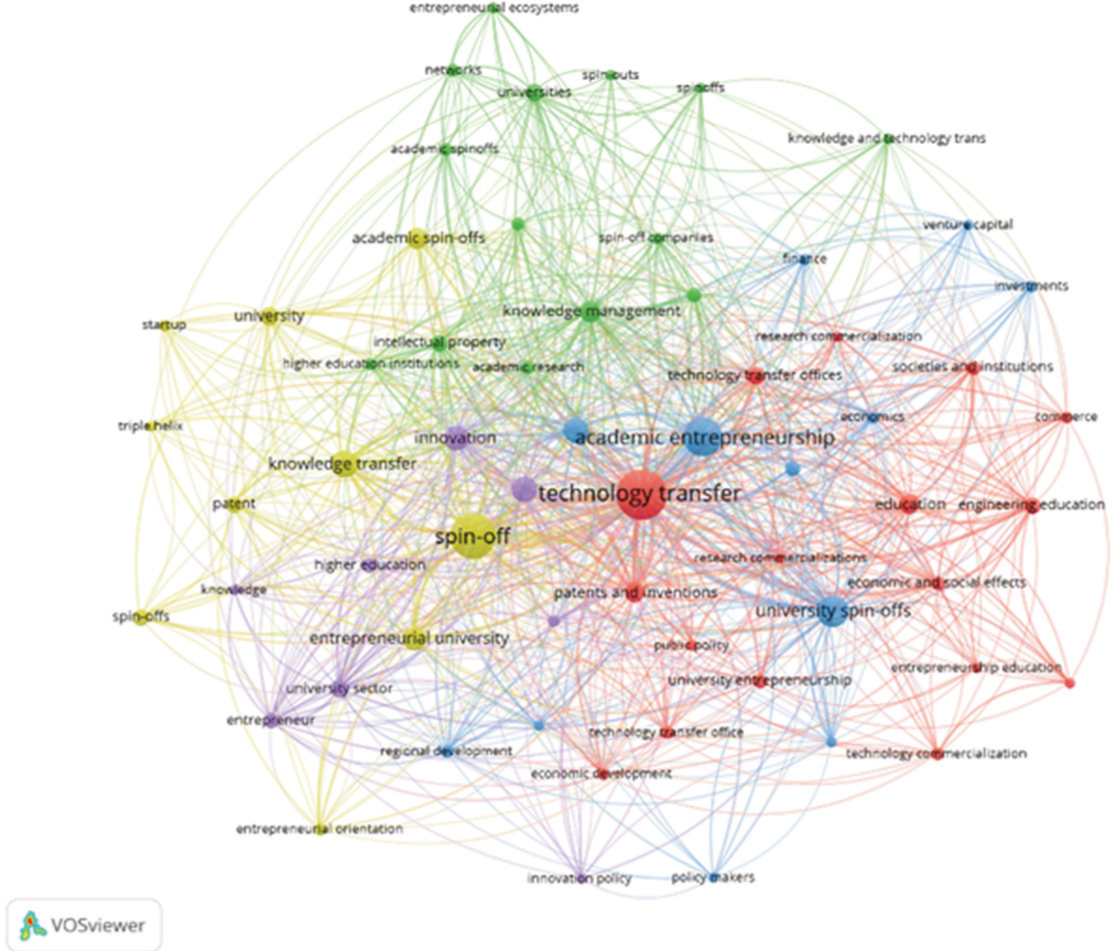
Figure 1a.
Co-occurrence network of keywords in recent scholarship on university spin-offs/spin-outs (2015–2025).
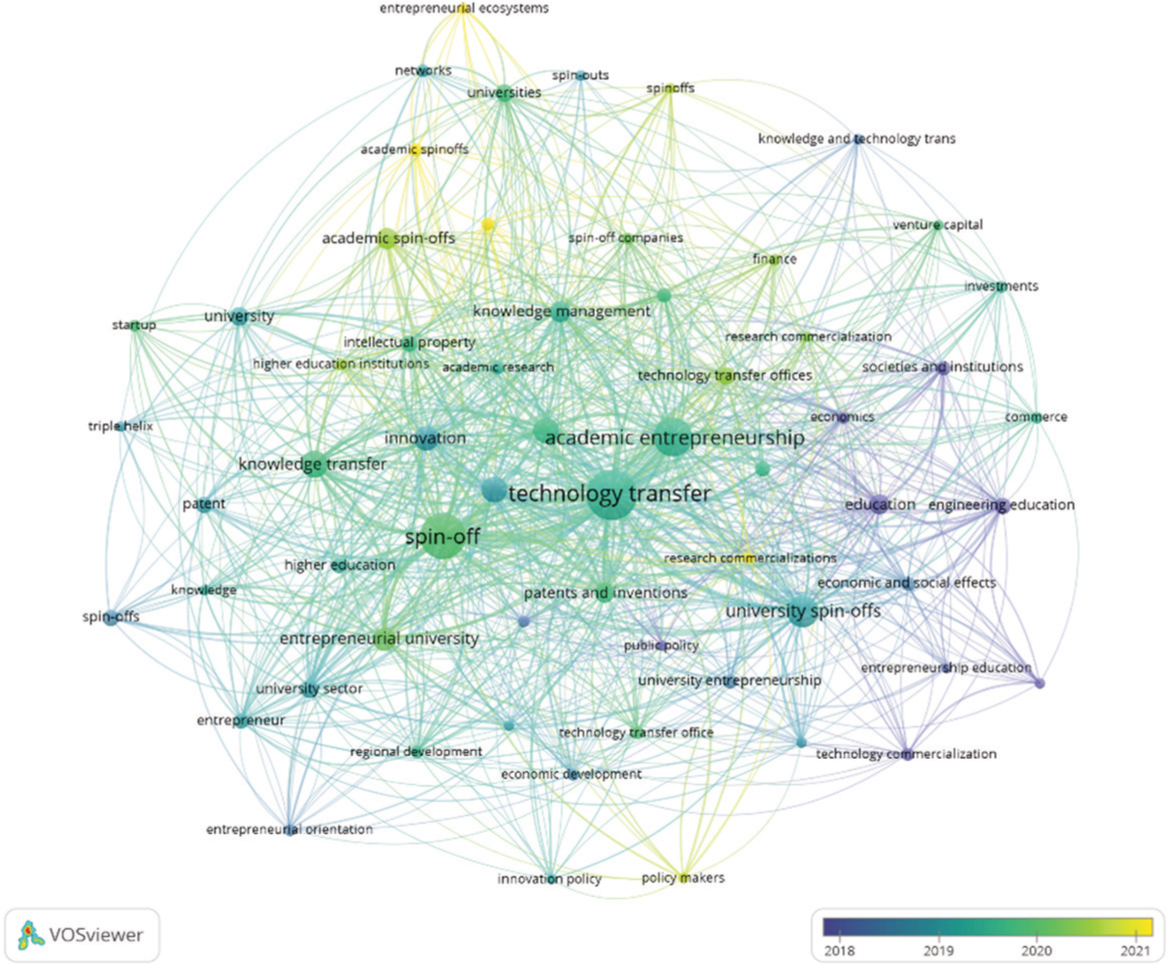
Figure 1b.
Overlay visualization (average publication year) of the co-occurrence network in Figure 1a.
Based on Scopus records (n = 322) indexed in 2015–2025, filtered to journal articles/reviews with spin-off/spin-out terms in titles/abstracts/keywords and an academic + technology-transfer/commercialization context (Business; Economics/Econometrics; Social Sciences). Co-occurrence mapping was conducted in VOSviewer using full counting, association-strength normalization, and a ≥ 6 keyword threshold. A light thesaurus harmonized common variants (e.g., spinoff → spin-off; spinout → spin-out; tech transfer → technology transfer; IPR → intellectual property) and removed generic terms.
Source: Original analysis of Scopus data using VOSviewer (CWTS, Leiden University). See Van Eck & Waltman (2010).
The resulting mapping reveals a structure of current scholarship centered on the same conceptual and operational tensions identified in the review, namely IP/licensing versus knowledge-/founder-based logics, resource and infrastructure access, and policy/finance governance. This provides a strong empirical warrant for the next section, which states explicit operational definitions of “spin-off” and “spin-out” and translates them into inclusion rules that make sampling and metrics portable across institutional contexts.
4. Discussion and synthesis
By matching canonical scholarship with institutional standards and the VOS viewer evidence, this study confirms that the ambiguity surrounding “spin-off” and “spin-out” is structural rather than incidental. As we have sought to show, complementary logics organize the field. A legal and statistical logic, exemplified by AUTM reporting conventions and long-standing OECD/EC frameworks, maximizes measurability and legal certainty by tying inclusion to verifiable acts such as license, assignment, or equity (Shane, 2004; OECD, 2003; OECD/Eurostat, 2005; AUTM definitions 2021–2024). Its strength is crisp comparability; its price is reductionism that filters out tacit-knowledge, software- and data-intensive, and other IP-light trajectories that now constitute a material share of academic venturing. A socio-scientific logic, rooted in broader definitions and process typologies, captures heterogeneity in origins, team roles, and organizational coupling to higher education institutions (HEIs), but is harder to operationalize consistently across institutions and countries (Rappert et al., 1999; Pirnay et al., 2003; Nicolaou & Birley, 2003; Heirman & Clarysse, 2004). Recent syntheses sharpen this divide by distinguishing academic engagement from commercialization sensu stricto and by explicitly recognizing software and data as first-class objects of valorization (Perkmann et al., 2021; Dabić et al., 2022). Policy has begun to move accordingly: the Council Recommendation on knowledge valorization (2022) and the Commission’s Code of Practice on intellectual assets (2023) reframe the object from “intellectual property” to “intellectual assets,” while the UK’s spin-out review and government response recalibrate equity norms and transaction practice (Council of the EU, 2022; European Commission, 2023; Tracey & Williamson, 2023; Ulrichsen et al., 2022).
The bibliometric map for 2015–2025 (n = 322 Scopus articles and reviews; Figures 1a–1b) renders these tensions as five stable clusters: a technology transfer operations cluster (TTOs, licensing, patents); an institutions and ecosystems cluster (HEIs, third mission, networks, knowledge management, intellectual property as a resource); a finance and development policy cluster (venture capital, investments, policy makers, regional development/planning); a definitional core (spin-off, entrepreneurial university, triple helix, entrepreneurial orientation); and a higher-education entrepreneurship/innovation cluster. The overlay visualization indicates post-2020 cooling-off of purely patent-centric themes and relatively newer attention to ecosystems, networks and financing, while technology transfer remains central. For Central and Eastern Europe (CEE), where indirect commercialization via special-purpose vehicles and national legal solutions (e.g., Poland’s higher-education law) complicate simple license tests, the divergence between the two logics is particularly visible and directly affects what enters institutional statistics (Konopka-Cupiał, 2020).
5. Operational definitions and a lightweight classification checklist
To translate between explanatory richness and reporting clarity, the following two operational categories are proposed:
Academic spin-off: a newly incorporated firm created to commercialize formally identified intellectual property developed within an HEI or public research organization (PRO), to which the firm acquires legal title via license, assignment, or in-kind contribution; at least one founder is affiliated with the HEI/PRO at founding, and the HEI-venture relationship is visible in a contract or ownership structure (Shane, 2004; AUTM reporting practice; OECD/EC comparability aims).
Academic spin-out: a newly incorporated firm founded by current or former members of the academic community whose advantage primarily derives from knowledge, capabilities or artefacts developed within an HEI/PRO; no formal transfer of IP from the HEI/PRO is required at founding, and access to institutional resources (equipment, data, software) may occur on market terms. This category explicitly admits IP-light software/data trajectories documented in recent literature and now recognized in EU guidance (Dabić et al., 2022; Council of the EU, 2022; European Commission, 2023).
For comparability, each case should be accompanied by four minimal flags recorded at the unit level:
asset type at founding (patent/prototype/software/data),
HEI-venture linkage (license/equity/none),
access to HEI resources (infrastructure/data/none),
source of initial finance (grant/seed/VC).
These descriptors do not replace the two categories; they make samples auditable and enable meaningful cross-study comparisons.
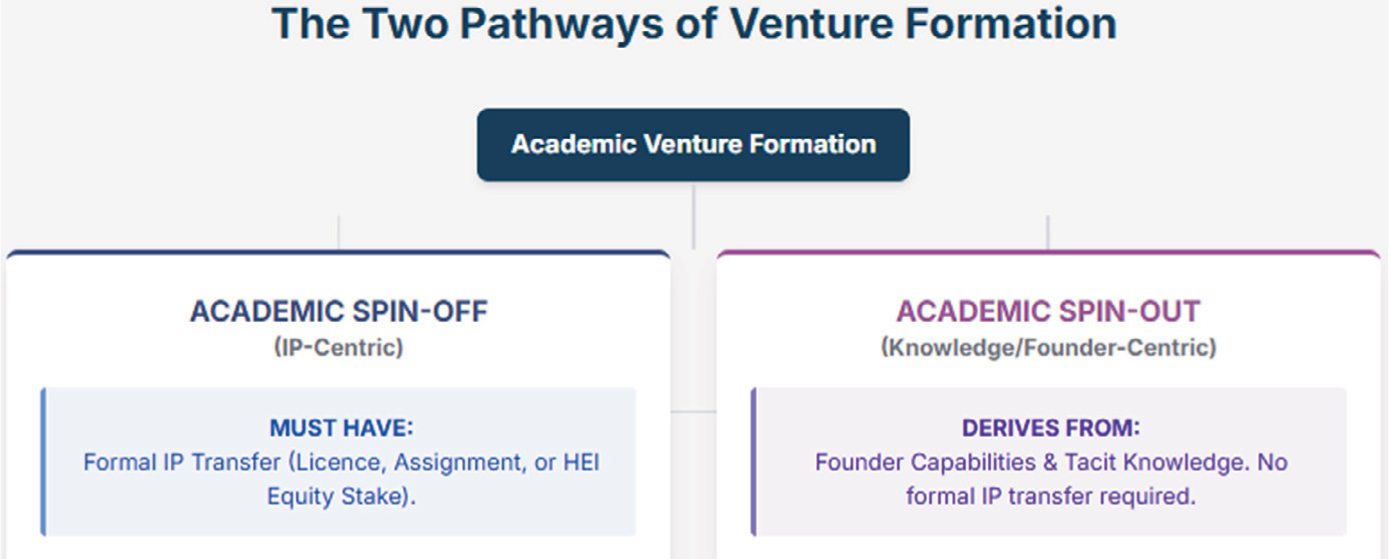
Figure 2.
Operational distinction: the two pathways of academic venture formation. Source: original proposal.
The implications of this conceptual synthesis and bibliometric analysis are far-reaching for institutional reporting and policy design. The evidence supports four distinct claims, providing a foundation for cumulative research. In essence, the findings validate the necessity of dual operational categories and a standardized reporting mechanism:
Definitional Clarity (RQ1): The distinction is operational. The Academic Spin-Off requires formal IP transfer (license, assignment, or in-kind contribution of IP originating in a HEI/PRO) at founding, while the Academic Spin-Out derives from knowledge and teams without such a formal transfer.
Regulatory Bias (RQ2 & RQ3): Regulatory regimes, including AUTM-style license windows and CEE special-purpose vehicles, systematically bias statistical samples. This bias is mirrored in the thematic clustering of the 2015–2025 literature, validating the necessity of two distinct operational categories.
Practical Implication (RQ4): The solution is dual-track reporting (spin-offs and spin-outs). This system, augmented with Minimal Descriptors – asset type, linkage form, infrastructure, and financing – enables cross-institutional comparability without erasing IP-light trajectories.
Taken together, these answers realign the field’s vocabulary with its measurement practice, reduce the risk of category error in cross-national benchmarking, and provide a workable foundation for cumulative, comparable research on university spin-offs and spin-outs.
6. Limitations and future research
The synthesis is limited by the scope of Scopus database coverage, by inconsistencies in indexing practices for author and indexed keywords, and by parameter choices in cooccurrence mapping (e.g. minimum-occurrence thresholds, normalization methods). Software-, data-, and AI-intensive paths may be undercounted when authors or indexers label them inconsistently. Beyond bibliometric data, transaction-level evidence remains limited and fragmented: license terms, equity ranges, times-to-deal, and follow-on finance are rarely linked to venture-level outcomes in public datasets.
Further research should therefore combine bibliometric analysis with transaction data from TTOs and public registers; conduct comparative legal and institutional analyses of IP ownership regimes (e.g., Bayh-Dole-style versus “professor’s privilege” models); and use mixed methods to study founder decision-making and university governance.
For CEE, careful mapping of SPV-mediated pathways is essential to avoid double counting and to attribute value creation correctly. Developing a multidimensional typology and a panel of indicators suitable for implementation in national and international statistical systems remains a priority for cumulative progress.
7. Conclusions
This article set out to achieve two objectives: first, to reconstruct the definitional landscape surrounding university-related ventures across scholarship, international standards and university policies; and second, to propose clear operational definitions of “academic spin-off” and “academic spin-out” that can be used consistently in management research and institutional reporting. Both aims have been addressed. The integrative review and the side-by-side treatment of institutional anchors clarified how inclusion rules shape what is counted, while the VOS viewer co-occurrence mapping situated these choices within the thematic structure of recent scholarship since 2015. The resulting definitions make the boundary conditions explicit and translate directly into recordable descriptors for comparable datasets.
Treating “spin-off” (necessarily involving formal IP transfer at founding) and “spin-out” (involving academic provenance without required IP transfer at founding) as complementary operational categories, and documenting four simple flags per case, builds a practical bridge between scholarly constructs and institutional measurement. The alignment with the EU’s shift from “intellectual property” to “intellectual assets” increases transparency and reduces benchmarking errors. With clear categories and auditable descriptors, comparative research becomes less fragile, institutional dashboards more informative, and policy design better matched to the heterogeneous realities of university-driven entrepreneurship.
| Variable | Cluster | M | SD | n | η2 | Tukey results |
|---|---|---|---|---|---|---|
| CNCEXC_W99 | Skeptics | 2.65 | 0.52 | 2951 | .29 | Skeptics > Cautious > Optimists |
| Cautious | 2.21 | 0.63 | 4336 | |||
| Optimists | 1.62 | 0.66 | 2639 | |||
| ALGFAIR_W99 | Skeptics | 2.35 | 0.69 | 2928 | .14 | Skeptics > Cautious > Optimists |
| Cautious | 2.06 | 0.73 | 4309 | |||
| Optimists | 1.58 | 0.72 | 2621 | |||
| TECH1_W99 | Skeptics | 1.87 | 0.68 | 1541 | .11 | Skeptics > Cautious > Optimists |
| Cautious | 1.55 | 0.62 | 2157 | |||
| Optimists | 1.29 | 0.52 | 1289 | |||
| SC1_W99 | Skeptics | 1.57 | 0.67 | 1403 | .08 | Skeptics > Cautious > Optimists |
| Cautious | 1.29 | 0.53 | 2175 | |||
| Optimists | 1.15 | 0.43 | 1348 |
1 Source: original compilation, based on data from Pew Research Center (2021).