
Table 1.
Structure of the research sample
| Number | (%) | |
|---|---|---|
| Total | 707 | (100.0) |
| Gender | ||
| Female | 373 | 52.76 |
| Male | 334 | 47.24 |
| Age | ||
| 18–29 | 128 | 18.10 |
| 30–39 | 134 | 18.95 |
| 40–49 | 127 | 17.96 |
| 50–59 | 101 | 14.29 |
| 60+ | 217 | 30.96 |
| Education | ||
| Primary | 43 | 6.08 |
| Basic vocational | 1023 | 14.43 |
| Secondary | 304 | 43.00 |
| Higher | 258 | 36.49 |
| Place of residence | ||
| Village | 268 | 37.91 |
| A town with up to 10,000 inhabitants | 45 | 6.36 |
| City from 10,000 to 20,000 inhabitants | 46 | 6.51 |
| City from 20,000 to 50,000 inhabitants | 82 | 11.60 |
| City from 50,000 to 100,000 inhabitants | 60 | 8.49 |
| City from 100,000 to 200,000 inhabitants | 61 | 8.63 |
| City over 200,000 inhabitants | 145 | 20.51 |
| Assessment of financial situation | ||
| Very bad | 13 | 1.84 |
| Bad | 55 | 7.78 |
| Average | 358 | 50.64 |
| Good | 254 | 35.93 |
| Very good | 27 | 8.82 |
| Assessment of overall health status | ||
| Bad | 9 | 1.27 |
| Rather bad | 75 | 10.61 |
| Neither good nor bad | 217 | 30.69 |
| Rather good | 350 | 49.50 |
| Good | 56 | 7.92 |
| Assessment of physical activity | ||
| No activity | 125 | 17.68 |
| Very weak | 192 | 27.16 |
| Moderate | 273 | 38.61 |
| High | 93 | 13.15 |
| Very high | 24 | 3.39 |
| Change in weight | ||
| Decreased | 110 | 15.56 |
| Remained unchanged | 390 | 55.16 |
| Increased | 207 | 29.28 |
| BMI | ||
| Below normal | 23 | 3.25 |
| Normal | 320 | 45.26 |
| Above normal | 364 | 51.49 |
Table 2.
Emocional determinants of increased consumption are divided into segments: WE, NE, PE, BE.
| Segment x̄ (σ) | ||||||
|---|---|---|---|---|---|---|
| WE | NE | PE | BE | |||
| Emotional states | Negative | Sad | 6.89 (1.528) | 5.46 (1.247) | 2.45 (1.463) | 3.34 (1.320) |
| Bored | 6.72 (1.477) | 5.32 (1.274) | 3.51 (2.150) | 4.32 (1.537) | ||
| Angry | 6.80 (1.778) | 5.23 (1.196) | 2.46 (1.388) | 3.29 (1.454) | ||
| Anxious | 6.80 (1.824) | 5.16 (1.273) | 2.66 (1.478) | 3.31 (1.350) | ||
| Frustrated | 6.81 (1.577) | 5.35 (1.271) | 2.62 (1.466) | 3.23 (1.281) | ||
| Tired | 6.35 (1.863) | 4.65 (1277) | 3.44 (1.964) | 3.26 (1.588) | ||
| Depressed | 7.05 (1.640) | 5.34 (1.366) | 2.53 (1.493) | 3.27 (1.340) | ||
| Scared | 6.35 (1.919) | 4.68 (1.358) | 2.16 (1.393) | 2.66 (1.279) | ||
| Lonely | 6.95 (1.595) | 5.45 (1.246) | 3.23 (2.101) | 3.95 (1.678) | ||
| Positive | Self-satisfied | 6.49 (1.411) | 5.03 (1.044) | 7.12 (1.398) | 5.10 (1.159) | |
| Happy | 6.81 (1.460) | 4.99 (1.098) | 7.76 (0.982) | 4.94 (1.251) | ||
| Relaxed | 6.51 (1.436) | 5.01 (1.078) | 7.32 (1.320) | 5.08 (1.132) | ||
| Cheerful | 6.79 (1372) | 5.01 (1.052) | 7.34 (1.298) | 4.92 (1.276) | ||
| Enthusiastic | 7.02 (1.263) | 4.91 (1.045) | 6.71 (1.606) | 4.75 (1.240) | ||
| n (%) | 85 (12.02%) | 375 (53.04%) | 93 (13.15%) | 154 (21.78%) | ||
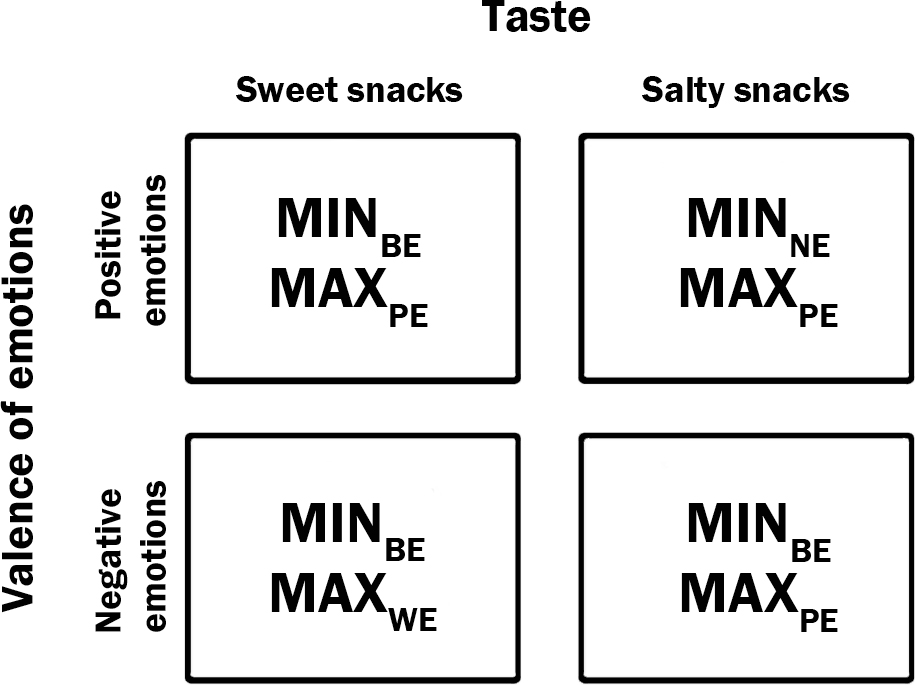
Figure 1.
Snack consumption and taste and valence of emotions
Table 3.
Consumer characteristics divided into segments: WE, NE, PE, BE
| Segment x̄ (σ) | Statistical verification | |||||
|---|---|---|---|---|---|---|
| WE | NE | PE | BE | |||
| Financial situation | Assessment of financial situation | 2.38 (0.886) | 2.24 (0.720) | 2.44 (0.729) | 2.42 (0.730) | F=3.480; p=0.016 |
| Health status | Assessment of overall health status | 2.42 (0.931) | 2.46 (0.813) | 2.63 (0.805) | 2.67 (0.833) | F=3.356; p=0.019 |
| Change in weight | 2.39 (0.638) | 2.15 (0.655) | 1.97 (0.683) | 2.06 (0.612) | F=7.086; p<0.001 | |
| BMI | 2.58 (0.564) | 2.49 (0.556) | 2.38 (0.569) | 2.474 (0.574) | F=1.914; p=0.126 | |
| Assessment of physical activity | 2.68 (1.093) | 2.55 (1.017) | 2.61 (1.022) | 2.56 (1.048) | F=0.454; p=0.714 | |
Table 4.
Positive emotions and the desire to eat snacks (salty/sweet)
| Segment x̄ (σ) | Statistical verification | |||||
|---|---|---|---|---|---|---|
| WE | NE | PE | BE | |||
| Positive emotion | Salty snacks (chips, snacks, crackers, and pretzels) | 2.40 (0.819) | 2.13 (0.737) | 2.58 (0.889) | 2.15 (0.703) | H=24.067; p<0.001 |
| Sweet snacks (cookies, chocolates, sweets, ice cream, candy bars) | 2.65 (0.812) | 2.41 (0.728) | 2.77 (0.782) | 2.37 (0.732) | H=19.659; p<0.001 | |
Table 5.
Negative emotions and the desire to eat snacks (salty/sweet)
| Segment x̄ (σ) | Statistical verification | |||||
|---|---|---|---|---|---|---|
| WE | NE | PE | BE | |||
| Negative emotion | Salty snacks (chips, snacks, crackers, and pretzels) | 2.45 (0.852) | 2.21 (0.741) | 2.47 (0.892) | 2.14 (0.667) | H=11.451; p<0.003 |
| Sweet snacks (cookies, chocolates, sweets, ice cream, candy bars) | 2.66 (0.894) | 2.53 (0.755) | 2.63 (0.844) | 2.36 (0.684) | F=3.743; p<0.11 | |
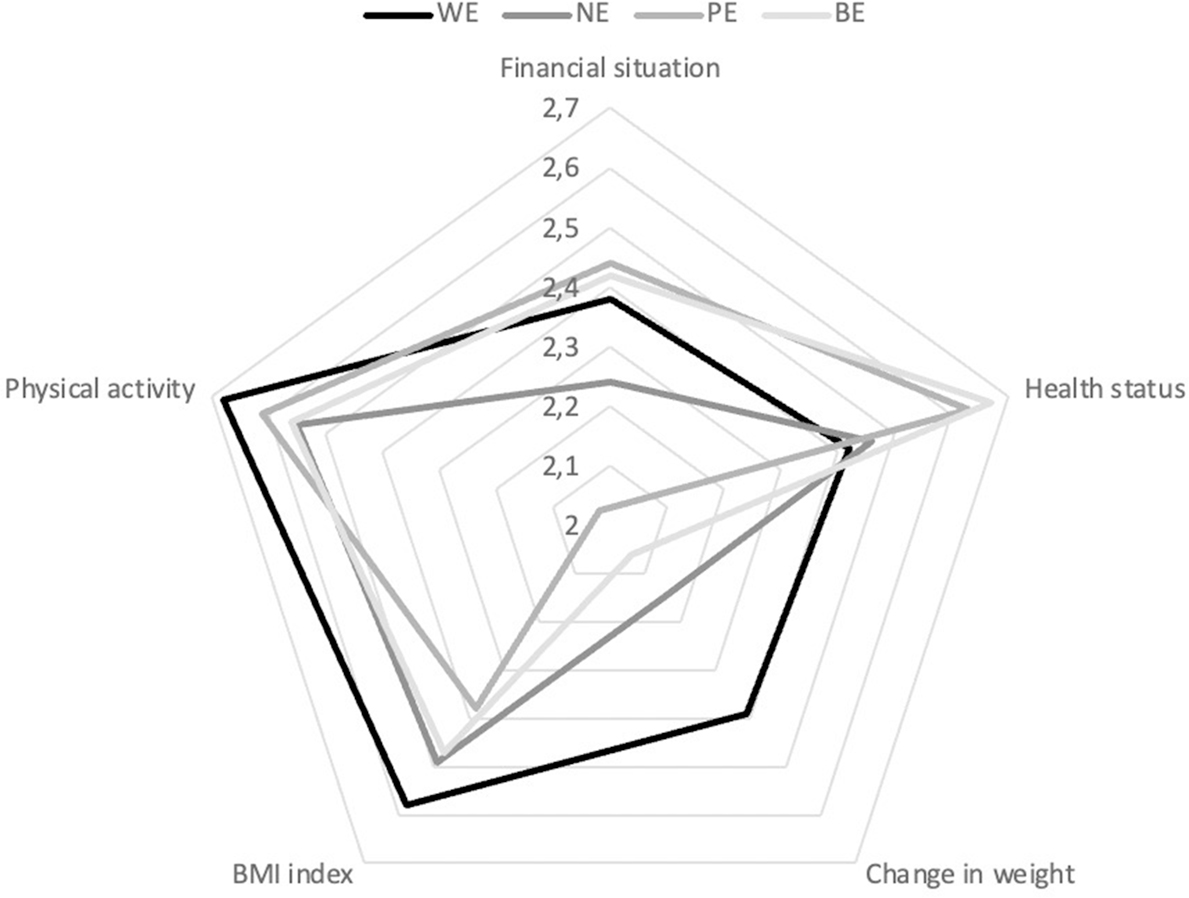
Figure 2.
Cluster profiles of snack consumers influenced by emotions