
Table 1.
Structure of the sample
| Gender identity | ||
|---|---|---|
| Woman | 72.0% | |
| Man | 22.3% | |
| Other | 5.7% | |
| Age (years) | ||
| Under 18 | 11.2% | |
| 18–26 | 56.9% | |
| 27–35 | 19.9% | |
| 36–45 | 6.0% | |
| 46–55 | 6.0% | |
| Education | ||
| Primary education | 7.7% | |
| Lower secondary education | 4.1% | |
| Secondary education | 37.5% | |
| Basic vocational education | 1.4% | |
| Higher education | 49.3% | |
| Average net income per person in the household | ||
| Under 1,000 PLN | 5.0% | |
| 1,000 PLN–1,500 PLN | 9.8% | |
| 1,500 PLN–2,000 PLN | 15.3% | |
| 2,000 PLN–3,000 PLN | 24.6% | |
| 3,000 PLN–4,500 PLN | 25.6% | |
| 4,500 PLN–5,500 PLN | 8.9% | |
| Over 5,500 PLN | 10.8% | |
| Current diet | ||
| Standard/Omnivore | 59.1% | |
| Pescatarian | 5.7% | |
| Vegetarian | 23.0% | |
| Vegan | 12.2% |
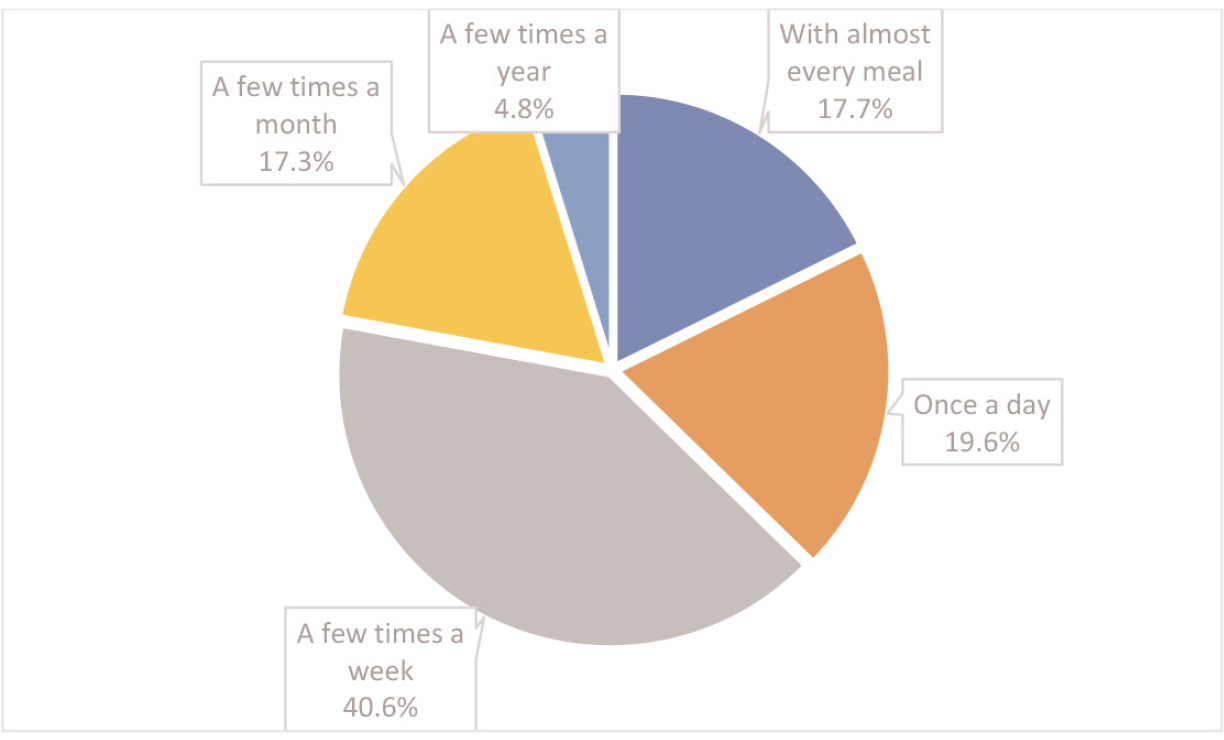
Figure 1.
Declared frequency of meat consumption by omnivorous and pescatarian respondents
Source: Own research.
Table 2.
Declared ability to stop eating meat and efforts to reduce meat in diet by consumers
| Definitely not | Rather not | Cannot say | Rather yes | Definitely yes | |
|---|---|---|---|---|---|
| Would you be able to quit eating meat? | 12.5% | 18.5% | 19.2% | 34.7% | 15.1% |
| General tendencies: | Not open to quitting meat consumption 31.0% | Open to quitting meat consumption: 49.8% | |||
| Are you trying to reduce the amount of meat in your diet? | 13.3% | 21.4% | 11.8% | 27.7% | 25.8% |
| General tendencies: | Not trying to reduce meat consumption: 34.7% | Trying to reduce meat consumption: 53.5% | |||
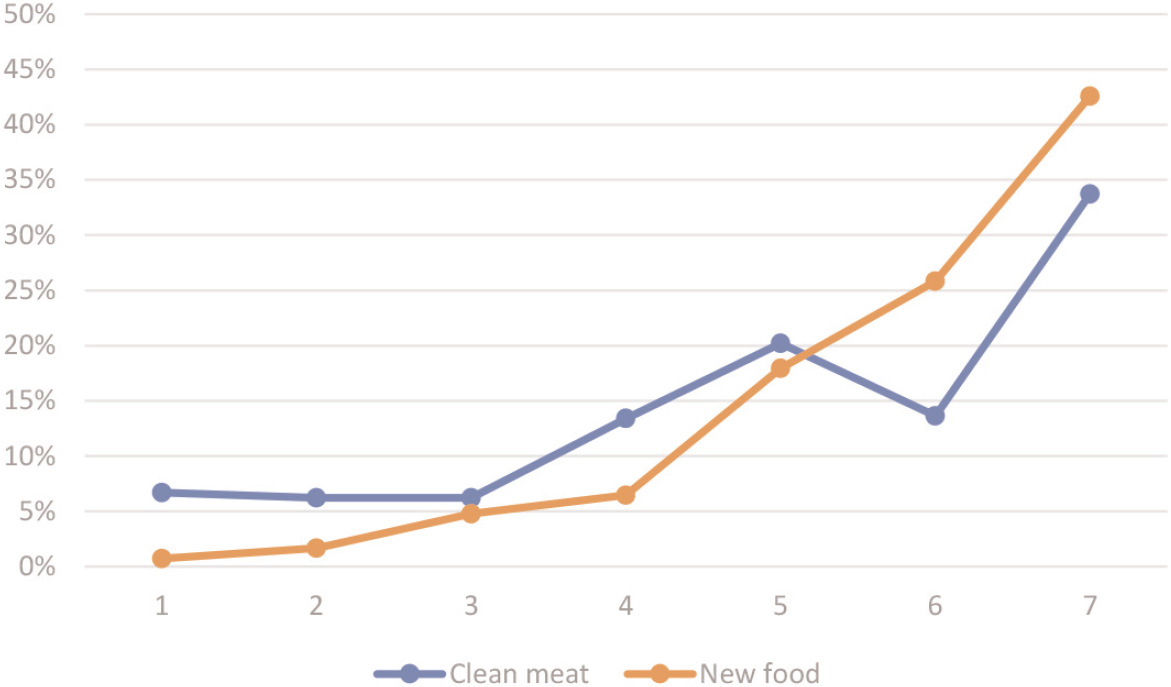
Figure 2.
Declared willingness to try new food and declared willingness to try ‘clean meat’, where 1 indicates definitely not willing to try and 7 indicates definitely willing to try
Source: Own research.
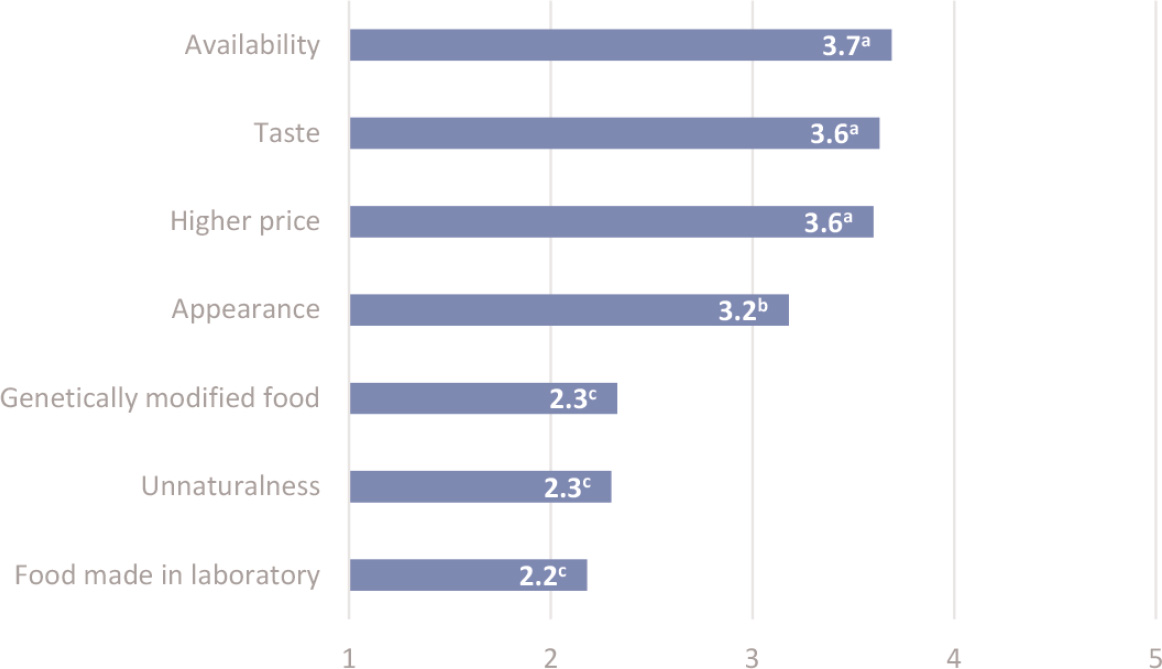
Figure 3.
Declared barriers towards ‘clean meat’, on a scale of 1–5, where 1 indicates that the concerned factor is not a significand barrier, whereas 5 a significant barrier. a, b, and c denote mean values marked with different letters to indicate statistically significant differences (p < 0.05)
Source: Own research.
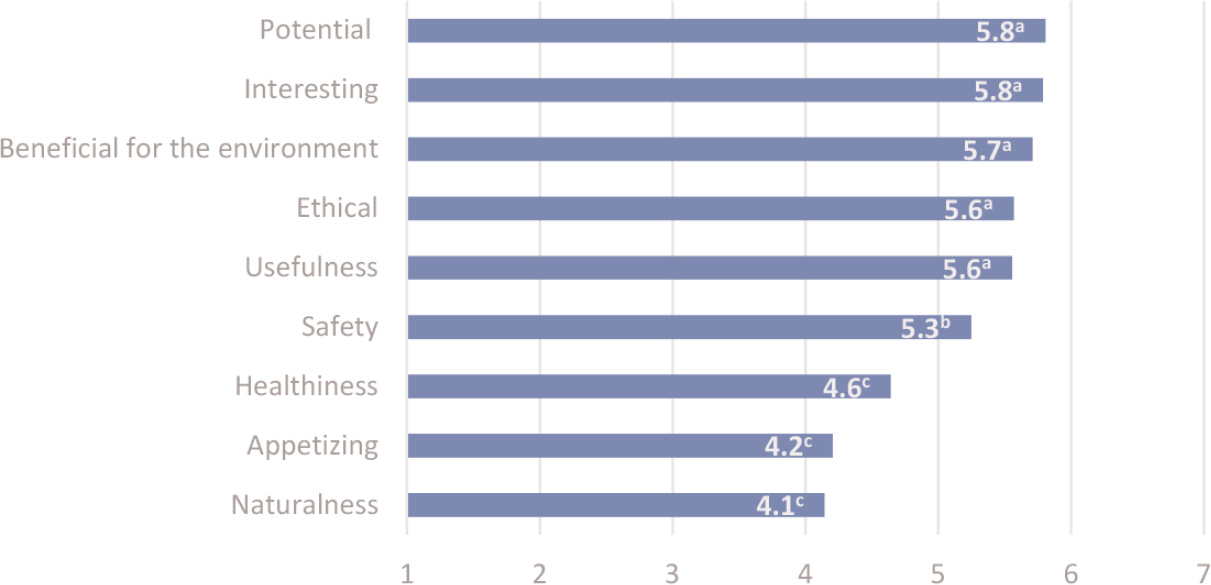
Figure 4.
Respondents’ associations of qualities of ‘clean meat’ on a 7-point scale, where 1 indicates definitely not, whereas 7 definitely yes. a, b, and c denote mean values marked with different letters to indicate statistically significant differences (p < 0.05)
Source: Own research.