
1. Introduction
The conducted analysis refers to an extremely significant demographic and social phenomenon, namely, the aging of societies, which poses enormous challenges and creates new solutions for improving the level and quality of life for people. This process is strongest in highly developed countries but has a global character. Projections from the World Social Report (2023) indicate that the proportion of older people in the global population will radically increase in the coming years, and by 2050, one in six people will be over 65 years old. The report Global Population Ageing: Peril or Promise? highlights demographic changes affecting all aspects of social and economic life and the need to rethink norms, behaviours, social expectations, as well as policies and institutions in a world where more people are over 60 than under 15 (Report, 2012). For over two decades, the most important and prestigious international organisations such as the world health organization (WHO), the international labour organization, the united nations population fund, the organisation for economic co-operation and development (OECD), the G20, the World Bank, as well as international civil society entities such as the Global Coalition on Aging, the International Federation on Ageing, HelpAge International, and the International Longevity Centre Global Alliance have been considering the aging of societies and developing related activities. This phenomenon is primarily viewed as a problem correlated with increasing amounts of social benefit payments and the need to expand the healthcare and caregiving systems. However, over the years, the approach to this issue has changed, as attention has shifted to possible strategies for addressing the problems of older people in ways that would also benefit society and its economy as a whole. In this context, the processes of life extension are seen as a civilisational success (Schoenmaeckers, 2005), associated with new opportunities for socio-economic development (Prettner, 2013) and megatrends in the contemporary economy: the silver economy and the 5.0 revolution.
The article is based on the premise that if we are dealing with two important processes – the ageing of societies and the development of the Economy and Society 4.0 and 5.0 – it is important to conduct research to identify the opportunities and ways in which older generations will function in the economy of the future. The aim of the article is to assess the possibilities of active participation of the 65+ generation in the Economy and Society 5.0. This assessment is based on the current socio-economic situation of seniors, expressed in indicators covering selected areas of senior functioning, namely, their financial situation, virtual reality, and quality of life. The study adopted the following hypothesis: There are differences among EU countries in terms of the socio-economic potential of older people, which determines their participation in the Economy and Society 5.0. The hypothesis was verified in the course of analysis of the above-mentioned metrics, based on the value of the determined synthetic indicator for EU countries.
In order to achieve the research objective, the article has separate sections containing a literature review and the theoretical background of the research concept, information on the research methodology, and results, as well as a section with a discussion and conclusion.
2. Literature review
2.1. Seniors and the silver economy
Insight into various cultures and civilisations allows for a generalised statement that, throughout human history, two opposing ways of treating the elderly have predominated (Neumann, 2023). The first approach is characterised by positive attitudes, full of social respect towards seniors, which consequently leads to surrounding them with care and concern (gerontocracy). The second approach views old age as a negative phenomenon, with the elderly often described by pejorative traits, leading to the depreciation of their knowledge and experience, and is frequently a symptom of gerontophobia.
Nowadays, the boundaries of old age are generally accepted according to the classifications adopted by the WHO: 60–75 years old – elderly age, also known as early old age; 75–90 years old – senile age, also known as late old age; and 90+ years old – venerable age, the period of longevity. At the same time, old age is seen to have social, biological, psychological, and socio-economic dimensions (Czekanowski, 2012). It should be added that it has become accepted in the literature that people aged 60 and 65+ are referred to interchangeably as seniors, the older generation, the elderly, and that any action aimed at this generation is called the silver economy.
Contemporary attitudes towards old age, its valuation, as well as the ways it is represented and criteria for ageing, are clearly changing (Moody & Sasser, 2012; Palmore, 1990). Historical research has begun to intensively analyse old age since the 1980s, as evidenced by the increasing number of gerontological and cultural-historical publications (Neumann, 2023). The most significant changes in thinking about older people occurred however in the twentieth century within the Euro-American civilisation. This is associated with observations of profound demographic changes that intensified in developed countries, characterised by a decline in natural increase and an increase in life expectancy, leading to a deepening ageing process within the population. In the twenty-first century, no one questions the phenomenon referred to as the “silver tsunami.” Instead, actions are taken to mitigate the disadvantages resulting from this process and to capitalise on existing opportunities for economic and social development. These actions include, among others, the creation and development of the silver economy (also referred to as the senior economy or longevity economy).
The silver economy encompasses the production of goods and services tailored to older people and shapes an environment where people over the age of 60 work collaboratively, succeed in the workplace, engage in innovative ventures, contribute to market development as consumers, and lead healthy, active, and productive lives (OECD-GCOA, 2014). The silver economy is understood as the sum of economic opportunities arising from increased consumer spending due to population ageing and the specific needs of people over 50 years of age. It is seen as a system based on adapting the production and distribution of goods to older people, and consequently to all age groups (age-friendly), using gerontechnology and social innovation. Age-friendly solutions are complementary to the concept of a “society for all ages” (Klimczuk, 2016).
In the literature, attention is drawn to the need for a comprehensive adaptation of business and economic development to an ageing society (Radvanský & Páleník, 2011), as well as to the utilisation of changes in the lifestyle of older generations – increased interest in recreation, culture, sports, and tourism (Pauhofova & Dovalova, 2015). It is emphasised that the silver economy should not be treated as a standalone sector of the economy, but rather as a cross-section of the market involving many industrial sectors (Enste et al., 2008). The silver economy has significant economic potential (Domonkost et al., 2013). According to estimates, by 2025, the value of the European Union silver economy will reach 6.4 trillion EUR, supporting 88 million jobs. This would account for approximately 32% of EU gross domestic product (GDP) and about 38% of EU employment (European Commission, 2018). This fact increases interest in issues related to entrepreneurship among older generations, harnessing the potential of older people in the labour market, and combating their premature withdrawal from professional and social activities (Ainsworth, 2015; Blid, 2018; Krzyminiewska, 2021; Weber & Schaper, 2004).
2.2. Economy (Industry) and Society 5.0
Bibliometric studies (Alpaslan & Çelik, 2023; Barataa & Kayserb, 2022; Wu et al., 2023) indicate the dynamic development of literature on Economy (especially Industry) and Society 5.0, which clearly underscores the importance of this issue in both an academic and practical approach to socio-economic life. As Ghobakhloo et al. (2022, p. 718) write, “there is a general agreement that Industry 5.0 diverges from previous industrial revolutions as it represents a stakeholder pulled socio-technological phenomenon that systematically shifts classic profit and consumption-driven economic models to circular, regenerative, sustainable, and resilient value-creating economic models.” The solutions of Economy/Industry 5.0 and Society 5.0 are based on human-centred activities, human-machine cooperation, and the promotion of employee well-being (Breque et al., 2021; Golovianko et al., 2023). Society 5.0 is the ultimate result of Industry 4.0, which is the outcome of a massive digital transformation and an information society, aimed at promoting human development in conjunction with technological progress. While Industry 4.0 was considered to be technology-driven, Industry 5.0 is value-driven. It is a vision of an industry that seeks efficiency and productivity while respecting human values and contributing to addressing important societal needs (Gladden, 2019; Zein et al., 2024). At the core of Society 5.0 is a commitment to human well-being, where advanced humanitarian technologies, guided by ethical principles and a deep understanding of human needs, become the driving force of development. This applies to all areas of life, including healthcare, education, urban planning and environmental sustainability. The goal is to integrate technology into everyday life, enhance human capabilities, support social inclusion and address societal challenges. Therefore, the revolution is not merely technological; it is fundamentally focused on humans (Shiroishi et al., 2019). Its aim is to improve the quality of life, increase productivity and efficiency, enhance social integration, and reduce inequalities.
In this context, the stage of development of Economy and Society 5.0 determines the introduction of a humanistic, person-centred approach to the senior population into development strategies. This approach will dignify the oldest generation, allowing them to remain active, respected, and adequately supported members of society.
2.3. Theoretical background of the research concept
The economy and society of the future, as is clear from the above considerations, will focus on people – especially their quality of life, and their ability to use modern technologies. This means that it is necessary to reflect on the situation of seniors from European Union countries in this regard.
WHO (1997) defines quality of life “as an individual’s perception of their position in life in the context of the culture and value systems in which they live and in relation to their goals, expectations standards and concerns.” Subjective and multidimensional nature of quality of life makes it difficult to assess, and various indicators are used to study the phenomenon. Kawa et al. (2017) highlight the objective, social, and subjective factors that determine quality of life. The authors point to the following as examples for assessing this area: standard of living (including income and consumption); social security (including interpersonal contacts); sense of security (including economic and local community); sense of satisfaction (including way of life, health); human environment and living conditions (e.g., communications infrastructure); social indicators (including life expectancy). Walker and Mollenkopf (2007) distinguished eight models of quality of life: (1) using objective social indicators of standard of living (e.g., regarding income and wealth); (2) based on satisfaction of human needs (subjective feelings of the individual); (3) using subjective social indicators of life satisfaction and psychological well-being; (4) based on social capital (measured by indicators of social networks, support, integration, participation in activities); (5) considering ecological and neighbourhood resources (objective, e.g. quality and access to services); (6) based on health and functioning (physical and mental fitness and work capacity; (7) psychological (taking into account cognitive competence, autonomy, adaptation, among others); (8) with a hermeneutic approach (emphasizing individual values).
In ensuring a high quality of life for seniors, knowledge of information and communication technologies will play a special role in the future. CSO (2022) includes simple indicators, i.e. Internet access, Internet use, Internet shopping, and digital skills, in its analysis of households. Liu et al. (2023) measured the digital participation of the elderly through their access to the Internet via cell phones and various digital devices. Scheerder et al. (2017) highlight three levels of analysis of the digital divide, i.e. access to the Internet, the skills to use it, and the consequences of using it. van Dijk and Hacker (2003) draws attention to the multifaceted concept of access, which should be considered in four dimensions: psychological, material, skills, and use. Niehaves and Plattfaut (2014) conducted research on the Internet's adaptation by older people, building models based on theories of technology acceptance. They focused, among other things, on intentions to use a particular technology, conditions, and behaviours associated with use, or the effectiveness of computer use.
Both the achievement of a high quality of life and active participation in digital reality are closely related to the income aspect of the individual (among the determinants of these processes, the material situation often appears). In view of the above, all three of these areas were included in the research conducted. The indicators adopted within each of them are a subjective choice and a starting point for further in-depth research.
3. Data and methodology
In the presentation of the theoretical aspects of the researched issues, secondary sources and literature analysis were used, whereas in the empirical part, descriptive statistics and the Technique for Order Preference by Similarity to Ideal Solution (TOPSIS) method. The time frame of the analysis covers the year 2022, i.e. the latest period for which data are available in the relevant area – selected based on substantive premises and encompassing all analysed countries (including the European Union). Seniors are defined in the survey as the population of people aged 65 and older. However, due to the system of reporting information on the elderly, the age of seniors ranged from 64 to 74 for online activity. The analysis carried out aims to determine the current situation of older people in terms of their ability to adapt to the demands of an evolving society. It provides a starting point for further research – covering the dynamics of change in the subject of study.
The empirical analysis was conducted using the method proposed by Hwang and Yoon in 1981, which belongs to the group of linear ordering methods for multi-criteria objects (TOPSIS). This method allows for creating a ranking of the studied countries from best to worst in terms of the examined features, based on the distances of the evaluated objects from the ideal object.
The TOPSIS procedure included the following (Bąk, 2016, pp. 26–27; Kisielińska et al., 2021, pp. 126–134):
Selection of diagnostic features and determination of their nature (stimulants, destimulants);
Standardisation of variables – normalisation performed using the zeroed unitarisation method, based on the following formulas:
a) In the case of stimulants:
b) In the case of destimulants:
where z ij – normalised value of the jth variable in the ith country, x ij – value of the jth variable in the ith country.c) Evaluation of the relevance of potential variables based on correlation and coefficients of variation.
d) Determining the coordinates of the pattern and antipattern.
e) Calculating the (Euclidean) distance of objects from the pattern and antipattern – in accordance with the following formulas:
f) Determining the synthetic indicator for the ith object using the following formula:
Initially, 15 indicators reflecting 3 areas of functioning for people over the age of 65 were selected for analysis, including:
− Material situation (four indicators) – assuming that the higher level of development of the economy, the availability of goods related to technological progress, new distribution channels for products and services (e.g. e-commerce) or the desire to actively use the virtual world generate costs that are more important determinants of seniors’ behaviour, for example, in terms of the role of consumers in the silver economy sector;
− Digital reality (five indicators) – taking into account one of its most important determinants, i.e. Internet activity, and bearing in mind that Internet use promotes social inclusion and building interpersonal relations as well as facilitates the everyday functioning of seniors in the era of e-economy and e-society development;
− Quality of life (six indicators) – understood as longevity in good health, based on communication and interpersonal integration, related to the creativity of seniors, recognising this area as essential for the active participation of older people in the future economy and society.
Indicators describing the material situation were defined as destimulants – a higher value of these indicates worse purchasing power of seniors, greater difficulty in adapting new technologies and meeting needs, greater risk of decline in quality of life. Indicators reflecting online activity were defined as stimulants – a higher value of these indicators indicates better integration of technology into daily life, better chances for social inclusion, and better opportunities to meet many needs. Indicators related to quality of life were defined as stimulants – higher values indicate higher levels of social inclusion, greater intensity of social relationships, and better chances for an active and longer life.
Due to a coefficient of variation of less than 10%, three variables (overall life satisfaction, percentage of the population maintaining contact with family, and percentage of seniors maintaining contact with friends) were eliminated from further analysis.
The indicators adopted in the study and their nature are presented in Table 1.
Table 1
Set and nature of variables included in the study.
| Indicator | Variable name | Variable type |
|---|---|---|
| Material situation | ||
| DEPR | Material and social deprivation rate (% of population 65+) | Destimulant |
| PSEx | Persons at risk of poverty or social exclusion (% of population 65+) | Destimulant |
| COMP- | People who cannot afford a computer (% of population 65+) | Destimulant |
| INT- | People who cannot afford Internet connection for personal use at home (% of population 65+) | Destimulant |
| Digital reality – internet activity | ||
| ONCOUR | Doing an online course on any subject (% of population 64–74) | Stimulant |
| TELVID | Telephoning or video calls (% of population 64–74) | Stimulant |
| INGS | Finding information about goods and services (% of population 64–74) | Stimulant |
| IBANK | Internet banking (% of population 64–74) | Stimulant |
| APPWEB | Making an appointment with a practitioner via a website (% of population 64–74) | Stimulant |
| Quality of life | ||
| HLY | Healthy life years at age 65+ | Stimulant |
| SOCNET | Participating in social networks (creating user profile, posting messages, etc.) (% of population 64–74) | Stimulant |
| PART-ACT | Persons participating in active citizenship (% of population 65+) | Stimulant |
Source: own elaboration based on: [Eurostat].
As a result of the various stages of the research procedure, culminating in the determination of a synthetic indicator, a ranking of the European Union countries was developed, taking into account the conditions of the 65+ population for transformation towards becoming active participants in the Economy and Society 5.0. In the linear ordering and classification of countries, the arithmetic mean and standard deviation of the synthetic indicator values were used. The EU countries are classified under four groups:
Group I (very good conditions):
Group II (good conditions):
Group III (poor conditions):
Group IV (very poor conditions):
The analysis assumes that all the characteristics considered in determining the synthetic measure and building the ranking of the EU countries are equivalent, and that the synthetic indicator reflects the current situation of seniors in the most balanced way possible – such an approach was taken, for example, in the case of the Index of Economic Freedom (Kim, 2023).
4. Research results
Preliminary information about the situation of the EU countries in the field under study is provided by basic statistics covering 2022:
For all the characteristics assessed, the greatest variation between the countries occurred for the indicator reflecting active citizenship: the highest percentage of the 65+ population surveyed was recorded in Finland – 72.5%, in Luxembourg it was almost 20%, in Sweden 16.6%, and in the Netherlands 15.2%; the lowest values were recorded in Bulgaria (1.1%) and Romania (1.4%). In the European Union as a whole, just over 6% of the surveyed population of seniors showed civic activity in the year under review.
There was also strong variation among the EU countries regarding the rate of material deprivation. The inability to meet basic needs affected as many as about 40% of people over 65 in Bulgaria and Romania, and only about 2% in Luxembourg and Sweden.
Material deprivation affected one in eight seniors in the EU, while nearly one in four people in this age group were at risk of poverty or social exclusion.
When it comes to Internet use, seniors in the age group surveyed were most active in the EU in the area of searching for information about products and services – the Community average was 45%, with the Netherlands, Sweden, and Denmark at around 80%, compared to just over 20% in Bulgaria and Romania.
As can be seen from the analysis, 11 out of the 27 European Union countries achieved a value of the synthetic measure higher than the Community average, with the overwhelming number of surveyed units (16) obtaining, unfortunately, a lower value (Table 2). In the group of countries with very good conditions for the senior population to face the challenges of Economy and Society 5.0, there were five entities – three Scandinavian countries, plus the Netherlands and Luxembourg (Figure 1), with Finland achieving the highest value of the synthetic indicator. It is a country whose material deprivation rate and the at-risk-of-poverty-or-exclusion rate for people 65 and older are among the lowest in the EU. The country’s seniors are highly active on the Internet – in 2022, three-quarters of the population aged 64–74 sought information about products and services in the virtual world, more than 80% used online banking, slightly more than half made a doctor’s appointment through a website and almost half were active on social media. Finnish seniors also exhibit the highest civic activity among seniors from various EU countries (73%).
Table 2
Distances of objects from patterns and antipatterns and a synthetic measure of the determinants of the 65+ population to active participation in Economy and Society 5.0.
| Country | d+ | d− | q |
|---|---|---|---|
| Belgium | 1.4844 | 2.2995 | 0.6077 |
| Bulgaria | 3.0672 | 0.6101 | 0.1659 |
| Czechia | 2.2023 | 1.8439 | 0.4557 |
| Denmark | 1.2603 | 2.9117 | 0.6979 |
| Germany | 2.2834 | 1.5845 | 0.4096 |
| Estonia | 2.4615 | 1.4327 | 0.3679 |
| Ireland | 1.9140 | 1.9675 | 0.5069 |
| Greece | 2.4866 | 1.4946 | 0.3754 |
| Spain | 1.7875 | 1.9265 | 0.5187 |
| France | 1.9866 | 1.8762 | 0.4857 |
| Croatia | 2.6708 | 1.2311 | 0.3155 |
| Italy | 2.1829 | 1.8149 | 0.4540 |
| Cyprus | 2.2977 | 1.8964 | 0.4522 |
| Latvia | 2.4419 | 1.2701 | 0.3422 |
| Lithuania | 2.5425 | 1.1820 | 0.3174 |
| Luxembourg | 1.4936 | 2.4599 | 0.6222 |
| Hungary | 2.1015 | 1.6255 | 0.4361 |
| Malta | 1.9908 | 1.8576 | 0.4827 |
| Netherlands | 1.0488 | 2.8913 | 0.7338 |
| Austria | 2.0876 | 1.9336 | 0.4808 |
| Poland | 2.4477 | 1.6541 | 0.4033 |
| Portugal | 2.3313 | 1.3938 | 0.3742 |
| Romania | 3.0460 | 0.8754 | 0.2232 |
| Slovenia | 2.1245 | 1.8404 | 0.4642 |
| Slovakia | 2.4062 | 1.6216 | 0.4026 |
| Finland | 0.9581 | 2.8185 | 0.7463 |
| Sweden | 1.0783 | 2.8188 | 0.7233 |
| UE-27 | 2.0809 | 1.8197 | 0.4654 |
Source: Own elaboration.
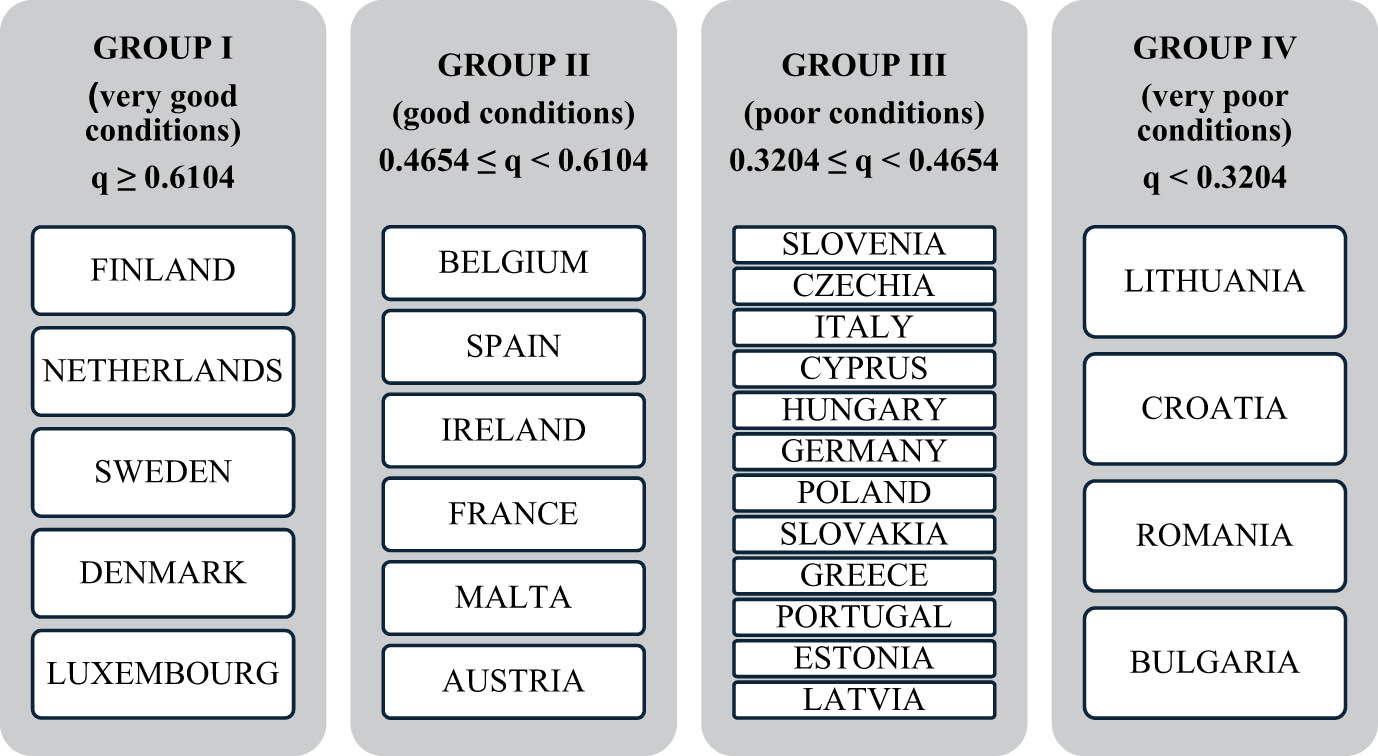
Figure 1
Classification and ranking of the EU countries according to the value of the synthetic measure of the determinants of the 65+ population to active participation in the Economy and Society 5.0 (descending).
Source: Own elaboration.
The above-mentioned characteristics describing the older part of Finnish society reflect the overall picture of the country and the conditions of society there; regardless of age, the country ranks first among the happiest countries in the world, being also the country with the highest social trust in Europe (Helliwell et al., 2024). The aforementioned high level of civic participation is due to the fact that Finns are perfectly organised in larger and smaller communities, care about their surroundings and each other, undertake various social initiatives – stemming from a strong tradition of cooperation and solidarity, and are committed to the environment and sustainable development.
The good economic indicators describing the population of seniors in Finland are due to the principle of fairness observed in this country – everyone has the same right to education and social benefits. This country is among the most social ones within the OECD group – it spends more than 30% of GDP on public benefits (Alfageme, 2020). The high online activity of Finnish seniors is due to the information society that has been built up over the years in the country – in 2009, the right to access the Internet was added to the catalogue of civil rights in Finland, and in 2010, the country became the first in the world where the Internet was guaranteed by law (Finland, n.d.).
The Netherlands, Sweden, Denmark, and Luxembourg are also among the countries whose seniors are in a very good starting position to meet the requirements of Economy and Society 5.0. The first three countries are part of the European Union, whose residents aged 65+ are characterised by a very good material situation and extremely high online activity (in 2022, searching for information about products and services was the activity of about 80% of people in the 64–74 age group in each of the countries mentioned, online banking was used by 80–88% of this population – the highest percentage in Denmark, 40–65% used websites to make appointments with a doctor – also the highest percentage in Denmark, and a similar percentage was present in social media – the highest again in Denmark. In contrast to Finland, the Netherlands, Sweden, and Denmark saw far less overall civic activity in 2022 – it involved 15–17% of people aged 65+ in the Netherlands and Sweden, and only about 8% in Denmark. At the same time, in the Netherlands or Denmark, one can see above-average involvement of seniors in formal volunteer activities (35 and 27% of the 65+ age group, respectively). Luxemburg’s seniors, meanwhile, are in a very good material situation – in 2022, the country recorded the lowest rate of material deprivation of the 65+ population among all EU countries, and the lowest percentages of people in this age group who could not afford a computer (0.4%) and/or the Internet (0.3% – second after Denmark, where such people were not recorded at all). Active citizenship also characterises the elderly in Luxembourg – in 2022, it was one in five people aged 65 and over (a higher percentage than in Sweden, the Netherlands, or Denmark, though much lower than in Finland).
The results of the research presented above, which includes the EU countries, correspond, for example, with the results of the research conducted by De Hoyos Guevara et al. (2021). These authors created a ranking of 57 countries of the world on the basis of the synthetic index S5I (Society Index 5.0). The synthetic measure was developed with 34 indicators reflecting: forward-looking skills (e.g. Data Science, Data Management, Communication, Finance, Technology, Computer Networking), society (e.g. Global Innovation Index, Control of Corruption, Environmental Performance Index, Democracy, Well-being), and development (e.g. Human Development Index, Human Progress Index). Although the study did not focus on the population of seniors and was based on a different research method, it made it possible to assess the place of the EU countries among other entities in terms of transformation towards Society 5.0. Among the 57 countries, Finland ranked third (behind Switzerland and Austria), followed by Belgium, Sweden, Germany, and the Netherlands.
Four countries, including Romania and Bulgaria, were among those in the EU with very poor conditions for seniors to make the transition to Economy and Society 5.0. In both of these countries, the material deprivation rate in 2022 reached just over 40%, and the at-risk-of-poverty-or-exclusion rate reached nearly 42% in Bulgaria and 35% in Romania. In Bulgaria, one in ten seniors aged 65+ could not afford a computer in the year under review, and one in six could not afford an Internet connection. The problem of Internet access was shared by one in five of the age group surveyed in Romania. In terms of online activity, the situation of seniors from Bulgaria and Romania looked dramatic, compared to the countries in the first group of the ranking – online banking was used by 3.4% of seniors aged 64–74 in Bulgaria and 4.3% in Romania (compared to approximately 88% in Denmark), doctor’s appointments were made via websites by 2.6% of people in this age group in Romania and 3.7% in Bulgaria (compared to about 63% in Denmark). In contrast, 1.1% of those in the 65+ age group in Bulgaria and 1.4% in Romania were civically active – compared to, mentioned earlier, nearly 73% in Finland. The need for greater socialisation and community integration of Romanian seniors is noted by Mangra (2023). Based on the results of a survey of participants in the Telefonul Vârstnicului Program for socialising and combating loneliness among the elderly, she found that most of them do not have high digital skills, and new technologies are used mainly by those who have family abroad.
In the context of the development of Economy and Society 5.0, an important area of activity for seniors seems to be education and the deepening of skills for functioning in a world dependent on technology and modern solutions – both in the area of carrying out daily duties as well as in the area of communication and intra- or inter-generational integration. They may take the form of participation in online courses covering various areas of life. Unfortunately, according to the analysis, in 2022, such activity was noted in a very low percentage of people aged 64–74 in all EU countries – with Romania and Bulgaria at 0.2 and 0.4%, respectively, and the Netherlands at 7.8% (the highest value), Sweden at 6.6%, and Finland at 5.5%. Seniors’ traditions in undertaking educational activities are largely associated with a country’s overall education system. According to the report entitled Real Opportunities for Adult Online Education. The White Paper (Report, 2019), participation rates in adult education in the EU countries ranged in 2017 from 30.4% in Sweden to 1.1% in Romania – results confirmed by the analysis of seniors in the field of online education (the highest activity in 2022 was noted in Sweden, the lowest in Romania). However, as the report’s authors note, the Internet and other tools will not result in the democratisation of education, which again is confirmed by the analysis conducted, showing that in countries such as Denmark and Luxembourg about 0.5% of people aged 65+ cannot afford a computer or the Internet, and only about 3% of people in this age group were participants in online courses in 2022.
There are many indications of the fact that seniors function efficiently in the world of technology and various relationships, among which – apart from the most dominant one, which is the financial situation – are the expected years of healthy life for people aged 65+. Among the EU countries, ten exceeded the threshold of 10 expected years of healthy life for 65+ population in 2022, with the highest value estimated for seniors from Sweden – 14.6. This indicator is reflected in various forms of activity of the elderly, e.g. in Sweden, there is a high degree of social participation, health-oriented activities, as well as attention to self-reliance and independence, which is often associated with longer working life. Peacock and Künemund (2007) presented a slightly different perspective on the issue of the relationship between the use of modern technologies and integration or social inclusion – it is common to consider new technologies as a source of building relationships, contact with the environment and openness, while the above-mentioned authors noticed differences in the use of modern communication technologies, among other things, in the ability to integrate into the community and experience in this area. This approach is also confirmed in the analysis – in countries where seniors are characterised by a low level of active citizenship (Bulgaria, Romania), they are also characterised by low activity on the Internet.
5. Discussion and conclusion
The development of features (indicators) characterising people aged 65 and over is a major challenge for the development of Economy and Society 5.0. In the overwhelming number of countries of the European Union, the conditions for the active participation of older people in the modern economy and society are weak and very weak.
Based on the results of the study, it can be concluded that the population of seniors in the EU countries varies widely in terms of the material situation, activity in virtual reality and quality of life. Similar conclusions were made, for example, by Pirhonen et al. (2020), based on a survey of seniors from Finland and Ireland on the perceptions of digitisation. Finland was not only defined as the fastest ageing society in Europe, but also as one of the leaders in the implementation of digital technologies in social and health services, while Ireland was defined as a demographically younger society, and also less “digital.”
The analysis makes several observations:
There are large differences among EU countries in terms of the socioeconomic potential of the elderly (varying values of the synthetic indicator), determining their functioning in Economy and Society 5.0, which means positive verification of the hypothesis set in the study.
In all the countries in the group with the highest values of the synthetic measure, due to the high level of social trust, social policy, promotion of equality, effective education system, nature of society (information), as well as the high level of safety and quality of life, seniors are in a much better starting position towards the pro-development processes of socio-economic change.
In the face of material difficulties, problems with access to modern technologies and poor pro-social attitudes, it seems that the introduction of the principles of Economy and Society 5.0 may further exacerbate the scale of inequality in the situation of seniors in various European Union countries.
The changing perception of the elderly, evolving into an active population with potential and experience worth managing, is by all means welcome. However, to effectively utilise these human resources, it is necessary to better diagnose their capabilities and needs. To date, data on the functioning of seniors in various areas of socio-economic life are insufficient. One example here could be information on the activity of age groups on the Internet – European statistics include the population of people aged 64–74, but do not take into account those over 74.
The changing conditions of seniors’ functioning also apply to the professional sphere. It is necessary to have a good recognition of the possibilities of activating seniors in the labour market. Among the EU countries, the highest labour force participation of people in the 50+ age group is characterised by Sweden and Estonia (nearly 50% in 2022). As Palacios (2023) notes, it has been estimated that Spain’s GDP could increase by about 10% if the employment level of people over 65 reached that of Sweden. In addition, entrepreneurship among members of this generation could significantly improve their spending capacity and quality of life.
Increasingly, development opportunities for various entities arising from the development of the silver economy are being highlighted. However, in order to properly determine the directions of this development, it is necessary to constantly analyse the changing conditions of senior citizens’ behaviour. Juxtaposing the needs of seniors with the factors determining their behaviour and diagnosing their ability to participate in various market areas undoubtedly allows a better assessment of the current and future situation of these people, including the conditions of Economy and Society 5.0.
Funding information
Supported by funds granted by the Minister of Science of the Republic of Poland under the “Regional Initiative for Excellence” Programme for the implementation of the project “The Poznań University of Economics and Business for Economy 5.0: Regional Initiative – Global Effects (RIGE).”
Author contributions
Hanna Pondel – 50% and Grażyna Krzyminiewska – 50% both in preparing the concept, conducting research, compiling results, drawing conclusions, and editing the text.
Conflict of interest statement
Authors state no conflict of interest.