

INTRODUCTION
Background
The healthcare system is burdened with increasing demands. Chronic conditions such as cardiovascular disease, diabetes or mental illness are on the rise (World Health Organization (WHO), 2022). Complex treatments of chronic or multiple health problems often require the collaboration of professionals from different disciplines or healthcare organizations. Interprofessional Collaboration (IPC) becomes a necessity (Gerber et al., 2018). However, healthcare institutions are also under pressure to provide services in a timely manner while managing with limited human and financial resources (OECD/European Union, 2022). According to Van Wyk (2017), efficient teamwork between different professional groups is essential to manage these complex needs in the healthcare system. The Swiss Academy of Medical Sciences (SAMW, 2020) also draws attention to the importance of interprofessionality as a precondition for quality, safety, and a positive outcome in healthcare.
The Interprofessional Education (IPE) Guidelines describe interprofessional (IP) healthcare as follows:
“Interprofessional Healthcare occurs when various professions learn from and about each other to improve collaboration and the quality of care. Their interactions are characterised by integration and modification reflecting participants understanding of the core principles and concepts of each contributing discipline and familiarity with the basic language and mind sets of the various disciplines”
(Barr et al., 2017, S. 14).
To prepare healthcare professionals (HCPs) optimally for IP patient-centered collaboration, IP training approaches are increasingly being pursued throughout education. IPE is defined as “when students from various professions learn from and about each other to improve collaboration and the quality of care” (Barr et al., 2017, S. 14). The WHO considers IP education as a strategy to counter the above-mentioned challenges and shortage of HCPs (WHO, 2010). In 2019, the federal health office (BAG) Switzerland adopted a new law regarding health professions. This included IP competences which need to be acquired during the bachelor’s programs of health professionals (BAG, 2019). A new approach to this has been created in the last few years by establishing IP clinical training wards (BAG, 2020).
The world’s first student-led IP clinical training ward (IPTW) was opened by Linköping University in Sweden in 1996. The IPTW aimed to train “interprofessional professionals” to increase patient safety. The concept of the Linköping Health Faculty follows principles of IP education and problem-based learning (Sottas et al., 2016). This concept served as a model for the ZIPAS®-program (Barlocher et al., 2020). ZIPAS® stands for “Zürcher interprofessionelle klinische Ausbildungsstation” (Zurich interprofessional clinical training ward”) and is established at four hospitals in the Zurich area: University Clinic Balgrist (Balgrist), University Hospital Zurich (USZ), Kantonal Hospital Winterthur (KSW), and Children Hospital Zurich (KISPI). At the KSW and the KISPI the ZIPAS®-project is implemented long term as a student-run ward.
The ZIPAS®-program started in 2018 at the USZ (BAG, 2020). Students in medicine, nursing, physical therapy, occupational therapy, nutrition scientists, and social workers take care of real patients under supervision of facilitators for three to four weeks as an IP-team (Ulrich, 2017). Facilitators are recruited from each professional group to provide learning support for students. All facilitators are professional educators, specialists, or senior physicians in the corresponding medical field and are selected from the existing staff (Projektverbund ZIPAS, 2018).
The goal of the ZIPAS®-program is to learn with, from, and about each other while working independently and interprofessionally to support self-regulated problem-solving (BAG, 2020; Barr et al., 2017). ZIPAS® enables participants to develop their IP competencies. Participants are sensitized for IPE and IPC (Ulrich, 2017).
An explorative literature research prior to this paper revealed that students working at clinical training wards develop knowledge about the roles of other professions and are improving their teamwork skills. Hall (2005) found that there is a culture and professional separatism in the health care system that is worsened by the lacking existence of IP training wards. However, a systematic review showed that, so far, no evidence has been available about a change of attitude towards other professions compared to single discipline wards (Kent & Keating, 2015).
People tend to make judgements about other people based on their own perspective. This leads to a conflict whenever the other person is not acting according to one’s own values (Schulz, 2011). In IP-teams HCP-students work together with various professions, thus judgements against other students can influence IPC negatively. Several authors stated that perspective taking leads to improved helpfulness and altruism, better judgements of others, and decline of stereotypes and prejudice (Galinsky et al., 2008; Todd & Galinsky, 2014). According to Bainbridge and Regehr (2015) taking someone’s perspective is an acquirable skill. Giving students the possibility to observe interactions where different perspectives are considered enables them to widen their viewpoint (Bainbridge & Regehr, 2015). Up to this point no studies were found about fostering factors for perspective taking in IP training wards. This paper has the aim to fill this knowledge gap.
A key element of perspective taking is assessing the knowledge of others and how they perceive something. Moreover, it includes the imagination about what the point of view of the other person might be (Heasman & Gillespie, 2022). Bainbridge and Regehr (2015, p. 58) state: “Valuing diversity of knowledge by enabling each type of expertise to make unique representations of their understandings and assisting people with different expertise to better recognize and accept the different ways of knowing of others are the foundation for perspective taking.”
Aim and research question
The aim of this study is to find out which factors foster developing perspective-taking skills in the context of the IP clinical training wards with HCP-students in Switzerland. The research question is: What factors foster the development of perspective-taking skills in the context of a clinical training ward with HCP-students in Switzerland?
METHODS
A mixed methods approach was chosen to evaluate the overall ZIPAS®-project (Kerry et al., 2023). The overall evaluation study will be published in a separate paper.
ZIPAS® project description
A ZIPAS®-ward is defined as six to eight beds of a regular unit. One of the specific aspects of ZIPAS® is a shared office for the HCP-students and facilitators involved. Patients are selected for the ZIPAS®-project by the bed allocation team of the clinic based on their diagnosis. The aim for the students is to work interprofessionally and independently with real patients from admission to discharge. Additionally, they must organize after-care for the patients. Students usually are in the last year of their education in nursing, medicine, physiotherapy, occupational therapy, nutritional counselling, or social work. All participants were in their one or last year of their education program. Medical students were mostly allocated to the ZIPAS®-project, whereas most of the other HCP-students chose this project voluntarily. The ZIPAS®-program lasts three to four weeks and is part of the regular internship of the respective study program.
On the first day of the ZIPAS®-program, there is an introduction-day for the students including team-building activities given by educators from the ZIPAS® development team. The HCP-students work during the day shift, which lasts from around 7am to 5pm. Every day there is time for group reflection on the interprofessional aspect of ZIPAS® and to talk about patients. During the ZIPAS®-program there are (daily) planned and spontaneous interprofessional activities. In addition, interprofessional ward rounds are organized and led by each profession in turn.
The facilitators act as supporters and supervisors. The main facilitation is done by a nurse. Their task is to ensure the safety of the patients, but to intervene as little as possible. Facilitators from the other professions specifically take over the daily reflection session and profession-specific support. The main responsibility for the patients, however, lies with the HCP-students. To achieve a high quality of care, they must support each other in their tasks.
Data collection
Data were collected between August 2018 and June 2022 in five different wards, including Neurology, Traumatology, Orthopedics, Internal Medicine, and General Internal Medicine for Children.
Data collection methods were:
1) An online questionnaire was sent out to HCP-students and facilitators before and after the ZIPAS®-program.
The questionnaire asked the students for:
demographic data
experiences of previous interprofessional teamwork in the internships
feelings as a team member
expectations of the facilitators
assessment of the importance of individual learning objectives.
The questionnaire additionally asked facilitators for:
procedure for supporting students.
2) On the second and the penultimate day of the ZIPAS®-program, focus group interviews (FGI) were conducted with all HCP-students and facilitators. The interviews addressed the following topics:
well-being during ZIPAS
comparison of ZIPAS with other internships
expectations of ZIPAS (post: fulfilment of expectations)
difficulties
other comments.
3) During the ZIPAS®-program participants filled out logbooks that provided information on the time spent on profession-specific and interprofessional activities.
Participants were also asked about their feelings regarding IP. The logbooks served as a tool to record the interprofessional time spent with and without patients.
4) In addition, the patients from both the ZIPAS®-ward and the regular ward completed a quantitative questionnaire about their satisfaction.
As the aim of the study was to identify factors that promote perspective taking in students, only data from the focus group interviews were used for this article.
Analysis
The current study focused on the analysis of the transcripts of the qualitative focus group interviews (pre and post). Thematic content analysis according to Braun and Clarke (2022) was chosen as the methodological approach. This method allows one to identify, analyze and interpret themes within the data (Braun & Clarke, 2022). Following the six stages of thematic analysis (see Table 1), codes were generated, themes were sought and reviewed, then defined and named. For this paper, only the code “perspective taking” and its correlating themes were used for an in-depth analysis done by two junior researchers (M.T. and A.K.). The results of the other dimensions will be presented in a separate paper.
Table 1:
Phases of thematic analysis.
| Phase | Title of Phase | Content of Phase |
|---|---|---|
| 1 | Familiarization with data | Transcribe and thoroughly review all interviews, identifying the initial key topics that emerge. |
| 2 | Generating codes | Systematically code documents, assigning primary codes and subcodes where necessary. Create code segments encompassing all potential themes. |
| 3 | Searching themes | Organize codes into broader themes, considering relationships between themes, codes, and different levels of thematic hierarchy. |
| 4 | Reviewing themes | Examine the functionality of themes in relation to codes and the entire dataset. Review and refine the analysis, recoding any missed data within themes. Develop a thematic map |
| 5 | Defining and naming themes | Conduct a detailed analysis of each theme, establishing coherent definitions and names for each. Explore how each theme contributes to the overall narrative. |
| 6 | Producing report | Select statements from themes that capture their essence. Relate themes to the research question and existing literature, producing report for dissemination. |
[i] Note. According to Braun and Clarke (2020) philosophically and procedurally. This plurality in TA is often not recognised by editors, reviewers or authors, who promote ‘coding reliability measures’ as universal requirements of quality TA. Focusing particularly on our reflexive TA approach, we discuss quality in TA with reference to ten common problems we have identified in published TA research that cites or claims to follow our guidance. Many of the common problems are underpinned by an assumption of homogeneity in TA. We end by outlining guidelines for reviewers and editors – in the form of twenty critical questions – to support them in promoting high(er, own design
Perspective of researchers
M. H. & P. S., the senior researchers of the evaluation project were involved in the development of the ZIPAS®-project from the very beginning. Thus, they have a positive approach regarding IP clinical training wards. Whereas the junior researchers M. T. & A. K. ensured a neutral view on the analysis.
Sample
In total 84 (64 female, 20 male) HCP-students participated in the focus group interviews. Most of them were under the age of 30 (97.6%) with only 2.4% were between 31 and 40.
Figure 1 shows the professions of the participants in the project.
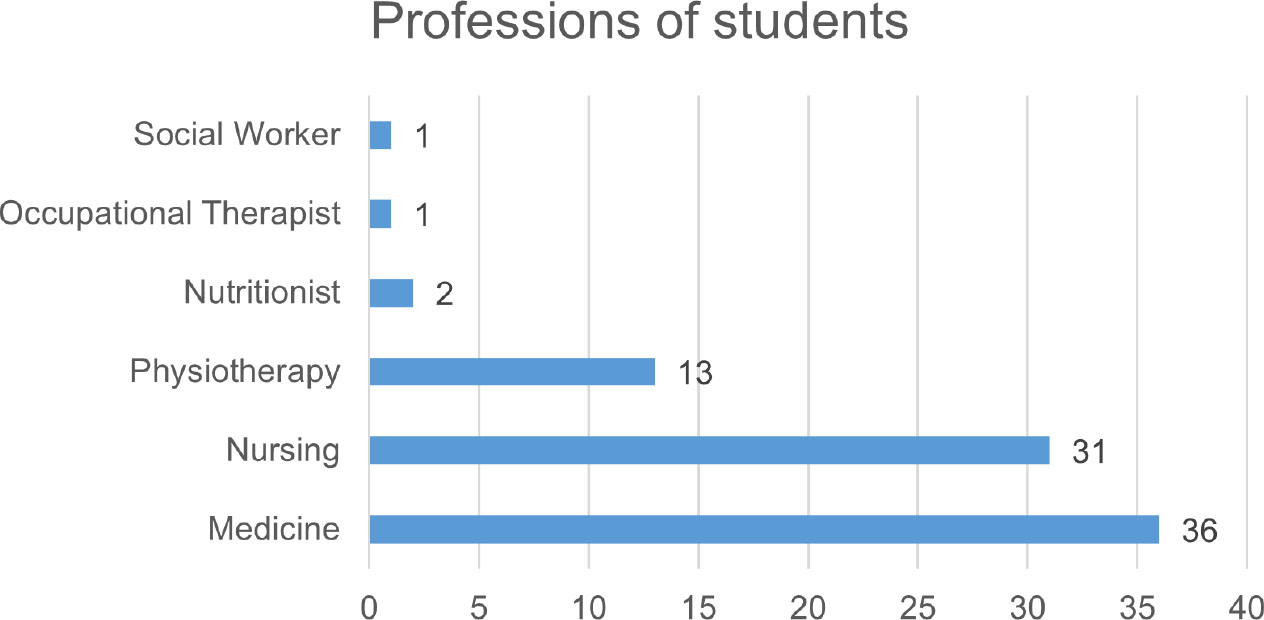
Figure 1:
Professions in ZIPAS®-project, own design.
Data preparation and analysis
Overall, 29 semi-structured focus group interviews were transcribed verbatim and translated from Swiss German to High-German in a second process. Hereby, the transcription rules for simple transcription according to Dresing & Pehl (2018) were adapted and used. Subsequently, all transcripts were read independently by two junior researchers (M. T. & A. K.). A code system was created based on all the transcripts. The development process was deductive along the leading questions of the focus group interviews and inductive by the emerging themes. Finally, all quotes in this paper were translated from High-German to English with the help of a native speaker (D.S.).
The following example demonstrates the pathway from the statement to the main code (deductive) and sub code (inductive):
“And that’s how we did it. First, the junior doctors who took the patient’s history and did the physical examination, then the nursing staff did all the assessments, followed by physiotherapy and then social services”
(Medical student, Inner Organs, 2019).
Benefit (main code) – Perspective taking (sub code) – getting to know the competences of others (sub-sub code) Table 2 shows the deductive categories, including “benefits”. The procedure and the findings of the other main categories (see Table 2) are the content of an upcoming publication. The present study was carried out using thematic content analysis according to Braun and Clarke (2022) with the analyzing tool MAXQDA 2024 by a junior researcher (M. T.).
Table 2:
Categories with subcodes, own design.
| Categories | |
|---|---|
| Successful IPC | Lack of IP interaction |
| Successful IPE | Hindering factors |
Benefits
| Enabling factors |
| Quality of care | Profession-specific delimination |
All documents were re-read by the junior researchers (M. T. & A. K.) and an inductive coding system focusing on the category “benefits” was developed by them. This ultimately led to five new subcodes of perspective taking (see Table 2), which will be presented in the results chapter.
For the sake of finding all fostering and hindering factors of perspective taking, a code relation model was generated in MAXQDA 2024, visual tools (see Picture 1). This instrument shows how often a topic was coded with other categories within one statement of the entire interview material. The result is presented in a map that shows the relative strength of these associations. The strength of the line between two codes is in relation to the frequency of the relationships.
While reading the transcripts, memos were used to write down latent content about fostering and hindering factors. Word Clouds depict the relative frequency of terms mentioned in the memos (https://www.wordclouds.com/).
During the whole process the method of communicative validation was used between the two junior researchers. This method ensures credibility and improves the validity of the analysis (Lincoln et al., 1985).
Ethical considerations
The ZIPAS®-project has been accompanied by the Zurich University of Applied Sciences (ZHAW) in a scientific evaluation since the beginning. In this context, the ethics review by the Zurich Ethics Committee has already been conducted, which is also valid for the present study (BASEC No. Req-201800634). All participants (HCP-students and facilitators) agreed to take part with a written declaration of consent. Beforehand the moderator pointed out that all information would follow established standards of data protection, the transcripts would be anonymized.
Funding
This research did not receive any specific grant from funding agencies in the public, commercial, or not-for-profit sectors.
RESULTS
A total of 29 documents were subjected to a thematic analysis. The results of the five sub-codes are presented below with verbatim quotes from the interview. In addition, the relationship of perspective taking and its sub-codes to other codes is illustrated and explained using a code model.
Getting to know the competences of others
Getting to know the competences of others refers to different aspects which promote the deep understanding of competences of other professions. The skills of others are visible and can be experienced in the daily routine of ZIPAS®. Furthermore, an IP exchange of knowledge takes place. Getting to know the competences of others therefore also implies willingness to learn.
In the interviews, HCP-students mentioned joint professional education or training courses as a valuable resource. For example, to learn about each other’s knowledge and skills and to benefit directly from them. Knowledge sharing and learning from each other was reported several times. For example, a learning situation came up after group reflection sessions, where topics were deepened in an IP way. Getting to know the different competences also led to improved IP communication. It was also mentioned that by experiencing the different skills, the understanding and awareness for others increased. Some participants also described that their view of hierarchies had changed and that they interacted with each other in a different way.
“You have the clichés of the professions, but now you see that the physio, for example, has much more knowledge and you can also exchange ideas as a result”
(Nursing student, Inner Organs, 2021).
“Often, at least in my opinion, the doctor makes the decisions, the other professions carry them out, but now, through ZIPAS®, we have learned that everything is an interwoven network in which everyone has their place and contributes their part”
(Medicine student, Internal Medicine, 2021).
Work shadowing
The subcode work shadowing summarizes experiences while following others during their working day. One of the main aspects is to gain insight into other professions. Other professions are therefore accompanied in their daily work. Work shadowing does not only mean observing, but it also means being in the situation and taking part in the tasks that need to be done.
The most frequent mention was following along and watching as a very interesting and valuable experience. Without exception, work shadowing was mentioned in a positive context. Shadowing was seen as being fun and allowing a good insight into the tasks and workflows of different professions. The participants mentioned watching others more than the possibility of being able to give others an insight into their own work. Work shadowing at ZIPAS® is appreciated by participants because there is no capacity within the normal daily work schedule. At one point it was also said that work shadowing helps to leave one’s own profession-specific thinking in order to involve other professions.
“ZIPAS® is for me to get to know other professions”
(Physiotherapy student, Traumatology, 2019).
Understanding others
Understanding others is defined as the way the participants of the ZIPAS®-project can adapt and get to know the thought process of other participants. Moreover, it is about understanding the interrelationships of their tasks regarding patient management. It is the ability to internalize the way of thinking from others and comprehend the struggles they may face during a day at work.
Students described that this process of comprehending how others think and what they do the whole day is happening naturally. It was often mentioned that being spatially close to each other and having several meetings a day favors the process of improving the perception of other’s tasks. Another finding was, that due to the project it was possible to experience closely what jobs the nursing students have and what tasks are included in a medical prescription by a doctor. Before ZIPAS® there was often a lack of empathy and knowledge towards other professions and ignorance about the amount of time a specific task takes. This was improved by giving the chance to have an in-depth insight into the daily work of other professions. As one student describes:
“I find the insight into the everyday life of the other professions very valuable, because when you work normally, ..., you see a little bit what the other professions do, how big the workload is. But now you can really see what the details are, and I think the details make the difference. We see how much paperwork the doctors do, how much computer work they have to do, writing all the prescriptions, it’s huge”
(Physiotherapy student, Traumatology, 2019).
Helpfulness
Helpfulness is understood as actively supporting others with their tasks, offering help that normally would not be offered. It also means taking over simple tasks from other professions or asking how they could assist with a specific job.
Students stated that it was challenging to consider handing over tasks to other participants in the beginning. But once they did, it was to be a big relief for them, and they were glad to be able to distribute tasks in the team. Furthermore, it was indicated that in general they would ask each other for support first, whereas normally they would ask the facilitators for help or no one at all. Offering to help others moreover increased their general knowledge, which they stated as being beneficial. One participant mentioned that they could always ask the other students, if someone would assist them, which then led to an IPC and the feeling of being a team. The offers of help additionally impacted the participants’ view on the jobs of others.
“I think that’s the best thing about it too, that they were allowed to help us with something we were doing and see what that means. Do a quick dressing change, which then takes 20 minutes”
(Nursing student, Traumatology, 2019).
Thinking for and with others
Thinking for and with others means an open-minded and collaborative approach in the given IP context. The different professions support each other with their own experiences and knowledge. In this way, thinking for and with others also supports the shared finding for solutions.
Participants describe that by being present and due to the close exchange, they have a better understanding of the work methods and objectives of other professions. The processes and ways of thinking of others become clearer and allow them to think for other professions as well. It is frequently mentioned that as the ZIPAS®-project proceeds, the capacity to think for other professions grows. In other words, the needs, ways of thinking and working, as well as the processes of others are present in the thinking and are considered. Furthermore, a sense develops for when one would like to specifically involve another profession and when one can pass on something. Someone also describes that their own goal is made clearer for others and at the same time, one also asks the other person about it:
“...because for me this and that is important and what is important for you now?...”
(Medicine student, Neurology, 2018).
Relationships to other codes
In the following chapter the relation between the main code perspective taking and other codes is explained. Figure 2 shows the relative strength of these relations as explained in the methods section (see Figure 2).
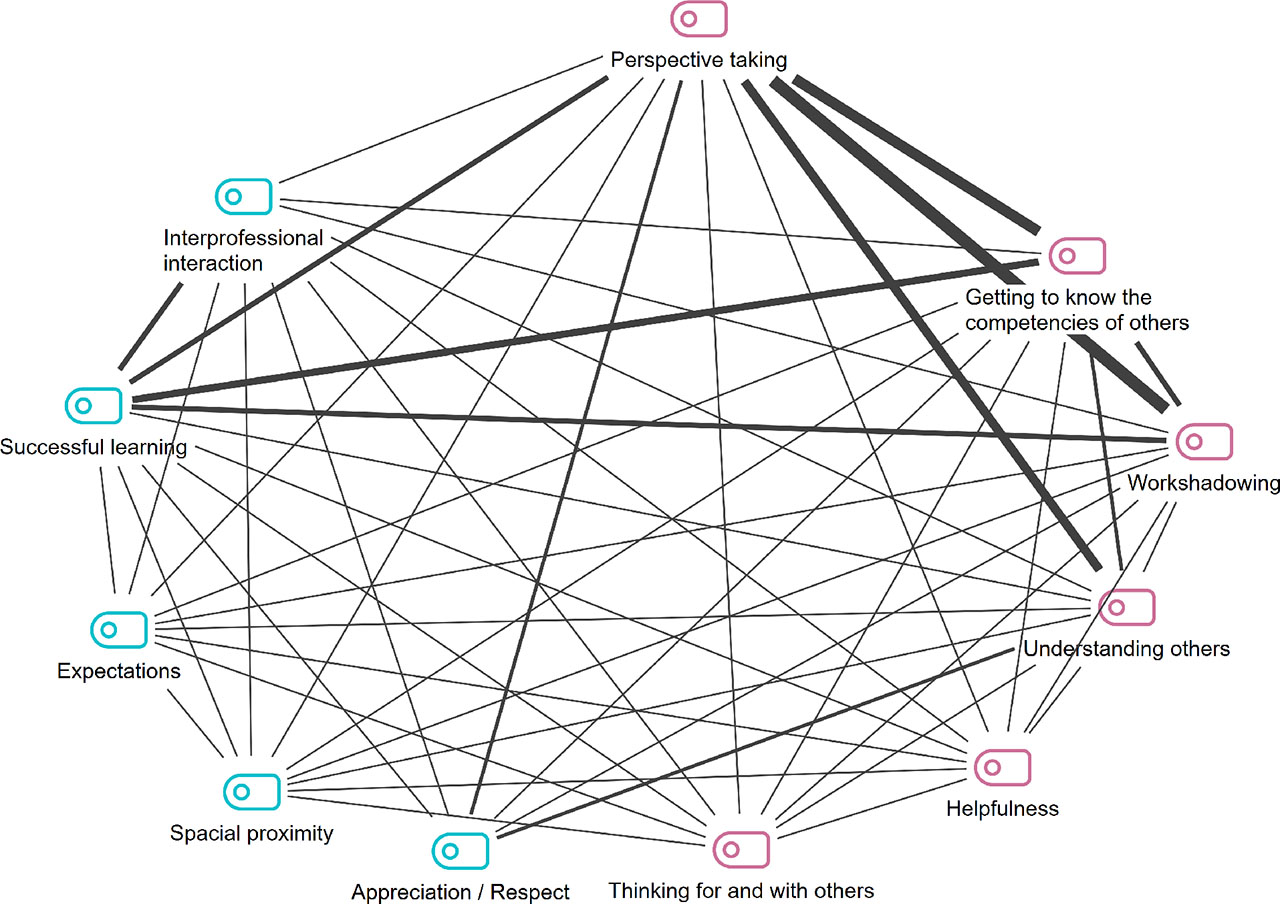
Figure 2:
Code-relations model, Visual Tools MAXQDA, 2024.
Note. The strength of the line is in relation to the frequency of the relationships.
Interprofessional interaction
In the overlap model, it can be seen that IP interaction is related to all main codes (see Picture1). Feedback from participants clearly reflects that IP interaction is a central part of ZIPAS®. Participants experienced the IP interaction as extremely educational and valuable. The close interaction quickly created a good team spirit. The inhibition to ask questions or to accompany and support each other was reduced in no time. IP interaction is part of everyday life at ZIPAS®. The interaction between the different professional groups creates a space for exchange, learning, and allowed the mental change of roles.
Successful learning
Learning about each other’s competencies was often mentioned as successful learning. At the beginning of the project, many participants were not familiar with the responsibilities and competencies of other professions. Through intense IP interaction, participants were able to get to know the other professions and their competencies. Participants report that they learned more about the other professions during the project and were able to better understand their way of working and thinking. This also promoted the willingness to help, the inhibition threshold to ask for help became smaller and it was easier to put themselves in the shoes of others and offer help.
“I also think it’s a very pleasant learning environment. It’s not so hierarchical, not so stressed. You are here to work, but also to learn. You are not just a cheap worker”
(Medicine student, Internal Medicine, 2019).
“I really see this as a great opportunity if one continues to do it this way. And that this discrepancy and this distance between individual professions simply becomes smaller”
(Student Medicine, Neurology, 2018).
Expectations
Positive expectations lead to an overall more positive attitude towards perspective taking. When a student mentions in the beginning of the project that their aim is to help other professions in their tasks, this is a supporting factor of perspective taking in the end. So, if participants show a strong attitude at the beginning, there is a high probability that their behavior will be guided by it.
“Yes, it actually exceeded my expectations, too. I actually thought it would be really great. I thought it would be a good thing, also from the email I read. It was also advertised at school. So, I was pleased when I received the email and knew that I was part of it. But I never thought it would be so cool”
(Physiotherapy student, Internal Medicine, 2019).
Spatial proximity
Spatial proximity is primarily created by the shared office within the ZIPAS® learning ward. The office is available to all participants and facilitators. Physical proximity promotes perspective-taking, IP interaction, learning about each other’s competencies, and work shadowing. Physical proximity simplifies IP interaction; it takes less time and effort to reach out to a team member of a different profession if they are in the same office. Participants report that they are more likely to exchange information or ask questions simply because it is easier. The physical proximity also creates more frequent opportunities for work shadowing. When challenging or interesting tasks come up, ZIPAS® participants have often been able to facilitate work shadowing at short notice. A spontaneous exchange in the shared office or listening to the discussions of others brings the competencies of the others closer and can help a change of perspective take place.
“I find it very exciting and also nice to work so close with each other, to exchange ideas and learn from each other and to really see behind the scenes what you do all day long.”
(Nursing student, Internal Medicine, 2021)
Appreciation and respect
Through ZIPAS®, understanding for others has grown among the participants, and with it, appreciation, and respect for others as well. The students noted that it was the experience of the other students in stressful and complex situations that made them appreciate their professions more. Particularly valuable for participants in this context was also a positive team spirit, which tempered the hierarchies in comparison to the normal routine in a ward. It was mentioned several times that a sense of distance or hierarchy between professional groups had been reduced and that participants would also like to see this in their everyday working lives in the future.
Fostering factors
The memos that were written during the coding phase of the analysis were divided into fostering and hindering factors of perspective taking. In order to answer the research question the memos were unified and graphically represented in a word cloud (see Figures 3 & 4). The fostering factor that was felt the most was the will to learn new things from other professions and being open to interprofessionality and therefore allowing perspective taking to happen. Another important point that was felt as beneficial is the fast communication possible due to the spatial proximity in a shared ZIPAS® office.
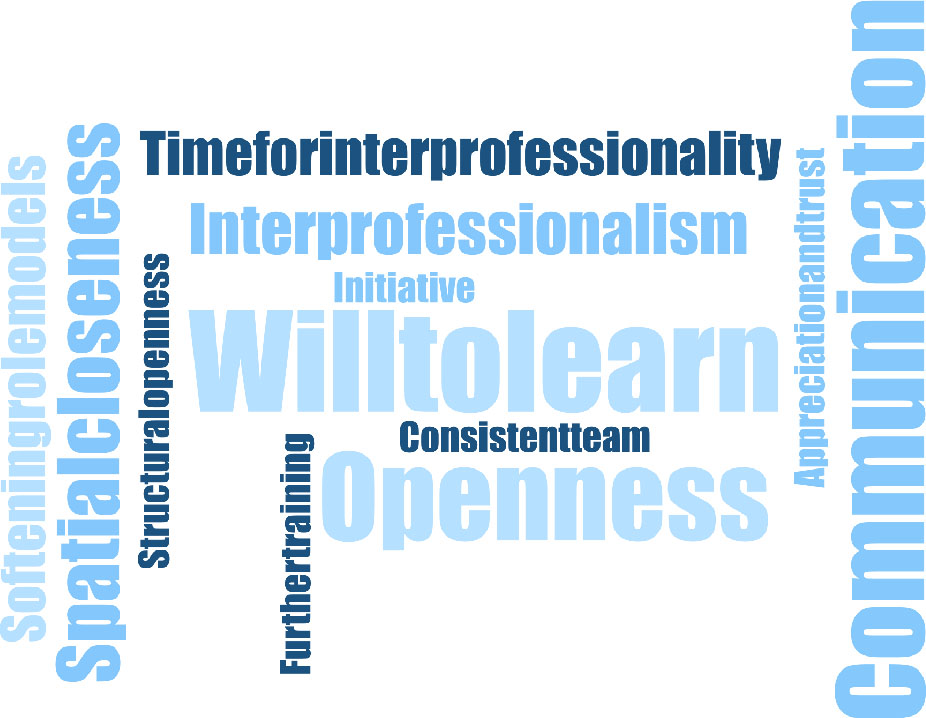
Figure 3:
Word-cloud Fostering factors, own design.
Note. The font size represents the relative frequency of mentions of a term, colors are irrelevant.
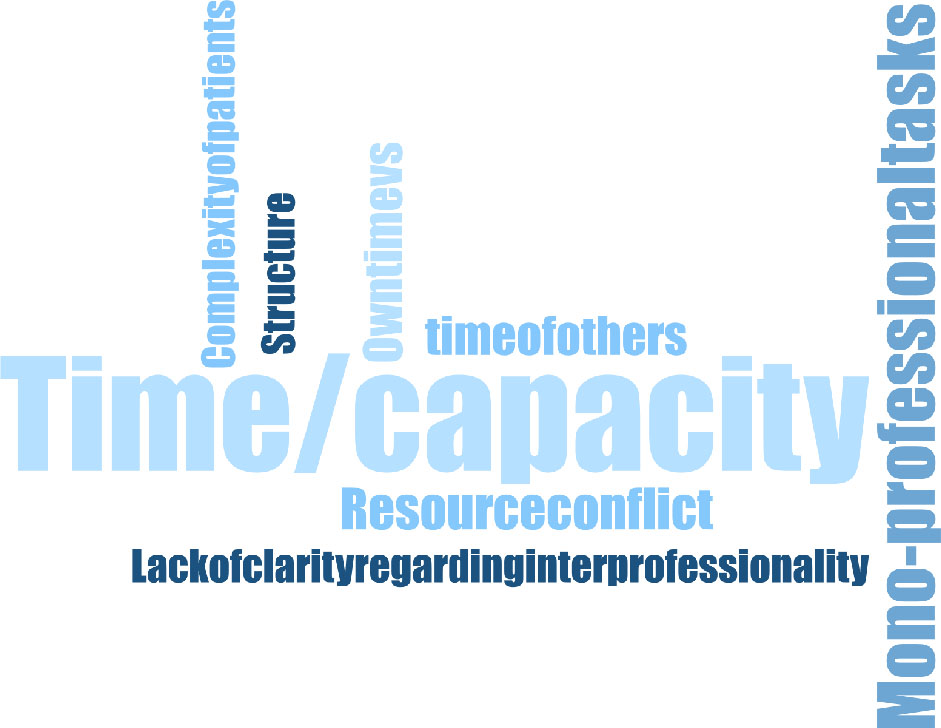
Figure 4:
Word-cloud Hindering factors, own design.
Note. The font size represents the relative frequency of mentions of a term, colors are irrelevant.
Hindering factors
Obstacles that occurred during the ZIPAS®-program made it harder to experience perspective taking. Time and capacity were mentioned most often by the participants as a hindering factor for taking perspective of others, especially by medical students. Furthermore, profession specific tasks used a lot of time and dedication and therefore interprofessionality was being experienced less often. Additionally, there was a resource conflict mentioned by the students, meaning that it was hard for them to decide whether they have time for IPC without neglecting their profession specific tasks. Another hindering factor that was highlighted was the lack of clarity regarding interprofessionality and the open structure of the project. Moreover, complex patients made it hard to hand over tasks to other participants and therefore prevented perspective taking.
DISCUSSION
The aim of the study was to identify factors that promote and hinder perspective-taking in IP clinical training wards in Switzerland. In summary the thematic content analysis generated five sub dimensions of perspective taking. Getting to know the competencies of others was mentioned by the participants most often, closely followed by work shadowing and understanding others. Helpfulness and thinking for and with others were mentioned less often by the participants. Those findings indicate the high importance of being able to learn about the professional skills of others for the purpose of facilitating perspective taking.
Fostering factors
The participants felt that the ZIPAS®-office was a safe space for them where they could ask all the questions and would not be perceived as stupid. This sharing of thoughts and being able to reveal insecurities allowed the participants to feel like a team and ultimately foster perspective taking during the project. A study from Visser et al. (2019) reinforces those experiences regarding the importance of having a shared office in order to ensure the possibility of seeing the work and thinking processes of others. A review from 2008 showed that four out of ten studies emphasized the importance of working in one office to exchange information quickly and increase personal familiarity (Xyrichis & Lowton, 2008). This increase of exchanging personal information could eventually lead to a better understanding of the person and their profession, which would support perspective taking.
The possibility to communicate fast within the team as a supporting factor is also found in the study from Ponzer et al. (2004). In the study the students mentioned that communication is one of the most important aspects of working together as a team (Ponzer S et al., 2004). Communication can lead to learning about the competences of others which then ultimately fosters perspective taking.
Hindering factors
Time and capacity are named as the strongest hindering factors. Time, because a lot of profession-specific tasks had to be done, and secondly, because the cases were so complex that there was a great need for profession-specific learning. Studies show that old professional structures and hierarchies still have great value in a hospital setting (Baxter & Brumfitt, 2008; Hall, 2005). These values are transmitted to the students during their training, or they slip into these behavioral patterns unconsciously. This is also to be seen as a hindering factor.
Limitations and strengths
The research team had a positive outlook on the feasibility of perspective-taking within the IP training wards in Switzerland. Therefore, this mindset could have led to a bias regarding the team coding more statements with perspective taking or having a tunnel view in favor of that topic. To limit this possible bias, two junior researchers (M. T. & A. K.) were involved in the coding process. Those researchers did not carry out the interviews and were not involved with the setup of the project. Secondly, one post interview from an orthopedics ward was not transcribed and therefore was also not coded or included in the analysis. Finally, the whole coding process was carried out by four people (P. S, M. H., M. T., & A. K.) in two steps. They have different professional backgrounds, seniority levels and IP experience which enables the inclusion of different perspectives. Thus, this broad level of peer reviewing will most probably have led to more accurate results.
As stated above, another influential element is the point of whether participation was voluntary or compulsory. Generally, students who decided themselves to participate in the ZIPAS®-project are seen to be more open and interested in perspective taking. These findings line up with general studies about voluntariness (Ryan & Deci, 2000). It is assumed, that participants who have voluntarily decided to participate in the ZIPAS® project are primarily intrinsically motivated. This is also reflected in the positive statements of the ZIPAS® participants about the IPC and the learning process. In the interviews, it was mentioned several times that the students consider IPC important and valuable, also in terms of the future.
CONCLUSION
The study identified key factors that both foster and hinder perspective taking in IP clinical training wards in Switzerland. The findings highlight the importance of understanding the competencies of others, work shadowing, and fostering a supportive environment for effective perspective taking. In particular, the ZIPAS® office was identified as a safe space that promoted open communication and team cohesion, which are essential for perspective taking. However, time constraints and entrenched professional hierarchies were significant barriers. These factors limited opportunities for IP learning and collaboration, and thus, perspective taking.
In summary, good preparation is needed for the implementation of clinical training sites. This includes that the structures in the hospital need to be adapted to support the students in interprofessionality. This requires sufficient time, a shared office, and an adaptation of the complexity of the patients to the respective level of training of the participating students. These preparations ultimately lead to the fact that hindering factors for perspective adoption can be mitigated.
ACKNOWLEDGMENTS
For methodological advice and validation, we thank in particular David Stamm and Patricia Schwärzler from the Zurich University of Applied Sciences.