
Table 1
The most critical parameters that impact on beer filtration and points where can be intervented in the process
| Critical parameters that impact on beer filtration | Intervention in the process |
|---|---|
| Before Filtration | |
| Number of yeast cells in the fermentation tank | Controlling yeast number in suspension through different |
| Number of yeast cells in the Bright Beer tank | intervention. |
| Using of flocculants | |
| Using of centrifugation process | |
| Intervention to candle filter process (change kieselguhr dosage and nature) | |
| Wort and Beer Turbidity | Controlling non-biological turbidity through enzymatic processes or different additives. |
| Wort and Beer Viscosity | Controlling non-biological turbidity through enzymatic processes |
| During Filtration Process | |
| Differential pressure on the filter | Intervention to candle filter process (change kieselguhr dosage and nature) |
| Intervention to beer nature regarding, microbiological load, and non microbiological turbidity (protein, carbohydrates and polyphenols) | |
| Turbidity at filter outlet | Controlling number of yeast and other spoilage microorganisms Recycling |
| Use of enzymes and different stabilisants Reorganizations of filter-aid dosage | |
| Microbiologic quality monitoring | Intervention to hygiene measure Reorganizations of filter-aid dosage |
| After Filtration | |
| Turbidity | Use of different stabilisants to control stability |
| Microbiologic quality monitoring | Intervention to hygiene measure Reorganizations of filter-aid dosage |
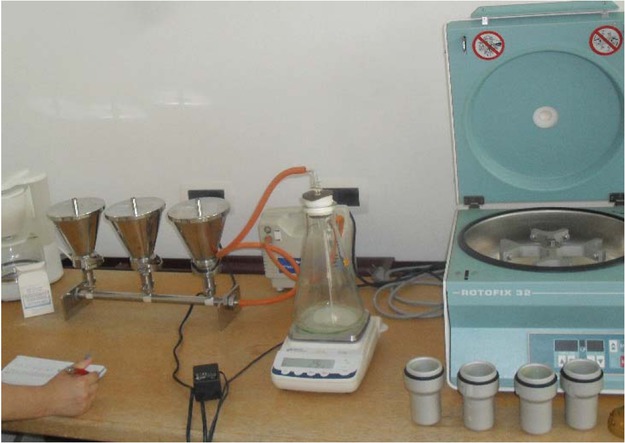
Figure 1
Pilot scale apparatus and centrifuge used for beer filterability monitoring in experimental scale.
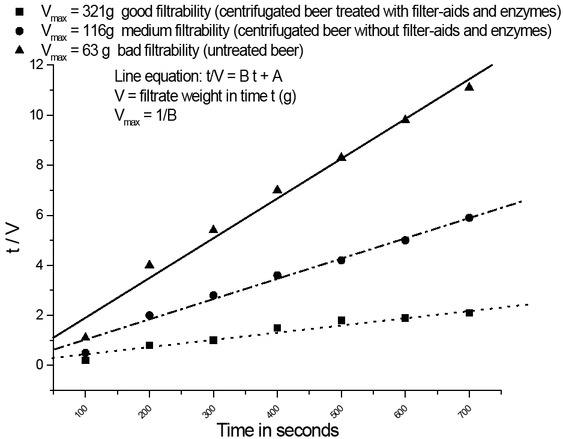
Figure 2
Filtrability of different beers treated and not treated with enzymes.
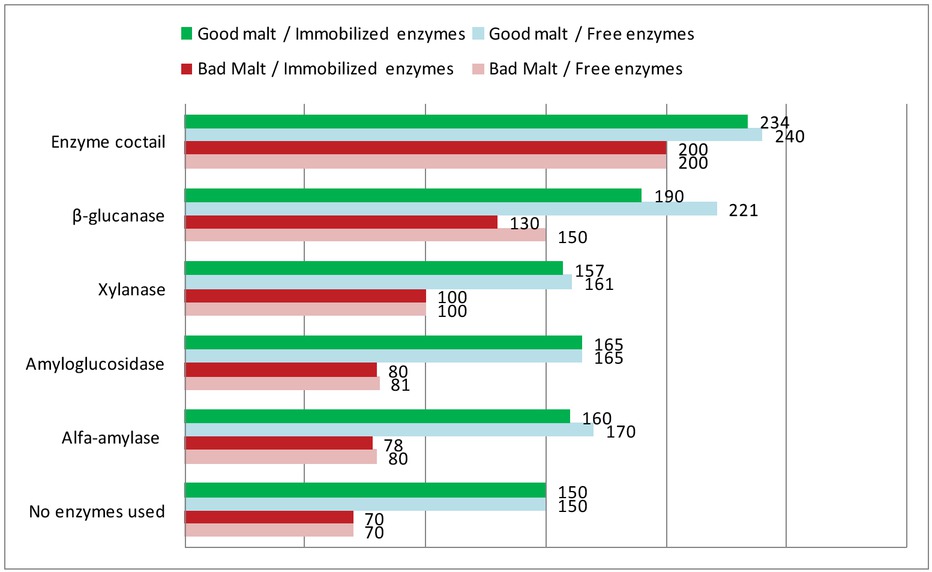
Figure 3
Impact of malt quality and different enzymes used at brewhouse on beer filterability (Vmax).
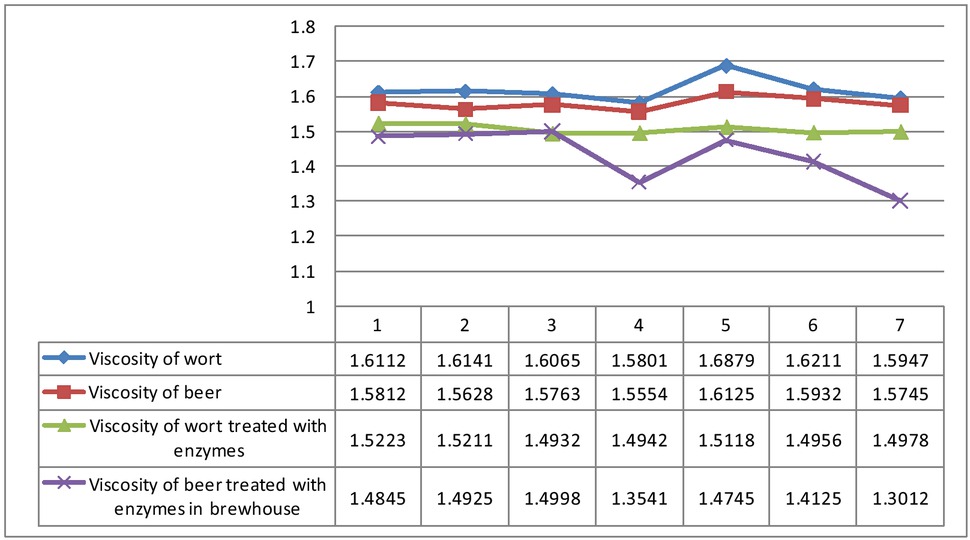
Figure 4
Dynamic Viscosity (mPa s) in worts treated and non treated with enzymes (β-glucanase enzyme).
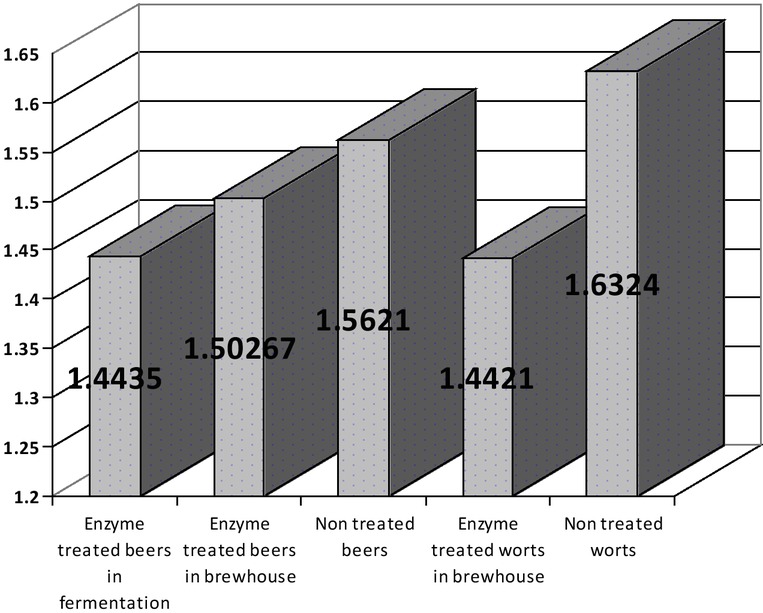
Figure 5
Viscosity in worts and beer treated in different manner with enzymes.
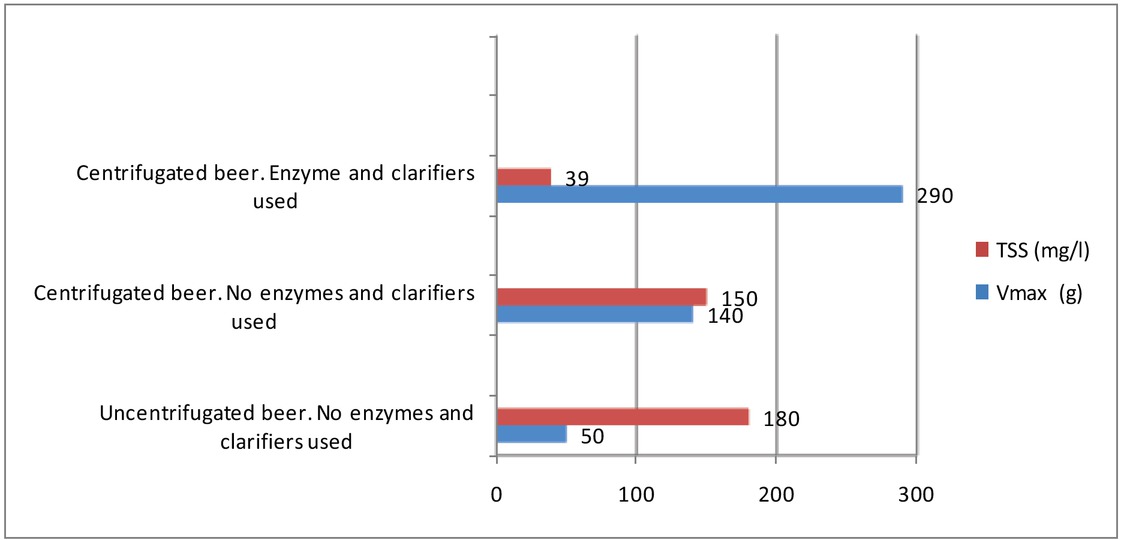
Figure 6
Average Vmax and TSS for different treated beers.
Table 2
Nature of Particles in suspension in beer
| Nature of particles in suspension | Composition | Source | Particle size in μm |
|---|---|---|---|
| Microorganisms | Brewing yeast (Saccharomyces carlsbengensis) + wild yeast (Saccharomyces sp.) | Fermentation process + contamination | 5 – 10 μm |
| Bacteria (Lactobacillus sp., Pediococcus sp.) | Contamination | 0.2 – 2 μm | |
| Turbidity | Carbohydrates turbidity (stable turbidity) | Brewhouse | Up to 3 μm |
| Proteins and Poliphenols | Brewhouse |
Table 3
Evaluation of most critical stability parameters of beer from fermentation to the Bright Beer Tank (These processes are in chain and experiments were carried out in industrial scale)
| In the end of Fermentation | After centrifugation | After filter aid tratment | Clarification process | After kiselguhr filtration | |
|---|---|---|---|---|---|
| Yeast cell cell/number ml | 5-30x106 | 1-10x105 | 1-8x10⁵ | 1-5x10⁵ | 0-10 |
| Turbidity EBC | 223 | 185 | 210 | 160 | 0.5 |
| Total N mg/l | 90 | 85 | 55 | 43 | 40 |
| Poliphenols mg/l | 23 | 15 | 6 | 5 | 0.8 |
Table 4
Experimental measurements for cell number using free yeast and immobilized yeast in alginate beads (Using industrial scale wort)
| Number of yeast cells in sunspension (cell/ml) | Free yeast fermentation | Immobilized yeast fermentation |
|---|---|---|
| Inoculation cell number | 10 x 106 - 20 x 106 | 10 x 106 - 20 x 106 |
| Yeast remain cell in number suspension in the end of fermentation | 25 -100 x 106 | 1-70 x 106 |
| vmax | 10 - 35 | 260 - 330 |
| TSS (mg/l) | 210 | 50 - 90 |