
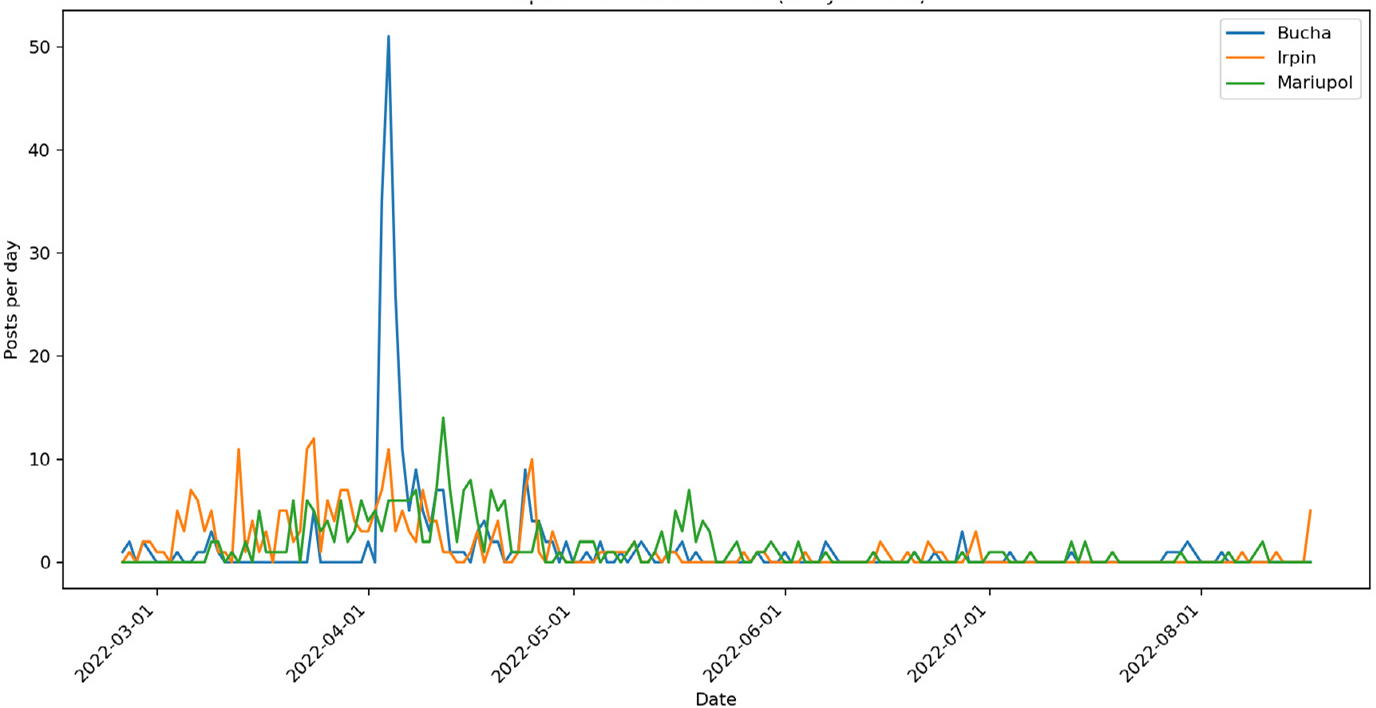
Figure 1:
Top 250 Posts Over Time (Daily Counts)
Table 1:
Summary of Meta-Frame Prevalence Across Incidents
| Meta-Frame | Bucha (n) | Irpin (n) | Mariupol (n) | Total |
|---|---|---|---|---|
| B1. Denial and Deflection | 1108 | 534 | 493 | 2135 |
| B2. Moral Justification and Legitimation | 636 | 505 | 795 | 1936 |
| B3. Dehumanization and Eliminationism | 60 | 117 | 383 | 560 |
| B4. Heroism and Glorification | 150 | 280 | 522 | 952 |
| B5. Escalation and Retribution | 16 | 42 | 14 | 72 |
| Total | 1970 | 1478 | 2207 |
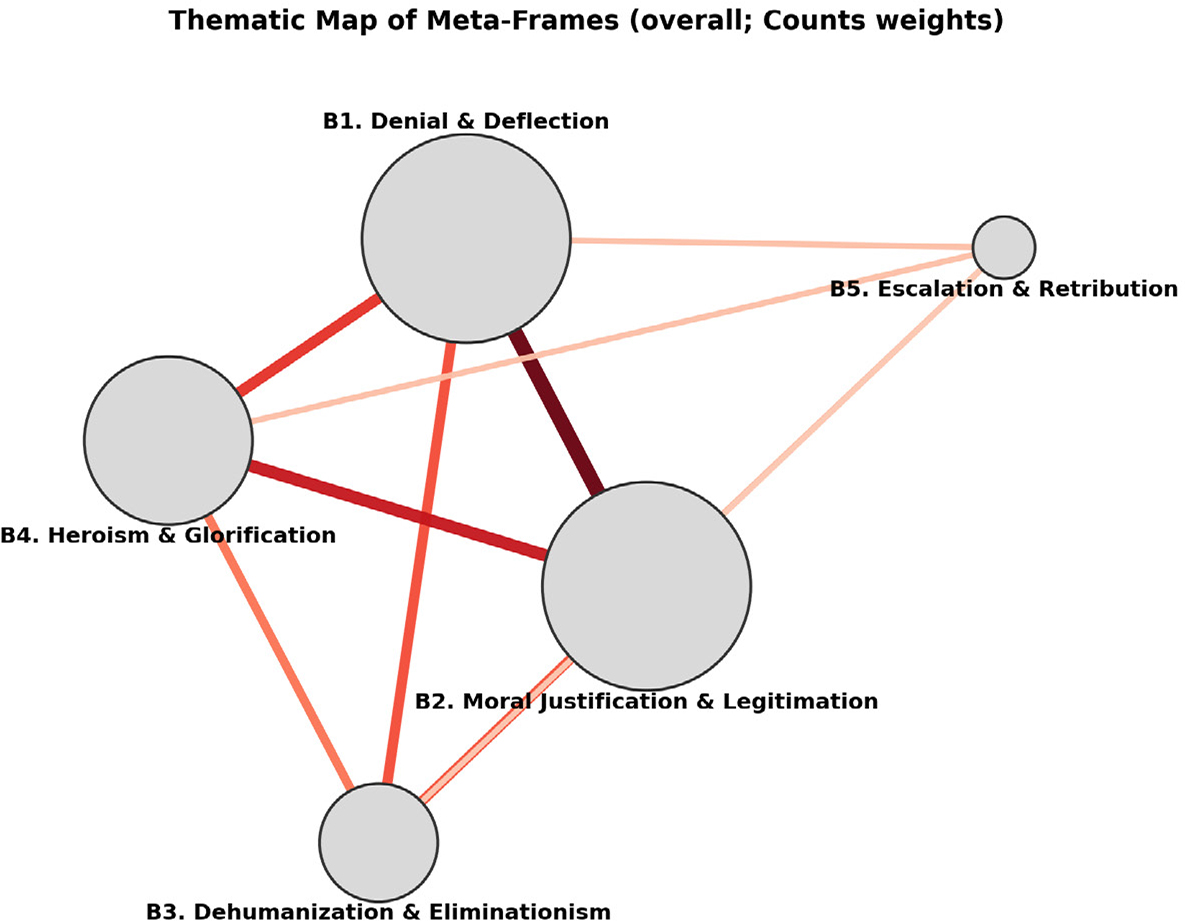
Figure 2:
Thematic Map of Meta-Frames
Note: Thicker lines indicate more frequent co-occurrence of themes; darker red stronger association.
Table 2:
Coding Results (Detailed Breakdown)
| Meta-Frame/Code | Label/Operational Definition | Bucha (n, %) | Irpin (n, %) | Mariupol (n, %) |
|---|---|---|---|---|
| A. General Coding Variables | ||||
| A1 | Explicit violence – Mentions or descriptions of violent acts, casualties, or destruction. | 128 (51.2%) | 187 (74.8%) | 133 (53.2%) |
| A2 | Stance – Evaluative tone towards the described violence (approving, condemning, neutral). | 236 (94.4%) | 250 (100.0%) | 250 (100.0%) |
| A3 | Primary target – Identifies who or what is targeted (civilians, military, infrastructure, etc.). | 227 (90.8%) | 250 (100.0%) | 250 (100.0%) |
| B1. Denial and Deflection – Total | 1108 | 534 | 493 | |
| B1a | Literal denial – Direct rejection of allegations (“feik,” “ne bylo,” “not true”). | 142 (56.8%) | 52 (20.8%) | 32 (12.8%) |
| B1b | Interpretive denial – Reframing events (“special operation”, “cleansing”, “liberation”). | 152 (60.8%) | 55 (22.0%) | 51 (20.4%) |
| B1c | Implicatory denial – Acknowledges harm but minimizes its moral or political significance. | 114 (45.6%) | 41 (16.4%) | 35 (14.0%) |
| B1d | Denial of injury – Claims that no civilians or innocents were harmed. | 85 (34.0%) | 56 (22.4%) | 30 (12.0%) |
| B1e | Denial of responsibility – Blames Ukraine, NATO, or legitimate orders for harm. | 185 (74.0%) | 76 (30.4%) | 91 (36.4%) |
| B1f | Condemning the condemners – Attacks critics as biased (“Western propaganda”, “fake news”). | 170 (68.0%) | 87 (34.8%) | 54 (21.6%) |
| B1g | Perpetrator other – Depicts Ukraine or the West as the true aggressor, Nazi, or terrorist. | 171 (68.4%) | 121 (48.4%) | 187 (74.8%) |
| B1h | Provocation/false-flag – Claims events were staged or fabricated by Ukraine or the West. | 169 (67.6%) | 46 (18.4%) | 13 (5.2%) |
| B2. Moral Justification and Legitimation–Total | 636 | 505 | 795 | |
| B2a | Deserving victim – Portrays victims as deserving harm (“Nazis”, “terrorists”). | 122 (48.8%) | 71 (28.4%) | 163 (65.2%) |
| B2b | Moral justification – Violence as righteous self-defence or restoration of justice. | 41 (16.4%) | 105 (42.0%) | 166 (66.4%) |
| B2c | Euphemistic labeling — Sanitized language for violence (“denazification”, “zachistka”, “operation”). | 110 (44.0%) | 115 (46.0%) | 185 (74.0%) |
| B2d | Advantageous comparison – Compares Russia’s actions favourably to Western wars. | 49 (19.6%) | 67 (26.8%) | 164 (65.6%) |
| B2e | Displacement/diffusion of responsibility – Assigns accountability to collective entities (“the army”, “orders from command”). | 131 (52.4%) | 81 (32.4%) | 39 (15.6%) |
| B2f | Minimization of consequences – Downplays severity of violence (“precision strikes”, “limited casualties”). | 95 (38.0%) | 66 (26.4%) | 78 (31.2%) |
| B3. Dehumanization and Eliminationism – Total | 60 | 117 | 383 | |
| B3a | Dehumanization – Compares Ukrainians to vermin, beasts, pests, machines, or objects. | 43 (17.2%) | 86 (34.4%) | 130 (52.0%) |
| B3b | “Liberation”/re-education – Imagines violence as curing or rehabilitating Ukraine (“de-Ukrainization”, “spiritual cleansing”). | 8 (3.2%) | 12 (4.8%) | 113 (45.2%) |
| B3c | Exterminationism/eliminationism – Advocates or celebrates total destruction (“wipe off the face of the earth”, “no mercy”). | 2 (0.8%) | 10 (4.0%) | 66 (26.4%) |
| B3d | Purification metaphors – Portrays violence as moral or spiritual cleansing. | 7 (2.8%) | 9 (3.6%) | 74 (29.6%) |
| B4. Heroism and Glorification – Total | 150 | 280 | 522 | |
| B4a | Heroic self – Describes Russian soldiers as “liberators”, “defenders”, or “heroes.” | 49 (19.6%) | 97 (38.8%) | 174 (69.6%) |
| B4b | Higher loyalties – Violence framed as patriotic or sacred duty. | 47 (18.8%) | 127 (50.8%) | 183 (73.2%) |
| B4c | Reconstruction/humanitarian – Frames rebuilding and aid as moral renewal, proof of Russian virtue. | 54 (21.6%) | 56 (22.4%) | 165 (66.0%) |
| B5. Escalation and Retribution – Total | 16 | 42 | 14 | |
| B5a | Collective punishment/retribution – Frames violence as revenge for earlier attacks. | 8 (3.2%) | 11 (4.4%) | 4 (1.6%) |
| B5b | Heavier/wider strikes – Calls for escalation (“strike decision centres”, “hit harder”). | 8 (3.2%) | 31 (12.4%) | 10 (4.0%) |