
Introduction
On 24 February 2022, the Russian Federation launched a full-scale invasion of Ukraine. Its campaign has been marked by repeated atrocities carried out against civilians. Investigators have documented unlawful killings, arbitrary detention, torture, and sexual violence which echo a familiar Russian ‘way of war’. For example, in Chechnya in the late 1990s and early 2000s, zachistki (‘cleansing operations’ employed as a system of violent control) linked to disappearances, murders and torture; filtration camps; indiscriminate bombardment; and impunity for abuses were typical of Russian conduct (Gilligan, 2009; Gould 2020). These methods made exterminatory violence a deliberate tool of quotidian military practice. As this brutality is again perpetuated, Russian state media propagandists and state-aligned digital channels have described and justified violence in genocidal terms, using a whirlwind of contradictory narratives which form “false narrative[s]” and “justify the committal of further war crimes” (McGlynn, Garner, 2022). These narratives seep into the everyday language of Russians at war (McGlynn, 2022), building an environment in which militarization “creeps into ordinary daily routines” (Enloe, 2000). Nonetheless, due to the speed of the state’s authoritarian and militarizing turn (Kuzio, 2023), the mechanisms and practices which link violence and the everyday remain relatively underexplored.
In Russia, the war is extensively and immediately mediated, witnessed, and contested through digital infrastructures which span the state, military, and public spheres. The mass messaging and social media platform Telegram plays an important role in this social media ecology. Used by as many as 90 million Russians, including frontline troops, it has become central to the state’s wartime information environment (Oleinik, Paniotto 2023). Telegram is today a conduit for the Kremlin’s propaganda, which aims to shape perceptions and behaviours in the military, civilian, domestic, and international spheres. This is an information warfare approach which treats the theatre of war and the media sphere as inseparable (Polegkyi, 2023), absorbing, producing, and recycling often contradictory discourses which include potentially strategically damaging information about, for example, the sites of Russian war crimes (Renic, 2024).
Mariupol, Bucha, and Irpin stand out as early examples of atrocities which have been mediated in this way. The siege of Mariupol (February–May 2022) left as many as 20,000 civilians dead and included alleged mass war crimes (Suliman et al., 2022). In Bucha, almost 500 bodies, with many showing signs of execution, torture, or violent trauma, were discovered after the Russian forces withdrew (Andreikovets, 2022). In Irpin, a suburb that neighbours Bucha, another 200–300 civilian deaths were recorded (Reuters, 2022). Material documenting these atrocities was widely shared online by Western OSINT (open-source intelligence) channels, investigators, and journalists (see e.g. Lemkin Center 2025). Moreover, news and discussion of these incidents rapidly spread from Western to Russian information spaces, including and especially Telegram. Multiple scholarly studies have already discussed both what happened in these locales and how Russian (social) media represented events there (e.g. Dudko, 2022; Garner, 2022).
Nonetheless, and despite the importance of the web to normalizing violence in contemporary warfare (Jackson et al., 2021), there has been little consideration in scholarship of how social media propaganda around these events has normalized violence within Russia’s media ecology. Hoskins’ (2009) treatment of the networked ‘flashbulb’ memory offers a framework to conceptualize how such propaganda efforts function on Telegram around the sudden flood of mediatized violence from the front. The ‘flashbulb’ in Hoskins’ sense describes the “vividly” felt, high-valence burst of mediated attention which on social media is so rapidly “compiled from multiple sources and occasions” that it “immediately and extensively interpenetrates the everyday” before dispersing into a “long tail” of ever-evolving, always-accessible memories (Hoskins, 2009). On a platform like Telegram, that ‘long tail’ is sustained by a high recirculation, inter-channel ecology (Hoskins, 2011b; Kiforchuk, 2023).
These flash-and-tail dynamic sediments become layered so deeply into routine communication through reiteration across discursive actors that they may come to govern “non-discursive practices” and behaviour (Jørgensen, Phillips, 2002, 62) discourse(s) around the sites of atrocities, even if this may be in some respects negative to military action (Renic, 2024). In the era of the ‘smartphone war’, distinctions between actor and audience, soldier and civilian, and front and rear collapse (Ford, Hoskins, 2022). In other words, the same Telegram feed that shocks with its visions and speech of atrocity, violence, and killing may also bridge the immediacy of the ‘flashbulb’, the ‘long tail’, and everyday discursive sedimentation around violence. In this light, the rapid and Telegram-heavy coverage of atrocities in Mariupol, Bucha, and Irpin makes these sites fertile ground for studying how public discourse interacts with on-the-ground atrocity, and how violence can be normalized both within the Russian armed forces and within the broader Russian discursive sphere. This study therefore addresses the following Research Questions (RQs):
RQ1: Did Russian state-aligned actors on Telegram rationalize or exhort violence in relation to Bucha, Mariupol, and Irpin during the war’s first six months?
RQ2: What discursive frames did these actors use in material linked to these incidents of extreme violence?
RQ3: Through which mechanisms did these discursive practices normalize violence, and what does this reveal about the everyday militarization of Russian forces and society within the space of its digital media ecology?
1. SCHOLARLY CONTEXT
Recent research on the violence used by Russian forces during their full scale invasion of Ukraine has converged on two intertwined dynamics: the ideological legitimation of civilian harm through genocidal narratives (e.g. Riabchuk, 2022), and the platformed circulation of those narratives within digitally saturated war ecologies. Some studies identify language around the invasion as perpetuating an imperial project designed to negate Ukrainian sovereignty within a Russocentric order (Kuzio, 2023). Language historically associated with genocide is employed and reframed to render Russian violence a defensive necessity (Etkind, 2022; Mälksoo, 2023). Oksamytna (2023) sees Russia as a colonial power animated by supremacist hierarchies: brutality is an attempt to dominate a population considered both the same and inferior, and aggravated by the shock in 2022 that Ukrainians neither desired nor needed ‘rescue’. This colonial frame helps to interpret both the breadth of justificatory rhetoric and the ferocity of violence against civilians in places like Bucha. Laryš (2025) demonstrates that the predominant genocidal discourse within the pro regime ecosystem is not (only) exterminationist talk but a paternalist project of “liberation through cultural genocide”: Ukrainians are to be turned back into ‘Little Russians’, with the Kremlin’s use of the term ‘denazification’ as code for violent de Ukrainization (see also Kuzio, 2023).
However, relatively little work has charted these eliminationist and genocidal themes at the meso-level on a major propaganda platform like Telegram. A number of micro-studies have focused on the moment of the ‘flashbulb’, finding evidence of denialist tropes (with incidents such as Bucha described as either “provocations” or “staged”) alongside eliminationism, especially in ultra-nationalist milieux (Garner, 2022; Hu, Wang, 2025). More work focuses solely on the strategies of those sources labelled as ‘elite’: policymakers, politicians, and state media (Makhortykh et al., 2025). Zavershinskaia (2024) analyses websites that reveal the Kremlin’s “strategic narration”: a polarized heroic self versus perpetrator other template which casts Russia, Putin, and “patriots” as protectors, and Ukraine and its supporters as the “real” perpetrators of historical crimes (see also Hamarowski, Lompe, 2024). Some studies (e.g. Dean, Porter 2025) suggest Russian public sentiment is becoming more neutral over the course of the war after a peak of enthusiasm after February 2022. Nonetheless, this group of studies tends to adopt macro-tracking, neglecting the richness of discourse-in-context, and thus leaving the linkages between the micro and macro, the immediate and the everyday, and Hoskins’ (2009) ‘flashbulb’ and its tail, unclear.
Discursive normalization is not a media epiphenomenon; institutions, media, and everyday practices make organized violence legitimate. Research on violent socialization and moral disengagement, a process by which individuals can “engage in harmful behaviour without self-censure” (Bandura, 1999), explains how communities come to accept and even valorize violence and cruelty. Discourse helps to produce the operating environment in which commanders, combatants, auxiliaries, and local collaborators perceive civilians, interpret rules, and anticipate sanction (Sykes, Matza, 1957; Bandura, 1999). Justificatory and denialist frames lower the perceived legal and moral risk by signalling a permissive command climate and a sympathetic audience, thereby shaping the local “rules in use” even when the formal rules of engagement remain unchanged. Dehumanizing and eliminationist language reduces the psychological cost of harming civilians and can encourage collective punishment framings which rationalize otherwise proscribed actions; these shifts in perceived permissibility are well documented correlates of support for extreme violence (Bandura, 1999; Haslam, Loughnan, 2014).
Bringing these traditions into dialogue with platform studies, and recognizing that modern interstate warfare increasingly challenges the “survival, livelihood, and dignity” of civilians (Moore et al., 2025), this study approaches Telegram as an environment which accelerates the circulation and sedimentation of violent norms in wartime; theoretically, the miasma of social media can lead to the execution of particular behaviours both in Russia’s domestic sphere and, given the digitized collapse of the divides between front and rear which Ford and Hoskins (2022) describe, in the theatre of war. Understanding this topic within the space of the new, digital war ecology is crucial to understanding how Russian propaganda may sediment discursive practices into violence in both the present and future wars.
2. METHODOLOGY
Qualitative content analysis interpreted through a discourse-analytic approach was employed to analyze the framing of violence on Russian state-aligned Telegram channels around Bucha, Mariupol, and Irpin. Qualitative content analysis is suited to the systematic examination of large volumes of textual material, as it allows for both category-based description and interpretive insight (Schreier, 2012; Mayring, 2015). Content and discourse analysis are often employed for understanding incitement to and normalization of violence in both conflict and non-conflict settings (Chiluwa, 2019; Danziger, 2025).
The analysis in this study covers a sample of data posted to Telegram between 24 February and 24 August 2022, including the first news and viral stories, and thus content touching on atrocities, about Bucha, Mariupol, and Irpin. Discursive trends within media coverage early in a war tend to crystallize attitudes and norms (Barceló, 2021). Moreover, this six-month window is likely to capture both the moment of the ‘flashbulb’, as the Russian atrocities created shockwaves in both the domestic and the international media coverage, and the ‘tail-off’ that Hoskins (2009) describes as significant in shaping platformed understanding during war. A six-month window has been used in numerous other studies of Telegram and the Russia-Ukraine War (Maathuis, Kerkhof, 2023; Garner, Edwards, 2025). Figure 1 represents the sample selected for coding (see below) over time, revealing a classic set of spikes and tail-offs which indicate that during this period, discursiveness around the three incidents studied was absorbed into the everyday.
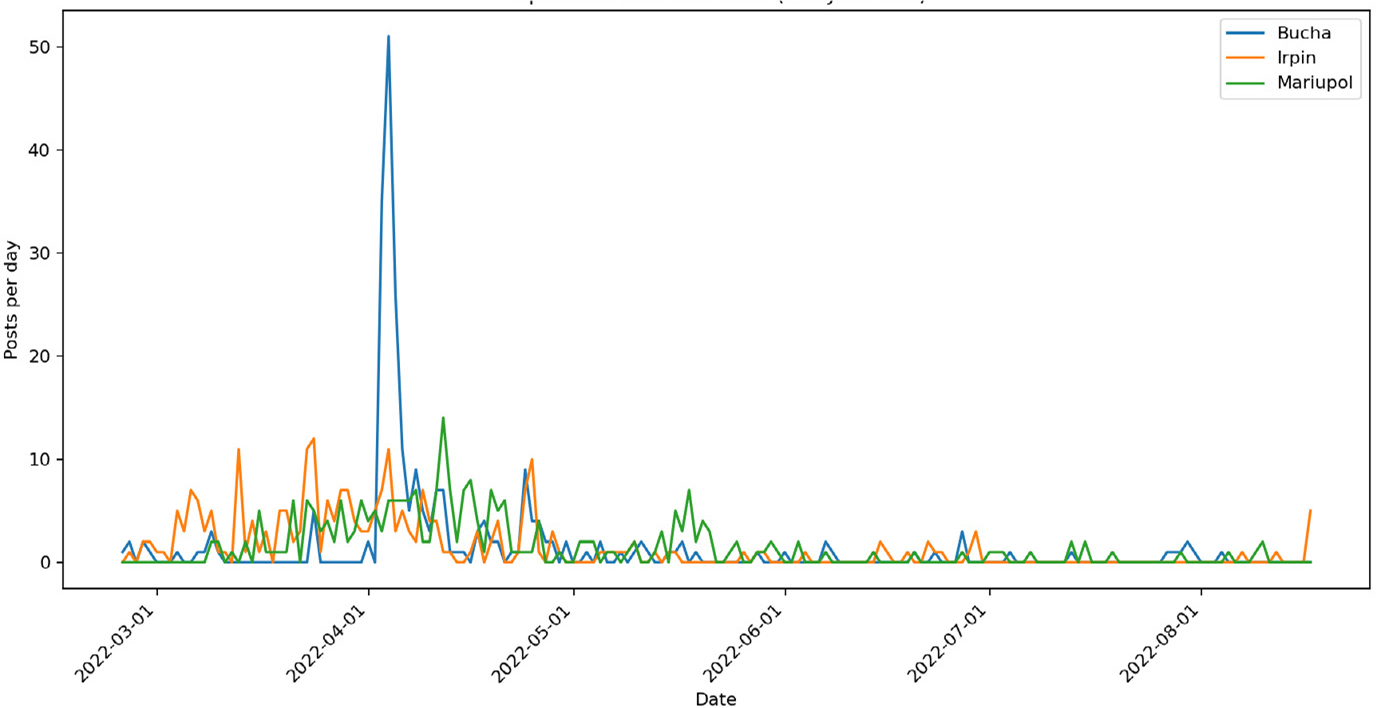
Figure 1:
Top 250 Posts Over Time (Daily Counts)
The data was gathered using the publicly available Telethon API to scrape all posts from the first six months of the full-scale war from a list of 387 Russian-language state-aligned Telegram channels. The list of sources was based on channels identified elsewhere as Russian state-aligned sources (War of Words, 2024; Bawa et al., 2025; Kireev et al., 2025). Channels which were not in all lists, which were not scrapable with the Telegram public API, or which had been deleted were excluded. The list included the largest and most viewed pro-state Russian Telegram channels, those boosted by known propagandists, and those regularly deploying the symbols and discourses (from state news stories to viewpoints which echo those stories and the use of ‘Z’ memes and imagery) most associated with Kremlin propaganda campaigns. 1 The list includes television propagandists, state news channels, astroturfed and grassroots news and discussion channels (acknowledging that differentiation between the two is near impossible), and analysts and commentators. Such a combination accounts for the problem of public distrust in official media sources and acknowledges the fluid movement of material between public and private and grassroots and astroturfed sources (Oleinik, 2024).
The resulting dataset rendered 1.9 million Telegram posts. Three separate subdatasets were created by capturing all posts that mentioned Bucha (8,853 posts), Mariupol (69,651), or Irpin (2,571) in Russian Cyrillic in any context (including all declensions, yet excluding typos, misspellings, visual content, and Latin iterations).
For each incident, the 250 posts with the highest view counts as captured at the time of scraping for coding (thus coding 750 posts comprising almost 90,000 words) were selected, emulating the approaches for sample selection in Kermani (2020) and Tretiakov et al. (2025). 2 The sample size is informed by a theoretical sampling logic which prioritizes manual coding to find ‘richness’ of discourse over statistical generalizability (Titscher et al., 2000; Alejandro, Zhao, 2023). Finding the appropriate sample size in content, thematic, and discourse analysis is an art rather than a science (Lazaraton, 2002). However, modestly sized social media samples produce stable distributional patterns with diminishing returns beyond the high hundreds of posts and after twenty weeks’ worth of data (Kim et al., 2018). Indeed, combining computational filtering with hand-coding can faithfully represent broader discursive ecologies (Nelson et al., 2021). Moreover, the sample size here compares favourably with those in qualitative work on Russian Telegram discourse during the war against Ukraine (Garner, 2022; Hoskins, Shchelin, 2022; Brusylovska, Maksymenko, 2023).
View count is employed here as a relative measure, since data recorded on Telegram may be manipulated by bots. Posts therefore do not necessarily represent those viewed most frequently by human users (see Zelenkauskaite, 2025). However, rank-view distributions of the scraped data show a smooth decay with a sharp drop after rank 250 across all three incidents (top 250 vs. 251–500 average-view ratios ≈ 1.70–1.89, with subsequent bands declining at regular intervals by ~10–20%), indicating that the sample for coding was unlikely to be inflated by systematic bot manipulation. Below, the Herfindahl-Hirschman Index is also employed as a means to calculate relative influence and thus account for the potentially distorting effects of large channels artificially skewing data. Regardless of the actual number of unique views by unique users, the sample is thus likely to be reflective of what was most propagated on Telegram. Indeed, Russian state propaganda on Telegram is widely viewed and effective (Oleinik, 2024; Tretiakov et al., 2025); in this data, it is likely that the view counts of the 750 posts at hand are either almost all or not at all artificially inflated.
A deductive coding scheme was developed to analyse the 750-post sample. By applying a structured coding frame, the analysis captured recurring patterns in how atrocities were represented, denied, or normalized, while maintaining contextual nuance. A comprehensive deductive codebook was created, which first identified whether a post mentioned violence and, if so, how that violence was targeted. The codebook then combined themes from two areas: firstly, the established literature on denial, neutralization, moral disengagement, dehumanization, genocidal discourse, and state strategic narration (Sykes & Matza’s (1957) “techniques of neutralization”, and Bandura’s (1999) mechanisms of moral disengagement 3); secondly, those from scholarship on atrocities and the Russia-Ukraine war (as described by Etkind, 2022; Garner, 2022; Oksamytna, 2023; Zavershinskaia, 2024; Laryš, 2025). 4 Given the risk of diluting coding accuracy through the comparatively large body of codes, the codes were then grouped into five meta frames consistent with the themes highlighted in the scholarship discussed here: 1) Denial and Deflection; 2) Moral Justification and Legitimation; 3) Dehumanization and Eliminationism; 4) Heroism and Glorification; 5) Escalation and Retribution. Coding then proceeded, consistent with qualitative content analysis norms.
Finally, a qualitative comparison of Bucha, Irpin, and Mariupol used an over/under-indexing method, along with short illustrative extracts, to highlight convergences and divergences in the dominant frames and their rhetorical sequencing. 5 This interpretation of the coded material is informed by discourse-analytic perspectives on militarization, which emphasize how violence is rendered routine and intelligible within communicative practices (Stavrianakis, Selby, 2013). In particular, Bandura’s (1999) work on moral disengagement provides a framework for understanding how language legitimates otherwise unacceptable violence, while complementary studies of denial (Cohen, 2001) and dehumanization (Haslam, 2006) highlight additional mechanisms by which violent practices are discursively normalized.
This mixed-methods approach allows for replicable coding and the analysis within debates on how violence is normalized through discourse. Nonetheless, the design has some limitations. The inferences concern high-view count content, not belief or approval among the audience, and only over the first six months of the full-scale conflict. In this study, no attempt has been made to chart how forwarding, network behaviours, and near-duplicates across channels may indicate attempts to manipulate discursive behaviours. 6 Such omissions should not alter the value of an incident-anchored reading of how violence was framed at moments of concentrated attention early in the war, given the representative size of the coded sample and its embedding within the ongoing scholarly discourse about Russian atrocities in Ukraine. Likewise, the size of the sample should negate issues around the single coder approach, although future studies should aim to repeat the approach with inter-coder agreement.
3. RESULTS
Posts mentioning Mariupol, Bucha, and Irpin accounted for 4.26% of all posts made by the Telegram channels scraped during the first six months of the war. The majority of this subtotal consisted of posts about Mariupol. Nonetheless, Irpin and Bucha occurred in the dataset over 11,000 times, with mentions spiking in the weeks around media coverage of atrocities in those locations. Moreover, posts mentioning Mariupol, Irpin, and Bucha were viewed widely: the average of views across all posts was 978,374; the maximum number of views for a single post was 3,153,588 and the minimum, 312,063. Compared to the average view count for all posts across the dataset, which was 94,586, this appears to represent a substantial information-shaping effort on behalf of the Kremlin-aligned actors under analysis.
Across the 750 posts coded for analysis, the distribution of codes between Irpin, Bucha, and Mariupol indicates a differentiated but mutually reinforcing strategy advancing two practical objectives of wartime propaganda: sustaining consent for continued force, and lowering inhibitions for violence. Across all three cases, stance-taking and audience targeting were coded as nearly universal (736 and 737 of 750 posts respectively), implying that the posts examined were not news or information updates but deliberate, audience-directed interventions in the information battlespace. Moreover, the raw majority of posts across the three incidents used language linked to violence (Table 2, A1), regularly using words alluding to or explicitly mentioning killing, death, and even torture, corpses, murder, and rape. Posts in the coded sample thus did not shy away from linking violence to the ongoing war and to alleged (at least in the Russian media ecology) sites of atrocities.
3.1. Systemic Discursive Trends: Denial and Heroism
Within the 750-post sample, the discursive dominant register consisted of denial (2,135 instances; see Table 1), moral justification (1,936), and the heroic presentation of Russian actors (952). Denial and Deflection was amplified by its frequency around Bucha (1,108), with lower counts vis-à-vis Irpin (534) and Mariupol (493). Moral Justification and Legitimation was comparatively high at Mariupol (795), followed by Bucha (636) and Irpin (505). Heroism and Glorification likewise peaked at Mariupol (522), then Irpin (280), then Bucha (150). Of greatest note, and the first significant finding of this paper, was the relatively low prevalence of content around Dehumanization and Eliminationism, and Escalation and Retribution. The former codes were most evident at Mariupol (383), with fewer instances in Irpin (117) and Bucha (60). The latter appeared altogether infrequently across all cases (Bucha 16; Irpin 42; Mariupol 14). These data and their co-occurrences are mapped in Figure 2.
Table 1:
Summary of Meta-Frame Prevalence Across Incidents
| Meta-Frame | Bucha (n) | Irpin (n) | Mariupol (n) | Total |
|---|---|---|---|---|
| B1. Denial and Deflection | 1108 | 534 | 493 | 2135 |
| B2. Moral Justification and Legitimation | 636 | 505 | 795 | 1936 |
| B3. Dehumanization and Eliminationism | 60 | 117 | 383 | 560 |
| B4. Heroism and Glorification | 150 | 280 | 522 | 952 |
| B5. Escalation and Retribution | 16 | 42 | 14 | 72 |
| Total | 1970 | 1478 | 2207 |
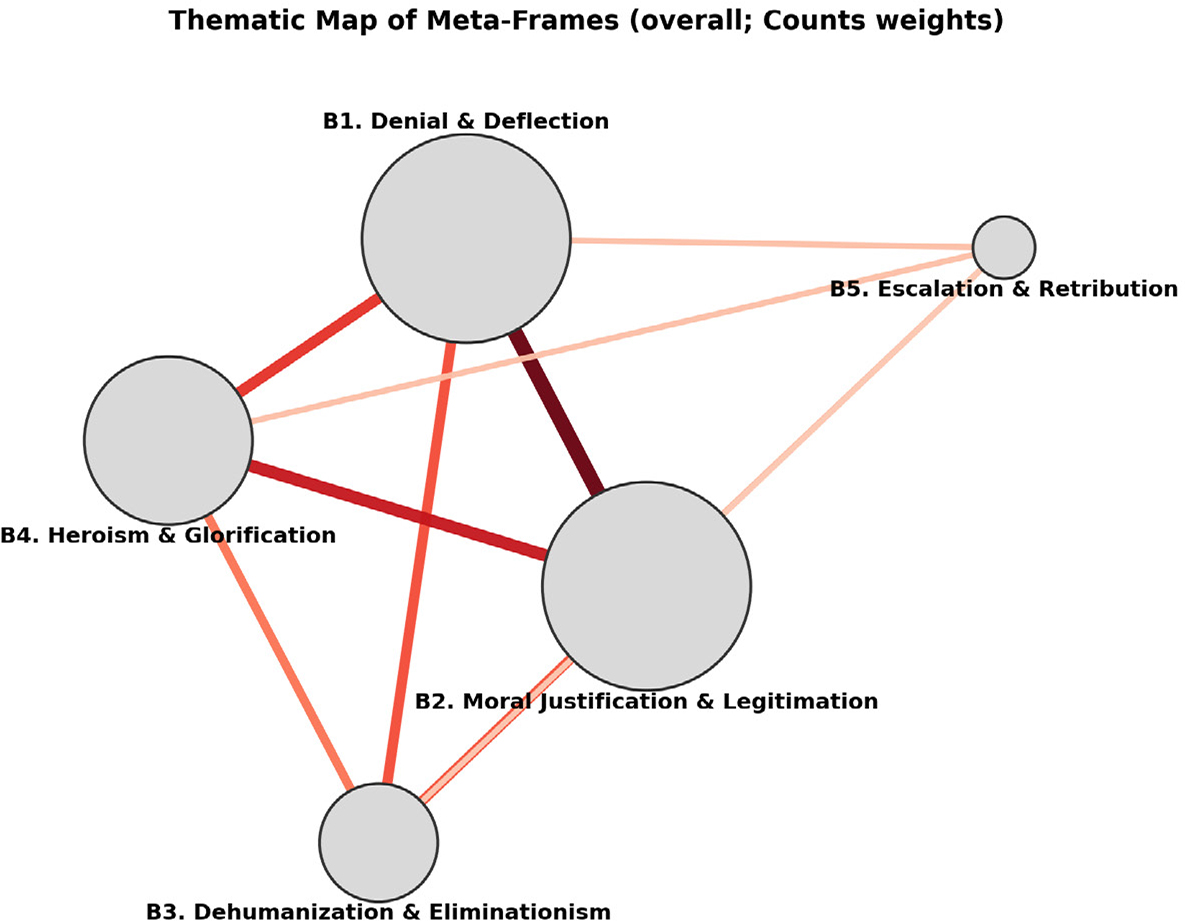
Figure 2:
Thematic Map of Meta-Frames
Note: Thicker lines indicate more frequent co-occurrence of themes; darker red stronger association.
The distribution of low-prevalence categories clarifies how Russian state-aligned channels pursued wartime persuasion without relying heavily on overtly eliminationist language, which appears in only 10.6% of the coded posts and is heavily concentrated around Mariupol (26.4% of posts). Even then, the majority of posts using this language are from a single account: that of the Chechen leader Ramzan Kadyrov, who praises, for example, a “liquidation phase,” demanding that “no one should escape alive,” and calling for “no mercy” (ID 1739, 1836, 1931). 7 This talk remained marginal in Bucha (0.78%) and low in Irpin (3.85%). 8 Closely related escalatory codes are also comparatively rare in the aggregate (see Table 2): collective punishment accounts for 3.1% of posts; calls for heavier/wider strikes just 6.6% of posts. Purification metaphors appear in 12.2% of posts, mostly in Mariupol. Here, 29.6% of the posts mentioning the city also mentioned purification.
Again, Ramzan Kadyrov was a prominent voice, repeatedly praising the zachistki (‘cleansing operations’) of the city.
Table 2:
Coding Results (Detailed Breakdown)
| Meta-Frame/Code | Label/Operational Definition | Bucha (n, %) | Irpin (n, %) | Mariupol (n, %) |
|---|---|---|---|---|
| A. General Coding Variables | ||||
| A1 | Explicit violence – Mentions or descriptions of violent acts, casualties, or destruction. | 128 (51.2%) | 187 (74.8%) | 133 (53.2%) |
| A2 | Stance – Evaluative tone towards the described violence (approving, condemning, neutral). | 236 (94.4%) | 250 (100.0%) | 250 (100.0%) |
| A3 | Primary target – Identifies who or what is targeted (civilians, military, infrastructure, etc.). | 227 (90.8%) | 250 (100.0%) | 250 (100.0%) |
| B1. Denial and Deflection – Total | 1108 | 534 | 493 | |
| B1a | Literal denial – Direct rejection of allegations (“feik,” “ne bylo,” “not true”). | 142 (56.8%) | 52 (20.8%) | 32 (12.8%) |
| B1b | Interpretive denial – Reframing events (“special operation”, “cleansing”, “liberation”). | 152 (60.8%) | 55 (22.0%) | 51 (20.4%) |
| B1c | Implicatory denial – Acknowledges harm but minimizes its moral or political significance. | 114 (45.6%) | 41 (16.4%) | 35 (14.0%) |
| B1d | Denial of injury – Claims that no civilians or innocents were harmed. | 85 (34.0%) | 56 (22.4%) | 30 (12.0%) |
| B1e | Denial of responsibility – Blames Ukraine, NATO, or legitimate orders for harm. | 185 (74.0%) | 76 (30.4%) | 91 (36.4%) |
| B1f | Condemning the condemners – Attacks critics as biased (“Western propaganda”, “fake news”). | 170 (68.0%) | 87 (34.8%) | 54 (21.6%) |
| B1g | Perpetrator other – Depicts Ukraine or the West as the true aggressor, Nazi, or terrorist. | 171 (68.4%) | 121 (48.4%) | 187 (74.8%) |
| B1h | Provocation/false-flag – Claims events were staged or fabricated by Ukraine or the West. | 169 (67.6%) | 46 (18.4%) | 13 (5.2%) |
| B2. Moral Justification and Legitimation–Total | 636 | 505 | 795 | |
| B2a | Deserving victim – Portrays victims as deserving harm (“Nazis”, “terrorists”). | 122 (48.8%) | 71 (28.4%) | 163 (65.2%) |
| B2b | Moral justification – Violence as righteous self-defence or restoration of justice. | 41 (16.4%) | 105 (42.0%) | 166 (66.4%) |
| B2c | Euphemistic labeling — Sanitized language for violence (“denazification”, “zachistka”, “operation”). | 110 (44.0%) | 115 (46.0%) | 185 (74.0%) |
| B2d | Advantageous comparison – Compares Russia’s actions favourably to Western wars. | 49 (19.6%) | 67 (26.8%) | 164 (65.6%) |
| B2e | Displacement/diffusion of responsibility – Assigns accountability to collective entities (“the army”, “orders from command”). | 131 (52.4%) | 81 (32.4%) | 39 (15.6%) |
| B2f | Minimization of consequences – Downplays severity of violence (“precision strikes”, “limited casualties”). | 95 (38.0%) | 66 (26.4%) | 78 (31.2%) |
| B3. Dehumanization and Eliminationism – Total | 60 | 117 | 383 | |
| B3a | Dehumanization – Compares Ukrainians to vermin, beasts, pests, machines, or objects. | 43 (17.2%) | 86 (34.4%) | 130 (52.0%) |
| B3b | “Liberation”/re-education – Imagines violence as curing or rehabilitating Ukraine (“de-Ukrainization”, “spiritual cleansing”). | 8 (3.2%) | 12 (4.8%) | 113 (45.2%) |
| B3c | Exterminationism/eliminationism – Advocates or celebrates total destruction (“wipe off the face of the earth”, “no mercy”). | 2 (0.8%) | 10 (4.0%) | 66 (26.4%) |
| B3d | Purification metaphors – Portrays violence as moral or spiritual cleansing. | 7 (2.8%) | 9 (3.6%) | 74 (29.6%) |
| B4. Heroism and Glorification – Total | 150 | 280 | 522 | |
| B4a | Heroic self – Describes Russian soldiers as “liberators”, “defenders”, or “heroes.” | 49 (19.6%) | 97 (38.8%) | 174 (69.6%) |
| B4b | Higher loyalties – Violence framed as patriotic or sacred duty. | 47 (18.8%) | 127 (50.8%) | 183 (73.2%) |
| B4c | Reconstruction/humanitarian – Frames rebuilding and aid as moral renewal, proof of Russian virtue. | 54 (21.6%) | 56 (22.4%) | 165 (66.0%) |
| B5. Escalation and Retribution – Total | 16 | 42 | 14 | |
| B5a | Collective punishment/retribution – Frames violence as revenge for earlier attacks. | 8 (3.2%) | 11 (4.4%) | 4 (1.6%) |
| B5b | Heavier/wider strikes – Calls for escalation (“strike decision centres”, “hit harder”). | 8 (3.2%) | 31 (12.4%) | 10 (4.0%) |
The Mariupol posts are distinct even beyond Kadyrov’s feed. They ridicule Ukrainian Azov fighters, frame violent surrenders as humane, and – like Kadyrov – celebrate the “cleansing” of entire districts. Thus, while content related to Mariupol includes a cluster of severe eliminationist and purification talk of the sort described by Riabchuk (2022), Garner (2022), and Laryš (2025), such language is not the modal register of high-view-count Russian Telegram propaganda in the first six months after the full-scale invasion, even when discussing the sites of atrocities and deploying violent language.
Eliminationist rhetoric is, however, frequently coded in allusive terms. In Mariupol, for example, themes of liberation appear in 45.2% of posts, typically paired with visions of soldiers and the heroic self (69.6% over-index vs. cross-incident mean), and higher loyalties to the state or abstract notions of Russia (64.0%). Violence (or atrocity) is dovetailed with talk of liberation, heroism, and so on to render it normal through juxtaposition. Indeed, this paper’s most important finding is the incidence of heroism and moral justification and those themes’ co-relationship with denial (see linkages in Fig. 2). Heroism and justification appear in a wide range of channels, from that of Dmitry Medvedev to those of bloggers like @yurasumy, @pgubarev, @NeoficialniyBeZsonoV, and @vysokygovorit. Across this variegated public-private ecology, each (re)iteration reinforces the narrative that Russian soldiers do not merely fight but embody a higher historical-moral purpose. This discursive bundling reframes violence as liberation, positions Russian action as morally justified, and elevates the perpetrating soldier as bound to a higher duty. Violence is normalized with layers of justificatory discourse (as in Bandura, 1999; Benesch, 2013); propagandists can approximate the permissions implied by exterminationist talk without assuming its explicit reputational and moral risks.
3.2. Differentiating Discursive Strategies: Contextualized Violence
A computation of over-indexing of the content, which shows how codes were spread across the three groups of 250 posts, reveals that the codes differed substantially across the three incidents (although these calculations serve purely to inform a discussion of discourse rather than to act as statistically significant anchors). Bucha, where the ‘flashbulb’ fired most vividly as discussion of events exploded on Telegram (Fig. 1), presents a particular problem for propagandists. The reported atrocities could not, as at Mariupol, be linked to a tangible strategic goal such as the capture of a major city. Around Bucha, the data coded shows layered and various forms of denial, which were coded 1,108 times (versus 534 for Irpin and 493 for Mariupol). Claims that Bucha was a ‘provocation’ or a ‘false-flag’ incident over-index by a large margin (+93.0): “Fake: A torture chamber was found in a Bucha basement… Truth: the video is staged” (ID 5073); “What happened is a staged performance. A spectacle designed for the Western viewer” (ID 11555); “Footage from Bucha is staged. In the video you can see that the corpses move and get up” (ID 2719). These were paired with denial of Russian responsibility (+67.7), literal denial that any incident took place at all (+66.7), denial of the scale of civilian injury (+28.0), and the minimization of the consequences (+15.3). Despite this denialism, the Russian soldiers who fought at Bucha were nonetheless praised as heroes (19.2% of posts) whose actions were morally justified (16.1%).
Denial was also recorded at the other sites: “The Ukrainian Armed Forces themselves shelled Irpin to blame Russia” (ID 7966); “Russia does not strike civilian sites. The Ukrainian army itself destroyed half the city while trying to blame us” (ID 990). However, news about Bucha spread rapidly from the Western into the Russian social media ecology (McGlynn, Garner, 2022). Faced with the reputational shock of civilian harm with high evidentiary salience, state-aligned channels flooded the zone with mutually supportive alternatives (as per Cohen, 2001; Paul, Matthews, 2016). Dovetailed but contradictory discourses thus suggest that nothing happened at Bucha, but if it did Russian soldiers did not do it, yet if Russian soldiers did do it, they were nevertheless heroes (a concatenation repeated to some extent across the data; see Fig. 2): “Russian soldiers are the honour and conscience of the nation. They cleanse the land of evil just as their grandfathers once cleansed Europe of fascism” (ID 2921); “A detachment of Russian fighters...came to help us!!!!” (ID 3054). What justifies the atrocity is not the Kadyrovian call to exterminate or to conduct genocide, it is the almost agency-less behaviour of the Russian soldier, whose presence, whether actual or discursive, justifies any action.
Discourses describing or calling for extermination existed at each site studied. Irpin, according to one ultranationalist channel (@Voenkorkotenok) “is being cleansed of Banderite filth that was hiding among civilians” (ID 2441). At Mariupol, “Russian warriors make the enemy vanish from the face of the earth. Such is the fate of all who raised their hand against the Donbass [sic]” (ID 1695). Nonetheless, these discourses were spread by only a small number of inflammatory ultranationalist channels (as in Garner, 2022, and Laryš, 2025), and were not widely observed. The sample about Irpin exhibits a measurable tilt toward intensification, with heavier/wider strikes signalled more than expected (+14.7), alongside a shift on collective punishment (+3.3).
Mariupol is, however, where moral authorization for atrocities is made most explicit, with 795 codes logged. The over-index profile is dominated by heroic self-presentation and justificatory tropes: painting Russian troops/civilians as heroic (+67.3), appeals to higher loyalties of nation or religion (+64.0), and moral justifications (+62.0). These are coupled with purification metaphors (+44.0), dehumanization (+43.7), and, even though they stem from a small array of large channels (as aforementioned, especially that of Ramzan Kadyrov), exterminationist narratives (+40.0). The result is not merely a claim that force is warranted in this case, but the creation of a generalized license to harm within the bounds of morally pure and warranted individual and collective actions which, euphemistically and in neutralizing mode, are portrayed as “denazification”, “cleansing”, and “demilitarization” across “the entire Ukrainian space” (ID 2348).
4. DISCUSSION: HEROISM, VIOLENCE, AND THE COLLAPSE OF BOUNDARIES
Providing a panoply of competing and affirming discursive motifs is consistent with theories of moral disengagement and impunity management; such propaganda approaches reduce inhibitions and preserve operational latitude most effectively when they provide many plausible rationales and deniable formulations, rather than a single, explicit call to elimination (Bandura, 1999; Cohen, 2001; Paul, Matthews, 2016; Haslam, 2006; Benesch, 2013). Thus, the absence of explicit exterminationist talk within the sample studied need not mean a broad disengagement from violence. Instead, violence is reframed through Telegram’s platformed capacity to normalize a steady circulation of violent frames both within the ‘flash’ of the bulb and its tail-off. Discourses are layered and interconnected, and traverse channel and event boundaries. Indeed, in Garde-Hansen’s (2009) view, the social media feed comprises a mass of near-indistinguishable content which “conjoins disjointed discussion postings in a multifaceted way”.
The most significant layering occurs in and around the image of Russian troops as benevolent and even loving towards civilians (and even while, as aforementioned, almost every post in the sample explicitly uses violent language around war). Troops hand out baby food and diapers – “parents of the children wept tears of joy in response to the kindness of our soldiers” (ID 476) – thereby displacing the blame for the atrocities in Bucha onto Ukrainians, while casting the Russian soldier as the humane hero. @NeoficialniyBeZsonoV amplifies a claim that Russian forces have “excellent relations” with civilians compared to “NATO [sic] soldiers” (ID 10916), propagating a narrative of heroism by contrast. Meanwhile, a Ukrainian civilian purportedly longs to enlist with the Russian army to liberate Ukraine from “fierce, senseless, and merciless Satanism” (ID 3022), casting participation in violence as both heroic and divinely sanctioned. Russian soldiers, even when associated discursively with violent incidents, are heroes building peace on behalf of and together with the nation as a whole: “The soldiers of the DNR and Russia are true heroes. They have brought long-awaited peace to the children of Donbas” (1906); “Today the heroism of our soldiers in Mariupol is an example for the whole country” (1955).
In the Mariupol material, acknowledgement of fighting and even atrocities is tightly coupled with discourses of national rebuilding and renewal, which is a vital discursive aim of the Russian war effort (Garner 2025): “In Mariupol our warriors show true heroism, liberating the city block by block” (ID 1734). One post celebrates the return of electricity to homes with the promise that “we will rebuild everything anew” (ID 3529), while another praises Russian rescuers who “revive life” amid the “ruins” (ID 2164). Nonetheless, these contrasts do not lead to cognitive dissonance in the feed. At Mariupol, destruction does not just precede aid, but in the collapsed space of the feed, becomes aid: “Together with his comrades [the soldier] breaks the enemy while helping civilians” (ID 3291). Through constant recoding of violence as heroism, denial as truth-telling, and destruction as renewal, the soldier is released from moral responsibility, becoming the passive agent of a higher power (see also Cohen, 2001; Haslam, 2006).
As a result, the heroic soldier, rewarded through vignettes of heroic action at the front and stories of medals and orders received (ID 7696, 96291), merges seamlessly with the figure of the builder and protector (further highlighting the collapsed boundaries between war and peace, soldier and civilian, front and rear in the digital, networked era). The soldier embodies Russia’s self-styled role as both destroyer of “fascists” and restorer of civilization (Kuzio, 2023): “One can only be proud of such cool-headed and courageous fighters!” (ID 1584). This framing cumulatively and immediately positions every Russian action – combat, occupation, reconstruction – as intrinsically heroic. The discourse around these incidents mirrors broader Russian militarizing discourse around patriotism away from the front (Edwards, 2024). The fluidity of such discursive creation around ‘flashbulb’ moments in conflict (Hoskins, 2011a) permits non-discursive boundaries to be collapsed, and competing, even contradictory, narratives to coalesce into a singular discursive space.
This ‘everydaying’ of violence on social media resonates with Sykes and Matza’s (1957) account of “techniques of neutralization”, where actors reframe violence to make it morally permissible, and with Bandura’s (1999) analysis of moral disengagement, in which harmful conduct is re-coded as serving higher values. Military and civilian publics are conditioned to accept or even demand wider target sets as a logical extension of a present fight. The discursive mechanism in the sample here achieves this end by exploiting the communicative platformed qualities of social media that Hoskins (2009, 2011a, 2011b) notes are vital to constructing a ‘fluidization’ experience of the new wartime present.
Indeed, if in the sample explicit calls for violence are comparatively rare, and the dominant rhetorical move is instead to portray Russian soldiers as the heroic creators of a ‘new world’ embodied in sites such as Mariupol, then the socialization of violence must take place at a level beyond that of individual discursive strands. The language of the everyday, not the extreme, permits atrocities to be emplotted as triumphs (Stavrianakis, Selby, 2013), then sedimented at the level of the everyday. (Pre-)genocidal rhetoric does not require overt exterminationist phrasing to lower thresholds for harm (Savage, 2013). The use of dehumanization (in 35.1% of the corpus) – where Ukrainians are described as animals or vermin using almost quotidian language which sees the Russian “destroying entire herds of swine” (ID 20709) or “smoking rats out of a cellar” (ID 7966) – as a discursive strategy can consequently be read through the prism of Hoskins’ understanding of the ‘flashbulb’; ‘sedimentation’ of discursive into non-discursive behaviour can happen almost unheeded.
Conclusion
Some research suggests that many Russians are at least somewhat aware of atrocities committed by their forces, yet simultaneously affirm competing narratives which deny or justify such violence (McGlynn 2022). The discursive data in this paper mirror this fractured epistemology: atrocities “did not happen”, those who claim otherwise are malign actors, and yet, in the same breath, those who committed the violence are lauded as exemplary soldiers who acted with moral rectitude against a deserving foe. Such cognitive and discursive dissonance is, in the sphere analysed here, sustained by the affordances of the Telegram platform, which enables the rapid circulation of parallel and often contradictory frames (Hoskins, Shchelin, 2022).
Simultaneously, however, a collapse in boundaries between platforms and events happens as equally contradictory and reassuring sets of discourses are woven through and around different sites (here, Mariupol, Bucha, and Irpin). Within this environment, violence is normalized not as a matter of individual decision or explicit exterminatory intent, but as part of a broader historical destiny in which Russian society, both at the (undifferentiated) front and rear, is cast as mobilized, heroic, and ultimately, agencyless, folded back through the social media miasma into the imperial-historical process traced by Etkind (2022) and Oksamytna (2023). The ‘flashbulb’ thus dissolves into the (a)historical and into the everyday.
Militarization as an everyday process takes root because in its ordinary forms it need scarcely look like violence at all (Enloe, 2000). In the material about the present war studied here, Telegram’s affordances amplify this creep in the dazzling ‘flash’ as news of atrocities breaks. Rapid recirculation, cross-posting, and the bundling of discourses collapse distinctions between front and rear, soldier and civilian, actor and audience, and time and space. Within the space of the Telegram feed, the user is bombarded with the message that violence is an ordinary part of reality. Russian soldiers, whether they commit violence or not, are always heroic and, like civilians, always working toward higher national ends.
The ‘creep’ of violence, within the platformed conditions of Telegram and in the data sample analysed here, thus does not proceed at an even tempo. Rather, it can burst into the feed, then, through the mechanisms discussed, be made everyday. State propaganda does not need to resort to the types of extreme calls for genocide and elimination highlighted by some scholars in order to justify or encourage its armed forces’ behaviour. Violence around Bucha, Irpin, and Mariupol can be made to not look like violence at all when both those events and the participants in them are reframed as part of a contiguous militarization of every aspect of the feed. In this sense, this study reinforces findings around everyday militarization in the Russian Federation, where the state attempts to use the full spectrum of media to embed patriotism around a violent war in the subject’s quotidian experience (Edwards, 2024).
The data described here form an everyday ecology of violence in which networked dynamics converge to rapidly embed sites of atrocities, and the violence discursively associated within them, within a fluid and always-on social media space. This adds significant nuance and context to studies that have highlighted imperialist and exterminationist language in Russia’s propaganda (Garner, 2022; Riabchuk, 2022; Laryš, 2025). Across the broader network and in the medium term, the dominant frames praised those who perpetrate or enable violence by narrating them as protectors and builders, even as the same channels categorically denied that proscribed violence occurred. Nonetheless, denial does not mean privileging topics which ignore violence (as suggested e.g. by Makhortykh et al., 2025). Violence is justified as part of normal broader behaviour before, during, and after conflict. Indeed, an incident like Irpin can be represented as one simultaneously associated with military cleansing (zachistka) and normal life: “In the Chernihiv region a cleansing is underway… in the rear of the advancing army normal life is beginning to be organized” (ID 10948). Here, such rhetorical assimilation is emphasized by the cross-channel platformed feed (Garde-Hansen, 2009) and the interlinkage of the frontline and the rear. Through the mass juxtaposition and reiteration of heterogeneous discourses across sites of atrocities, a networked platform like Telegram can rapidly normalize and sediment discourses around violence in this way. Such a propaganda tool, therefore, can serve a useful military purpose in both justifying past and future wartime violence.
A crucial next step is to ask how these frames travel beyond state-aligned Telegram channels into the (non-)discursive practices of everyday users, civilian, and military alike: which motifs endure, and which are “sedimented” most rapidly or widely into routines of speaking, seeing, and doing? In particular, did this change in the time following the window studied in this paper? Here, the literature on Soviet and post-Soviet subjectivity offers a suggestion for what may be: the (neo-)totalitarian self which internalizes and performs official narratives while finding agency displaced onto history and higher loyalties (Hellbeck, 2006, 2015; Etkind, 2022; Oksamytna, 2023). The research design here, which focuses on high-visibility content rather than reception or belief, does not seek to answer these questions. Nonetheless, it identifies important discursive trends and the platform conditions which enable their rapid uptake, offering a framework for further studies. Such studies could incorporate user-level interaction data and bot-detection methods (e.g. Vanetik et al., 2023) to address questions of reach, reception, and the algorithmic amplification of violence-legitimizing content. Comparative analyses could examine additional sites of Russian wartime atrocities, especially as the war against Ukraine is now in its fourth year, to assess whether similar justificatory and normalizing frames coalesced or diverged across different temporal and spatial contexts. Cross-platform research could use network and topic-model analyses to explore how militarized discourses circulate, mutate, and sediment within Russia’s broader digital public sphere, especially on parallel state-dominated or owned platforms such as VK or the new Max app.