
1. Introduction
Chickpea (Cicer arietinum L.) ranks as the third most produced seed legume globally, following soybeans and peas (Food and Agriculture Organization of the United Nations, 2023). Originating in the Neolithic era of the Fertile Crescent around 10,000 years ago, chickpeas trace their origins to West Asia (Lev-Yadun et al., 2000). Subsequently, they underwent widespread geographic distribution, reaching regions such as the Middle East, India, and the Mediterranean. Today, with an annual yield of 8.4 million tons, India stands out as the leading global producer, contributing around 80% toward the world‘s total production. Europe represents only a 4% share of the global production, with cultivation predominantly concentrated in Spain, Bulgaria, and France (FAOSTAT, 2024b). European chickpea production has experienced a notable increase in recent years, rising from 47,000 tons in 2013 to 270,000 tons in 2018, indicating a growing interest in chickpea in the region (Kezeya et al., 2020).
The typical phenotypic appearance of chickpea seeds varies in different types. In Europe, mainly the Kabuli type is known, which has large, round-shaped, cream-colored seeds with a thin seed coat and forms white flowers. However, the Kabuli type only accounts for 20% of the global market, while the Desi type is more popular with a market share of around 80%. The Desi type is characterized by narrow, angular, and dark-colored seeds with a thick seed coat and reddish-purple flowers ( Merga and Haji, 2019; Eker et al., 2022a). Within the Desi type, the Gulabi subspecies is distinguished by a more rounded, pea-shaped seed (Blessing, 2021). Natural mutation and selections from Desi type chickpea have resulted in the development of Kabuli type varieties (Kozgar, 2014).
Currently, no European country achieves self-sufficiency in chickpea production and imports into the European Union (EU) are around 150,000 tons per year. The primary origins of chickpea imports for EU member states are the Americans, with Argentina, Mexico, and the USA collectively contributing 75% of the overall imports (Kezeya et al., 2020). According to data of the Food and Agriculture Organization of the United Nations (FAO), Austria imported 1,569 tons of dried chickpeas in 2020, around seven times more than in 2010 (FAOSTAT, 2024a). The rising domestic cultivation, expanding from 80 ha in 2017 to 337 ha in 2025, and peaking at 472 ha in 2021 (Agrarmarkt Austria, 2025), does not meet the increasing demand for chickpeas in the country.
Chickpea is a high-quality source of protein and is considered to have a smaller environmental impact compared to meat production (Zamecnik et al., 2023). Regarding chemical composition, chickpea seeds typically contain 17%–22% protein, approximately 60% starch, around 2% fiber, and up to 7% fat in their dry matter. As in all legumes, higher amounts of oligosaccharides belonging to the raffinose family are found (Begum et al., 2023). Also typical for legumes, glutamic acid is the most abundant amino acid, followed by aspartic acid and arginine, whereas sulfur-containing amino acids (e.g., methionine, cysteine) are deficient (Boye et al., 2010). Chickpea seeds contain large amounts of vitamins and minerals as well as high levels of phenolic compounds, particularly isoflavones, which help to reduce oxidative stress and inflammation (de Camargo et al., 2019; Kaur and Prasad, 2021; Ayerdi Gotor and Marraccini, 2022). Raw chickpea seeds also contain remarkable concentrations of antinutritive substances, of which trypsin inhibitors are among the most present ones, resulting in an increased difficulty of digesting the raw chickpea protein (Márquez and Alonso, 1999).
Increasing chickpea cultivation in Austria has the potential to reduce the country‘s reliance on imports and enhance the availability of domestic protein sources, aligning with the goals outlined in the federal government‘s protein strategy (Bundesministerium für Landwirtschaft, Regionen und Tourismus, 2021). Chickpea is considered a sustainable and crisis-proof protein-rich crop (Zamecnik et al., 2023) and is also attractive to farmers as a cost-effective production crop (Fikre et al., 2020). Chickpeas are relatively good nitrogen fixers, which can fix more than 60% of their nitrogen requirements through symbiosis with specific nodule bacteria in the soil (Carranca et al., 1999; Turpin et al., 2002). This capability enriches the soil with nitrogen, reducing the need for nitrogen fertilizers and benefiting subsequent crops. Consequently, chickpea is highly valuable for crop rotation, particularly in organic farming contexts (Armstrong et al., 1997; Peoples et al., 2009; Grains Research and Development Corporation, 2017). Its stability facilitates the chickpea harvest with conventional combine harvesters (Blessing, 2022). Chickpea is known for its drought tolerance, partially attributed to its long taproot and high root length density, which allows the crop to extract deeper water sources in the soil for transpiration (Mia et al., 1996; Kashiwagi et al., 2006; Food and Agriculture Organization of the United Nations, 2023). Chickpea requires only medium to low rainfall of 300–500 mm annual precipitation (Grains Research and Development Corporation, 2017). While Kabuli types require a minimum of 400 mm, Desi types grow with minimum 350 mm of annual precipitation (Grains Research and Development Corporation, 2017). In the drought-prone Eastern Austrian growing regions like the Marchfeld, farmers seek crops resilient to heat and dry conditions (Bundesministerium für Land- und Forstwirtschaft, Regionen und Wasserwirtschaft, 2023). Traditionally grown crops like potatoes that are used to temperate conditions suffer from reduced yields due to excessive heat and drought, necessitating irrigation (Bomers et al., 2024). However, irrigation is not always practical or economically feasible, prompting the need for crops that require less water to adapt to the changing climate (Bundesministerium für Land- und Forstwirtschaft, Regionen und Wasserwirtschaft, 2023). An Austrian study has shown that chickpea, unlike pea, oat, or barley, exhibits resilience to dry conditions and minimal yield loss, making it a viable alternative for farmers in Austria’s arid growing region (Neugschwandtner et al., 2013). The approval of chickpea varieties is not yet regulated at the EU level. This means that the transition from farmers’ varieties to commercial varieties is fluid. Farmers cannot be sure that the available varieties were tested in multi-year variety trials by independent national institutions. However, 11 chickpea varieties have EU-wide plant variety protection, which means that they have undergone registration trials and have been independently tested for distinctness, uniformity, and stability (Community Plant Variety Office, 2024). The breeders of the protected varieties, which originate mainly from France and Spain, have the exclusive right to produce and market propagating material. In addition, in some countries such as France, Spain, or Hungary, chickpea is regulated nationally and appears on national lists with available national test reports ( Groupe d‘étude et de contrôle des variétés et des semences, 2024; Nemzeti Élelmiszerlánc-biztonsági Hivatal, 2024; Oficina Española de Variedades Vegetales, 2024). In Austria, chickpea is not regulated in the Austrian Seed Regulation (“Saatgutverordnung 2006”). Thus, chickpea seeds can be marketed without official certification or variety registration. Chickpea breeding is not being practiced in Austria, leading to the absence of domestic varieties. The seed of chickpea varieties may not be thoroughly controlled, for example through germination tests, before marketing, and little information is available about the suitability of the varieties in Austria. Nevertheless, information can be obtained by experiments with chickpea that have been conducted and continue to be explored by Austrian organizations such as universities, agricultural research institutions, and agricultural associations (Wichmann et al., 2005; Neugschwandtner et al., 2013; Anschober, 2018; Landwirtschaftliche Koordinationsstelle, 2018; Maierhofer et al., 2020; Landwirtschaftliche Koordinationsstelle, 2021). Here, it has been shown that the yield of chickpea can be higher than that of other legumes, such as beans, lentils, soybean, or peas, especially in dry years (Wichmann et al., 2005; Neugschwandtner et al., 2013; Maierhofer et al., 2020). Some of the projects compared the performance of different varieties, but the number of varieties was low and multi-location and multi-year variety trials are still lacking. The objective of this study was to evaluate the suitability of different chickpea varieties as an alternative protein crop for cultivation in the arid growing regions of Eastern Austria. For this purpose, a variety trial with 24 chickpea varieties was conducted in 2023. The project aimed to improve the understanding of the seed material properties and the plant development of these varieties and to provide an overview of varietal differences with regard to yield, yield components, as well as differences between the chemical composition of the harvested material of the Kabuli and Desi types. In addition, over the course of the project, we wanted to identify potential barriers and future research needs, which still might hinder the introduction and cultivation of chickpea in the Austrian agricultural system.
2. Material and Methods
2.1. Seed Material
Seeds from 24 distinct chickpea varieties were acquired from breeders and institutions from five different countries. According to the Community Plant Variety Office (2024), these chickpea varieties were bred in nine different countries, as denoted by the country of first registration: Italy, France, Hungary, Greece, Portugal, Canada, Russia, Spain, and the Czech Republic. The registration years for these varieties range from 1986 to 2022. The most recently bred variety was the variety Jafar, registered in Italy in 2022. The varieties Dora and Thiva were the oldest varieties included, both registered 37 years before the trial (1986), in Hungary and Greece, respectively. Out of the 24 varieties, 19 were classified as Kabuli type, three as Desi type, and two as the Desi subspecies Gulabi type (Table 1).
Table 1.
Source, type, country, and year of first variety registration according to CPVO, as well as germination rate, TKW of the seeds, and adjusted sowing rate as determined before sowing of the 24 chickpea varieties used in the variety trial.
Tabelle 1. Bezugsquelle, Typ, Land und Jahr der ersten Sortenzulassung gemäß dem Gemeinschaftlichen Sortenamt (CPVO), sowie im Labor bestimmte Keimfähigkeit und Tausendkorngewicht des Saatguts und die daraus berechnete angepasste Aussaatstärke der 24 im Versuch verwendeten Kichererbsensorten.
| Variety | Source | Type | Country of first variety registration | Year of first variety registration | Laboratory germination rate (%) | TKW (g) | Adjusted sowing rate (seeds/m2) |
|---|---|---|---|---|---|---|---|
| Amorgos1 | Saatbau Linz (Austria) | Kabuli | Greece | 1997 | 97 | 322 | 52 |
| Analisto | LIDEA Germany GmbH (Germany) | Kabuli | France | 2018 | 87 | 334 | 57 |
| Badil | Semo Bio GmbH (Germany) | Kabuli | Spain | 2005 | 94 | 271 | 53 |
| Bori | Szarvasi Medicago Kft. (Hungary) | Desi | Hungary | 2004 | 95 | 118 | 53 |
| CDC Orion | LIDEA Germany GmbH (Germany) | Kabuli | Canada | 2014 | 90 | 391 | 56 |
| Cicerone | Tec2Trade (Austria) | Kabuli | Italy | 1995 | 66 | 262 | 76 |
| Donia | Hungarian University of Agriculture and Life Sciences (Hungary) | Kabuli | Hungary | 2013 | 97 | 310 | 52 |
| Dora | Hungarian University of Agriculture and Life Sciences (Hungary) | Gulabi | Hungary | 1986 | 91 | 286 | 55 |
| Elixir | Tec2Trade (Austria) | Kabuli | Portugal | 2006 | 88 | 315 | 57 |
| Elmo | LIDEA Germany GmbH (Germany) | Desi | Portugal | 1993 | 78 | 259 | 64 |
| Flamenco2 | Strube GmbH & Co. KG (Germany) | Kabuli | France | 1991 | 86 | 280 | 58 |
| Gavdos | Saatbau Linz (Austria) | Kabuli | Greece | 2006 | 93 | 531 | 54 |
| Jafar | Societa Produttori Sementi S.p.A. (Italy) | Kabuli | Italy | 2022 | 91 | 430 | 55 |
| Katalin | Szarvasi Medicago Kft. (Hungary) | Desi | Hungary | 2018 | 85 | 211 | 59 |
| Maragiá | Tec2Trade (Austria) | Kabuli | Italy | 2016 | 87 | 435 | 57 |
| Olga | Research Institute for Fodder Crops Ltd. Troubsko (Czech Republic) | Gulabi | Czech Republic | 2017 | 79 | 233 | 63 |
| Pasciá | Tec2Trade (Austria) | Kabuli | Italy | 2000 | 71 | 446 | 70 |
| Reale | Societa Produttori Sementi S.p.A. (Italy) | Kabuli | Italy | 2002 | 77 | 429 | 65 |
| Rondo2 | Strube GmbH (Germany) | Kabuli | France | 2019 | 86 | 345 | 58 |
| Sokol | BSV Saaten (Germany) | Kabuli | Russia | 2016 | 83 | 258 | 60 |
| Sultano | MyLocalFarm GmbH (Germany) | Kabuli | Italy | 1990 | 83 | 306 | 60 |
| Thiva | Saatbau Linz (Austria) | Kabuli | Greece | 1986 | 97 | 342 | 52 |
| Twist | RWA AG (Austria) | Kabuli | France | 1991 | 62 | 350 | 81 |
| Vulcano | MyLocalFarm GmbH (Germany) | Kabuli | Italy | 1996 | 86 | 282 | 58 |
To achieve the desired plant density for all varieties, germination rate and thousand kernel weight (TKW) were determined before sowing to calculate the respective sowing rate. Laboratory germination tests were performed according to the International Rules for Seed Testing guidelines for chickpea on sand with 100 seeds per variety (International Seed Testing Association, 2023). Due to the delayed arrival of seeds, germination tests for the varieties Flamenco, Rondo, and Amorgos were precluded. In the case of Amorgos, the germination rate printed on the packaging was used instead. For Flamenco and Rondo, where package information was unavailable, the average germination rate derived from all measured germination rates (86%) was utilized. TKW measurements were conducted using an automatic seed counter. For each variety, the adjusted sowing rate was calculated based on the germination rate of the seed material and TKW, aiming at a desired plant density of 50 plants/m2, except for the variety Flamenco, which was sown with a plant density of 50 plants/m2 as well as 60 plants/m2.
2.2. Soil and Environmental Conditions
The trial was carried out in the dry region of Eastern Austria at the experimental station of the Austrian Agency for Health and Food Safety in Fuchsenbigl (48.1952, 16.7464; altitude: 143 m a.s.l.), which is characterized by a long-term average (1990–2019) annual temperature of 11.3 °C and a long-term average annual precipitation of 577 mm. The soil is classified as a Chernozem of alluvial origin and rich in calcareous sediments (pH 7.6). The 2023 growing season was characterized by a wet May (sum of 72 mm precipitation) and a wet beginning of June (97 mm of precipitation), followed by a hot and dry July with only 21 mm of precipitation, around one-third of the recorded long-term average. The maximum temperature recorded between the date of sowing and harvest was 36.5 °C (July 10, 2023), while the minimum temperature recorded was 8.9 °C (May 10, 2023). The months June, July, and August were 2.7 °C, 4.1 °C, and 4.3 °C warmer than the long-term average (Figure 1).
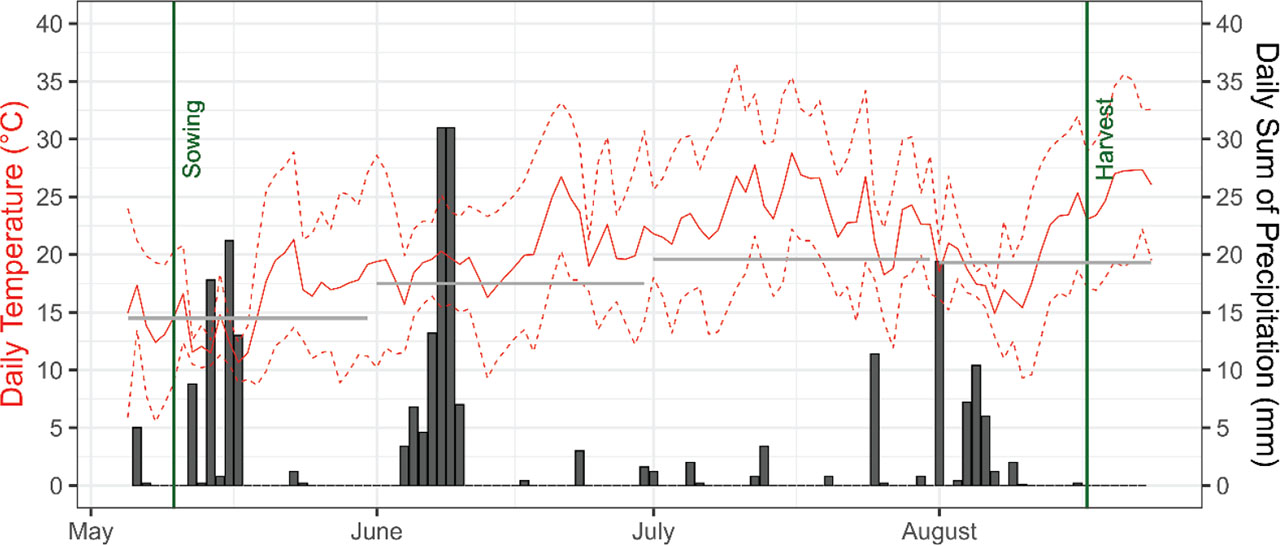
Figure 1.
Temperature and precipitation over the growing period of the chickpea variety trial in Fuchsenbigl, Austria, in 2023. Daily average temperature (°C) is indicated by a red solid line; maximum and minimum daily temperatures (°C) are indicated by red dashed lines; daily sum of precipitation (mm) is indicated by bars; monthly long-term average temperature (°C) is indicated by gray horizontal lines; sowing and harvest dates are indicated by green vertical lines.
Abbildung 1. Temperatur und Niederschlag während der Wachstumsperiode des Kichererbsensortenversuchs in Fuchsenbigl, Österreich, im Jahr 2023. Die durchschnittliche Tagestemperatur (°C) wird durch eine rote durchgezogene Linie angezeigt; die maximalen und minimalen Tagestemperaturen (°C) werden durch rote gestrichelte Linien angezeigt; die tägliche Niederschlagssumme (mm) wird durch Balken dargestellt; der monatliche langjährige Durchschnitt der Temperatur (°C) wird durch graue horizontale Linien angezeigt; die Aussaat- und Erntetermine werden durch grüne vertikale Linien angezeigt
2.3. Trial Design and Crop Management
The trial was set up in a randomized complete lattice design with four replicate plots per variety. The variety Flamenco was included twice in the trial design, once with a calculated plant density of 50 plants/m2 and once with 60 plants/m2, resulting in a total of 25 treatments and 100 plots for the whole trial design. Seeds were sown with a plot drill, 4–5 cm deep into four rows per plot, with a row distance of 39 cm. Plot width was 1.56 m and plot length was 8.5 m, resulting in a total plot size of 13.26 m2. The distance between plots was 40 cm. The trial was managed under organic growing conditions. The preceding crops on the field were spring wheat (in 2022) and winter wheat (in 2021). The chickpea seeds were inoculated with LegumeFix Torf (Gartensoja, D-59602 Rüthen), containing Rhizobia bacteria specific to chickpea, according to product specifications before sowing. All varieties were untreated, except for Rondo, for which the seeds were previously stained with Actifilm pro by the seed supplier. The chickpeas were sown on May 10, 2023. Weed control was performed twice mechanically on June 01, 2023, and June 19, 2023. Harvesting occurred on August 17, 2023, 99 days after sowing (DAS), using a plot harvester.
2.4. Phenotypic Data Collection
Over the course of the field trial, phenotypic data was collected to assess differences between the chickpea varieties. The first phenotypic description was made on June 20, 2023, at 41 DAS. Here, plant density (plants/m2), developmental stage (BBCH-scale), and the share of plants with at least one flower (%) were determined for each plot. Plant density was evaluated by counting all plants within a 1 m2 frame placed in the middle of each plot. To assess the percentage of seeds that successfully germinated in comparison to the laboratory germination tests, the field germination rate for each plot was calculated using plant density per square meter and the adjusted sowing rate per square meter. Developmental stage was determined by adapting the BBCH coding scheme for soybean. The share of plants with at least one flower was estimated per plot and reported as percentage. On July 10, 2023 (61 DAS), the developmental stage (BBCH-scale) was evaluated for the second time. The last phenotypic description was made 1 week before harvest on August 11, 2023 (93 DAS). Here, canopy height (cm) as well as the number of pods per plant (n) and the number of seeds per pod (n) were evaluated for one plot per variety. The number of pods per plant was determined as the average number of pods at maturity from five representative plants. The number of seeds per pod was assessed in accordance with guidelines by the International Union for the Protection of New Varieties of Plants (UPOV), using an average of 10 pods from five representative plants per plot.
2.5. Yield and Yield Components
The chickpeas were harvested on August 17, 2023 (99 DAS), and the yield in kilogram per plot was automatically measured by the plot harvester. Subsequently, the arithmetic mean in deciton per hectare (dt/ha) was computed for each variety. Considering varietal variations in seed moisture content at harvest, the mean yield in dt/ha was normalized to 86% dry matter and the potential block effect within the lattice design was taken into account. Hence, an adjusted mean yield was calculated following the instructions outlined by Williams (1977). The harvested material from the four replicate plots of each variety was combined into a composite sample of 1 kg. TKW of the harvested material was determined in duplicate following the guidelines of Austrian Standards International (2010). The moisture content of the harvested material was analyzed in duplicate following the guidelines of the International Seed Testing Association (2023). Around 10 g of coarsely ground chickpea sample was dried for 60 min at 130 °C. The moisture content was then calculated based on the weight of the dried sample. The crude protein content of the harvested material was determined in duplicate by combustion according to ÖNORM EN ISO 16634 (Austrian Standards International, 2009; Austrian Standards International, 2016). A finely ground sample (particle size <0.5 mm) was analyzed according to the Dumas combustion method, in which nitrogen is measured and the protein content is calculated using a conversion factor of 6.25.
2.6. Chemical Composition of Harvested Material
Multiple further parameters were measured in duplicate samples from the post-harvest seed material to assess varietal differences in the chemical composition. Among these were the trypsin inhibitor activity (TIA), the mono-, di-, and oligosaccharide content, the content of polyphenols, and assessment of the amino acid composition of the chickpea seed material. TIA of the harvested material was assessed following the standard method described in ÖNORM EN ISO 14902 (Austrian Standards International, 2002). The determination of mono-, di-, and oligosaccharides was conducted according to ÖNORM CEN/TS 15754 (Austrian Standards International, 2008) by means of high-performance anion exchange chromatography in combination with pulsed amperometric detection. The measurement of polyphenols was done with the Folin– Ciocalteu method, based on the redox reaction of the Folin–Ciocalteu reagent with the phenolic substances in the sample (Makkar, 2003). The amino acid analysis was carried out as laid down in regulation (EC) 152/2009 (European Commission, 2009), where the amino acids were separated by ion exchange chromatography and determined by reaction with ninhydrin using photometric detection at 570 nm (440 nm for proline).
2.7. Statistical analysis
The field experiment was set up as a quadratic lattice design using 25 different treatments in quadruple repetition. Each variety was considered as one individual treatment, while the variety Flamenco was included twice with different sowing densities (the standard 50 seeds/m2 and an increased sowing density of 60 seeds/m2) to complete the used field design. Statistical analysis of differences between varieties was done using the program R Studio version 4.4.2 and the package AgriStat to perform a standard analysis of variance with a significance level of p < 0.05. Pairwise comparison between different treatments was done with testing for least significant differences by using the R package Agricolae (α = 0.05). To assess differences between the Kabuli and Desi types for multiple measured chemical composition parameters, the Mann–Whitney U test was used with a significance level of p < 0.05, with the Kabuli type group including 20 samples (i.e., varieties including the variety Flamenco with both sowing densities) and the Desi type group including five samples. For these analyses, varieties of the Desi type subspecies Gulabi were grouped together with the Desi type varieties to form the Desi type group.
3. Results
3.1. Development and Phenotypical Appearance of Varieties
The calculated field germination rate averaged 67% across all varieties, while the average laboratory germination rate for all varieties was 85%. The variety Amorgos achieved the highest field germination rate at 87%, while the variety Pasciá had the lowest, with a rate of 46% in our field trial. Compared to the germination rate determined under laboratory conditions, the average field germination rate across all varieties was 18% lower. None of the varieties in our field trial exhibited a higher germination rate in the field than in the laboratory, although the field germination rate of the variety Elmo was only 3% lower than its laboratory germination rate. The variety Gavdos showed the greatest discrepancy between laboratory and field germination, with the field rate being 46% lower than the laboratory rate. Statistical analysis revealed no significant correlation between field and laboratory germination rates or between field germination rate and TKW before sowing. Plant density varied among the varieties from 27 (Gavdos) to 48 (Elmo) plants/m2. None of the varieties reached the desired plant density of 50 plants/m2, which was calculated based on the germination rate of the seed material and TKW. On average, a plant density of 40 plants/m2 was achieved (Table 2). In case of the variety Flamenco, which was sown once with a targeted plant density of 50 plants/m2 and once with 60 plants/m2, the higher seed density resulted in an increase in plant density of 32%, reaching 58.5 plants/m2.
Table 2.
Details about development and phenotypic appearance for each of the 24 chickpea varieties in the variety trial in Fuchsenbigl, Austria in 2023 evaluated at 41, 61, and 93 DAS.
Tabelle 2. Details zu Entwicklung und phänologischem Erscheinungsbild der 24 Kichererbsensorten im Sortenversuch in Fuchsenbigl, Österreich im Jahr 2023, bewertet 41, 61 und 93 Tage nach der Aussaat (DAS).
| Variety | Calc. field germination rate (%) | Plant density 41 DAS (plants/m2) | Developmental stage 41 DAS (BBCH) | Plants with min. one flower 41 DAS (%) | Developmental stage 61 DAS (BBCH) | Plant canopy height 93 DAS (cm) | Number of pods per plant 93 DAS (n) | Number of seeds per pod 93 DAS (n) |
|---|---|---|---|---|---|---|---|---|
| Amorgos | 87 | 45 | 57 | 3 | 77 | 30 | 25 | 1 |
| Analisto | 58 | 33 | 63 | 73 | 80 | 40 | 30 | 2 |
| Badil | 74 | 39 | 62 | 88 | 79 | 30 | 30 | 1 |
| Bori | 58 | 31 | 53 | 0 | 77 | 20 | 30 | 2 |
| CDC Orion | 75 | 42 | 63 | 89 | 79 | 30 | 20 | 1 |
| Cicerone | 58 | 44 | 55 | 1 | 76 | 40 | 20 | 1 |
| Donia | 84 | 44 | 55 | 2 | 76 | 50 | 35 | 1–2 |
| Dora | 76 | 42 | 54 | 3 | 77 | 40 | 35 | 1 |
| Elixir | 68 | 39 | 57 | 6 | 79 | 35 | 18 | 1–2 |
| Elmo | 75 | 48 | 58 | 14 | 80 | 27 | 30 | 1 |
| Flamenco | 76 | 44 | 59 | 10 | 78 | 25 | 23 | 1 |
| Gavdos | 50 | 27 | 55 | 2 | 79 | 35 | 15 | 1–2 |
| Jafar | 75 | 41 | 57 | 5 | 77 | 42 | 22 | 2 |
| Katalin | 70 | 41 | 57 | 5 | 79 | 32 | 15 | 1–2 |
| Maragiá | 71 | 41 | 58 | 2 | 78 | 40 | 25 | 1 |
| Olga | 61 | 38 | 53 | 1 | 77 | 50 | 35 | 1 |
| Pasciá | 46 | 32 | 55 | 4 | 78 | 35 | 20 | 1 |
| Reale | 67 | 44 | 58 | 3 | 77 | 42 | 25 | 1 |
| Rondo | 75 | 43 | 57 | 6 | 77 | 30 | 35 | 1 |
| Sokol | 52 | 31 | 54 | 3 | 77 | 40 | 30 | 1–2 |
| Sultano | 60 | 36 | 56 | 1 | 75 | 42 | 30 | 1 |
| Thiva | 76 | 40 | 61 | 28 | 79 | 30 | 25 | 1 |
| Twist | 57 | 47 | 55 | 1 | 78 | 30 | 18 | 1 |
| Vulcano | 66 | 38 | 59 | 6 | 77 | 35 | 25 | 1 |
The varieties also differed in their speed of plant development, the number of pods formed, as well as the plant height. At 41 DAS, the developmental stages ranged between flower bud development (BBCH 53) and flower development (BBCH 63). On average, 15% of the plants displayed at least one flower at 41 DAS. The varieties Badil, CDC Orion, and Analisto were early flowering, while Bori and Olga were late flowering. In the plots of the three early flowering varieties, more than 70% of the plants had at least one flower at 41 DAS. At 61 DAS, the varieties varied between the developmental stage pod development (BBCH 75) and pod maturity (BBCH 80). At maturity (93 DAS), the heights of plant canopies varied from 20 cm (Bori) to 50 cm (Donia, Olga), with an average height of 35 cm across all varieties. Regarding pod production, the number per plant ranged from 15 pods (Katalin, Gavdos) to 35 pods (Olga, Dora, Donia, Rondo), averaging 26 pods per plant. Most varieties formed on average one seed per pod; however, eight varieties had more than one seed per pod (Table 2).
3.2. Yield and Yield Components
The seed moisture content after harvest exhibited significant variation among the different varieties, ranging from 11.4% in CDC Orion to 12.5% in Cicerone, with an overall mean of 11.9%. The effect of the variety on the moisture content was highly significant (p < 0.001), indicating substantial differences among the varieties. Normalizing the dry matter content to 86% and incorporating the block effects of the lattice design, the adjusted yields demonstrated significant variation among the different varieties, ranging from 16 dt/ha in Gavdos and Bori to 24 dt/ha in Flamenco, Jafar, and Amorgos, with an overall mean of 20 dt/ha. The effect of the variety on adjusted yield was highly significant (p < 0.001), highlighting substantial differences among the varieties (Table 3).
Table 3.
Yield and yield parameters for each of the 24 chickpea varieties of the variety trial in Fuchsenbigl, Austria, in 2023. Different letters indicate significant statistical differences between means (p < 0.05).
Tabelle 3. Ertrag und Ertragsparameter der 24 Kichererbsensorten im Sortenversuch in Fuchsenbigl, Österreich, im Jahr 2023. Unterschiedliche Buchstaben symbolisieren signifikante statistische Unterschiede zwischen den Mittelwerten (p < 0.05).
| Variety | Adjusted yield at 86% dry matter content (dt/ha) | Harvest moisture (%) | TKW (g) | Protein at 86% dry matter content (%) | Protein yield (dt/ha) |
|---|---|---|---|---|---|
| Amorgos | 25.12 a | 11.97 f | 296.0 g | 20.86 g | 5.04 b |
| Analisto | 16.96 ghi | 11.66 m | 281.5 hi | 22.98 a | 4.07 kl |
| Badil | 17.93 fghi | 11.67 m | 249.5 lm | 20.23 i | 3.84 n |
| Bori | 16.64 hi | 12.25 c | 110.0 r | 21.85 d | 3.56 p |
| CDC Orion | 22.59 abcde | 11.41 p | 335.5 e | 19.14 j | 4.30 j |
| Cicerone | 20.14 fghi | 12.49 a | 276.5 ij | 20.18 i | 3.86 n |
| Donia | 21.72 bcdefg | 12.44 b | 269.0 jk | 20.78 g | 4.31 j |
| Dora | 23.71 abcd | 12.02 e | 253.0 l | 20.13 i | 4.62 de |
| Elixir | 19.63 fgh | 12.21 cd | 288.0 gh | 20.16 i | 3.87 mn |
| Elmo | 19.4 bcdefg | 11.77 jk | 239.5 n | 21.29 ef | 4.41 hi |
| Flamenco | 24.02 abc | 11.72 l | 268.5 jk | 21.97 d | 5.17 a |
| Flamenco+ | 20.58 bcdefg | 11.72 l | 244.5 mn | 22.32 c | 4.55 f |
| Gavdos | 16.28 i | 11.53 o | 393.5 b | 22.53 bc | 3.55 p |
| Jafar | 24.79 ab | 11.58 n | 385.5 b | 20.91 g | 4.94 c |
| Katalin | 16.81 ghi | 12.17 d | 169.0 o | 21.79 d | 3.86 n |
| Maragiá | 22.95 abcdef | 11.81 ij | 402.0 a | 20.01 i | 4.38 i |
| Olga | 16.2 hi | 11.84 hi | 182.0 p | 22.56 b | 3.75 o |
| Pasciá | 18.85 defg | 11.85 hi | 361.0 d | 21.45 e | 4.31 j |
| Reale | 19.19 cdefg | 11.75 kl | 373.5 c | 21.87 d | 4.46 gh |
| Rondo | 23.10 abcdef | 11.52 o | 286.5 h | 20.84 g | 4.48 g |
| Sokol | 16.55 ghi | 11.91 g | 215.0 o | 22.49 bc | 4.04 l |
| Sultano | 19.97 efgh | 11.74 kl | 274.0 ij | 21.14 f | 4.09 k |
| Thiva | 22.99 abcde | 11.85 h | 314.0 f | 20.51 h | 4.65 d |
| Twist | 18.93 abcdef | 11.81 ij | 322.0 f | 21.20 f | 4.59 e |
| Vulcano | 19.27 fghi | 12.03 e | 262.0 k | 20.69 gh | 3.91 m |
TKW after harvest exhibited significant variation among the different varieties, ranging from 110 g in Bori to 402 g in Maragiá, with an overall mean of 282 g. The effect of the variety on TKW was highly significant (p < 0.001), indicating substantial differences among the varieties. Compared to the TKW before sowing, the variety Cicerone exhibited the highest relative increase (+6%) and was the only variety in the trial to show a positive difference. In contrast, the variety Gavdos demonstrated the greatest relative decrease (−26%). On average, the difference between TKW before sowing and after harvest was −12% for all varieties.
The crude protein content at 86% dry matter content varied significantly among the different varieties, ranging from 19.1% in CDC Orion to 23.0% in Analisto, with an overall mean of 21.1%. When multiplied by the adjusted yield, this resulted in a protein yield at 86% dry matter content ranging from 3.55 dt/ha (Gavdos, Bori) to 5.17 dt/ha (Flamenco), with an average protein yield of 4.26 dt/ha across the varieties. The effect of the variety was highly significant (p < 0.001) in both parameters, demonstrating substantial differences among the varieties (Table 3).
Differences between the two different treatments of the variety Flamenco, which was sown with a targeted plant density of 50 plants/m2 as well as 60 plants/m2, could be observed. While the harvested yield did not show significant differences, the thousand grain weight was significantly higher in the plots with lower plant density. The thousand grain weight reached 268.5 g in the plots with lower plant density, compared to 244.5 g in the plots with higher plant density. The protein content at 86% dry matter in the harvested chickpeas was slightly higher in the plots with higher plant density (22.3% compared to 21.9%).
3.3. Chemical Composition
Post-harvest, the chemical composition of seed material from all 24 different chickpea varieties was analyzed in regard to TIA, mono-, di-, and oligosaccharide content, polyphenol content (Table 4), as well as amino acid composition and content (Table 5). The measured TIA ranged between 5.25 mg/g for the variety Dora of the Desi type and 8.22 mg/g for the variety Sokol of the Kabuli type, with some considerable differences being observed between the harvested varieties. Overall, the average TIA for all varieties was 6.7 mg/g. We did not observe any statistical significance in TIA between the seeds from varieties of the Kabuli type, which averaged a TIA of 6.83 mg/g, and of the Desi type, which averaged 6.23 mg/g of TIA.
Table 4.
TIA, mono-, di-, and oligosaccharide content, as well as polyphenol content of the harvested seed material of the 24 chickpea varieties.
Tabelle 4. Trypsin-Inhibitor-Aktivität (TIA), Mono- Di und Oligosaccharidegehalt sowie Polyphenolgehalt des Erntegutes der 24 untersuchten Kichererbsensorten.
| Variety | TIA (mg/g) | Galactose (%) | Glucose (%) | Sucrose (%) | Raffinose (%) | Stachyose (%) | Verbascose (%) | ∑ Saccharide (%) | Polyphenol (%) |
|---|---|---|---|---|---|---|---|---|---|
| Amorgos | 6.61 | 0.114 | 0.040 | 2.278 | 0.375 | 1.545 | 0.091 | 4.44 | 0.10 |
| Analisto | 5.29 | 0.062 | 0.017 | 2.162 | 0.515 | 1.319 | 0.079 | 4.15 | 0.10 |
| Badil | 7.42 | 0.147 | 0.034 | 2.491 | 0.413 | 1.919 | 0.119 | 5.12 | 0.12 |
| Bori | 7.58 | 0.097 | 0.017 | 1.168 | 0.308 | 1.350 | 0.103 | 3.04 | 0.16 |
| CDC Orion | 7.03 | 0.130 | 0.028 | 2.816 | 0.356 | 1.699 | 0.102 | 5.13 | 0.09 |
| Cicerone | 7.57 | 0.137 | 0.057 | 2.343 | 0.491 | 1.583 | 0.091 | 4.70 | 0.09 |
| Donia | 7.54 | 0.091 | 0.029 | 2.244 | 0.520 | 1.542 | 0.074 | 4.50 | 0.10 |
| Dora | 5.25 | 0.102 | 0.011 | 2.068 | 0.534 | 1.813 | 0.080 | 4.61 | 0.15 |
| Elixir | 6.36 | 0.120 | 0.051 | 2.329 | 0.410 | 1.555 | 0.097 | 4.56 | 0.1 |
| Elmo | 6.15 | 0.113 | 0.017 | 1.558 | 0.674 | 2.051 | 0.102 | 4.52 | 0.28 |
| Flamenco | 6.11 | 0.119 | 0.017 | 2.628 | 0.493 | 1.467 | 0.079 | 4.80 | 0.09 |
| Flamenco | 6.00 | 0.102 | 0.045 | 2.633 | 0.527 | 1.535 | 0.079 | 4.94 | 0.10 |
| Gavdos | 6.83 | 0.107 | 0.034 | 2.730 | 0.446 | 1.486 | 0.079 | 4.88 | 0.09 |
| Jafar | 6.53 | 0.079 | 0.051 | 2.935 | 0.407 | 1.431 | 0.079 | 4.98 | 0.11 |
| Katalin | 6.26 | 0.171 | 0.046 | 1.548 | 0.547 | 1.679 | 0.108 | 4.10 | 0.3 |
| Maragiá | 7.28 | 0.102 | 0.023 | 3.356 | 0.442 | 1.650 | 0.091 | 5.66 | 0.10 |
| Olga | 5.91 | 0.147 | 0.045 | 1.849 | 0.403 | 1.690 | 0.096 | 4.23 | 0.22 |
| Pasciá | 7.32 | 0.136 | 0.051 | 2.541 | 0.318 | 1.373 | 0.091 | 4.51 | 0.09 |
| Reale | 6.99 | 0.085 | 0.028 | 3.156 | 0.476 | 1.507 | 0.085 | 5.34 | 0.11 |
| Rondo | 5.86 | 0.090 | 0.011 | 2.323 | 0.537 | 1.678 | 0.090 | 4.73 | 0.10 |
| Sokol | 8.22 | 0.142 | 0.045 | 2.219 | 0.392 | 1.754 | 0.114 | 4.67 | 0.1 |
| Sultano | 6.83 | 0.119 | 0.045 | 2.368 | 0.538 | 1.694 | 0.085 | 4.85 | 0.11 |
| Thiva | 6.59 | 0.142 | 0.045 | 2.331 | 0.408 | 1.730 | 0.108 | 4.76 | 0.10 |
| Twist | 6.90 | 0.108 | 0.023 | 2.574 | 0.317 | 1.440 | 0.079 | 4.54 | 0.1 |
| Vulcano | 7.33 | 0.097 | 0.057 | 2.455 | 0.506 | 1.728 | 0.097 | 4.94 | 0.09 |
Table 5.
Percentage of proteinogenic amino acids relative to dry matter in the harvested seed material of the 24 chickpea varieties, as well as the total AA conten, and content of EAA.
Tabelle 5. Prozentualer Gehalt bezogen auf die Trockenmasse der verschiedenen proteinogenen Aminosäuren des Ernteguts der 24 untersuchten Kichererbsensorten, sowie der gesamte Aminosäuregehalt (AA) und der Gehalt an essenziellen Aminosäuren (EAA).
| Variety | Cys (%) | Asp (%) | Met* (%) | Thr* (%) | Ser (%) | Glu (%) | Pro (%) | Gly (%) | Ala (%) | Val* (%) | Ile* (%) | Leu* (%) | Tyr (%) | Phe* (%) | His (%) | Lys* (%) | Arg (%) | ∑AA (%) | ∑EAA (%) |
|---|---|---|---|---|---|---|---|---|---|---|---|---|---|---|---|---|---|---|---|
| Amorgos | 0.38 | 2.83 | 0.36 | 0.87 | 1.21 | 4.15 | 0.95 | 0.97 | 1.04 | 1.14 | 1.09 | 1.82 | 0.65 | 1.49 | 0.64 | 1.68 | 2.02 | 23.29±0.92 | 8.45±0.47 |
| Analisto | 0.36 | 2.93 | 0.37 | 0.89 | 1.24 | 4.30 | 0.98 | 1.02 | 1.06 | 1.14 | 1.14 | 1.88 | 0.67 | 1.52 | 0.66 | 1.71 | 2.53 | 24.42±0.98 | 8.66±0.48 |
| Badil | 0.37 | 2.71 | 0.35 | 0.86 | 1.19 | 3.87 | 0.95 | 0.93 | 0.99 | 1.05 | 1.03 | 1.74 | 0.67 | 1.41 | 0.61 | 1.64 | 2.02 | 22.39±0.87 | 8.08±0.45 |
| Bori | 0.39 | 2.80 | 0.35 | 0.82 | 1.22 | 4.13 | 0.92 | 0.95 | 1.00 | 1.05 | 1.05 | 1.78 | 0.61 | 1.41 | 0.63 | 1.66 | 2.63 | 23.34±0.96 | 8.10±0.46 |
| CDC Orion | 0.35 | 2.53 | 0.34 | 0.82 | 1.15 | 3.73 | 0.92 | 0.87 | 0.93 | 0.97 | 0.94 | 1.62 | 0.62 | 1.35 | 0.55 | 1.49 | 1.92 | 21.12±0.83 | 7.53±0.41 |
| Cicerone | 0.38 | 2.69 | 0.35 | 0.87 | 1.16 | 3.87 | 0.99 | 0.93 | 0.98 | 1.05 | 1.07 | 1.75 | 0.65 | 1.45 | 0.59 | 1.63 | 1.91 | 22.33±0.86 | 8.17±0.45 |
| Donia | 0.38 | 2.75 | 0.35 | 0.88 | 1.21 | 3.95 | 0.85 | 0.94 | 1.00 | 1.05 | 1.03 | 1.76 | 0.66 | 1.45 | 0.60 | 1.63 | 1.95 | 22.44±0.88 | 8.15±0.45 |
| Dora | 0.36 | 2.61 | 0.34 | 0.83 | 1.15 | 3.76 | 0.81 | 0.89 | 0.94 | 0.98 | 0.97 | 1.68 | 0.62 | 1.37 | 0.57 | 1.50 | 2.00 | 21.41±0.85 | 7.68±0.42 |
| Elixir | 0.36 | 2.68 | 0.34 | 0.83 | 1.16 | 3.91 | 0.99 | 0.93 | 0.98 | 1.06 | 1.02 | 1.72 | 0.62 | 1.43 | 0.60 | 1.60 | 1.98 | 22.21±0.87 | 8.02±0.44 |
| Elmo | 0.38 | 2.77 | 0.35 | 0.86 | 1.20 | 4.09 | 0.88 | 0.95 | 1.00 | 1.07 | 1.03 | 1.76 | 0.62 | 1.39 | 0.63 | 1.66 | 2.34 | 22.94±0.93 | 8.11±0.45 |
| Flamenco | 0.37 | 2.93 | 0.37 | 0.91 | 1.29 | 4.33 | 0.87 | 0.99 | 1.06 | 1.10 | 1.06 | 1.85 | 0.68 | 1.51 | 0.66 | 1.68 | 2.38 | 24.01±0.98 | 8.46±0.47 |
| Flamenco+ | 0.37 | 2.92 | 0.37 | 0.93 | 1.32 | 4.34 | 0.92 | 1.00 | 1.07 | 1.09 | 1.06 | 1.86 | 0.71 | 1.52 | 0.67 | 1.69 | 2.27 | 24.07±0.97 | 8.50±0.47 |
| Gavdos | 0.39 | 2.95 | 0.37 | 0.88 | 1.28 | 4.32 | 0.97 | 1.01 | 1.08 | 1.11 | 1.10 | 1.88 | 0.68 | 1.47 | 0.68 | 1.74 | 2.53 | 24.39±0.99 | 8.53±0.48 |
| Jafar | 0.39 | 2.78 | 0.37 | 0.88 | 1.23 | 4.06 | 0.87 | 0.96 | 1.02 | 1.06 | 1.03 | 1.78 | 0.66 | 1.47 | 0.63 | 1.65 | 2.08 | 22.88±0.91 | 8.22±0.46 |
| Katalin | 0.37 | 2.90 | 0.37 | 0.85 | 1.23 | 4.25 | 0.97 | 0.99 | 1.05 | 1.15 | 1.08 | 1.84 | 0.65 | 1.53 | 0.66 | 1.71 | 2.48 | 24.06±0.97 | 8.53±0.48 |
| Maragiá | 0.38 | 2.67 | 0.35 | 0.84 | 1.18 | 3.87 | 0.75 | 0.93 | 0.97 | 1.00 | 0.98 | 1.72 | 0.65 | 1.41 | 0.60 | 1.58 | 1.86 | 21.75±0.86 | 7.90±0.44 |
| Olga | 0.41 | 2.99 | 0.39 | 0.92 | 1.28 | 4.29 | 1.02 | 1.02 | 1.07 | 1.20 | 1.15 | 1.92 | 0.69 | 1.52 | 0.66 | 1.78 | 2.36 | 24.68±0.97 | 8.90±0.49 |
| Pasciá | 0.38 | 2.82 | 0.37 | 0.87 | 1.20 | 4.09 | 0.98 | 0.95 | 1.02 | 1.12 | 1.09 | 1.81 | 0.66 | 1.47 | 0.62 | 1.68 | 2.17 | 23.32±0.92 | 8.42±0.46 |
| Reale | 0.40 | 2.81 | 0.37 | 0.89 | 1.25 | 4.09 | 0.85 | 0.96 | 1.02 | 1.04 | 1.04 | 1.78 | 0.67 | 1.43 | 0.62 | 1.65 | 2.21 | 23.06±0.92 | 8.20±0.45 |
| Rondo | 0.37 | 2.79 | 0.36 | 0.87 | 1.24 | 4.03 | 0.90 | 0.94 | 1.00 | 1.05 | 1.04 | 1.78 | 0.66 | 1.42 | 0.61 | 1.61 | 1.97 | 22.63±0.90 | 8.12±0.45 |
| Sokol | 0.41 | 2.99 | 0.39 | 0.92 | 1.29 | 4.36 | 1.09 | 1.02 | 1.07 | 1.17 | 1.14 | 1.91 | 0.70 | 1.58 | 0.67 | 1.78 | 2.34 | 24.85±0.98 | 8.89±0.49 |
| Sultano | 0.39 | 2.82 | 0.34 | 0.88 | 1.21 | 4.07 | 0.92 | 0.97 | 1.04 | 1.11 | 1.07 | 1.79 | 0.67 | 1.46 | 0.63 | 1.71 | 2.12 | 23.15±0.91 | 8.34±0.47 |
| Thiva | 0.36 | 2.64 | 0.35 | 0.83 | 1.18 | 3.91 | 0.94 | 0.92 | 0.98 | 1.01 | 1.01 | 1.73 | 0.64 | 1.41 | 0.60 | 1.60 | 1.97 | 22.09±0.87 | 7.94±0.45 |
| Twist | 0.36 | 2.71 | 0.35 | 0.81 | 1.16 | 4.01 | 0.91 | 0.93 | 0.99 | 1.10 | 1.06 | 1.75 | 0.64 | 1.48 | 0.61 | 1.61 | 2.09 | 22.59±0.90 | 8.18±0.45 |
| Vulcano | 0.37 | 2.69 | 0.35 | 0.84 | 1.16 | 3.93 | 1.01 | 0.93 | 0.99 | 1.08 | 1.08 | 1.77 | 0.64 | 1.45 | 0.61 | 1.64 | 1.98 | 22.48±0.88 | 8.17±0.47 |
The total saccharide content of the harvested material ranged between a minimum of 3.04%, as observed for the variety Bori of the Desi type, and a maximum of 5.66% for the Kabuli variety Maragiá and averaged 4.67% for all tested seed material. Total saccharide content for seed material of the Kabuli type was 4.81% and was significantly higher (p = 0.006) compared to the total saccharide content of the Desi type (4.10%). The most prevalent saccharide present in the harvested seed material was the disaccharide sucrose, followed by the oligosaccharides stachyose and raffinose. The average sucrose content was 2.36% for all chickpea varieties, although some statistically significant difference was observed between Kabuli and Desi types (p = 0.004), with Kabuli seeds averaging a higher sucrose content (2.55%) compared to Desi seeds (1.64%). Stachyose and raffinose contents overall averaged 1.61% and 0.49%, respectively, without any significant differences being observed between the two seed types. To a lesser extent, the monosaccharides galactose and glucose, as well as the oligosaccharide verbascose were also present in the analyzed material, with galactose content averaging 0.11% for all varieties (0.11% for Kabuli varieties and 0.13% for Desi varieties), glucose content averaging 0.03% for all varieties (0.04% for Kabuli and 0.03% for Desi), and verbascose content averaging 0.09% (0.09% for Kabuli and 0.1% for Desi), although no statistical differences were observed between the Desi and Kabuli types in the concentration of these saccharides in the analyzed material. Since the amount of fructose in the samples was below the detection level, this monosaccharide is not listed in Table 4.
Measured polyphenol content ranged from a minimum of 0.09% as measured in the varieties Cicerone, Vulcano, Flamenco, Gavdos CDC Orion, and Pasciá – all of the Kabuli type – to a maximum of 0.3% for the variety Katalin of the Desi type. In general, Desi varieties displayed a statistically significant (p = 0.001) higher polyphenol content with an average of 0.22%, compared to 0.10% for the Kabuli type. We observed some slight variation in the amino acid content of the harvested seed material, ranging from 21.12% as measured for the variety CDC Orion to 24.85% for the variety Sokol (Table 5). No significant difference in amino acid content was observed between the Desi and Kabuli types, with varieties of the Kabuli type averaging an amino acid content of 22.97%, while the Desi type averaged 23.28%. Glutamic acid (Glu) was the most prevalent amino acid present in the harvested material of all varieties, averaging a content of 4.07% in the analyzed dry matter, followed by aspartic acid (Asp) with 2.79% and arginine (Arg) with 2.16%, all of them being non-essential amino acids. Leucine (Leu) – which, like all essential amino acids, cannot be synthesized by the human body and must be obtained by dietary means – was the essential amino acid most prevalent in the analyzed material with an average concentration of 1.79% in the dry matter, while only small amounts of the sulfur-containing amino acids methionine (0.36%; Met) and cysteine (0.38%; Cys) were found in the samples. Other essential amino acids that we could quantify in the harvested seed material were threonine (Thr), Valine (Val), isoleucine (Ile), phenylalanine (Phe), and lysine (Lys), while the non-essential amino acids serine (Ser), proline (Pro), glycine (Gly), alanine (Ala), tyrosine (Tyr), and histidine (His) were also found. Total essential amino acid content in the dry matter ranged between 7.53% for the variety CDC Orion of the Kabuli type and 8.90% for the Desi variety Olga.
4. Discussion
Our study adds to the understanding of growing chickpea in Austria’s arid agricultural regions and shows the difference in plant development, yield potential, and chemical composition of different available varieties. The results of our field trial demonstrate the importance of variety choice, as they differ considerably in key parameters like appearance, growth, yield, and chemical composition, all of which influence profitability and marketability.
4.1. Experimental Conditions and Seed Quality
The experimental site was located in the eastern part of Austria, characterized by a Pannonian climate with hot, dry summers and annual precipitations of around 500 mm, which is considered optimal for chickpea (Grains Research and Development Corporation, 2017). The summer of 2023 on the trial site was exceptionally warm and dry. In contrast to pea, barley, or oat, chickpea is considered drought tolerant (Neugschwandtner et al., 2013); so, comparatively minimal yield losses were expected under these dry conditions. However, the night temperatures were below 15 °C on some days during the flowering period end of June, which might have negatively influenced the fertility of the pollen (Rani et al., 2020). The yield might have been further negatively impacted by hot conditions during the podding phase, with temperatures peaking at 35 °C in July (Kaushal et al., 2013; Blessing, 2022). The rather late sowing date in the middle of May was chosen to avoid the risk of poor emergence due to potential soil frost in Austria (Blessing, 2022). However, adequate conditions for a proper field germination of soil temperatures of at least 5 °C were already reached in early April in an experiment in the same region (Anschober, 2018).
Yield and protein quality can further be influenced by the nutrient content in the soil. In our trial, the soil was classified as a Chernozem of alluvial origin and rich in calcareous sediments. Varietal responses to these conditions remain an open question. It was observed that the soil in the field was heterogeneous, as the arithmetic and the adjusted mean yield differed for some varieties. The difference was particularly pronounced for the variety Twist, indicating a significant block effect, mainly attributed to soil heterogeneity (Gomez and Gomez, 1984). Good seed quality with a high germination rate is crucial for successful chickpea cultivation. In our trial, the germination rates of the varieties posed a challenge, as 37% did not reach the recommended threshold of 85% (Food and Agriculture Organization of the United Nations, 2023) and several of them fell below 70% in the performed laboratory germination tests. Here, our findings are consistent with observations from previous research, which also reported a low germination rate for chickpea varieties (Anschober, 2018; Blessing, 2021). The germination rate considerably affects the sowing rate and seed costs for farmers, as varieties with lower germination rates require higher sowing rates, leading to increased seed expenses. Since chickpea is not regulated under Austria‘s seed law (“Saatgutverordnung 2006”), there is no mandatory germination test before marketing, emphasizing the importance of assessing germination individually before sowing to determine the required sowing rate accurately (Food and Agriculture Organization of the United Nations, 2023).
Although we adjusted the sowing rates in our trial accordingly, none of the varieties reached the targeted plant density of 50 plants/m2, but instead varied between 27 and 48 plants/m2. This variation is mainly due to the discrepancy between laboratory and field germination rates caused by less favorable conditions in the field (Jettner et al., 1999). A lack of correlation between laboratory-measured germination and field emergence has been discussed in other studies, both for other legumes and for chickpea, and has mainly been attributed to unfavorable environmental factors after sowing (Egli and TeKrony, 1995; Kolasinska et al., 2000; Esmaeilzade-Moridani et al., 2011). The targeted plant density of 50 plants/m2 aligned with recommendations from other authors (Jettner et al., 1999), but differed from recommendations elsewhere (Hernandez and Hill, 1983; Grains Research and Development Corporation, 2017; Food and Agriculture Organization of the United Nations, 2023). Chickpea, due to its slow development, low plant height, and delayed soil coverage, struggles to compete effectively against weeds, potentially resulting in a reduction of crop dry matter and yield losses (Yenish, 2007; Hakeem et al., 2025). Achieving optimal plant density is crucial for enhancing weed competition, ensuring uniform maturity, and maximizing yield potential, as highlighted in previous studies (Singh et al., 1988; Jettner et al., 1999; Hakeem et al., 2025). Varieties that branch a lot usually profit from lower plant densities, while higher plant densities help to reduce weed pressure (Hernandez and Hill, 1983; Anschober, 2018; Food and Agriculture Organization of the United Nations, 2023). In addition, varieties with a good germination, fast development, and a spreading growth habit contribute to effective soil coverage and reduced weed presence (Blessing, 2022). It should be noted that we have not considered the different preferences of the varieties, and the chosen density might not be optimal for all varieties. Despite efforts to achieve uniform plant density through adjusted sowing rates based on germination rates and TKW, the goal was not fully met, leading to variability among varieties, which inevitably affected yield.
4.2. Development and Phenotypical Appearance
The varieties in our field trial differed considerably in reaching the flowering and maturity phases. When grown in Austria, chickpea reportedly requires between 100 and 130 days from planting to harvest (Anschober, 2018; Blessing, 2022). In our field trial, most varieties were ready for harvest after 99 days, likely due to the warm conditions during vegetation. Our data confirmed that the Desi types mature earlier than the Kabuli types (Grains Research and Development Corporation, 2017). While the varieties Elmo, Analisto, CDC Orion, Katalin, Badil, Elixir, Gavdos, and Thiva demonstrated early maturity, Cicerone, Sultano, and Donia exhibited later maturity. Categorizing chickpea varieties into maturity groups, as typically done for soybeans, could be beneficial for adapting chickpea cultivation to different environmental conditions and growing regions. For Austria, early maturing varieties are recommended to avoid the cold temperatures in spring and autumn by facilitating a later sowing date and an earlier harvest.
The height of the chickpeas in our trial was similar to other results from Austria (Anschober, 2018), but for some varieties, it was lower then reported in trials from Australia, indicating that chickpea plant height is not only dependent on variety, but also on environmental conditions (Grains Research and Development Corporation, 2017). CDC Orion belonged to the chickpeas with low plant height as confirmed in its variety description ( Groupe d‘étude et de contrôle des variétés et des semences, 2024). Notably, the varieties Olga and Donia, of Desi and Kabuli types, respectively, stood out with a relatively tall plant height compared to the other varieties in our trial.
Chickpea produces one or two seeds per pod, with Kabuli types generally reported to form only one seed per pod, whereas Desi types typically produce more than one (Anschober, 2018; Blessing, 2022). In our experiments, the Kabuli varieties Jafar, Elixir, Sokol, Gavdos, Donia, and Analisto developed on average more than one seed per pod, while the Desi variety Elmo and the two Gulabi varieties Dora and Olga only had one.
4.3. Yield and Yield Components
Harvested yield in our experiment ranged from 16 to 24 dt/ha, which is roughly consistent with trial results from southern Germany and Eastern Austria in 2021 (Blessing, 2021; Landwirtschaftliche Koordinationsstelle, 2021). In practice, global chickpea yields range around 12 dt/ha (FAOSTAT, 2024b), showing that trial results often exhibit higher yields compared to those achieved in practical farming scenarios. The yields in our trial demonstrated highly significant differences among the varieties, highlighting the importance of variety choice. The varieties Amorgos, Jafar, Flamenco, and Dora exhibited high yields of around 23–24 dt/ha in our trial in 2023. While the first three varieties are of Kabuli type, which is the preferable type for Austrian consumers, Dora is of Desi type. The high yield of the Flamenco variety was also shown in Southern Germany and Eastern Austria, confirming the potential of the variety for the regions (Blessing, 2021; Landwirtschaftliche Koordinationsstelle, 2021). Whereas the high yields attained by Jafar, Amorgos, or Dora in Austria have not been validated by trials of other authors as these varieties have not been tested in other trials in Central Europe. These four varieties originated from different countries, for example, Greece, France, Italy, and Hungary. Contrary to expectations based on previous studies (Hernandez and Hill, 1983; Kleemann and Gill, 2007; Anschober, 2018; Eker et al., 2022), the high-yielding varieties did not exhibit higher numbers of pods per plant or seeds per pod. A comparison of yields in our experiment with results of other variety trials in similar environments revealed some differences, but also similar yield heights, indicating strong site and yearly effects on the variety yield (Neugschwandtner et al., 2013; Anschober, 2018; Landwirtschaftliche Koordinationsstelle, 2018; Maierhofer et al., 2020; Blessing, 2021; Landwirtschaftliche Koordinationsstelle, 2021). To draw reliable conclusions about which varieties thrive in Austrian soil and climate, multiple and multi-year trials might be necessary.
In our trial, TKW after harvest exhibited significant differences between the varieties. The variety Bori displayed the lowest TKW, while the variety Gavdos had the highest TKW, which is consistent with results from a variety trial in the same region (Anschober, 2018). Our results confirmed that Desi type chickpeas generally have lower TKWs compared to Kabuli types (Blessing, 2022). TKW is variety specific, but several other factors influence it, including the sowing date, drought stress, pod position, germination rate, and plant density (Ghassemi-Golezani et al., 2010; Anschober, 2018). Solely, the variety Cicerone displayed an increase of TKW post-harvest compared to the TKW pre-sowing. On average, across all varieties, we observed a decrease in TKW from 323 g pre-sowing compared to 284 g post-harvest, which could potentially be attributed to any of these factors. The protein content of the chickpeas in our trial differed significantly between the varieties but was comparable with literature data. Although lower than the protein content of soybean, chickpea can serve as good protein substitute for meat (Hedley, 2001; Jukanti et al., 2012; Grains Research and Development Corporation, 2017). Consequently, a high protein content is desirable, and Analisto was the variety with the highest protein content. The potential of introducing chickpea as an alternative protein crop in drought-prone regions of Central Europe was also demonstrated by other researchers, who showed in a field trial that chickpea grown in the Marchfeld region under drought conditions produced a higher grain protein yield and was more effective at nitrogen utilization than pea, barley, and oat, thereby representing a viable option for maximizing protein yield in dry years (Neugschwandtner et al., 2015).
To complete the used field design, the variety Flamenco was sown with a plant density of 50 plants/m2 as well as 60 plants/m2. The higher seed density resulted in an increase in plant density. However, no significant difference in yield was observed between the two sowing rates, which can be explained by increasing intraspecific competition among the plants (Anschober, 2018). Literature on this topic described both yield increases with higher sowing rates (GRDC, 2017; Jettner et al., 1999) as well as yield losses with higher sowing rates (Anschober, 2018). In our trial, TKW was significantly higher in the plots with lower plant density, which has also occurred in previous experiments (Anschober, 2018). Moreover, the protein content of the harvested chickpeas was higher in the plots with a higher plant density. This effect was previously noted in an experiment with soybean seeds in the USA (Epie et al., 2023). However, further investigation is recommended to explore this topic in greater detail.
4.4. Chemical Composition
Next to yield and yield quality, the chemical composition of harvested material can be an important factor in determining the processability and marketability of different chickpea varieties. High levels of TIA are generally unfavorable, as it negatively affects digestion of plant protein as well as absorption of nutrients in the small intestine. In comparison to other widely grown legumes like soybean (Glycine max), common bean (Phaseolus vulgaris), and Lathyrus cultivars, chickpea tends to contain lower values of TIA, while other legumes like lentil (Lens culinaris) and faba bean (Vicia faba) display even lower TIA (Guillamón et al., 2008). The analyzed harvested material of our field trial displayed a TIA below the 8.4 mg/g reported by Márquez and Alonso (1999), but above the 2.71 mg/g measured by Savage and Thompson (1993). While TIA was on average slightly lower in the varieties of the Desi type, which was also reported in the findings of Singh et al. (1982), we did not find these differences to be statistically significant. However, we observed some notable variation between varieties and cultivars, which might be utilized in further breeding efforts. In another study, measured TIA – reported as Trypsin Inhibitor Units (TIU) obtained through a different analytical procedure and hence not directly comparable to our measured TIA – ranged from 38.53 to 64.47 TIU/g for Kabuli type cultivars, from 32.91 to 112.32 TIU/g for Desi type cultivars, and from 122.73 to 150.18 TIU/g in wild species, once again highlighting the big varietal differences (Kaur et al., 2019). TIA can be greatly reduced by different preparation methods, thereby rendering it more suitable for consumption, and hence negating the necessity of a low TIA. Here, soaking and boiling of the chickpea seeds have been described as the most effective methods (Savage and Thompson, 1993; Márquez and Alonso, 1999).
Regarding detected mono-, di-, and oligosaccharides, the disaccharide sucrose was most prevalent in the chickpea seeds, followed by the oligosaccharides stachyose and raffinose as well as the monosaccharides galactose and glucose, and the oligosaccharide verbascose. Here, statistically significant differences in concentration between Desi and Kabuli types were only noticed for sucrose. Our findings are in line with the research of Ramadoss et al. (2015), who in their analysis of 213 chickpea germplasm accessions reported a similar sugar profile, with sucrose being the major detectable sugar in all samples. They observed a great variability between different accessions, with sucrose content ranging from 3.57 to 54.12 mg/g, highlighting great genetic differences, which might be of interest in future breeding efforts. Here, sucrose and total sugar content was reportedly higher in Kabuli morphotypes in comparison to Desi types. High genetical variation was also observed in a different study, where the fructose content ranged from 3.66 to 4.33 mg/g in Kabuli types and from 2.0 to 5.33 mg/g in Desi types (Kaur et al., 2019), which might indicate that general genetic disposition might play a more important role in determining the sugar profile than simply the accession type. Our analyzed chickpea varieties also had detectable amounts of the oligosaccharides stachyose, raffinose, and verbascose, of which the concentration in the chickpea seed material can reportedly vary among cultivars, again highlighting the impact of genetical variation (Jha et al., 2024). Given that measured fructose levels were below the detectable threshold, both Desi and Kabuli cultivars may be considered a valuable addition in diets formulated for individuals with fructose intolerance. Polyphenols found in chickpea are bioactive compounds which possess antioxidant and anti-inflammatory properties and can hence have a positive effect on human health when incorporated into the diet (Mahbub et al., 2021). In our findings, all Desi varieties displayed a higher polyphenol content than those of the Kabuli type, with the average of 0.22% being more than twice as high as the average of 0.10% for the Kabuli type. This is in line with findings from other researchers like Heiras-Palazuelos et al. (2013), who reported a total phenolic content ranging from 1.51 to 1.23 mg gallic acid equivalents per gram (GAE/g) for analyzed Desi cultivars and 0.57 mg GAE/g for the analyzed Kabuli cultivar, and Kaur et al. (2014), who also reported a higher total average phenol content (1.67 mg/g seeds) for chickpea cultivars of the Desi type in comparison to Kabuli type cultivars (1.33 mg/g seeds). Our findings demonstrate that the darker-colored seeds of the Desi variety exhibit a higher total phenolic content. This observation corroborates the results of Segev et al. (2010), who reported elevated phenolic levels in chickpea seeds with darker pigmentation, and is further supported by studies on other legume species indicating that pigmented seeds generally possess greater phenolic content compared to their light-colored counterparts (Singh et al., 2017). In comparison to other legumes, chickpea seeds contain comparatively low rates of total phenolic content, especially when compared to lentil or bean cultivars (Zhao et al., 2014; Singh et al., 2017). Further processing procedures of the harvested chickpea seed material can have further and far-reaching influence on the phenolic content, as studies have shown that dehulling of the seeds results in reduced phenol content and reduced polyphenol variety (Sreerama et al., 2010), or that soaking, cooking, and steaming the seeds will result in reduced total phenolic content by leaching the components from the testa (Segev et al., 2011). All these processing procedures might play a more important role in total phenolic content than varietal differences.
Amino acid composition and amino acid content play an integral role in the nutritional quality of food. Our amino acid profiling of the chickpea seeds revealed a composition characteristic of legumes, with glutamic acid occurring at the highest concentrations, followed by aspartic acid and arginine, whereas the sulfur-containing essential amino acids methionine and cysteine were present only at low levels (Boye et al., 2010). Our observed amino acid profile was similar to the one reported in other studies, which used cultivars from different regions of the world (Alajaji and El-Adawy, 2006; Begum et al., 2023; Onder et al., 2023; Xiao et al., 2023). Some studies reported differences between the amino acid profiles of Desi and Kabuli cultivars, namely for methionine, leucine, lysine, and serine (Xiao et al., 2023; Jha et al., 2024), while other studies reported no significant differences (Khan et al., 1995). However, it is important to remember that the chemical composition of chickpea seed material is not only dependent on genetic variation, i.e., cultivar, but is also influenced by environmental conditions and maturity stage at harvest (Onder et al., 2023), as well as any further processing like certain cooking methods (Alajaji and El-Adawy, 2006).
4.5. Limitations and Future Research Needs
Several questions regarding chickpea cultivation in Austria remain unanswered, warranting further investigation in future trials. Exploration of the optimal sowing date to mitigate the risks of drought, heat, and cold temperatures during critical growth stages is imperative (Anschober, 2018). Moreover, the impact of soil on root and nodulating bacteria habitat warrants detailed examination. Experimentation involving different Austrian soils and fertilization methods could provide valuable insights. Another interesting research question might be if the long taproot of chickpea, which provides drought resilience for the crop, depletes moisture from the soil profile, negatively affecting subsequent crops (FAO, 2023).
In contrast to other trials (Anschober, 2018; Blessing, 2021), the varieties in this trial were harvested at the same time, which was not the optimal time for all of them and might have influenced yield, yield quality, and chemical composition of the harvested material. The diverse maturity levels of the varieties made it challenging to accurately assess the harvest time in the trial. Categorizing chickpea varieties into different maturity groups is considered very helpful for the farmers and breeders and should be another future research goal. The indeterminate growth habit of chickpea complicates the assessment of the accurate harvest time as it tends to mature unevenly. With precipitation, chickpea can regrow, flower again, and produce new pods and seeds. Varieties that halt growth even under favorable conditions are desired to avoid that unripe seeds reduce the quality and value of the harvest (Hegde, 2011). Here, the development of markers for semi-determinate growth might be helpful in identifying and breeding such varieties that ensure uniform maturity (Ambika et al., 2021).
While our experiment with 24 varieties represents unprecedented varietal diversity, it is important to acknowledge that other potentially interesting varieties, for example, Irenka, Rodin, Ares, CDC Frontier, or CDC Palmer, which displayed high yield in other trials in Austria and Germany, have not been considered due to capacity limits of the field trial (Anschober, 2018; Maierhofer et al., 2020; Blessing, 2021). Several Austrian breeders have shown interest in the self-pollinating crop, raising the possibility that chickpea may soon gain further recognition. Since there are no local chickpea origins in Austria, adapting foreign varieties to Austrian regions is necessary. In addition, utilizing chickpea accessions from gene banks for breeding purposes holds promise (e.g., www.genbank.at, www.eurisco.ipk-gatersleben.de). Objectives for enhanced yield potential in Austrian conditions include high cold tolerance during flowering, rapid and determinate growth, early and harmonized maturity, efficient symbiosis with nodulating bacteria, and multi-pods per peduncle (Kozgar, 2014; Grains Research and Development Corporation, 2017; Maierhofer et al., 2020; Eker et al., 2022b). The varieties assessed in our trial may exhibit some desirable traits, yet the restricted evaluation at a single location and during a single growing season posed limitations. Assessing chickpea varieties across multiple locations could prove beneficial in uncovering additional traits not observed in our trial.
Efficient processing facilities for chickpea are currently limited in Austria, posing additional challenges for farmers that rely on market demand. The establishment of organized quality seed production, distribution, and storage systems, as well as contract farming and marketing could support chickpea farmers. Alternatively, exploring direct marketing channels may offer additional avenues for farmers (Blessing, 2022). Here, a profitability analysis of chickpea cultivation in Austria with consideration of various distribution and marketing options would be of great interest.
5. Conclusion
The findings from our field trial suggest that chickpea holds promise as a viable crop for dry regions in Eastern Austria due to its drought tolerance, nitrogen-independent growth, and high protein yield. Increasing chickpea production in Austria could contribute to reduced reliance on imports and provide an interesting alternative to traditional protein crops, especially in more arid growing regions. Notably, the varieties Amorgos, Jafar, Flamenco, and Dora exhibited high yields in this trial in 2023. Flamenco has in addition a high protein content and has already displayed high yields in other trials in Austria and Germany. As the first three varieties are of Kabuli type, which is the more prevalent type on European markets, there is potential for these varieties to undergo breeding adjustments tailored to Austrian conditions. Unlike in other EU countries, chickpea is currently not regulated by Austrian seed law. However, official tests for varieties and seed quality are deemed crucial for establishing, maintaining, and enhancing chickpea production.
Acknowledgements
The work was funded by BIOS Science Austria – Verein zur Förderung der Lebenswissenschaften.
The authors would like to thank their colleagues from the Department for Sustainable Agriculture, Institute for Sustainable Plant Production (Austrian Agency for Health and Food Safety), explicitly Johannes Hösch, Thomas Miksch, and Samuel Winkler for their help in planning, conducting, and evaluating the trial. Furthermore, they thank Armin Bajraktarevic from the same institute for the analysis and evaluation of soil samples.