
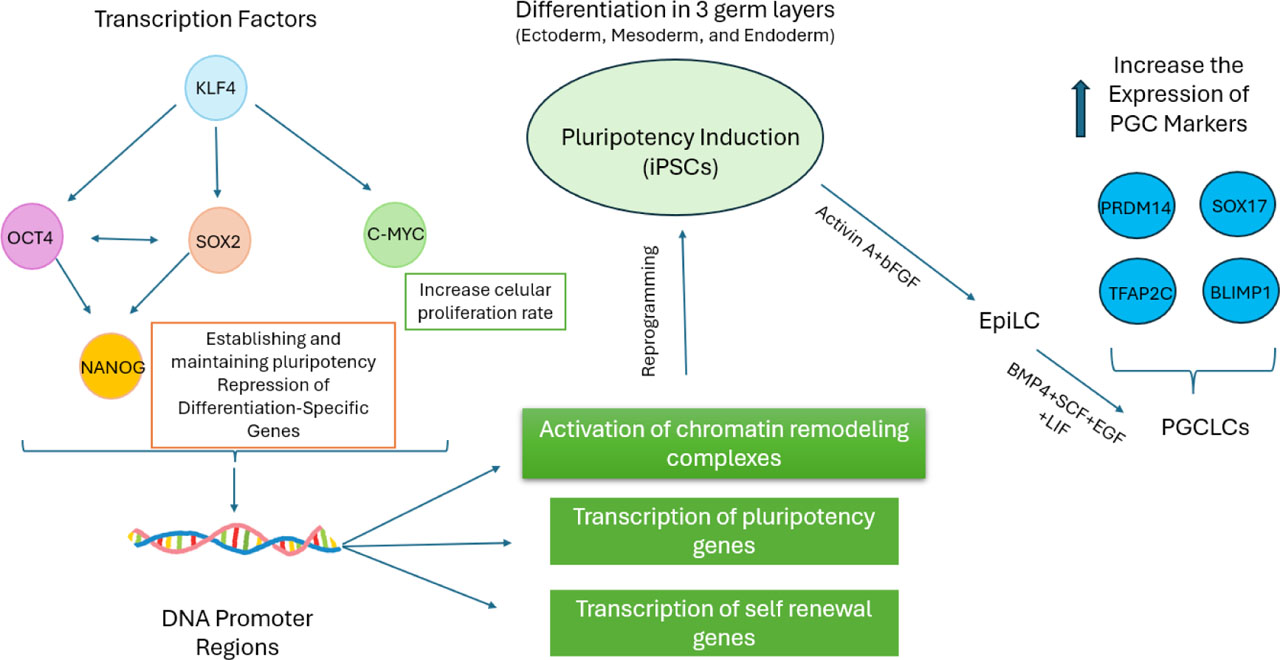
Figure 1.
Representation of the principal interactions between pluripotency transcription factors to induced reprogramming and pluripotency state in target cells. In addition, differentiation of iPSCs into PGCs and germ line markers are represented. Abbreviations: KLF4: Kruppel-like factor 4, OCT4: octamer-binding transcription factor 4, NANOG: Nanog homeobox, SOX2: SRY-box transcription factor 2, c-MYC: MYC proto-oncogene, BMP4: bone morphogenetic protein 4, PRDM14: PR domain zinc finger protein 14, SOX17: SRY-box transcription factor 17, BLIMP1: B lymphocyte-induced maturation protein 1 (also known as PRDM1), TFAP2C: transcription factor AP-2 gamma iPSCs: induced pluripotent stem cells, EpiLC: epiblast-like cells, PGCs: primordial germ cells, PGCLCs: primordial germ cell-like cells, bFGF: basic fibroblast growth factor, SCF: stem cell factor, EGF: epidermal growth factor, LIF: leukemia inhibitory factor
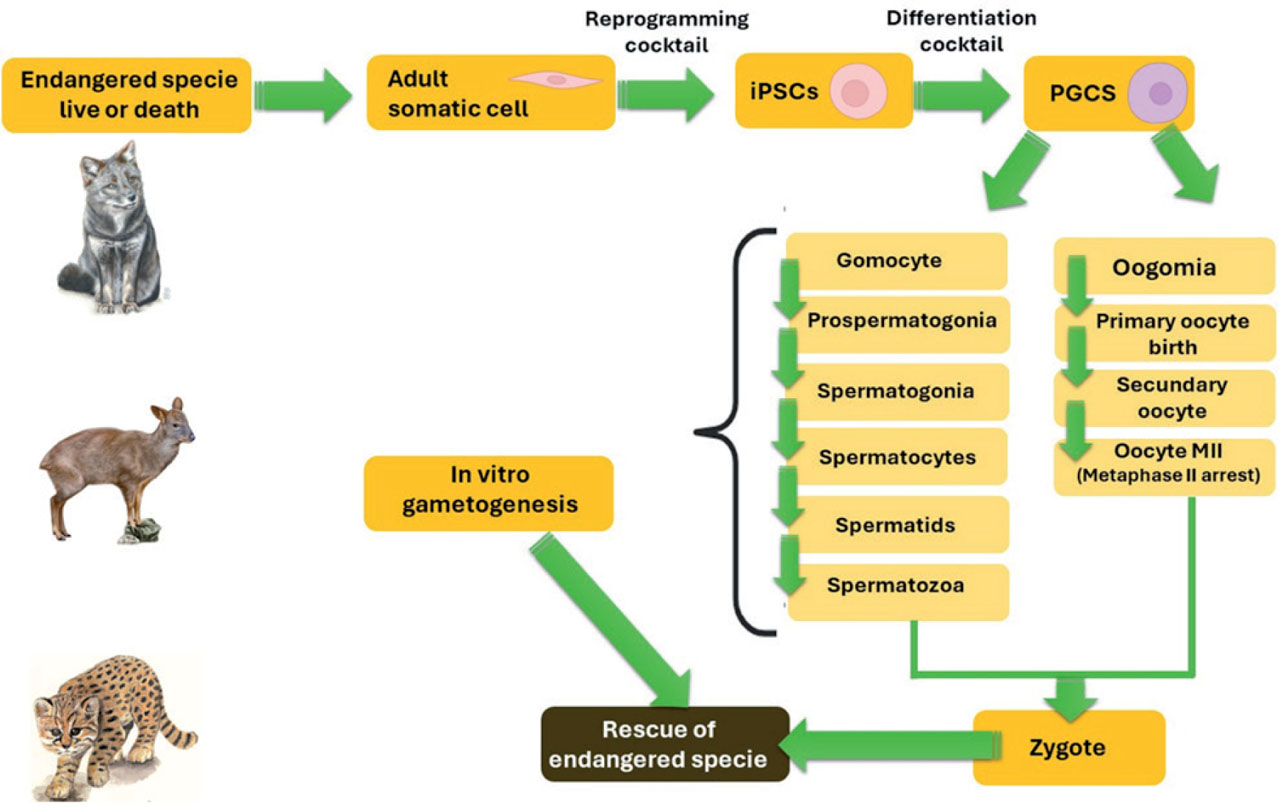
Figure 2.
Future application representation of in vitro gametogenesis using iPSCs in endangered animal species
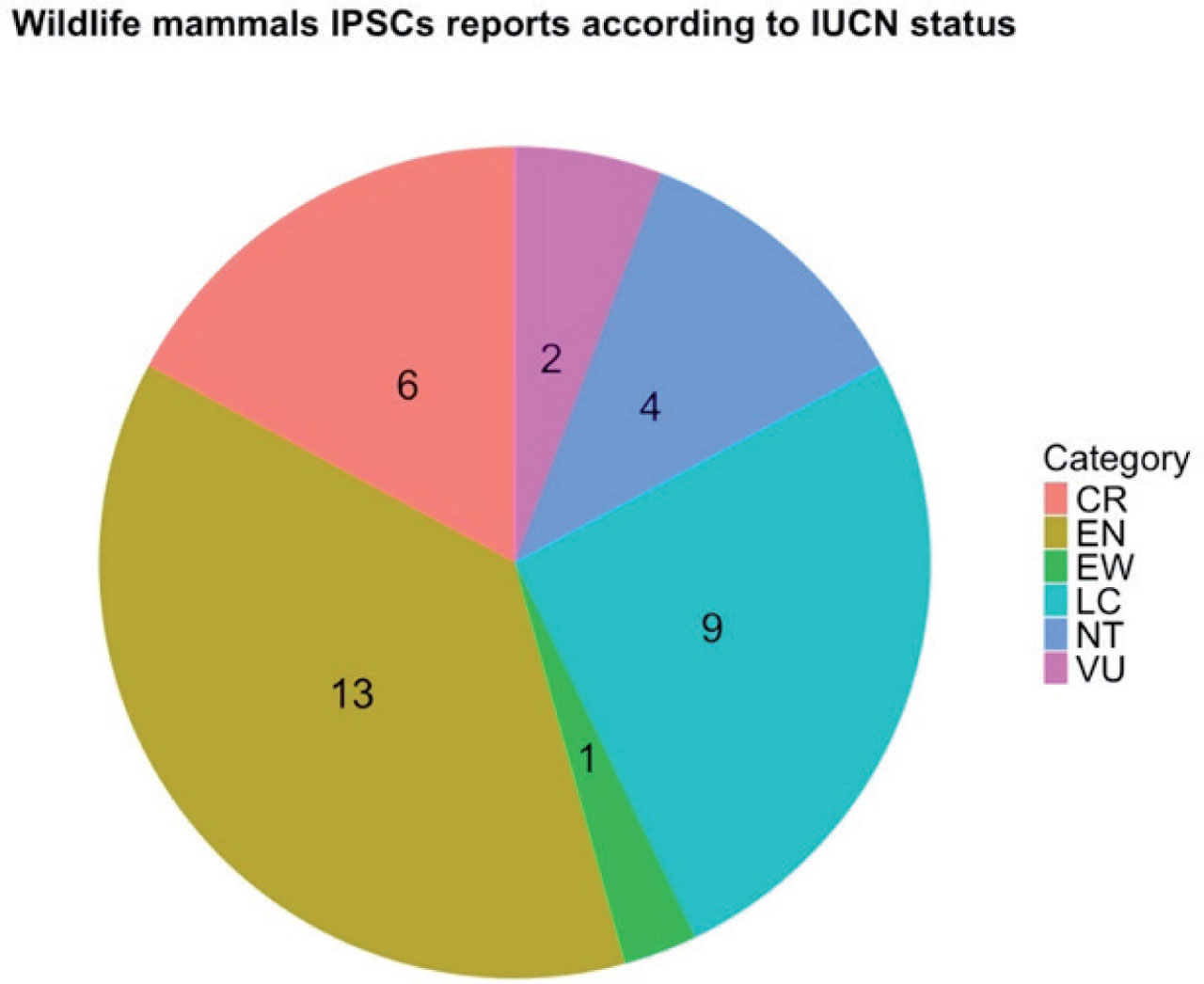
Figure 3.
Numbers of reports of iPSCs attainments represented, according to IUCN category. CR: critically endangered, EN: endangered, VU: vulnerable, NT: near threatened, LC: least concern, EW: extinct in the wild
Table 1.
Principal reports of iPSCs attainment in wild animal species reprogramming (Total number of cells plated) × 100
| Species | Common name | Reprogrammed cell type | Reprogramming method | Reprogramming factors | iPSCs characterization | Reprogramming efficiency (5) | PGCs generation | References |
|---|---|---|---|---|---|---|---|---|
| 1 | 2 | 3 | 4 | 5 | 6 | 7 | 8 | 9 |
| Macaca mulatta | Rhesus monkey | Adult fibroblasts | Retroviral vector (pMX) | OSKM | PME, TGLD in vitro and in vivo | 0.033% | No | Liu et al., 2008 |
| Mandrillus leucophaeus | Drill | Adult fibroblasts | Retroviral vector | OSKM | Karyotype, PME, TGLD in vivo | 0.0003 | No | Ben-Nun et al., 2011 |
| Ceratotherium simum cottoni | Northern white rhinoceros | Adult fibroblasts | Retroviral vector (retro-VSV. G viruses) | OSKM | Karyotype, PME, TGLD in vitro | 0.0006 | No | Ben-Nun et al., 2011 |
| Macaca fascicularis | Long-tailed macaque | Adult fibroblasts/Fetal fibroblasts | Lentivirus vector | OSKM | PME, TGLD in vitro and in vivo | NR | No | Okahara-Narita et al., 2012 |
| Panthera uncia | Snow leopard | Adult fibroblasts | Moloney-based retroviral vectors (pMXs) | OSKM NANOG | Karyotype, PME, TGLD in vivo | 0.000525% | No | Verma et al., 2012 |
| Bubalus bubalis | Water buffalo | Fetal fibroblasts | Retroviral vector (pMX) | OSKM | Karyotype, PME, TGLDin vivo and in vitro | 0.77% | No | Deng et al., 2012 |
| Microtus ochrogaster | Prairie vole | Embryonic fibroblasts | Ecotropic retrovirus vector | OSKM | PME, TGLD in vivo and in vitro | 0.0013% | No | Manoli et al., 2012 |
| Panthera tigris | Tiger | Adult fibroblasts | Retroviral vector (pMX) | OSKM NANOG | Karyotype, PME, TGLD in vivo and in vitro | 0.00065% | No | Verma et al., 2013 |
| Leptailurus serval | Serval | Adult fibroblasts | Retroviral vector (pMX) | OSKM NANOG | Karyotype, PME, TGLD in vivo and in vitro | 0.00067% | No | Verma et al., 2013 |
| Panthera onca | Jaguar | Adult fibroblasts | Retroviral vector (pMX) | OSKM NANOG | Karyotype, PME, TGLD in vivo and in vitro | 0.00062% | No | Verma et al., 2013 |
| Pan troglodytes | Chimpanzee | Adult fibroblasts | Retroviral vector (non specified) | OSKM | Karyotype, PME, TGLD in vivo and in vitro | NR | No | Marchetto et al., 2013 |
| Pan paniscus | Pygmy chimpanzee | Adult fibroblasts | Retroviral vector (non specified) | OSKM | Karyotype, PME, TGLD in vivo and in vitro | NR | No | Marchetto et al., 2013 |
| Myotis brandtii | Brandt's bat | Embryonic fibroblasts | PiggyBac (PB) vector | OSKM LIN28 Nr5a2 miR302/367 | Karyotype, PME, TGLD in vivo and in vitro | 0.001% | No | Mo et al., 2014 |
| Pan paniscus | Pygmy chimpanzee | Adult fibroblasts | Lentiviral vector | OSKM | Karyotype, PME, TGLD in vivo and in vitro | NR | No | Wunderlich et al., 2014 |
| Gorilla gorilla gorilla | Western lowland gorilla | Adult fibroblasts | Lentiviral vector | OSKM | Karyotype, PME expression, TGLD in vivo and in vitro | NR | No | Wunderlich et al., 2014 |
| Pongo abelii | Sumatran orangutans | Adult fibroblasts | Retroviral pMX vector | OSKM | PME, TGLD in vivo and in vitro | NR | No | Ramaswamy et al., 2015 |
| Equus africanus somaliensis | Somali wild ass | Adult fibroblasts | Retroviral vector (non specified) | OSKM | PME | NR | No | Ben-Nun et al., 2015 |
| Bos javanicus | Banteng | Adult fibroblasts | Retroviral vector (non specified) | OSKM | PME | NR | No | Ben-Nun et al., 2015 |
| Neovison vison | American mink | Embryonic fibroblasts | Lentiviral vector + Valproic acid | OSKM | Karyotype, PME, TGLD in vivo | 1.2% | No | Menzorov et al., 2015 |
| Tokudaia osimensis | Ryukyu spiny rat | Adult fibroblasts | PiggyBac (PB) transposase vectors | OSKM NANOG | Karyotype, PME, TGLD in vivo and in vitro | 0.000333% | Oocytes: 0.29%; Spermatocyte : 0.031% | Honda et al., 2017 |
| Heterocephalus glaber | Naked mole-rat | Adult and embryonic fibroblasts | Lentiviral vector | OSKM | PME, TGLD in vivo and in vitro | 0.24% | No | Lee et al., 2017 |
| Sarcophilus harrisii | Tasmanian devil | Adult fibroblasts | Lentiviral vector | OSKM NANOG LIN28A | Karyotype, PME, TGLD in vitro | 0.0002% | No | Weeratunga et al., 2018 |
| Ictidomys tridecemlineatus | Thirteen-lined ground squirrel | Neural precursor cells | Lentiviral and Sendai virus vectors | OSKM | PME, TGLD in vitro | 0.0002% | No | Ou et al., 2019 |
| Ornithorhynchus anatinus | Platypus | Adult fibroblasts | Lentiviral vector | OSKM LIN28 | Karyotype, PME, TGLDin vitro | 0.0002% | No | Withworth et al., 2019 |
| Ictidomys tridecemlineatus | Thirteen-lined ground squirrel | Neural precursor cells | Lentiviral and Sendai virus vectors | OSKM | PME, TGLD in vitro | NR | No | Singhal et al., 2020 |
| Equus grevyi | Grevy's zebra | Adult fibroblasts | Retroviral pMXs vectors | OSKM | Karyotype, PME, TGLD in vitro | 0.75% | No | Endo et al., 2022 |
| Ceratotherium simumsimum | Southern white rhinoceros | Adult fibroblasts | Non-integrating Sendai virus | MYC-5 KLF4-3 | Karyotype, PME, TGLD in vitro | 0.0077% | Yes PGCME:BMP4 PRDM1 PRDM14 TFAP 2c | Korody et al., 2021 |
| Ceratotherium simum cottoni | Northern white rhinoceros | Adult fibroblasts | Sendai virus vector | OSKM | TGLD in vitro, PGCs differentiation | Embryonic PSCs | No | Hayashi et al., 2022 |
| Dicerorhinus sumatrensis | Sumatran rhinoceros | Adult fibroblasts | Sendai virus vector | OSKM | Karyotype, TGLD in vitro, PME | Efficency range: 0.000013–0.000081% | No | Zywitza et al., 2022 |
| Bactrian camel | Bactrian camel | Fetal fibroblasts | Retroviral vector pMX | OSKM | Karyotype, TGLD in vitro and in vivo | 0.036% | No | Li et al., 2023 |
| Callithrix jacchus | Common marmoset | Peripheral blood mononuclear | Sendai reprogramming kit | KOS C-MYC, KLF-4 | Karyotype, PME, TGLD in vitro | 1.7% | No | Seita et al., 2023 |
| Elephas maximus | Asian elephant | Placental endothelial cells | Sendai and lentivirus vectors | OSKM NANOG LIN28A, blocking TPS3 expression | Karyotype, PME, TGLDin vitro | NR | No | Appleton et al., 2024 |
| Macaca nigra | Crested macaque | Adult fibroblasts | Sendai virus reprogramming kit | OSKM | Karyotype, PME, TGLD in vitro | 0.12–0.14% | PGCME: BMP4, PRDM1, and TFA2C in vitro | Bao et al., 2024 |
| Hylobates lar | Lar gibbon | Adult fibroblasts | Sendai virus reprogramming kit | OSKM | Karyotype, PME, TGLD in vitro | >1% | PGCME: BMP4, PRDM1, and TFA2C in vitro | Bao et al., 2024 |
| Symphalangus syndactylus | Siamang | Adult fibroblasts | Episomal plasmids | OSKM | Karyotype, PME, TGLD in vitro | 0.19% | PGCME: BMP4, PRDM1, and TFA2C in vitro | Bao et al., 2024 |
| Nasalis larvatus | Proboscis monkey | Adult fibroblasts | Episomal plasmids | OSKM | Karyotype, PME, TGLD in vitro | >1% | PGCME: BMP4, PRDM1, and TFA2C in vitro | Bao et al., 2024 |
| Ailuropoda melanoleuca | Giant panda | Adult fibroblasts | Episomal plasmids | OCT4, SOX2, SV40LT, and KLF4 | PME, karyotype, TGLD in vitro and in vivo, AP activity | 0.00006% | No | Liu et al., 2024 |
Table 2.
Induced pluripotent stem cells (iPSCs) in domestic species and their reprogramming efficiency across different species and induction protocols
The reprogramming efficiency = (Number of iPSC colonies / Total number of cells plated) × 100
| Species and common name | Reprogrammed cell type | Reprogramming method | Reprogramming factors | iPSCs characterization | Reprogramming efficiency (5) | References |
|---|---|---|---|---|---|---|
| Capra aegagrus hircus (goat) | Lentiviral vector | Bovine POU5F1, SOX2, MYC, KLF4, LIN-28, and NANOG + MIR302/3 +FGF | Colony morphology, AP activity, and TGLD in vitro and in vivo | 0.00016% | Sandmaier et al., 2015 | |
| Canis lupus familiaris (dog) | Sendai virus vector | Human factors OCT3/4, KLF4, SOX2, C-MYC, NANOG, and LIN28A | AP activity in vitro and in vivo TGLD, PME and karyotype | 0.05% | Tsukamoto et al., 2024 | |
| Canis lupus familiaris (dog) | Sendai virus vector | Canine factors OCT3/4, KLF4, SOX2, C-MYC, NANOG, and LIN28A | AP activity in vitro and in vivo TGLD, PME and karyotype | 0.2% | Tsukamoto et al., 2024 | |
| Bos taurus (cattle) | Retroviral vector | OSKM murine factors | AP activity in vitro and in vivo TGLD, PME and karyotype | 0.09% | Cravero et al., 2015 | |
| Bos taurus (cattle) | Retroviral vector | OSKM murine factors | AP expression, TGLD in vivo, PME and karyotype | 0.11% | Cravero et al., 2015 | |
| Sus scrofa domesticus (pig) | Lentiviral vector | OSKM human factors | AP expression, TGLD in vitro, PME | 11.30% | Machado et al., 2020 | |
| Sus scrofa domesticus (pig) | Lentiviral vector | OSKM mice factors | AP expression, TGLD in vitro, PME | 10.14% | Machado et al., 2020 | |
| Sus scrofa domesticus (pig) | Episomal vectors | FGF2, activin A, Chir99021, and IWR1 | Karyotype, PME, TGLD in vivo | 0.13% | Conrad et al., 2023 | |
| Equine (horse) | Polycistronic lentiviral vector | hOSKM (human factors) at 5% O2 | AP detection, PME, TGLD in vitro | 0.08% | de Castro et al., 2020 | |
| Equine (horse) | Polycistronic lentiviral vector | hOSKM (human factors) at 20% to 5% O2 | AP detection, PME, TGLD in vitro | 0.09% | de Castro et al., 2020 | |
| Equine (horse) | Polycistronic lentiviral vector | hOSKM (human factor) at 20% O2 | AP detection, PME, TGLD in vitro | 0.06% | de Castro et al., 2020 | |
| Ovis aries (sheep) | PiggyBac transposon system | Bovine OCT4, SOX2, KLF4, cMYC, porcine NANOG, human LIN28, SV40 large T antigen, and human TERT | Chimeric contribution to the early blastocysts of sheep and mice in vitro, PME | 0.1% | Lui et al., 2021 | |
| Capra aegagrus hircus (goat) | Lentiviral vector | Bovine POU5F1, SOX2, MYC, KLF4, LIN-28, and NANOG reprogramming factors in combination with a MIR302/3 +LIF | Colony morphology, AP expression, and TGLD in vivo and in vitro | 0.00004% | Sandmaier et al., 2015 | |
[i] Abbreviations: OCT3/4: octamer-binding transcription factor; SOX2: RY-box transcription factor 2; KLF4: Krüppel-like factor 4 and cMYC: MYC proto-oncogene, mGSCs: male germline stem cells, MSCs: mesenchymal stem cells, PB-MSCs: peripheral blood-derived MSCs, ESCs: embryonic stem cells, RA: retinoic acid, SSCs: spermatogonial stem cells, AMSCs: adipose mesenchymal stem cells, GCs: germ cells, GCM: germ cells markers, CM: conditioned medium, SCs: Sertoli cells, AP: alkaline phosphatase, PME: pluripotency markers expression, NR: no reported, ESC: embryonic stem cells, TGLD: three germ layer differentiation, PGCME: primordial germ cell markers expression, PME: pluripotency markers expression.
Table 3.
Principal reports of primordial germ cells (PGCs) or germ line cells attainment in domestic animal species
| Species and common name | Reprogrammed cell type | Reprogramming method | Reprogramming factors | iPSCs or origin cell type characterization | Reprogramming efficiency (5) | PGCs generation and characterization | References |
|---|---|---|---|---|---|---|---|
| Capra aegagrus hircus (goat) | ESCs | BMP-4 and RA | BMP-4 and RA (for PGCs differentiation) | Morphology and differentiation ability | Efficiency of oocyte formation from ESCs: 25–34.61% | PGCs markers: VASA, DAZL, STELLA, and PUM1 were detected at protein and mRNA level. | Malik et al., 2020 |
| Canis lupus familiaris (dog) | AMSCs | Culture medium for PGCs differentiation | BMP4 (12.5 ng/mL) for PGCs differentiation | CAMSCs are positive for MSCs markers and PME | NR | PGCME: PRDM1, PRDM14, AP2γ and. male germ markers: PLZF, VASA and DMRT1 | Wei et al., 2016 |
| Bos taurus (cattle) | Adult fibroblasts | 5-azacytidine | BMP2, BMP4 follicular fluid (for PGCs differentiation) | mRNAs for SOX2, OCT4, NANOG and REX | NR | PGCME: VASA, DAZL and GDF9. Also markers of oocytes (ZPA, GDF9 and SCP3) | do Nascimento Costa et al., 2017 |
| Bos taurus (cattle) | Somatic adult cell (no specified) | NR | NR | NR (they work with a iPSCs line previously characterized) | NR | Detection of AP, PME and PGCME: OCT4, DDX4, VASA, and OCT4 and SOX2, as well as of imprinted genes (H19, SNRPN) | Bressan et al., 2019 |
| Bos taurus (cattle) | PB-MSCs, and SSC | CM derived from SCs | CM derived from SCs | Pluripotent, GCs, and MSC marker expression. | NR | SSCs cultured with SCs/CM increased the expression of PIWIL2 and DAZL, while PB-MSCs only increased the expression of DAZL. | Segunda et al., 2024 |
| Equus ferus caballus (horse) | Embryonic fibro-blasts + ESCs | Episomal vector | OSKM + Lin28 | PME expression, in vitro and in vivo | NR | PGCME SOX17/TFAP2C/PRDM1 PGC differentiation in vitro and contribution to chimera in vivo | Yu et al., 2021 |
| Sus scrofa domesticus (pig) | Embryonic fibro-blasts | NR | Porcine iPSCs CM: LIF medium NR specific factors | AP-positive PME, TGLD in vitro | NR | GCM expression: PRDM1, PRDM14, STELLA. DAZL and VASA. Differentiation into SSCs | Wang et al., 2016 |
| Sus scrofa domesticus (pig) | Adult dermal fibroblasts | STEMCCA | SOX2, TFAP, EP4, MYC+ bFGF | PME | 14.58% | GCM (VASA, DAZL) and BLIMP1, PRDM14 | Pieri et al., 2022 |
| Ovis aries (sheep) | MSCs | 10 μM RA | RA for male GSCs differentiation | Three mesenchymal differentiation lineages | NR |
| Ghasemzadeh-Hasankolaei et al., 2014 |
| Capra aegagrus hircus (goat) | GSCs derived from 2–5-month fetal testis | RA for male GSCs differentiation | RA for male GSCs differentiation | Oct4, Sox2, C-myc, and Tert | Efficiency of GSCs lines: 30% | GCM (VASA), and haploid markers (FE-J1, PRM1). Differentiation into sperm-like cells in vivo and sperms in vitro | Hua et al., 2011 |
[i] Abbreviations: OCT3/4: octamer-binding transcription factor; SOX2: RY-box transcription factor 2; KLF4: Krüppel-like factor 4 and cMYC: MYC proto-oncogene, AP: alkaline phosphatase, PME: pluripotency markers expression. NR: no reported, ESC: embryonic stem cells, TGLD: three germ layer differentiation, PGCME: primordial germ cell markers expression, PME: pluripotency markers expression, mGSCs: male germline stem cells, MSCs: mesenchymal stem cells, PB-MSCs: peripheral blood-derived MSCs, ESCs: embryonic stem cells, RA: retinoic acid, SSCs: spermatogonial stem cells, AMSCs: adipose mesenchymal stem cells, GCs: germ cells, GCM: germ cells markers, CM: conditioned medium, SCs: Sertoli cells.