
As we know, biodiversity on our planet is constantly and progressively in threat due to anthropogenic activity (Romero-Muñoz et al., 2021; Vergara-Tabares et al., 2020; Chase et al., 2020). This results in habitat degradation, which is one of the primary causes of biodiversity loss. Different studies indicate a massive extinction of species (Pykälä, 2019; Ceballos et al., 2020; Borgelt et al., 2022) affecting flora and fauna of local areas (Varas-Myrik et al., 2022; da Silva et al., 2019; Romero-Muñoz et al., 2021; Pinto et al., 2020).
Furthermore, deforestation has a significant impact, creating synergistic effects with hunting and adversely affecting mammalian species (Romero-Muñoz et al., 2021). These anthropogenic effects are evident in species such as huemul (Hippocamelus bisulcus) and Andean cat (Leopardus jacobita) in South America, both classified as an endangered species by the IUCN (The International Union for Conservation of Nature) Red List of Threatened Species (Huaranca et al., 2022; Flueck et al., 2022). Nevertheless, the roster of globally endangered species is extensive, including well-known examples such as the northern white rhinoceros and the Amur leopard (Lewis et al., 2020Hayashi et al., 2022). Hence, beyond implementing in situ conservation strategies, the utilization of additional ex situ conservation tools becomes imperative to secure the persistence of these species in vulnerable ecosystems (Fynn et al., 2016).
Biotechnologies are a promising tool for the conservation of endangered wild animals. In livestock, multiple assisted reproductive technologies (ARTs) have been developed and employed (Cunningham, 1999; Hansen, 2014; Tonamo, 2015). However, less development of these biotechnologies has been described for wild specimens (Fritts, 2022).
Somatic cell nuclear transfer (SCNT) was considered an innovative biotechnology tool for animal conservation at the end of the 20th century (Smith et al., 2000; Holt et al., 2004; Borges and Pereira, 2019; Cowl et al., 2024). Nevertheless, SCNT presents some difficult obstacles to overcome such as the low efficiency in embryo production, incorrect development of placental tissue, improper epigenetic reprogramming and morphological alterations in the newborn animal (Smith et al., 2000; Ibtisham et al., 2016; Malin et al., 2022; Cowl et al., 2024).
Other biotechnologies such as mesenchymal stem cells (MSCs) have also been considered a tool for animal conservation (Echeverry et al., 2019, 2020 a, b; An et al., 2020; Liu et al., 2013; Luo et al., 2022). However, these cells present reduced potency, as they are only being able to differentiate into mesodermal tissues in vitro such as osteogenic, chondrogenic and adipogenic tissues (Ng et al., 2008), suggesting to consider a better tool for regenerative medicine than animal conservation (Satija et al., 2009; Gonçalves et al., 2014; Rajabzadeh et al., 2019).
Pluripotent cells were first isolated from mouse embryos in 1981. This study was the first to report the isolation and progressive growth of pluripotent cells in an in vitro culture system, without relying on teratocarcinomas for their isolation (Evans and Kaufman, 1981). This milestone marked the beginning of the era of pluripotent stem cell (PSC) research. Seventeen years later, in 1998, James Thomson and his team at the University of Wisconsin-Madison successfully isolated and cultured human embryonic stem cells (Thomson et al., 1998).
During the last century, improvements have been made to PSC attainment and development among different animal species. PSCs are able to be differentiated into the 3 embryonic germ layers, in vivo and in vitro, giving rise to multiple cell types such as neural cells, hepatocytes and cardiomyocytes, among others (Aravalli et al., 2012; D'Aiuto et al., 2014; Funakoshi et al., 2016). These characteristics make them a promising tool for regenerative medicine, animal production, infertility and conservation of endangered animal species. PSCs can be obtained from inner cell mass (ICM) of early development embryos (Evans and Kaufman, 1981; Thomson, 1998; Ulloa-Montoya et al., 2005; Vajta et al., 2010). Although, this method has inherent difficulties associated with ethical concerns and methodological procedures, as embryos are difficult to obtain (Vajta et al., 2010). In wild animals, the development of embryo technology is quite limited because reproductive characteristics are not known in depth (Pukazhenthi and Wildt, 2003). Additionally, gamete isolation, for embryo production, requires excessive manipulation that may be detrimental for these animals. Most of reports focused on reproductive biotechnologies in wild species obtain gametes from dead individuals (Lamglait, 2014; de Oliveira Santos et al., 2022; de los Reyes et al., 2024). However, the availability of dead specimens is limited (de los Reyes et al., 2024). An alternative is to generate PSC by direct reprogramming of adult somatic cells resulting in induced pluripotent stem cells (iPSCs) (Takahashi and Yamanaka, 2006).
Takahashi and Yamanaka in 2006 reported for the first time the generation of iPSCs from mice adult fibroblasts. To this end, they developed a technique that consisted of the use of transcription factors (OCT3/4: octamer-binding transcription factor 3/4, SOX2: sex determining region Y-box 2, MYC: Myc proto-oncogene, and KLF4: Kruppel-like factor 4 or OSKM factors) in retroviral vectors that induced a pluripotency stage, through the expression of pluripotency genes expression in receptor cells (Takahashi and Yamanaka, 2006). These factors were called Yamanaka factors. Nowadays iPSCs technologies have advanced significantly. Reprogramming methods have improved, allowing efficient generation of high-quality and safe iPSCs (Zhong, 2024). As new applications are discovered and techniques are optimized, iPSCs keep promising innovations and, for animal conservation, are the most innovate biotechnology (Malin et al., 2022; Cowl et al., 2024; Wu et al., 2024).
One of the multiple uses in the application of iPSCs technologies, is the generation of primordial germ cells (PGCs), which are considered the progenitor cells for male and female gametes. The differentiation of PGCs into gametes has been deeply described in humans and mice (Hayashi et al., 2011; Ishikura et al., 2016). Along time, not only rodents and humans, but also domestic farm animals, such as porcine and bovine species, have been subjects for the development of iPSCs and their differentiation into PGCs in vitro (Malaver-Ortega et al., 2016; Wang et al., 2016).
The molecular mechanism of iPSCs has been explored in wild-type animals, making progress in wild endangered species. The differentiation of iPSCs into PGCs was successful in two wild species: the northern white rhinoceros (Ceratotherium simum cottoni; hereinafter NWR), which is categorized as an extinct species (IUCN), and the Ryukyu spiny rat (Tokudaia osimensis), where germ cells differentiation was evaluated in vivo by the production of male mouse chimera embryos (Honda et al., 2017; Hayashi et al., 2022). The acquisition of gametes through PGCs might increase genetic variability in endangered populations. Since gametes undergo meiosis, the resulting potential individual from those gametes might exhibit greater adaptability to the environment compared to cloned animals (Saitou and Hayashi, 2021). This is crucial for the populations of endangered animals, as the small number of individuals limits genetic diversity, which hinders their ability to adapt and can drive them toward extinction (Allendorf et al., 2008; DeWoody et al., 2021).
Given the difficulty in obtaining PSCs from embryos, iPSCs open the door for a new possibility of noninvasive recovery of cells that can be differentiated into PGCs and originate from indistinguishable female or male gametes The collection of gametes in endangered species is a valuable resource for animal preservation.
The main goal of this review is to highlight the importance of PGCs generation in endangered/wild animals, through iPSCs differentiation. For this purpose, this article will describe the advances that have been made in wild species on iPSCs development, contrasting the advances with domestic animals' reports. Also, the PGCs state of art and differentiation processing in wild and domestic species will be described.
Primordial germ cells (PGCs) and in vitro gametogenesis (IVG): state of art
The principal advantage of PGCs generation is the acquisition of gametes. The differentiation of PGCs into gametes in vitro is called in vitro gametogenesis (IVG). Across time, different studies have successfully elucidated the molecular mechanisms involved in germ cell development. In vitro gametogenesis (IVG) has been performed in rodents, proving their functionality through the production of viable offspring (Hayashi et al., 2011, 2012; Hikabe et al., 2016; Ishikura et al., 2016).
PGCs differentiation into male gametes
The mouse primordial germ cell-like cells (PGCLCs) have the potential to colonize the seminiferous tubules once they arrive through transplantation and undergo correct spermatogenesis (Hayashi et al., 2011). Moreover, a similar system has been developed for mouse spermatogenesis in vitro. Reconstituted testes (rTestes), from mouse embryonic testicular somatic cells, form structures like seminiferous tubules, where the PGCLCs differentiate into pro-spermatogonia (Ishikura et al., 2016). These cells were capable of colonizing adult testes and promoting spermatogenesis and producing fertile off-spring (Ishikura et al., 2016).
Functional in vitro meiosis has also been evidenced in mice by Zhou et al. (2016). In this work, embryonic stem cells (ESCs) from embryo mice were first differentiated into epiblast-like cells (EpiLCs) and cultured under the influence of BMP-4 (bone morphogenetic protein 4), BMP-8a, epidermal growth factor (EGF), stem cell factor (SCF), and leukemia inhibitory factor (LIF) for the induction of PGCs. This molecule cocktail activated the expression of PGCs related genes such us BLIMP1 TCFAP2C, and NANOS3 among others, while somatic-related genes were downregulated (Zhou et al., 2016). The resulting PGCLCs were then co-cultured with testicular somatic cells under the effect of morphogens (RA (retinoic acid), BMPs, and activin A) for the initiation of meiosis and cells were positive for haploid spermatic markers and originated haploid spermatid-like cells (SLCs) (Zhou et al., 2016). SLCs could also be developed without the use of rTestes (Li et al., 2019). Li et al. (2019) successfully differentiated mouse ESC into PGCLCs adding cytokines into the culture medium. These cells experimented meiosis using RA and gave rise to SLCs, that were able to produce offspring after being transferred into an infertile mouse testis (Li et al., 2019). However, the differentiation efficiency in vitro of PGCLCs remained low due to improper epigenetic modifications (Ishikura et al., 2016). In 2021, an in vitro culture system for male germ-cell development was performed in mice to improve male germ-cell development using forskolin (10 mM), rolipram (10 mM), and cyclosporin A (5 mM) (FR10Cs5) molecules for a proper reprogramming process. The resulting spermatids were used for intracytoplasmic sperm injection (ICSI) procedure, which is a method for in vitro embryo production, and gave rise to fertile offspring, contributing to improving the efficiency of male germ line differentiation in vitro (Ishikura et al., 2021).
GCs differentiation into female gametes
Concerning female germ line differentiation, germinal vesicle (GV) oocytes were obtained from mouse ESCs or iPSCs differentiated in vitro. For this purpose, PGCLCs were cultured with somatic cells from female embryonic gonads, and the aggregates were transplanted under the ovarian bursa, where the PGCLCs differentiated into GV oocytes. The resulting oocytes could be matured and fertilized in vitro, leading to the production of healthy and fertile offspring (Hayashi and Saitou, 2013)
In addition, mouse PSCs have been differentiated into fetal ovarian somatic cell-like cells (FOSLCs) (Yoshino et al., 2021). For this purpose, ESCs were first differentiated into EpiLCs and then cultured with BMP4 and WNT agonists for PGCs generation. The resulting PGCLCs were co-cultured with FOSLCs, to support oocyte development. Secondary follicles could develop into preovulatory follicles. Granulosa cells derived from FOSLC could form cumulus-oocyte complexes (COCs). The oocyte reached the MII stage for fertilization in vitro. These resulting embryos could develop into offspring (Yoshino et al., 2021).
After a decade of using mice for IVG, the first successful IVG was performed in rats in 2022 (Oikawa et al., 2022). Rats' PGCLCs were obtained from PSCs differentiation. Unlike the mouse, rats EpiLCs were produced through a floating aggregate culture system instead of adherent monolayer. For the PGCLCs differentiation, BMP4 was added since it is a necessary cytokine for PGC fate and co-cultured with gonadal somatic cells (Li et al., 2019; Oikawa et al., 2022). Interestingly, female gonadal somatic cells were more efficient in supporting differentiation and epigenetic modifications compared to male ones. Finally, when these cells were transplanted into seminiferous tubules on infertile male rats, they were able to generate spermatids that produced viable offspring (Oikawa et al., 2022).
Currently, it is possible to obtain functional oocytes from male mice fibroblasts, a process that involves converting XY chromosomes into XX using iPSC technology (Murakami et al., 2023). This progress provides new insight into the maximization of the use of individuals to apply this technology, especially in endangered mammals, where the number and sex selection of the individuals are limited in availability.
However, for now, only rodents have been proven functionality of PGCLCs. More research is needed to clarify the mechanisms involved in functional PGCs differentiation into functional gametes in other species.
In vivo generation of gametes through blastocyst complementation
Blastocyst complementation is a technique used for in vivo gamete differentiation within a host blastocyst. Initially described by Bradley et al. (1984) it involved the injection of male embryonic-derived cells (XY) into chimeric mouse blastocysts, which could provide functional germ cells and result in live offspring. This method has been applied to generate chimeric blastocysts that not only produce germline cells but also develop tissues and even organs (Founta and Papanayotou, 2022). This is achieved by using mutant blastocysts that cannot fully develop, creating a niche that can be filled with donor cells from other animals or species for the development of specific tissues or organs (Founta and Papanayotou, 2022). For in vivo gamete differentiation, rat blastocysts with a germline deficiency (Prdm14 knockout) were injected with mouse PSCs, which successfully colonized and produced functional mouse spermatids (Kobayashi et al., 2021). This demonstrated that interspecies rat-mouse chimeras could give rise to spermatids derived from mouse PSCs (Kobayashi et al., 2021). A year later, a similar approach was used to generate mouse chimeras for rat spermatozoa production. Mouse blastocysts with a mutation in the TSC22D3 gene (critical for spermato-genesis) were injected with rat PSCs, which led to the production of functional rat spermatozoa capable of fertilizing oocytes in vitro (Zvick et al., 2022).
The in vivo generation of gametes in interspecies chimeras has been successfully achieved in mice and rats. Studies have demonstrated that germ cells from mice can produce live rats (Zvick et al., 2022), and similarly, rat-derived germ cells can generate mice (Kobayashi et al., 2021). In the case of endangered species such as Tokudaia osimensis, iPSCs have been generated to contribute to interspecific chimeras, using mouse embryos as hosts for in vivo development. The experiments show the differentiation of Tokudaia gametes in vivo through mouse embryos, though at low efficiency. In Tokudaia osimensis chimeras, spermatocytes were occasionally detected in testicular sections (0.031%), with similar results observed for female gametes (0.29%) (Honda et al., 2017).
Exploring the use of chimeras as a method to produce individuals capable of generating germ cells from endangered species offers promising potential. Research efforts should prioritize the effective reprogramming of iPSCs to achieve the appropriate pluripotency, facilitating the formation of in vivo gametes within chimera embryos. Additionally, selecting both donor and recipient animals with traits closely resembling those of the endangered species would be critical. However, embryo production involves significant challenges, such as low blastocyst formation rates, that occur even in well-studied species like bovines (Rizos et al., 2008). Investigating alternative approaches, including the use of iPSCs derived from fibroblasts, may provide a viable solution to reduce reliance on embryos.
Induced pluripotent stem cells (iPSCs) generation among domestic and wild species reprogramming for iPSCs generation
Reprogramming, in simple terms, is the process in which cells genes, responsible for differentiation, are silenced, while genes associated with pluripotency are activated (Singh et al., 2015). The iPSCs generation process involves several factors, including the cellular sources, delivery pluripotency factors methods, culturing media pluripotency induction, and characterization (Singh et al., 2015).
As the initial instance, iPSCs were generated through reprogramming factors in the research conducted by Takahashi and Yamanaka (2006). Based on previous reports, Yamanaka and collaborators selected a group of genes that could maintain a pluripotency state in embryonic stem (ES) cells. These genes are named as pluripotency genes, which were selected according to their presence on pluripotent and tumor cells, conferring to these cells the pluripotency characteristics like self-renewal and high cell proliferation rate (Takahashi and Yamanaka, 2006).
These selected reprogramming factors function by regulating the cell genome epigenetically, without inducing genomic modifications. Reprogramming somatic cells entails alterations in the epigenetic landscape, including changes in histone modifications and DNA methylation patterns (Schmidt and Plath, 2012; Parsons, 2012). Somatic DNA is typically hypermethylated at key pluripotency genes. During reprogramming, DNA demethylases remove methyl groups from these regions, facilitating gene expression (Schmidt and Plath, 2012; Parsons, 2012). The chromatin remodeling is required for transcription factors to access these pluripotency genes and allow their expression (Schmidt and Plath, 2012; Parsons, 2012). The reprogramming factors induced his-tone modifications and demethylation at promoter's regions of pluripotency genes, enabling their transcription (Schmidt and Plath, 2012; Parsons, 2012).
Additionally, these pluripotency transcription factors (that are coded in pluripotency genes) activate various pathways that support the reprogramming process. The Wnt/β-catenin signaling pathway promotes pluripotency and self-renewal in stem cells, while the PI3K/Akt pathway plays a crucial role in maintaining cell survival, growth, and metabolism (Li et al., 2020). Pluripotency genes are transcribed into proteins known as transcription factors, as they can stimulate the transcription of their own genes as well as promoter regions of other genes, forming a network that regulates the expression of pluripotency genes while repressing differentiation-specific genes (Johansson and Simonsson, 2010).
The resulting iPSCs acquire pluripotent properties, enabling them to differentiate into a variety of cell types (Figure 1).
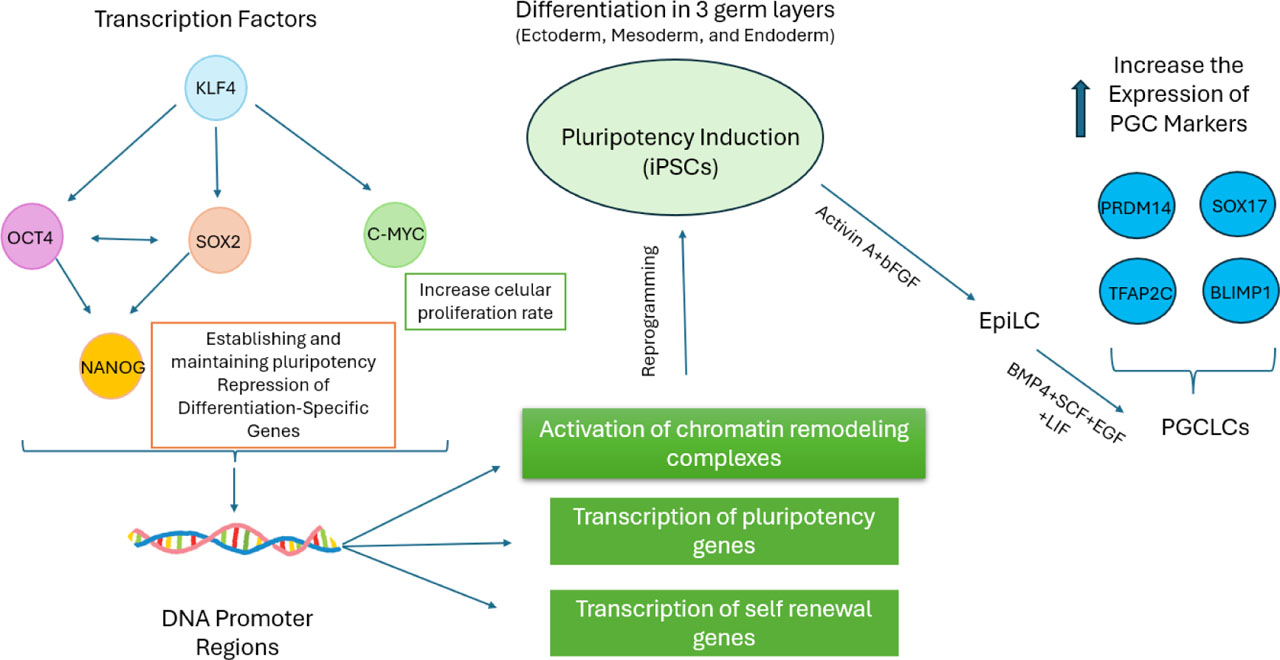
Figure 1.
Representation of the principal interactions between pluripotency transcription factors to induced reprogramming and pluripotency state in target cells. In addition, differentiation of iPSCs into PGCs and germ line markers are represented. Abbreviations: KLF4: Kruppel-like factor 4, OCT4: octamer-binding transcription factor 4, NANOG: Nanog homeobox, SOX2: SRY-box transcription factor 2, c-MYC: MYC proto-oncogene, BMP4: bone morphogenetic protein 4, PRDM14: PR domain zinc finger protein 14, SOX17: SRY-box transcription factor 17, BLIMP1: B lymphocyte-induced maturation protein 1 (also known as PRDM1), TFAP2C: transcription factor AP-2 gamma iPSCs: induced pluripotent stem cells, EpiLC: epiblast-like cells, PGCs: primordial germ cells, PGCLCs: primordial germ cell-like cells, bFGF: basic fibroblast growth factor, SCF: stem cell factor, EGF: epidermal growth factor, LIF: leukemia inhibitory factor
Each pluripotency transcription factor plays a role in the induction of pluripotency state. OCT4 binds to the promoters of pluripotency-related genes like NANOG and SOX2, thereby activating their expression (Rodda et al., 2005; Kuroda et al., 2005). This is crucial for establishing and maintaining pluripotency. With respect to chromatin remodeling, OCT4 interacts with chromatin remodeling complexes to relax the chromatin and allow the entry of pluripotency transcription factors (Parsons, 2012). Finally, OCT4 represses lineage-specific genes by recruiting co-repressors like HDAC (histone deacetylase) to their promoters (Tan et al., 2013; Parsons, 2012). SOX2 also binds to the promoters of genes like OCT4 and NANOG to sustain their expression (Kuroda et al., 2005). This is crucial for maintaining self-renewal and pluripotency. SOX2 is involved in recruiting coactivators with histone acetyltransferase activity to enhance the acetylation of histones at pluripotency gene promoters, facilitating their expression (Baltus et al., 2009). With respect to MYC, this factor binds in the promoters of genes involved in cell cycle progression, metabolism, and pluripotency, leading to their activation (Varlakhanova et al., 2010; Chappell and Dalton, 2013). This accelerates reprogramming by increasing cell proliferation (Varlakhanova et al., 2010). Finally, KLF4 binds to promoters of genes such as OCT4 and NANOG, inducing their expression and also promotes histone acetylation (Huang et al., 2013; Wei et al., 2013). These four factors mentioned before, are also known as “Yamanaka's factors”, composed by OCT3/4, SOX2, MYC and KLF4 (OSMK). The progress in the field of iPSCs has been focused mainly in humans and mice (Okita et al., 2008; Chen et al., 2011; Li et al., 2011; Tedesco et al., 2012; Malik and Rao, 2013; Huang et al., 2019). However, iPSC technology development began to prioritize other species.
Multiple reports focused mainly on the development of iPSCs in domestic farm animals (Scarfone et al., 2020). Although, the first report of iPSCs in wild species was published in 2008 by Liu and co-workers, who isolated rhesus macaque fibroblasts from an ear and reprogrammed them into iPSCs (Liu et al., 2008). After this event, other studies reported successful iPSCs acquisition from different wild animals. In 2011, Ben-Nun et al. successfully induced PSCs from fibroblasts of two endangered species: silver-maned drill (Mandrillus leudophaeus) and northern white rhinoceros (Ceratotherium simum cottoni). Subsequently, attempts were made at generalized iPSCs attainment in other species (Ben-Nun et al., 2011)
Initially, most studies focused on obtaining iPSCs by replicating the methodology of Yamanaka's study (Takahashi and Yamanaka, 2006). Although, some modifications in the protocol have been applied to improve reprogramming process. The effectiveness of reprogramming can be measured using different approaches. One indicator could be the reprogramming efficiency which indicates the proportion of somatic cells that are exposed to the reprogramming factors compared to the number of resulting iPSC colonies (Singh et al., 2015). Alkaline phosphatase (AP) staining, which is a common technique to characterize iPSCs, also assesses their pluripotent state. The presence and activity of alkaline phosphatase serve as indicators of pluripotency, as pluripotent stem cells express high levels of AP (Martí et al., 2013). In this article, the efficiency was calculated by determining the percentage of reprogrammed somatic cells relative to the total number of resulting iPSC colonies, then multiplying by 100.
Reprogramming systems described
Reprogramming somatic cells into iPSCs involves introducing specific factors or modifying the cell environment to reverse cellular differentiation. One of the most widely used methods is the viral-based system, in which retroviruses or lentiviruses deliver reprogramming factors such as Oct4, Sox2, Klf4, and c-Myc into somatic cells, inducing epigenetic changes that promote pluripotency (Hu and Li, 2016; Li et al., 2014). Integration of Yamanaka's factors into the cell genome via retrovirus has been the most common way to induce a pluripotent state in somatic cells (González et al., 2011). However, the integrative method has some disadvantages. There are certain risks associated with the use of integrative methods, such as destabilization of cell genome with a consequent increase in the probability of mutations and tumor formation (Wuputra et al., 2020; Zhong et al., 2022).
Non-integrating methods started to appear to overcome these negative effects (Brouwer et al., 2016 a; Wang et al., 2021). Episomal vectors use non-integrating plasmids to express reprogramming factors (Keisuke et al., 2008; Li et al., 2014). Another non-integrative approach is the mRNA-based system, where synthetic mRNA encoding the reprogramming factors is directly introduced into cells, avoiding genetic integration (Warren et al., 2010). However, this method requires repeated transfection and still has lower delivery efficiency (Zhong et al., 2022). Another strategy is the use of small molecule-based reprogramming, which involves molecules that modulate key signaling pathways, such as Wnt or TGF-β, to promote pluripotency, often in combination with other methods to improve efficiency (Zhong et al., 2022).
Integration-defective adenoviral (Stadtfeld et al., 2008), Sendai virus vector (Fusaki et al., 2009), protein delivery (Zhou et al., 2009) and chemical reprogramming (Zhao et al., 2015) are some other examples of non-integrative methodologies for iPSCs induction.
In domestic animals, non-integrating vectors have been applied since 2012, using episomal vectors in porcine species (Aravalli et al., 2012). In contrast, the first episomal vector reported in wild animals was applied in rhesus monkey (Zhang et al., 2017). Dermal fibroblasts were reprogrammed into iPSCs that successfully differentiated into cardiomyocytes by the delivery of human reprogramming factors. Recently, episomal and Sendai vectors have also been used in endangered Southeast Asian primates: siamang (Symphalangus syndactylus) and proboscis monkey (Nasalis larvatus) (Bao et al., 2024). Interestingly, only episomal vectors were able to reprogram fibroblasts for proboscis monkey. This implies that inherent differences in the transcriptional demands govern the reprogramming process between species. In addition, this report could not demonstrate the complete removal of plasmid after iPSCs generation, which is necessary to presume the safety of this non-integrative method. Other non-integrative vectors such as Sendai virus vectors have been applied mainly in domestic canines (Ben-Nun et al., 2011; Tsukamoto et al., 2024, 2018; Chow et al., 2017)
Although, recently, a report demonstrates the applicability of using the Sendai virus vector in the southern white rhino (Ceratotherium simum simum), a wild near threatened species (IUCN). Fibroblasts were successfully reprogrammed into iPSCs, improving their reprogramming efficiency after using Sendai as a non-integrative vector compared to the integrative ones (Ben-Nun et al., 2011; Korody et al., 2021). Changes such as titration of the virus concentration, altering the composition of the culture medium, and varying cell plating density were modified from human's protocol to enhance the reprogramming efficiency in white rhinos (Korody et al., 2021).
In elephants (Elephas maximus), attempts for iPSCs generation were performed using lentivirus integrative methods and Yamanaka's human factors, however, this methodology was not appropriate for elephants (Appleton et al., 2024). The achievement of the first iPSCs elephant was reported by improving the methodology of pluripotency induction combining chemical pluripotency induction media with non-integrating vectors such as Sendai virus, and the addition of elephant-specific reprogramming factors (OSKM+NANOG, LIN28A) (Appleton et al., 2024).
Other wild species such as the Sumatran rhinoceros (Dicerorhinus sumatrensis), common marmoset (Callithrix jacchus), southern white rhinoceros (Ceratotherium simum simum), crested black macaque (Macaca nigra), and lar gibbon (Hylobates lar) have successfully obtained iPSCs using the non-integrative Sendai virus vector (Korodoy et al., 2021; Zywitza et al., 2022; Seita et al., 2023; Bao et al., 2024)
The PiggyBac (PB) vector system represents an integrated vector that offers advantages compared to retroviral methods. The high transposition efficiency and reversible integration system for leaving few traces in the host genome after excision, are some features that minimized the potential impact on host gene regulation (Aguiar et al., 2016; Bjork et al., 2010). This type of vector has been applied in equines with an 82.5% of iPSCs differentiation efficiency achieved (Aguiar et al., 2016). Piggy-Bac vectors have also been used in bats (Myotis brandtii) and Ryukyu spiny rat (Tokudaia osimensis) (Honda et al., 2017; Mo et al., 2014). Additionally, the combination of induction iPSC medium and PiggyBac vector improved the reprogramming efficiency in bat iPSCs and during characterization, almost 100% of induced cells exhibit the positivity for AP staining (Mo et al., 2014).
At present, iPSCs can be generated without the use of oncogenes like c-Myc and Klf4, employing non-viral, integration-free methods, however, the reprogramming efficiency is still low. Each reprogramming method offers distinct advantages and challenges, with ongoing research focused on improving efficiency, reducing risks, and optimizing these techniques for applications in endangered species conservation (Li et al., 2014; Hu and Li, 2016; Zhong et al., 2022).
Cells used for reprogramming
The intrinsic properties of the starting cell type significantly influence the success of reprogramming, making certain cells more suitable for iPSC generation than others (Li et al., 2014; Raab et al., 2014). Fibroblasts are commonly used in iPSC technology, serving as the benchmark for reprogramming efficiency and differentiation potential against which new methods are evaluated (Mali et al., 2008; Park et al., 2008; Raab et al., 2014). Due to the low methylation of the OCT4 and NANOG promoter regions, fibroblasts are thought to have an enhanced capacity for reprogramming, supported by their favorable transcriptional and epigenetic profile (Streckfuss-Bömeke et al., 2013).
At first, the principal cells in which iPSCs were successfully reached were adult fibroblasts (Takahashi and Yamanaka, 2006). Reprogramming adult fibroblasts has been reported in livestock and companion animals (Ao et al., 2014; Cravero et al., 2015; Song et al., 2016; Tsukamoto et al., 2024). In wild animal species, almost all reports incorporate the use of adult fibroblasts for reprogramming. These reports include primates, wild rodents and even platypus (Wunderlich et al., 2014; Whitworth et al., 2019). For wild mammalian species, adult fibroblasts have even more advantages than other types of cells, since these cells can be isolated in an easy and noninvasive way (Liu et al., 2008; Verma et al., 2013; Wunderlich et al., 2014).
However, reprogramming somatic cells, such as adult fibroblasts, requires reversing specialized cells into a pluripotent state, making some embryonic or fetal fibroblasts easier to reprogram than adult ones (Mali et al., 2008; Easley IV et al., 2012; Wang et al., 2012; Raab et al., 2014). Some reports including mice, bovines and humans have consistently shown that fetal or embryonic cells, including fibroblasts, tend to exhibit higher reprogramming efficiency and yield with better pluripotency and differentiation potential compared to adult fibroblasts (Easley IV et al., 2012; Han et al., 2011; Lee et al., 2000; Medvedev et al., 2010; Spinelli et al., 2013; Xiang et al., 2021). Fetal fibroblasts have also contributed to iPSCs differentiation in Bactrian camel (Camelus bactrianus) (Li et al., 2023), naked mole-rat (Heterocephalus glaber) (Lee et al., 2017), American mink (Neovison vison) (Menzorov et al., 2015), Brandt's bat (Myotis brandtii) (Mo et al., 2014), prairie vole (Microtus ochrogaster) (Manoli et al., 2012), buffalo (Bubalus bubalis) (Deng et al., 2012) and long-tailed macaque (Macaca fascicularis) (Okahara-Narita et al., 2012).
Stem cells are another option since they can be reprogrammed easily due to their remarkable potential and ability to differentiate into various cell types. These cells exhibit a more permissive epigenetic landscape, characterized by lower methylation and open chromatin, which allows transcription factors to more easily activate pluripotency genes (Arabacı et al., 2021; Han and Yoon, 2012; Spitzhorn et al., 2019). The developmental origin of these cells also plays a role, as those from early embryonic tissues or with greater developmental plasticity are more responsive to reprogramming, as embryonic or fetal cells (Mali et al., 2008; Easley IV et al., 2012; Spitzhorn et al., 2019; Arabacı et al., 2021). These cells have contributed to iPSCs generation in some species like equine through adult MSCs (Lee et al., 2016) and bovine adult neural stem cells (Bai et al., 2016).
In addition, the cell cycle dynamics influence reprogramming efficiency, as actively proliferating cells are generally more receptive to induced changes (Tsubouchiet al., 2013). In contrast, more specialized cells may exhibit “cellular memory” due to epigenetic modifications from differentiation and aging, making it harder for them to revert to a pluripotent state (Mali et al., 2008; Easley IV et al., 2012; Wang et al., 2012; Raab et al., 2014). Therefore, the level of cell specialization can influence the selection of pluripotency factors for reprogramming.
Some transcription factors could be dispensable for the reprogramming cocktail since certain cells have higher endogenous expression of pluripotency genes than others (Nakagawa et al., 2008). Neural progenitor cells can be only reprogrammed using OCT4 and KLF4 since SOX2 and MYC are highly expressed in this type of cells.
Other types of cells that have been reprogrammed into pluripotency state are bone marrow cells (porcine) (Wu et al., 2009), adult keratinocytes (equine) (Sharma et al., 2014), epithelial and testicular adult cells (bovine) (Wang et al., 2013), peripheral blood mononuclear cells (marmoset) (Seita et al., 2023) and placental endothelial cells (elephants) (Appleton et al., 2024).
Reprogramming factors
The first reprogramming factors used, as we mentioned before, were the four factors identified by Takahashi and Yamanaka (2006) for cellular reprogramming which are OCT4, SOX2, KLF4 and MYC-C, also known as OSKM. These factors successfully induced pluripotency in adult mice fibroblasts. After this event, several cell types were subjected to reprogramming testing using the same transcription factors cocktail, with successful results in mice (Raab et al., 2014), humans and rhesus monkey, the first wild animal (Liu et al., 2008).
However, the quality of resulting iPSCs depends on the combination of reprogramming factors used (Buganim et al., 2014). This opened the door for the employment of other transcription factors that could improve reprogramming efficiency. In fibroblasts from mice, SOX2 can be replaced with the addition of SOX1 and SOX3 in reprogramming cocktail (Nakagawa et al., 2008). Also, human fibroblasts could be reprogrammed with better efficiency by the effect of OCT4, SOX2, NANOG (Nanog homeobox, pluripotency gene), and LIN28 (Lin-28 homolog) (Yu et al., 2007).
The reprogramming factors are partially conserved among species (Fu et al., 2018), which is why the transcription factors of humans can be applied for reprogramming cells of other species with relative success (Takahashi and Yamanaka, 2006; Weeratunga et al., 2018; Marchetto et al., 2013; Zywitza et al., 2022; Bao et al., 2024). However, there are some differences in complementation that could influence the binding capacity and, therefore, the reprogramming efficiency of the transcription factor utilized (Fu et al., 2018). Currently, it is unknown how this species-specificity feature could affect the reprogramming process in other species. Recently, a report in canines used a total of six canine reprogramming factors (OCT3/4, KLF4, SOX2, C-MYC, NANOG, and LIN28A) which were more efficient than humans' transcription factors in canine iPSCs generation (Tsukamoto et al., 2024).
As regards factor reprogramming selection, domestic cats also require the addition of NANOG to enhance reprogramming efficiency (Dutton et al., 2019). In fact, wild felids such as jaguar (Panthera onca), serval (Leptailurus serval) and tigers (Panthera tigris) also need NANOG for reprogramming (Verma et al., 2013). Like wild felids, the Ryukyu spiny rat (Tokudaia osimensis) needs NANOG for improved reprogramming efficiency (Honda et al., 2017).
In pigs, adult fibroblasts were reprogrammed into iPSCs using a lentiviral vector integrated with OSKM and two more transcription factors; NANOG and LIN28 (Kwon et al., 2017). Moreover, in other species such as the Tasmanian devil (Sarcophilus harrisii) and the platypus (Ornithorhynchus anatinus platypus) it was necessary to add LIN28 into the reprogramming factors cocktail for an optimal reprogramming (Weeratunga et al., 2018; Whitworth et al., 2019).
Several reports from wild and domestic species described the addition of LIN28 and NANOG for enhanced reprogramming efficiency. NANOG is an essential pluripotency transcription factor for maintaining the pluripotency of iPSCs. It regulates the expression of genes associated with the pluripotent state, such as OCT4 and SOX2, forming a positive feedback loop with these factors (Rodda et al., 2005). In addition, NANOG prevents the differentiation of PSCs towards specific cell lineages by repressing genes that induce differentiation (Pan and Thomson, 2007; Ortega et al., 2020). LIN28, on the other hand, is a protein that plays a crucial role in regulating cellular pluripotency through the regulation of genes involved in cellular pluripotency, such as NANOG and OCT4 which are essential for maintaining the pluripotent state in reprogrammed cells (Zheng et al., 2009; Qiu et al., 2010). Therefore, the expression of LIN28 and NANOG can improve pluripotency characteristics in reprogrammed cells (Wang et al., 2019).
Although the four factors remain the principal cocktail for reprogramming, some additional molecules could improve efficiency and even replaced the functional role of transcription factors, improving reprogramming. In domestic and wild species, the addition of FGF (fibroblast growth factor) and LIF in culture medium improved pluripotency characteristics (Koh et al., 2013; Mo et al., 2014; Dutton et al., 2019). Other molecules such as micro RNAs (miRNAs) can also improve the efficiency of reprogramming. In wild species, like Brandt's bat (Myotis brandtii), the addition of miR302/367 can enhance the reprogramming of embryonic fibroblasts (Mo et al., 2014).
Recently, a reprogramming cocktail was evaluated in the endangered giant panda (Ailuropoda melanoleuca) to identify specific signaling molecules that could enhance reprogramming efficiency (Liu et al., 2024). Various molecules were incorporated into the induction culture medium for iPSC generation. Notably, the addition of epigenetic remodelers like valproic acid and signaling pathway modulators such as BMP4 and A8301 (a selective inhibitor of TGF-β receptor type I) improved reprogramming efficiency, shortening the induction time (Liu et al., 2024). Furthermore, A8301 increased reprogramming efficiency fivefold and even induced the expression of pluripotency markers. Other molecules, such as the GSK-3β (glycogen synthase kinase 3 beta) inhibitor CHIR99021, also facilitated the maintenance and expansion of iPSCs during long-term culture and played a key role in OCT4 expression (Liu et al., 2024).
iPSCs characterization
Over time, different experiments have been performed to attain and develop iPSCs from different species and types of cells. For this reason, to determine a successful reprogramming, minimal criteria for iPSCs characterization were developed by Maherali and Hochedlinger (2008). A pluripotency state should be evaluated in terms of morphological, molecular and functional features (Maherali and Hochedlinger, 2008; Boulting et al., 2011).
Morphologically, iPSCs should be like ESCs, being able to undergo unlimited self-renewal. As regards molecular features, the pluripotency state should be demonstrated through gene and protein expression of transcription factors associated with pluripotency. This attainment must be archived independently of exogenous transcription factors used for the initial induction. For functional characterization, the cells must be able to differentiate into the three germ layers (endoderm, mesoderm and ectoderm) ideally in vivo (teratomas) (Maherali and Hochedlinger, 2008; Boulting et al., 2011; Martí et al., 2013).
Other features such as chimera contribution and germ line transmission could be also considered. Karyotyping has also been a test considered to determine genome anomalies due to integrative reprogramming protocols (Martí et al., 2013).
In domestic species, the resulting iPSCs from fibroblast are positive to pluripotency markers (LIN28, REX1, OCT4, SOX2, and NANOG among others), and can differentiate into the 3 germ layers in vitro (embryoid bodies) and in vivo (teratomas), (Breton et al., 2013; Cravero et al., 2015; Luo et al., 2011; Dutton et al., 2019; Kwon et al., 2017).
The iPSCs characterization in wild animals has been evolving from the detection of pluripotency markers only (Ben-Nun et al., 2011) to differentiation into three germ layers in vitro and in vivo (Li et al., 2023). The most frequent characterization of the resulting cells involved karyotyping, pluripotency markers expression, and three germ layers differentiation in vitro and in vivo. In common marmoset (Callithrix jacchus), for example, peripheral blood mononuclear marmoset cells were differentiated into iPSCs. For the characterization, better results in endodermal and mesodermal marker expression were observed in feeder-free culture conditions. The resulting cells had normal karyotype and pluripotency markers expression, according to iPSCs phenotype. Also, these cells were reprogrammed into marmoset primordial germ cell-like cells (PGCLCs) (Seita et al., 2023).
Nowadays, it is still necessary to standardize the protocol for stable iPSCs line generation in wild species, since the requirement for each one is different, and most protocols include the use of Yamanaka's factors that are based on mice or human transcription factors. Future applications of iPSCs in PGCs in wild/endangered species are depicted in Figure 2.
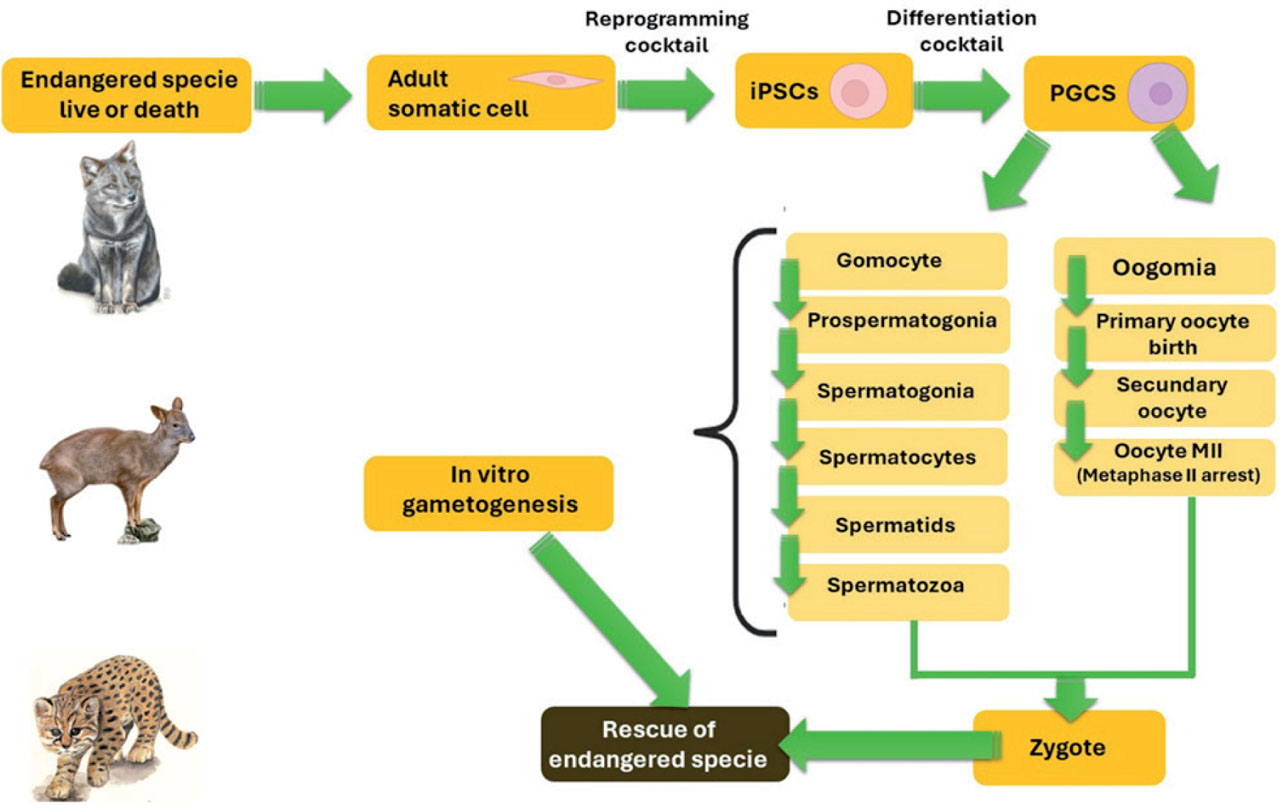
Figure 2.
Future application representation of in vitro gametogenesis using iPSCs in endangered animal species
The reports of iPSCs from endangered/wild animal species are detailed in Table 1. In addition, these reports are also classified according to the IUCN (International Union for Conservation of Nature's Red List of Threatened Species) category and represented in Figure 3.
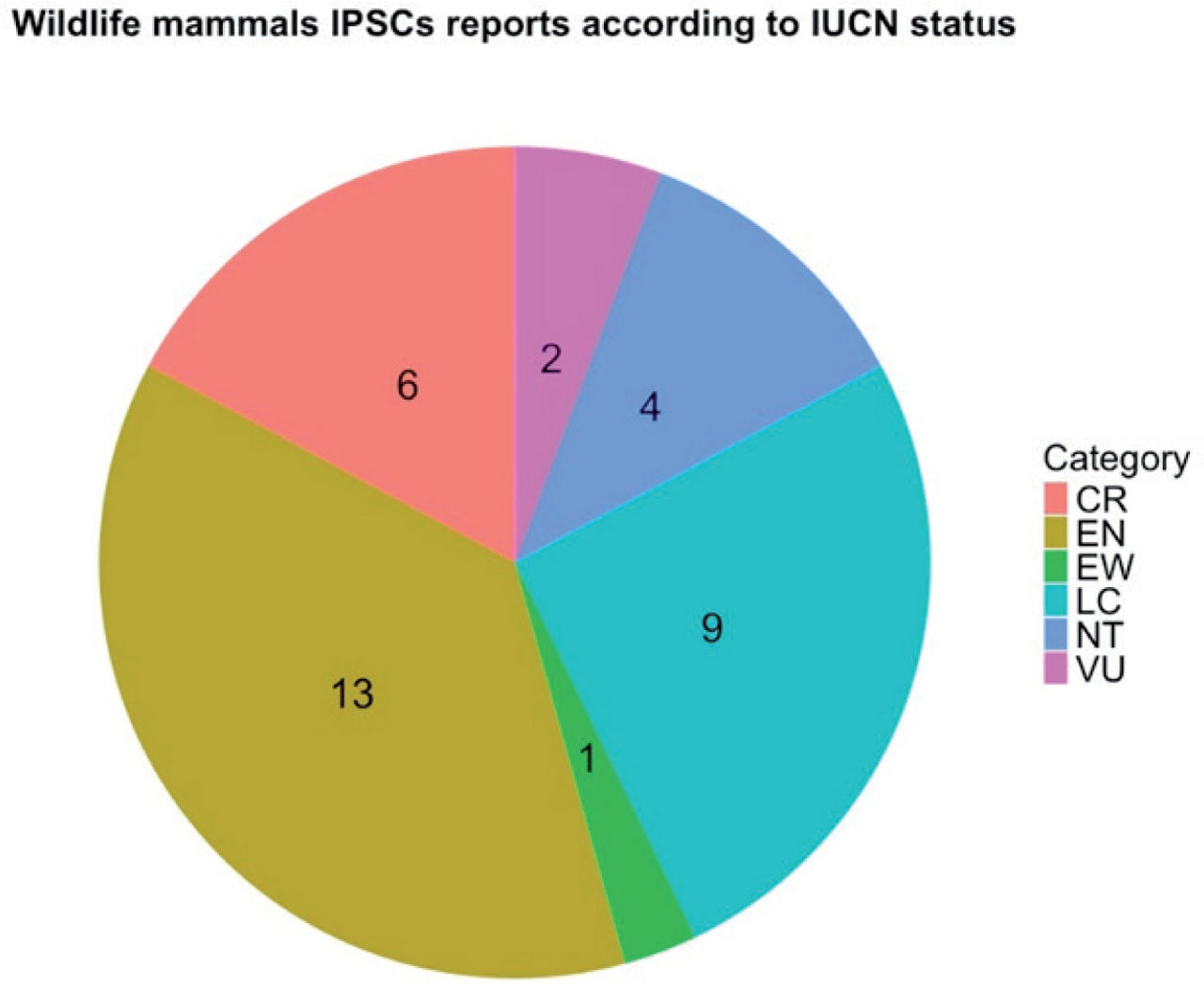
Figure 3.
Numbers of reports of iPSCs attainments represented, according to IUCN category. CR: critically endangered, EN: endangered, VU: vulnerable, NT: near threatened, LC: least concern, EW: extinct in the wild
Table 1.
Principal reports of iPSCs attainment in wild animal species reprogramming (Total number of cells plated) × 100
| Species | Common name | Reprogrammed cell type | Reprogramming method | Reprogramming factors | iPSCs characterization | Reprogramming efficiency (5) | PGCs generation | References |
|---|---|---|---|---|---|---|---|---|
| 1 | 2 | 3 | 4 | 5 | 6 | 7 | 8 | 9 |
| Macaca mulatta | Rhesus monkey | Adult fibroblasts | Retroviral vector (pMX) | OSKM | PME, TGLD in vitro and in vivo | 0.033% | No | Liu et al., 2008 |
| Mandrillus leucophaeus | Drill | Adult fibroblasts | Retroviral vector | OSKM | Karyotype, PME, TGLD in vivo | 0.0003 | No | Ben-Nun et al., 2011 |
| Ceratotherium simum cottoni | Northern white rhinoceros | Adult fibroblasts | Retroviral vector (retro-VSV. G viruses) | OSKM | Karyotype, PME, TGLD in vitro | 0.0006 | No | Ben-Nun et al., 2011 |
| Macaca fascicularis | Long-tailed macaque | Adult fibroblasts/Fetal fibroblasts | Lentivirus vector | OSKM | PME, TGLD in vitro and in vivo | NR | No | Okahara-Narita et al., 2012 |
| Panthera uncia | Snow leopard | Adult fibroblasts | Moloney-based retroviral vectors (pMXs) | OSKM NANOG | Karyotype, PME, TGLD in vivo | 0.000525% | No | Verma et al., 2012 |
| Bubalus bubalis | Water buffalo | Fetal fibroblasts | Retroviral vector (pMX) | OSKM | Karyotype, PME, TGLDin vivo and in vitro | 0.77% | No | Deng et al., 2012 |
| Microtus ochrogaster | Prairie vole | Embryonic fibroblasts | Ecotropic retrovirus vector | OSKM | PME, TGLD in vivo and in vitro | 0.0013% | No | Manoli et al., 2012 |
| Panthera tigris | Tiger | Adult fibroblasts | Retroviral vector (pMX) | OSKM NANOG | Karyotype, PME, TGLD in vivo and in vitro | 0.00065% | No | Verma et al., 2013 |
| Leptailurus serval | Serval | Adult fibroblasts | Retroviral vector (pMX) | OSKM NANOG | Karyotype, PME, TGLD in vivo and in vitro | 0.00067% | No | Verma et al., 2013 |
| Panthera onca | Jaguar | Adult fibroblasts | Retroviral vector (pMX) | OSKM NANOG | Karyotype, PME, TGLD in vivo and in vitro | 0.00062% | No | Verma et al., 2013 |
| Pan troglodytes | Chimpanzee | Adult fibroblasts | Retroviral vector (non specified) | OSKM | Karyotype, PME, TGLD in vivo and in vitro | NR | No | Marchetto et al., 2013 |
| Pan paniscus | Pygmy chimpanzee | Adult fibroblasts | Retroviral vector (non specified) | OSKM | Karyotype, PME, TGLD in vivo and in vitro | NR | No | Marchetto et al., 2013 |
| Myotis brandtii | Brandt's bat | Embryonic fibroblasts | PiggyBac (PB) vector | OSKM LIN28 Nr5a2 miR302/367 | Karyotype, PME, TGLD in vivo and in vitro | 0.001% | No | Mo et al., 2014 |
| Pan paniscus | Pygmy chimpanzee | Adult fibroblasts | Lentiviral vector | OSKM | Karyotype, PME, TGLD in vivo and in vitro | NR | No | Wunderlich et al., 2014 |
| Gorilla gorilla gorilla | Western lowland gorilla | Adult fibroblasts | Lentiviral vector | OSKM | Karyotype, PME expression, TGLD in vivo and in vitro | NR | No | Wunderlich et al., 2014 |
| Pongo abelii | Sumatran orangutans | Adult fibroblasts | Retroviral pMX vector | OSKM | PME, TGLD in vivo and in vitro | NR | No | Ramaswamy et al., 2015 |
| Equus africanus somaliensis | Somali wild ass | Adult fibroblasts | Retroviral vector (non specified) | OSKM | PME | NR | No | Ben-Nun et al., 2015 |
| Bos javanicus | Banteng | Adult fibroblasts | Retroviral vector (non specified) | OSKM | PME | NR | No | Ben-Nun et al., 2015 |
| Neovison vison | American mink | Embryonic fibroblasts | Lentiviral vector + Valproic acid | OSKM | Karyotype, PME, TGLD in vivo | 1.2% | No | Menzorov et al., 2015 |
| Tokudaia osimensis | Ryukyu spiny rat | Adult fibroblasts | PiggyBac (PB) transposase vectors | OSKM NANOG | Karyotype, PME, TGLD in vivo and in vitro | 0.000333% | Oocytes: 0.29%; Spermatocyte : 0.031% | Honda et al., 2017 |
| Heterocephalus glaber | Naked mole-rat | Adult and embryonic fibroblasts | Lentiviral vector | OSKM | PME, TGLD in vivo and in vitro | 0.24% | No | Lee et al., 2017 |
| Sarcophilus harrisii | Tasmanian devil | Adult fibroblasts | Lentiviral vector | OSKM NANOG LIN28A | Karyotype, PME, TGLD in vitro | 0.0002% | No | Weeratunga et al., 2018 |
| Ictidomys tridecemlineatus | Thirteen-lined ground squirrel | Neural precursor cells | Lentiviral and Sendai virus vectors | OSKM | PME, TGLD in vitro | 0.0002% | No | Ou et al., 2019 |
| Ornithorhynchus anatinus | Platypus | Adult fibroblasts | Lentiviral vector | OSKM LIN28 | Karyotype, PME, TGLDin vitro | 0.0002% | No | Withworth et al., 2019 |
| Ictidomys tridecemlineatus | Thirteen-lined ground squirrel | Neural precursor cells | Lentiviral and Sendai virus vectors | OSKM | PME, TGLD in vitro | NR | No | Singhal et al., 2020 |
| Equus grevyi | Grevy's zebra | Adult fibroblasts | Retroviral pMXs vectors | OSKM | Karyotype, PME, TGLD in vitro | 0.75% | No | Endo et al., 2022 |
| Ceratotherium simumsimum | Southern white rhinoceros | Adult fibroblasts | Non-integrating Sendai virus | MYC-5 KLF4-3 | Karyotype, PME, TGLD in vitro | 0.0077% | Yes PGCME:BMP4 PRDM1 PRDM14 TFAP 2c | Korody et al., 2021 |
| Ceratotherium simum cottoni | Northern white rhinoceros | Adult fibroblasts | Sendai virus vector | OSKM | TGLD in vitro, PGCs differentiation | Embryonic PSCs | No | Hayashi et al., 2022 |
| Dicerorhinus sumatrensis | Sumatran rhinoceros | Adult fibroblasts | Sendai virus vector | OSKM | Karyotype, TGLD in vitro, PME | Efficency range: 0.000013–0.000081% | No | Zywitza et al., 2022 |
| Bactrian camel | Bactrian camel | Fetal fibroblasts | Retroviral vector pMX | OSKM | Karyotype, TGLD in vitro and in vivo | 0.036% | No | Li et al., 2023 |
| Callithrix jacchus | Common marmoset | Peripheral blood mononuclear | Sendai reprogramming kit | KOS C-MYC, KLF-4 | Karyotype, PME, TGLD in vitro | 1.7% | No | Seita et al., 2023 |
| Elephas maximus | Asian elephant | Placental endothelial cells | Sendai and lentivirus vectors | OSKM NANOG LIN28A, blocking TPS3 expression | Karyotype, PME, TGLDin vitro | NR | No | Appleton et al., 2024 |
| Macaca nigra | Crested macaque | Adult fibroblasts | Sendai virus reprogramming kit | OSKM | Karyotype, PME, TGLD in vitro | 0.12–0.14% | PGCME: BMP4, PRDM1, and TFA2C in vitro | Bao et al., 2024 |
| Hylobates lar | Lar gibbon | Adult fibroblasts | Sendai virus reprogramming kit | OSKM | Karyotype, PME, TGLD in vitro | >1% | PGCME: BMP4, PRDM1, and TFA2C in vitro | Bao et al., 2024 |
| Symphalangus syndactylus | Siamang | Adult fibroblasts | Episomal plasmids | OSKM | Karyotype, PME, TGLD in vitro | 0.19% | PGCME: BMP4, PRDM1, and TFA2C in vitro | Bao et al., 2024 |
| Nasalis larvatus | Proboscis monkey | Adult fibroblasts | Episomal plasmids | OSKM | Karyotype, PME, TGLD in vitro | >1% | PGCME: BMP4, PRDM1, and TFA2C in vitro | Bao et al., 2024 |
| Ailuropoda melanoleuca | Giant panda | Adult fibroblasts | Episomal plasmids | OCT4, SOX2, SV40LT, and KLF4 | PME, karyotype, TGLD in vitro and in vivo, AP activity | 0.00006% | No | Liu et al., 2024 |
Molecular challenges of cellular reprogramming in wild animals
The molecular challenges associated with cellular reprogramming in wild animals are complex and diverse, requiring a deep understanding of the molecular mechanisms underlying pluripotency, as well as species-specific adaptations that influence reprogramming efficiency and outcomes. One significant challenge lies in the transcription factors used for reprogramming. The core factors (e.g., Oct4, Sox2, Klf4, c-Myc) exhibit varying effectiveness depending on the species (Zhang et al., 2023; Tsukamoto et al., 2024). These factors interact with species-specific promoter and enhancer regions, which can impact reprogramming efficiency (Tsukamoto et al., 2024). For example, in domestic animals such as dogs, previously described, using species-specific reprogramming factors improved the reprogramming process (Tsukamoto et al., 2024). Similarly, bovine reprogramming factors have shown higher efficiency for generating bovine iPSCs compared to human factors (Han et al., 2011). In the case of buffalo (Bubalus bubalis), six species-specific transcription factors, synthesized from buffalo in vitro embryos, were used to reprogram somatic cells into buffalo iPSCs, yielding better efficiency than human-derived factors (Deng et al., 2012). Likewise, in camels, additional pluripotency genes were considered for the reprogramming process, based on camel RNA sequencing data, such as ASF1B, DTL, CDCA5, PROM1, CYTL1, NUP210, Epha3, and SYT13 (Zhang et al., 2023).
In addition to the species-specific transcription factors, the reprogramming process also involves significant changes to the epigenetic landscape including DNA methylation and histone modifications. Wild animals, with their distinct evolutionary histories and environmental adaptations, may possess unique epigenetic profiles (Meissner, 2010; Wunderlich et al., 2014). Variations in epigenetic promoters can also affect the response to reprogramming. The epigenetic status of promoter regions for endogenous pluripotency genes plays a crucial role in reprogramming efficiency, hypomethylated promoters typically resulting in higher reprogramming success (Deng et al., 2012). For instance, in buffalo, the methylation status of OCT4 and NANOG promoters differs from that of SOX2 and E-Cadherin (Deng et al., 2012). The pluripotency genes OCT4 and NANOG are initially hypermethylated, whereas SOX2 and E-cadherin are hypomethylated and express early in the reprogramming process (Deng et al., 2012). In chimpanzees, which are phylogenetically close to humans, iPSCs exhibit different epigenetic regulation of long interspersed element-1 (L1) transposons compared to human iPSCs (Marchetto et al., 2013). In contrast, human embryonic stem cells share similar epigenetic modifications with mouse cells (Hanna et al., 2010). Mice exhibit flexibility in the epigenetic status of developmental genes, which may explain why mice are commonly used as a model species for iPSC development (Hanna et al., 2010).
The epigenetic barriers in wild animals may differ from those found in model organisms like mice, needing optimization of reprogramming protocols using epigenetic modulators. Moreover, species-specific factors, including growth factors (e.g., FGF2, LIF), additional pluripotency genes such as NANOG, or non-coding RNAs like miRNAs, may be essential for modulating signaling pathways and metabolism to promote pluripotency (Koh et al., 2013; Mo et al., 2014; Dutton et al., 2019). For example, in species like leopards and other felines, adding NANOG to the reprogramming protocol has been shown to improve efficiency (Verma et al., 2013), while Brandt's bat (Myotis brandtii) requires the inclusion of miR302/367 (Mo et al., 2014).
Further, reprogramming efficiency in wild species can be influenced by factors such as the culture medium. Wild animals have unique nutritional requirements, including specific amino acids or metabolites not present in media used for model species, which may necessitate the development of custom media to optimize iPSC viability and proliferation (Manoli et al., 2012). Finally, incubation conditions such as temperature, oxygen levels, and pH must be tailored to the physiological needs of cells from wild species, as their optimal growth conditions may differ significantly from those of domesticated animals.
Due to these numerous challenges, research on wild species remains limited, with few studies conducted for each species. This creates significant obstacles in evaluating pluripotency and primordial germ cell (PGC) differentiation using iPSCs or other cell sources, especially when compared to domesticated species, which have greater economic importance in animal production.
Domestic species and induced pluripotent stem cells (iPSCs) generation
The generation of iPSCs in domestic animals exhibits notable differences in reprogramming efficiencies and protocols across species. For instance, in pigs, the use of episomal vectors combined with miRNA-302/367 led to a reprogramming efficiency of only 0.13% (Conrad et al., 2023). However, when lentiviral vectors and OSKM factors were applied to embryonic porcine fibro-blasts, efficiency improved significantly, reaching up more than 10% of reprogramming efficiency (Machado et al., 2020). In contrast, cattle showed lower reprogramming efficiencies using retroviral vectors for bovine mammary epithelium and dermal fibroblasts, with rates of 0.11% and 0.09%, respectively (Cravero et al., 2015). These protocols commonly involved the murine OSKM factors and were characterized by alkaline phosphatase staining, teratoma formation, and pluripotency marker expression.
Goats, however, demonstrated much lower reprogramming efficiencies, with values as low as 0.00016% to 0.00004% when using lentiviral vectors with a combination of bovine POU5F1, SOX2, MYC, KLF4, LIN-28, and NANOG factors, along with miRNA-302/3. This stark contrast highlights how species-specific factors significantly affect reprogramming success. This fact can be also evidenced in the study of Tsukamoto et al (2024) which demonstrated that the use of species-specific factors can significantly improve the reprogramming efficiency in the generation of iPSCs in canines (Tsukamoto et al., 2024). Furthermore, the use of different vector systems (episomal, retroviral, lentiviral, or PiggyBac transposon) and combinations of reprogramming factors (e.g., murine, bovine, or human OSKM) contributes to the variability in efficiency. For example, sheep iPSCs were generated using a PiggyBac transposon system with doxycycline-inducible bovine and human factors, yielding a reprogramming efficiency of 0.1% and demonstrating chimeric contribution to blastocysts (Lui et al., 2021). In horses, the use of a polycistronic lentiviral vector with human OSKM factors at varying oxygen concentrations resulted in efficiencies ranging from 0.06% to 0.09% (de Castro et al., 2020). The iPSCs generation through domestic species and their characterization are listed in Table 3.
Table 2.
Induced pluripotent stem cells (iPSCs) in domestic species and their reprogramming efficiency across different species and induction protocols
The reprogramming efficiency = (Number of iPSC colonies / Total number of cells plated) × 100
| Species and common name | Reprogrammed cell type | Reprogramming method | Reprogramming factors | iPSCs characterization | Reprogramming efficiency (5) | References |
|---|---|---|---|---|---|---|
| Capra aegagrus hircus (goat) | Lentiviral vector | Bovine POU5F1, SOX2, MYC, KLF4, LIN-28, and NANOG + MIR302/3 +FGF | Colony morphology, AP activity, and TGLD in vitro and in vivo | 0.00016% | Sandmaier et al., 2015 | |
| Canis lupus familiaris (dog) | Sendai virus vector | Human factors OCT3/4, KLF4, SOX2, C-MYC, NANOG, and LIN28A | AP activity in vitro and in vivo TGLD, PME and karyotype | 0.05% | Tsukamoto et al., 2024 | |
| Canis lupus familiaris (dog) | Sendai virus vector | Canine factors OCT3/4, KLF4, SOX2, C-MYC, NANOG, and LIN28A | AP activity in vitro and in vivo TGLD, PME and karyotype | 0.2% | Tsukamoto et al., 2024 | |
| Bos taurus (cattle) | Retroviral vector | OSKM murine factors | AP activity in vitro and in vivo TGLD, PME and karyotype | 0.09% | Cravero et al., 2015 | |
| Bos taurus (cattle) | Retroviral vector | OSKM murine factors | AP expression, TGLD in vivo, PME and karyotype | 0.11% | Cravero et al., 2015 | |
| Sus scrofa domesticus (pig) | Lentiviral vector | OSKM human factors | AP expression, TGLD in vitro, PME | 11.30% | Machado et al., 2020 | |
| Sus scrofa domesticus (pig) | Lentiviral vector | OSKM mice factors | AP expression, TGLD in vitro, PME | 10.14% | Machado et al., 2020 | |
| Sus scrofa domesticus (pig) | Episomal vectors | FGF2, activin A, Chir99021, and IWR1 | Karyotype, PME, TGLD in vivo | 0.13% | Conrad et al., 2023 | |
| Equine (horse) | Polycistronic lentiviral vector | hOSKM (human factors) at 5% O2 | AP detection, PME, TGLD in vitro | 0.08% | de Castro et al., 2020 | |
| Equine (horse) | Polycistronic lentiviral vector | hOSKM (human factors) at 20% to 5% O2 | AP detection, PME, TGLD in vitro | 0.09% | de Castro et al., 2020 | |
| Equine (horse) | Polycistronic lentiviral vector | hOSKM (human factor) at 20% O2 | AP detection, PME, TGLD in vitro | 0.06% | de Castro et al., 2020 | |
| Ovis aries (sheep) | PiggyBac transposon system | Bovine OCT4, SOX2, KLF4, cMYC, porcine NANOG, human LIN28, SV40 large T antigen, and human TERT | Chimeric contribution to the early blastocysts of sheep and mice in vitro, PME | 0.1% | Lui et al., 2021 | |
| Capra aegagrus hircus (goat) | Lentiviral vector | Bovine POU5F1, SOX2, MYC, KLF4, LIN-28, and NANOG reprogramming factors in combination with a MIR302/3 +LIF | Colony morphology, AP expression, and TGLD in vivo and in vitro | 0.00004% | Sandmaier et al., 2015 | |
[i] Abbreviations: OCT3/4: octamer-binding transcription factor; SOX2: RY-box transcription factor 2; KLF4: Krüppel-like factor 4 and cMYC: MYC proto-oncogene, mGSCs: male germline stem cells, MSCs: mesenchymal stem cells, PB-MSCs: peripheral blood-derived MSCs, ESCs: embryonic stem cells, RA: retinoic acid, SSCs: spermatogonial stem cells, AMSCs: adipose mesenchymal stem cells, GCs: germ cells, GCM: germ cells markers, CM: conditioned medium, SCs: Sertoli cells, AP: alkaline phosphatase, PME: pluripotency markers expression, NR: no reported, ESC: embryonic stem cells, TGLD: three germ layer differentiation, PGCME: primordial germ cell markers expression, PME: pluripotency markers expression.
Table 3.
Principal reports of primordial germ cells (PGCs) or germ line cells attainment in domestic animal species
| Species and common name | Reprogrammed cell type | Reprogramming method | Reprogramming factors | iPSCs or origin cell type characterization | Reprogramming efficiency (5) | PGCs generation and characterization | References |
|---|---|---|---|---|---|---|---|
| Capra aegagrus hircus (goat) | ESCs | BMP-4 and RA | BMP-4 and RA (for PGCs differentiation) | Morphology and differentiation ability | Efficiency of oocyte formation from ESCs: 25–34.61% | PGCs markers: VASA, DAZL, STELLA, and PUM1 were detected at protein and mRNA level. | Malik et al., 2020 |
| Canis lupus familiaris (dog) | AMSCs | Culture medium for PGCs differentiation | BMP4 (12.5 ng/mL) for PGCs differentiation | CAMSCs are positive for MSCs markers and PME | NR | PGCME: PRDM1, PRDM14, AP2γ and. male germ markers: PLZF, VASA and DMRT1 | Wei et al., 2016 |
| Bos taurus (cattle) | Adult fibroblasts | 5-azacytidine | BMP2, BMP4 follicular fluid (for PGCs differentiation) | mRNAs for SOX2, OCT4, NANOG and REX | NR | PGCME: VASA, DAZL and GDF9. Also markers of oocytes (ZPA, GDF9 and SCP3) | do Nascimento Costa et al., 2017 |
| Bos taurus (cattle) | Somatic adult cell (no specified) | NR | NR | NR (they work with a iPSCs line previously characterized) | NR | Detection of AP, PME and PGCME: OCT4, DDX4, VASA, and OCT4 and SOX2, as well as of imprinted genes (H19, SNRPN) | Bressan et al., 2019 |
| Bos taurus (cattle) | PB-MSCs, and SSC | CM derived from SCs | CM derived from SCs | Pluripotent, GCs, and MSC marker expression. | NR | SSCs cultured with SCs/CM increased the expression of PIWIL2 and DAZL, while PB-MSCs only increased the expression of DAZL. | Segunda et al., 2024 |
| Equus ferus caballus (horse) | Embryonic fibro-blasts + ESCs | Episomal vector | OSKM + Lin28 | PME expression, in vitro and in vivo | NR | PGCME SOX17/TFAP2C/PRDM1 PGC differentiation in vitro and contribution to chimera in vivo | Yu et al., 2021 |
| Sus scrofa domesticus (pig) | Embryonic fibro-blasts | NR | Porcine iPSCs CM: LIF medium NR specific factors | AP-positive PME, TGLD in vitro | NR | GCM expression: PRDM1, PRDM14, STELLA. DAZL and VASA. Differentiation into SSCs | Wang et al., 2016 |
| Sus scrofa domesticus (pig) | Adult dermal fibroblasts | STEMCCA | SOX2, TFAP, EP4, MYC+ bFGF | PME | 14.58% | GCM (VASA, DAZL) and BLIMP1, PRDM14 | Pieri et al., 2022 |
| Ovis aries (sheep) | MSCs | 10 μM RA | RA for male GSCs differentiation | Three mesenchymal differentiation lineages | NR |
| Ghasemzadeh-Hasankolaei et al., 2014 |
| Capra aegagrus hircus (goat) | GSCs derived from 2–5-month fetal testis | RA for male GSCs differentiation | RA for male GSCs differentiation | Oct4, Sox2, C-myc, and Tert | Efficiency of GSCs lines: 30% | GCM (VASA), and haploid markers (FE-J1, PRM1). Differentiation into sperm-like cells in vivo and sperms in vitro | Hua et al., 2011 |
[i] Abbreviations: OCT3/4: octamer-binding transcription factor; SOX2: RY-box transcription factor 2; KLF4: Krüppel-like factor 4 and cMYC: MYC proto-oncogene, AP: alkaline phosphatase, PME: pluripotency markers expression. NR: no reported, ESC: embryonic stem cells, TGLD: three germ layer differentiation, PGCME: primordial germ cell markers expression, PME: pluripotency markers expression, mGSCs: male germline stem cells, MSCs: mesenchymal stem cells, PB-MSCs: peripheral blood-derived MSCs, ESCs: embryonic stem cells, RA: retinoic acid, SSCs: spermatogonial stem cells, AMSCs: adipose mesenchymal stem cells, GCs: germ cells, GCM: germ cells markers, CM: conditioned medium, SCs: Sertoli cells.
Reprogramming efficiency in wild and domestic species
The reprogramming of iPSCs has shown higher success in domestic species compared to wild species. This is primarily due to the higher efficiency of reprogramming methods used in domestic species such as pigs (Sus scrofa domesticus) and horses (Equus ferus caballus), which achieve efficiencies of 10.14% and 11.30%, respectively, using lentiviral vectors and specific factors such as miRNA-302/367 and FGF2 (Machado et al., 2020; Conrad et al., 2023). In contrast, wild species such as the northern white rhinoceros (Ceratotherium simum cottoni) and Siberian tiger (Panthera tigris) present much lower efficiencies, around 0.0006% and 0.00065%, respectively (Ben-Nun et al., 2011; Verma et al., 2013). The methods employed in domestic species, including Sendai virus and episomal vectors, are considered more advanced and efficient, whereas wild species often use retroviral vectors, which, although effective, have lower success rates and higher risks of unwanted genomic integration. Furthermore, in domestic species, reprogramming factors such as OSKM (Oct4, Sox2, Klf4, c-Myc) have been optimized, with species-specific factors such as miRNA-302/367 in pigs or canine-specific factors in dogs (Canis lupus familiaris) (Tsukamoto et al., 2024).
Comparative advantages of induced pluripotent stem cells (iPSCs) technology
The iPSCs technology has several advantages compared with other biotechnologies applied for therapeutic or conservation purposes. Sample collection and cellular source for future iPSCs induction can be optimized since fibroblasts can be isolated from different tissues, ensuring a maximal conservation of animal's genetic material. In addition, sample collection can be obtained from individuals from different stages of live, from fetal and newborn to adults and even recently dead animals (Mastromonaco et al., 2014). Moreover, the application of this technology allows not only therapeutic approach research, but also, a potential for generation of in vitro gametes and live offspring, already performed in mice studies (Hayashi et al., 2011, 2012; Hikabe et al., 2016; Ishikura et al., 2016). Gametes produced in vitro are capable of being fertilized, generating embryos that can be cultured, cryopreserved, and transferred (Ishikura et al., 2016; Yoshino et al., 2021). These applications play a crucial role in ex situ conservation, offering distinct advantages over other biotechnologies for animal conservation.
The acquisition of pluripotent stem cells (PSCs) from in vitro or in vivo produced embryos involves several challenges. For in vivo produced embryos, the process is particularly intricate, as it necessitates the use of insemination protocols, which rely on a thorough understanding of the species' reproductive anatomy and cycle – factors that are not always well understood (Rola et al., 2021).
The process of obtaining pluripotent stem cells (PSCs) from in vitro or in vivo produced embryos involves several challenges. In the case of in vivo produced embryos, this process is especially complex as it requires the use of insemination protocols, which depend on a detailed understanding of the reproductive anatomy and cycle of the species – knowledge that is often insufficient (Rola et al., 2021). Additionally, the manipulation of these animals for reproductive management introduces further complications (Rola et al., 2021). On the other hand, in vitro produced embryos also face limitations, such as the low efficiency and quality of embryo production systems, which results in a limited number of blastocysts (Rizos et al., 2008; Hildebrandt and Holtze, 2024). Moreover, in vitro embryos have species-specific requirements that vary across species, further complicating the process (Hildebrandt and Holtze, 2024).
Mesenchymal stem cells (MSCs) are another option, isolated from tissues like adipose and bone marrow (Ng et al., 2008; Renzi et al., 2013). MSCs have primarily been applied in therapeutic research, particularly for medical cases involving osteoarthritis and musculoskeletal injuries (Dias et al., 2021; Reis et al., 2024). MSCs have also been isolated from wild animal species for conservation purposes (An et al., 2020; Liu et al., 2013; Luo et al., 2022). In some cases, MSCs can be isolated from recently deceased animals. Furthermore, MSCs have been shown to differentiate into germ cells in mouse models (Nayernia et al., 2006). However, there are technical challenges that limit the use of MSC technology in endangered animal conservation. Cell culture conditions and isolation procedures for MSCs are more complex compared to those for fibroblasts used in reprogramming (Bunnell et al., 2008). Additionally, MSCs are obtained at a very low efficiency per sample, requiring prolonged culture periods to yield a sufficient number of cells (Fortier and Travis, 2011).
Cloning, or interspecies somatic cell nuclear transfer (SCNT), is another biotechnology applied in ex situ conservation (Smith et al., 2000; Holt et al., 2004; Borges and Pereira, 2019; Cowl et al., 2024). However, this technique faces significant challenges, primarily due to epigenetic alterations from intensive manipulation and in vitro conditions (Li and Sun, 2022). Despite being employed for over 30 years, cloning still suffers from low reprogramming efficiency, resulting in few embryos and high mortality rates in newborns (Smith et al., 2000; Ibtisham et al., 2016; Malin et al., 2022; Cowl et al., 2024). The primary obstacle to cloning, as well as iPSC production, is low reprogramming efficiency. However, in mice, the use of iPSCs as donor cells for cloning has been shown to increase SCNT or cloning efficiency compared to somatic differentiated cells (Han et al., 2011).
On the other hand, transdifferentiation is the process by which one specialized type of cell is directly converted into another without first becoming a pluripotent stem cell. In domestic animals, transdifferentiation was performed in bovine dermal fibroblasts, which were reprogrammed directly into oocyte-like cells through reprogramming molecules (5-azacytidine) and germ cell induction molecules (BMP2/BMP4) (do Nascimento Costa et al., 2017). However, transdifferentiation involves directly reprogramming somatic cells into other specialized cells, which can present challenges in the reprogramming process, as a non-pluripotent stage is reached before differentiation occurs (Cieślar-Pobuda et al., 2017). As a result, transdifferentiation may be less efficient compared to the restoration of pluripotency stage (Prasad et al., 2017), which involves first increasing the potency of the somatic cell before differentiating it into a specialized cell type, such as iPSCs into PGCs.
In contrast, induced pluripotent stem cells (iPSCs) offer an alternative by enabling the reprogramming of adult somatic cells. This method allows for the generation of a larger number of cells per sample (Brouwer et al., 2016 b). Furthermore, iPSCs can be differentiated into primordial germ cells (PGCs) in vitro, providing a valuable model to understand the mechanisms involved in PGC specification across wild species. The generation of in vitro gametes from stable cell lines could represent a significant breakthrough in the conservation and reproduction of endangered animal species. Additionally, the possibility of differentiated iPSCs to produce in vitro gametes, could generate offspring without losing genomic variability, which is essential for species adaptation to environmental changes.
Despite the comparative advantages of iPSCs in animal conservation, several challenges remain. Issues such as low iPSC quality, chromosomal abnormalities, and low reprogramming efficiency are unresolved. Reprogramming efficiency can range from as low as 0.001% to 1%, especially in wild animals (Mo et al., 2014; Bao et al., 2024). For many domestic species, basic cell culture systems can be used, including human or mouse transcription factors for reprogramming (Cravero et al., 2015; Castro et al., 2020; Tsukamoto et al., 2024). However, the use of integrating vectors that encode human, or mouse transcription factors can induce genomic instability and mutations, as exogenous DNA from other species may be incorporated into the iPSC genome. To counteract these unwanted effects, non-integrating vectors, such as Sendai virus, have been explored to minimize the risk of genomic integration, although they still present similar reprogramming challenges but with a lower risk of mutagenesis or karyotype alterations. The quality of iPSCs is determined by their self-renewal capacity and the maintenance of a normal karyotype, which can persist through several passages.
Some species, especially those with a distant phylogenetic relationship to model organisms, require specialized culture systems and protocols to improve reprogramming efficiency and iPSC quality (Mastromonaco et al., 2014). Protocols for iPSC generation are crucial, as the quality of iPSCs depends on them (Mastromonaco et al., 2014). Research efforts should therefore focus on developing culture systems tailored to the specific needs of wild species.
Another disadvantage that remains unsolved is the potential for tumor formation due to elevated c-Myc expression (Lutz et al., 2002), which increases proliferation, as well as genetic and epigenetic instability, and inefficient reprogramming that can lead to incomplete or low-quality cell lines. Differentiating iPSCs into specific cell types remains difficult, often resulting in heterogeneous populations. Low reprogramming efficiency is likely due to a lack of understanding of the mechanisms that erase epigenetic marks. The failure to demethylate the OCT4 promoter region, which is crucial for maintaining pluripotency alongside SOX2 and NANOG (Reik, 2007), is an example of inefficiency on remodeling epigenetic marks.
Characterization of primordial germ cells (PGCs) induced in vitro
The characterization of induced primordial germ cells (PGCs) in vitro is essential to confirm the differentiation of pluripotent stem cells into the germline lineage. This process involves a combination of morphological, immunocytochemical, and gene expression analyses.
To begin with, cell morphology and alkaline phosphatase (ALP) activity – a classical marker of pluripotency – are assessed to determine whether the cells remain in an undifferentiated state. This step is vital to confirm that induced pluripotent stem cells (iPSCs) maintain their pluripotent characteristics before proceeding to differentiation into germline cells (Pieri et al., 2022).
For further characterization, gene expression analysis is carried out, focusing on markers of germline differentiation. PGCs are distinguished by their specification through the combined actions of key transcription factors, such as BLIMP1, PRDM14, and AP2γ (Fang et al., 2020; Magnúsdóttir et al., 2013). BLIMP1 plays a critical role by repressing somatic and cell proliferation genes while directly inducing AP2γ (Magnúsdóttir et al., 2013). Together with PRDM14, AP2γ initiates the PGC-specific fate, forming an interdependent transcriptional network essential for PGC development. In addition, NANOS3 is also a crucial regulator for the expression of early germ cell markers and is considered a key transcription factor during PGC differentiation (Julaton and Reijo Pera, 2011).
In the next phase, the detection of key PGC markers, such as VASA, DAZL, and STELLA, both at protein and mRNA levels can be performed through techniques like immunofluorescence assays and reverse transcription polymerase chain reaction (RT-qPCR) (Malik et al., 2020). VASA and DAZL are indispensable for PGC development and germline maintenance, while STELLA plays a significant role in the epigenetic regulation of PGCs during their early stages (Hansen and Pelegri, 2021). Immunofluorescence staining is employed to visualize the presence and localization of these markers within the cells, ensuring accurate identification (Wei et al., 2016; Yu et al., 2021).
Along with protein marker analysis, gene expression of PGC-specification genes, including PRDM1, PRDM14, SOX17, and TFAP2C, is examined. These genes are vital for PGC differentiation and their maintenance in a germline state. PRDM1 and PRDM14 are essential transcriptional regulators for germline specification, while SOX17 is involved in the early stages of germ cell formation (Irie et al., 2015). TFAP2C plays an important role in maintaining pluripotency and supporting early germline development. These genes are assessed using quantitative RT-PCR, which allows for quantitative analysis of mRNA levels and provides confirmation of the molecular characteristics of the induced PGCs (Malik et al., 2020; Yu et al., 2021).
Furthermore, the in vivo functionality of induced PGCs can be evaluated through their ability to contribute to chimera formation in mouse embryos (Honda et al., 2017). This crucial step verifies that the induced cells are not only phenotypically similar to PGCs but also functionally competent to give rise to viable gametes.
The ability of induced PGCs to differentiate into functional germ cells within the gonads of host embryos is an essential test of their true germline potential (Wang et al., 2016; Pieri et al., 2022).
In summary, the comprehensive characterization of induced PGCs involves morphological assessments, immunocytochemical staining for key markers, gene expression analysis, and in vivo contributions to chimera formation. These steps are essential for verifying the successful induction of PGCs from pluripotent stem cells. This process is vital for understanding the reprogramming and differentiation of somatic cells into germline cells and holds significant potential for applications in reproductive medicine and conservation biology (Hua et al., 2011; Pieri et al., 2022). The primary characterization steps for PGCs are summarized in Table 3.
Generation of primordial germ cells (PGCs) in domestic species
Although reproductive biotechnologies have been widely applied in farm animals, iPSC-based technologies for the generation of primordial germ cells (PGCs) are considered one of the major technological innovations today (de Castro et al., 2024). However, in non-rodent species, this process remains a challenge, as no studies have yet demonstrated the functionality of in vitro-derived PGCs that result in viable offspring (Irie et al., 2015; Wang et al., 2016; Malaver-Ortega et al., 2016; Yu et al., 2021). On the other hand, the success in PGC or germline differentiation in vitro in farm animals can be partly explained by the knowledge accumulated through various studies over time.
For instance, the genomes of many farm species have been sequenced, and in some cases, almost completely mapped (Li et al., 2021; Rossetti et al., 2022). This progress is essential for developing species-specific transcription factors that could enhance reprogramming efficiency. Additionally, several studies have provided information about suitable cell sources for PGC differentiation, as well as transcription factors that may work across different species. For example, in humans and wild primates, SOX17 is a key regulator in PGC specification, alongside other genes necessary for germ cell fate, such as TFAP2C and BLIMP1 (Irie et al., 2015; Sakai et al., 2020). However, in mice, SOX17 is not critical for PGC differentiation. In fact, PGC differentiation occurs in SOX17-null mouse embryos. Additionally, BLIMP1, an important factor for both human and mouse PGC induction, is downstream of SOX17 in human primordial germ cell-like cells (PGCLCs). It is also necessary for the expression of pluripotency genes like NANOG and OCT4, while inhibiting the expression of endodermal and somatic genes during PGCLC induction (Irie et al., 2015).
In bovine species, iPSCs have also been differentiated into germ cell lineages. Both bone morphogenetic protein 4 (BMP4) and retinoic acid (RA) have been used to induce germ cell differentiation from PSCs (Malaver-Ortega et al., 2016). Differentiation efficiency improved in the presence of LIF as a pretreatment, which induced the expression of BVH (an early germ cell marker) and SOX2 (Malaver-Ortega et al., 2016). Bressan et al. (2016) focused on differentiating bovine iPSCs into PGCs, adapting a protocol from murine models (Hayashi et al., 2011). Bovine iPSCs were cultured in a specific medium with cytokines (BMP4, SCF, BMP8b, and EGF) for four days to induce PGCs. Morphological analysis and immunofluorescence for key markers such as OCT4, DDX4, VASA, and c-Kit confirmed successful differentiation. In 2018, Bressan et al. further refined the process by differentiating bovine iPSCs into EpiLCs before inducing PGCs. Gene expression analysis revealed changes in two imprinted genes, H19 and SNRPN, indicating epigenetic reprogramming (Bressan et al., 2018).
Similarly, the differentiation of bovine embryonic stem (bES) cells into PGCLCs has been studied. BLIMP1-tdTomato and TFAP2C-mNeonGreen reporter constructs were introduced into bovine ES cells to track PGCLC differentiation via fluorescence (Shirasawa et al., 2024). After 24 hours of culture with BMP4, the cells were maintained in three-dimensional (3D) culture conditions to enhance PGCLC differentiation. The differentiated cells were positive for the reporter constructs, confirming successful differentiation. These PGCLCs expressed key germ cell markers such as PRDM1/BLIMP1, TFAP2C, SOX17, and NANOS3 (Shirasawa et al., 2024).
The action of morphogens has also been studied for rabbit PGC generation in vitro, using WNT and BMP signaling (Kobayashi et al., 2021). BMP4 was identified as the key factor determining rabbit PGC fate, and SOX17 was found to be necessary for rabbit PGC differentiation, similar as in humans and wild primates (Irie et al., 2015; Sakai et al., 2020).
In addition, bovine dermal fibroblasts have been directly differentiated into PGC-like cells through a combination of 5-azacytidine treatment (for reprogramming) and BMP2/BMP4/follicular fluid supplementation (for germ cell induction). After culturing for 7–14 days, the fibroblasts exhibited oocyte-like morphology and expressed germ cell and oocyte markers (do Nascimento Costa et al., 2017).
Dermal cells have also been used to generate germ cells in other domestic farm animals. For example, porcine skin-derived stem cells (pSDSCs) were reprogrammed to induce differentiation into porcine primor-dial germ cells (pPGCLCs) using RA, the active form of vitamin A. RA was found to accelerate the growth and proliferation of pPGCLCs, which expressed markers such as VASA and DAZL. Flow cytometry and immunostaining for germ cell markers confirmed successful differentiation (Yan et al., 2019). More recently, fetal porcine SOX9 skin-derived stem cells (SOX9 SDSCs) were used for PGC generation. These cells were cultured for 8 days, and RNA sequencing, western blot, and immunofluorescence staining confirmed that SOX9 SDSCs could transdifferentiate into pPGCLCs, showing changes in transcription factor activation, germ layer differentiation, and epigenetic modifications (Zhang et al., 2023).
Porcine iPSCs have also been used to generate PGCLCs. In this process, BMP4, BMP8a, LIF, SCF, and EGF were added to the culture medium to induce differentiation (Wang et al., 2016). However, by day 5 of the induction process, the cells exhibited a decreased proliferation capacity. To address this, a well-established cell line of expanded potential stem cells (EPSCs) was created in pigs, which maintained the characteristics of pluripotent stem cells and could differentiate into PGCLCs upon the addition of BMP2 (Gao et al., 2019). Pieri et al. (2022) further explored how different culture conditions influence the differentiation of porcine iPSCs into PGCLCs, testing supplementation strategies such as LIF, bFGF, and a combination of LIF and bFGF, which resulted in heterogeneous phenotypic profiles. Continuous supplementation with bFGF was particularly beneficial, promoting both the maintenance of pluripotency and differentiation into PGCLCs.
Wang et al. (2016) developed a defined culture system for inducing PGCLCs from porcine PSCs, confirming their identity through morphological observations, gene expression analysis of germ cell markers, and epi-genetic evaluation. These porcine PGCLCs were able to further differentiate into spermatogonial stem cell-like cells (SSCLCs) in vitro, with meiosis occurring during SSCLC induction. When xenotransplanted into the semi-niferous tubules of infertile immunodeficient mice, the germ cell-like cells were successfully detected in vivo via immunohistochemistry (Wang et al., 2016).
PGC generation has also been explored in horses. Su et al. (2020) introduced equine pluripotent stem cells (XPSCs), along with those from mice and humans, showing the unique ability of equine XPSCs to contribute to chimera formation and respond to PGC specification. By modulating key signaling pathways such as fibroblast growth factor (FGF), TGF-β, and WNT, they induced a formative pluripotent state in horses, enabling the generation of PGC-like cells in vitro. Additionally, these cells could contribute to chimera formation in vivo.
Equine embryonic stem cells (ESCs) were also differentiated into PGCs in response to BMP signaling (Yu et al., 2021). Gene expression analysis revealed the upregulation of PGC markers on day 3 of induction with BMP4. These equine PGCLCs did not express PRDM14, which is involved in PGC fate determination in mice (Irie et al., 2015; Yu et al., 2021). Comparisons of gene expression profiles between human, horse, and mouse PGCLCs revealed many similarities between horse PGCLCs and those of humans and mice (Yu et al., 2021).
These studies demonstrate the potential for generating PGCs and gametes in vitro from farm animals, offering crucial insights into cellular reprogramming and germ cell biology. A summary of the principal studies on germline attainment in domestic animals is presented in Table 2.
Primordial germ cells (PGCs) in endangered and wild species
Although progress has been made in obtaining PGCs from domestic and farm species, it remains a challenge for endangered and wild species. iPSCs hold potential for contributing to germline chimeras, which can enhance the preimplantation development of embryos and produce germline cells from endangered species using a closely related species as a host and recipient. An example of this is the endangered Tokudaia osimensis, which used mice as a host and recipient (Honda et al., 2017). iPSCs obtained from this rodent were able to form a chimera with mouse embryos, leading to the production of T. osimensis gametes in the resulting chimeric individual (Honda et al., 2017).
Wild monkeys have also been studied for PGC generation due to their similarity to humans. As mentioned earlier, peripheral blood cells from the common marmoset (Callithrix jacchus) were reprogrammed into iPSCs and differentiated into PGCLCs (Seita et al., 2023). Inhibition of WNT signaling was crucial for promoting PGC differentiation. The resulting PGCLCs exhibited immunophenotypic and transcriptomic features similar to premigratory in vivo PGCs isolated from marmoset embryos. These PGCLCs displayed germ-line transcriptomic profiles, and when co-cultured with mouse testicular somatic cells, they were able to differentiate into an early prospermatogonia-like phenotype (Seita et al., 2023).
Although the northern white rhino is now extinct, efforts have been made to preserve its genomic resources. In 2018, iPSCs were first generated from this species (Hildebrandt et al., 2018). Skin fibroblasts were isolated from a male rhino that died in 2015. Initial challenges arose in the cellular differentiation process. The first report indicated that SOX17 was not expressed as expected, and pluripotency markers were absent (Hildebrandt et al., 2018). Other markers, such as OCT4, were present but at low levels, though the cells displayed the typical morphology and colony formation characteristic of iPSCs. This report represented the first attempt to differentiate PGCs from endangered species using iPSCs. Later, in 2022, gamete precursors (PGCs) were successfully obtained from a female northern white rhino that had also died in 2015 (Hayashi et al., 2022). Skin fibroblasts were isolated and reprogrammed using a Sendai virus vector with reprogramming factors (OSKM). The resulting cells tested positive for pluripotency markers as well as early PGC markers such as SOX17, PRDM1, and TFAP2C (Hayashi et al., 2022). NANOS3 was expressed when iPSCs were differentiated into PGCLCs (Hayashi et al., 2022).
Comparing primordial germ cells (PGCs) generation in wild and domestic species
When comparing the efficiency of generating primordial germ cells (PGCs) between wild and domestic species, notable differences emerge both in terms of reprogramming efficiency and the success in generating PGCs. Among wild species, the efficiency of reprogramming adult or embryonic fibroblasts into iPSCs tends to be very low. For instance, in species like the northern white rhinoceros (Ceratotherium simum), tiger (Panthera tigris), and others, reprogramming efficiencies typically fall below 1%, with some species, such as the snow leopard (Panthera uncia), showing efficiencies as low as 0.0003% to 0.00065% (Ben-Nun et al., 2011; Verma et al., 2013). Additionally, these species have not reported successful PGC generation or characterization after iPSC derivation (Ben-Nun et al., 2011; Hayashi et al., 2022).
In contrast, domestic species have demonstrated higher efficiencies in both reprogramming and PGC generation. For example, in pigs (Sus scrofa domesticus), reprogramming efficiency reaches 14.58% when using reprogramming factors such as SOX2, TFAP, and MYC, with successful PGC marker expression observed through immunocytochemistry for germline markers like VASA and DAZL (Pieri et al., 2022). Similarly, in goats (Capra aegagrus hircus), both embryonic stem cells and germline stem cells (GSCs) derived from fetal testis show efficiencies ranging from 25% to 30% for oocyte formation and male germ cell differentiation, respectively, with significant expression of key germline markers like VASA and DAZL (Hua et al., 2011; Malik et al., 2020). Additionally, in cattle (Bos taurus), different methods of inducing pluripotency in somatic cells have also demonstrated success in generating PGCs with markers like DAZL and VASA (Bressan et al., 2018); do Nascimento Costa et al., 2017; Segunda et al., 2024)
In summary, while domestic species exhibit much higher reprogramming efficiencies and successful PGC generation, wild species still face significant challenges in these areas, with both lower reprogramming efficiencies and fewer successful cases of PGC generation. This disparity likely reflects differences in the biological and physiological challenges associated with working with endangered or less-studied species versus those with more established reproductive and cellular models in domestic animals.
Challenges from in vitro gametogenesis (IVG) in wild animals
Several challenges need to be addressed in the generation of functional PGCs across species, particularly for wild endangered species, where PGC specification mechanisms are less explored. Improving culture conditions for somatic cell reprogramming is crucial, as epigenetic abnormalities can arise in iPSCs (Bar and Benvenisty, 2019). Additionally, transgenes introduced through retroviral reprogramming can be reactivated, causing issues with the differentiation and development of the resulting cells (Toivonen et al., 2013).
The lack of information regarding the different mechanisms involved in PGC differentiation in wild species is also a limiting factor. While these mechanisms are conserved among species, they can vary between them. Given the advances in domestic animals regarding PGC specification, it is important to explore this process in wild animals. Although the precise mechanisms and culture protocols for PGC generation are still not fully elucidated in most wild species, some wild species have successfully produced PGCs in vitro.
Even if the mechanisms of PGC differentiation can be clarified over time, significant efforts are still needed to generate functional gametes, which have only been successfully achieved in rodents. One of the key aspects for in vitro gametogenesis (IVG) from PGCs is the culture system used. In vitro differentiation of PGCs into gametes can be studied using the mouse model, where somatic cells from the ovary or testis are cultured in monolayers to support the differentiation of PGCs into gametes (FOSLCs or rOvaries/rTestis). However, this culture system could be more complex when applied to endangered animals, as embryos are needed for the acquisition of supporting cells during in vitro gamete differentiation. Xenogeneic reconstituted testis (xrTestis) could be a potential option, as human PGCLCs were successfully differentiated into prospermatogonia using mouse embryonic testicular somatic cells (Hwang et al., 2020). Another approach could be the development of embryonic somatic cells derived from iPSCs to generate supporting cells for gamete differentiation, as demonstrated in mice (Yoshino et al., 2021). Moreover, other systems have been applied to avoid the application of somatic embryonic cells as fundamental for supporting differentiation. Li et al. (2019) successfully differentiated ESCs into PGCLCs and SLCs adding cytokines in the culture medium, as we mentioned previously; however, the reprogramming efficiency was still low.
Currently, the main goal for IVG in wild animals, is to use defined factors without relying on somatic embryonic cells for gamete differentiation (Wesevich et al., 2023). This could be achieved by using specific molecules under defined culture conditions. In mice, the use of forskolin, retinoic acid, and BMP molecules has proven essential for gamete differentiation (Ishikura et al., 2021).
Nevertheless, it is important to direct the research in the acquisition of iPSCs and PGCs stable cell lines from endangered species to focus on the IVG next challenges that remain to be overcome.
Ethical concerns
The use of biotechnology in conservation, particularly techniques like induced pluripotent stem cells (iPSCs) for genetic preservation and species revival, raises significant ethical and cultural challenges that must be carefully considered. One of the primary concerns is the opposition to genetic manipulation in certain cultures and communities, where there are strong beliefs about the sanctity of nature and natural order. In these cultures, the idea of intervening in the genetic makeup of species, especially through methods like gene editing or cloning, is often seen as unnatural or morally unacceptable. Additionally, there is the question of whether humans should have the power to alter the genetic code of endangered species or even revive extinct ones, potentially disrupting ecological balances or creating unforeseen consequences. Another key ethical concern is the welfare of the animals involved. Biotechnological techniques could lead to unforeseen health issues or suffering in cloned or genetically modified organisms, raising questions about their quality of life. Furthermore, the use of biotechnologies in conservation may divert attention and resources from more traditional, sustainable conservation efforts, such as habitat preservation and reducing human-wild-life conflicts. These ethical dilemmas must be addressed through open dialogue between scientists, ethicists, and the broader public, ensuring that any biotechnological advances align with societal values and respect for nature. Thus, while biotechnological approaches like iPSCs offer tremendous potential for conserving biodiversity, they also require a balanced consideration of the ethical and cultural implications involved.
Future perspectives / conclusions
Limitations in the application of some assisted reproductive technologies (ARTs) in wild animals are the limited number of individuals, the early death of specimens, and inability to easily transport and handle the animals, among others. Establishing stable PGC lines in endangered animals could help overcome several challenges inherent in captive breeding programs, such as limited genetic diversity and the high mortality rates of embryos. The creation of biobanks of iPSCs derived from endangered species represents a promising strategy to preserve genetic diversity and safeguard the future of biodiversity. By reprogramming somatic cells from these species into iPSCs, which have the potential to differentiate into any cell type, scientists can establish a renewable source of genetic material. These iPSCs can be stored for long-term use, enabling the preservation of genetic information even if the species faces extinction. Such biobanks can serve as a tool for future genetic rescue efforts, potentially aiding in the restoration of populations through techniques like cloning, gene editing, or reintroduction of genetic variation. This approach offers a unique opportunity to maintain genetic diversity in endangered species, helping to ensure their survival and adaptability in the face of environmental changes and human-induced threats.
Abbreviations
- PSCs
pluripotent stem cells
- iPSCs
induced pluripotent stem cells
- PGCs
primordial germ cells
- PGCLCs
primordial germ cell-like cells
- ESC
embryonic stem cells
- IUCN
International Union for Conservation of Nature's Red List of Threatened Species