
In 2022, aquaculture surpassed capture fisheries as the main producer of aquatic animals. Global aquaculture production reached an unprecedented 130.9 million tonnes, of which 94.4 million tonnes are aquatic animals, 51 percent of the total aquatic animal production. The aquaculture industry has become an important economic growth sector globally with annual production expected to reach 109 million tonnes by 2030, up to 38% higher than reported in 2016 (Zheng et al., 2019; FAO, 2024). However, it has been projected to increase its share (52%) in 2025 (Zheng et al., 2019; Anwar et al., 2020). Consequently, increasing feed use is mainly responsible for the overall impact of aquaculture production with significant amounts of fishmeal being included in aquatic feeds (Malcorps et al., 2019; Davies et al., 2020). With such high pressure and limited marine resources, increasing demand and rising price of fishmeal (FM) in the market, there is an expanding requirement for alternatives for either partial or complete replacements of marine ingredients like fishmeal (Ahmed et al., 2019). Recently, concerns regarding plant-based proteins have also been rising due to sustainability issues such as with soybean meals. In this regard, the production of protein from new plant sources has increased enormously because of their nutritional and effective properties. A focus towards legumes has risen due to their nutritional composition, satisfactory functional properties, and low cost (Burgos-Díaz et al., 2019; Lee, 2019). Lupins are a potential competitor to fishmeal and soybean due to their high protein content (up to 44%), good amino acid profile, digestible protein, energy value, and competitive market price. Furthermore, there is an opportunity for cultivation in different climates and soil types in addition to high protein content, therefore they can be considered an option for developed and developing countries alike (Anwar et al., 2020). Lupins are of considerable relevance in Europe and South America (Chile). There is much attention on lupins as a feed crop in the UK and EU for the home and export market for pigs, poultry, and fish (Bowyer et al., 2020). Numerous studies have reported that meals from different lupin species can be used to substitute fishmeal in aquafeeds without significant effects on growth, nutrient digestibility, and health condition of fish. Solid-state fermentation (SSF) is defined as any fermentation process performed on a non-soluble substrate where the microorganisms are mixed with appropriate ingredients in a dry state and microbial action ferments the plant matter in a low water activity or the absence of water completely (Enyidi and Etim, 2018). Additionally, they can enhance the shelf-life and nutritional and organoleptic properties of feed that act both as a physical support and a source of nutrients in the absence of free-flowing liquid (Kaprasob et al., 2017; Magro et al., 2019). Solid-state fermentation has a long history of the production of traditional foods using different organisms. It was reported that in SSF, the production of metabolites, such as enzymes, antibiotics etc. was higher than that in the submerged fermentation (Handa et al., 2019). Growth and nutritional performance of fish can be enhanced by utilizing solid-state fermented (SSF) supplements in diet formulations for monogastric animals and fish. Accordingly, Mazour et al. (2022) reported the successful use of the commercial feed additives Allzyme SSF® (0.1%) and Polizyme® multimix (0.1%) in their experimental diets for Nile tilapia attaining superior growth and protein utilization compared to control group. The key haematological, metabolic and immunological indices were also elevated for fish fed Allzyme SSF® and Polizyme® multimix supplements. The attributes of fermentation of actual ingredients were recently highlighted by Amaral et al. (2023) and proved effective in diets for European seabass (Dicentrarchus labrax). It was shown by these researchers that a plant ingredient blend (i.e., soybean meal, rapeseed meal, sunflower seed, and rice bran) fermented with Aspergillus niger as a pre-treatment could be upgraded with enhanced nutritional capacity. Solid-state fermentation may remove ANFs and improve the amino acid digestibility profile of the ingredients, thereby elevating their biological value (BV) of proteins (Shi et al., 2015). The technique for solid-state fermentation is relatively easy and can be adapted to suit different scenarios. The SSF process produces a host of bioactive molecules and metabolites from the action of the inoculant such as the fungus Aspergillus niger often used on rice bran or other plant substrates. These may include various natural enzymes like proteases, carbohydrases and phytases. The latter is important in the freeing of phosphorus with the feed matrix and enabling efficient use in feeds and reducing the need for inorganic P supplementation. Specific carbohydrases (xylanases and beta-glucanases) can degrade the complex cell-wall non-starch polysaccharide (NSP) structures such as pentans, arabinoxylans and assisting in the release of bound energy and nutrients in the intestinal lumen. This can lead to more efficient use of P and reduce the need for P supplementation in high plant-based diets.
The SSF product Synergen™ is available on the market as a leading feed additive with many interesting properties that may go beyond its natural multi-enzyme characteristics. Therefore, dietary supplementation of this product to fish diets containing lupin and soybean meals could reduce the negative effects of anti-nutritional factors and enhance the nutritional value as a fishmeal replacement.
Rainbow trout, Oncorhynchus mykiss, is a widely cultured freshwater fish species around the world and an important farmed species of salmonid for aquaculture. Great attention has been paid to increasing its productivity (Hauptman et al., 2014). The introduction and farming of rainbow trout has been so widespread that the species is now present on every major continent. It was the objective of the present study to evaluate the effect of inclusion of 30% of lupin as a fishmeal replacement and together with the addition of the commercial SSF on feed utilization, nutrient digestibility, and particularly mineral bioavailability for rainbow trout.
Material and methods
Fish and experimental facilities
Three hundred and thirty-six juvenile rainbow trout (Oncorhynchus mykiss) were conveyed from Exmoor Fisheries (Somerset, UK) to the research facility and acclimated for two weeks in circular 120 L tanks within a RAS aquarium. Trout were fed a control diet at ~1.8% body weight per day. Following the conditioning period, the fish were graded by size and visual condition noted. Fish were assigned into quadruplicate tanks of 36 individuals (n = 4). Average initial fish weight was 43.58 g ± 0.41 g/fish, corresponding to a stocking density of 13.5 kg/m3 ± 0.13, rearing conditions (12.5 ± 1°C) and a photoperiod regime (12:12 h light: dark). The detailed protocols for the husbandry conditions are described by Bowyer (2016) for this trial.
Experimental diets
Four test diets were formulated, using FeedSoft Pro™ (TX, USA), meeting known nutrient requirements of rainbow trout (NRC, 2011) and isonitrogenous, isolipidic and isocaloric on gross analysis (Table 1). The yellow lupin control diet (LC) contained 30% yellow lupin (L. luteus cv. Pootalong), sourced from the same stock (Soya, UK). Two inclusions of Synergen™ were incorporated into the control diet mix at the expense of corn starch. Synergen is a product of Alltech, Nicholasville, KY 40356, USA.
Table 1.
Feed formulations, proximate compositions, and element concentrations of the basal and control trout diets with Synergen SSF addition for rainbow trout
| LC (basal) | FMR (fishmeal reference) | |
|---|---|---|
| Ingredients (g/kg) | ||
| Yellow lupin | 300.00 | 0.00 |
| Herring meal1 | 250.00 | 638.62 |
| Soya bean meal2 | 180.71 | 0.00 |
| Fish oil3 | 137.15 | 119.97 |
| Corn starch4 | 70.14 | 229.40 |
| Soya protein concentrate5 | 50.00 | 0.00 |
| Carboxyl-methyl-cellulose6 | 5.00 | 5.00 |
| Vitamin/mineral premix7 | 5.00 | 5.00 |
| Ascorbyl-phosphate8 | 1.00 | 1.00 |
| Yttrium oxide9 | 1.00 | 1.00 |
| Synergen™ ** | – | – |
| Proximate composition (%) | ||
| Dry matter (DM) | 99.30 | 99.23 |
| Crude protein (N*6.25) | 43.07 | 44.01 |
| Crude lipid | 20.47 | 19.80 |
| Crude fibre | 2.70 | – |
| Ash | 6.60 | 6.70 |
| Gross energy (MJ/kg) | 21.66 | 23.21 |
| Element concentrations | ||
| Ca (g/kg) | 78.01 | 157.61 |
| P (g/kg) | 80.26 | 136.17 |
| K (g/kg) | 104.30 | 64.42 |
| Na (g/kg) | 44.55 | 86.67 |
| Mg (g/kg) | 17.78 | 13.40 |
| S (g/kg) | 38.05 | 54.11 |
| Fe (g/kg) | 1.58 | 1.36 |
| Zn (mg/kg) | 644.74 | 777.46 |
| Mn (mg/kg) | 801.62 | 67.86 |
| Cu (mg/kg) | 133.56 | 73.42 |
The experimental incorporation levels of SSF were 0.1 and 0.5% (LS0.1 and LS0.5, respectively). A fish-meal-based reference diet (FMR) simulating a diet for juvenile trout with a low plant ingredient inclusion level was also evaluated for strategic comparisons of tissue mineral retention with lupin as suggested by the commercial sponsors. The experimental diet formulations are described in detail by Davies et al. (2021) for the preceding rainbow trout trial.
Feed and tissue mineral concentrations
After faecal collection at the end, 9 fish per triplicate tank (27 per treatment group) were randomly selected for whole carcass analysis and were frozen at −20°C. On defrosting, various organs and tissues were excised and processed (liver, skin, muscle, caudal fins) as described by Bowyer (2016). ICP OES was used to analyse element concentrations. Cu, Fe, Mn, yttrium (Y) and Zn were detected by inductively coupled plasma optical emission spectrometry (ICP-OES) (Varian 725-ES OES spectrometer, Varian Inc. CA, USA) for each element. A Thermo Scientific iCAP 7400 series (Thermo Scientific Inc., MA, USA) with a cyclone spray chamber and a Burgener Peek Mira Mist® nebulizer (Burgener Research Inc., ON, Canada) was utilised throughout. For each element, the following wavelengths (nm) were implemented; Ca 317.93 and 315.89, Co 238.89, Cr 283.56, Cu 324.75, Fe 259.94, K 766.49, Mg 285.21, Mn 257.61, Mo 202.03, Na 589.59, P 177.50 and 178.28, S 180.73, Y 371.01, Zn 213.86.
Calcium: phosphorous ratio (Ca: P) was calculated for the vertebrae via the following: Ca:P (AU) = Ca / P
Whereby, Ca = vertebral calcium concentration (mg/g) and P = vertebral phosphorous concentration (mg/g).
Nutrient digestibility and mineral bioavailability calculations
Faecal collection protocol
When rainbow trout attained a mean weight of 300 g they were anaesthetised in buffered MS 222 (200 mg/L), until loss of equilibria and response to human contact was observed. Manual stripping of faeces was performed by hand, by lightly applying pressure to the hind portion of the abdomen. Nine fish per triplicate tank (27 fish per treatment group) were sampled as described. After rainbow trout were sampled, they were reintroduced to their respective tanks for full recovery and again sampled after a period of three days and further feeding. Faecal material was collected in aluminium trays over ice and pooled by tank. The faecal samples collected were freeze-dried and homogenised with a pestle and mortar to achieve a fine texture.
Dry matter, crude protein, crude lipid, crude fibre, gross energy and mineral concentrations of feed and faeces were determined in accordance with AOAC methods.
Calculation of mineral and trace element digestibility/bioavailability
Nutrient digestibility and mineral bioavailability calculations were assessed according to procedures of Davies et al. (2021) that utilised yttrium oxide (YO) as the inert dietary marker for assessment of coefficients of digestibility and mineral availability as below.
Whereby, Yd = YO concentration in the diet, Yf = YO concentration in the faeces, Nd = nutrient concentration in the diet, Nf = nutrient concentration in the faeces.
Enzyme assays
Rainbow trout attaining a mean weight of ~300 g were sampled for gut enzyme assays after euthanasia by terminal dosage with MS 222. The mid-gut section in rainbow trout was selected because it is the primary digestive enzyme region for secondary protease secretion after the stomach/pyloric caeca and active for nutrient absorption.
Between 150.0 and 500.0 mg of sample was weighed into microcentrifuge tubes and homogenised in 2 volumes of ultra-pure water. The homogenate was sonicated in five, 3 sec bursts, taking care not to raise its temperature. Following sonication, the homogenate was centrifuged at 20,000 X g for 20 min at 4°C. The supernatant, containing enzymes, was then separated from lipid and solid residues via pipette and transferred to aliquots. All crude enzyme extraction procedures were performed over ice, following direct removal of tissue samples from storage at −80°C without a thaw period. Eight fish per tank (24 total per treatment group) were assayed for the respective enzyme activities. All methods and protocols are described in detail by Bowyer (2016).
Vertebral histology and morphometrics
Four fish per triplicate tanks were removed for evaluation (12 fish in total per treatment group). The vertebral specimens were cleared of any remaining muscular tissues and neural and haemal spines were excised. The specimens immediately underwent decalcification with 10% ethylenediaminetetraacetic acid (EDTA), in phosphate-buffered saline (PBS), for 12 days at 4°C, with continuous agitation (60 rpm). Fresh EDTA solution was replaced every 4 days. Vertebral bone area was measured in accordance with Nordvik et al. (2005) and Frost (1990). This area comprised of the lamellar compact bone of the amphicoel along with collagen fibres which sheath the notochord; ossified areas outside of these layers were not included (as per Frost, 1990). Gross anatomical descriptions and analytical measurements are displayed in Figure 1 (note: pink hue has been enhanced for the aid of centrum definition). Detailed measurement was done by the methods described by Bowyer (2016). These are described as in the following.
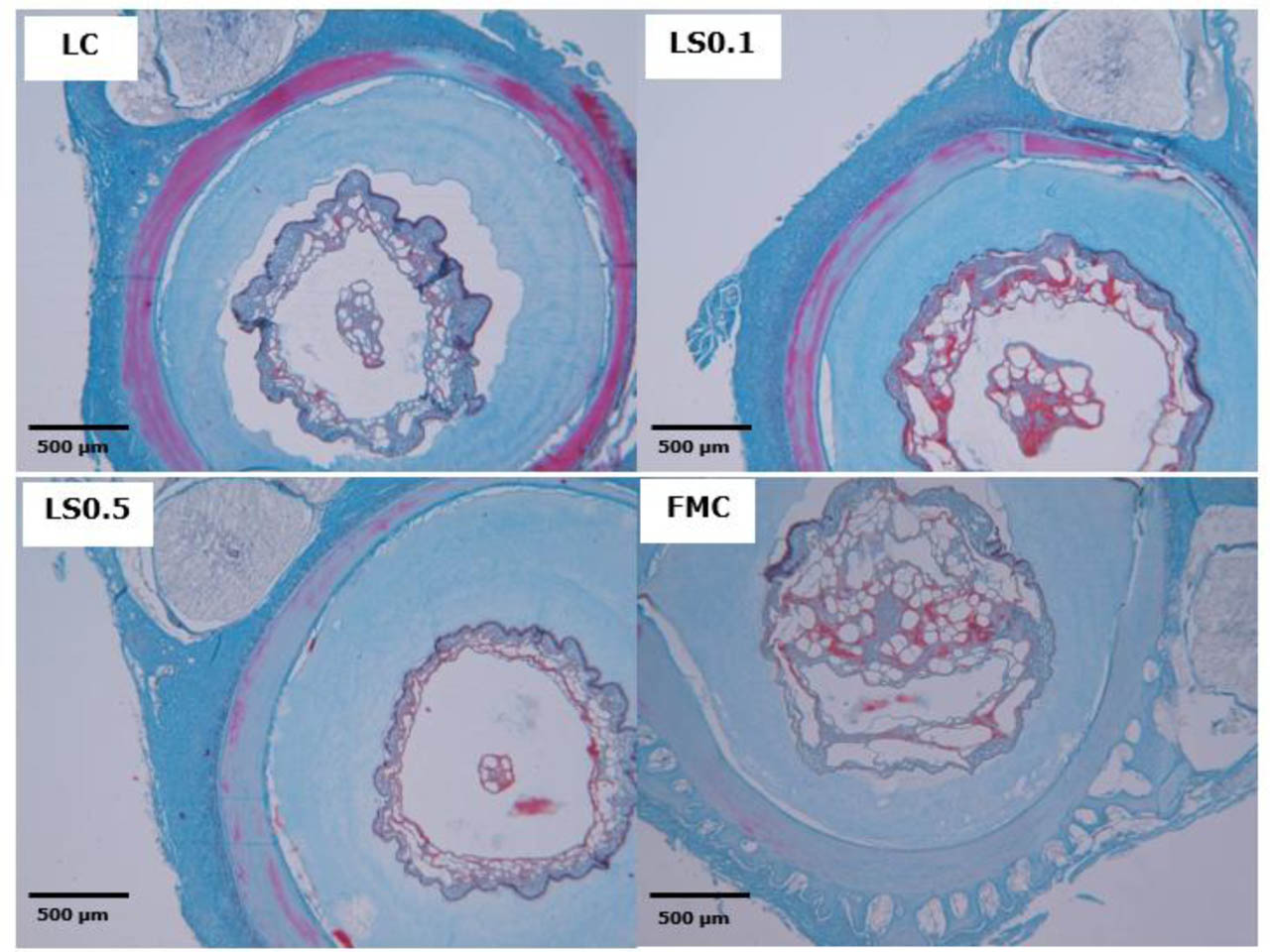
Figure 1.
Histological sections of the 47th–48th vertebrae of fish fed the experimental diets (4 fish per triplicate, total of 12 sampled fish per treatment group). Vertebral and scale morphology, remodelling and mineralisation were then assessed by histomorphometry and colorimetric assays. No significant effects of diet on the measured parameters were detected for the parameters assessed. However, more uniform mineralisation is observed in the centrum region of vertebrae taken for rainbow trout fed the higher SSF SynergenTM diet. This could be due to greater calcium and phosphorous bioavailability
Trabeculae (ossified protrusions from the autocentrum) were omitted from the study by deleting their presence during image analysis. This was performed to the level of their crypts. Consequently, all transverse measurements were taken from areas positioned at the crypt of two trabeculae. Gross anatomical descriptions and analytical measurements are displayed in Figure 1 (note: pink hue has been enhanced for the aid of centrum definition).
Centrum thickness index (CTI) was calculated as follows:
Whereby, CT = centrum thickness (µm) and CD = centrum diameter (µm)
Perimeter: area ratio (VPA) was calculated as follows:
Whereby, CP = centrum perimeter (µm) and CD = centrum area (µm2)
Statistical analysis
Statistical analyses were performed using Sigma Plot 13.0 (SyStat Software Inc., IL, USA). All values expressed as percentages herein were arcsine-transformed prior to statistical analysis. All tests on normally distributed data were conducted via ANOVA with post-hoc Fisher’s LSD with significance accepted at P≤0.05. Non-parametric data were analysed via Kruskal-Wallis and Mann Whitney U tests with significance accepted at P≤0.05.
Ethical statement
Fish protocols were approved by the Institutional Animal Care and Welfare Committee and conformed to the United Kingdom Animal Scientific Procedures (APC’s) and the Animal Scientific Procedures Act 1986.
Results
Growth and feed performance of rainbow trout
Results for the growth and feed performance of rainbow trout used in this trial have been previously presented by Davies et al. (2020) in detail. In summary, trout achieved a 400% average increase in body weight. Significant differences in final weight, weight gain, feed conversion ratio (FCR), specific growth rate (SGR) and protein efficiency ratio (PER) were observed between the dietary treatments. Furthermore, LC- and LS0.1-fed fish did not differ from one another, whilst significant performance enhancement was observed in LS0.5 fed fish (P<0.05). FMR (fishmeal reference group) fed fish performed significantly better than the lupin-based treatments in all biometric parameters recorded.
Tissue mineral concentrations
Liver, muscle, vertebral and caudal fin mineral concentrations are displayed in Table 2. A fishmeal reference (FMR) diet was included in the study as an independent reference formulation since most juvenile rainbow trout and salmonid fish have higher fishmeal containing diets. It was deemed important to compare the mineral tissue retention levels to ensure that all lupin fed trout had consistent macro and trace elemental profiles. This diet was not included in the digestibility and bioavailability trial for strategic and space limitation reasons. Table 2 shows there were only marginal differences in the mineral and trace element profiles for the rainbow trout receiving the fishmeal control diet (FMC) at the end of the trial period with no significant trend or differences compared to all lupin (LC) diets, the only elevation being for FMR trout, where the level of vertebral zinc was 93.95 µg/g, and 76.68 µg/g for the LC group.
Table 2.
Tissue mineral concentrations of liver, muscle, vertebrae, and caudal fin in experimental fish with Synergen SSF (S) supplemented lupin diets respectively and fishmeal reference (FMR diet) (± SD)
| Diet | ||||
|---|---|---|---|---|
| LC | LS0.1 | LS0.5 | FMR | |
| 1 | 2 | 3 | 4 | 5 |
| Liver | ||||
| P (mg/g) | 11.72±0.27 | 11.68±0.45 | 11.40±0.54 | 11.64±0.20 |
| K (mg/g) | 11.54±1.13 | 11.56±0.46 | 11.70±0.31 | 11.85±0.59 |
| S (mg/g) | 8.43±0.56 | 8.59±0.23 | 8.58±0.57 | 8.84±0.34 |
| Na (mg/g) | 4.23±0.51 | 4.29±0.09 | 4.32±0.31 | 4.69±0.16 |
| Mg (mg/g) | 0.74±0.05 | 0.77±0.02 | 0.75±0.04 | 0.76±0.04 |
| Ca (mg/g) | 0.38±0.10 | 0.46±0.12 | 0.44±0.29 | 0.45±0.08 |
| Cu (mg/g) | 0.30±0.02 | 0.28±0.02 | 0.27±0.02 | 0.26±0.07 |
| Fe (mg/g) | 0.19±0.05 | 0.17±0.03 | 0.18±0.02 | 0.15±0.03 |
| Zn (mg/g) | 0.15±0.01 a | 0.16±0.02 a | 0.16±0.01 a | 0.20±0.01 b |
| Mn (µg/g) | 4.12±0.12 a | 4.39±0.49 ab | 4.90±0.34 b | 2.70±0.27 c |
| Muscle | ||||
| K (mg/g) | 14.73±0.80 | 14.59±0.30 | 14.13±0.65 | 14.97±0.09 |
| P (mg/g) | 8.59±0.27 | 8.59±0.29 | 8.43±0.17 | 8.77±0.15 |
| S (mg/g) | 7.64±0.05 | 7.71±0.11 | 7.64±0.25 | 8.00±0.27 |
| Na (mg/g) | 2.42±0.06 | 2.38±0.06 | 2.38±0.09 | 2.19±0.14 |
| Mg (mg/g) | 0.99±0.04 | 0.98±0.03 | 0.94±0.02 | 0.96±0.01 |
| Ca (mg/g) | 0.81±0.11 | 0.98±0.09 | 1.05±0.24 | 0.83±0.12 |
| Zn (µg/g) | 16.27±0.18 | 17.41±1.00 | 17.33±0.68 | 17.51±0.77 |
| Fe (µg/g) | 12.03±1.78 | 11.98±1.39 | 11.89±1.82 | 11.94±1.63 |
| Mn (µg/g) | 0.61±0.20 ab | 0.77±0.23 a | 0.93±0.07 a | 0.40±0.18 b |
| Vertebrae | ||||
| Ca (mg/g) | 93.81±9.01 | 91.29±6.02 | 87.50±3.99 | 90.68±7.73 |
| P (mg/g) | 56.69±4.44 | 55.99±3.00 | 54.66±2.09 | 55.88±4.06 |
| Ca:P | 1.65±0.03 a | 1.63±0.02 b | 1.60±0.02 c | 1.62±0.02 bc |
| Na (mg/g) | 15.99±0.75 | 16.11±0.47 | 16.91±0.13 | 15.74±0.62 |
| K (mg/g) | 7.38±0.85 | 7.38±0.47 | 8.06±0.25 | 7.96±0.69 |
| S (mg/g) | 3.30±0.06 | 3.32±0.08 | 3.43±0.15 | 3.44±0.09 |
| Mg (mg/g) | 2.11±0.18 | 2.09±0.07 | 2.08±0.05 | 2.02±0.12 |
| Zn (µg/g) | 76.68±7.82 | 85.33±0.72 | 85.79±12.72 | 93.95±8.80 |
| Mn (µg/g) | 12.30±3.32 a | 13.14±0.70 a | 14.21±2.25 a | 6.23±1.06 b |
| Caudal fin | ||||
| Ca (mg/g) | 106.90±5.08 | 103.90±4.67 | 107.32±2.58 | 98.90±2.63 |
| P (mg/g) | 62.07±4.36 | 59.73±7.46 | 58.97±3.73 | 51.91±4.13 |
| Na (mg/g) | 44.62±1.14 ab | 33.16±5.51 c | 39.14±2.54 bc | 48.82±3.21 a |
| K (mg/g) | 5.30±0.28 a | 7.41±0.38 b | 6.81±0.81 b | 5.39±0.24 a |
| S (mg/g) | 5.40±0.06 a | 5.32±0.22 a | 5.42±0.10 a | 5.80±0.05 b |
| Mg (mg/g) | 2.25±0.10 ab | 2.36±0.18 a | 2.36±0.08 a | 2.05±0.05 b |
| Zn (µg/g) | 95.78±7.11 | 95.15±12.54 | 104.29±3.86 | 102.57±6.40 |
| Mn (µg/g) | 15.37±3.21 a | 16.38±1.21 ab | 19.71±2.40 b | 8.30±1.33 c |
[i] Ca = total calcium; P = total phosphorus; Mg = total magnesium; K = total potassium; S = total sulphur; Fe = total iron; Zn = total zinc; Mn = total manganese; Na = total sodium; Cu = total copper; Co = total cobalt; Cr = total chromium.
For the experimental lupin diets there were no differences in the levels of macro-elements, P, Mg and Ca. in the liver, muscle, vertebrae, and caudal fin of rainbow trout except for P which showed a noticeable decline in the SSF supplemented fish and lower for the FMR group. Although no significant differences in Ca and P concentrations were observed, the ratio of these elements (Ca:P) was significantly different among the treatments (P<0.001). Mg concentration was significantly affected between treatments (P<0.05). The concentration of Mg in the caudal fin of FMR-fed fish was significantly lower than those of SSF-fed fish. For trace elements Cu and Fe, there were also no observable trends in these tissues for the diet regimes.
Lupin-fed fish did not differ significantly from one another, nor did LC and FMR. Mn concentration differed significantly between treatments (P≤0.05). The concentration of this element was significantly lowest in FMC fed fish. The concentration of Mn in fins of LS0.5-fed fish was significantly higher than that of LC, whilst LC and LS0.1 did not differ from one another. Liver Zn concentration was significantly higher in the FMC group compared to the lupin-fed fish (P<0.05); no effect was observed through SSF treatment but there was a progressive increase in Zn levels in the vertebrae of trout with SSF addition. In the caudal fin, Zn was appreciably elevated in LS0.5 and like the status in the FMR fed group. A significant difference in Mn liver concentration was observed (P<0.05) with Mn concentration being significantly higher in LS0.5. However, Mn concentration in fish fed the fishmeal-based diet was significantly lower than all lupin-fed fish.
The muscle of the fish showed significant differences in Mn concentrations (P<0.05) but Mn was significantly lower in FMR compared to trout fed the diets LS0.1 and LS0.5, respectively. However, numerical trends towards increasing Mn concentration with SSF addition may be apparent. Vertebral Mn concentration differed significantly between dietary treatments (P<0.05). Mg was significantly lower in FMR fed fish compared to the fish fed the lupin-based diets. Similarly to muscle concentration, trends towards increased concentration with SYN are apparent.
Nutrient digestibility and mineral bioavailability
Apparent digestibility and bioavailability coefficients are displayed in Table 3. The apparent digestibility of total dry matter and crude lipid was unaffected by dietary treatment. Apparent digestibility of crude protein was, however, significantly different between the lupin-based diets, significant incremental increases were observed between LC, LS0.1 and LS0.5. Crude fibre apparent digestibility was significantly different between treatments, being significantly higher in LS0.5 than LC and LS0.1. No significant difference was observed between LC and LS0.1. Gross energy apparent digestibility was significantly higher in LS0.1 compared to LC (P<0.05), LS0.5 than LC (P<0.05)
Table 3.
Apparent macronutrient digestibility coefficients (ADC) (%) and apparent mineral bioavailability coefficients (ABAC) (%) of the experimental lupin-based and fishmeal-based rainbow trout diets with SSF (S) (± SD)
| Diet | |||
|---|---|---|---|
| LC | LS0.1 | LS0.5 | |
| ADC (%) | |||
| DM | 96.97±0.43 | 96.71±0.21 | 97.08±0.69 |
| CP | 83.65±0.02 a | 85.26±0.03 b | 85.55±0.03 c |
| CL | 89.11±0.77 | 88.93±0.10 | 90.43±0.79 |
| CF | 33.99±1.05 a | 35.52±1.60 a | 44.69±2.62 b |
| GE | 66.29±0.62 a | 68.41±0.83 b | 71.76±0.15 c |
| ABAC (%) | |||
| Ca | 0.67±1.57 a | 13.80±1.62 b | 20.20±0.77 c |
| P | 55.02±0.72 a | 63.86±0.69 b | 73.53±0.47 c |
| Mg | 33.43±0.03 a | 42.91±0.64 b | 51.27±0.45 c |
| K | 92.14±0.05 a | 93.30±0.06 b | 94.04±0.11 c |
| S | 53.82±0.35 a | 58.97±0.37 b | 62.00±0.72 c |
| Fe | 41.77±2.19 a | 48.34±1.99 b | 39.59±0.83 a |
| Zn | 29.39±0.96 a | 30.41±2.68 a | 41.59±3.96 b |
[i] DM = dry matter; CP = crude protein; CL = crude lipid; CF = crude fibre; GE = gross energy; Ca = total calcium; P = total phosphorus; Mg = total magnesium; K = total potassium; S = total sulphur; Fe = total iron; Zn = total zinc. LC = yellow lupin control diet; LS0.1 = yellow lupin basal + Synergen™ (0.1%); LS0.5 = yellow lupin basal + Synergen™ (0.5%); FMC = fishmeal reference/control diet.
The bioavailability for calcium, phosphorous, magnesium, manganese and iron were significantly different between treatments in respect of their apparent mineral bioavailability coefficients (ABAC). Apparent bioavailability was higher in LS0.1 compared to LC and LS0.5. On the other hand, apparent bioavailability in zinc was higher in LS0.5 compared to LC and LS0.1.
Intestinal enzyme activities
Anterior intestinal protease activity results are displayed in Table 4. Total alkaline protease (TAP), trypsin and chymotrypsin activities in the digesta of fish were unaffected by dietary treatment (P>0.05). Alkaline phosphatase (ALP) activity in digesta varied appreciably between treatments (P<0.05). Activity of ALP in digesta was significantly higher in SYN treatments than LC. No significant difference in ALP activity was present between SSF treatments. L-leucine aminopeptidase (LAP) activity in digesta was indicated to be significantly affected by dietary treatment (P<0.05). Activity of LAP was slightly significantly (P<0.05) higher in LS0.1 fed fish than LC fed fish. Activity of LAP was also significantly higher in LS0.5 fed fish than LC fed fish. No significant difference was observed between SSF treatments. No significant effects of dietary treatment were observed in ALP and LAP activities in anterior intestinal mucosa samples, although numerical tendencies towards decreased activity with SSF supplementation may be present.
Table 4.
Proteolytic enzyme activities in digesta and mucosa of fish fed the lupin-based diet, with and without SSF (S) inclusions
| Diet | |||
|---|---|---|---|
| LC | LS0.1 | LS0.5 | |
| Digesta | |||
| TAP* (U/g) | 17.50±3.75 | 16.03±1.26 | 17.71±1.32 |
| Trypsin (U/g) | 68.18±21.31 | 66.97±14.02 | 65.03±13.89 |
| Chymotrypsin (U/g) | 325.50±129.00 | 290.29±27.89 | 368.57±98.38 |
| ALP (U/g) | 51.64±8.94 a | 78.92±17.14 b | 79.37±20.56 b |
| LAP (U/g) | 5.91±1.27 a | 7.61±2.85 b | 8.50±1.06 b |
| Mucosa | |||
| ALP (U/g) | 216.73±56.31 | 203.24±57.98 | 169.73±68.43 |
| LAP (U/mg) | 837.87±225.36 | 737.07±113.59 | 692.20±102.33 |
Vertebral histomorphology
No significant difference in centrum thickness index (CTI) was observed between treatment groups of fish (P>0.05) (Table 5). Similarly, no significant difference in vertebrae perimeter: centrum area ratio (VPA) was observed (P>0.05) (Table 5). Representative micrographs are exhibited in Figure 1.
Discussion
The use of sustainable plant ingredients like lupin and supplementation with SSF can offer a reduction or removal of anti-nutritional factors (ANFs) and therefore alleviate the dependence on fishmeal or soybeans in feeds. In the present study, 0.05 and 0.1% of SSF as Synergen™ with FM-based diets and diets that contained 30% lupin were tested to reduce the negative effects of ANFs and enhance diet characteristics for rainbow trout. The findings here show that SSF supplementation was highly effective in promoting growth performance and general feed utilization (Davies et al., 2020) and mineral availability for rainbow trout as described here. Most promisingly, the lupin LS0.5-fed fish were closer in performance to those fed a high-grade fishmeal reference (FMR) diet, compared with the 0.1% inclusion returning negligible effects.
Lupins have been highlighted as having a promising potential for use in aquaculture feeds (Zhang et al., 2012). Recent studies have shown the use of lupin in diets for several species with importance in aquaculture. Numerous researchers have advocated this legume in recent years. For example, in rainbow trout (Oncorhynchus mykiss) (Hernández and Roman, 2012), whiteleg shrimp (Litopenaeus vannamei) (Weiss et al., 2020), red hybrid tilapia (Oreochromis niloticus × O. mossambicus) (Abdel-Moneim and Yones, 2010), juvenile barramundi (Lates calcarifer) (Van Vo et al., 2015; Ilham et al., 2018), gilthead seabream (Sparus aurata L.) (Omnes et al., 2015). In addition, some researchers have investigated lupin with solid state fermentation (SSF) as in more optimised form in the diets of a variety of aquatic species. These include juvenile Nile tilapia (Oreochromis niloticus) (Bowyer et al., 2020), African catfish (Clarius gariepinus) (Enyidi and Etim, 2018), common carp (Cyprinus carpio) (Anwar et al., 2020; Bowyer et al., 2020) who found that following inclusion of SSF in diets with lupin, juvenile tilapia showed significant improvements to their overall weight gain, final weight, SGR and FCR. Also, Diógenes et al. (2018) investigated commercial exogenous enzymes and the SSF product Synergen™ with very promising results on the performance of turbot juveniles.
Ilham et al. (2018) also reported that barramundi (Lates calcarifer) fed fermented lupin meal (FLM) attained similar performance to fish fed a fishmeal-based diet indicating that fermented lupin meal had a potential to substantially replace 75% FM protein in the diets of barramundi. The possibility of replacing fishmeal by up to 30–50% in the diets for rainbow trout without negative effects on growth performance and feed utilization has been previously reported (Borquez et al., 2011 a; Glencross et al., 2011). Bransden et al. (2001) also reported that replacing up to 40% of fishmeal protein by de-hulled blue lupin in diets for Atlantic salmon (Salmo salar L.) did not have any adverse effects on growth. Gouveia et al. (1993) reported that inclusion up to 20% of white lupin in the diet for rainbow trout did not adversely affect growth performance. Previously, Bórquez et al. (2011 b) stated that whole seed white lupin meal at up to 20% in extruded diets for rainbow trout did not adversely affect growth performance and feed performance. Similarly, Hernández and Roman (2012) and Hansen et al. (2004) reported that lupin meal can be used as a possible plant protein source for the formulation of low phosphorus loading diets for rainbow trout without affecting feed acceptability and growth performance. This legume represents a clear opportunity to supply the high demand for plant protein sources for aquaculture.
Some exogenous carbohydrase enzymes, derived from SSF, particularly cellulases, express efficacy within the luminal environment of the intestine. Hemicellulase action is also likely since industrial fermentation processes with A. niger (within SSF fermentation) are known to produce potent activities of xylanases, mannanases and galactosidases (Laerke et al., 2015; Inoue et al., 2015). Furthermore, earlier studies have demonstrated that SSF may be used to reduce the fibre fraction of distillers’ dried grains with solubles (DDGS), improving its feasibility to be used as a feed commodity (Lio and Wang, 2012). Also, for other feed ingredients like maize stalk (Darwish et al., 2012) or groundnut oil cake (Mandal and Ghosh, 2013), crude fibre content also decreased through the SSF process. So, the decrease in cellulose could be attributed to the action of enzymes that degrade cellulose and release bound nutrients such as macro and trace elements (Egwim and Onwuchekwa, 2016; Tengku Norsalwani et al., 2012). Overall, the increase in digestibility as well as bioavailability of minerals demonstrated a multi-faceted efficacy in improving nutrient profile; with much similarity to results observed in both phytase (see Kumar et al., 2012) and carbohydrase (Compston, 1994) inclusions in fish diets.
We have observed in this study with rainbow trout some general trends in the improvement of specific trace element retention in only certain tissues with SSF supplementation of lupin. Mostly there were only marginal and non-significant changes in mineral profiles.
The electrolytes were not significantly affected so we only addressed specific elements and trace elements. In aquatic animals like fish, the interaction of Na and K is in a flux state and dietary effects would have had minimal impact. Rainbow trout have the capacity to osmo-regulate and acquire K and Na from their aqueous environment and these may overshadow the dietary uptake due to homeostatic mechanisms.
However, a progressive increase in Zn levels in the vertebrae of trout with SSF addition was noted. In the caudal fin, Zn was appreciably elevated in LS0.5 and like the status in the FMR (fishmeal reference) fed trout used as our reference diet. An improved Mn liver concentration was noted with Mn concentration being significantly higher in the intermediate SSF level for lupin diets. However, Mn concentration in fish fed the fishmeal-based diet was significantly lower than all lupin-fed rainbow trout indicating that fishmeal is the best source for this important trace element. This validates why we included a separate fishmeal reference diet in this investigation for tissue mineral profile comparison with all lupin diets.
Caudal fin sampling of fish is a widespread non-lethal technique providing tissue samples for the analysis of pollutants which has been shown more useful in predicting Hg exposure than muscle or bone tissues (Magro et al., 2019). In the current investigation, significant change was observed to mineral and trace element availability throughout the SSF-supplemented diets, especially an increase in phosphorus uptake in the LC and LS0.5 between 55 and 74%. These results agree with many others (Vandenberg et al., 2012; Verlhac-Trichet et al., 2014; Liu et al., 2015; Carter and Sajjadi, 2011) who all observed elevated P assimilation with phytase supplementation in plant protein diets for various fish species. Furthermore, it is highly likely that the increased P bioavailability observed in this study is due to the degradation of phytate-mineral chelates and fibre bound P. Since the basal diet contained both soya bean products and lupin kernel meal, it is probable that the phytate degraded in this process was from both ingredient types. This has important implications for P output into the aqueous environment that can alleviate P impact in intensive aquaculture operations.
These values, under the current experimental conditions, appeared to show tendencies towards higher tissue retention of particularly P and Mg within fish receiving a dietary supplementation of SSF. It was also observed that several trace elements such as Mn in the liver, muscle, vertebra and caudal fin were elevated with the higher SSF fortified lupin diets. Ca status of muscle was also observed to be higher for the SSF diet fed rainbow trout. A higher Ca would help to support muscle strength and function as an important element of physiological relevance.
The activity of trypsin and chymotrypsin (the indicators of digestive capacity) appeared not to be altered by the SSF inclusions, suggesting no endo-exogenous interactions or any noticeable reduction in inhibitors. This is somewhat supported by findings of Vandenberg et al. (2012) where phytase-supplemented rainbow trout were effective in reducing protein-limiting phytate, yet they did not affect trypsin activity within the intestine of exposed fish. However, endogenous intestinal ALP and LAP activity were indicated to be elevated following SSF inclusion within the digesta, whilst activity within their predominant site, the mucosa, appeared slightly reduced.
Although these assays were aimed at identifying the activity of endogenous proteases, the significant results observed in LAP and ALP activity within the lumen may be examined as to whether they were in fact endogenous. Certainly, the intestinal tracts of the experimental fish possessed sources of exogenous bioactivity, from the colonising microbiota as well as A. niger (Hansen et al., 2004).
Finally, this study did not reveal any alteration to the vertebral centrum size (area) or morphological structures in rainbow trout, thus no feasible improvement for structural robustness could be advocated on a morphological level in this assessment.
Similarly, supplementing of broiler diets with SSF was reported to show no effect upon bone strength by Vandenberg et al. (2012). It must be noted that the size of fish used in the present study was one which had already undergone a vast proportion of its ontogenetic developments and was long-past life-stages where ossification is most critical. Nevertheless, seen as the mineral release by SSF appeared to modulate bone mineralisation even in advanced juveniles, future work should consider younger developmental stages in order to reassess whether mineral release by SSF may improve structural integrity of muscle and bone tissue morphology.
Conclusion
The results of this investigation with Synergen™ inclusion, at 0.5%, proved quite effective in the diet containing 30% yellow lupin, attributable to its likely residual bioactive components. Furthermore, there were improvements in production and efficiency parameters, equating to performance which was more comparable with a high-grade FM reference diet than the original lupin-based counterpart. Hence, the use of sustainable plant ingredients like lupins and supplementation with SSF can mitigate dependence on fishmeal in feeds. The enhancement of mineral absorption by rainbow trout can lead to a reduction in environmental impact given concerns for mineral excretion from intensive fish farming operations. This has strong implications for the farming of Atlantic salmon, the most important related farmed salmonid species.
Acknowledgments
The authors are grateful for the support of Alltech LCC for the donation of the Synergen™ product and the Innovate UK Lupin program. This research was partially supported by Chiang Mai University.