
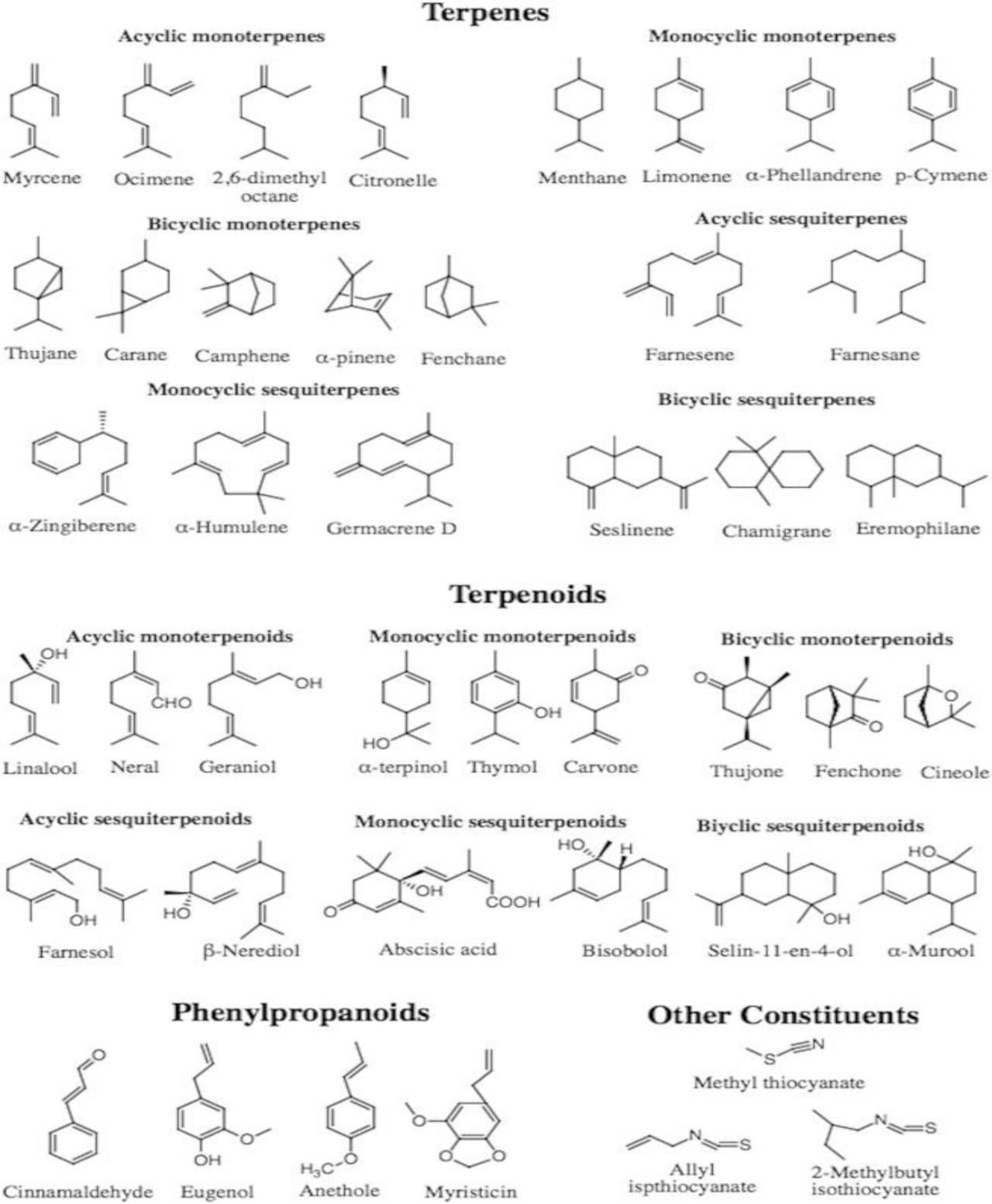
Figure 1.
The chemical structures of the bioactive compounds in essential oils

Figure 2.
The rumen and methane production

Figure 3.
The mode of action of encapsulated essential oils on methane production
Table 1.
Overview of encapsulation techniques with their physical and chemical mechanisms (Adapted from Yammine et al., 2024 and Li et al., 2025)
| Technique | Type | Process description | Advantages | Disadvantages |
|---|---|---|---|---|
| Spray-drying | Physical | Essential oils are atomized into fine droplets and rapidly dried using heated air. Protective wall materials (e.g., polysaccharides) can be applied to enhance stability. |
|
|
| Freeze-drying | Physical | Involves freezing followed by sublimation of water under reduced pressure. The technique helps preserve essential oils but may result in some loss due to temperature sensitivity and volatility. |
|
|
| Extrusion methods | Physical | Essential oils are processed through an orifice under controlled conditions. Techniques include: hot-melt extrusion, melt injection, centrifugal/co-extrusion, electrostatic spinning, and particle formation from gas-saturated solutions. |
|
|
| Solvent evaporation | Physical | A four-step process involving dissolution of core and shell materials, emulsification, solvent removal to solidify microcapsules, and final drying. |
|
|
| Complex coacervation | Chemical | Occurs through interactions between oppositely charged biopolymers, leading to phase separation. The polymer-rich phase is collected to encapsulate essential oils. |
|
|
| Ionic gelation | Chemical | Involves ionic crosslinking of biopolymers, where essential oils are incorporated and trapped within the polymer matrix. |
|
|
| Emulsion-based encapsulation | Chemical | Two immiscible liquids are mixed, forming dispersed droplets that serve as carriers for essential oils within a stable emulsion system. |
|
|
| Co-extrusion and gelation | Chemical | Droplets are generated through controlled vibration and fall into a gelling solution, effectively encapsulating volatile bioactive compounds. |
|
|
Table 2.
Detailed encapsulation methods, materials, proportions, and stability, release profile, and functionality of encapsulated essential oils
| Method | Suitable materials | Stability | Release profile | Functionality | Reference |
|---|---|---|---|---|---|
| Spray-drying | Maltodextrin, Arabic gum, whey protein, gelatin, lecithin | High stability under optimized drying conditions; protects from light and oxygen; moderate thermal/humidity stability | Controlled release depending on wall material; suitable for long-term storage | Cost-effective; improves shelf-life, preserves bioactivity, enhances photostability | Aguiar et al. (2020) |
| Freeze-drying | Maltodextrin, trehalose, gelatin, trehalose, polysaccharides | Retains volatile compounds but may lose some due to freezing | Gradual release over time | Preserves essential oils during storage; suitable for heat-sensitive compounds | Sousa et al. (2022) |
| Extrusion methods | Alginate, chitosan, carrageenan | Moderate (pH-sensitive) | Controlled release based on polymer properties | Produces uniform particles; suitable for large-scale production | Chiriac et al. (2021); Asbahani et al. (2015) |
| Solvent evaporation | Poly(lactic-co-glycolic) acid (PLGA), ethyl cellulose, poly-ε- caprolactone (PCL) | High stability with minimal degradation; sensitive to solvents | Sustained release due to polymer matrix | Controlled release; targets methanogens; protects essential oils from external factors; enhances antioxidant capacity | González-Reza et al. (2020) |
| Complex coacervation | Gelatin-gum Arabic, chitosan-alginate | High pH/thermal stability; stable against environmental factors like light and oxygen | Controlled release through polymer degradation | Improves bioavailability, masks odor and taste | Muhoza et al. (2022); Sousa et al. (2022) |
| Ionic gelation | Alginate, chitosan, pectin | Stable in mild processing conditions | Rapid release in aqueous environments | Simple and fast process; protects sensitive compounds | Yammine et al. (2024); Chiriac et al. (2021) |
| Emulsion-based | Alginate, cyclodextrins, lecithin | Stable in emulsified form; low oxidative stability | Release depends on emulsion stability | Suitable for hydrophilic and hydrophobic compounds | Lu et al. (2016); Sousa et al. (2022) |
| Co-extrusion and gelation | Alginate-chitosan multilayers | High (multilayer protection) | Delayed (lower gastrointestinal) | Targeted delivery; reduces rumen bypass | Homayouni-Rad et al. (2024); How et al. (2022) |
Table 3.
Materials employed in the encapsulation of essential oils to mitigate methane emissions in ruminants
| Material | Type | Encapsulation methods | Key benefits | Limitations | Reference |
|---|---|---|---|---|---|
| Maltodextrin | Polysaccharide | Spray-drying, freeze-drying | Cost-effective, high solubility, improves shelf-life, preserves bioactivity | Hydrophilic; may have limited protection in aqueous environments | Fernandes et al. (2014) |
| Arabic gum | Polysaccharide | Spray-drying, coacervation, complex coacervation | Emulsifying properties, stabilizes volatile compounds | Limited thermal stability, expensive | Fernandes et al. (2014); Al-Hamayda et al. (2023) |
| Whey protein | Natural polymer | Spray-drying, coacervation | High encapsulation efficiency, biodegradable | Sensitive to pH and heat | Xiao et al. (2022) |
| Alginate | Natural polymer | Extrusion, ionic gelation | pH-sensitive, controlled release, suitable for sensitive compounds | May have rapid release in certain conditions | Benavides et al. (2016); Sousa et al. (2022) |
| Chitosan | Natural polymer | Co-extrusion, extrusion, ionic gelation, coacervation | Improves bioavailability, enhances stability | pH-dependent release (insoluble at neutral pH) | Arias et al. (2021); Negi and Kesari (2022) |
| Gelatin | Natural polymer | Coacervation, spray-drying, freeze--drying | Thermo responsive, biocompatible, high stability, protects from light and oxygen | Requires cross-linking for stability; may not be suitable for all essential oils | Sousa et al. (2022) |
| Trehalose | Disaccharide | Freeze-drying | Protects essential oil volatiles, stabilizes during drying | High energy input required | Domian et al. (2015) |
| Poly (lactic-co-glycolic) acid (PLGA) | Synthetic polymer | Solvent evaporation | Biodegradable, controlled release, improves bioavailability | Expensive, may require specific processing conditions | Blasi (2019) |
| Ethyl cellulose | Synthetic polymer | Solvent evaporation | High mechanical strength, sustained release | Hydrophobic; may have limited biodegradability | Julaeha et al. (2023); Sousa et al. (2022) |
| Poly-ε-caprolactone (PCL) | Synthetic polymer | Solvent evaporation | Slow degradation, long-term release | May require organic solvents for processing | De Ávila et al. (2017); Chiriac et al. (2021) |
| Polysorbate (Tween 80) | Surfactant | Emulsion-based | Enhances essential oil solubility, stabilizes nanoemulsions | Oxidative instability; requires antioxidants | Baranauskaite et al. (2021); Sousa et al. (2022) |
| Lecithin | Lipid-based | Emulsion-based, spray-drying | Natural emulsifier, improves bioavailability | Sensitive to pH and temperature | Sánchez-Osorno et al. (2023) |
| Vegetable hydrogenated fatty acids | Natural matrix | Emulsion-based, microencapsulation | Cost-effective, protects lipophilic essential oils; effective rumen by-pass, protects essential oils from ruminal degradation | Prone to oxidation over time; may require specific processing conditions | Amin et al. (2021) |
Table 4.
Summary of in vitro and in vivo studies on the use of encapsulated essential oils for methane emission reduction in ruminants
| Encapsulated essential oil | Encapsulation method | Test system | Ruminant species | Dose | Observed effect | Reference |
|---|---|---|---|---|---|---|
| 1 | 2 | 3 | 4 | 5 | 6 | 7 |
| Blend of essential oils | N/A | in vivo | beef steers | 150 mg/kg DM |
| Alemu et al. (2019) |
| Blend of essential oils (cinnamaldehyde, eugenol, carvacrol, and capsicum oleoresin) | Fat matrix | in vivo | sheep | 0, 200, and 400 mg/kg dietary DM |
| Soltan et al. (2018) |
| Blend of essential oils (cinnamaldehyde, named Olistat-Cyn, Olistat-G, and Olistat-P) | Fat matrix | in vitro | cows | 1.0 g |
| Amin et al. (2021) |
| Blend of essential oils | N/A | in vitro | dairy cow | 0, 50, 100, 200, 300, 400, and 500 mg/L |
| Ahmad (2023) |
| Blend of essential oils | N/A | in vitro | sheep | 0, 400, 800 μg/kg DM |
| Ahmed et al. (2014) |
| Fruit peel phytonutrient | Spray-drying with chitosan | in vitro | cows | 0, 2, 4, and 6% DM |
| Phupaboon et al. (2024) |
| Blend of essential oils | Fat matrix | in vivo | dairy cows | 1.2 g/cow/day |
| Tondini et al. (2024) |
| Lemongrass and man gosteen peel phytogenic compounds | Ionic gelation | in vivo | steers | 0, 1, 2, 3, and 4% of substrate |
| Prachumchai et al. (2024) |
| Pepper blend | N/A | in vivo | bullocks | 0, 200, and 400 mg/kg of concentrate |
| Giacomelli et al. (2023) |
| Phytogenic blend | N/A | in vivo | steers | 300 mg/kg of concentrate |
| Brunetto et al. (2023) |
| Yucca schidigera extract | Nano-encapsulation | in vitro | N/A | 0.25, 0.5, and 1 mL/g DM |
| Botia-Carreño et al. (2024) |
| Acacia tannin extract | Gum Arabic-maltodextrin microparticles | in vitro | sheep | N/A |
| Adejoro et al. (2019 b) |
| Blend of essential oils | N/A | in vivo | bulls | 150 mg/kg DM |
| Martins et al. (2018) |
| Phytonutrient of Wolffia globosa | Spray-drying using chitosan | in vitro | dairy cows | 0%, 2%, 4%, and 6% of total DM substrate |
| Muslykhah et al. (2024) |