
Table 1.
Search strategy used in each database
| Database (number of studies) | Search strategy |
|---|---|
| PubMed (3214) EBSCO (2325) Scopus (1256) WOS (1572) | (((CP) AND (rehabilitation)) AND (context focused intervention)) AND (Context therapy) |
| (((CP) AND (rehabilitation)) AND (participation)) AND (Functional independence) | |
| ((CP) AND (rehabilitation) AND (family) | |
| (((CP) AND (Rehabilitation)) AND (family)) AND (acceptance and commitment therapy) | |
| ((CP) AND (rehabilitation)) AND (home based) | |
| ((CP) AND (rehabilitation) AND (social environment) | |
| (((CP) AND (rehabilitation)) AND (self-help devices)) AND (assistive technology) | |
| ((CP) AND (rehabilitation)) AND (health services accessibility) | |
| ((CP) AND (rehabilitation)) AND (health knowledge, attitudes, practice) | |
| Context-focused intervention AND CP | |
| Context-focused intervention environments AND CP | |
| CP [Title] AND (‘enriched environments’[Title] OR ‘steppingstones’[Title] OR ‘family centered therapy’[Title] OR ‘performance’[Title] OR ‘environment’[Title]) | |
| ‘CP’ AND ‘f words’ | |
| ‘CP’ AND ‘health knowledge’ | |
| ‘CP’ AND ‘health services accessibility’ | |
| ‘CP’ AND (‘health technologies’ OR ‘self-help devices’) |
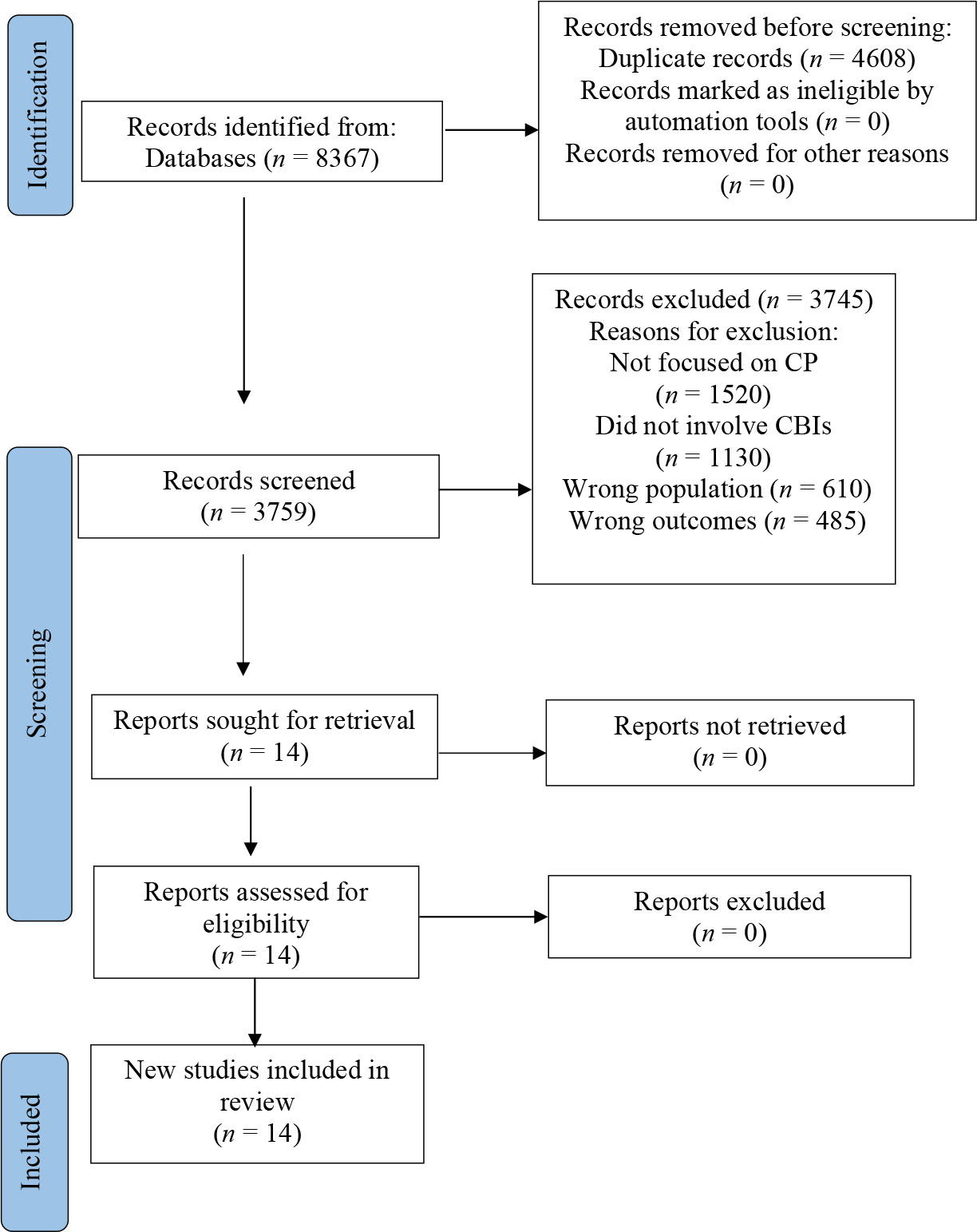
Figure 1.
PRISMA flow diagram for study selection through database searching. CP - cerebral palsy, CBIs - context-based interventions
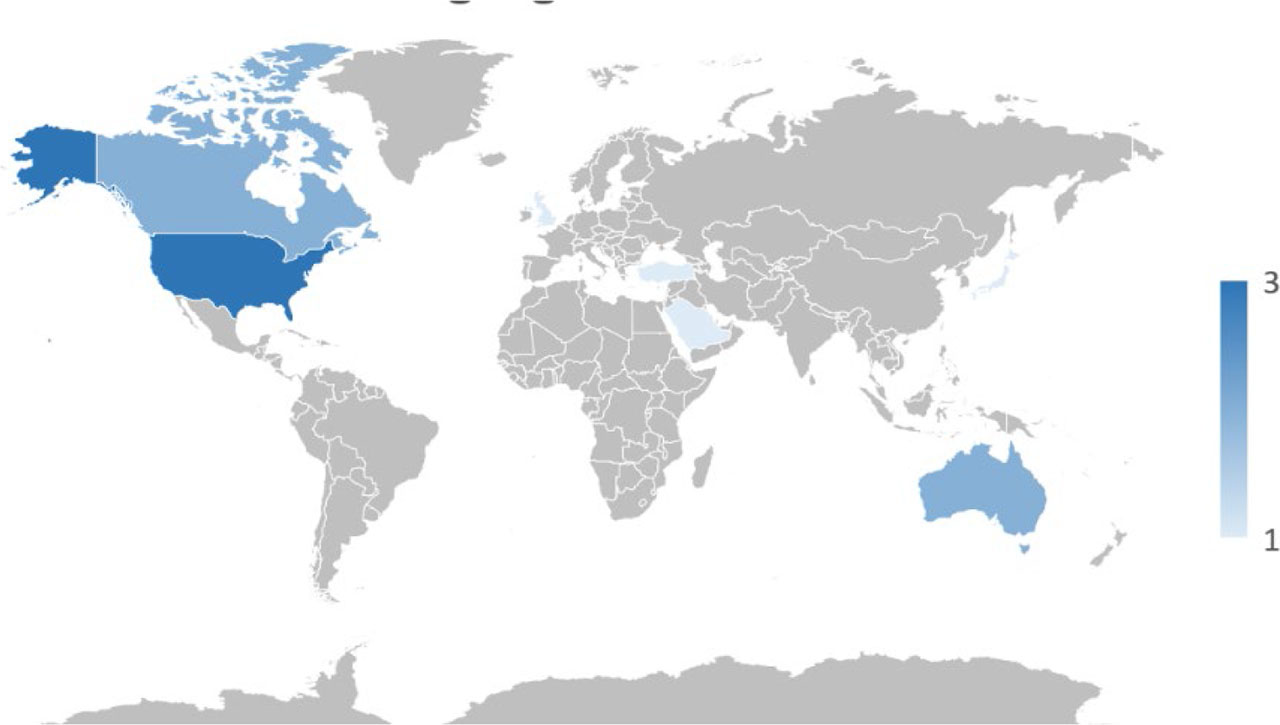
Figure 2.
Geographic distribution of studies included (own source)
Table 2.
General characteristics of the included studies
| Author | Country | Study design | Aim | Type of CBIs | Sample age | Number of participants | ICF components addressed | Outcome measures | Level of evidence (CEBM) |
|---|---|---|---|---|---|---|---|---|---|
| AlSaif et al. 12 | Saudi Arabia | RCT | To examine the effects of Nintendo Wii Fit training on motor performance in children with spastic CP | Home-based use of Nintendo Wii Fit | 6–10 years | 40 (20 intervention/20 control) | Activity, Motor Function | BOTMP 5:6,mABC-2, 1MWT | 2b |
| Chiu et al. 13 | Taiwan | Pre–post feasibility study | To assess the feasibility and clinical benefits of home-based Wii Fit training in children with CP | Home-based Wii Fit training supervised by parents and therapists | 6–12 years | 20 | Activity, Motor Function, Participation | APS, Muscle strength, 6MWT, 10MWT | 4 |
| Chen et al.14,15 | USA | Pilot study (case series) | To evaluate the feasibility and effectiveness of a low-cost home-based VR system (Super Pop VR) for children with CP | Home-based virtual reality (Super Pop VR) supervised by caregivers | 7–10 years | 3 children with CP | Activity, Motor Function, Participation | BOT-2, PMAL, Reaching kinematics (VR), | 4 |
| Chan-Víquez et al.16 | Canada | Mixed-methods case study | To evaluate the feasibility, motor outcomes, and user experiences of the Bootle Blast home-based videogame for upper limb rehabilitation in children with hemiplegic CP | Home-based goal-directed therapy using Bootle Blast | 8–13 years | 4 children with hemiparesis | Activity, Participation, Motor Function | AHA, BBT, COPM, CHEQ, Grip Strength, ROM | 4 |
| Farr et al. 17 | UK | RCT | Feasibility of virtual reality rehabilitation in children with CP | Home-based virtual reality therapy with family involvement | 5–16 years | 30 | Activity, Participation, Motor Function | BOT-2, GMFM-66, GAS SDQ, TUG | 2b |
| Goswami et al. 18 | India | RCT | To assess home-based activity therapy in children with spastic diplegic CP | Home-based functional activity therapy supervised by caregivers | 5–12 years | 59 (30 intervention/29 control) | Activity, Participation, Motor Function | 6MWT, 10MFWT, CP-QoL, GMFM-88, MAS, MTS | 2b |
| Hung et al.19 | USA | Quasi-experimental (pre-post) | To evaluate home-based bi-manual training in children with unilateral CP. | Intensive home-based bimanual training (H-HABIT) led by caregivers | 2.5–4.5 years | 7 | Activity, Motor Function, Participation | Bimanual coordination (kinematic analysis), joint motion | 4 |
| Kassee et al.20 | Canada | Pilot study | To compare home-based Wii and resistance training in children with hemiplegic CP | Wii group: home-based Nintendo Wii use | 7–12 years | 6 (3 Wii/3 resistance) | Activity, Motor Function | ABILHAND-Kids, MA2, Grip Strength (dynamometer) | 3b |
| Mattern-Baxter et al.21 | USA | RCT | Comparing low- versus high-intensity home-based treadmill training on walking in children with CP | Home-based treadmill training | 14–32 months | 19 (10 LI/9 HI) | Activity, Motor Function | 1MWT, 10MWT, FMS, GMFM-66 D/E, PDMS-2, PEDI, Step Watch | 2b |
| Preston et al.22 | UK | Pilot study | To assess the feasibility and effects of computer-assisted arm rehabilitation games in schools for children with CP | Computer-assisted robotic games in school | 6–12 years | 11 (9 schools) | Activity, Motor Function | ABILHAND-Kids, COPM, CKAT (kinematics: speed, smoothness, accuracy) | 3b |
| Preston et al.23 | UK | Pilot RCT | To assess home-based rehabilitation gaming for arm function in children with spastic CP. | Robotic rehabilitation games at home post-botulinum toxin | 5–12 years | 15 (8 intervention/7 control) | Activity | ABILHAND-Kids, COPM | 2b |
| Reedman et al.24 | Australia | RCT | To evaluate the effects of participation-focused therapy on goal performance and physical activity in children with CP | Participation-focused therapy (ParticiPAte CP): home/community-based individualised intervention | 8–12 years | 37 (18 intervention/19 control) | Activity, Participation, Environmental Factors | COPM (performance/satisfaction), Accelerometry (MVPA), BPPA-Q, PEM-CY | 2b |
| Sel et al.15 | Turkey | Triple-blind RCT | To evaluate the effectiveness of a telerehabilitation-based structured home program in pre-school children with CP | Structured home program with telerehabilitation support | 3–6 years | 43 (23 intervention/20 control) | Activity, Participation, Motor Function | GMFM-66, COPM, GAS, PEDI | 1b |
| Wang et al.25 | Taiwan | Pilot RCT | Comparing home-based Nintendo Wii-augmented constraint-induced therapy with conventional CIT in children with CP | Conventional CIT versus CIT with exergaming (Wii) at home | 5–12 years | 18 (10 CIT-Wii/8 CIT) | Activity, Participation, Motor Function | ABILHAND-Kids, BOT-2,Top, PSI-SF | 2b |
[i] 1MWT - one-minute walk test, 6MWT - six-minute walk test, 10MFWT - ten-meter fast walk test, BOT-2 - Bruininks–Oseretsky test of motor proficiency – second edition, BOTMP - Bruininks–Oseretsky test of motor proficiency, CBIs - context-based interventions, CFCS - communication function classification system, COPM - Canadian occupational performance measure, CP - cerebral palsy - CP-QoL - cerebral palsy quality of life questionnaire - EQ - engagement questionnaire, GAS - goal attainment scale, GMFCS - gross motor function classification system, GMFM-66 - gross motor function measure-66, GMFM-88 - gross motor function measure-88, MACS - manual ability classification system, MAS - modified ashworth scale, mABC-2 - movement assessment battery for children – second edition, MTS - modified Tardieu scale, PEDI - paediatric evaluation of disability inventory, PMAL - paediatric motor activity log, PMAL-R - revised paediatric motor activity log, PEM-CY - participation and environment measure for children and youth, Top - test of playfulness, WeeFIM - functional independence measure for children.