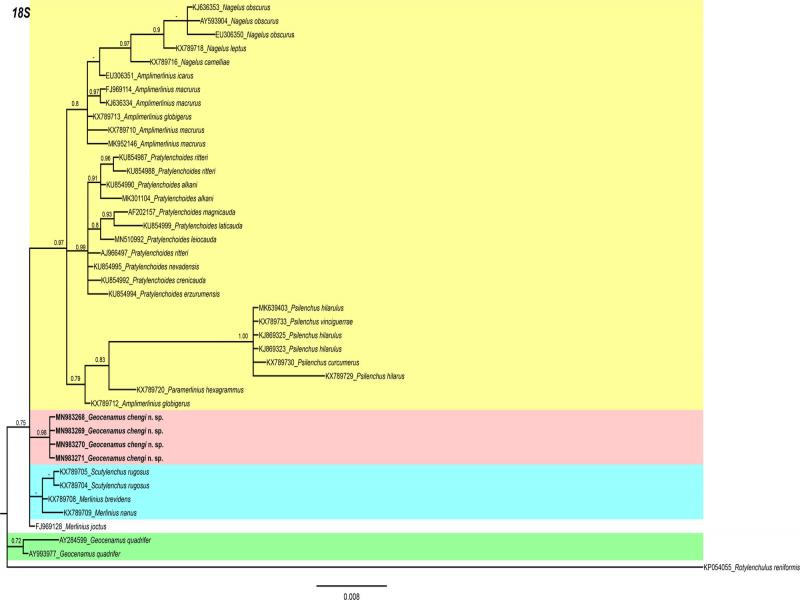
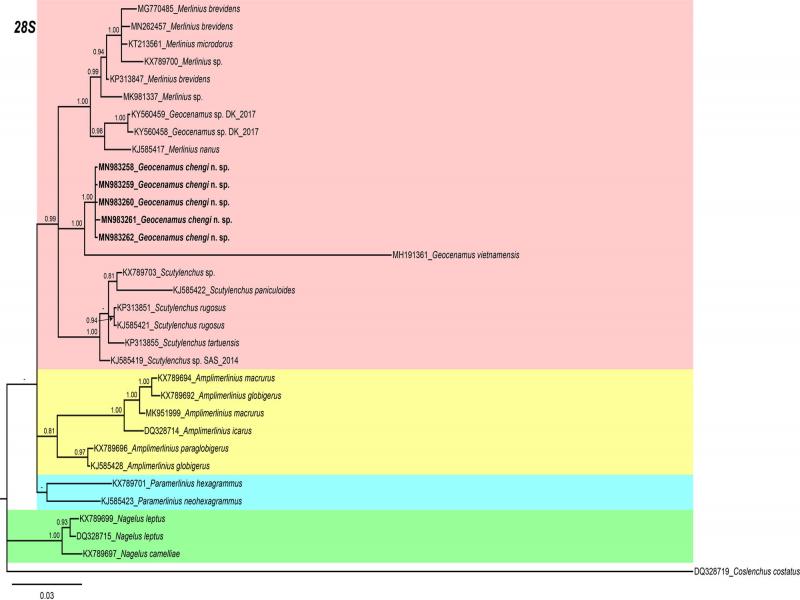
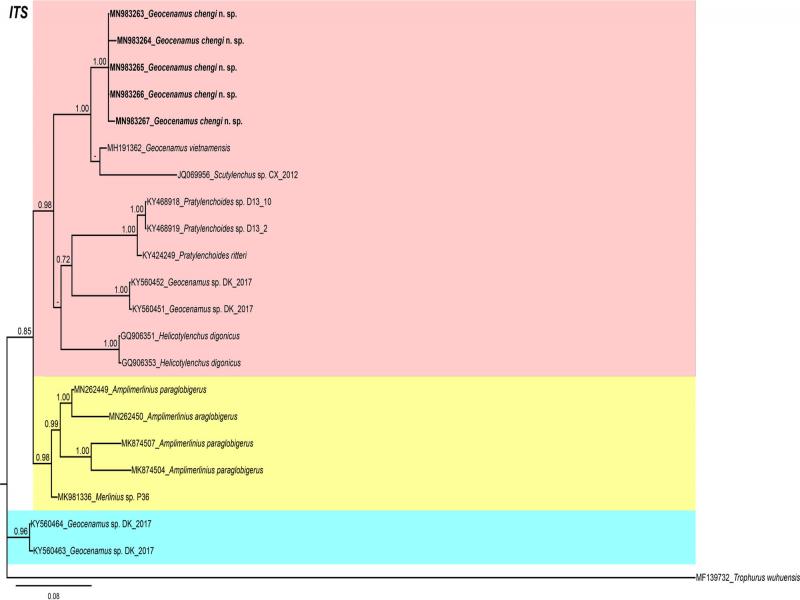
The tea plant is native to China; this country has the highest tea production and consumption rate in the world. More than 100,000 hectares of tea acreage are located in seven Chinese provinces: Yunnan, Sichuan, Fujian, Hubei, Zhejiang, Guizhou, and Anhui (Yao and Chen, 2012). In an attempt to investigate the nematode biodiversity associated with the tea plantations of Hangzhou, Zhejiang Province, a population of stunt nematode of subfamily Merliniinae was detected. This family comprises migratory ectoparasites of roots; merlinid nematodes are root feeders and can subsist on a variety of host plants (Siddiqi, 2000). The detected population of stunt nematode was examined carefully, and the morphological characterization indicated that this population belongs to the genus Geocenamus (Thorne and Malek, 1968).
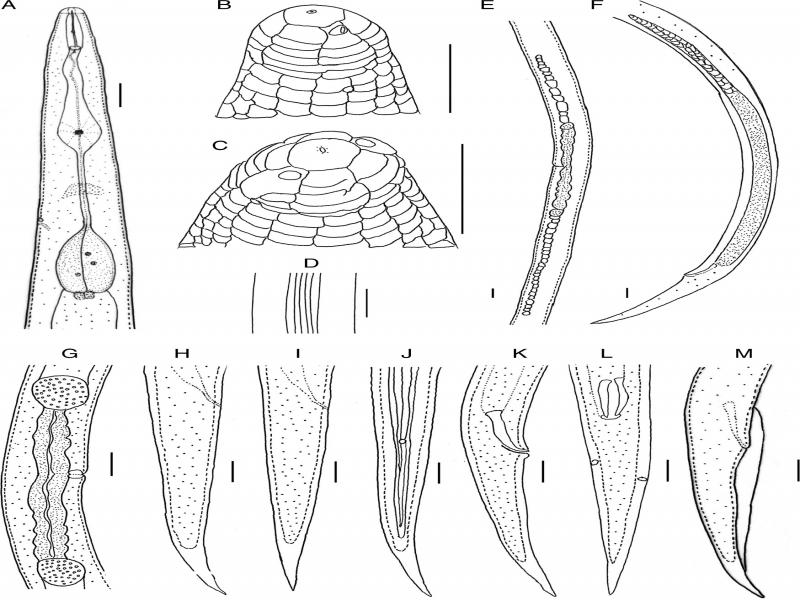
Figure 1:
Line drawings of Geocenamus chengi n. sp. A: pharyngeal region; B, C: en face view; D: lateral lines: E: female gonad; F: male gonad; G: vulval region; H-J: female tails: K-M: male tails (Scale bars = A; D-M = 10 μm, B,C = 5 μm).
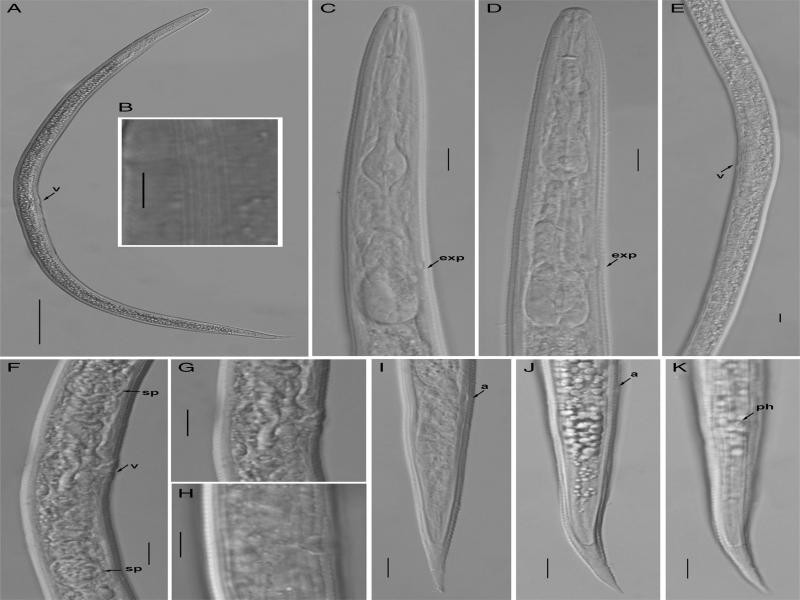
Figure 2:
Light photomicrographs of Geocenamus chengi n. sp. Female. A: entire body; B: lateral lines; C, D: pharyngeal regions, arrow pointing on the excretory pore (exp): E: gonad; F: vulval region arrows pointing on vulva (v) and spermatheca (sp); G, H: vulval region; I-K: female tails arrows pointing on anus (a) and phasmid (ph) (Scale bars = A = 100 μm; B-K = 10 μm).
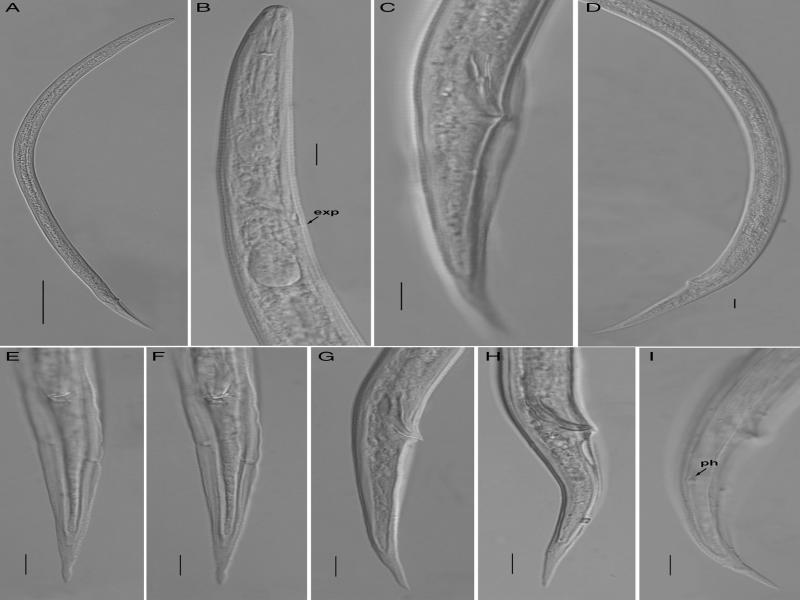
Figure 3:
Light photomicrographs of Geocenamus chengi n. sp. Male. A: entire body; pharyngeal regions, arrow pointing on the excretory pore (exp); C: tail with bursa; D: gonad; E, F: tail in ventral view; G, I: male tail arrows pointing on phasmid (ph) (Scale bars = A = 100 μm; B-I = 10 μm).
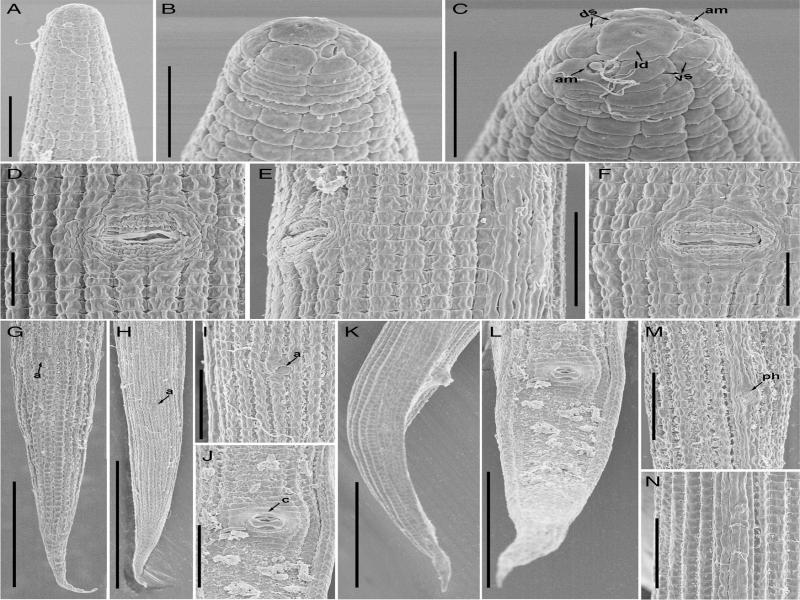
Figure 4:
Scanning electron microscopy of Geocenamus chengi n. sp. A: anterior region; B-C: en face view; D-F: vulval regions; G, H: female tail regions arrows pointing anus (a); I: anal area at higher resolution, arrow pointing on the position of anus; J: cloacal area at higher resolution, arrow pointing on the position of cloaca (c); K, L: male tail; M: lateral field with phasmid (ph); N: lateral field. Abbreviation: am, apmphid; ds, dorsal sectors; vs, =ventral sectors; ld, labial disc (Scale bars, A, E, I, J, M, N = 10 μm; B, C, D, E, F = 5 μm; G, K = 30 μm; H = 50 μm; L = 20 μm).
Table 1.
Morphometric data for Geocenamus chengi n. sp. All measurements are in µm and in the form of mean ± SD (range).
| Holotype | Paratype | ||
|---|---|---|---|
| Female | Male | ||
| n | 20 | 10 | |
| Body length | 884.8 | 879.0 ± 59.6 (783–997) | 822.8 ± 34.2 (772–892) |
| a | 33.3 | 33.3 ± 2.6 (28–39) | 32.9 ± 1.2 (31–34) |
| b | 6.0 | 6.1 ± 0.3 (5.5–6.6) | 6.1 ± 0.2 (5.8–6.6) |
| c | 10.4 | 10.5 ± 0.6 (9.2–11.7) | 9.7 ± 0.6 (8.7–10.3) |
| c' | 4.7 | 4.6 ± 0.4 (4.2–5.5) | 4.8 ± 0.3 (4.5–5.2) |
| V | 52.8 | 52.5 ± 1.6 (49.5–55.7) | 39.4 ± 5.4 (33.1–47.4) |
| Lip height | 7.5 | 7.6 ± 2.4 (7.0–8.0) | 7.6 ± 0.3 (7.0–8.0) |
| Lip width | 3.7 | 3.8 ± 0.3 (3.4–4.5) | 3.7 ± 0.3 (3.2–4.0) |
| Stylet length | 22.3 | 22.2 ± 0.6 (21–23) | 21.5 ± 0.7 (20–23) |
| DGO distance from stylet knobs | 2.0 | 2.0 ± 0.1 (1.7–2.2) | 2.1 ± 0.1 (1.9–2.3) |
| Excretory pore from anterior end | 122.8 | 120.6 ± 5.2 (109–126) | 108.3 ± 5.2 (101–116) |
| Hemizonid from anterior end | 118.4 | 116.7 ± 5.1 (104–123) | 103.0 ± 6.7 (94–113) |
| Pharynx length | 148.4 | 145 ± 5.7 (130–152) | 134 ± 3.6 (127–139) |
| Maximum body diam. | 26.6 | 26.6 ± 2.5 (22–33) | 25.0 ± 1.0 (23–27) |
| Vulval body diam. | 25.4 | 26.6 ± 2.3 (23–32) | − |
| Anal/cloacal body diam. | 18.3 | 18.1 ± 1.2 (16–21) | 17.7 ± 0.9 (16–19) |
| Tail length | 85.2 | 83.8 ± 5.4 (76–92) | 85.2 ± 5.4 (78–93) |
| Hyaline tail part length | 25.2 | 22.4 ± 2.2 (19–25) | 21.3 ± 1.9 (18–24) |
| Phasmid position from anus/cloaca | 12.4 | 15.5 ± 4.1 (10–19) | 24.6 ± 3.9 (19–29) |
| Phasmid % of tail | 14.6 | 17.4 ± 4.0 (12–20) | 29.5 ± 4.0 (24–35) |
| Spicule length | − | 23.4 ± 1.9 (22–25) | |
| Gubernaculum | − | 8.0 ± 0.7 (7–9) | |