
Introduction
Because of its accessibility, flexibility, and scalability, online education is fast growing (Allen et al. 2016; Seaman et al. 2018), with rising enrollments representing a clear pathway for increasing the size and diversity of the engineering workforce. However, although the proportion of higher education students enrolling in online courses and programs has gradually expanded over the last decade—from 26% in 2012 to 61% in 2021 (National Center for Education Statistics 2023; Seaman et al. 2018)—engineering education and research have been slower to adopt and investigate the online educational format than other disciplines such as business, management, education, health, and the humanities. Further, student course-level attrition remains a concern in the online format (Bowers & Kumar 2015; Shea & Bidjerano 2016; Gregori et al. 2018), limiting the number of online students earning engineering degrees. A 20–50% dropout rate in online education has been reported, with additional research putting online course attrition rates at 10–20% higher than face-to-face courses (Herbert 2006; Willging & Johnson 2009; Simpson 2010; Smith 2010). We conducted a systematic literature review (SLR) on the trends and current state of knowledge arising from research on online engineering education. We used the Preferred Reporting Items for Systematic Reviews and Meta-Analyses (PRISMA) framework to guide the SLR process. Findings from this review provide a summary of the main topics studied in the online engineering education space, connections between these topics, gaps in the research, and recommendations for future work. Together, these findings increase awareness and capacity for online engineering education research and catalyze effective practices for online engineering teaching and learning.
Notably, the literature on online learning includes research pertaining to a broad range of online course formats, including fully online asynchronous courses, synchronous online courses, hybrid courses offered as part of a formal curriculum, and massive online open courses (MOOCs). We restricted our SLR to fully online asynchronous courses offered as part of a formal engineering curriculum at either the graduate or undergraduate level in recognition of the increasing number of engineering courses and programs being provided in this format. We excluded research related to synchronous online and hybrid courses, as much of the recent literature has focused on the shift to these types of online learning during or after the COVID-19 pandemic, and we wanted to focus on exemplars in online engineering education rather than transitions made during duress. Research related to MOOCs was also excluded since MOOCs differ from other online courses in that they usually are open to anybody, require no formal academic preparation or approval, employ automated grading, and are not part of formal engineering curricula (Sezan & Sevim Cirak 2020; Staubitz et al. 2020).
This study aims to answer the overall research question: What is the current state of research on asynchronous online course offerings in formal engineering curricula? The first portion of our findings characterizes the sampled articles based on the following attributes: year of publication, publication type and outlet, country of affiliation of the first author, engineering disciplines studied within the work, theoretical frameworks utilized, research design utilized, sampling method and sample size, and study population and participant demographics. The second portion of our findings presents a synthesis and categorization of research themes across the articles.
Methods
We used the PRISMA framework in this research to guide our SLR process (Page et al. 2021). This framework has three main phases: (1) identification, wherein articles are retrieved from different databases using search terms; (2) screening, wherein articles are screened by abstract and full text following a set of predefined exclusion criteria; and (3) inclusion, wherein the final articles included in the review process are analyzed in detail to address a set of research questions. We selected the PRISMA framework to guide our SLR process for its transparency and methodological rigor. The SLR process began by entering different search terms into several databases (Borrego et al. 2014; Clapton et al. 2009; James et al. 2016). We used a total of eight search terms/phrases in this study: online engineering courses, online engineering persistence, online STEM persistence, online engineering retention, online engineering effectiveness, online engineering engagement, online engineering assessments, and online engineering challenges. Initially, we included only the first six terms in the SLR process, with the search terms related to student persistence (i.e., online engineering persistence, online engineering retention, and online STEM persistence) selected due to the relatively higher dropout rate within the online (versus in-person) learning format (Bowers & Kumar 2015; Shea & Bidjerano 2016; Gregori et al. 2018). Based on the review of articles from these search terms, we decided to include two more search terms (online engineering challenges and online engineering assessment) to provide a complete view of the research topic under consideration. The databases used to find articles were ProQuest, Google Scholar, IEEE Xplore Digital Library, ERIC (Education Resources Information Center), Science Direct, Compendex, Wiley Online Library, EBSCOhost, and Scopus.
Data collection
The complete article selection process for the SLR is presented in Figure 1. We eliminated articles meeting any of the following nine exclusion criteria (EC) because they did not meet the purpose of the study: EC1) published in a language other than English; EC2) published before 2011 or after 2020; EC3) not a full-length refereed conference or journal paper; EC4) contained no focus on online engineering; EC5) focused on synchronous online teaching and learning (e.g., via Zoom); EC6) focused on Massive Online Open Courses (MOOCs); EC7) focused on transitioning a face-to-face course to an online or hybrid course due to the COVID-19 pandemic; EC8) focused on blended learning in which some elements of the course were taught face-to-face and other elements of the course were taught online; or EC9) focused on how a specific component of the course (e.g., assignment, assessment, activity) was planned and executed online, with the remainder of the course being taught either in person or in a format not explicitly identified within the article.
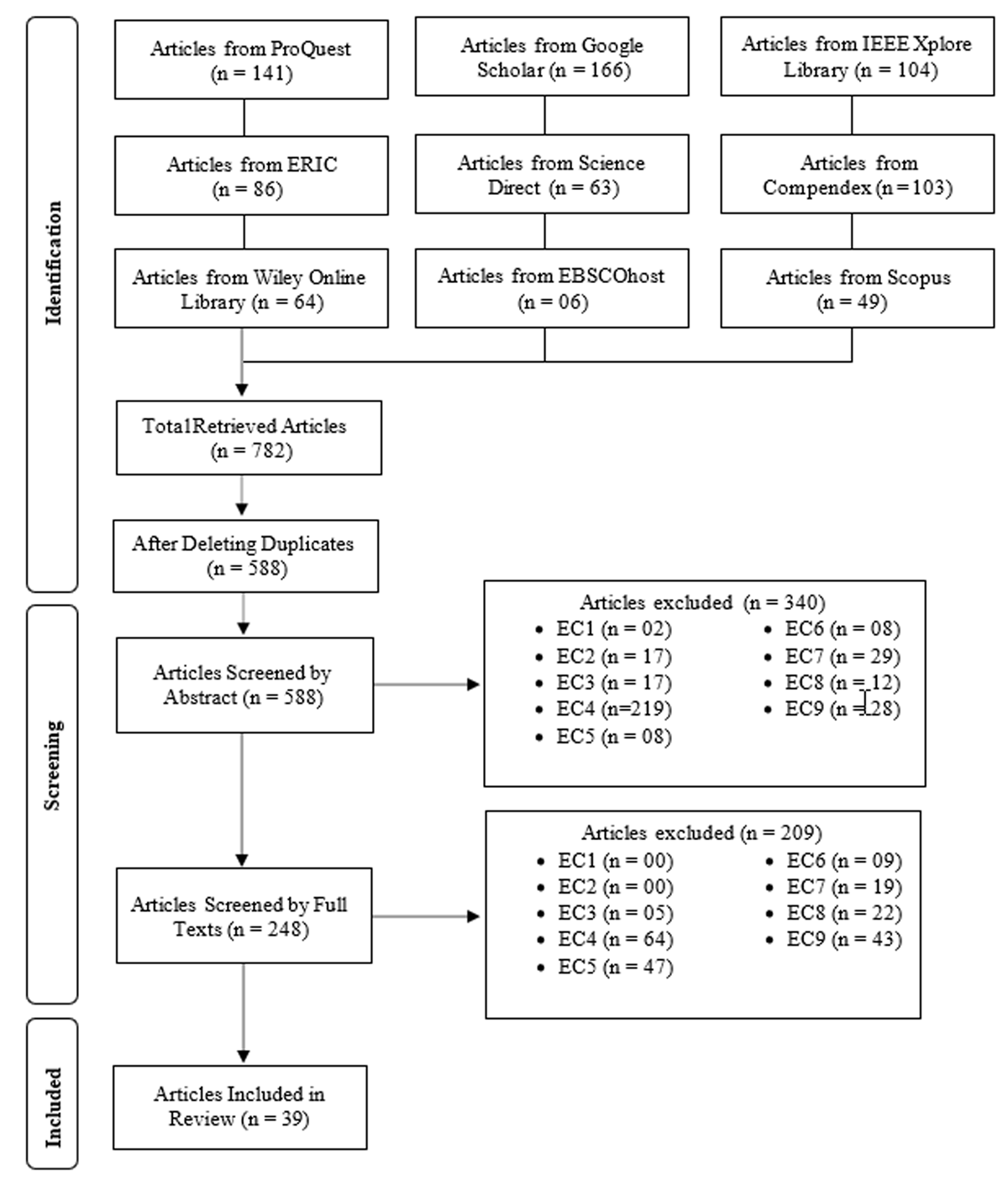
Figure 1
Systematic Literature Review Article Selection Process using PRISMA.
As shown in Figure 1, 782 articles were initially retrieved using the eight search phrases and nine databases. To conclude the identification phase, the first author removed duplications among articles pulled from various databases and then completed the initial screening of abstracts and, later, full articles to eliminate articles that were easily identifiable as meeting one or more of the exclusion criteria. The remaining articles were evaluated independently for inclusion by the first and fourth authors (hereafter referred to as “readers,” both of whom were advanced PhD students at the time of the analysis). Disagreements about whether to include articles were resolved through discussion, after which the first author reevaluated the remaining articles against the exclusion criteria. Thirty-nine articles were ultimately included in the final synthesis phase of the review.
Data analysis
With the final 39 articles identified, the readers followed a six-step process to synthesize and create meaning from the publications. First, each reader independently read and summarized a sample of fifteen articles. The following information was recorded for each article by each reader: year of publication; publication type (e.g., conference proceeding vs. journal publication) and publication outlet; engineering discipline(s) and courses represented in the article; country affiliation of the first author; theoretical frameworks used; research foci and research methods applied; study populations and participant demographics; sampling methods and range of sample sizes; and research findings. The summaries from both readers were then compared to confirm that the records were consistent.
Second, readers worked together to inductively generate codes describing common patterns across the fifteen articles and a related codebook. Eleven codes were generated: assessment, feedback, attrition or enrollment, class design or structure, content delivery, engagement, laboratory design, learning technology, pedagogical considerations, technical challenges, and time challenges. These codes, their description, and exemplars of each code are presented in Appendix A. Third, another sample of fifteen articles was reviewed independently by both readers to capture the same summarizing information as before and either map each article to the fourteen parent codes generated in the previous step or, if an article could not be mapped to the codes, propose new codes.
Fourth, codes generated in the second and third steps were further analyzed and grouped to create the following five emergent themes: content design and delivery, student engagement and interactions, assessment, feedback, and challenges. Cohen’s Kappa measure of agreement was next used to determine inter-rater reliability between the two readers (in assigning articles to the themes) to assess the dependability of the analysis. Across the thirty articles reviewed by both readers, Cohen’s Kappa was calculated as κ = 0.88, where a score of .81 to 1.00 indicates near-perfect agreement (Landis & Koch 1977). In the final step of the analysis, the first author independently summarized and assigned one or more of the five emergent themes to each of the nine remaining articles.
Data analysis in this paper is presented in two parts. The first phase uses descriptive statistics to examine the trends in the 39 articles retained for final investigation. The second part presents the qualitative analysis of these articles across the five identified themes.
Strengths and Limitations
This SLR provides a holistic picture of research on asynchronous online engineering education by assessing the trends and current state of knowledge in the field. Each theme generated as part of this study is complemented by implications for both practice and research meant to provide instructors and researchers in the online engineering education space with specific and actionable guidance. The findings of this study greatly expand the current understanding of research in the field of online engineering education as they help categorize the strengths of existing research and identify opportunities for future research. Based on our evaluation of the literature, no other SLR on the topic exists.
Regarding limitations, we selected the final set of articles based on exclusion criteria that did not include a metric of quality or uniqueness of information therein. In alignment with other SLRs within engineering education (e.g., Anwar et al. 2019; Borrego et al. 2018; Sezgin & Sevim Cirak 2021; Verdin et al. 2016), we used nine databases that we expected to contain many journal and conference articles focused on online engineering education research; we hope this limitation was mitigated through using these separate and highly reputable databases. We also excluded books and other technical reports in our search, which may have limited the scope of information covered within the SLR. The search terms we used in this study focused on the intersection of online education, engineering, and specific areas of interest (e.g., assessment, persistence), which may have excluded other articles and themes relevant to online engineering education that might have emerged using different combinations of these and other words. Because we did not include articles published after 2020 in the systematic review, the review may be missing other courses or programs that practitioners and researchers might find interesting or relevant but were not yet published. As we limited the articles to English, they may have only captured a portion of the global scholarship on online engineering education.
Findings
We first present a descriptive summary of trends in research and practice among asynchronous online courses in formal engineering curricula in publications across the decade 2011–2020. Then, we provide descriptions, exemplary studies, and research and practice implications for the five themes identified from synthesizing the final 39 articles.
Descriptive findings related to publication trends
Publications per year
From 2011 through 2020, there was a general increase in the number of articles published on online engineering education research per year, reaching a high in 2020 (Figure 2). This trend is encouraging because it suggests increased interest in the online learning format by engineering scholars and practitioners over time in their respective research and teaching activities.
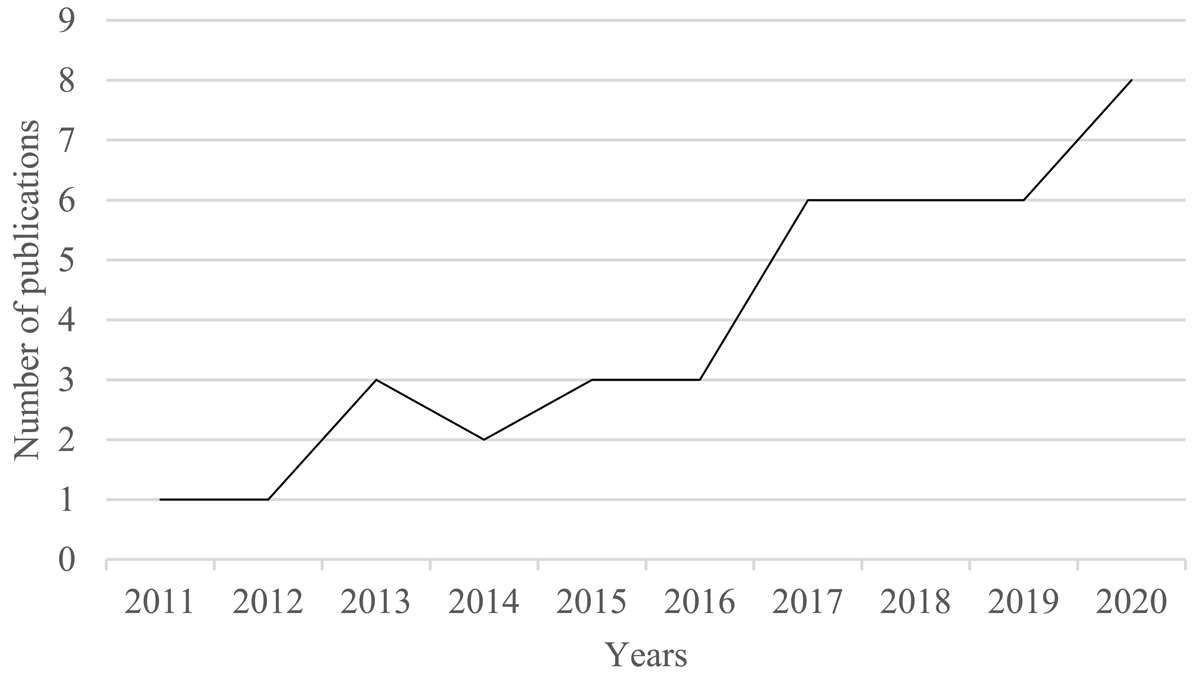
Figure 2
Number of Publications in Online Engineering Education by Year.
Publication type and publication outlet
Among the 39 articles reviewed for this study, 69% were published as conference proceedings and 31% as journal articles. Most conference papers sampled in this systematic review were published in conferences sponsored by the American Society for Engineering Education (ASEE) (48%) and the Institute of Electrical and Electronics Engineers (IEEE) (22%), with the remainder published in other venues. Further, the journal articles sampled in this study appeared in the following journal outlets: Computer Applications in Engineering Education (25%), Education and Information Technologies (8.3%), Advances in Engineering Education (8.3%), Chemical Engineering Education (8.3%), IEEE Transactions on Education (8.3%), IEEE Transactions on Learning Technologies (8.3%), Internet and Higher Education (8.3%), Journal of Online Engineering Education (8.3%), Sustainability (8.3%), and Online Learning (8.3%).
Country affiliation of first author
Table 1 shows that the articles selected for this review featured first-authors from fourteen countries. The majority of first authors heralded from the US (53.9%), followed by Spain (12.8%) Australia (5.1%), and 2.6% for each of 11 remaining countries. We acknowledge that the high occurrence of online engineering education research originating from the US in our search could be influenced by the fact that we included articles written only in English. In addition, practitioners in other countries may engage and invest in online engineering education but have different pressures, incentives, or research support infrastructure to publish on this work.
Engineering programs and courses
Table 2 lists the engineering programs and courses studied in the 39 articles. Across all fields, Mechanical Engineering (13.3%) was the most often studied program, followed by Computer and Telecommunications Engineering (13.3%), Engineering Management (10.0%), First-Year Engineering (6.7%), Systems Engineering (6.7%), and 3.3% for each of nine remaining programs. In Table 2, the word “course” refers to a single class offering in the specified subject. Further, the courses studied span undergraduate and graduate courses, as well as theory-based and laboratory-based courses. These findings indicate the applicability of online learning to diverse courses and programs within engineering. (Note: nine articles in the sample were not included in Table 2 because they comprised literature reviews and general online engineering-based studies wherein specific programs or courses were not indicated).
Table 2
Disciplines and courses of sampled articles.
| # | PROGRAMS | N | % | COURSES |
|---|---|---|---|---|
| 1 | Mechanical Engineering | 4 | 13.3 | - Computer Aided Engineering - Engineering Dynamics - Introduction to Natural Sciences - Strength of Materials - Thermodynamics |
| 2 | Computer and Telecommunications Engineering | 4 | 13.3 | - Cognitive Network Design* - Digital Design - Mathematical Analysis - Mathematics II |
| 3 | Engineering Management | 3 | 10.0 | - Operations Management* - Technology Planning and Management* |
| 4 | First-year Engineering | 2 | 6.7 | - Support Program in Mathematics |
| 5 | Systems and Control Engineering | 2 | 6.7 | - All courses program-wide* - Lab Practices on Instrument. and Control* |
| 6 | Aerospace Engineering | 1 | 3.3 | - Mechanics of Materials |
| 7 | Chemical Engineering | 1 | 3.3 | - Core Chemistry Concepts I* - Core Chemistry Concepts II* |
| 8 | Computer Science | 1 | 3.3 | - Operating Systems - Signals and Systems |
| 9 | Computing, Engineering, and Management of Information Systems | 1 | 3.3 | - Courses not indicated |
| 10 | Electrical and Computer Engineering | 1 | 3.3 | - Electrical Circuits - Introduction to Electrical Laboratory |
| 11 | Engineering Science | 1 | 3.3 | - Learning from Engineering Disasters |
| 12 | Informatics Engineering | 1 | 3.3 | - Software Development Laboratory |
| 13 | Manufacturing Systems Engineering | 1 | 3.3 | - All courses program-wide* |
| 14 | Marine Engineering | 1 | 3.3 | - English Academic Course for Engineering |
| 15 | Program Not Indicated | 6 | 20.0 | - Economic Decision Making* - Effectiveness in Technical Organizations* - Info. Management and Data Engineering - Intercultural Engineering - Thermoelectricity* - Product Data Management |
[i] Note: * Denotes graduate courses.
Theoretical frameworks
Fifteen articles used a theoretical framework, nine used a conceptual framework grounded in literature, and the remaining fifteen did not use a framework in their study. For papers that employed a theoretical framework, the frameworks they used are summarized in Table 3. Notably, frameworks were not repeated across these studies, suggesting a wide range of theoretical perspectives being applied in the online engineering learning space and indicating an opportunity for further testing and application. However, while none of the frameworks repeated, the importance of peers, faculty, and learning environment for online student engagement was mentioned across multiple articles. Five of the fifteen articles that did not use a framework were literature reviews, for which a framework is typically not used. The remaining articles that did not use a framework discussed the design of a new course or new interventions within a course.
Table 3
Theoretical frameworks used in sampled articles.
| # | FRAMEWORK(S) | REFERENCE ARTICLE |
|---|---|---|
| 1 | Backward design, Bloom’s taxonomy | Chatterjee et al. 2016 |
| 2 | Community of Inquiry (CoI) Model | Rutz & Ehrlich 2016 |
| 3 | Constructivism | Minichiello et al. 2013 |
| 4 | Inquiry-based Learning | Uribe et al. 2016 |
| 5 | Social Influence Theory | Schutz et al. 2018 |
| 6 | Systems Engineering-based Framework | Bozkurt & Helm 2013 |
| 7 | Trifecta of Engagement | Fu 2019 |
| 8 | Skills in e-learning courses | Levy & Ramim 2017 |
| 9 | Bloom’s taxonomy | Pamplona et al. 2018 |
| 10 | Motivational frameworks (expectancy x value theory, four phase model of interest, multiple goals model) | Cooper et al. 2020 |
| 11 | Self and co-regulation of learning | Pedrosa et al. 2020 |
| 12 | Problem based learning | Andersson & Logofatu 2018 |
| 13 | Kolb learning styles | Mansor & Ismail 2012 |
| 14 | Self-regulation theory | Sancho-Vinuesa et al. 2018 |
| 15 | Theories of formative assessment | Lawton et al. 2012 |
Research foci and research methods
Table 4 summarizes the different research foci and methods used in the sample articles. Five kinds of articles emerged from the set: literature reviews (12.8%), articles focused on the description of new or existing courses (33.3%), articles focused on the description of new or existing interventions (30.8%), articles focused on the description of new or existing programs (5.1%), and more fundamental research that transcends specific courses and programs (17.9%). Studies marked as “no research” in Table 4 were descriptive and did not include original data collection and analysis.
Table 4
Research foci and research approach in sampled articles.
| # | RESEARCH FOCI | N | % | RESEARCH METHODS | N | % |
|---|---|---|---|---|---|---|
| 1 | Literature review | 5 | 12.8 | No research (descriptive) | 5 | 12.8 |
| 2 | Course description | 13 | 33.3 | No research (descriptive) | 3 | 7.7 |
| Qualitative | 2 | 5.1 | ||||
| Quantitative | 4 | 10.3 | ||||
| Qualitative and quantitative | 4 | 10.3 | ||||
| 3 | Intervention description | 12 | 30.8 | No research (descriptive) | 1 | 2.6 |
| Qualitative | 1 | 2.6 | ||||
| Quantitative | 4 | 10.3 | ||||
| Qualitative and quantitative | 6 | 15.4 | ||||
| 4 | Program description | 2 | 5.1 | No research (descriptive) | 2 | 5.1 |
| 5 | Fundamental research | 7 | 17.9 | Quantitative | 5 | 12.8 |
| Qualitative and quantitative | 2 | 5.1 |
The five identified literature reviews in online engineering education cover topics including the teaching of online laboratory courses (Badjou & Dahmani 2013), the measurement of quality online education (Danaher 2014), holistic online instructional design (Kiridena et al. 2014), sustainability challenges in online engineering education (Perales Jarillo et al. 2019), and the prevention of academic cheating in online courses (Siddhpura & Siddhpura 2020).
The thirteen articles focusing on a new or existing course tended to use both qualitative and quantitative research methods. The qualitative studies under this category collected open-ended student responses or instructor reflections about their course perceptions and experiences. Likewise, the quantitative studies under this category surveyed students about their course perceptions, while studies mixing qualitative and quantitative methods collected student perception, student course performance, and student teacher evaluation data. Five of the eight studies utilizing quantitative or mixed methods reported descriptive statistics only; the remaining three included simple inferential statistical tests in their analyses.
The twelve studies focused on interventions skewed more heavily quantitatively in their research methods. Five of these studies present interventions related to feedback and assessment, whereas the other seven describe new tools and technologies embedded into the classroom or laboratory. Data collected in these studies include (1) open-ended and survey responses related to students’ perceptions about the course, the intervention, and gains in their conceptual understanding; (2) student course performance and completion data; and (3) student usage and interaction data (e.g., with the instructor). Of the ten studies employing quantitative or mixed methods, six used inferential statistical analyses to evaluate the effectiveness of their intervention on students.
Two of the 39 articles reviewed for this study focused on program design or improvement. One paper detailed the development of a master’s-level program in manufacturing systems engineering (Badurdeen et al. 2015). The other described the implementation of a course equivalence program that allows students in a master’s-level systems engineering program to fulfill their degree requirements with course credit from other institutions (Zhang 2020). Both papers were descriptive, containing no student or instructor data.
Lastly, seven articles focused on what we define as “fundamental research,” that is, research that transcends specific courses or programs to increase general knowledge related to online engineering education. All papers in this category included a quantitative component to their data collection and analysis and tended to employ more advanced statistical techniques. Further, papers under this category were more likely to use institutional, programmatic, or instructor-based data to support their analyses.
Study populations and participant demographics
Table 5 shows the study populations included among the 39 papers in this systematic review. Twelve (50.0%) studied only undergraduate student populations, five (20.8%) studied only graduate student populations, three (12.5%) studied both undergraduate and graduate student populations, one (4.2%) studied employees in the workforce, and three (12.5%) studied student populations without specifying their academic level (undergraduate or graduate). Further, two papers (5.1%) featured instructors as their population, while another two papers (5.1%) featured US institutions with online master’s engineering programs as their population. The remaining eleven papers in the review (28.9%) contained literature reviews and other descriptive works, thus not including participant data.
Table 5
Distribution of study populations in sampled articles.
| STUDY POPULATION | N | % | STUDY SUBPOPULATION | N | % |
|---|---|---|---|---|---|
| Students | 24 | 61.5 | Undergraduate only | 12 | 50.0 |
| Graduate only | 5 | 20.8 | |||
| Undergraduate and graduate | 3 | 12.5 | |||
| Employees in workforce | 1 | 4.2 | |||
| Unknown | 3 | 12.5 | |||
| Instructors | 2 | 5.1 | – | ||
| Institutions | 2 | 5.1 | – | ||
| Not applicable (not research; descriptive) | 11 | 28.2 | – |
Of the 24 articles featuring student populations, only nine (37.5%) reported information about students’ demographic backgrounds. All nine reported students’ gender identities, four reported students’ racial and ethnic identities, and four reported students’ ages. The remaining fifteen (65.2%) did not report any participant demographic information. These findings highlight the need for greater reporting of demographic information when presenting online engineering education research involving students; such information would allow for better contextualization and understanding of specific student experiences related to online learning.
Sampling approaches and sample sizes
Table 6 presents the sampling methods and sample sizes for the studies referenced above, categorized by research foci (refer to Table 4). Sample size ranges in Table 6 are based on studies for which sample sizes were indicated. The results reveal a tendency for studies about courses and interventions to draw data from just one course and, as such, to rely on smaller sample sizes. Alternatively, data for fundamental research in online engineering education tends to come from multiple (more than 2) courses and/or institutions, from which larger datasets are available to conduct the associated analyses (e.g., regression modeling). These findings suggest both a potential to expand the generalizability of results from single courses and interventions by engaging instructors from other courses, programs, and institutions in replication and extension studies, as well as the need for more fundamental research in online engineering education to expand current knowledge to beyond what we can learn from isolated efforts.
Table 6
Sampling methods and sample sizes by research foci.
| RESEARCH FOCI | N | % | SAMPLING METHOD | N | % | SAMPLE SIZE: RANGE (MEDIAN) |
|---|---|---|---|---|---|---|
| Course description | 10 | 25.6 | One course | 9 | 90.0 | 10–175 |
| Multiple courses | 1 | 10.0 | (35) | |||
| Intervention description | 11 | 28.2 | One course | 9 | 71.8 | 1–2,047 |
| Multiple courses | 2 | 18.2 | (25) | |||
| Fundamental research | 7 | 17.9 | Multiple courses | 2 | 28.6 | 46–5,000 |
| Multiple institutions | 5 | 71.4 | (136) | |||
| Not applicable (not research; descriptive) | 11 | 28.2 |
Thematic analysis: Descriptions, exemplars, and implications
This section explores the five identified themes (content design and delivery, student engagement and interactions, assessment, feedback, and challenges) in depth. We introduce the theme, explain how the articles grouped under the theme relate to the theme, present two exemplar studies identified based on the relatively (among the group of articles within the theme) strong connection to the theme, and conclude with a summary of the implications of the theme for future research and practice. We chose exemplars that explicitly focused on the topic of the theme compared to other papers, which may have only touched upon the topic. Table 7 defines each of the five themes, the codes mapped to that theme (see Appendix A for code definitions), and the number of papers we categorized as related to that theme. Appendix B provides a table mapping of articles to themes; notably, an article could be mapped to more than one theme.
Table 7
Distribution of sampled articles based on thematic classification.
| THEMES | DEFINITION | CODES | N |
|---|---|---|---|
| Content design and delivery | Topics related to content design of online courses, pedagogies implemented in online format, and the delivery of educational content online through different formats. These online courses could be fundamental and/or laboratory courses in online engineering. | - class design and structure - content delivery - laboratory design - pedagogical considerations | 21 |
| Student engagement and interactions | Topics describing student engagement throughout the course, interactions between students, interactions between students and instructors, and interactions of students with the course content in online engineering courses. | - engagement - learning technology | 6 |
| Assessment | Topics related to course assessments including quizzes, assignments, exams, projects, etc. in online engineering courses. Other topics include assessment of students’ conceptual knowledge, misconceptions, and academic misconducts in online engineering courses/programs. | - student learning assessment - course assessment - evaluation | 8 |
| Feedback | Topics related to different types of feedback including feedback from the instructor to students using different approaches (e.g., text-based, interactive, or automated feedback), and student feedback about the instructor’s teaching approaches and the overall course. | - student feedback - instructor feedback | 5 |
| Challenges in online engineering | Topics that discuss challenges related to time management, technical issues, enrollment, retention, or persistence in online engineering courses/programs. | - time challenges - technical challenges - attrition or enrollment | 9 |
Figure 3 displays the frequency of occurrence of each theme from 2011 to 2020. The theme of content design and delivery has clearly received constant attention throughout the years. Additionally, there has been an increasing focus on assessment and challenges in online engineering courses, respectively.
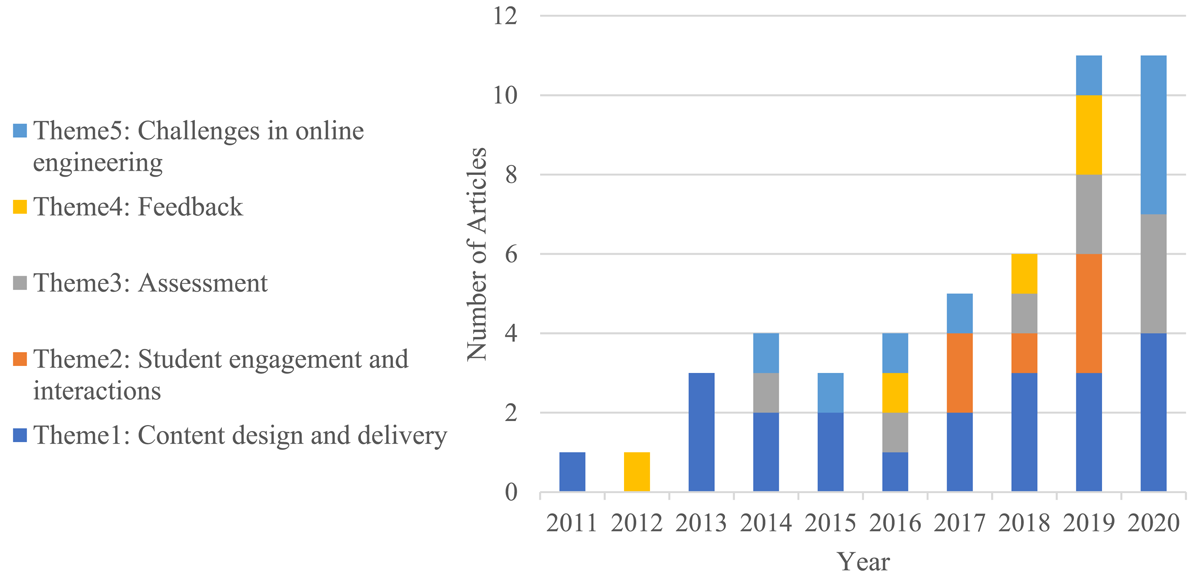
Figure 3
Frequency of occurrence of themes across the years.
Theme 1: Content design and delivery
Twenty-one articles addressed the elements of online engineering course design and delivery. Together, these articles highlight that teaching online requires a different approach than teaching in the face-to-face format and deserves more attention to fully leverage the online modality.
We categorized fourteen articles under this theme as describing the design and delivery of online fundamentals courses (e.g., Balagiu & Sandiuc 2020; Bir & Ahn 2017; Bozkurt & Helm 2013; Chen et al. 2018; Fatehiboroujeni et al. 2019; Kiridena et al. 2014; Minichiello et al. 2013; Purwar & Scott 2019; van de Vegte 2017). These studies provide practical insights into the development of new supportive technology for blind and deaf engineering students (Batanero et al. 2019), the incorporation of learning about engineering disasters in a multidisciplinary online course (Halada 2017), the analysis of a support distance learning program in mathematics (Matzakos & Kalogiannakis 2018), the implementation of simulation-based programming to promote self and co-regulated learning (Pedrosa et al. 2020), and the use of instructional videos in an online engineering economics course (Pohl & Walters 2015).
We categorized an additional five articles under this theme as describing the design and delivery of online laboratory courses (Andersson & Logofatu 2018; Astatke et al. 2011; Badjou & Dahmani 2013; de la Torre et al. 2020; Uribe et al. 2016; Zhang 2020). These studies cover the use of computational simulations (Badjou & Dahmani 2013; Uribe et al. 2016), problem-based learning (Andersson & Logofatu 2018), remote or virtual laboratories (Astatke et al. 2011; Badjou & Dahmani 2013; de la Torre et al. 2020), home kits (Badjou & Dahmani 2013), and residential lab experiences (Badjou & Dahmani 2013) as methods for providing online students access to laboratory experiments. Lastly, two articles (Badurdeen et al. 2015; Zhang 2020) discussed the design and implementation of new systems engineering degree programs.
Exemplar studies. Exemplar studies under the content design and delivery theme include two articles highlighting the importance and use of videos in online engineering fundamentals courses. One such study is Purwar and Scott (2019), who presented the design, development, and implementation of an online sophomore-level engineering dynamics course. The course was offered over six weeks as eight modules, each containing eight to ten videos explaining course concepts and problem-solving approaches. In addition, each module included homework assignments and summative quizzes that contributed to students’ grades. Students were given opportunities to interact (ask questions and/or discuss) with peers and the instructor using a web-based forum called Piazza. In another exemplar study, Pohl and Walters (2015) explored the use of instructor-developed videos to teach economic decision-making to engineering graduate students. In the course, lecture videos provided an introduction, motivation, and theoretical background for course content, while tutorial videos included working example problems. The authors argued that posting lectures and tutorials as separate videos reduced the length of each video, made the purpose of each video more apparent, and helped students understand each video’s content better.
Exemplar studies under the content design and delivery theme also include two articles that highlight the use of technology and problem-based and collaborative learning pedagogies in online engineering laboratory courses. Astatke, Scott, and Ladeji-Osias (2011) discussed using Mobile Studio Technology to enable electrical and computer engineering students to conduct laboratory experiments online. Students also had to demonstrate their design and circuit for each experiment to the instructor using Adobe Connect software. Separately, Andersson and Logofatu (2018) applied problem-based learning to an Introduction to Natural Sciences laboratory course in mechanical engineering. In this course, students were divided into groups and asked to solve chemistry-related problems using a seven-step process. Students communicated with their group members through chat forums, web conferences, and email to solve each problem.
Research implications. A potential direction for future research based on this theme could be to determine how learners perceive instructional videos categorized as lectures and tutorials and what aspects help them best engage with the course content and enhance their learning. Additionally, research examining the relevance and applicability of the approaches (laboratories using simulations, remote laboratories, home kits, and residential lab experiences) to teach different engineering topics would aid in designing and developing approaches that support a variety of engineering courses. Finally, more research is necessary into the unique skill sets required for an instructor to develop and deliver online courses in a learner-centered format successfully.
Practice implications. The studies under this theme offer several practice implications for instructors designing online engineering fundamentals and laboratory courses. First, instructors are encouraged to incorporate the following six elements into their course design: (1) clear teaching roles and expectations, (2) use of a learning management system (LMS) platform, (3) integrated assessment and feedback, (4) integrated opportunities for student accountability, (5) integrated opportunities for student involvement and participation, and (6) a safe environment for discussion (Fatehiboroujeni et al. 2019; Halada 2017; Purwar & Scott 2019). Second, instructors can embed quizzes (or another form of assessment) in online videos to monitor if students view the videos, assess their conceptual knowledge, and enable students to reflect on their learning (Purwar & Scott 2019). Third, instructors can keep instructional videos short and focused, use effective visual slides, include audio and video of the instructor, and provide an introductory overview of the video content (Pohl & Walters 2015). Lastly, instructors can ensure that online laboratory courses are low cost to the student, do not compromise student learning, include reasonably achievable goals, provide adequate online demonstration, minimize risk, and provide guidance to students through assignments and feedback (Andersson & Logofatu 2018; Uribe et al. 2016).
Theme 2: Engagement and interactions in online courses
We categorized six articles under student engagement and interaction in online engineering courses. All articles underscored the importance of online student engagement and support the notion that students have better learning opportunities and experiences when they positively interact with their course content, student peers, and course instructor (Avanzato 2017; Fatehiboroujeni et al. 2019; Fu 2019; Odom et al. 2019; Schutz et al. 2018; Yousuf & Conlan 2017).
Exemplar studies. We chose the exemplar studies for this theme because they centered on student engagement, focusing on interactions with course content, other students, and the instructor. Fu (2019), an exemplar of this theme, proposed a Trifecta Framework of Engagement based on the three pillars of student-to-content, student-to-student, and student-to-instructor engagement. Fu adopted this framework in the operations management course of an online graduate-level engineering management degree program. Students in the course were tasked with reading materials, participating in online collaborative sessions, contributing to threaded question-and-answer discussion boards, watching instructional videos, and completing all quizzes, exams, assignments, and a group project. In the article, Fu demonstrated that these activities can significantly improve student-to-content, student-to-student, and student-to-instructor engagement. Students also reported that the course promoted curiosity, critical thinking, and problem-solving skills.
Another exemplar, Fatehiboroujeni et al. (2019) conceptualized student engagement as a function of time spent on different course activities, including interaction with course content, peers, and the instructor. They developed instruments to measure student motivation and engagement in two mechanical engineering courses and made two discoveries. First, students dedicated the most time to watching videos and assignments related to lectures and labs and the least to activities that were neither assessed nor graded, such as discussion with peers, optional problem sets, and reflection questions. Second, one-on-one student-to-student interactions (e.g., asking another student for help understanding course material, explaining course material to one or more students) were high, and student participation in the instructor-generated online discussion boards was minimal in both courses.
Research implications. Potential directions for future work include analyzing how student interactions influence student learning and engagement at different points during a course; determining the optimal nature and amount of student interaction with their course content, student peers, and course instructor to maximize student learning and engagement; and examining how the quality and type of student interactions in their online course enhance student learning and course completion. Further, despite the importance of student engagement in online courses, little work has provided specific measures, formulae, or frameworks for calculating online student engagement scores. One exception is Kittur et al. (2021), who computed online undergraduate engineering students’ engagement scores based on their patterns of interaction with their course learning management system (LMS).
Practice implications. Articles under this theme highlighted that instructors of online engineering courses should strive to intentionally create opportunities within online courses for students to interact with the course content, other students, and the instructor, as these interactions play a significant role in enhancing students’ engagement, learning, and success rate (Avanzato 2017; Fu 2019). The studies under this theme provide suggestions for increasing student engagement and interaction. For example, instructors can use different techniques to involve students in the course and encourage participation, such as interaction with the instructor, group activities, and poster sessions (Avanzato 2017). They can increase student participation in discussion forums by assigning credit to student responses to discussion board items and providing examples that initiate discussion and sharing thoughts and ideas (Fatehiboroujeni et al. 2019). Instructors can adopt tools such as visual narratives, which motivate student engagement by providing personalized information about course engagement to date, resources used, and time spent on activities (Yousuf & Conlan 2017). Finally, they can monitor student logins to their course learning management system (LMS) to better understand their engagement. Odom et al. (2019) revealed a medium correlation between the average number of times students are expected to log into their LMS and institutional student engagement score, suggesting that requiring students to visit their LMS more often will lead to increased engagement in the course and their education overall.
Theme 3: Assessment in online courses
We classified eight studies under assessment. Articles described the assignments, quizzes, midterms, final exams, online discussions, and projects used to formally assess student learning (Balagiu & Sandiuc 2020; Chatterjee et al. 2016; Cooper et al. 2020; Danaher 2014; Fu 2019; Purwar & Scott 2019). One article detailed the instruments used to assess students’ conceptual knowledge and identify potential causes for misconceptions (e.g., Pamplona et al. 2018), while yet another article provided an overview of best practices for assessing academic misconduct (Siddhpura & Siddhpura 2020). Articles under this theme also discussed the post-course evaluation of student learning through surveys, questionnaires, and other relevant instruments (Cooper et al. 2020; Fu, 2019; Purwar & Scott 2019).
Exemplar studies. We chose the exemplar studies for this theme to highlight the importance of assessments, the drawbacks of poorly designed assessments, and the design and implementation of formative assessments to support learning. Designing robust assessments is important since poorly designed assessments can lead to academic misconduct because they may make it easier for students to cheat. In their review article, Siddhpura and Siddhpura (2020) analyzed various forms of academic misconduct, student motivation for involvement in academic misconduct, and ways to identify academic misconduct in online engineering. The authors argued that plagiarism and contract cheating in online assessments could be minimized using three kinds of approaches: (1) a virtues-based approach, in which students are encouraged not to cheat; (2) a prevention approach, in which prudent course design and delivery and effective online assessments minimize the likelihood that students can cheat; and (3) a police approach, in which students involved in academic misconduct are penalized.
In another study, Chatterjee, Kamal, and Wang (2016) illustrated the design and implementation of formative assessments to support learning in an online graduate computer engineering course. The assessments included asynchronous online discussions, virtual labs, open-ended module assignments, and a culminating project. The instructor reflected on the course that these assessment activities together promoted student creativity and critical thinking.
Research implications. Differences between the face-to-face and online learning modalities bring challenges and opportunities to explore differences in the effectiveness of their assessments. Further research in this area is required to answer questions about the effectiveness of assessments designed for face-to-face courses when used in the online learning format and to understand what changes must be made (if any) in the design of assessments to facilitate the translation from the face-to-face learning to the online learning format. Separately, there is a need to investigate further the strategies for assessing and addressing student misconceptions to enhance student learning in the online space (Pamplona et al. 2018).
Practice implications. Since monitoring student behavior during assessment in online courses is comparatively more difficult than in face-to-face courses, and poorly designed assessments may make it easier for students to cheat and can lead students toward academic misconduct (Siddhpura & Siddhpura 2020), adequate attention must be given to the design of effective assessments. Creating awareness about academic integrity, establishing the instructor’s role as both advisor and mentor, encouraging lifelong learning, creating awareness about the benefits and drawbacks of information available online, and setting high academic integrity expectations are some strategies that instructors can use to reduce academic misconduct (Siddhpura & Siddhpura 2020). Further, instructors should include different assessments in their online courses to evaluate students’ understanding of course content, just as they might in face-to-face courses. Open-ended assignments, real-world laboratory experiences, and course projects can supplement traditional assessments, such as exams and quizzes, to boost students’ conceptual understanding (Chatterjee et al. 2016).
Theme 4: Feedback in online courses
The five articles under this theme address the importance of two types of feedback: the feedback the instructor provides students throughout the course and the feedback the students provide the instructor during and toward the end of the course. A few articles discuss the differential importance of instructors providing students with text-based, interactive, and automated feedback (Rutz & Ehrlich 2016; Sancho-Vinuesa et al. 2018). Other articles discuss the importance of collecting student feedback in online courses to evaluate the course’s effectiveness (Fu 2019; Mansor & Ismail 2012; Purwar & Scott 2019).
Exemplar studies. The exemplar studies in this theme were chosen to emphasize the different types of feedback used in engineering education research, specifically text-based, interactive, and automated feedback. Rutz and Ehrlich (2016) used the Community of Inquiry (COI) framework to evaluate the use of text-based and interactive feedback on learner engagement in an online course on effectiveness in technical organizations. Learners were offered both conventional text-based feedback and interactive feedback on assignments, and surveys with five-point Likert scales and open-ended questions were used to collect student perceptions on both types of feedback and to assess the impact of these feedback formats on student perceptions related to different parts of the COI framework (cognitive presence, social presence, teacher presence). The responses showed that both formats for receiving instructor feedback helped students feel connected to the course. However, students rated their perceptions of the three elements related to the COI framework as higher for the interactive feedback than for the text-based feedback.
In another study, Sancho-Vinuesa et al. (2018) presented the use of a quiz-based assessment tool with automatic feedback in two mathematics courses for computer and telecommunications engineering students. The tool provides random self-evaluation exercises, such as multiple-choice, true or false, matching, and short answer questions, to assess student learning. The results revealed that students’ learning of mathematical analysis concepts, engagement, and completion rates increased from previous semesters with the adoption of the new application.
Research implications. Further research is necessary into the different types of feedback that can enhance student learning and performance in an online engineering course. Additionally, work is needed to investigate further the impact of feedback on student learning in an online engineering course. Some potential questions tying these areas together are how students perceive automated feedback as compared to the feedback they receive from the instructor, how the quality of automated feedback compares to the feedback they receive from the instructor, and how the differences between automated and instructor feedback affect student learning (Sancho-Vinuesa et al. 2018). This question is important because students in online classes already have limited interactions with their instructors, and automating feedback results in even more of a loss in the possibility of obtaining personalized feedback. Separately, while collecting student feedback at the end of a course is common (Fu 2019; Mansor & Ismail 2012; Purwar & Scott 2019), these evaluations typically focus on course outcome attainment or student perceptions. Determining strategies to effectively collect meaningful data as a part of student course evaluations represents another future research area that would support continuous improvement in online course delivery.
Practice implications. Instructors in the online education space should provide different types of feedback to students, including text-based feedback, interactive feedback, and automated feedback (Rutz & Ehrlich 2016; Sancho-Vinuesa et al. 2018). Instructors can use different feedback techniques to determine which types work best for their course, students, and themselves. Further, instructors can collect student feedback during and near the end of the course to help them reflect on their course design and delivery and look for opportunities to make improvements to their course in subsequent offerings (Fu 2019; Mansor & Ismail 2012; Purwar & Scott 2019).
Theme 5: Challenges in online engineering
We categorized nine articles under challenges in delivering online engineering courses. Three out of the nine articles were focused primarily on challenges inherent to online engineering courses (Hachey et al. 2015; Perales Jarillo et al. 2019; Pedrosa et al. 2020), such as comparatively lower student sense of belongingness and higher student feelings of isolation and attrition relative to face-to-face courses (Bowers & Kumar 2015; Gregori et al. 2018; Robertson 2020; Shea & Bidjerano 2016).
The remainder of the articles under this theme documented various challenges faced by online instructors, including challenges using the course learning management system (LMS), challenges designing online laboratories and design projects, challenges maintaining student engagement and student-faculty interactions, challenges equipping students with e-learning skills, challenges closing the gender gap in online engineering graduate enrollments, challenges providing timely feedback, challenges providing clear enough instruction, and technical challenges (Cooper et al. 2020; Hammout & Hosseini 2020; Kiridena et al. 2014; Levy & Ramim 2017; Rutz & Ehrlich 2016; Zhang 2020).
Exemplar studies. We chose the exemplar studies for this theme because detailing challenges in online engineering was an important aspect of the articles’ contribution. Pedrosa and colleagues (2020) identified the pedagogical and technical challenges that arose from implementing SimProgramming in an online software development laboratory for informatics engineering students. SimProgramming is a motivation-based instructional approach that teaches students programming through a dynamic design, development, testing, and analysis process. The identified challenges included low and late student participation, student sense of isolation, inadequate feedback mechanisms, and unclear task descriptions, primarily attributable to ineffective instructor and student communication.
In another exemplar study, Hachey, Wladis, and Conway (2015) investigated the impact of student performance and prior online course experiences on the successful completion of future online courses. This study used logistic regression to analyze data from 1,566 community college students enrolled in online STEM courses. The study revealed that students’ prior online experience significantly predicted the outcome of subsequent online courses, controlling for grade point average (GPA). Specifically, students who were unsuccessful in completing prior online courses and had lower GPAs were at higher risk than other students of dropping out of or failing subsequent online courses.
Research implications. Pedrosa et al. (2020) reported that students struggle with feelings of isolation, low sense of belongingness, low participation, and misunderstanding of task-related descriptions in their online courses. Research is required to explore these challenges in online engineering education and their influencing factors. Additionally, Hachey et al. (2015) found that students’ previous unsuccessful experiences in online courses and low GPAs can increase their likelihood of dropping out of future online courses. Therefore, investigating the types of interventions and strategies that mitigate these influences represents another potential direction for future research.
Practice implications. Ensuring that all course information (e.g., instructions, resources, deadlines) is clear to students is essential for maintaining student interest, engagement, and retention (Pedrosa et al. 2020). Hence, instructors must devote sufficient time to examining the material offered to students and confirming that the information is easily understood. Further, online instructors should get to know their students and monitor their progress in the course for clues that they are at risk of dropping out of the course (Hachey et al. 2015).
Discussion and Conclusions
While the five themes in the findings section are distinct, several papers in this review looked at intersections across themes. For example, Pedrosa et al. (2020) examined the intersection of content design and delivery and challenges in online engineering while examining the pedagogical and technical difficulties encountered in implementing SimProgramming in an online software development laboratory. In another study, Purwar and Scott (2019) examined integrating student feedback and assessment into the design and implementation of an online course to evaluate course effectiveness, representing work at the intersection of the content design and delivery, assessment, and feedback themes. Finally, Fu’s (2019) work sharing their experiences designing and teaching an online Operations Management course lay at the intersection of content design and delivery, student engagement and interaction, assessment, and feedback, as the main goals of the study were understanding how to engage students in an online learning environment and evaluating the effectiveness of the engagement with evidence collected from the students.
Further examination of the intersections of the themes identified in this SLR generates additional observations and implications for research and practice. For example, a potential research question could be: What aspects of content design and delivery, assessment, and feedback influence engineering students’ engagement and learning in their online courses, and how do engineering students perceive these different aspects as influencing their sense of belonging and persistence in their online courses? Studies could also be conducted to understand better the challenges related to content design and delivery, assessment, providing and receiving feedback, and student engagement as they relate to the learning experiences and persistence decisions of students with different demographic characteristics. Finally, further examining the relationship between feedback and assessment in assessing online student outcomes is another potential direction for further research motivated by the intersection of identified themes.
Our descriptive analysis of the articles also highlighted an opportunity to test and apply existing frameworks to new research on online learning and propose new frameworks for use in this space. Additionally, studies focused on fundamental research were more likely than those focused on course development to use advanced research methods and more likely than those focused on course and intervention development to use larger sample sizes spanning multiple courses or institutions. As our community creates knowledge around effective pedagogical practice in online engineering education, these trends suggest an opportunity to elevate studies about teaching practices to the level of larger-scale investigations. Finally, only two studies from the sampled articles focused on broadening student participation in online engineering courses; this indicates an urgent need for more research on the experiences of traditionally underserved students (e.g., Black and Brown students, women, and disabled students) in online engineering education.
In conclusion, this SLR features articles published between 2011 and 2020 on asynchronous online engineering education. We retrieved 782 articles from nine databases using eight search terms and synthesized 39 of them, summarizing their themes and publication trends. Across the 39 articles, we identified five guidelines for effective teaching of fully online asynchronous courses, including: (1) optimize course design and delivery to enhance clarity, accountability, and safety, (2) provide students with opportunities for interaction with course content, peers, and instructors, (3) design effective and varied assessments to monitor student learning, (5) provide students with prompt and useful feedback, and (6) implement strategies to counteract student isolation, disengagement, and misunderstanding. We also pulled out future research directions associated with each guideline, intended to deepen understanding and enhance instructor practice. Through trend analysis, we determined research on content design and delivery, assessment, and challenges to be particularly relevant. We also uncovered a need for more theory-based research, conducted at scale, and focused on broadening student participation.
Appendices
Appendix A: Codes, Code Description, and Exemplars
| CODE | DESCRIPTION | EXEMPLAR |
|---|---|---|
| Assessment | Topics related to course assessments including quizzes, assignments, exams, projects, etc. in online engineering courses. Other topics include assessment of students’ conceptual knowledge, misconceptions, and academic misconducts in online engineering courses/programs. | “Student Assessment of Learning Gains survey” (Halada 2017) |
| Feedback | Topics related to different types of feedback including the feedback provided by the instructor to students using different approaches such as text-based, interactive, or automated feedback, student feedback about the instructor’s teaching approaches and the overall course. | “The first investigation was completed during the 2013–2014 academic year and included 40 students. During the first half of the semester students received text-based feedback on their written assignments (this method had been used by the instructor for the previous five years). During the second half of the semester, students received interactive feedback on their written assignments. In all cases the feedback was provided to the students via the university’s leaning management system.” (Rutz & Ehrlich 2016) |
| Attrition or Enrollment | Topics referring to student enrollment, dropout, and attrition in online education. | “Actively participating students seems to be one of the success factors for avoiding dropouts in online courses as well as a strong sense of responsibility and community with the group.” (Andersson & Logofatu 2018) |
| Class Design or Structure | Topics related to overall class design such as topics being covered, targeted academic level, and projects. | “The digital systems course was a 15- week lecture online course that covered Boolean algebra, logic gates, combinational logic, minimization, number systems, MSI devices, sequential circuits, finite state machines, memory and programmable logic devices, and FPGA technology.” (Avanzato 2017) |
| Content Delivery | Topics related to the delivery of course content online such as through lecture videos | “An online version of the class consisting of topical videos of the lecture, on-line quizzes and homework, and assessments could 1) facilitate self-study and -pacing of the material on part of students, 2) enable problem solving and critical discussion between students and instructors using an online forum, and 3) scale-up the class to reach a large number of students.” (Purwar & Scott 2019) |
| Engagement | Topics describing course engagement throughout the course (engagement with the course, peers, the instructor, etc.) | “Various approaches are adopted to improve student participation, such as integration of quizzes in the instructional lectures, use of discussion boards, and offering synchronous review sessions.” (Fatehiboroujeni, Qattawi, & Goyal 2019) |
| Laboratory Design | Topics related to developing online laboratories and simulations to mimic in-person hands-on experiences | “It was found at the colloquy that, surprisingly, common there was no clear and definition among engineering educators of what exactly the objectives of laboratory experimentation are. So, the teaching of laboratory experience online could not even be addressed without first defining what those objectives are for onsite laboratory experiments.” (Badjou & Dahmani 2013) |
| Learning Technology | Topics related to a specific implementation of a technology for the course but not limited to learning management systems (LMS) like Blackboard or Canvas | “Panopto Focus” (Astatke & Scott 2011); “Moodle” (Pedrosa et al. 2020) |
| Pedagogical Considerations | Topics regarding specific pedagogies and instructional practices that engineering educators are implementing in the online format | “This study focuses on using problem-based learning in online lab classes for mechanical engineering students” (Andersson & Logofatu 2018) |
| Recommendations | Strategies and recommendations for enhancing the online experiences of students and instructors | “Keep Videos Short” (Pohl & Walters 2015) |
| Technical Challenges | Topics describing technical challenges encountered by students or instructors in the online course | “Technical Complaints: In topic 2, on March 23rd, a student reported that an API registration was missing from the repository where he had posted it. This can be an actual technical glitch or a misinterpretation of repository operation” (Pedrosa et al. 2020) |
| Time Challenges | Topics that mention challenges related to time or timing, such as time spent by the instructor developing the course or time spent by the students attempting to complete the course | “Our study demonstrates that students invest significant time on lecture videos, homework, quizzes, and projects” (Fatehiboroujeni, Qattawi, & Goyal 2019) |
Appendix B: Classification of the reviewed studies based on specific themes
Theme 1
Content design and delivery.
| AUTHORS | COUNTRY AFFILIATION OF FIRST AUTHOR | TITLE |
|---|---|---|
| Pohl, L. M., & Walters, S. (2015) | United States | Instructional Videos in an Online Engineering Economics Course |
| Halada, G. P. (2017) | United States | Learning from Engineering Disasters: A Multidisciplinary Online Course |
| Andersson, C., & Logofatu, D. (2018) | Germany | Implementation of Online Problem-Based Learning for Mechanical Engineering Students |
| Fatehiboroujeni, S., Qattawi, A., & Goyal, S. (2019) | United States | Assessing and Improving Student Engagement and Motivation in Mechanical Engineering Online Courses |
| Uribe, M. D. R., Magana, A. J., Bahk, J. H., & Shakouri, A. (2016) | United States | Computational Simulations as Virtual Laboratories for Online Engineering Education: A Case Study in the Field of Thermoelectricity |
| Pedrosa, D., Morgado, L., Cravino, J., Fontes, M. M., Castelhano, M., Machado, C., & Curado, E. (2020) | Portugal | Challenges Implementing the SimProgramming Approach in Online Software Engineering Education for Promoting Self and Co-regulation of Learning |
| Purwar, A., & Scott, C. A. (2019) | United States | An Online Engineering Dynamics Class for College Sophomores: Design, Implementation, and Assessment |
| Astatke, Y., & Scott, C. J. (2011) | United States | Electric Circuits Online – Towards a Completely Online Electrical Engineering Curriculum |
| Zhang, Y. (2020) | United States | A Cross-Referencing System for Curriculum Coordination in Multi-Institution Online Graduate Engineering Degree Programs: Case Study of the Virginia Engineering Online Program |
| Balagiu, A., & Sandiuc, C. (2020) | Romania | Developing an online course for marine engineering |
| Badjou, S., & Dahmani, R. (2013) | United States | Current Status of Online Science and Engineering Education |
| Chen, B., Bastedo, K., & Howard, W. (2018) | United States | Exploring Design Elements for Online STEM Courses: Active Learning, Engagement & Assessment Design |
| Kiridena, S. B., Samaranayake, P., & Hastie, D. B. (2014) | Australia | Instructional Design for Online Course Delivery in Engineering Management: Synthesizing Learning Styles, Pedagogical Perspectives and Contingency Factors |
| Badurdeen, F., Baker, J. R., Rouch, K. E., Goble, C. F., Swan, G. M., Brown, A., & Jawahir, I. S. (2015) | United States | Development of an Online Master’s Degree Program in Manufacturing Systems Engineering |
| Minichiello, A., Legler, N., Hailey, C., & Adams, V. D. (2013) | United States | Online Engineering Course Design, Part I: Toward Asynchronous, Web-based Delivery of a First Course in Thermodynamics |
| Bozkurt, I., & Helm, J. (2013) | United States | Development and Application of a Systems Engineering Framework to Support Online Course Design and Delivery |
| Matzakos, N. M., & Kalogiannakis, M. (2018) | Greece | An analysis of first year engineering students’ satisfaction with a support distance learning program in mathematic |
| de la Torre, L., Sàenz, J., Chaos, D., Sánchez, J., & Dormido, S. (2020) | Spain | A Master Course on Automatic Control Based on the Use of Online Labs |
| Batanero, C., de-Marcos, L., Holvikivi, J., Hilera, J. R., & Otón, S. (2019) | Spain | Effects of New Supportive Technologies for Blind and Deaf Engineering Students in Online Learning |
| Bir, D. D., & Ahn, B. (2017) | United States | Examining student attitudes to improve an undergraduate online engineering course |
| Danaher, M. (2014) | United Arab Emirates | Online Engineering Courses: Benchmarking Quality |
Theme 2
Interactions in Online Engineering Courses.
| AUTHORS | COUNTRY AFFILIATION OF FIRST AUTHOR | TITLE |
|---|---|---|
| Avanzato, R. L. (2017) | United States | Virtual World Technology to Support Student Collaboration in an Online Engineering Course |
| Fatehiboroujeni, S., Qattawi, A., & Goyal, S. (2019) | United States | Assessing and Improving Student Engagement and Motivation in Mechanical Engineering Online Courses |
| Yousuf, B., & Conlan, O. (2017) | Ireland | Supporting Student Engagement Through Explorable Visual Narratives |
| Odom, P. W., Merzdorf, H. E., Montalvo, F. J., & Davis, J. M. (2019) | United States | Analysis of Student Engagement Data from U.S. World News Report Regarding Online Graduate Engineering Programs |
| Fu, P. (2019) | United States | Trifecta of Engagement in an Online Engineering Management Course |
| Schutz, D. M., Kim, Y. Y., & Dionne, D. (2018) | Japan | Factors Influencing Student Veteran Participation in Online Engineering Education |
Theme 3
Assessment in Online Engineering Courses.
| AUTHORS | COUNTRY AFFILIATION OF FIRST AUTHOR | TITLE |
|---|---|---|
| Purwar, A., & Scott, C. A. (2019, June) | United States | An Online Engineering Dynamics Class for College Sophomores: Design, Implementation, and Assessment |
| Siddhpura, A., & Siddhpura, M. (2020, December) | Australia | Plagiarism, Contract Cheating And Other Academic Misconducts In Online Engineering Education: Analysis, Detection And Prevention Strategies |
| Pamplona, S., Seoane, I., & Bravo-Agapito, J. (2018, October) | Spain | Assessing Conceptual Knowledge in Three Online Engineering Courses: Theory of Computation and Compiler Construction, Operating Systems, and Signal and Systems |
| Balagiu, A., & Sandiuc, C. (2020) | Romania | Developing an online course for marine engineering |
| Chatterjee, R., Kamal, A. E., & Wang, Z. (2016, June) | United States | Alternate Assessments to Support Formative Evaluations in an Asynchronous Online Computer Engineering Graduate Course |
| Cooper, M. E., Bullard, L. G., Spencer, D., & Willis, C. (2020) | United States | Direct and Indirect Assessment of Student Perspectives and Performance in an Online/Distance Education Chemical Engineering Bridging Course Sequence |
| Fu, P. (2019) | United States | Trifecta of Engagement in an Online Engineering Management Course |
| Danaher, M. (2014) | United Arab Emirates | Online engineering courses: Benchmarking quality |
Theme 4
Feedback in Online Engineering Courses.
| AUTHORS | COUNTRY AFFILIATION OF FIRST AUTHOR | TITLE |
|---|---|---|
| Purwar, A., & Scott, C. A. (2019) | United States | An Online Engineering Dynamics Class for College Sophomores: Design, Implementation, and Assessment |
| Rutz, E., & Ehrlich, S. (2016) | United States | Increasing Learner Engagement in Online Learning through Use of Interactive Feedback: Results of a Pilot Study |
| Mansor, M. S. A., & Ismail, A. (2012) | Malaysia | Learning styles and perception of engineering students towards online learning |
| Fu, P. (2019) | United States | Trifecta of Engagement in an Online Engineering Management Course |
| Sancho-Vinuesa, T., Masià, R., Fuertes- Alpiste, M., & Molas-Castells, N. (2018) | Spain | Exploring the effectiveness of continuous activity with automatic feedback in online calculus |
Theme 5
Challenges in Online Engineering.
| AUTHORS | COUNTRY AFFILIATION OF FIRST AUTHOR | TITLE |
|---|---|---|
| Pedrosa, D., Morgado, L., Cravino, J., Fontes, M. M., Castelhano, M., Machado, C., & Curado, E. (2020) | Portugal | Challenges Implementing the SimProgramming Approach in Online Software Engineering Education for Promoting Self and Co-regulation of Learning |
| Perales Jarillo, M., Pedraza, L., Moreno Ger, P., & Bocos, E. (2019) | Spain | Challenges of Online Higher Education in the Face of the Sustainability Objectives of the United Nations: Carbon Footprint, Accessibility and Social Inclusion |
| Hachey, A. C., Wladis, C., & Conway, K. (2015) | United States | Prior online course experience and GPA as predictors of subsequent online STEM course outcomes |
| Cooper, M. E., Bullard, L. G., Spencer, D., & Willis, C. (2020) | United States | Direct and Indirect Assessment of Student Perspectives and Performance in an Online/Distance Education Chemical Engineering Bridging Course Sequence |
| Kiridena, S. B., Samaranayake, P., & Hastie, D. B. (2014) | Australia | Instructional Design for Online Course Delivery in Engineering Management: Synthesizing Learning Styles, Pedagogical Perspectives and Contingency Factors |
| Rutz, E., & Ehrlich, S. (2016) | United States | Increasing Learner Engagement in Online Learning through Use of Interactive Feedback: Results of a Pilot Study |
| Zhang, Y. (2020) | United States | A Cross-Referencing System for Curriculum Coordination in Multi-Institution Online Graduate Engineering Degree Programs: Case Study of the Virginia Engineering Online Program |
| Levy, Y., & Ramim, M. M. (2017) | United States | The E-Learning Skills Gap Study: Initial Results of Skills Desired for Persistence and Success in Online Engineering and Computing Courses |
| Hammout, N., & Hosseini, S. (2020) | Morocco | Involvement of students in online master’s studies of Engineering and Science: a path to minimize the gender gap in STEM |
Competing Interests
The authors have no competing interests to declare.
Author Contributions
All authors have approved the author list and the manuscript for submission to Studies in Engineering Education. They also agree to be accountable for all aspects of the work.
Kittur led the research work, contributing to all phases of the research process, manuscript preparation, and revisions.
Brunhaver and Bekki provided constructive feedback from the initial idea generation through to the final revisions.
Thomas acted as a second reviewer, enhancing inter-rater reliability by reviewing a significant number of articles.