
Introduction
Peer Teaching and Learning in Chemistry
Peer learning programs are used in introductory science courses at many universities and have been shown to improve student outcomes, such as course pass rates, GPA, and retention in science majors. Participation in peer learning programs has also been shown to improve students’ attitudes about science, confidence, and scientific reasoning skills (Achat-Mendes et al., 2019; Bodner & Elmas, 2020; Clements et al., 2025; Clements et al., 2022; Durante et al., 2024; Frey et al., 2018; Lewis, 2011; Sellami et al., 2017; Snyder et al., 2016). While formal peer learning programs such as peer-led team learning (Wilson & Varma-Nelson, 2016; Woodward et al., 1993), Supplemental Instruction (Arendale, 1994), and learning assistants (Otero et al., 2010) are known to improve learning goals for students, the impact of serving as a peer teacher has not been significantly quantitatively studied in the literature. Most investigations have looked at self-reported skills gained by peer teachers, only giving qualitative information. These studies have shown that peer teachers believe the experience improves their confidence on assessments, time management, communication skills, and mentoring skills (Abbot et al., 2018; Barnard et al., 2018; Gafney & Varma-Nelson, 2007; Griffin et al., 2024; Hockings et al., 2008; Price et al., 2019; Rempel et al., 2024; Zhang & Bayley, 2019). Few studies have investigated quantifiable learning gains or measured gains in communication skills of peer teachers. One study of peer teachers in introductory biology courses showed inconsistent gains in critical thinking skills (Sellami et al., 2017).
Literature from teacher and tutor training can provide additional insights into the impact of peer teaching experience on the peer teachers. As tutors and peer teachers are often chosen for their academic achievement rather than teaching ability, studies of tutor and teacher training have shown that scenario-based and pedagogical training can help peer tutors develop more varied and less rigid teaching strategies to engage students, which is especially important for online tutoring, where encouraging engagement can be challenging (Lin et al., 2018; Pan et al., 2025; Song et al., 2025). Studies of peer tutoring indicate that when tutors teach students close to their own level, they ask more questions about reasoning and metacognition using authentic language (Wang et al., 2025) and that posing problems in tutoring sessions improves the tutors’ reasoning and problem-solving skills (Burgos et al., 2025). Thus, peer teachers benefit from the experience by developing more flexible thinking as they develop teaching experience, and this may improve their problem-solving skills.
It is important to not only understand how peer teachers self-report the benefits of their experience, but also to quantify how peer teaching impacts learning gains and problem-solving in ways we can statistically analyze. Here, we report a study in which we aimed to quantify differences in problem-solving approaches in undergraduate chemistry peer teachers and comparable undergraduates who do not teach. Specifically, we investigated how serving as a peer teacher influences chemistry problem-solving approaches and conceptual explanations in an assessment-like setting, employing qualitative coding techniques to identify commonly used problem-solving approaches and expert ranking of conceptual explanations. We believe this study adds to the literature showing the benefits of peer teaching by showing how teaching experience impacts how undergraduate chemistry students approach problem-solving and writing brief scientific explanations.
Theoretical Framework
Peer learning is rooted in the theoretical frameworks of Vygotsky’s theories of social constructivism and sociocultural theory (Gauvain, 2020; Shabani et al., 2010; Vygotsky, 1978; Wass & Golding, 2014). Social constructivism, an extension of Piaget’s theory of constructivism, (Piaget, 1964) states that knowledge is built through social interaction and collaboration. Peers interact to make meaning of what they are learning. Sociocultural theory introduces the zone of proximal development as the range of tasks a learner can do with guidance from a “knowledgeable other” but not yet independently (Shabani et al., 2010; Wass and Golding, 2014). In peer learning environments, interaction between peers facilitates the construction of knowledge. Peer teachers serve as the “knowledgeable other,” able to provide scaffolding for learners as they tackle problems. Peer teachers benefit from this social learning environment, as well; peer teachers encounter different, diverse perspectives from their students and need to adjust their instruction and communication to best serve their learners. Teaching necessitates making the implicit, explicit. Peer teachers must verbalize problem-solving logic and respond to questions about problem-solving processes possibly for the first time in their academic careers. Using the lens of social constructivism and sociocultural theory, we can view teaching and learning as a reciprocal process in which teachers and learners construct understanding and meaning together.
Additionally, peer-led teaching can be viewed through the cognitive apprenticeship model, which is rooted in social constructivism. In cognitive apprenticeship, the expert instructor makes their thinking explicit to the learners, with the goal of developing the learners’ cognitive and problem-solving skills. The cognitive apprenticeship model consists of six teaching strategies to help students construct and apply their knowledge to problem solving: modeling, coaching, scaffolding, articulation, reflection, and exploration (Mees et al., 2025; Zhang et al., 2025). The cognitive apprenticeship model has been shown to be effective in STEM education, specifically in improving students’ understanding of quantum mechanics (Nautiyal et al., 2025). The authentic modeling of problem-solving approaches, as well as the opportunity for reflection after the learner makes attempts, creates an authentic learning experience that we believe benefits both the learners and peer teachers as they have to articulate and reflect upon their problem-solving strategies, developing a community of practice where group members work together to develop expertise.
By making implicit problem-solving strategies explicit, peer teachers engage in metacognitive strategies that deepen their understanding of the material. Metacognition refers to developing an understanding of one’s learning, and it includes skills such as self-awareness, planning, monitoring, and self-assessment. Higher metacognitive skills are associated with stronger self-regulation, higher critical thinking skills, and more transferrable learning. Within the framework of metacognition, Anderson’s Self-Explanation Theory posits that explaining your thinking during the learning process leads to deeper understanding and retention (Anderson et al., 1996; Mazari, 2025). As peer teachers explain their problem-solving strategies and explain chemical concepts to their students, they develop stronger metacognitive skills, which enhance their understanding and retention of the material being taught. As peer teachers develop expertise, they develop cognitive flexibility, the ability to interpret phenomena through different lenses (Talanquer, 2026), which may broaden the peer teachers’ ability to approach problems in different ways with different problem-solving strategies. The exercise and experience of verbalizing and defending logic, and the mutual construction of understanding among peer teachers and learners, may improve undergraduate peer teachers’ metacognitive skills and ability to connect conceptual and procedural knowledge in chemistry problem-solving.
Methods
Informed Consent
This study was reviewed and approved by the St. John’s University Institutional Review Board (IRB; Application IRB-FY2022-2023). The study was granted “exempt” status, meaning the standard informed consent procedure, all data collection, research methods, and analysis methods were approved by the IRB. All written artifacts collected were anonymized with numeric codes prior to analysis to preserve subject privacy.
Research Subjects
Research subjects were recruited from two populations. Peer teachers were recruited from the list of active peer leaders for the chemistry peer-led workshop program at an urban primarily undergraduate university in the northeastern United States. Peer teachers are in their sophomore through senior undergraduate years. Peer teachers generally teach one to two supplemental peer-led workshops per week for the general chemistry courses. In the workshops, peer teachers work with small groups of general chemistry students on problem-solving worksheets aligned with their class material. Peer teachers are provided with instructional materials weekly by the chemistry faculty program coordinator. The peer teachers undergo semiannual training with the chemistry faculty program coordinator as well as additional training from the university tutoring center. A total of 23 peer teachers were recruited for the study, and the peer teachers ranged from sophomore to senior level. Peer teachers had experience ranging from one semester to five semesters of peer teaching. Many peer teachers were also one-on-one peer tutors in the university tutoring center, but this data was not collected or applied in the current study. Students who are peer teachers either applied for the position or were recommended for the position by faculty. Thus, the peer teacher selection process may favor students who already possess strong academic skills, which does add to selection bias. The comparison group of students without teaching experience were recruited from a junior and senior-level physical chemistry course at the same university. These students did not have peer teaching or one-on-one peer tutoring experience. A total of 32 comparison students without teaching or tutoring experience were recruited for the study, and these students ranged from junior to senior level. Academic performance differences between the peer teaching group and comparison group were unable to be assessed.
Assessment Instrument
The assessment instrument (Figure 1) used in the study was written to mimic types of questions asked in a general chemistry exam. When taking the assessment, subjects were given a standard scientific calculator and a printed periodic table but did not have access to other materials. The peer teacher subject group took the assessment all at the same time in a chemistry office room at tables similar to those in standard classrooms at the university. The chemistry office room was not the room used for peer instruction. The comparison group took the assessment all at the same time in their physical chemistry classroom, sitting at tables. The subjects in both the peer teacher and comparison groups were given fifteen minutes to complete the assessment.
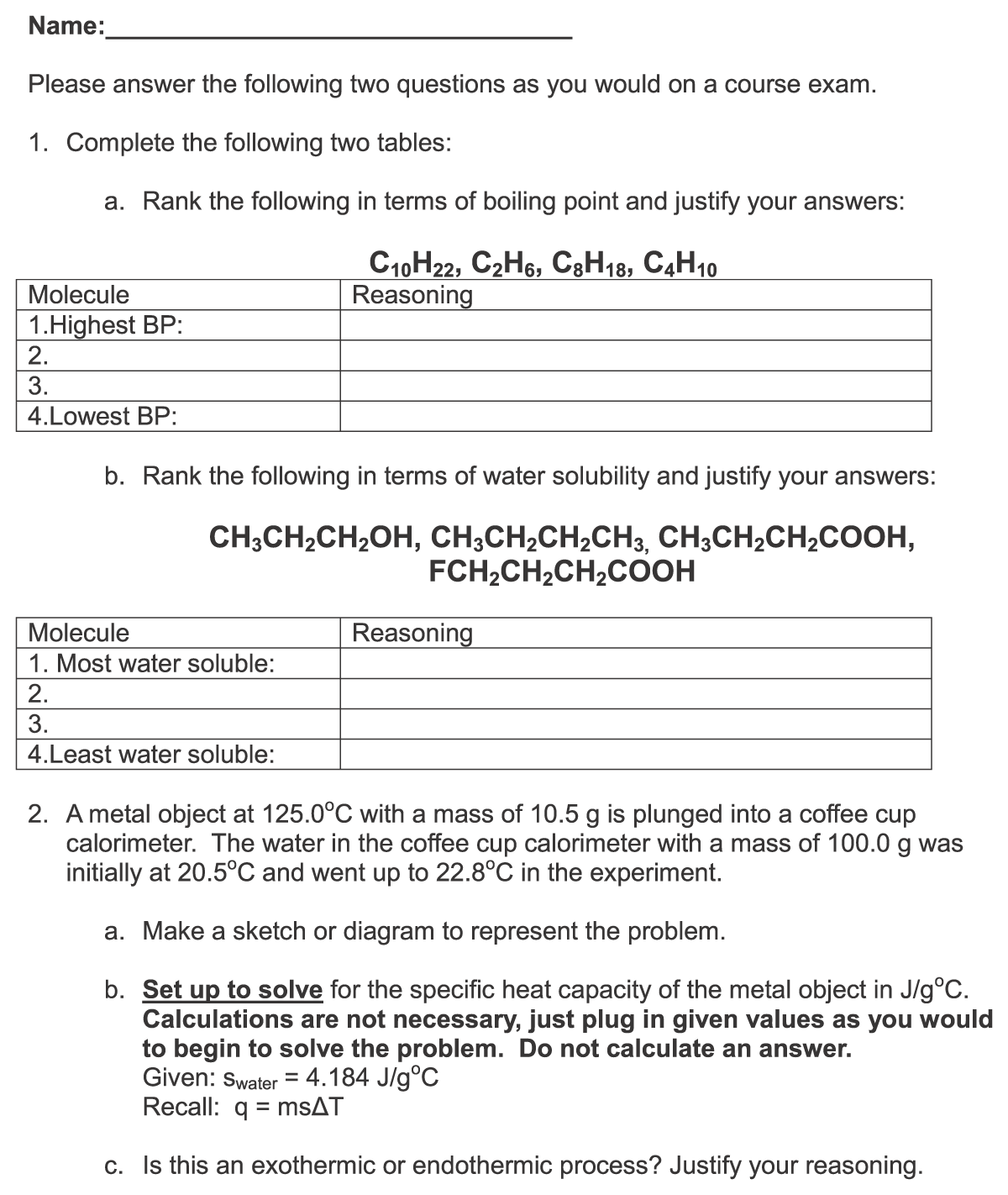
Figure 1
Assessment Instrument (Condensed).
One question in the assessment was a thermodynamics calculation question in which a hot piece of metal comes to thermal equilibrium in a coffee cup calorimeter. Subjects were asked to sketch the coffee cup calorimeter, set up the equation to solve for the specific heat capacity of the metal, and determine whether the process is exothermic or endothermic. Subjects were not asked to completely solve the problem because of time constraints. The other question involved ranking sets of compounds based on physical properties. First, they were asked to rank a set of compounds by their boiling point. Second, they were asked to rank a set of compounds with different polarities by their water solubility. For both ranking questions, they were asked to briefly explain their logic.
Analysis Methods
Assessments were collected and anonymized using numerical codes so that the researchers did not know which subjects were from the peer teacher or comparison group until coding analysis was complete.
Open iterative coding was used to identify common problem-solving strategies employed for the coffee cup calorimeter problem. Two coders used open iterative coding to determine agreed-upon themes for commonly observed problem-solving strategies in consultation with the principal investigator. Codes were refined until the final set of codes was determined. For example, during the iterative process, the “related q’s” code was separated from the “priming equations” code because it was sometimes observed independently of other equations, and conversely, the equation for heat was sometimes written without explicitly showing the relationship between heat evolved and heat absorbed. The final coding presented in this paper was done by one researcher using the standardized protocol we developed to ensure consistency. The total number of problem-solving strategies employed by each subject was tallied. Then, the use of individually identified problem-solving strategies was tallied. Individual problem-solving strategies that were identified are listed in Table 1 and will be discussed in more detail below.
Table 1
Common Problem-Solving Strategies Identified for the Thermodynamics Question.
| STRATEGY | DESCRIPTION |
|---|---|
| Circling | Circling or boxing the answer |
| Margins | Writing notes in the margins of the problem |
| Underlining | Underlining, circling, boxing, or otherwise highlighting written words, formulas, or numbers in the question |
| Topic recall | Specific words, phrases, or diagrams commonly used in instruction are reproduced by the subject in responding to the question |
| Priming equations | Equation is written before putting in numbers for calculations |
| Labeling and variables | Variables and their values are noted on diagrams or in a list |
| Related q’s | The relationship between heat (q) evolved and heat absorbed is specifically stated (qsystem = –qsurroundings) |
| Before and after | Shows how conditions in the coffee cup calorimeter changes in the described experiment (for example, changes in temperature) |
After coding was complete and individual subjects’ problem-solving strategies were tallied, the Welch’s t-test with 95% confidence was employed to identify differences in problem-solving strategy use between peer teachers and the comparison population. The Welch’s t-test was chosen to account for the difference in sample size and variance (Kim, 2019; Welch, 1947). The Cohen’s d test was used to calculate effect size (Cohen, 1988).
The other question in the assessment instrument involving ranking a list of compounds based on physical properties was assessed in a different manner (Figure 1). As this was a problem requiring brief explanations rather than computational reasoning or drawing a diagram, it was difficult to identify specific problem-solving strategies employed by the subjects in answering the question. We chose to assess the quality of explanation as judged by outside experts with experience teaching undergraduate chemistry (Vázquez et al., 2012). In this analysis method, we aimed to capture nuanced differences in how peer teachers and the comparison students explained chemistry concepts that may be attributed to teaching experience. Correct responses to the second question were transcribed to type, preserving any figures or other marks. This was done to minimize any biases based on handwriting and to preserve anonymity of subjects. The typed responses were randomly grouped into sets of three responses to the same question, including at least one response from a peer teacher in each grouping, and put into surveys (Figure 2). The surveys instructed the reader to rank the three responses “best quality,” “middle quality,” or “worst quality.” The surveys were distributed to graduate students with significant chemistry teaching experience for assessment. Twenty surveys were completed and returned for analysis. In analyzing survey data, the rankings of peer teachers’ and comparison students’ writing was tallied.
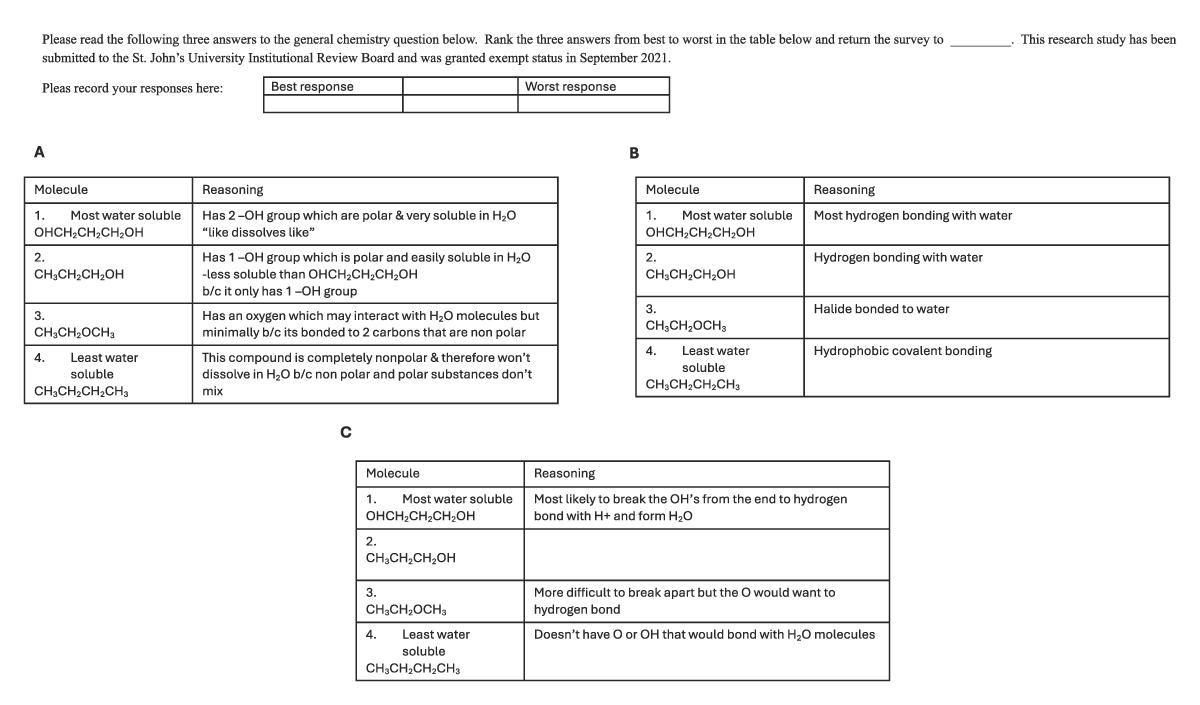
Figure 2
Example Survey Given to Experts to Rank Explanations.
Results and Discussion
Thermodynamics Calculation Question
Figure 3 shows the normalized average use of the common problem-solving strategies identified in coding the responses. The problem-solving strategies were counted in a binary fashion; a score of 1 indicates that the subject used the problem-solving strategy, and a score of 0 indicates that the subject did not use the problem-solving strategy. Table 2 shows calculated p-values denoting significant differences in strategy use between peer teachers and the comparison student group as well as effect size calculated by Cohen’s d.
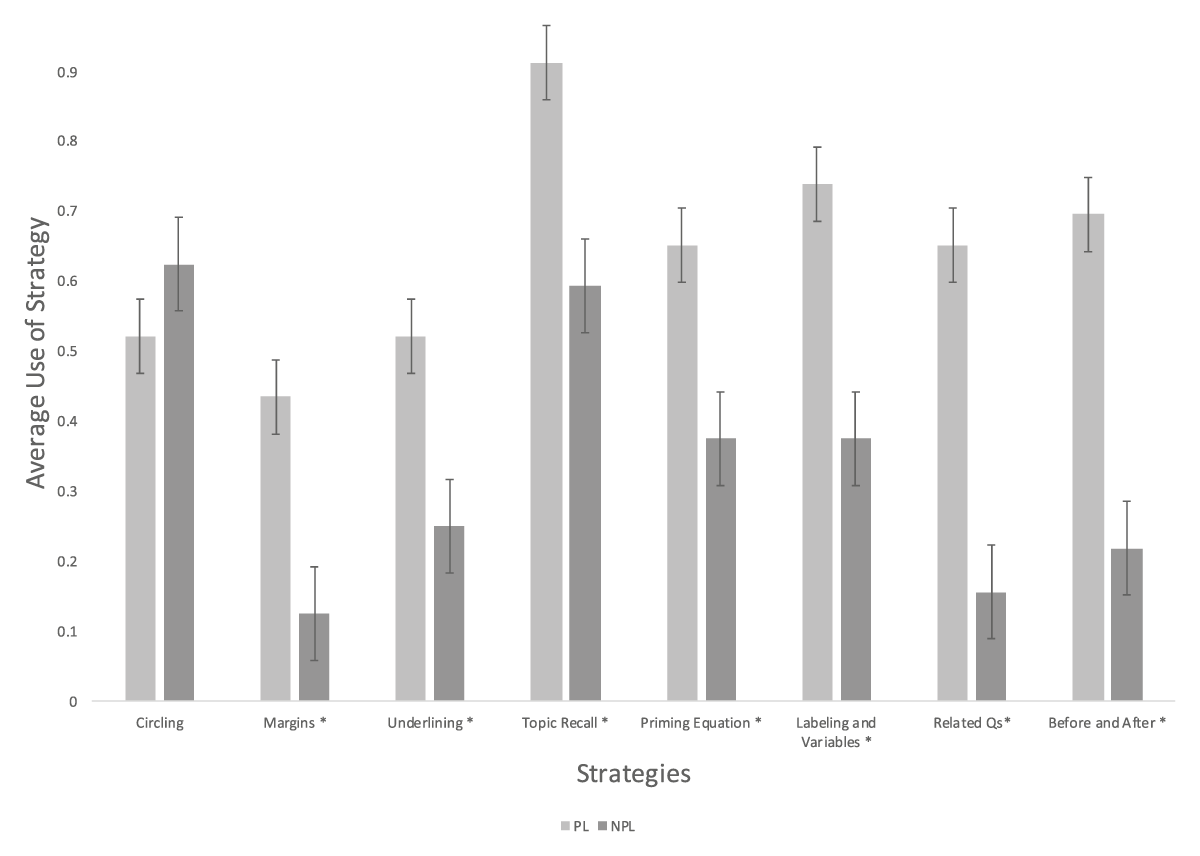
Figure 3
Average Problem-Solving Strategy Use Between Peer Teachers and Comparison Students.
Note. Asterisk * denotes significance.
Table 2
Calculated Significance (p) of Each Problem-Solving Strategy (p = 0.05 CI Two-Tailed) and Effect Size Calculated by Cohen’s d.
| STRATEGY | SIGNIFICANCE | COHEN’S d | EFFECT SIZE |
|---|---|---|---|
| Circling | 0.46 | 0.550 | Medium |
| Margins | 0.015* | 0.554 | Medium |
| Underlining | 0.045* | 0.551 | Medium |
| Topic recall | 0.0043* | 0.549 | Medium |
| Priming equations | 0.044* | 0.550 | Medium |
| Labeling variables | 0.0063* | 0.549 | Medium |
| Related q’s | 0.00020* | 0.553 | Medium |
| Before and after | 0.00035* | 0.550 | Medium |
[i] Note. Asterisk * denotes significance.
The use of all identified problem-solving strategies except for circling was found to be significantly different between peer teachers and comparison students at the 95% confidence level.
Because the same two groups and sample sizes were compared across all coded behaviors, similar effect sizes were expected. Further, medium effect sizes using Cohen’s d were observed for all problem-solving strategies. Of note, while the circling code was not found to have significant differences between the peer teachers and comparison students, a medium effect size was calculated. This discrepancy may be due to sample size limitations for this problem-solving strategy. Figure 4 shows the normalized total number of strategies used by students with peer teaching experience and the comparison student group, counted in a binary fashion and normalized by the total possible number of strategies that could have been used by members of the group based on the number of subjects in each group. For peer teachers, 118 total strategies were used out of a possible 184 strategies, and for comparison students, a total of 88 strategies were used out of a possible 256 strategies. Here, it is observed that students with peer teaching experience use more problem-solving strategies than students who do not have peer teaching experience.
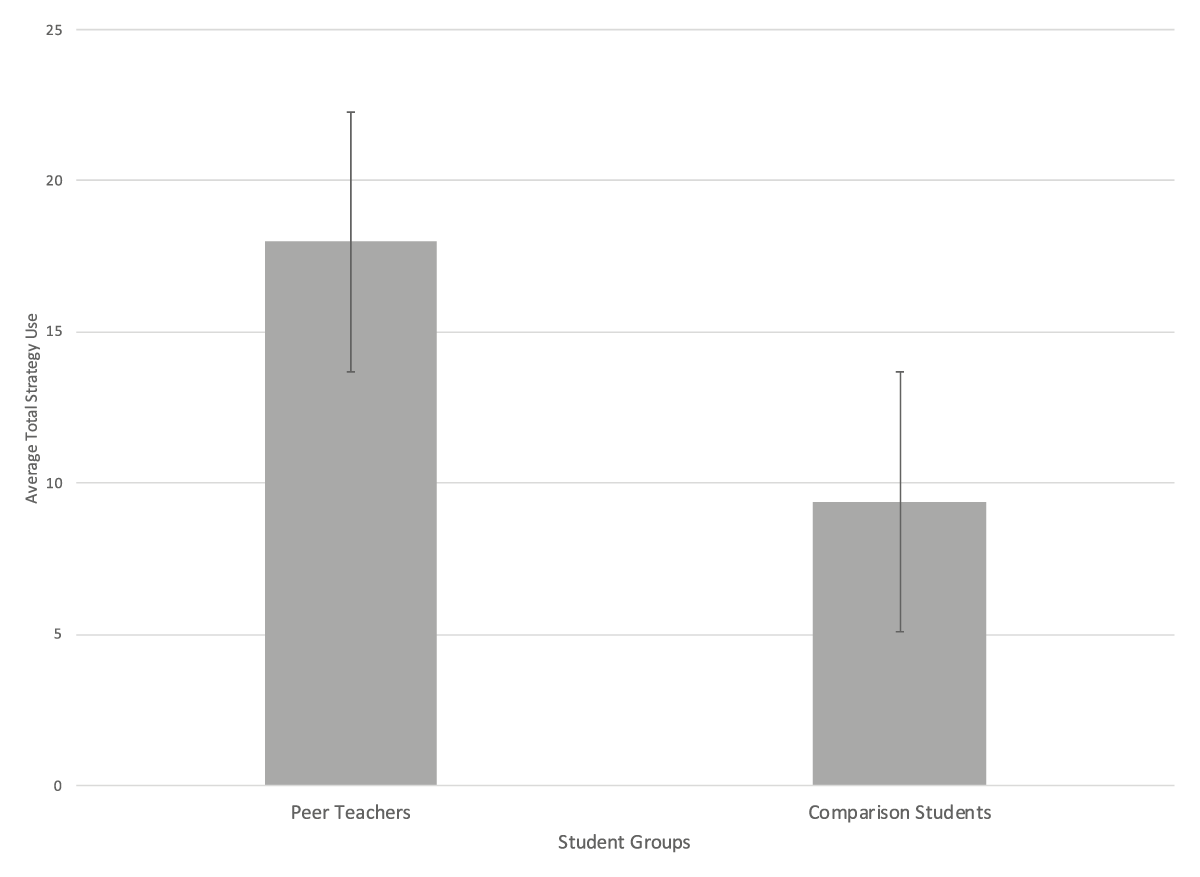
Figure 4
Normalized Average Use of Identified Problem-Solving Strategies for Peer Teachers and Comparison Students.
Analysis of Identified Types of Problem-Solving Strategies
The “circling” code refers to instances of circling, boxing, underlining, or otherwise highlighting the answer in the problem. Circling was the only identified problem-solving strategy whose use was found to not be statistically different between peer teachers and comparison students, with 52% of the peer teachers using the strategy and 63% of the comparison group using the strategy. The effect size of 0.550 was found to be medium, indicating that differences between groups may not be captured due to sampling. Interestingly, the comparison group circled answers more often than the peer teacher group. Circling one’s answer on exams is a test-taking strategy that is explicitly taught in most educational settings, so it is surprising that the peer teacher group used this strategy less often as both the peer teacher and comparison groups are undergraduate students who frequently take exams. It is possible that for this commonly taught test-taking strategy, the environment in which the subjects took the assessment played a role. Peer teachers took the assessment in a chemistry office that was set up like a classroom but was not used for instruction. The comparison group took the assessment in their physical chemistry classroom where they take regular exams, so they may have been more primed to think of the assessment as a “test” and circle their answers.
The “margins” code indicates examples of writing text other than explicitly solving the problem, often in the margins of the paper. This strategy was used more by peer teachers (43%) than comparison students (13%), showing statistical significance and a medium effect size of 0.554. Writing in the margins generally included notes related to the question topic, lists of variables, constants, and language the student would later use to answer the question. The increased use of margin notes in peer teachers may be related to their teaching experience. Teaching requires us to make implicit thoughts explicit for the learner. Writing margin notes may be related to the teaching strategy of explicitly writing important information before beginning a problem to guide students in their problem-solving approach. Similarly, peer teachers showed significantly more use of the “underlining” strategy than the comparison students, with 53% of the peer teachers and 25% of the comparison group using the strategy. The difference was significant with a medium effect size of 0.551. Underlining refers to any instance of underlining, circling, or otherwise highlighting the text in the question. Much like writing in the margins, this strategy shows the student’s ability to parse out important information in the question. This strategy may develop in peer teachers as they prompt their students to identify key information in problems, and students with peer teaching experience are more likely to transfer this teaching strategy to their own problem-solving.
The code “topic recall” denotes the subject accurately recalling and writing specific words, phrases, or diagrams commonly used in general chemistry textbooks and lectures. For example, in a discussion of molecular polarity, “like dissolves like” is a commonly used phrase in textbooks and classes. Peer teachers used this strategy more (91%) than comparison students (59%) with statistical significance and a medium effect size of 0.549. This problem-solving strategy shows the subject’s ability to retrieve and accurately reproduce information from their general chemistry course as well as their choice to explicitly write the information as they solve the problem on the assessment. Peer teachers may use these common phrases in instruction to remind students of important generalities from class and may transfer using this technique in their own problem-solving as well.
“Labeling and variables” was a problem-solving strategy code used to describe precise depiction and clear labeling of components in the diagram subjects were asked to draw in the coffee cup calorimetry problem. For example, a subject may include variables such as water temperature or mass on their diagram of the experiment. Peer teachers were found to use this strategy more often than comparison students. While all subjects were asked to draw a diagram of the experiment, labeling the diagram shows the subject’s ability and choice to communicate details from the problem visually. In the assessment, 74% of peer teachers labeled variables while 38% of the comparison students did. This difference was statistically significant with a medium effect size of 0.549. A related strategy, “before and after” refers to explicitly showing the changes in temperature that occur in the coffee cup calorimeter problem. In this code, subjects either wrote the different temperatures (Tinitial and Tfinal) within their sketch, or they drew two pictures of the coffee cup calorimeter at the initial and final conditions. Peer teachers used this strategy more frequently (70%) than the comparison group (22%), with statistical significance and a medium effect size of 0.550. In teaching, we often make sketches to explain and clarify complex experimental setups to students. The experience of instruction primes peer teachers to include these details when making sketches for their own problem-solving, which may help them in parsing out important information in more complex problems.
The final problem-solving strategies observed in this study, “priming equations” and “related q’s,” were both used more by peer teachers than comparison students. “Priming equations” were used by 65% of peer teachers and 38% of comparison students, while “related q’s” was used by 65% of peer teachers and 16% of comparison students. Differences between populations were significant for both the “priming equations” and “related q’s” codes with medium effect sizes of 0.550 and 0.553, respectively. “Priming equations” refers to presenting and manipulating the formula before engaging in numerical computations. The priming process establishes a cognitive framework for problem-solving by using a schema, or a mental framework of knowledge, to approach the problem. Employing schemas allows students to reduce cognitive load and has been shown to improve problem-solving performance outcomes (Sweller et al., 1998). A similar code, “related q’s” refers to a specific strategy of explicitly writing the relationship between heat (q) of the system (qsystem) and heat of the surroundings (qsurroundings) (qsystem = –qsurroundings). This strategy combines topic recall, as the relationship between the heat of the system and surroundings is frequently stated in chemistry classes, and priming equations, as the subject is presenting a manipulated formula before engaging in computation. Recalling the relationship between the heat of the system and surroundings before engaging in calculations is also using a schema to lessen cognitive load and primes the subject to be able to focus on problem-solving. Both priming and recall strategies are likely employed frequently during peer instruction in problem-solving to help students understand the meaning behind computational problems.
Peer teachers were more likely to explicitly show problem-solving strategies in their own work, and peer teachers employed a more diverse set of strategies for solving problems on this assessment. The findings suggest that the social and collaborative nature of peer teaching encourages students to develop and apply explicit problem-solving strategies that they then translated to their own problem-solving on the assessment in this study. This study adds to the literature on tutor and teacher training, showing that peer teaching experience does improve problem-solving skills and flexibility, as peer teachers used more varied problem-solving strategies in the assessment. Peer teachers both need to make their implicit thoughts explicit for their students and also need to answer questions from novice learners. Answering questions forces us to explain logic in different ways and may encourage peer leaders to problem-solve in more creative, visual ways. The experience of having to be explicit in problem-solving and explain problem-solving logic may benefit students with peer teaching experience as they move on to more advanced science and math courses that require more complex mathematical problem-solving. Peer teachers may transfer these problem-solving skills developed in teaching to their own learning. Through the social constructivist and cognitive apprenticeship lens, this study shows that peer teaching improves problem-solving skills and cognition for peer teachers through the reciprocal relationship between peer teacher and learner. We believe providing experience in teaching, either in a formal setting such as peer-led workshops or tutoring, or in informal opportunities in class, may broaden the students’ toolset of problem-solving techniques that could be applied in other areas.
Scientific Explanation Question
To determine differences in how the peer teachers and comparison group wrote short scientific explanations, they were asked to rank a set of compounds based on a property and then briefly explain their reasoning in the second question of the assessment instrument (Figure 1).
To assess the quality of their written explanations, surveys with three randomized sets of correct responses were given to graduate students with significant experience as teaching assistants for undergraduate chemistry. The graduate students were asked to simply rank the explanations from “best” to “worst” quality with 1 being “best,” 2 being “middle quality,” and 3 being “worst.” The graduate student survey respondents did not know which assessment answers were from peer teachers and which were from comparison students. Figure 5 shows the results from the scientific explanation question survey. Students with peer teaching experience were more likely to be ranked “best” (68% peer teachers, 32% comparison students), and they were less likely to be ranked “worst” (16% peer teachers, 84% comparison students). The middle ranking was 58% peer teachers, 47% comparison students. While all responses were correct, responses written by peer teachers were more often considered to be better explanations by graduate students who frequently grade undergraduate chemistry work. We believe the experience of teaching and having to verbalize understanding to novice learners leads to improvements in explanatory writing by students with peer teaching experience. Much like with thermodynamics problem-solving, peer teaching experience improves communication skills and flexibility that allows peer teachers to communicate complex ideas in different ways.
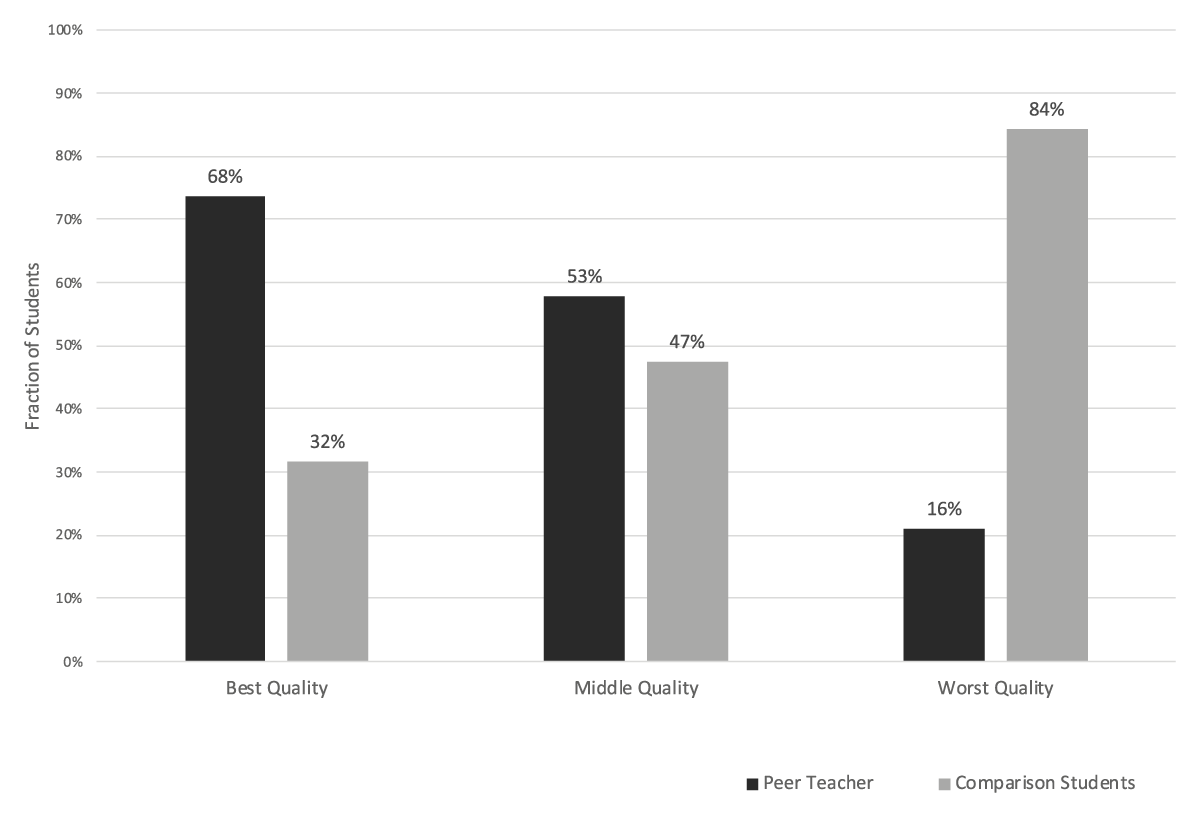
Figure 5
Expert Ranking of Written Explanations.
Note. All written explanations were correct in content.
Limitations and Future Directions
The presented study does have limitations that highlight the need for future research on how peer teaching experience affects problem-solving in undergraduate chemistry students. Sample sizes of comparison students were limited to chemistry junior and senior undergraduate students at one university, which limits the power of statistical testing. There is also self-selection bias with the peer teacher population. Students who are peer teachers either applied for the position or were recommended for the position by faculty. Thus, peer teacher selection favors students who already may possess strong academic skills. We were unable to compare academic records between the peer teacher and comparison groups to assess any significant differences in academic preparation between the groups. Further, the comparison group was self-selected as they consented to participate in the research study. A larger study encompassing multiple institutions with different student populations would be beneficial for minimizing this potential bias, and the ability to compare academic skills through chemistry grades would also account for population biases. Additionally, expanding the study to peer teachers in other fields would show generalizability of the results. Chemistry, and most STEM disciplines, requires the integration of computational skills, visual-spatial skills, and representational competencies with conceptual understanding of the underlying ideas. Additional studies highlighting the effect of peer teaching experience on these different STEM competencies would be of interest. The analysis of written assessments alone fails to capture the nuances of the problem-solving process. We are unable to know the order in which marks on the paper were made, nor do we know the students’ thought process for when and why they engaged in different problem-solving techniques. Conducting think-aloud interviews with subjects as they solve problems would provide further insights into the problem-solving process and differences between how students with and without teaching experience approach problem-solving.
Conclusions and Implications for Teaching
The presented study shows evidence that peer teaching experience impacts how undergraduate chemistry students approach problem-solving and scientific explanation on exam-like problems. Through qualitative coding of students’ written work, commonly used problem-solving strategies were identified. Students with peer teaching experience explicitly employed more problem-solving strategies, and they employed a greater diversity of types of problem-solving strategies than comparison students without teaching experience. Strategies such as writing notes in the margins, underlining important information, and labeling drawings show the explicit use of common teaching strategies in students’ own engagement with chemistry problems. Strategies such as priming equations shows evidence of using schemas to reduce cognitive load and improve problem-solving efficiency. Students with peer teaching experience used these varied strategies in their own problem-solving unprompted; their teaching experience primed these students to be explicit in their work. This practice may aid students with teaching experience as they take more advanced science and math courses requiring complex problem-solving. Further, brief written explanations of scientific concepts written by peer teachers were on average ranked higher than those written by the comparison students. Experience discussing scientific concepts in peer teaching environments transferred to written explanations on the assessment. This work adds to the literature on teacher and tutor training by specifically showing that peer teaching experience broadens the types of problem-solving strategies used by chemistry peer teachers, and that the cognitive flexibility gained through teaching experience also led to improved written scientific explanations. Providing opportunities for undergraduates to teach their peers, both in formal settings such as peer-led workshops or tutoring and in informal class activities such as think-pair-share, is beneficial for undergraduate chemistry students. Experience in describing problem-solving logic and explaining chemical concepts can encourage students to explore and employ different problem-solving techniques and refine their ability to craft explanations.