
Introduction
Virtual reality (VR) has recently become a supportive teaching and learning tool in the field of education. When learners are cognitively immersed in a virtual world (Sherman and Craig, 2019), they may benefit from emerging learning experiences that overcome time- and space-related limitations of the physical world. Traveling through the solar system, learning human anatomy through 3D navigation, or practicing speaking in public by visiting a 3D lecture hall are only a few examples that illustrate the emerging benefits of VR-afforded pedagogic meaning-making. Ongoing research highlights the various advantages of using VR technologies in educational settings, such as enhancing motivation (Häfner et al., 2018), arousing personal interest (Makransky, Petersen, and Klingenberg, 2020), or empowering problem solving and team collaboration (Wang et al., 2021). However, the creation of educational VR content is commonly left in the hands of software developers and teachers with limited to no options for customizing the content and refining the teaching methods (Fransson, Holmberg, and Westelius, 2020). As Amiri (2000: 80) indicates, language teachers in particular commonly lack the skills to produce their own digitally enhanced learning material and restrict their use of information technology (IT) to ‘delivering and using ready-made materials’. To empower digital self-determination among educational practitioners, the present study aims to address the following research question: how can language teachers without a background in software programming create and present their own VR learning experiences?
Empirically, this paper draws on insights from the development of a spherical video-based VR learning prototype that allows learners of English as a foreign language (EFL) to immerse themselves in different phases of an oral examination in English. The VR learning environment evolved as a collaborative project among the media education lab and the language center at Bundeswehr University Munich. Methodologically, the paper specifies the key features of spherical video-based VR and its affordances for pedagogic meaning-making and then identifies structural and contextual aspects of oral examinations in English. Subsequently, the paper describes the design choices and implementation details involved in the creation of the spherical video-based VR training world, ‘VR Test Anxiety English’. The remaining paragraphs expand on major learning theories in spherical video-based learning and suggest the best practices for teachers when developing teaching materials for use with spherical media.
Method: Designing and Implementing Spherical Video-Based VR Learning Environments
An affordable and time-efficient alternative to coding sophisticated VR learning applications is creating immersive learning experiences with the help of spherical videos. In contrast to computer-generated VR experiences that merely build on constructed animations and artificial 3D computer graphics, spherical media – also referred to as 360-degree media – is based on the (audio-)visual recording of events, actions, or places in the physical world. While previous research attests to the great potential of immersive learning experiences based on spherical videos (Pirker and Dengel, 2021), the design and implementation process of pedagogic meaning-making via and within spherical videos remains a vastly underrepresented area of research. Feurstein (2018) identifies generic steps for creating spherical videos in a general higher education context. Eisenlauer (2020) investigates how meaning-making practices in educational spherical videos draw upon and expand on core competencies of digital literacy. Following Lim (2021: 87), the educational potential of emergent semiotic technologies, such as spherical media, can be located in their specific affordances or in their ‘actions possibilities, that is what you can do, and not do, with a (digital) tool’. In this sense, spherical media allow users to capture or experience spatiality by presenting or observing multiple viewing angles simultaneously. While watching spherical media, the user has full control over where to look next and may pan around the depicted scene either by clicking and dragging, when viewed on a screen, or by turning their head, when accessed via a dedicated head-mounted display (HMD). As opposed to computer-generated VR environments that enable full body experiences, such as walking around or grabbing virtual objects, the interactive experiences afforded via and within spherical media are more limited. However, having fewer options for interacting with the depicted environment is by no means connected to having fewer learning experiences. In fact, there is evidence from previous research that elaborated physical and mental immersions may even impair learning performance when they lead to cognitive overload and mental fatigue (Hebbel-Seeger, 2018; Rupp et al., 2016). The spatiality and multiple views afforded by spherical media allow learners to experience situations that would be difficult to access in a conventional classroom context, such as visiting a foreign country (see ‘London City Guided Tour – 360’ on YouTube), exploring the edge of space (see ‘Journey on the Edge of Space’ on YouTube), or experiencing an oral exam without consequences.
The EFL Oral Examination as a Didactic Challenge
Previous EFL research demonstrates how learners may benefit from using spherical videos for language learning activities. Shadiev, Yu, and Sintawati (2021) identify the positive impact on student satisfaction with the learning experience as well as the enhancement of students’ EFL abilities, intercultural communicative competence, and knowledge sharing. Repetto et al. (2021) report beneficial effects of immersion on emotion induction and vocabulary learning, suggesting that immersive spherical videos may offer embodied experiences. While very little is known about the ways in which spherical videos may support EFL students’ oral test-taking abilities, the emotional and spatial immersion afforded by spherical videos holds great potential for learners to overcome their potential test anxiety. Having the opportunity to go through the individual phases of an oral examination in VR with the help of a spherical video – from preparing for the exam, to waiting to take the exam, to the exam interview – enables students to rehearse authentic exam scenarios and become more familiar with the examination procedure and direct communication during an oral examination.
To fully understand how EFL learners’ oral test-taking abilities may benefit from spherical videos and their educational affordances, it is necessary to delve deeper into EFL oral test situations and their didactic challenges. In contrast to written examinations with predefined questions and tasks, oral examinations are usually much more flexible and interactive. Follow-up questions depend heavily on the answers given to the preceding questions, and both the examiner and the examinee have the opportunity to influence the course of the conversation. Unlike in written exams, in oral exams, examinees receive immediate feedback on their speech, for example, in the form of short comments or through non-verbal feedback, such as looks, body posture, facial expressions, gestures, or intonation. Beyond the contents of the oral test, the examiner and examinee participate in a constant exchange at an interpersonal level. Students may radiate tension, insecurity, or self-assurance when facing teachers, who exercise their authority, appear dissatisfied and/or benevolent. Students commonly encounter challenges depending on their personal traits, such as fear of criticism, avoidance of eye contact with the examiner, and blanking out, during an oral exam (Al-Nouh, Abdul-Kareem, and Tagi, 2015). The relational dynamics between the examiner and examinee may have a tremendous influence on the exam procedure and the student’s performance (Kirk, 2004). In addition to these circumstances, time pressure can intensify the situation. Due to the specific nature of oral examinations, which are characterized by a direct interaction between the examiner and examinee and a relatively open test format (Joughin, 1998), it is commonly quite challenging to prepare students adequately for oral assessments in regular EFL lessons. Although speaking ability, as part of communicative competence, is considered a key component of EFL teaching and learning, students often appear tense and nervous during oral examinations and sometimes exhibit symptoms typical of test anxiety, such as blushing, sweating, and trembling. Language learners who demonstrate more foreign language anxiety are more likely than their less anxious classmates to achieve a lower exam score (Zheng and Cheng, 2018).
Preparing for EFL Oral Examinations with the Help of Spherical Videos
The spherical video ‘VR Test Anxiety English’ was shot with a 360-degree camera (also known as an omnidirectional camera) that allows for capturing spherical panoramic videos portraying various aspects of an exam situation. A brief version of the learning environment can be accessed at https://youtu.be/rjjYdtNyl8w. While the application of spherical videos aids learners in immersing themselves into the entire sphere of a simulated exam situation, the content must be positioned so that viewers direct their attention to the most relevant information when panning around the depicted scene. Following Alger (2015), interactive visual experiences in VR can be characterized according to different content zones that are defined by the users’ visual faculties and fields of view as well as by the technological restrictions of individual HMDs. After combining an HMD device’s field of view with an average, comfortable head rotation of 30 degrees, Alger (2015) concludes that users feel comfortable viewing persistent content at a horizontal level of 77 degrees to either side. Objects placed between 77 and 102 degrees are only visible when the user strains their neck, while objects placed at a horizontal angle of 102 degrees or more necessitate the user’s body rotation. Moreover, elements closer than 0.5 meters may induce indisposition and eye strain (see Figure 1).
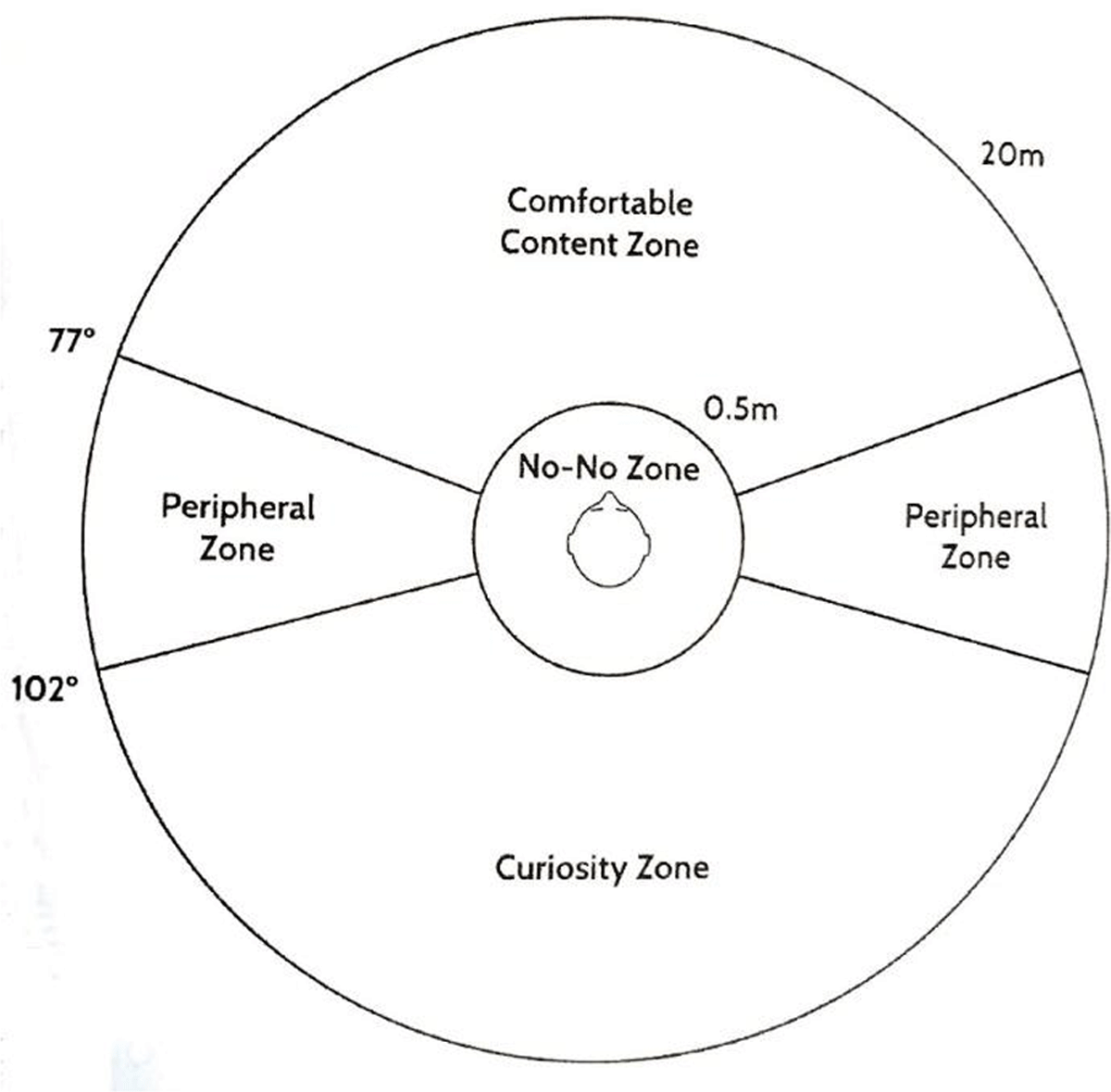
Figure 1
Content Zones in Virtual Reality (Alger, 2015, as cited in Feyder and Rath-Wiggins, 2018).
Accounting for Alger’s (2015) findings and for the specific affordances of spherical videos, the typical phases of an English oral exam were identified and formulated into a sequence plan during the conception phase of the project. In close collaboration with the staff of the language center, the experiences of an oral exam in English were described from an internal perspective and structured into consecutive film shots. Thereby, a distinction was made between the main and peripheral actions, which were distributed over the entire space, thus creating an authentic and immersive experience of the different situations of an oral exam in English. Main actions included all activities that were directly linked to the exam procedure and took place in the users’ direct line of sight, such as the teacher handing out the topic and protocol sheets. Peripheral actions referred to activities that were visible in the corners of the field of view, such as a fellow student sitting in the far left appearing very nervous.
The spherical video enabled practical and realistic preparation for the EFL oral exam scenario. Students may experience the testing environment as a special kind of communication scenario on the basis of three different exam phases: the preparation phase, when students receive the topics and have time to take notes (see Figure 2); the waiting phase, when students are placed in the hallway waiting to be called in for the oral exam and encounter fellow test takers (see Figure 3); and the exam phase, where students face their examiners and the oral examination takes place (see Figure 4).
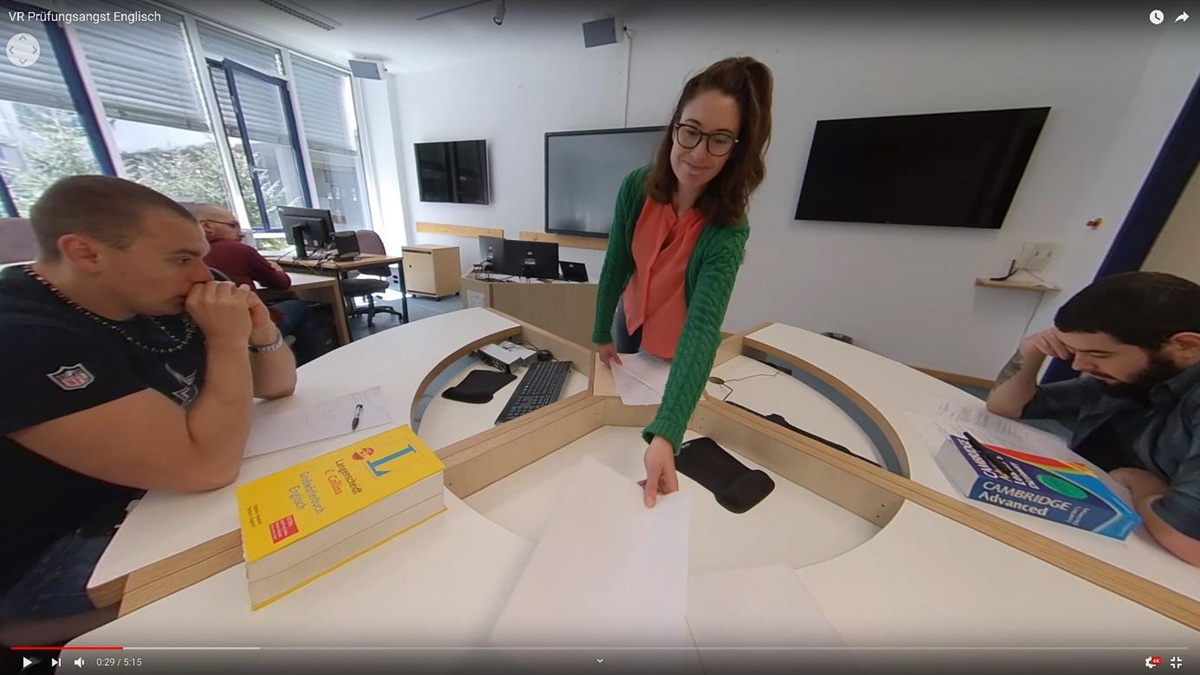
Figure 2
The Preparation Phase.
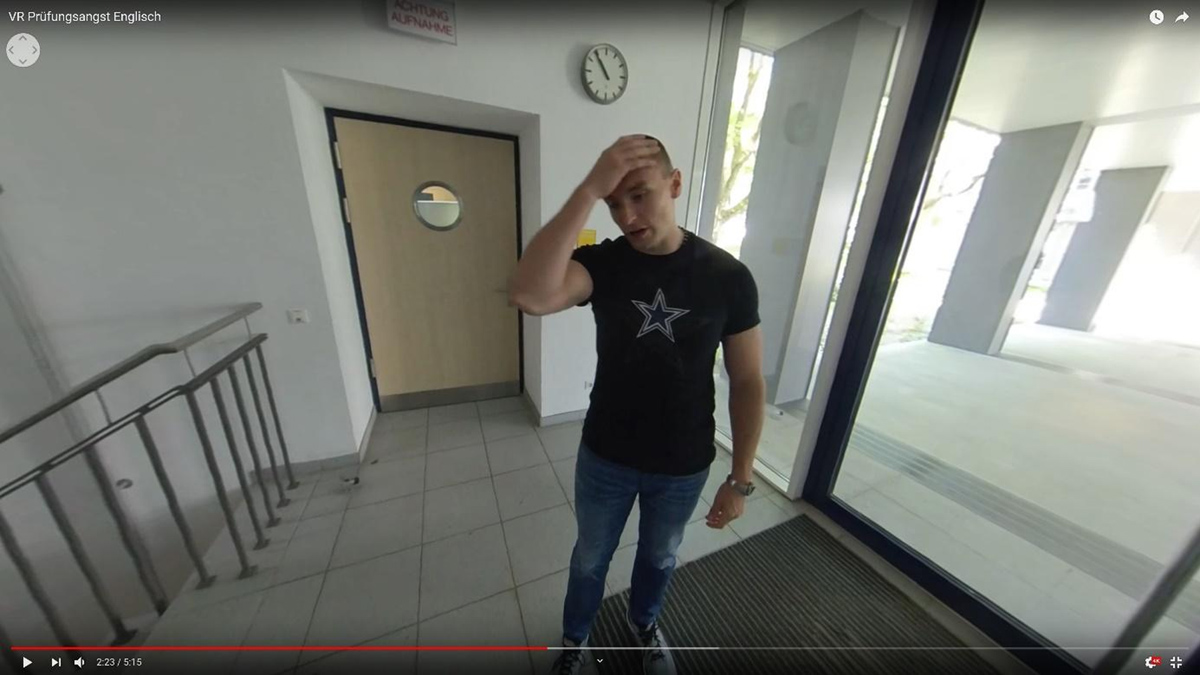
Figure 3
The Waiting Phase.
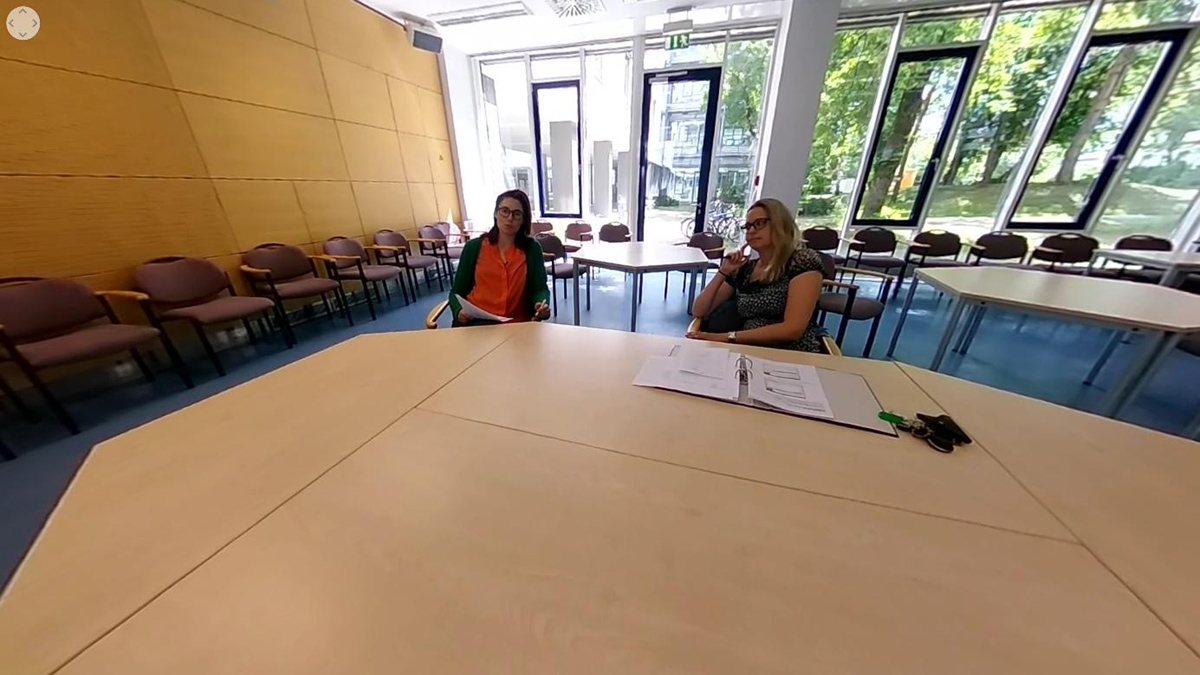
Figure 4
The Exam Phase.
The spherical video-based learning environment was designed and implemented as a training world that, according to Schwan and Buder (2002), allows users to experience the examination process without any direct consequences to their performance assessment. The different phases of the exam can be experienced in a sensory and concrete way and give the user limited space for exploring the 360-degree panoramas independently. In contrast to exploration worlds, in which users are free to decide in what order and at what pace they receive the content (Schwan and Buder, 2002), the option for interactivity in the training world ‘VR Test Anxiety English’ is more restricted. Here, identical to a real exam situation, the sequence and duration of the individual exam phases are fixed. Accordingly, the behavior within the virtual exam situation is less self-directed but largely shaped by the various stimuli typical of an examination. Therefore, a central aspect is the authentic representation of corresponding stimuli, which can be experienced within the VR learning environment. Moreover, students can repeat the different phases as often as necessary. This may allow them to become more aware of how their emotions in this environment can impact their performance.
Discussion and Findings
Drawing on insights from building a spherical video-based VR learning prototype our discussion expands on major learning theories in spherical video-based learning and suggest best practices for teachers when developing teaching materials for use with spherical media.
A Cognitivist and Constructivist Perspective on Spherical Video-Based Learning
In line with the cognitivist approach to learning, the immersive experience obtained by watching the spherical video ‘VR Test Anxiety English’ provides profound insights into a typical action procedure of an EFL oral examination process. Consistent with findings in cognitive psychology (Craik and Lockhart, 1972), distinguishing different phases of cognitive activities, the visual and auditory stimuli provided by the VR training world enable step-by-step processing of information, from perceiving and identifying the environment, via understanding and remembering typical patterns of examination phases, to automatizing and retrieving test-taking strategies. By repeatedly going through the immersive experiences, learners may internalize the communicative rules of the oral examination so they can use them to pursue their own success. In this way, the spherical video-based learning environment not only provides an opportunity to train testing skills but allows users to reflect on their learning process at a metacognitive level. When learners participate in an oral examination, they can link their prior knowledge to the rules they have absorbed from the training world and apply them to the current test scenario.
In accordance with the basic tenet of the constructivist approach, learning by doing (Piaget 1950/1975), the immediate experiences in the spherical video-based training world provide a basis for knowledge construction. Users of the VR training world are able to explore the testing environment themselves and internalize action patterns, test-taking knowledge, and the oral testing process by repeating the activity as often as they would like to. Though the order and duration of the exam phases are fixed, learners may explore the examination setting to become familiar with the conditions of an oral examination and thus engage in the construction, organization, and reflection of relevant knowledge for test taking. Moreover, 360-degree cameras are easy and convenient to use and enable teachers and learners without enhanced technical skills to create VR experiences. By letting learners design and implement their own learning goals in a spherical video-based learning environment, they activate and deepen their understanding of the learning process. Shadiev, Yang, and Huang (2021) predict that students’ creation and viewing of spherical videos will occur in the future of the field of education. The creation of spherical videos as a classroom project not only establishes authentic learning environments but promises to result in self-directed and meaningful learning by doing.
Best Practices for Designing Spherical Video-Based Learning Environments with Teachers
Although the presented training world was developed for the purpose of exam preparation in foreign language training, the adopted design and implementation workflow may be easily transferred to other educational contexts or institutions. On the basis of insights from the presented case study as well as findings from previous research into spherical video learning (Eisenlauer, 2020; Feurstein, 2018), we identify best practices that promote the design and implementation of spherical video-based learning environments among education practitioners. The best practices can be distinguished in different phases: planning, production, post-production, and delivery.
Planning phase
Spherical videos enable learning and instruction by establishing an authentic and immersive learning environment in which students can acquire new concepts and practice their skills (Shadiev, Yang, and Huang, 2021). During the planning phase, it is essential for educational practitioners to familiarize themselves with such emerging learning environments. In other words, they need to become acquainted with 360-degree viewing and spherical video-based learning experiences. Once they reach an understanding of the characteristics of 360-degree media, teachers may build on this knowledge when planning their own learning experiences. The table below identifies several activities that help teachers familiarize themselves with spherical videos and design their own VR learning experiences.
| GETTING FAMILIAR WITH SPHERICAL VIDEOS | SETTING LEARNING OBJECTIVES/DESIGNING A SEQUENCE PLAN |
|---|---|
Exploring content published on 360-degree media platforms gives an understanding of and inspiration for the immersive experiences achieved via and within spherical media. The following sources were considered to be especially useful:
|
|
Production and post-production phases
When comparing 360-degree cameras to conventional cameras, the main difference is that the former always film the complete setting (Tricart, 2018). When producing spherical videos, operating the camera can become challenging, as the long-held distinction between in front and behind the camera has dissolved. Moreover, 360-degree cameras can easily capture too much information, which has the potential risk that recipients will be distracted from the learning activity at hand. Most 360-degree cameras record images and videos with two lenses. To create a seamless spherical video, the recorded material needs to be stitched. Imagery with overlapping fields of view need to be combined into a 360-degree object. Most cameras come with customized apps or software that enable stitching.
| POSITIONING AND OPERATING THE CAMERA | STITCHING THE IMAGERY AND EDITING THE RECORDED MATERIAL |
|---|---|
|
|
Delivery phase
Spherical videos can be viewed on a desktop or tablet with a 360-degree capable media player (such as VLC) or via a video sharing platform, such as YouTube or Vimeo. For a more immersive experience, spherical videos can be viewed on an HMD, such as the Oculus Quest or the Pico Neo 3 Pro. VR cardboard is a cost-effective alternative. After launching the spherical video on a smartphone, the user places their device into the VR cardboard and can explore the depicted spaces by turning their head. Depending on the degree of interactivity desired, it might be advisable to upload the edited footage to a VR authoring tool, such as Adobe Captivate, Google Tour Creator, or ThingLink.
Conclusion: Advantages and Disadvantages
Teacher-made spherical training worlds are time efficient, practical, and convenient aids for students’ learning processes. Well-developed VR experiences can challenge the user’s knowledge and engage them individually (Farley, 2016). Teachers can, therefore, control the development of the spherical video to fit the objectives of the lesson and improve the content for the future. Recording a spherical video consists of minimal training or guidance and does not require advanced technical coding skills. Spherical training worlds provide students with an individual and immersive learning environment they can observe at their own pace and replay or slow down as often as necessary. However, the exploration is limited to the position the camera is set to. In addition, the student does not have the option to interact and receive feedback. In-person teaching cannot be replaced by immersive computer-assisted language learning systems, and learning environments may not explicitly influence the knowledge gain (Pirker and Dengel, 2021). Hence, it is vital not to adopt an all-or-nothing approach but rather implement VR as a supplement to the learning environment.
Acknowledgements
We would like to thank Bethan Stokes for her assistance in scripting the sequence plan and acting. We wish to extend special thanks to Denis Frischbier for his expertise in editing the film material and acting. We would like to express our gratitude to Maleen Hurzlmeier and Marcus Seichter for their acting.
Funding Information
We acknowledge financial support from Universität der Bundeswehr München.
Competing Interests
The authors have no competing interests to declare.
Author Contributions
V.E. conceived the presented idea and design, developed the training world, and took the lead in writing the manuscript. D.S. contributed their background as an educator and revised and translated the manuscript. Both authors provided critical feedback and discussed the development of the theory.