


Figure 1.
Workflow of semantic-aware trajectory planning including two consecutive steps. They are semantic-aware search and optimization, described in section 4 and 5, respectively
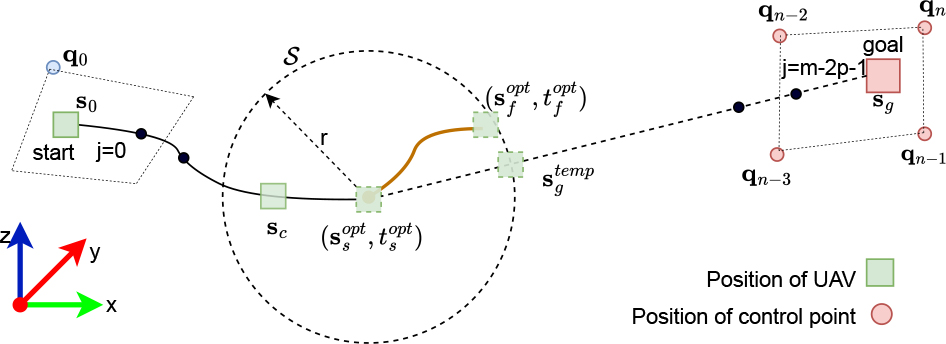
Figure 2.
The problem of UAV trajectory planning in a cluttered and dynamic environment. The trajectory is generated portion by portion to ensure real-time performance and feasibility
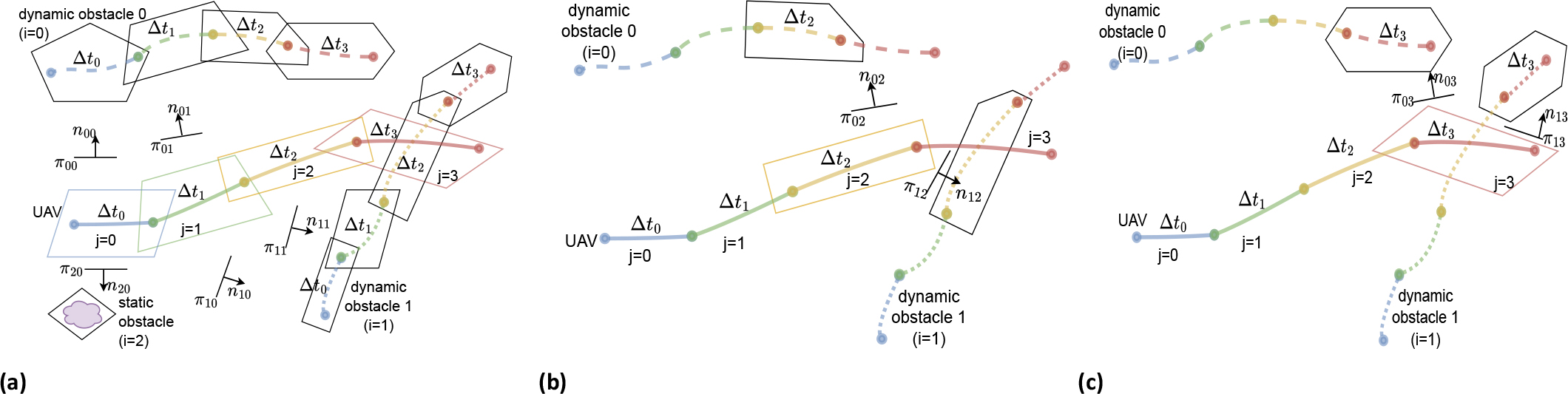
Figure 3.
Outer representation of trajectories of UAV, dynamic obstacles (for instance, obstacle 0 and 1), static obstacle (for example, obstacle i = 2) and Collision-checking by separating planes πij: (a) Collision-checking at the 1st and 2nd interval of UAV trajectory. (b) Collision-checking at the 3rd interval of UAV trajectory.(c) Collision-checking at the 4th interval of UAV trajectory
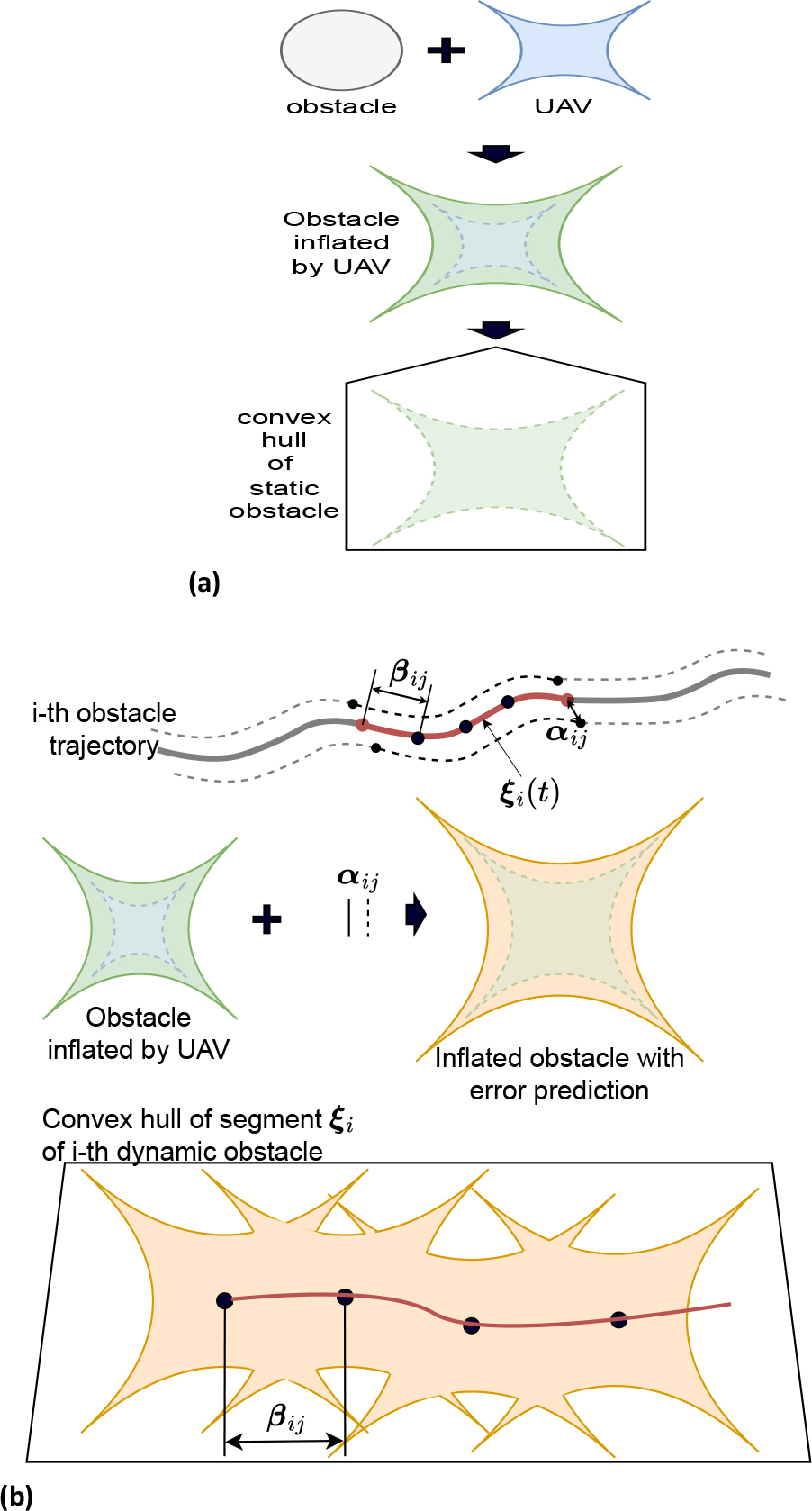
Figure 4.
Outer representation of the obstacles: (a) For static obstacle. (b) For dynamic obstacle
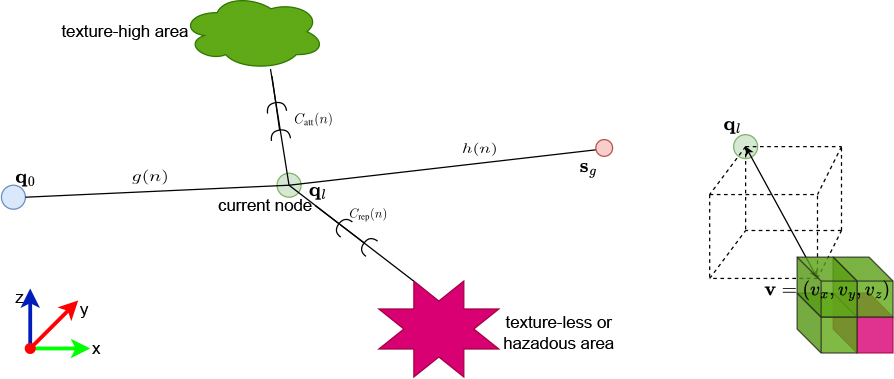
Figure 5.
The total cost of semantic-aware A* includes traditional costs, along with repulsive and attractive costs arising from texture-less/hazardous regions (vivid pinkish-magenta color) and high-texture areas (fresh green color), respectively. Along with HOW TO calculate the Euclidean distance in 3D space used as primitive for calculating the costs
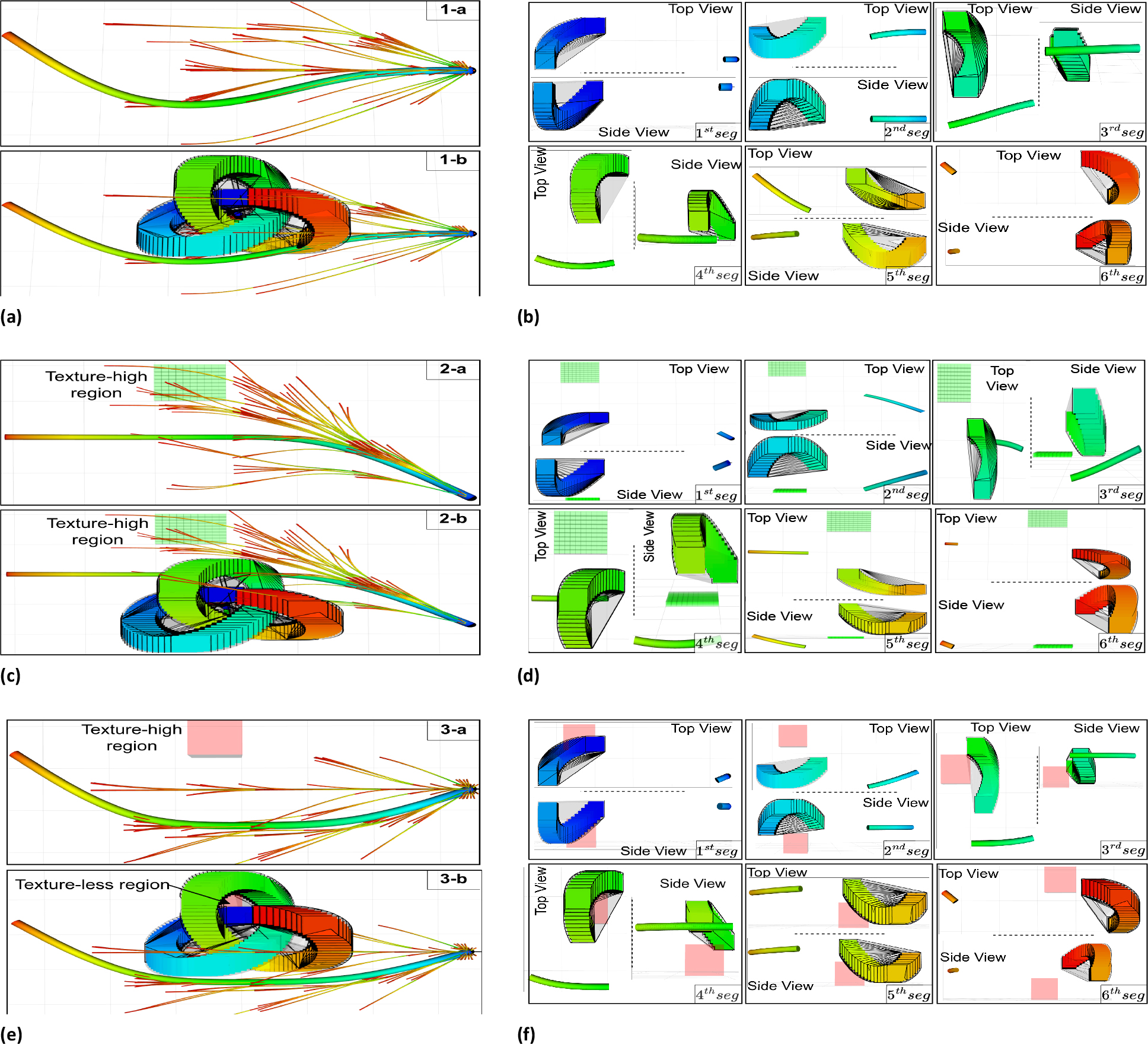
Figure 6.
The experimental results of semantic-aware A* with one dynamic obstacle in three cases (Without semantics, Considering the influence of the attractive region and Considering the influence of the repulsive region): (a), (c), and (e) show the complete trajectories, while (b), (d), and (f) display the corresponding individual trajectory segments (1-6) for each case
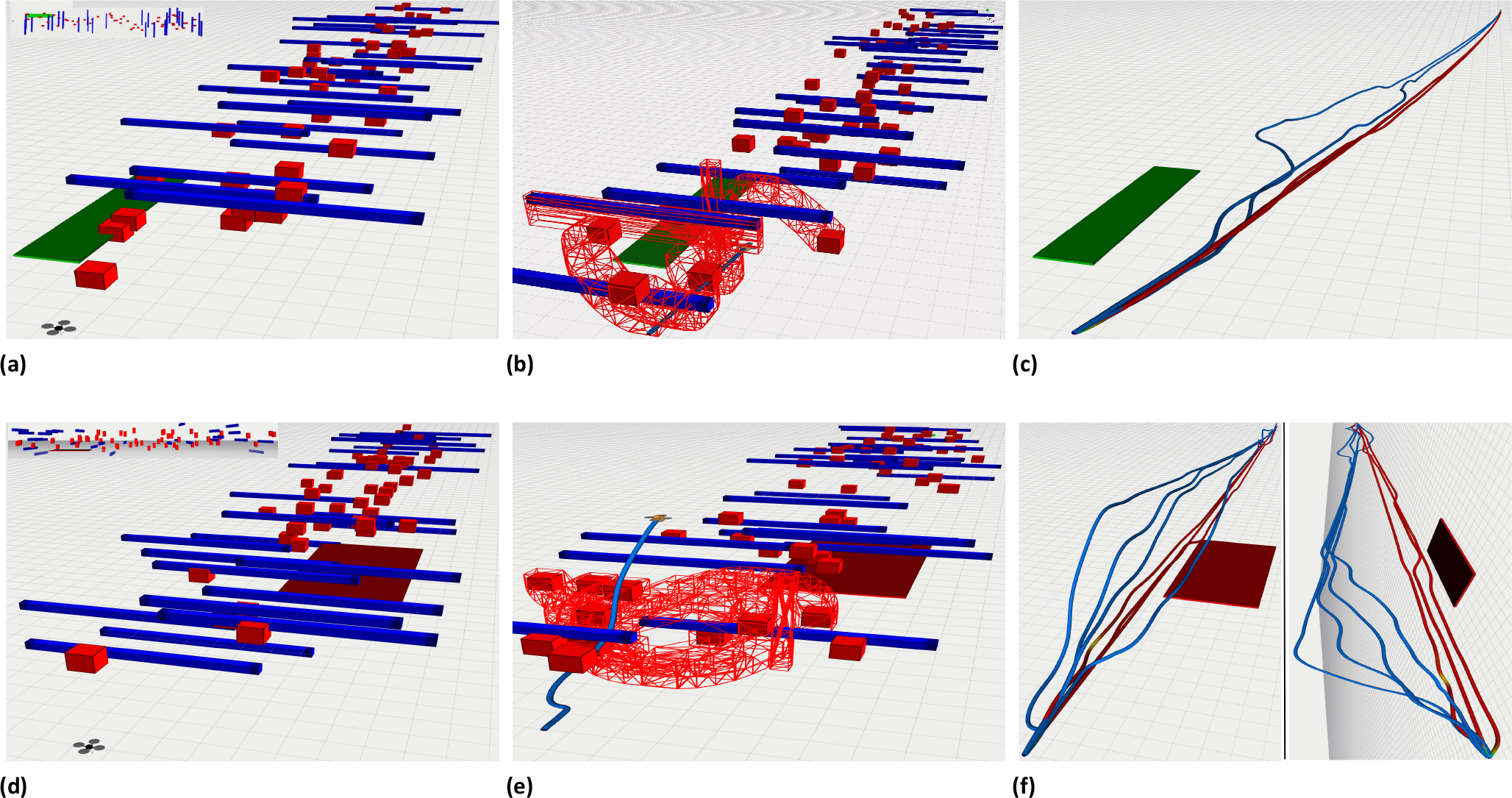
Figure 7.
Experiments in dynamic corridor environment: (a) The environment includes dynamic and static obstacles (the red cube and the blue rectangular box, respectively), as well as a rich-information region (the green rectangular box); (b) The quadrotor flies in a dynamic environment, with outer polyhedra (red boxes) surrounding obstacles; (c) The dark blue and dark red trajectories come from our suggestion and MADER [38], respectively; (d-f) The corresponding setup, flight, and trajectory results for a scenario including a low-texture or hazardous region (red rectangular box)