
Introduction and Literature Review
Emotions and their potential impacts have historically been ignored in educational settings (Pekrun 2024). However, over the past 25 years it has become increasingly apparent that emotions play a critical role in students’ learning and achievement (Pekrun 2024). Furthermore, emotions can also considerably impact students’ physical and mental health (Goetz et al. 2023). In this paper, emotions will be viewed as relatively brief, but often intense, psychophysiological responses caused by situations that are personally significant to an individual (Rosenberg 1998). The experience of pleasant emotions, such as enjoyment, can: enhance a student’s motivation to learn; foster the use of flexible learning strategies; and positively influence mental wellbeing (Luo & Wang 2023; Pekrun 2024; Wu & Yu 2022). Conversely, the experience of unpleasant emotions, such as disappointment, can: hinder a student’s task engagement; have damaging consequences on physical and mental health; and increase the chances of the student dropping out of their course of study (Hilliard et al. 2020b; Loderer et al. 2020; Pekrun 2024; Wang et al. 2022).
The increasing adoption of online learning in higher education has led to a growing focus on the emotional aspects of learning in these environments (Graesser 2020; Shea, Richardson & Swan 2022). Among the various forms of online learning, group projects—especially those linked to assessment—have been found to be particularly emotionally charged (Hilliard 2022). Online group projects involve small groups of students communicating and collaborating together, primarily through online tools, to achieve a specific outcome, complete a defined task, or produce a shared product (Donelan & Kear 2024). Each group has designated members who are collectively responsible for contributing to the outcome and success of the project (Donelan & Kear 2024). Research shows that students experience a wide range of emotions during online group projects, with anxiety and frustration being especially common (Capdeferro & Romero 2012; Hilliard et al. 2020b). This heightened emotional response can be attributed to several factors. For instance, conflicts can often arise from group dynamics, such as imbalances in effort and commitment or personality clashes (Hilliard 2022). Additionally, online group work reduces study flexibility compared to independent online work, which is a crucial aspect for students who are balancing other commitments, such as work or caregiving (Donelan & Kear 2024). Furthermore, students may experience reduced confidence and self-belief when communicating and collaborating with others in an online setting (Herrera-Pavo 2021).
Due to their profound importance, being able to adeptly regulate one’s emotions is a crucial process when learning (Nakamura 2023); this is especially important in collaborative learning contexts, where a wide range of emotional challenges can arise (Järvenoja, Näykki & Törmänen 2019). Emotion regulation refers to the processes by which individuals influence the type, intensity, and duration of emotion they experience (Gross 2015). Typically, this will involve trying to reduce the experience of unhelpful emotions and maintain or increase the experience of helpful emotions. For example, if a student is experiencing anxiety which is hindering their performance in an online group project, they may try to reduce this feeling by thinking more positively or seeking social support from their lecturer. On the other hand, if they are experiencing excitement which is facilitating their engagement, they may try to maintain this feeling by increasing their involvement in the task or sharing their feelings with other students in the group.
Currently little is known about students’ emotion regulation when participating in online group learning in distance education. However, when compared to in-person learning environments, these online settings present novel challenges which can make emotion regulation more difficult (Feidakis et al. 2019). For example, in online environments, there are typically fewer opportunities for peer support compared to studying in-person (Shimizu et al. 2022). Responses when interacting with peers and lecturers can also be delayed, as communication is often undertaken using text-based, asynchronous methods (Ez-zaouia, Tabard & Lavoué 2020). Working online can also make it more challenging to be aware of others’ emotions due to limited emotional cues (Han, Hamka & Kim 2023). This reduced visibility of emotional and affective experiences can limit the support available to students, compared with in-person learning (Ez-zaouia, Tabard & Lavoué 2020).
Emotional awareness—the ability to identify, understand and differentiate emotions being experienced (Boden & Thompson 2015)—is an important step in the self-regulation process (Pintrich 2004), as it helps individuals activate strategies needed to control and regulate their emotions in ways that support their goals and wellbeing (Järvenoja, Järvelä & Malmberg 2020). For students to effectively regulate their emotions, it is important that they are aware of, and understand, the emotions they are experiencing as well as the situations causing their emotions (Boden & Thompson 2015; Järvelä & Hadwin 2024). Research has shown that students who are aware of their emotions are more likely to engage in regulation processes and adopt adaptive regulation strategies (Subic-Wrana et al. 2014; Wright, Adcock & LaBar 2025). Unfortunately, not all students are skilled at understanding and regulating their emotions, and many find these processes extremely challenging (Harley et al. 2019; Järvenoja, Järvelä & Malmberg 2020). This can result in misdirected or ineffective emotion regulation, which can have detrimental impacts on learning, achievement, and wellbeing.
Researchers have started to develop technological tools to prompt and support emotion regulation (e.g., Coughlan, Lister & Lucassen 2021; Ez-zaouia, Tabard & Lavoué 2020; Webster 2019). The guiding premise behind many of these tools is that emotion regulation can be supported if students are prompted to: increase their awareness of their emotions (e.g. by monitoring and reflecting on their emotional experiences); and activate key regulation processes (Järvenoja, Järvelä & Malmberg 2020). An example of such a tool, and one that forms the foundation of the work discussed in this paper, is the Socio-Emotional Sampling Tool (SEST; see Webster 2019). The SEST has been designed for in-person online collaborative learning tasks; it prompts students to assess their emotions and plan strategies for regulating them at different stages of a collaborative activity. This aims to help students maintain beneficial emotions while managing those that could hinder collaboration (Webster 2019). An important feature of the SEST is that it has been designed to be completed before, during, and after collaboration and, therefore, aims to support students at different phases of a collaborative activity. Findings from the SEST have indicated that, during in-class computer-supported collaborative tasks, undergraduate students aimed to increase or maintain pleasant emotions and decrease unpleasant emotions, primarily by staying focused on the task or using positive thinking strategies to regulate their emotions (Webster 2019).
Despite the advances in the use of technological tools to support students’ emotion awareness and regulation, there is still extremely limited research exploring ways to support students in naturalistic online group learning projects in distance education settings. This is extremely important, due to the critical role emotions play in learning and academic achievement as well as the highly emotional nature of these learning activities. Therefore, there is a need to provide students with tools that raise their awareness of their emotions so that they can be supported with regulating them when needed (Lavoué et al. 2020). This paper aims to address this gap by trialling the use of a digital tool, based on the SEST, to support students’ emotional experiences in a real-world online collaborative learning environment. By examining the use of this tool, this study contributes to the understanding of emotion regulation in online group learning and offers insights into how educators can better support students in these settings.
An Approach Trialled at the UK Open University
Context
In this section, we describe an approach trialled at the UK Open University (UKOU) to support students’ emotion awareness and regulation during an assessed, online, group project. The assessed group project runs over a 9-week period and is part of a Level 2 undergraduate module (the equivalent to study in the second year of a full-time undergraduate degree) in ‘Communication and Information Technologies’. This module, completed over 9 months and equivalent to 15 ECTS credit points, is undertaken by part-time distance learners. The group project requires students to work in groups of between six and eight to design and build a website for a specific ‘client’ (e.g., the managers of a family-friendly hotel or community theatre), and then evaluate another group’s work. To carry out the project, groups are provided with a tool for website development and a forum on the module’s VLE for group discussion. A student’s overall grade is made up of both individual and group marks and the project contributes 1/6 of the overall module grade. Although groups can largely work how and when they want, there are several milestones during the project (as shown at the top of Figure 1).
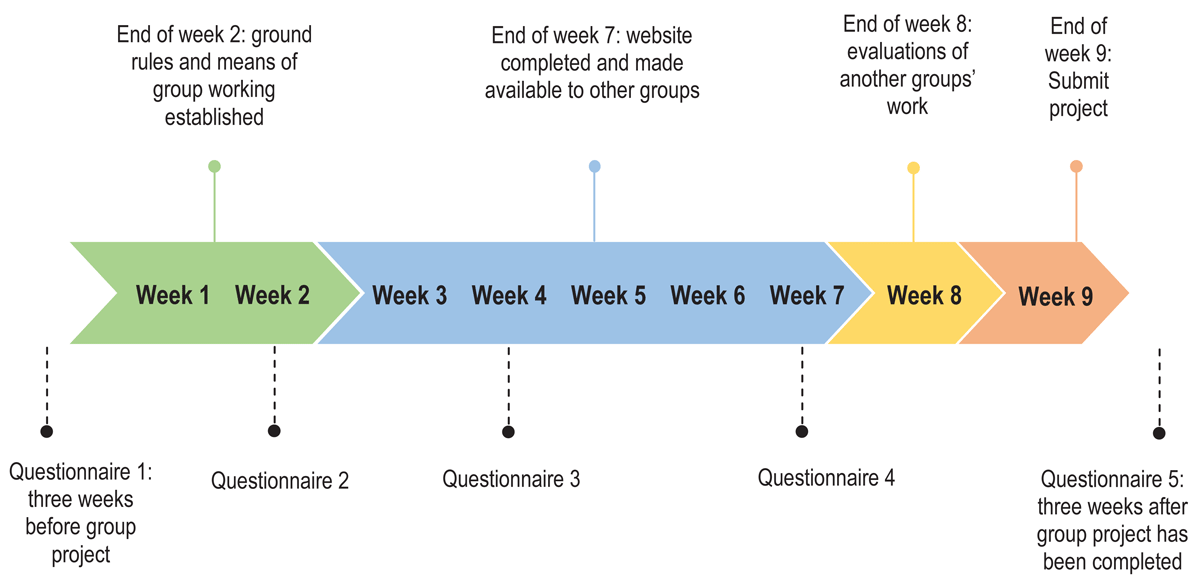
Figure 1
Milestones and timings of questionnaires through the group project.
Emotion questionnaires
To support the emotion awareness and regulation of students during the group project, several short questionnaires have been embedded into the module’s VLE pages at different points. Ethical approval for the inclusion and use of the questionnaire in this study was gained by the UKOU’s Student Research Project Panel (Reference number: SRPP 2019/120). The questionnaires are placed before the project, at several points during it, and after it has finished, so that students are supported at various stages. The timings of these are shown at the bottom of Figure 1. Originally, four questionnaires were included; however, after the first year of implementation it was decided that a fifth questionnaire would be added (Questionnaire 4 in Figure 1) to provide support to students nearer to the end of the group project.
The aim of the questionnaires is to: 1) allow students to reflect upon their feelings and help them understand the emotions they are experiencing; 2) prompt ways to regulate their emotions during the activity (if required); 3) support students’ emotion management by providing positive, tailored feedback dependent on their questionnaire responses; 4) allow the possibility of proactive strategies to be implemented by the module team that would support students during the project, based on questionnaire responses; and 5) improve student retention and engagement on the project.
All responses to the five questionnaires are anonymous. Each questionnaire is open for two weeks; after this time, students are unable to access them. This is so that students’ responses can be linked to specific stages of the group project.
Before the group project
The first questionnaire asks students about their initial feelings about undertaking the project. Students respond by selecting one of three options: I am looking forward to it; I am uncertain about it; or I am very worried about it. Based on their response, students are provided with tailored feedback aimed at acknowledging and supporting their feelings before starting the group project. For those looking forward to it, the feedback reinforces the value of collaboration, highlighting positive experiences from previous students. Students who feel uncertain are reassured that their feelings are normal and are encouraged to seek advice from their tutor or the OU support area if needed. For students who feel very worried, the feedback acknowledges their concerns, explains how such feelings can positively influence effort and motivation, and emphasises the importance of accessing support if their worries feel overwhelming. Questionnaire 1 also asks students to reflect on why they are feeling the way they are, by responding in an open-ended textbox.
During the group project
Questionnaires completed during the group project (Questionnaires 2–4) are primarily based on the SEST, although statements have been slightly adapted to reflect the specific learning context (online distance learning), and the format of how the items are presented is different. In the SEST, students construct a short self-narrative about their current emotional experiences by selecting options from drop-down menus and writing responses in open-ended textboxes embedded into a short pre-written paragraph. In this work, items are presented in more of a traditional questionnaire format (i.e., items listed one after the other) due to the functionality of the VLE questionnaire tool. Each of these three questionnaires prompt students to indicate an emotion they are currently experiencing in relation to the group project. Other questions ask about: the cause and intensity of the emotion; their evaluation of the emotion; goals; and strategies for regulating the emotion; the student’s perception of the overall group atmosphere; and their level of satisfaction with how things are going in the project. For these questionnaires, students receive tailored feedback based on their response to the final question (about their level of satisfaction).
Below is a more detailed description of each of the items included in the questionnaires. This highlights how (if at all) they have been adapted from the SEST as well as any other items that have been added or removed.
Emotions. Students are asked to select one emotion they are experiencing in relation to the group project. Students can select from eight pleasant emotions and eight unpleasant emotions (see Table 1). Although many of these emotions are included in the SEST, some have been changed to better reflect the emotions experienced in the specific learning context (an online group project). For instance, previous research we have undertaken has highlighted that relief (not included in the SEST) is one of the most reported emotions by students in assessed, online, group learning contexts (Hilliard et al. 2019). The questionnaires also include more pleasant and unpleasant emotions than the SEST, allowing for greater choice and diversity when describing emotions (see Table 1). Students also have the option to select ‘other’ if they feel that the predefined list does not capture the feelings they are experiencing.
Cause of emotions. After selecting the emotion relevant to them, students are asked to describe the cause of this emotion. Due to the multitude of reasons that can evoke an emotional response, this is an open-ended question. Allowing students to describe the cause of their emotion helps them reflect on and better understand the feelings they are experiencing. This also provides module teams with qualitative data that can be used to implement actions and interventions that can further support students during the project.
Intensity of emotion. Students are then asked to rate how strong the emotion is that they are experiencing, on a scale from 1 (very weak) to 5 (very strong). Research has shown that emotional intensity significantly influences how individuals choose to regulate their emotions (Kozubal, Szuster & Wielgopolan 2023).
Evaluation of emotion. Students evaluate the perceived desirability of their emotion from three response options: good that I feel this way; bad that I feel this way; and neither good nor bad that I feel this way. In the SEST, students are only provided with two response options (good or bad). We have included a third option to allow students to identify when an emotion may be interpreted more neutrally (Linnenbrink-Garcia, Wormington & Ranellucci 2016). Although it might be thought that all pleasant emotions would be evaluated as good and all unpleasant emotions would be evaluated as bad, this is not always the case. For example, experiencing a high level of excitement may be debilitative as it can lead to reduced task focus and attention, whereas experiencing moderate levels of anxiety or frustration can have facilitative effects for some students, such as increased motivation and effort (Pekrun 2024).
Emotion regulation goals. Due to emotion regulation being a goal-directed process, it is important to understand students’ intentions for regulating their emotions. As such, students are asked whether they want to increase, decrease, maintain, or do nothing about the emotion they have reported experiencing.
Emotion regulation strategies. Students are asked to identify how they would regulate the emotion they are experiencing, by selecting one or more statements from a pre-defined list. This consists of 12 statements which aim to reflect a range of possible strategies that could be used to regulate emotions in the group project (see Figure 2). The strategies are predominantly based on those described in the SEST; however, four other strategies have been included (supporting and encouraging others in the group, talking to my tutor, making sure that I don’t become complacent, and talking to my family and/or friends). These are strategies that have been previously reported by students when discussing how they regulate their emotions in online group learning and are, therefore, very relevant to the specific learning context (Hilliard et al. 2020b; Hilliard et al. 2020a). As potential strategies are wide ranging, and the 12 options are not an exhaustive list, an ‘other’ option is also available.
Group atmosphere. Students are asked to rate the general group atmosphere by selecting one of three response options: positive, negative, or neutral. Although this was not included in the SEST, it was considered important to understand students’ perceptions of group atmosphere when undertaking the project, as this concept is related to group support, engagement and social interaction, and overall group dynamics (Yildiz Durak & Atman Uslu 2023).
Overall satisfaction. The last item of each questionnaire asks students to rate their overall satisfaction with how the group project is going, by selecting between four response options: very satisfied with how things are going; moderately satisfied with how things are going; not very satisfied with how things are going; and not at all satisfied with how things are going. Again, this item is not included in the SEST. The inclusion of this final item allowed for a more holistic understanding of students’ feelings of participating in the group project beyond the more specific items covered in the SEST.
Table 1
Emotions listed in the questionnaires described in this paper and the Socio-Emotional Sampling Tool (SEST).
| QUESTIONNAIRES DESCRIBED IN THIS PAPER | SOCIO-EMOTIONAL SAMPLING TOOL (SEST) | ||
|---|---|---|---|
| PLEASANT EMOTIONS | UNPLEASANT EMOTIONS | PLEASANT EMOTIONS | UNPLEASANT EMOTIONS |
| Excited | Anxious | Excited | Anxious |
| Calm | Frustrated | Calm | Frustrated |
| Confident | Disappointed | Confident | Disappointed |
| Happy | Angry* | Happy | Worried# |
| Curious* | Bored* | Focused# | Stressed# |
| Proud* | Confused* | Optimistic# | Doubtful# |
| Relieved* | Embarrassed* | ||
| Hopeful* | Overwhelmed* | ||
[i] Emotions in bolded text are included in both: the questionnaires described in this paper; and the SEST. Other emotions are either: additional emotions included in the questionnaires described in this paper but not in the SEST (*); or emotions included in the SEST but not in the questionnaires described in this paper (#).
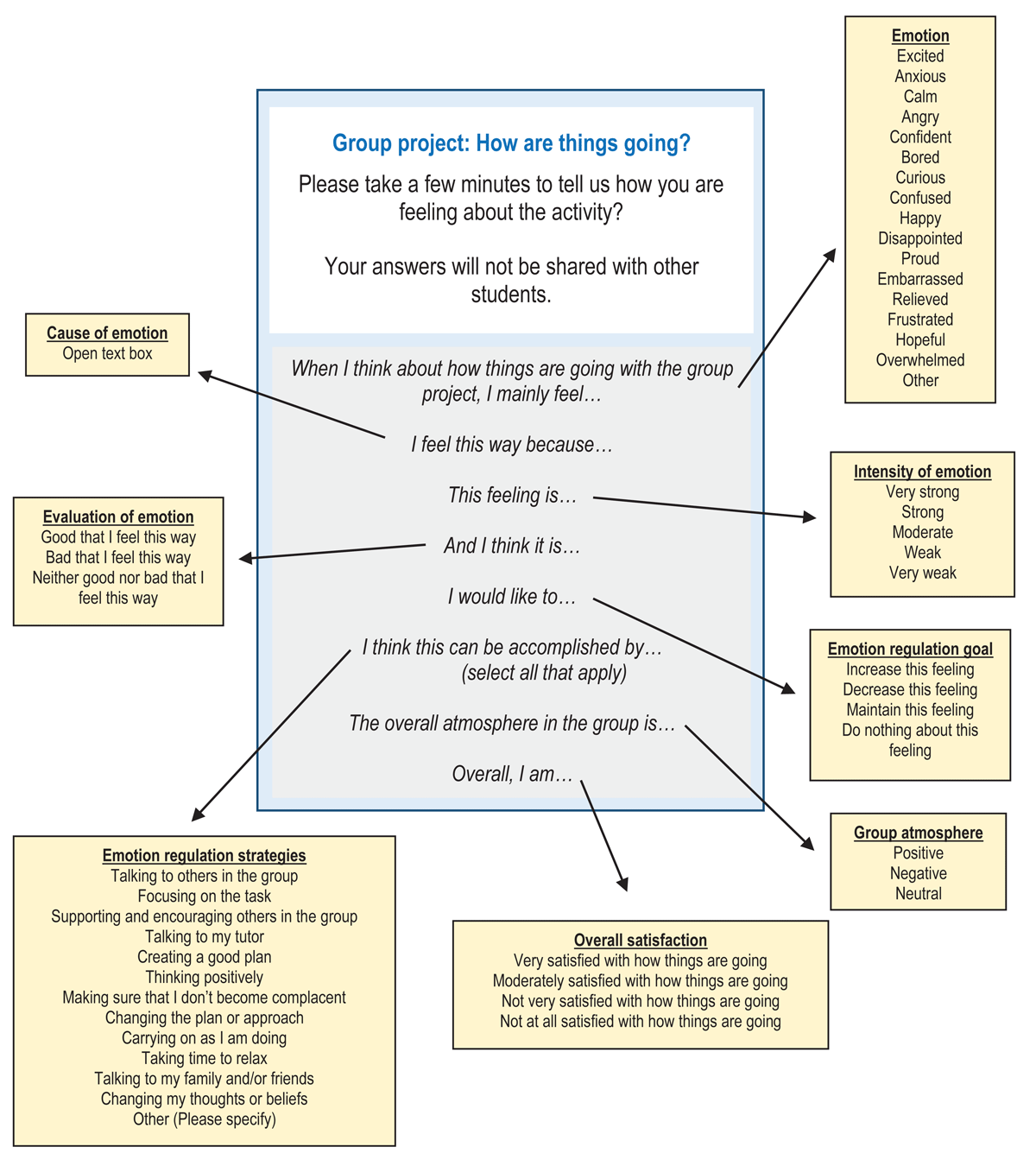
Figure 2
Statements and responses included in questionnaires during the group project (Questionnaires 2, 3, and 4).
All statements and responses included in Questionnaires 2–4 are shown in Figure 2.
After the group project
The final questionnaire is also primarily based on the SEST and includes most of the items discussed in the previous section. However, statements related to emotion regulation goals and strategies have been excluded, as the purpose of these items was to prompt regulation during collaboration rather than after it had been completed. Additionally, this questionnaire asks students to respond to four Likert-type questions about their perceptions of using the emotion awareness and regulation questionnaires. These questions explore whether the questionnaires helped them become more aware of or manage their feelings, whether they used any strategies selected in earlier questionnaires, and whether the listed strategies prompted new ideas for regulating their emotions. These questions are not included in the SEST. Each question uses a 5-point response scale, ranging from 1 (Yes, definitely) to 5 (No, definitely not). After the four questions, students are also given the opportunity to provide further information in an open-ended ‘Additional comments’ textbox.
Findings
A summary of students’ responses to key items in the questionnaires is provided below.
Over four academic years, a total of 1305 students have responded to Questionnaire 1. When asked how they felt about the forthcoming group project, the majority (51.1%) have stated that they were uncertain about the task. Fewer students have stated that they were either looking forward to the activity (26.6%) or were very worried about it (22.3%).
Emotions listed in the questionnaires during and after the project (Questionnaires 2–5) have been selected, in total, 2377 times by students. Of these, feeling anxious and frustrated have been the most reported emotions. Other commonly reported emotions by students include feeling confident, relieved, and hopeful. Figure 3 provides an overview of how frequently each emotion has been selected over the four academic years and a breakdown of which questionnaires they have been selected in.
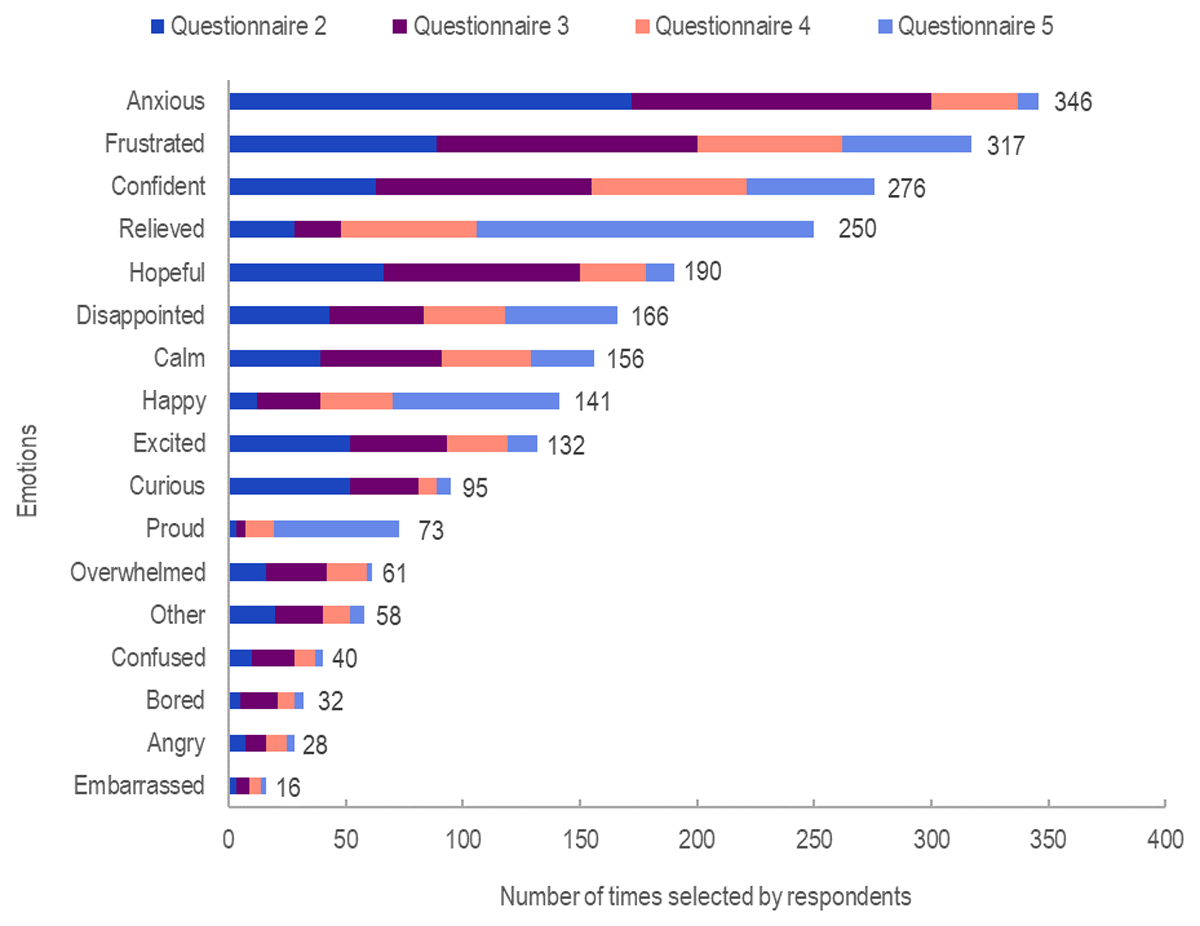
Figure 3
Emotions selected by students.
In relation to how students planned to regulate their emotions (in Questionnaires 2–4), strategies in the predefined list have been selected, in total, 4423 times. Of the strategies, talking to others in the group and focusing on the task have been the most frequently selected by students. Other strategies that have been frequently reported include supporting and encouraging other group members and thinking positively. Figure 4 provides an overview of how frequently each emotion regulation strategy has been selected in total over the four academic years.
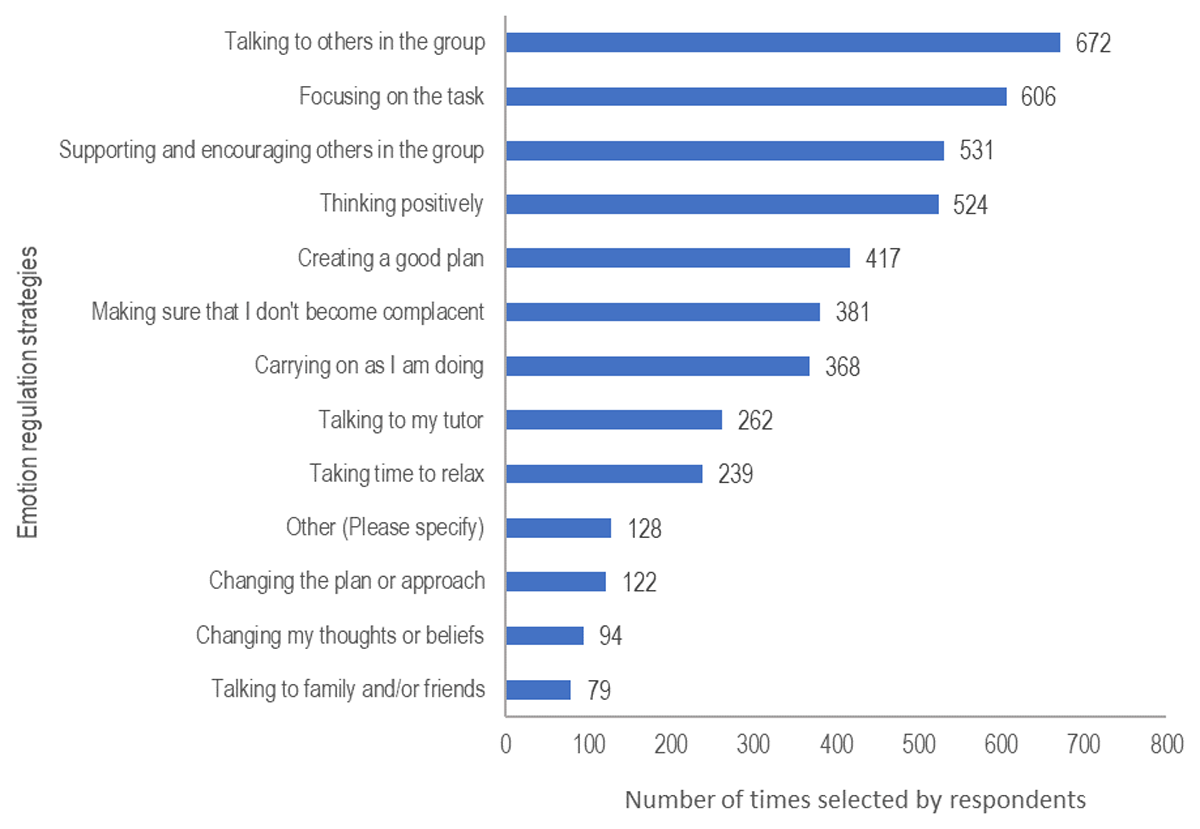
Figure 4
Emotion regulation strategies selected by students.
Students often find it challenging to regulate their emotions when learning (Harley et al. 2019), and this can be made more difficult when learning in online settings (Zhoc et al. 2022). The answers to questions evaluating students’ perceptions of the emotion questionnaires have emphasised their usefulness in supporting emotion awareness and regulation (see Figure 5). When asked whether the questionnaires made students more aware of their emotions in relation to the group project, nearly half the respondents reported that they did (47.0% of the 506 respondents over the four years selected either ‘Yes, definitely’ or ‘Yes, somewhat’). When asked if the questionnaires supported the regulation of emotions during the project, nearly a third of respondents (31.0%) reported that they did. Slightly over half of the respondents (54.7%) indicated that they had used strategies selected in the questionnaires to regulate their emotions. Furthermore, nearly half of the respondents (43.3%) indicated that the strategies listed in the questionnaires prompted new ideas for how they could regulate their emotions during the group project.
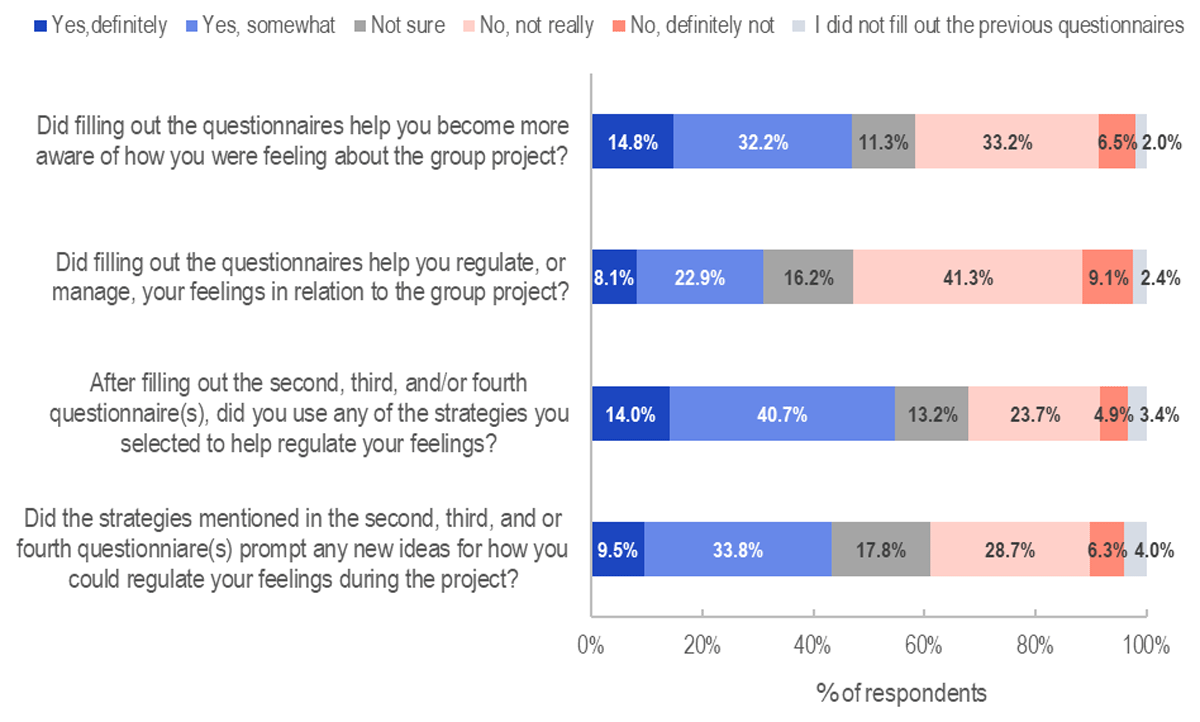
Figure 5
Students’ perceptions of using the questionnaires to support their emotion awareness and regulation.
A small number of qualitative comments (n = 46) have also been provided by students in the ‘Additional comments’ textbox at the end of the final questionnaire. A number of these have highlighted the usefulness of the questionnaires in helping students understand and regulate their emotions during the group project:
‘They’re a good checkpoint to see how we’re coping with the feelings we have about group work.’
‘The short surveys were a good way of making you think about how you actually felt, almost like someone asking how things are going’.
A few students also described how the questionnaires allowed them to express their feelings and emotions about the activity. For example:
‘They were useful in helping me to vent about certain situations. I was aware of how great the group was by writing down my feelings, but also aware of the group’s shortcomings’.
Several students emphasised how the questionnaires allowed them to reflect more generally about the group project, as well as the progress being made:
‘They were helpful in order to gather together thoughts about the project’.
‘The short surveys helped me to keep on tracking my progress’.
Although the majority of comments about the questionnaires were positive, there were a few students who indicated that they did not find them helpful for supporting their emotion regulation. For instance, one student wrote:
‘The surveys didn’t prompt ideas or affect my feelings’.
Two students also highlighted that the questionnaires had a negative impact on their emotional experiences during the activity:
‘They acted as a constant reminder that the activity was not going smoothly which was unpleasant’.
‘Attempting to follow strategies is just more work on top of the work I’m already stressing about.’
The design of the questionnaire, and how student responses could be used by the module team, were mentioned by a small number of students. This included positive comments related to the use of multiple questionnaires through the group project (before, during, and after) as well as the short length of each of the questionnaires. However, the ability to only be able to select one emotion-word in the questionnaires was viewed as a limitation by one student:
‘Picking only one word to describe your feeling at any one stage is very restrictive’.
There were also a few comments which highlighted ways in which responses to the questionnaire could be used to better support students:
‘Perhaps they [the questionnaires] could be backed up with a bit more tutor support’.
‘Try sharing the results with all students so they can see what others are actually feeling’.
Discussion and Conclusion
The purpose of the research reported in this paper was to explore the effectiveness of a new approach for supporting students’ emotion awareness and regulation during an online group project. This involved embedding several short questionnaires into the VLE of the module, with each questionnaire at a different stage of the group project. This work aimed to add to a growing line of research which has started to explore the use of digital tools to help students understand and manage their emotions when learning.
Findings from this work are encouraging as they highlight the usefulness of the questionnaires in supporting students’ emotion awareness and regulation in a naturalistic online group learning setting. For instance, nearly half of the respondents to the final questionnaire over the four-year period have stated that the questionnaires made them more aware of the emotions they were experiencing, and nearly a third stated that the questionnaires helped them regulate their emotions. These are important findings as research has shown that students who can sufficiently understand and manage their emotions will perform better academically (MacCann et al. 2020). Furthermore, being able to effectively regulate emotions is associated with positive mental health and wellbeing (Tsujimoto et al. 2024). However, care needs to be taken that questionnaires do not have a negative impact on students, as illustrated by a very small number of comments left by students.
The questionnaires described in this paper offer a practical and simple approach for supporting students’ emotion awareness and regulation when learning collaboratively online: one which could easily be adopted by other educational institutions. Although the questionnaires have been specifically used for a group project in this context, they could be adapted to suit learning situations other than group work, or could be used to support students’ emotion awareness and regulation throughout their learning journey (e.g., from the start to the end of a module or qualification).
Another key benefit of using the embedded VLE questionnaires is that student feedback is available at selected points throughout an activity, providing timely insight into students’ emotions. This information is important for educators, as previous literature has highlighted that a teacher’s ability to understand students’ emotions is essential for high-quality teaching and learning (Ez-zaouia, Tabard & Lavoué 2020; Hargreaves 2000). Furthermore, understanding the affective experiences of students in online learning settings can be extremely challenging (e.g., due to the limited emotional cues when learning online). Having access to such information allows the possibility of proactive strategies and interventions by educators, which could benefit students studying live on the module, rather than only those who will study it in subsequent academic years.
In line with previous research (Capdeferro & Romero 2012; Hilliard et al. 2019), responses to the questionnaires have highlighted that students can experience high levels of unpleasant emotions in online group projects. For instance, anxiety and frustration have been the two most frequently reported emotions by students in the questionnaires. It is important that teaching staff are aware of this so that suitable support and encouragement can be provided to students before and during online group projects. This should include trying to promote self-confidence and feelings of control in students prior to the activities (Goetz et al. 2023). Responses to the questionnaires also highlight the importance of social support for students when regulating their emotions during online collaboration. The most frequently planned emotion regulation strategy by students was ‘Talking to others in the group’ and the third most frequently reported was ‘Supporting and encouraging others in the group’. Educators should therefore endeavour to create a positive and supportive learning environment where students feel comfortable interacting with their peers and tutors, and they should ensure that suitable online spaces are provided for this to take place (Goetz et al. 2023; Linnenbrink-Garcia, Patall et al. 2016).
This paper highlights that the integration of short emotion questionnaires within the VLE pages of a module represents a promising strategy for supporting students’ emotion awareness and regulation during online group learning. This approach, which is both simple and practical, has considerable potential to be adopted by other educational institutions which offer online learning courses. By implementing strategies like the one outlined in this paper, educators can help foster emotionally healthy learning environments and develop emotionally resilient learners. Helping students to become aware of their own feelings and to think about how they can strategically engage in and adapt to challenging situations is a crucial part of developing better regulatory skills.
Limitations and Future Work
This study has several limitations that should be acknowledged. First, the research relies exclusively on self-report data, which, while essential for understanding students’ subjective experiences, may provide a limited perspective on emotion regulation (Pekrun 2020). Although self-reports are valuable for capturing personal experiences, they are vulnerable to biases such as social desirability and recall inaccuracies (Pekrun 2020). Second, the sample in this study was self-selected, introducing potential biases that may affect the representativeness and generalisability of the findings. As noted by Olsen (2008), self-selection can lead to the overrepresentation or underrepresentation of particular sub-groups within the population. Third, the study was conducted at a single institution, involving students from one specific module. As a result, the findings may not be fully applicable to students engaged in online group projects at other institutions or within different academic contexts.
Regarding the questionnaires used in this study, several refinements should be considered to enhance their effectiveness in the future. Currently, in the questionnaires during and after the group project, students are asked to select only one emotion they are experiencing; this may limit their ability to reflect on the full scope of their emotional responses. Future iterations should allow students to select multiple emotions and then focus on one that they would like to regulate. Additionally, the use of a pre-defined list of emotions may lead to other important emotions being overlooked. This could include socially related emotions, such as admiration, empathy, resentment, and gratitude, which have traditionally been underexplored in emotion research within educational settings. More recent research, however, has started to highlight the important role these emotions play in learning (Pekrun 2024), particularly within online group learning contexts (Hilliard 2022). Some rarely selected emotions in the current questionnaires, such as embarrassment, anger, boredom, and confusion, could also be removed allowing greater focus on more relevant emotional experiences to online group learning. The final questionnaire (after the group project) does not currently prompt students to plan for regulating their emotions. Including this aspect could support students in managing lingering unpleasant emotions or in prolonging pleasant feelings that are experienced during the group project, such as pride and satisfaction (e.g., by celebrating the great work they have completed).
Looking forward, several potential avenues for future research are worth exploring. First, combining self-report data with additional forms of evidence, such as trace data (i.e., data collected from students’ activities and behaviours in the VLE) or online discussion forum interactions, could provide a more comprehensive understanding of emotion regulation in online collaborative environments. Second, exploring the use of the emotion questionnaires with different groups of students, particularly disabled, neurodiverse, or students with mental health challenges, would help determine the questionnaires’ effectiveness and applicability across different student populations. Third, extending the research across multiple institutions and disciplines would allow for a more nuanced understanding of how emotion regulation functions in different contexts, while also ensuring the findings are more generalisable. Finally, future work should also investigate how educators use the information provided by these questionnaires to support students, and the types of actions and interventions that could be used to support students’ emotional wellbeing, based on this information. For example, sharing students’ collective emotional data with the group may promote empathy and reduce anxiety, particularly in the early stages of group work (Hilliard et al. 2020b).
Although there are challenges to be addressed, this research helps advance how students’ emotion awareness and regulation can be supported and improved when undertaking online collaborative projects in distance education settings. By refining the emotion questionnaires used and expanding the scope of the research, future work can make a meaningful contribution to supporting students’ emotional experiences, ultimately fostering more successful online collaborative learning outcomes.
Competing Interests
The authors have no competing interests to declare.