
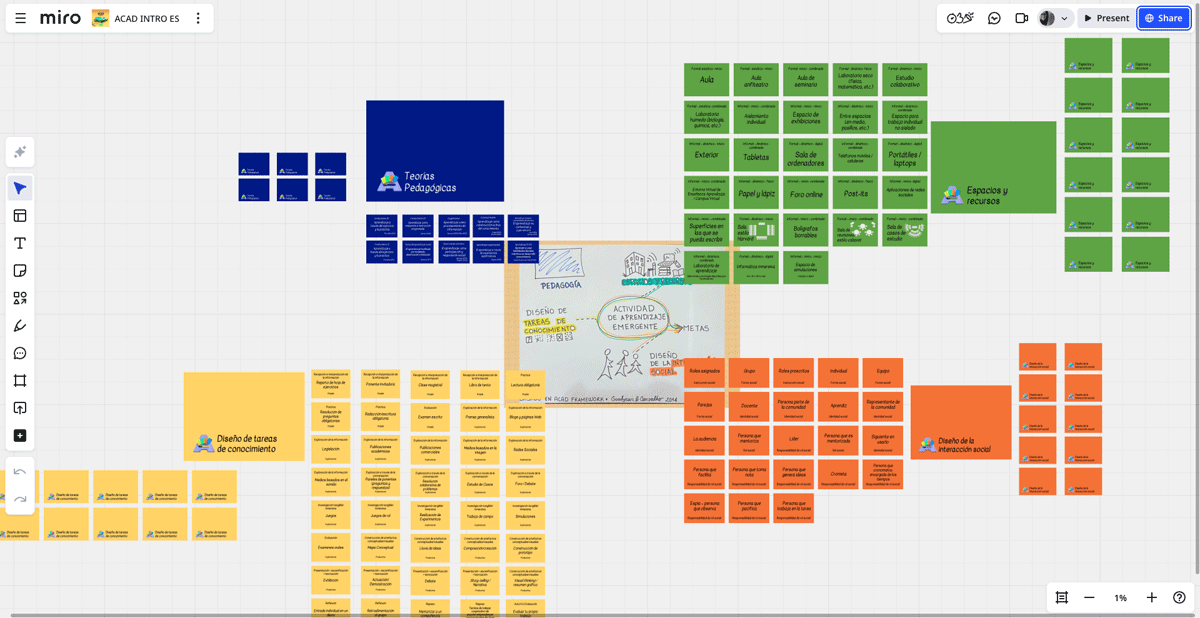
Figure 1
ACAD toolkit intro in MIRO. Authors https://miro.com/app/board/uXjVKiZ7SUE=/?share_link_id=780578369091.
Table 1
Overview of re-coded practice segments by ACAD dimension.
| EPISTEMIC DESIGN | SET DESIGN | SOCIAL DESIGN | |
|---|---|---|---|
| Segments codified in this category | 905 | 540 | 293 |
| Without duplicates | 794 | 438 | 258 |
| Appear more than once | 53 | 30 | 19 |
| Maximum of appearances | 11 | 37 | 13 |
| Minimum of repetitions | 2 | 2 | 2 |
Table 2
Elements included in the first round.
| EPISTEMIC DESIGN | SET DESIGN | SOCIAL DESIGN | |
|---|---|---|---|
| CoDiCri ACAD Toolkit Cards (round 1) | 66 (53+13) | 46 | 25 |
| Not used segments | 397 | 241 | 94 |
| % not used | 50 | 55.02 | 36.43 |
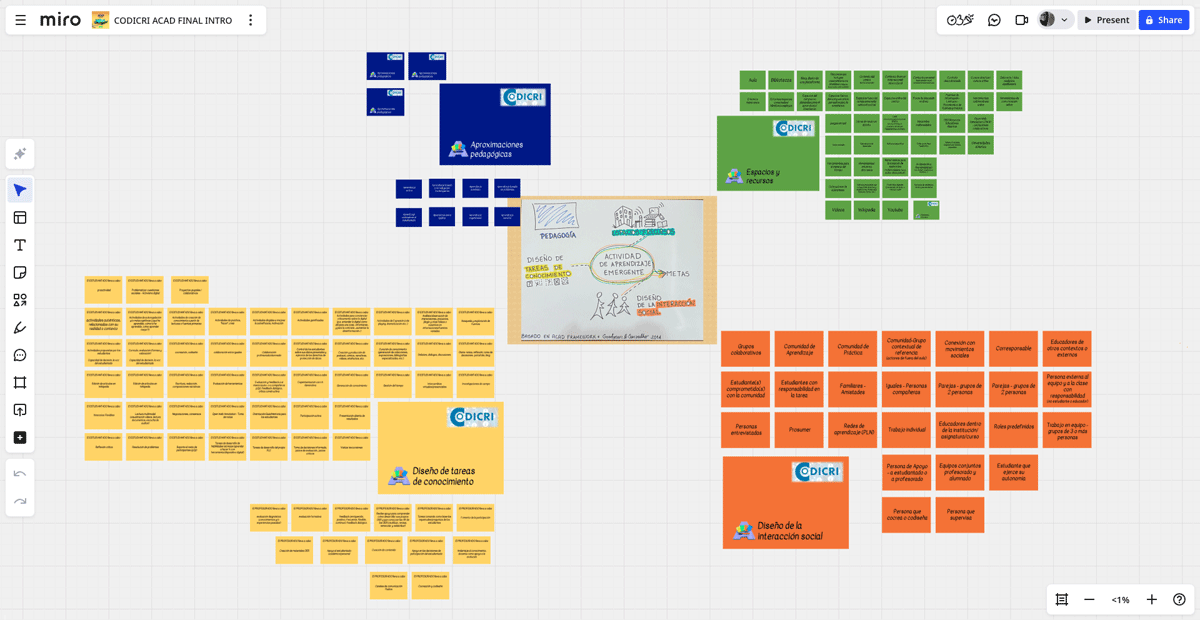
Figure 2
CoDiCri ACAD toolkit Beta into MIRO. Authors https://miro.com/app/board/uXjVKh67Bsg=/?share_link_id=128260664177.
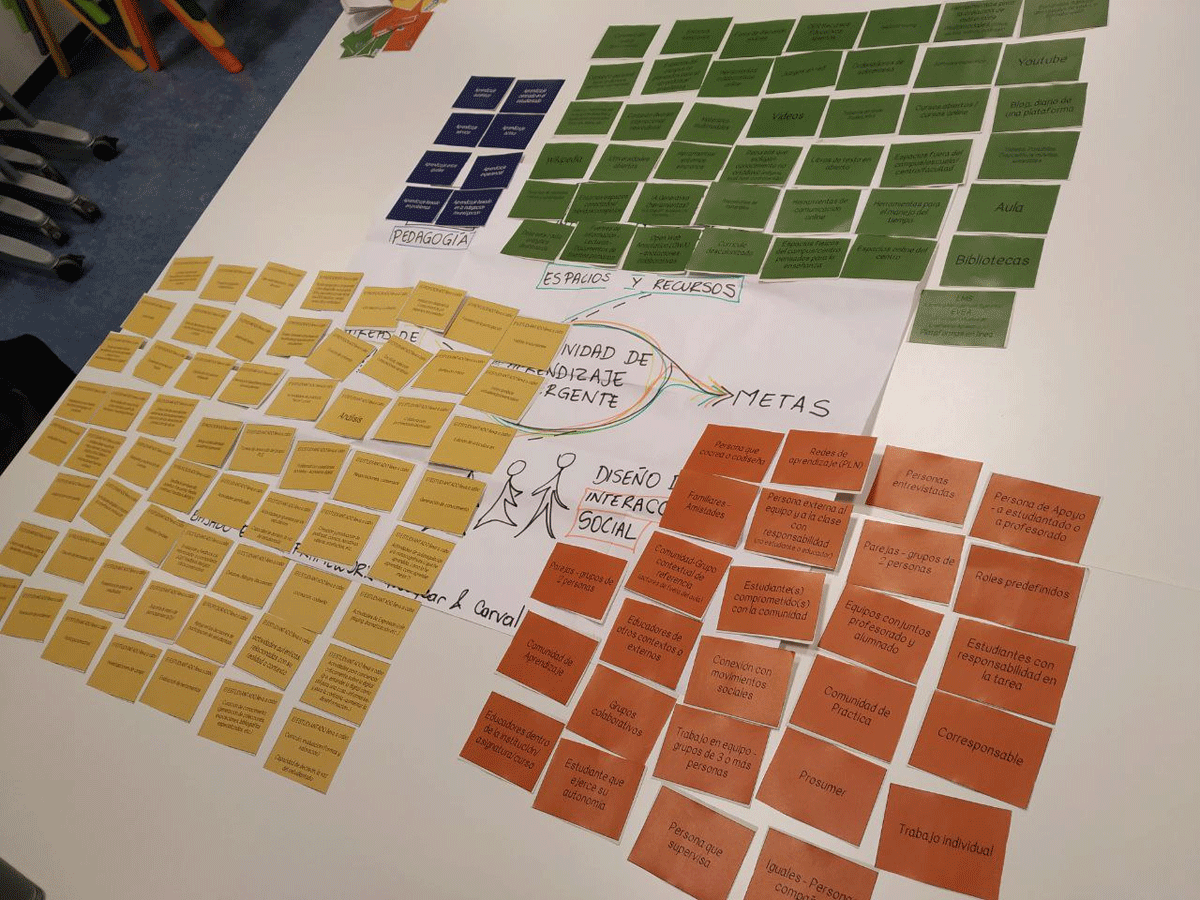
Figure 3
CoDiCri ACAD toolkit Beta. Authors.
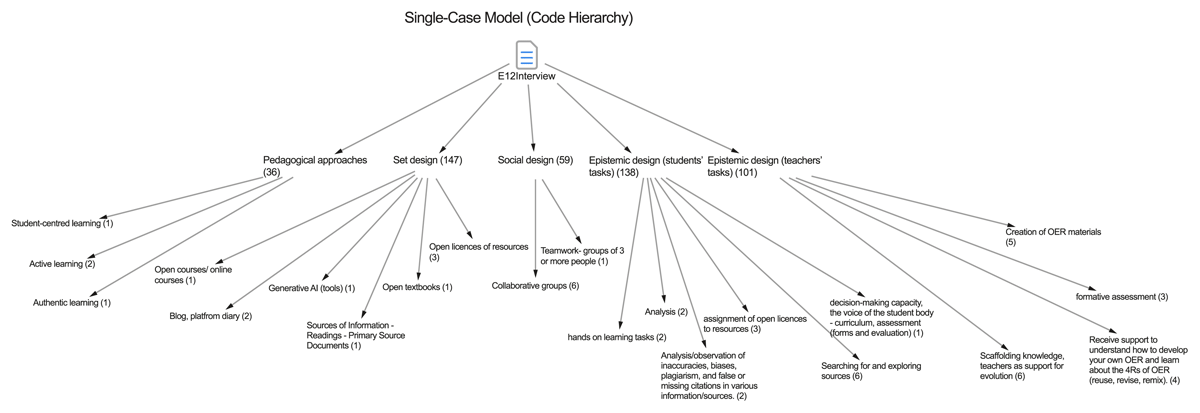
Figure 4
Single-case model (code hierarchy).
Table 3
Examples of coded excerpts illustrating the use of the CoDiCri ACAD framework in interview analysis.
| DIMENSION/CODE (n) | EXAMPLE OF CODED TEXT |
|---|---|
| Pedagogical approaches: active learning (2) | ‘When they are thinking about how to adapt the curriculum, how to create and develop activities, and how to combine methodologies, they have to combine objectives, skills, and expectations.’ (Segment 100) |
| Set design: open licences of resources (3) | ‘The blog is part of their group identity, and everything they post there will potentially be read by other teacher trainees. In the same way that they collect information and materials under a Creative Commons licence, they too are obliged to return that information through that licence.’ (Segment 82) |
| Social design: collaborative groups (6) | ‘I use them as cooperative portfolios. In these cooperative portfolios, there are many activities and many team tasks.’ (Segment 82) |
| Epistemic design – students’ tasks: searching for and exploring sources (6) | ‘I hold a special information search session, then I give them a series of open educational resource banks.’ (Segment 100) |
| Epistemic design – teachers’ tasks: scaffolding knowledge, teachers as support for evolution (6) | ‘I explain what licences are available and what advantages they offer, because what you find in open educational resource banks is usually validated by teachers. Right?’ (Segment 82) |