
1. Introduction
As digital technologies – and increasingly, artificial intelligence (AI) – continue to reshape higher education, educators face the challenge of designing learning experiences that are not only technologically enhanced but also pedagogically grounded in openness, critical engagement and student participation. In the field of learning design, numerous frameworks help educators (Bower & Vlachopoulos 2018; Goodyear, Carvalho & Yeoman 2021; Lewin, Cranmer & McNicol 2018), yet educators often lack mediating artefacts that allow them to translate principles such as critical digital competence (CDC) and student agency into the actual design of learning activities – especially within open educational practices (OEP) (Bali, Cronin & Jhangiani 2020; Castañeda & Selwyn 2018).
This article responds to that challenge by presenting the CoDiCri ACAD toolkit, developed within the Spanish research project Critical Digital Competence: Towards Agency for Learning through Open Educational Practices (CoDiCri). The toolkit is an adaptation of the Activity-Centred Analysis and Design (ACAD) toolkit (Goodyear, Carvalho & Yeoman 2021), and is designed to support the analysis and (re)design of teaching and learning practices in which openness, critical engagement with digital technologies and learner agency are central concerns.
Importantly, this work does not propose an evolution of the ACAD framework itself. Rather, it builds on ACAD’s deliberately open and non-prescriptive nature to develop a situated, context-specific adaptation, explicitly aligned with the aims of the CoDiCri project. ACAD’s conceptual strength lies precisely in its capacity to be appropriated and reconfigured without losing its integrity; the CoDiCri ACAD toolkit represents one such configuration, oriented towards CDC, OEP and agency rather than a generalisable reformulation of the framework.
The development of the CoDiCri ACAD toolkit followed a qualitative and collaborative design process, with a focus on interpretation and transformation. The process combined systematic engagement with the literature, qualitative analysis of practice-oriented materials and participatory workshops with educators and experts. This resulted in a tangible design resource – a set of cards and an associated canvas – that enables educators to examine existing practices or plan new ones through structured discussion of tasks, tools and participation structures.
In this paper, we advance three related claims. First, we argue that established learning design toolkits such as ACAD can be adapted so that values like openness, critical digital competence and student agency become explicit objects of design deliberation. Second, we present a replicable adaptation pathway – grounded in a coded corpus of practices and refined through collaborative design – that may inform similar adaptation efforts in other contexts. Third, we demonstrate the toolkit’s analytic utility by using it as a lens to map how these values are distributed across epistemic, set and social design dimensions in interview-based accounts of open educational practice.
The paper concludes by outlining implications for academic development and directions for further evaluative research, while also proposing a theoretically principled approach to contextualising open learning design frameworks through adaptation.
2. Background and Theoretical Framework
The conceptual foundation of this study lies at the intersection of three pedagogical priorities: the development of CDC, the fostering of student agency and the implementation of OEP in higher education. Each of these areas has been examined independently. Few resources explicitly guide educators in how to bring these ideas together in practical, designable ways.
Beyond technical and informational proficiency, CDC includes ethical, political and epistemic dimensions that call for critical engagement with digital infrastructures (Esteve-Mon, Postigo-Fuentes & Castañeda 2023; Marín & Castañeda 2023; Miao & Cukurova 2024; Pötzsch 2019). It involves recognising that technologies are never neutral but embody assumptions, values and power relations (Gourlay 2021; Oliver 2016). Developing CDC means designing learning experiences that invite students to interrogate the sociotechnical systems and algorithmic logics that shape their educational realities (Carvalho, Czerniewicz & Lamb 2024; Fawns 2022; Peters & Green 2024).
Student agency, meanwhile, refers to learners’ capacity to act intentionally and reflectively in their own learning processes. It is closely linked to autonomy, participation and the ability to make meaningful decisions in educational contexts (Biesta & Tedder 2007). Designing for agency requires moving beyond transmissive or procedural pedagogies and instead creating conditions where students can influence the pace and substance of their learning (Marín et al. 2025; Stenalt & Lassesen 2022). However, agency is not an individual trait but a relational phenomenon, co-constructed through interaction and constrained or enabled by institutional, social and material conditions. It therefore needs to be approached through the design of the environments and structures that make such action possible.
OEP provides a context for engaging with both CDC and agency. OEP includes the use of open resources, collaborative methodologies and participatory pedagogies aimed at expanding access to knowledge and empowering learners (Cronin & MacLaren 2018). In practice, they often involve remixing, recontextualising and co-creating learning materials, as well as connecting with broader learning communities. However, openness by itself does not ensure agency or criticality; these must be intentionally designed into educational experiences. The recent Council Recommendation on Improving the Provision of Digital Skills & Competences in Education and Training (European Council 2023) recognises openness as a strategic imperative for European higher education institutions, highlighting the need for design frameworks that help educators translate policy aspirations into pedagogical reality. As several authors note, genuinely open practices redistribute epistemic authority, positioning learners not merely as recipients but as co-creators and critics of knowledge (Bali, Cronin & Jhangiani 2020; Boulord et al. 2024; Cook-Sather 2020).
This is precisely where the field of learning design becomes crucial (Bower & Vlachopoulos 2018; Conole 2008). Learning design offers a formal yet flexible approach to planning, representing and analysing learning experiences, particularly those mediated by digital technologies (Lewin, Cranmer & McNicol 2018). It moves the focus from content delivery towards the structures and affordances of learning environments, making pedagogical intentions explicit and discussable. Among the many frameworks developed in this field, the ACAD framework (Carvalho, Castañeda & Yeoman 2023) has proven useful for conceptualising learning as the emergent outcome of student activity within designed environments.
ACAD distinguishes three interrelated layers of design: epistemic design (tasks and activities), set design (tools, artefacts and resources) and social design (arrangements for interaction and collaboration) (Goodyear, Carvalho & Yeoman 2021). These dimensions are embedded within broader pedagogical approaches and contextual constraints. The ACAD toolkit materialises this conceptual framework into a practical resource – comprising cards and a canvas – that supports educators in visualising and coordinating the components of a learning situation (Carvalho & Yeoman 2019).
The toolkit has already been translated and adapted across languages, disciplines and cultures, including Spanish-speaking contexts (Goodyear et al. 2021). It has inspired derivative tools such as those created in the DALI project, which extended ACAD to game-based learning for data literacy (Castañeda et al. 2024).
The original ACAD toolkit was developed as a deliberately flexible and open-purpose resource, adaptable to diverse contexts without being tied to a specific pedagogical framework. While this versatility allows it to accommodate priorities such as OEP, CDC and student agency, it does not explicitly articulate them. This openness – conceived as a feature rather than a constraint – provided the motivation for the present study: to explore how ACAD might be reinterpreted to explicitly address these pedagogical concerns.
Rather than replacing the ACAD model, our approach builds upon its relational and generative strengths, reorienting them towards the challenges of post-digital and open education. The outcome is a toolkit that preserves the clarity of the original framework while embedding new conceptual and practical elements that foreground questions of technology, power and participation in learning. In this sense, it is both a practical instrument for educators and a situated example of how an open-purpose learning design framework can be reconfigured to foreground openness, agency and critical engagement with digital technologies.
3. Methodology
This study followed a design-based and collaborative research approach, consistent with the CoDiCri project’s aim to develop a toolkit to support learning design around critical digital competence, student agency and open educational practices. Drawing on the principles of design-based research (Amiel & Reeves 2008; Barab & Squire 2004), the process was iterative, context-sensitive and aimed at creating a usable design.
3.1 Research Design and Context
The development of the CoDiCri ACAD toolkit took place during the second phase of the broader project CoDiCri. The project as a whole integrates theoretical exploration and practical experimentation in higher education settings, treating research and design as mutually informing activities (Goodyear, Carvalho & Yeoman 2021).
While the first phase of the project established a conceptual and empirical foundation, this second phase is focussed on transforming that knowledge into a tangible, adaptable design tool. The goal was to develop a working material that could help educators analyse and (re)design learning situations through the lenses of openness, agency and critical digital engagement.
The CoDiCri project received a positive ethical evaluation from the Research and Knowledge Transfer Ethics Committee (Comitè d’Ètica de la Recerca i la Transferència, CERT) of the Universitat de Lleida (approval code CERT69).
3.2 Phase 1: Systematic Reviews and Empirical Foundations
During the first phase, the project team conducted systematic literature reviews to explore existing educational practices connected to CDC, student agency and OEP. These reviews were carried out using the EPPI-Reviewer software (Thomas et al. 2020) and resulted in the identification and coding of 1255 segments of practice descriptions. These segments were further classified based on their relevance to (1) direct implementation of one of the three concepts, (2) the intersection between concepts (e.g., CDC and agency), (3) or the prerequisites for each.
In parallel, a series of interviews with higher education educators implementing OEP in Spanish universities provided concrete examples of practice and served as a dialogic basis for later stages of development. These conversations offered rich descriptions of how openness, agency and critical digital literacy were being enacted in diverse institutional contexts, forming an interpretive bridge between conceptual insights and design translation.
3.3 Phase 2: Toolkit Development and iterative refinement
The first step was a collaborative workshop devoted to deconstructing the original ACAD framework. Using a digital Miro version of the ACAD toolkit, participants explored how its dimensions – epistemic, set and social design, along with pedagogical approaches – could be reinterpreted to align with the aims of CoDiCri. This stage established a shared conceptual understanding and highlighted areas requiring adaptation or expansion.
Next, the team recoded the previously identified practice segments, assigning each to one or more ACAD dimensions: epistemic design (student and teacher tasks), set design (resources and tools) and social design (interactional structures).
A second expert review workshop invited specialists to discuss and refine these draft elements. Working in pairs, experts who were not involved in codifying compared included and excluded segments, proposed rewordings and identified overlaps or gaps. This dialogic validation resulted in a refined set of cards and a beta version of the toolkit, again hosted on Miro for collaborative use.
Finally, the beta version was explored in a usability and reflection session with a group of educators. Participants analysed an existing open educational practice (previously drawn from the interviews) using the toolkit to articulate how openness, agency and critical digital engagement appeared in its design. The goal of this exercise was not convergence of interpretation, but shared reflection on the toolkit’s clarity, coverage and usefulness for pedagogical enquiry. The insights gathered informed the final set of adjustments before release.
3.4 Methodological Contribution
This process shows how design-based methodologies can support the co-creation of educational design tools that are both conceptually grounded and practically usable. Methodological development and artefact construction evolved together in a continuous dialogue between theory, interpretation and practice.
In this sense, the development of the CoDiCri ACAD toolkit represents not only a design outcome but also a methodological stance: one that treats design as a form of enquiry and collaboration, and that values qualitative, interpretive engagement with educators’ practices.
4. Development of the CoDiCri ACAD Toolkit
The development of the CoDiCri ACAD toolkit combined critical reflection on existing design frameworks with the practical reworking of their components. The goal was to produce a resource that could help educators analyse and (re)design learning practices through the lenses of openness, agency and CDC.
The process unfolded across several iterative cycles, conducted entirely online. The first stage consisted of a collective exploration of the original ACAD toolkit, using a digital Miro version (Figure 1). During this workshop, team members examined how ACAD’s core dimensions – epistemic, set and social design, plus the overarching pedagogical approach – could be meaningfully connected with the aims of the CoDiCri project. This step allows participants to identify points of alignment and areas requiring reconceptualization.
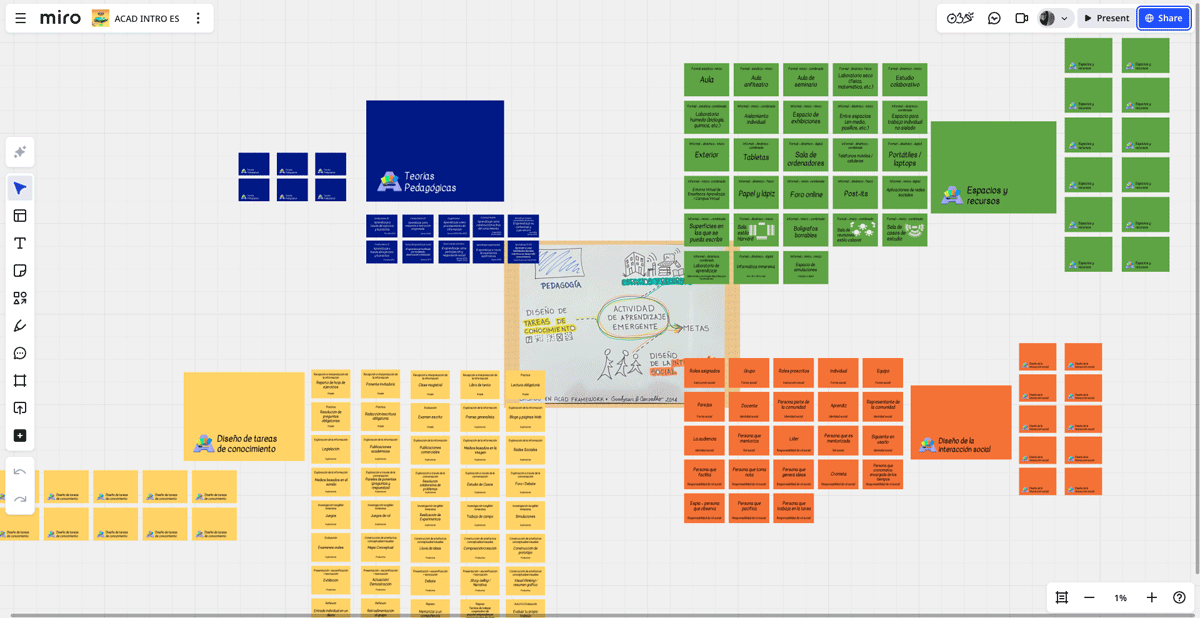
Figure 1
ACAD toolkit intro in MIRO. Authors https://miro.com/app/board/uXjVKiZ7SUE=/?share_link_id=780578369091.
Building upon that shared understanding, the team returned to the corpus of 1,255 coded practice segments identified during the project’s earlier phase. Each segment was revisited and re-coded through the ACAD dimensions. The re-coding process yielded 794 unique epistemic design elements, 438 set design elements and 258 social design elements (Table 1 summarises the number of coded segments and their categorisation across the three ACAD dimensions).
Table 1
Overview of re-coded practice segments by ACAD dimension.
| EPISTEMIC DESIGN | SET DESIGN | SOCIAL DESIGN | |
|---|---|---|---|
| Segments codified in this category | 905 | 540 | 293 |
| Without duplicates | 794 | 438 | 258 |
| Appear more than once | 53 | 30 | 19 |
| Maximum of appearances | 11 | 37 | 13 |
| Minimum of repetitions | 2 | 2 | 2 |
Rather than aiming for exhaustive representation, the team sought a coherent and pedagogically meaningful repertoire that could inform the creation of the toolkit cards. Table 2 presents the distribution of elements included in the first round of card construction.
Table 2
Elements included in the first round.
| EPISTEMIC DESIGN | SET DESIGN | SOCIAL DESIGN | |
|---|---|---|---|
| CoDiCri ACAD Toolkit Cards (round 1) | 66 (53+13) | 46 | 25 |
| Not used segments | 397 | 241 | 94 |
| % not used | 50 | 55.02 | 36.43 |
Segments that appeared repeatedly across sources were prioritised as indicators of recurrent practices, while isolated examples were examined for their conceptual distinctiveness. Some were merged into broader categories (e.g., variations of collaborative project work), while others were reformulated to highlight critical or open dimensions. In this stage, each potential card represented a small design decision about what aspects of learning should be made visible and discussable.
A second expert co-design workshop focussed on refining these initial sets of cards. Working in pairs, project collaborators discussed phrasing, overlaps and omissions, drawing from their own experiences of learning design and open practice. This resulted in a beta version of the CoDiCri ACAD toolkit, which was built once again on Miro to support collective editing and testing (Figure 2).
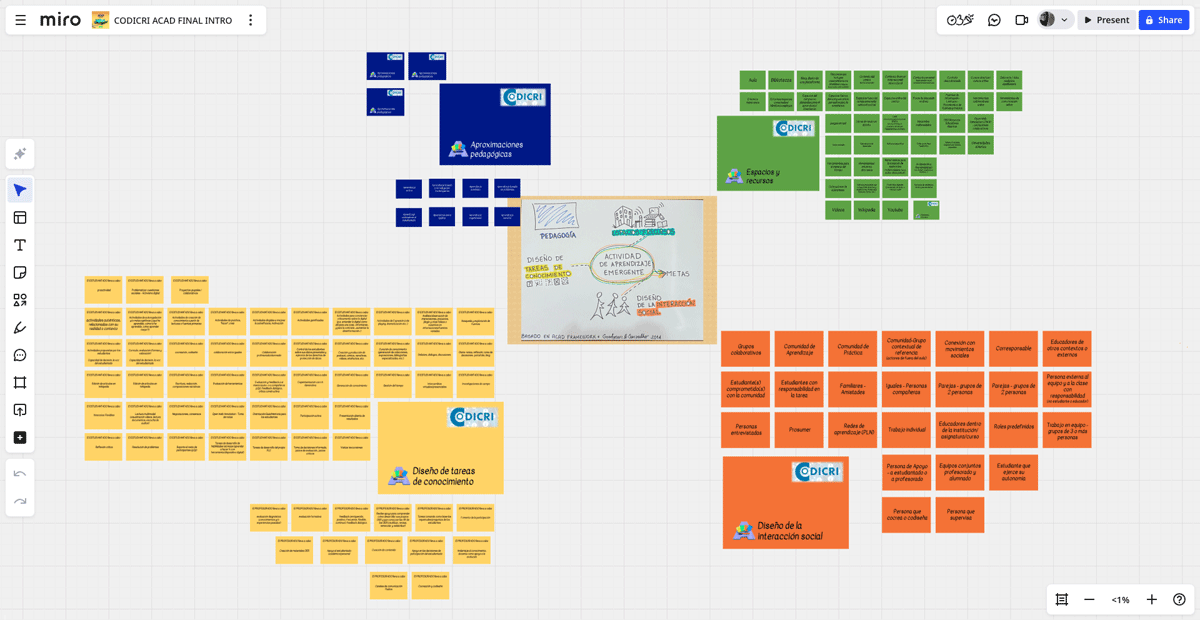
Figure 2
CoDiCri ACAD toolkit Beta into MIRO. Authors https://miro.com/app/board/uXjVKh67Bsg=/?share_link_id=128260664177.
The beta version was then explored. Participants used the toolkit to analyse an authentic learning design previously collected in the project’s interview phase. The exercise functioned both as a usability test and as a space for interpreting the design. Educators were encouraged to discuss which cards they found most resonant, which dimensions felt underrepresented, and how the toolkit supported their understanding of openness, agency and criticality. The focus was on identifying the affordances and tensions of the toolkit as a mediating artefact.
Insights from this session led to final adjustments, including the simplification of overlapping elements, the addition of clarifying examples and the inclusion of a small set of cards addressing pedagogical approaches – a new category. At this stage, the epistemic design element was further refined by distinguishing between student tasks and teacher tasks, allowing for greater clarity in the representation of learning and teaching activities. This resulted in eight additional cards capturing ideas such as authentic learning, participatory assessment and critical engagement with technology.
Available both as a MIRO-based digital version and as a ‘print and play’ PDF, it includes the full card sets, a visual canvas for mapping learning designs and an introductory guide. The design deliberately remains open as in the original ACAD Toolkit: several blank cards are provided for users to create their own elements, recognising that learning design is a situated, evolving and collective practice (Agbo et al. 2021; Mor et al. 2015; Schön 1984).
In this sense, the CoDiCri ACAD toolkit embodies not only a product of research but also an invitation to dialogue – a practical demonstration of how frameworks like ACAD can be reconfigured through collaborative interpretation, responding to the changing ethical and pedagogical priorities of post-digital higher education.
5. The Toolkit: Description and Features
The final version of the CoDiCri ACAD toolkit represents the last stage of a process that combines both conceptual coherence and practical usability. While it remains structurally faithful to the original ACAD toolkit, its content has been reinterpreted to reflect the pedagogical priorities of CDC, student agency and OEP.
In total, the CoDiCri ACAD toolkit comprises 60 cards related to epistemic design, 43 to set design, 25 to social design and 8 to pedagogical approaches (Figure 3). Within the epistemic dimension, a distinction is made between tasks performed by learners and those undertaken by educators, acknowledging the different forms of activity that shape a learning situation. This dual focus operationalises interest in agency not merely as a learner attribute but as a relational and distributed process supported by co-construction through design.
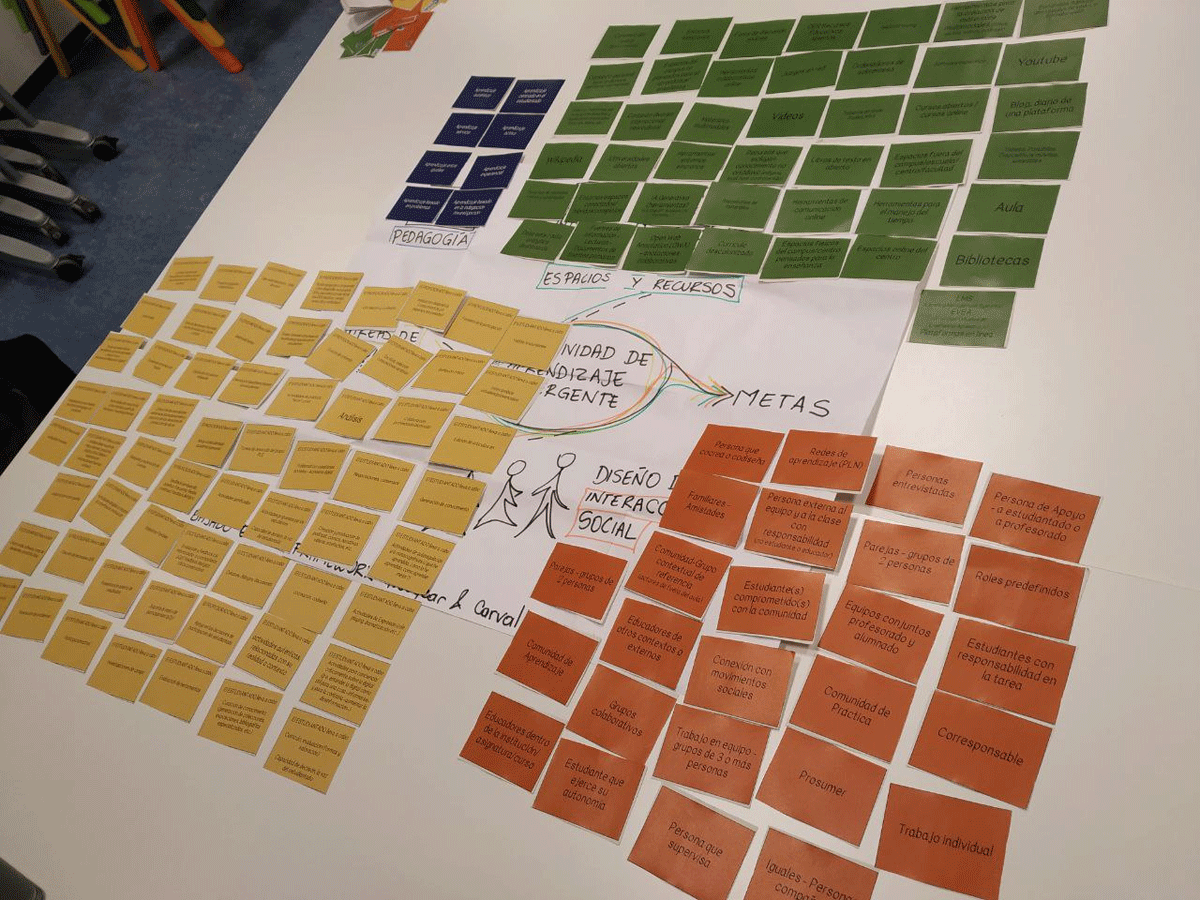
Figure 3
CoDiCri ACAD toolkit Beta. Authors.
The cards grouped under set design refer to resources, tools, environments, materials and spatial conditions of implementation, many of which are explicitly linked to open education. They include elements such as open repositories, collaborative platforms, remixable content formats, and include cards that support explicit consideration of generative AI tools as part of set design. Rather than treating AI as a separate domain, the toolkit embeds it within the broader ecology of learning environments to be critically examined as part of the design process.
Social design cards address the organisation of interaction and collaboration. The diversity of this category reflects both the empirical material analysed and the project’s emphasis on participatory and co-creative practices. Several cards explicitly challenge conventional teacher–student roles, inviting educators to design configurations that distribute responsibility and power more equitably across the learning community.
The fourth dimension – pedagogical approaches – emerged during the final refinement stage. It comprises eight cards that articulate the underlying educational philosophies guiding design decisions. These include orientations such as authentic learning, critical pedagogy, participatory assessment and reflective enquiry. Their inclusion recognises that every learning design carries implicit values and assumptions, which the toolkit encourages educators to make explicit and discussable.
As in the original ACAD version, the cards are intended to be used in combination with a central canvas that supports the visual organisation of a learning activity. Cards can be combined, the meaning can be negotiated by users, who collectively reflect on the coherence of the design. Several blank cards are also provided in each category to allow for contextual additions, reinforcing the idea that the toolkit is not prescriptive but generative and open-ended.
The CoDiCri ACAD toolkit is currently available in two formats: a digital version hosted on the Mural platform (due to Miro platform constrains), made available through editable access links provided by the project team, and a print-and-play PDF package. The latter includes the cards, the canvas and a concise introductory guide with examples of use. Both versions are openly licenced under Creative Commons and can be accessed through the CoDiCri project website and the University of Lleida institutional repository. The full ‘print & play’ version – including the complete set of cards, the design canvas and an introductory guide – is openly available for download at https://hdl.handle.net/10459.1/467571. Materials can be adapted, translated, or remixed to fit different educational contexts. Although the materials are currently in Spanish, their conceptual structure allows easy translation and adaptation to other linguistic and cultural contexts.
Overall, the CoDiCri ACAD toolkit maintains the conceptual integrity of the ACAD framework while extending its scope and pedagogical relevance. It provides educators with a tangible, flexible and openly available resource for engaging with complex goals such as openness, agency and critical engagement with digital technologies – without reducing these dimensions to technical checklists or isolated features.
6. Illustrating Analytic Use of the CoDiCri ACAD Framework for Analysis Tasks
The use of the CoDiCri ACAD framework for analysing educational practice was integrated into the toolkit’s own construction process. This section does not report an evaluation of the toolkit’s effectiveness. Instead, it illustrates its analytical affordances by showing how the emerging categories can be used as an interpretive lens to analyse interview accounts of open educational practice. The illustration is included to demonstrate analytic tractability and interpretability, not impact.
Thirteen interviews with higher education lecturers from diverse Spanish universities served as the analytical corpus. All participants were recognised for their engagement with OEP and were invited to discuss how they design for openness, student agency and CDC. Their professional profiles were intentionally diverse, ranging from ten to over thirty years of teaching experience and representing multiple disciplines, although social sciences were the most frequent field.
All participating educators were informed about the aims of the study, the use of the data for research purposes, and their right to withdraw at any time. Written informed consent was obtained from all interviewees prior to data collection. Due to ethical and confidentiality constraints, the interview transcripts are not publicly available. De-identified extracts supporting the findings are included in the manuscript; further materials can be requested from the corresponding author, subject to ethical approval.
A team of four researchers carried out the interviews, transcription reviews and analysis using the CoDiCri ACAD coding scheme derived from the toolkit. The process was designed as a collaborative interpretive exercise rather than a mechanical coding task. Each researcher independently analysed one interview using the preliminary code set; findings were then discussed in synchronous online meetings to reach shared understandings about the meanings of segments and codes. After agreement on the interpretive framework, the remaining interviews were distributed among researchers, who later reconvened to review questions, refine interpretations and discuss the emerging structure.
To illustrate this process, the following example presents the analysis of one interview used as a reference case for team discussion. The participant was a male lecturer in Teacher Education at a university, on Spain’s east coast, with a long trajectory in OEP and a strong commitment to collaborative pedagogies. The 45-min conversation was structured around three themes: personal and professional profile, the design of two OEP and perceived enablers and barriers for mainstreaming openness in higher education.
Using the CoDiCri ACAD coding structure, his two practices were mapped across all framework dimensions. As visualised in the single-case model (Figure 4), codes appeared throughout the four dimensions: 36 under pedagogical approaches, 147 under set design, 59 under social design and 239 under epistemic design – the latter divided into students’ tasks (138) and teachers’ tasks (101). While the numerical distribution is not the focus, the diversity of occurrences indicates how each dimension of the toolkit found resonance in the participant’s descriptions.
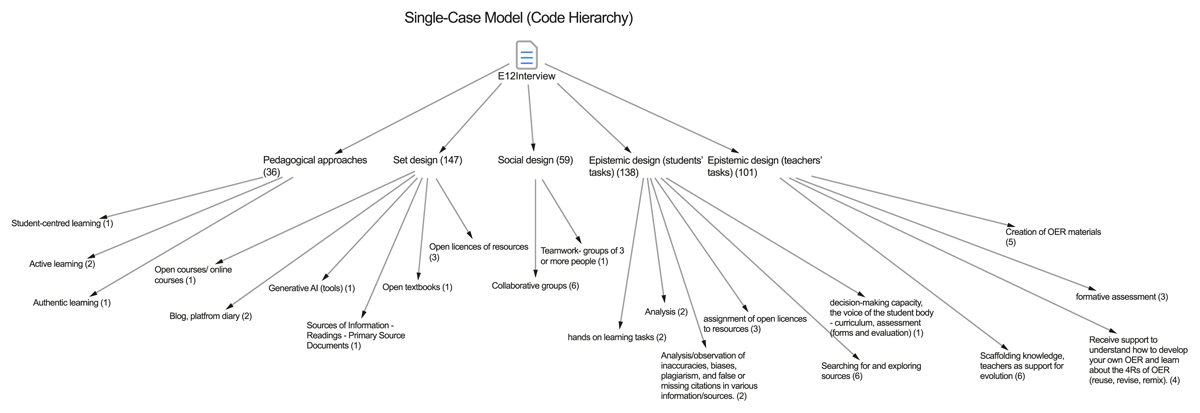
Figure 4
Single-case model (code hierarchy).
This single case helps to illustrate how the toolkit captures the layered structure of pedagogical design and makes visible the interplay between material, social and epistemic elements in practice.
The participant’s designs can be summarised as follows:
Pedagogical approaches: Both practices were grounded in student-centred and authentic learning principles.
Set design: Online and onsite environments integrated open licences, blogs as reflective diaries, open courses, generative AI tools and open textbooks as key resources.
Social design: Collaboration was central, with students working in teams of more than three to develop shared outputs.
Epistemic design – Students’ tasks: Most frequent codes corresponded to searching and exploring sources, applying open licences and engaging in hands-on enquiry and analysis. Students were also given opportunities to make decisions about curriculum and assessment.
Epistemic design – Teachers’ tasks: Fewer codes appeared here, focussing mainly on scaffolding, formative support, creating OER and understanding licensing implications.
Table 3 provides examples of coded text fragments, illustrating how the framework connects discourse and design.
Table 3
Examples of coded excerpts illustrating the use of the CoDiCri ACAD framework in interview analysis.
| DIMENSION/CODE (n) | EXAMPLE OF CODED TEXT |
|---|---|
| Pedagogical approaches: active learning (2) | ‘When they are thinking about how to adapt the curriculum, how to create and develop activities, and how to combine methodologies, they have to combine objectives, skills, and expectations.’ (Segment 100) |
| Set design: open licences of resources (3) | ‘The blog is part of their group identity, and everything they post there will potentially be read by other teacher trainees. In the same way that they collect information and materials under a Creative Commons licence, they too are obliged to return that information through that licence.’ (Segment 82) |
| Social design: collaborative groups (6) | ‘I use them as cooperative portfolios. In these cooperative portfolios, there are many activities and many team tasks.’ (Segment 82) |
| Epistemic design – students’ tasks: searching for and exploring sources (6) | ‘I hold a special information search session, then I give them a series of open educational resource banks.’ (Segment 100) |
| Epistemic design – teachers’ tasks: scaffolding knowledge, teachers as support for evolution (6) | ‘I explain what licences are available and what advantages they offer, because what you find in open educational resource banks is usually validated by teachers. Right?’ (Segment 82) |
This exercise demonstrated through application how the CoDiCri ACAD framework can operate not only as a tool for design but also as an analytical lens for understanding educational practices. Its categories encourage researchers and educators alike to interpret teaching and learning situations as ecologies of interrelated decisions, where openness, agency and critical digital engagement are distributed across tasks, resources, relationships and pedagogical intentions.
The purpose of this illustration is methodological: to demonstrate how the emerging categories function as an analytic lens. It is not presented as evidence of impact or as a basis for generalisation.
7. Discussion
The development of the CoDiCri ACAD toolkit illustrates how open-purpose learning design frameworks can be locally adapted, without implying a new version of the underlying model. Building on the structure and theoretical grounding of the original ACAD framework, this adaptation reconfigures it around contemporary priorities – namely, designing for student agency, CDC and openness. Learning design toolkits vary in what they make salient for designers – whether they foreground sequencing and orchestration, or the values and participation conditions embedded in design decisions. Unlike toolkits primarily oriented towards sequencing activities or representing instructional flow, the CoDiCri ACAD adaptation is explicitly designed to surface questions of agency, openness and critical digital engagement as objects of design deliberation. In doing so, it extends ACAD’s analytical reach from representing the architecture of learning activities to surfacing their underlying values and power relations.
One of the main contributions of the CoDiCri ACAD toolkit lies in its ability to operationalise concepts that are often treated as aspirational in educational discourse. While ‘agency’ or ‘criticality’ frequently appear in policy and scholarly rhetoric, they often remain under-specified in design processes (Bali, Cronin & Jhangiani 2020; Cook-Sather 2020; Biesta 2013; Marín et al. 2025). The toolkit helps educators render these dimensions visible and actionable, encouraging them to question who acts, with what tools and under what conditions (Esteve-Mon, Postigo-Fuentes & Castañeda 2023). By making such questions central, the CoDiCri ACAD Toolkit pushes learning design closer to an ethical and political practice – one that acknowledges how pedagogical choices materialise particular views of knowledge, authority and participation (Bower & Vlachopoulos 2018; Conole 2008).
From this perspective, learning design can be approached as a shared space for making assumptions about tasks, tools and participation explicit and discussable (Carvalho & Goodyear 2018; Chan & Stacey 2022; Gartner & Wagner 1996). This provides a rationale for understanding the CoDiCri ACAD configuration as a reflective design aid that supports deliberation about how learning activities are structured within digitally mediated and institutionally situated contexts (Gourlay 2023; Peters, Besley & Jandrić 2018).
The inclusion of open educational practices (OEP) as a central focus also invites a re-examination of openness itself. Openness has long been celebrated as a value in higher education, yet it can easily become depoliticised – reduced to access to materials or compliance with licencing (Cronin 2020). The CoDiCri ACAD toolkit helps educators engage with openness as a pedagogical stance that involves redistribution of epistemic authority and co-construction of knowledge (Bali, Cronin & Jhangiani 2020). Its categories encourage the design of learning environments where students are not merely consumers of open resources but co-creators and critics within open networks.
In parallel, embedding AI-related considerations within the toolkit (rather than isolating them) signals a move towards understanding digital infrastructures as conditions of possibility for learning. Rather than treating AI as an external ‘add-on,’ the framework invites educators to problematise its use – to question how automation, datafication and algorithmic mediation influence both content and agency (Castañeda & Williamson 2021; Knox, Williamson & Bayne 2020; Selwyn 2022). This reflects a broader pedagogical imperative: that of cultivating critical digital awareness as a shared responsibility in the design process, not a post-hoc reflection.
Methodologically, the development of the CoDiCri ACAD toolkit exemplifies an approach to learning design as enquiry (Goodyear, Carvalho & Yeoman 2021; Lewin, Cranmer & McNicol 2018; Mor et al. 2015). The process demonstrates how design-based methodologies can be enacted not as controlled experiments but as collective meaning-making practices. Each iteration – literature analysis, co-design workshops and reflective applications – functioned as a dialogic encounter in which theory and practice informed one another. In this sense, the toolkit is both an artefact and a record of how educational knowledge can be co-produced through design.
From a sociotechnical perspective, this orientation resonates with approaches such as the Theory of Practice Architectures (TPA), which conceptualises learning design as a situated practice shaped by cultural-discursive, material-economic and social-political arrangements (Olney & Wood 2023). While the CoDiCri ACAD toolkit does not adopt TPA as an analytical framework, it aligns with this view by prompting reflection on how tasks, tools and participation structures condition what can be said, done and related in practice.
This collaborative orientation has important implications for academic development and professional learning. By externalising and naming the components of pedagogical design, the toolkit provides educators with a shared language for discussing decisions that are often implicit – about technology, participation and assessment.
The CoDiCri ACAD toolkit also opens new avenues for qualitative analysis of educational practices. It can be used to examine how designs embody or constrain openness, agency, or critical digital engagement, offering a structure that balances analytical rigour with interpretive flexibility. In this sense, the toolkit operates not only as a pedagogical resource but also as a research lens – a bridge between the descriptive and the normative dimensions of educational design.
At a broader level, the project illustrates how learning design frameworks can be re-oriented through situated adaptation to address the ethical, epistemic and social challenges of the post-digital university. As higher education navigates tensions between automation and autonomy, scale and intimacy, innovation and care, design tools like CoDiCri ACAD can help educators reassert pedagogical intentionality and ethical reflexivity at the heart of digital transformation (Castañeda & Williamson 2021; Peters, Besley & Jandrić 2018).
In sum, the CoDiCri ACAD toolkit embodies a move from describing learning to questioning how learning is structured and for whom. It bridges theory and practice, fostering critical dialogue about the purposes and consequences of design decisions. At a time when higher education faces accelerating technological change and growing pressure for efficiency, such reflective, open and participatory approaches to design – when mediated through concrete tools such as CoDiCri ACAD’s cards and canvas – may provide a counterbalance – recentring values, agency and collective deliberation as the foundations of digital pedagogy.
8. Conclusions and Future Work
The CoDiCri ACAD toolkit emerges as both a conceptual adaptation and a practical extension of the ACAD learning design framework, adapted to respond to pressing pedagogical challenges in the digital era. It integrates concerns that are central but often undertheorized in conventional instructional planning – namely, the promotion of student agency, critical digital competence (CDC) and open educational practices (OEP) – into a usable, flexible and theoretically grounded design tool.
Developed through an iterative and collaborative design process, the toolkit has been conceived not as a technical artefact but as a pedagogical mediation device: a means to foster intentional reflection about the dimensions, relationships and infrastructures that shape learning. It maintains the structure of the original ACAD framework while reconfiguring its content to support practices rooted in openness, ethical digital engagement and learner participation. In this sense, it does not merely ‘add cards’ to an existing model – it shifts the gaze towards the kind of learning for which we design.
From a pedagogical standpoint, one of the toolkit’s core strengths lies in its capacity to make visible dimensions of learning that often remain implicit or marginalised in design processes. By including elements that address the social and ethical dimensions of educational practice, it encourages educators to reflect not only on what students do, but on how and with whom they do it and under what technological and institutional conditions. By embedding references to generative AI and other digital infrastructures, it invites an ongoing critical dialogue about the implications of automation, authorship and epistemic responsibility in teaching and learning.
At the same time, the project carries certain limitations that should be acknowledged. The toolkit’s current version reflects the context and expertise of a specific research team working primarily within Spanish higher education; while this grounding enhances contextual depth, it may also limit its immediate transferability to other educational or cultural settings without further adaptation. The exploratory application of the toolkit involved a relatively small number of participants, which allowed for depth and iteration but not for generalisation. Similarly, the coding structure – though validated through collaborative use – remains open to refinement as new practices and technologies reshape the landscape of openness and critical digital education. Finally, as with any framework that structures pedagogical reflection, there is an inherent tension between guidance and prescription: while the CoDiCri ACAD toolkit seeks to enable critical and creative design, its very structure may influence how educators conceptualise agency or openness. These limitations, however, are understood as productive constraints – invitations for dialogue, adaptation and further research.
Methodologically, the development process demonstrates how design-based approaches can generate reusable yet locally adaptable resources. The CoDiCri ACAD toolkit provides a concrete example of how learning design frameworks can be reoriented towards emerging educational values without losing conceptual coherence. This approach may inspire other researchers or educators seeking to adapt existing tools to underrepresented domains such as sustainability, epistemic justice, or inclusion, opening pathways for the co-creation of context-sensitive design materials.
Currently, the toolkit is being employed in ongoing analyses of educational practices and in the redesign of learning activities in teacher education programmes. These applications are consolidating its dual function – as both a design instrument and an analytical lens. By offering a shared vocabulary and structure for reflection, the toolkit can support comparative studies, collaborative curriculum planning and professional development initiatives focussed on critical pedagogy and digital ethics.
Looking ahead, future research should engage with the toolkit across a broader range of disciplines, languages and educational levels, particularly in fields where AI and datafication are transforming pedagogical logics. Longitudinal studies could explore how sustained use of the toolkit shapes educators’ design practices, understandings of openness, or approaches to fostering student agency. Further work may also examine how institutional cultures and policies mediate the uptake of open and critical design approaches, thus connecting micro-level pedagogical reflection with broader questions of governance and ethics in higher education. Additionally, future research may build on this work by operationalising questions of epistemic authority through complementary methods, including analysis of student artefacts, participation patterns, or longitudinal design studies.
In short, the CoDiCri ACAD toolkit can be understood as a concrete adaptation of the ACAD framework that supports reflective discussion about how learning activities are designed under conditions of digital mediation and institutional constraint. Rather than offering prescriptive solutions, it provides a shared language and set of prompts through which educators can examine how openness, agency and critical digital engagement are configured in practice. As an openly licensed and localisable resource, the toolkit aligns with the 2023 Council Recommendation on the uptake of Open Educational Resources and Practices, offering a practical contribution to ongoing efforts to support inclusive and reflective approaches to digital education in European higher education.
Acknowledgements
The authors wish to acknowledge the wider CoDiCri project team for their ongoing intellectual and collaborative contribution to the development of the ideas, materials, and discussions that made this work possible. We are also deeply grateful to all colleagues, educators, and experts involved in the different stages of the design, review, and refinement of the CoDiCri ACAD Toolkit, whose critical feedback and generous engagement significantly enriched the process. Our thanks also go to the lecturers who participated in the interview study and, especially, to those whose practices informed the case-based illustration included in this article. Finally, we warmly thank the anonymous reviewers for their careful reading and constructive comments, which have helped improve the clarity and quality of the manuscript.