
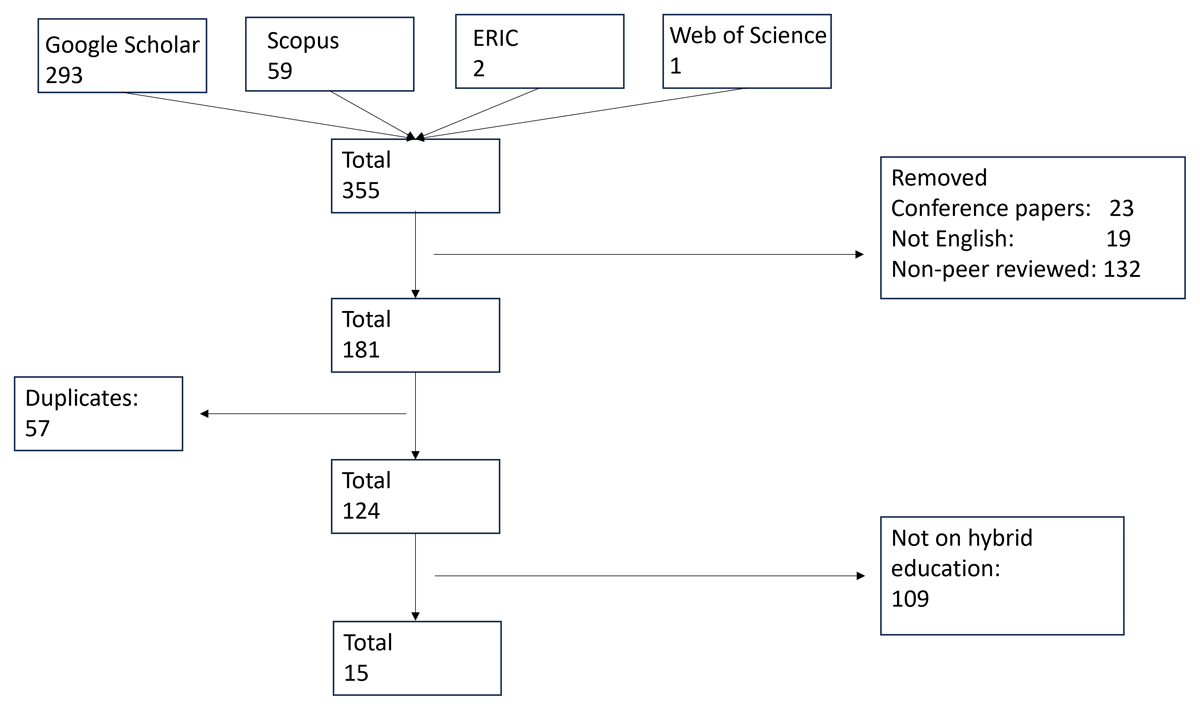
Figure 1
Flow diagram of the identified, screened, and included studies on hybrid education and transactional distance.
Table 1
Publications included in the review. This table displays the publications that are included in this review. The different columns represent different aspects of the publication. For example, the publication defined the concept of transactional distance (TD), which is mentioned in the framework, the RQ, the methods, the results, and the discussion/conclusions. Then, the last three columns show if and what the publications have concluded on the three core variables of transactional distance theory: dialogue, structure, and autonomy. The dashes represent that TD is not present in that section of the publication.
| PAPER | CONCEPT DEFINED TD | FRAMEWORK TD | RQ TD | METHOD TD | RESULTS | DISCUSSION/CONCLUSION TD | MAIN ASPECTS OF TD | ||
|---|---|---|---|---|---|---|---|---|---|
| DIALOGUE | STRUCTURE | AUTONOMY | |||||||
| Athens (2023) | – | – | – | – | Transactional distance as part of the answers given by the students when given the question: ‘What was the worst aspect of this course delivery?’ | Transactional distance and co-presence mentioned in relation to literature | Students were satisfied with the connection with their instructor but not with their connection with their peers, due to technological difficulties | The need for instructor preparation is paramount in terms of highly organised materials | A high percentage of failures were among first-year students who emphasized the importance of explicit self-regulatory skill within an encouraging and supportive learning environment |
| Bower et al. (2015) | – | Transactional distance (Moore 1993) | – | – | Co-presence mentioned in student reporting in multiple cases and cross-case analysis | Co-presence – connectedness mentioned as a pedagogy outcome and in relation to literature | The online students had a hard time communicating as they had to go through software | There was a consensus among teachers about the need to be highly organized for blended synchronous learning lessons | – |
| Chan (2024) | Transactional distance (Moore 1993) | Transactional distance and Connectedness | – | – | – | – | – | – | – |
| Conklina et al. (2017) | Transactional distance (Moore 1993) | Transactional distance | – | A dedicated questionnaire similar to Paul et al. (revised Zhang scale) | Results from the dedicated questionnaire similar to the revised Zhang scale | Co-presence mentioned in relation to literature | – | The instructor needs to create active learning activities and test the technology in the course environment before class implementation | – |
| Divanoglou et al. (2018) | Transactional distance (Moore 1993) | Transactional distance | – | – | – | Transactional distance mentioned in relation to the results and literature | A competent educator should be present in class at all times to facilitate dialogue, even when the session is primarily facilitated by an educator located at the remote campus | With careful planning, synchronous dual-campus learning environments can be an effective and attractive delivery option in tertiary education institutions | – |
| Francisco Pérez et al. (2023) | – | – | – | – | – | Transactional distance (Shearer & Park 2019) mentioned in relation to the results and literature | – | Inadequate planning and the lack of technological support and teaching skills, generated stress, overwork, and exhaustion in nursing professors and students | – |
| PAPER | CONCEPT DEFINED TD | FRAMEWORK TD | RQ TD | METHOD TD | RESULTS | DISCUSSION/CONCLUSION TD | MAIN CONCLUSIONS TD | ||
| DIALOGUE | STRUCTURE | AUTONOMY | |||||||
| Gleason & Greenhow (2017) | – | – | – | Make use of surveys, focus groups, and written reflections to focus on perceptions of social presence, embodiment, and transactional distance in terms of frequency of interaction, quality of interaction, and sense of closeness | – | Co-presence mentioned in relation to literature | – | – | – |
| Murray et al. (2021) | Transactional distance (Moore 1993) | Transactional distance | No specific RQ but is mentioned in the hypothesis | Make use of the revised scale of transactional distance (Paul et al. 2015) | Shows the results of the transactional distance scale | Transactional distance mentioned in relation to the results and literature | Lack of engagement; however, including course content that reduced the perceived distance, such as group work or non-course related professor and student interactions, could improve the overall learning outcomes of the students Instructors must build relationships with the students For instance, an increased use of group projects, the use of break-out rooms in online learning, and non-course related social engagements were proposed to reduce the distance | – | Lack of motivation |
| Nussli et al. (2022) | Transactional distance (Moore 1993) | Transactional distance | – | – | – | Transactional distance in relation to how educators can promote student engagement based on the references that participants made | – | – | – |
| Nussli and Oh (2024) | Transactional distance (Moore 1993) | Transactional distance | – | – | – | Transactional distance in relation to literature | – | – | Learner choice emerged as a key affordance in this study |
| Phelps & Vlachopoulos (2020) | Transactional distance (Moore 1997) | Transactional distance | – | – | Transactional distance mentioned as part of the quantitative findings | Transactional distance and connectedness in relation to the recommendations and literature | – | Facilitator skills should further be refined through professional development to support positive inquiry, resolution, and assessment strategies. | – |
| Şat et al. (2022) | – | – | – | – | Transactional distance mentioned in relation to literature | – | Web 2.0 tools are compelling technologies that can turn traditional icebreakers into dynamic and interactive online learning communities in which students feel free to speak, share their thoughts and ideas, and learn from each other | – | – |
| Tierney, Hopwood & Davies (2023) | – | Transactional distance and connectedness | – | – | – | – | Lower engagement and motivations in online-only learning compared with face-to-face settings; the significance of domains of sociability and engagement; uneven reliability and use of technology | – | – |
| Wang & Huang (2024) | – | – | – | – | Transactional distance and connectedness mentioned in relation to literature | – | The challenges that caused low engagement of online learners included inadequate learner-learner interactions, insufficient learner–instructor interactions, limited learner–content interactions, and technological constraints. Designing group activities involving classroom and online learners would create opportunities for them to collaborate and interact with each other | – | – |
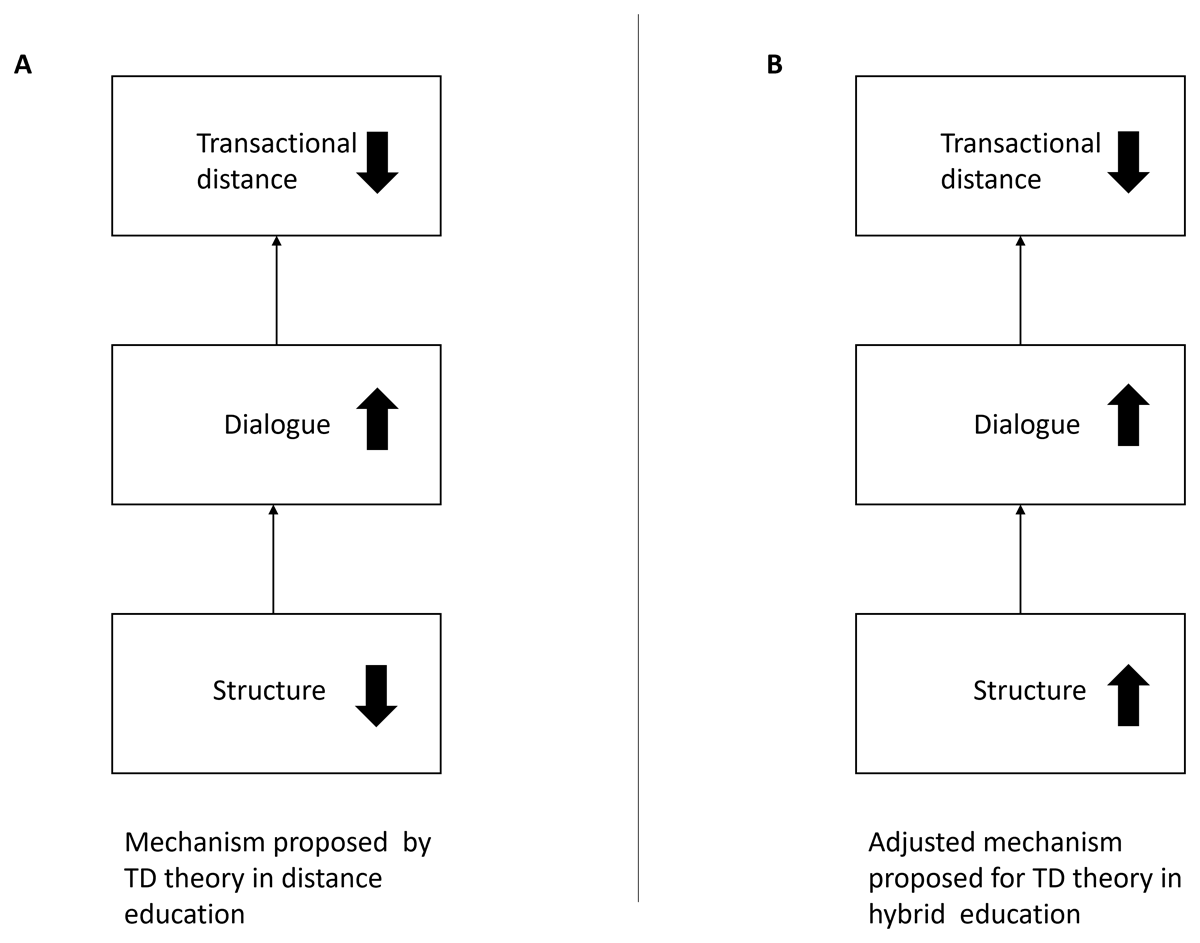
Figure 2
Mechanism within TD in distance education versus mechanism within TD in hybrid education. In Figure 2A the mechanism of the inverse relation between the variables dialogue and structure is present as it was originally proposed within TD theory. When structure goes down, the dialogue increases, and students perceive less transactional distance. In 2B, the proposed mechanism adjustment is visible for hybrid education. When structure increases, dialogue also increases, and the perceived transactional distance will decrease.