
1. Introduction and Background
Transactional distance (TD) is a concept developed to understand the dynamics of distance education and remote learning environments. Coined by Moore (1972), transactional distance refers to the psychological and emotional distance between the teacher and the student, as well as among students themselves. Over the years, this theory evolved from focusing on the teacher and the student to also including student-student and student-content interactions, leading to the ubiquitous educational triangle (Moore, 1989). While originally developed in the context of distance education, TD theory remains highly relevant in today’s educational landscape, particularly as new teaching formats have emerged in response to technological advances and the COVID-19 pandemic. One such format is hybrid education, which blends online and onsite learning simultaneously, with some students being present in the classroom and others participating online in real time (Lakhal et al. 2021; Raes et al. 2020). This simultaneous delivery introduces unique challenges to maintaining interaction and engagement across both groups. As hybrid education changes how students and teachers interact, it becomes even more important to understand the psychological and emotional distance that students might experience. This is exactly what Moore’s TD theory aims to describe. The word ‘transactional’ refers to the exchange of ideas, experiences, and knowledge among students and teachers, while ‘distance’ refers to the psychological distance perceived by the teacher and/or the student. TD is influenced by a variety of factors, including physical separation, isolation, differences in communication methods, and the structure of the learning environment. When students experience greater distance, their engagement decreases (Bolliger & Halupa 2018); hence, higher TD can negatively impact the learning experience, whereas lower TD fosters increased engagement, representing a positive outcome.
Moore identified three key variables influencing transaction distance: dialogue, structure, and autonomy. Dialogue is defined as intentional communication that increases learning between the teacher and the student and between students. Increasing dialogue leads to a lower transactional distance and vice versa. In contrast, increased structure leads to a higher TD because it allows for less flexibility, which likely results in reduced dialogue. Moore defines structure as the extent to which the course’s design and organization are predetermined and inflexible, dictating the content and the process of the learning experience. It encompasses the rigidity or flexibility of the curriculum, instructional methods, and assessment practices. As mentioned, dialogue and structure are inversely related, with greater structure often resulting in less dialogue, thereby increasing transactional distance. Autonomy is included in the theory to refer to the autonomy a student needs when there is a certain amount of transactional distance. In this theory, autonomy refers to students’ ability to take responsibility for and control their learning process. The variable highlights the degree to which learners are capable of setting their own goals, managing time, and making decisions about their learning trajectory. When TD is high, students need more autonomy. When TD is low, and there is more dialogue, the student will need less autonomy. Students who would rather work with more autonomy would thus prefer a lesson in which there is a higher TD (Moore 2018).
Throughout the development of this concept, these three variables have remained the same, while the ways to measure transactional distance have varied. In early studies, students were asked to rate their degree of closeness or distance (Bischoff et al. 1996; Xiao 2024). The Zhang scale aimed to significantly improve the amount of detail, using a Likert-scale questionnaire of 31 items (Zhang 2003). This questionnaire included all three types of interactions—teacher-student (T-S), student-student (S-S), and student-content (S-C) (23 questions for three constructs)—with eight questions referring to the interaction between the student and the interface. In this questionnaire, ‘interface’ refers to the online space in general. Questions such as ‘I hate using the web’ are included in this category. Zhang (2003) found that the strongest construct that affected students’ sense of transactional distance and engagement was the S-S interaction, followed by the T-S interaction (Zhang, 2003). However, as distance education became more technology-driven over time, Zhang’s revised scale was introduced in 2015. This revised scale only included T-S, S-S, and S-C interactions and consisted of 12 items. The student-interface construct was dropped as it no longer emerged as significant due to the increased general knowledge on the use of technology. The assumption was that technology was more widespread than in 2003 and students had more experience with the needed technology (Paul et al. 2015).
Despite the long-standing relevance of TD theory, relatively few studies have explored how it applies to hybrid education. Some studies do compare transactional distance in online, on-site, and hybrid education contexts, but these often treat students in hybrid groups as one homogenous group (Kassandrinou et al. 2014; Murray et al. 2021; Vasiloudis et al. 2015). As a result, they fail to consider the potentially very different experiences of on-site and online students within the same hybrid class. The key difference between hybrid and other forms of education is that teachers in hybrid settings must simultaneously engage two groups of students, which many find difficult (Bower et al. 2015; Ottenheim et al. 2025). Teachers often end up focusing on one group at the expense of the other, either primarily engaging with students in the physical classroom or with those online, leading to uneven learning experiences (Lakhal et al. 2021; Raes 2022; Szeto & Cheng 2016). The above considerations lead us to the following research question: How and to what extent can transactional distance theory be applied to hybrid education?
To address this research question, we will conduct a systemic review of publications that explore both hybrid education and TD. Specifically, we will analyze how these publications apply TD and explore their conclusions regarding the three core variables: dialogue, structure, and autonomy.
2. Systematic Literature Review
A systematic literature review was conducted in three databases; Scopus, ERIC, and Scholar were searched for all studies on hybrid education and transactional distance published up to 20 June 2024. The following advanced search query was applied in Scopus (All Fields), ERIC, Web of Science, and Scholar: ‘Transactional distance’ AND (‘Hybrid education’ OR ‘blended synchronous learning’ OR ‘hyflex education’). Study selection and data extraction were performed following the flow chart in Figure 1. These searches resulted in 59 publications in Scopus, two publications in ERIC, one publication in Web of Science, and 293 publications in Scholar, totaling 355 publications. Non-peer-reviewed papers, conference papers, and non-English papers were excluded, leaving 181 publications. Of these papers, 57 duplicates were removed, thus leaving 124. After reading the abstracts, 61 publications were removed, as these did not match our definition of hybrid education, leaving 63 publications. After reading the introductions and conclusions of these papers, we concluded that 43 publications did not match our definition of hybrid education. This left 20 papers to be fully read, after which 5 papers were excluded due to not fitting the research question, leaving us with 15 publications (See Figure 1). These 15 publications were present in both Scopus and Scholar search results. These 15 papers are analyzed and discussed by the authors until full agreement was reached on the most important findings, which will be presented in the next section.
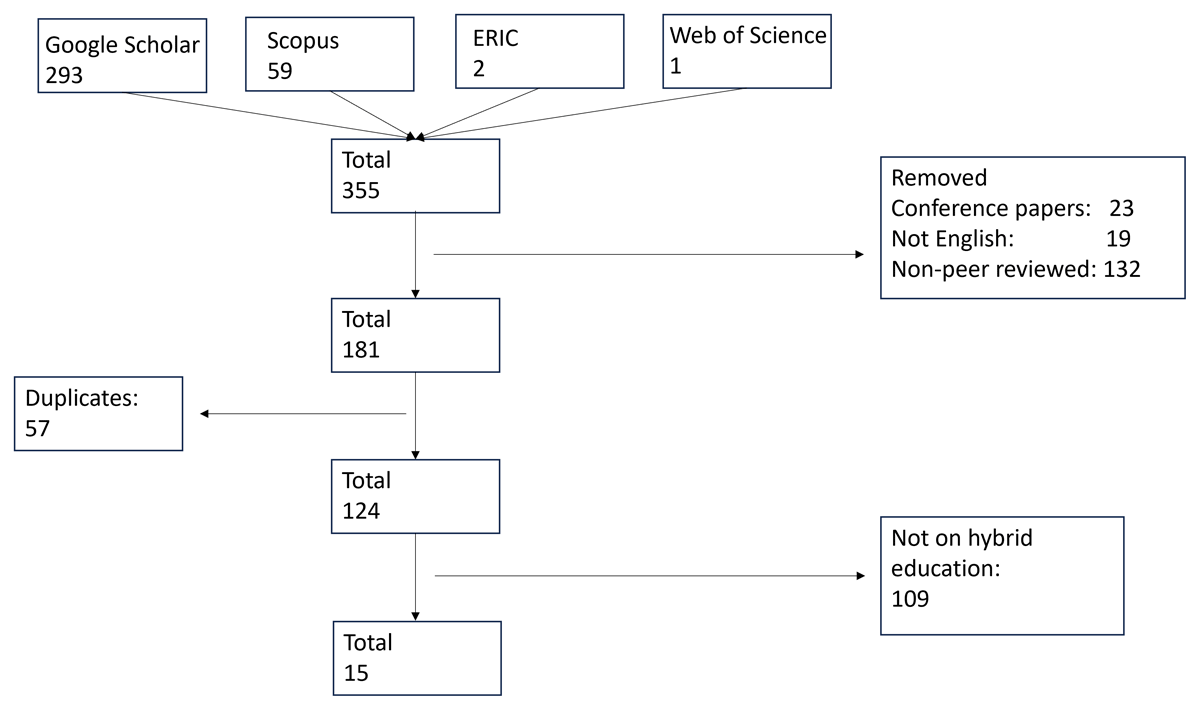
Figure 1
Flow diagram of the identified, screened, and included studies on hybrid education and transactional distance.
3. Results
This section presents the findings of our systematic review of 15 publications addressing hybrid education in the context of TD theory. We identified common patterns, gaps, and strategies related to the reduction of transactional distance in hybrid learning environments by analyzing these studies in terms of concepts such as interaction, dialogue, structure, and autonomy. The results are presented in Table 1 (below).
Table 1
Publications included in the review. This table displays the publications that are included in this review. The different columns represent different aspects of the publication. For example, the publication defined the concept of transactional distance (TD), which is mentioned in the framework, the RQ, the methods, the results, and the discussion/conclusions. Then, the last three columns show if and what the publications have concluded on the three core variables of transactional distance theory: dialogue, structure, and autonomy. The dashes represent that TD is not present in that section of the publication.
| PAPER | CONCEPT DEFINED TD | FRAMEWORK TD | RQ TD | METHOD TD | RESULTS | DISCUSSION/CONCLUSION TD | MAIN ASPECTS OF TD | ||
|---|---|---|---|---|---|---|---|---|---|
| DIALOGUE | STRUCTURE | AUTONOMY | |||||||
| Athens (2023) | – | – | – | – | Transactional distance as part of the answers given by the students when given the question: ‘What was the worst aspect of this course delivery?’ | Transactional distance and co-presence mentioned in relation to literature | Students were satisfied with the connection with their instructor but not with their connection with their peers, due to technological difficulties | The need for instructor preparation is paramount in terms of highly organised materials | A high percentage of failures were among first-year students who emphasized the importance of explicit self-regulatory skill within an encouraging and supportive learning environment |
| Bower et al. (2015) | – | Transactional distance (Moore 1993) | – | – | Co-presence mentioned in student reporting in multiple cases and cross-case analysis | Co-presence – connectedness mentioned as a pedagogy outcome and in relation to literature | The online students had a hard time communicating as they had to go through software | There was a consensus among teachers about the need to be highly organized for blended synchronous learning lessons | – |
| Chan (2024) | Transactional distance (Moore 1993) | Transactional distance and Connectedness | – | – | – | – | – | – | – |
| Conklina et al. (2017) | Transactional distance (Moore 1993) | Transactional distance | – | A dedicated questionnaire similar to Paul et al. (revised Zhang scale) | Results from the dedicated questionnaire similar to the revised Zhang scale | Co-presence mentioned in relation to literature | – | The instructor needs to create active learning activities and test the technology in the course environment before class implementation | – |
| Divanoglou et al. (2018) | Transactional distance (Moore 1993) | Transactional distance | – | – | – | Transactional distance mentioned in relation to the results and literature | A competent educator should be present in class at all times to facilitate dialogue, even when the session is primarily facilitated by an educator located at the remote campus | With careful planning, synchronous dual-campus learning environments can be an effective and attractive delivery option in tertiary education institutions | – |
| Francisco Pérez et al. (2023) | – | – | – | – | – | Transactional distance (Shearer & Park 2019) mentioned in relation to the results and literature | – | Inadequate planning and the lack of technological support and teaching skills, generated stress, overwork, and exhaustion in nursing professors and students | – |
| PAPER | CONCEPT DEFINED TD | FRAMEWORK TD | RQ TD | METHOD TD | RESULTS | DISCUSSION/CONCLUSION TD | MAIN CONCLUSIONS TD | ||
| DIALOGUE | STRUCTURE | AUTONOMY | |||||||
| Gleason & Greenhow (2017) | – | – | – | Make use of surveys, focus groups, and written reflections to focus on perceptions of social presence, embodiment, and transactional distance in terms of frequency of interaction, quality of interaction, and sense of closeness | – | Co-presence mentioned in relation to literature | – | – | – |
| Murray et al. (2021) | Transactional distance (Moore 1993) | Transactional distance | No specific RQ but is mentioned in the hypothesis | Make use of the revised scale of transactional distance (Paul et al. 2015) | Shows the results of the transactional distance scale | Transactional distance mentioned in relation to the results and literature | Lack of engagement; however, including course content that reduced the perceived distance, such as group work or non-course related professor and student interactions, could improve the overall learning outcomes of the students Instructors must build relationships with the students For instance, an increased use of group projects, the use of break-out rooms in online learning, and non-course related social engagements were proposed to reduce the distance | – | Lack of motivation |
| Nussli et al. (2022) | Transactional distance (Moore 1993) | Transactional distance | – | – | – | Transactional distance in relation to how educators can promote student engagement based on the references that participants made | – | – | – |
| Nussli and Oh (2024) | Transactional distance (Moore 1993) | Transactional distance | – | – | – | Transactional distance in relation to literature | – | – | Learner choice emerged as a key affordance in this study |
| Phelps & Vlachopoulos (2020) | Transactional distance (Moore 1997) | Transactional distance | – | – | Transactional distance mentioned as part of the quantitative findings | Transactional distance and connectedness in relation to the recommendations and literature | – | Facilitator skills should further be refined through professional development to support positive inquiry, resolution, and assessment strategies. | – |
| Şat et al. (2022) | – | – | – | – | Transactional distance mentioned in relation to literature | – | Web 2.0 tools are compelling technologies that can turn traditional icebreakers into dynamic and interactive online learning communities in which students feel free to speak, share their thoughts and ideas, and learn from each other | – | – |
| Tierney, Hopwood & Davies (2023) | – | Transactional distance and connectedness | – | – | – | – | Lower engagement and motivations in online-only learning compared with face-to-face settings; the significance of domains of sociability and engagement; uneven reliability and use of technology | – | – |
| Wang & Huang (2024) | – | – | – | – | Transactional distance and connectedness mentioned in relation to literature | – | The challenges that caused low engagement of online learners included inadequate learner-learner interactions, insufficient learner–instructor interactions, limited learner–content interactions, and technological constraints. Designing group activities involving classroom and online learners would create opportunities for them to collaborate and interact with each other | – | – |
These publications are thoroughly examined in the following subsections, focusing on key aspects of hybrid education and TD theory. Table 1 serves as an overview. Then several key aspects will be discussed separately: learning dynamics in hybrid education (Section 3.2), Moore’s three variables of TD, dialogue, structure, and autonomy (Section 3.3), and strategies that can help lower transactional distance in hybrid education (Section 3.4).
3.1 Systematic review table
Table 1 summarizes the publications included in our sample. The table follows the general structure of an academic publication, beginning with the introduction, followed by method, results, discussion, and conclusion. Within the table, dashes indicate that TD is not addressed in that particular section. When the TD is addressed in the section, it is summarized in the sections of the table.
The first column of Table 1 demonstrates that the concept of TD is not at the forefront of these publications, despite the selection criteria. Only seven publications explicitly define the concept of transactional distance, while the other eight do mention TD theory in the literature reviews or theoretical framework, albeit only in passing. It is also notable that several publications use alternative terms such as ‘co-presence’ and ‘connectedness’ to describe concepts related to, but not identical to, TD. These terms reflect similar ideas about perceived distance or connection between students, their peers, and their teachers, without specifically referring to elements of TD theory. In some cases, TD is first mentioned in the results section without prior explanation (Athens 2023; Şat et al. 2022). These authors have assigned transactional distance as one of the codes emerging from inductive coding (e.g., Athens 2023; Şat et al. 2022). In nine of the publications, TD is mentioned in the discussion section, sometimes concerning the results (Athens 2023; Conklina et al. 2017; Murray et al. 2021). In other cases, the theory is referenced more as an afterthought (Divanoglou et al. 2018; Francisco-Pérez et al. 2023; Nussli & Oh 2024).
Within the sample, only one paper incorporates TD into its research aim, hypothesis, and methods. In this study by Murray et al. (2021), the authors use the revised Zhang scale to measure TD in online, hybrid, and on-site education to compare these three types of education. Other studies (e.g., Conklina et al. 2017) use a dedicated questionnaire similar to the revised Zhang scale, focusing on the connection between students, their teachers, and peers. However, the Conklina et al. (2017) questionnaire also focuses on the hybrid environment and how this is experienced by students (Conklina et al. 2017). Both Murray et al. (2021) and Conklina et al. (2017) refer back to their methods when discussing their findings. Murray et al. directly report on the measured transactional distance, while Conklina et al. (2017) highlight that although students were satisfied with their teacher, online students felt they lacked the same opportunities to form relationships with their teacher and peers.
Table 1 shows that most of the publications in the sample refer to TD in their theoretical background. However, none of these studies have used TD theory specifically in hybrid education, suggesting that it may not be fully operationalized or adequately considered in existing hybrid education research. To address this knowledge gap, we decided to focus on the components of TD theory. Therefore, we analyzed how the publications in the sample approached these interactions. We started by analyzing the interactions between teachers and students, as well as interactions among students. Next, we explored the three core variables of TD theory: dialogue, structure, and autonomy. Finally, we will discuss the implications of the findings and strategies for reducing TD in hybrid education.
3.2 Teacher-Student and Student-Student interaction
Murray et al. (2021) take the position that there is little difference between hybrid education and traditional onsite education when it comes to TD. They demonstrate that the highest level of TD is experienced in online education, followed by hybrid education and then traditional onsite education. As previously mentioned, this paper considered all students, both online and on-site as a single group, which may have contributed to the outcomes reported in the publication. Moreover, their results reveal that student-teacher interactions accounted for the biggest differences in TD between the three settings. They found the modality (online, hybrid, or on-site) of the course, specifically online and hybrid, to be a confounding factor for the relationship challenges with the teachers. However, it is important to note that the (online and on-site) students in hybrid education were seen as one group, instead of the two different groups that are present in hybrid education; this could have thus influenced the results from this study.
Similarly, Conklina et al. (2017) showed that teachers who teach in a hybrid setting would sometimes forget that the online students were also ‘present’ in the classroom. Some of their online students reported that they did not have the same opportunities to build a relationship with their teacher as did their on-site counterparts. Moreover, one student added that their teacher would sometimes forget to acknowledge the online students. Their questionnaire results also demonstrate a low sense of community for the online group. The authors suggest that this might be due to the cognitive overload of the teacher attempting to give equal attention to both the online and the on-site students.
Even though it was not specifically measured, Conklina et al. (2017) also suggested that technology played a significant role when it came to how online students viewed their teacher and onsite peers. For example, the video or audio would not always work properly, and students felt a greater barrier due to being online. Alternatively, Nussli and Oh (2024) found that their online students did have interactions with their teacher and were satisfied with these interactions. However, they also found that communication between the online and on-site students was mostly nonexistent. Likewise, in Athens (2023), 21% of students reported that the worst part about hybrid education was the lack of connection with their peers, even though 72% did feel a connection with their teacher. These observations illustrate two extremes when it comes to technology: either students feel connected to their teacher but not with their peers (Conklina et al. 2017; Divanoglou et al. 2018; Murray et al. 2021; Şat et al. 2022; Tierney et al. 2023), or students feel no connection with their teacher and more of a connection with their peers compared to with their teachers (Athens 2023; Nussli et al. 2022; Nussli & Oh 2024).
3.3 The three variables of Transactional Distance Theory
As mentioned above, only two publications in the sample specifically focused on transaction distance theory in hybrid education, even though many (N = 13) employed TD theory as a supplementary framework or an afterthought. However, numerous publications at least referenced elements of the three variables underlying TD theory. While these studies did not explicitly identify these variables (dialogue, structure, and autonomy), their findings do emphasize the significance of these variables and thus, possibly, the importance of TD by proxy. Accordingly, we will examine how these studies address each of these variables.
Dialogue
The most frequently mentioned variable in the sample of studies is dialogue. As mentioned before, multiple studies recommend using small group work or group discussions to decrease TD. The small-group work and discussion are meant to stimulate the dialogue in the lectures. Murray et al. (2021), for example, conclude that the lack of engagement could be improved by group work or non-course-related interactions, which can help improve the overall learning outcomes and learning engagement and lower the perceived distance. Similarly, Wang and Huang (2024) suggest that the inadequate interactions between the student and the teacher, as well as the limited student-student interactions in hybrid education, contribute to a higher TD for the online students. Thus, they also suggest that the teachers need to be able to create opportunities for them to collaborate and converse with each other. Bower et al. (2015) also added to the conclusions on the lack of dialogue for online students by adding that online students communicated less because of the limitations of the software used (Athens 2023). Divanoglou (2018) states that even in remote campus teaching, where one educator teaches from one location and the session is livestreamed to students in classrooms at other campuses, a separate educator should still be physically present with students at each location. This in-person presence supports dialogue and helps maintain student engagement, even when the primary instruction is delivered remotely. Overall, these findings suggest that groupwork and effective student-to-student communication are essential for reducing TD in hybrid learning environments.
Structure
TD theory is based on the assumption that when a course is highly structured, there is less flexibility, and this will limit spontaneous dialogue in a lecture/course. In contrast, when a course design is less structured, there is more room for flexibility, and it is easier for spontaneous dialogue to occur (Moore 2018). However, whenever the publications in this study discuss the hybrid course structure and/or the preparation, they do not refer to the need for flexibility (Athens 2023; Bower et al. 2015; Francisco-Pérez et al. 2023; Phelps & Vlachopoulos 2020). Athens, for example, suggests that teachers need more preparation time when teaching in a hybrid manner, suggesting that it is essential that the lesson be highly organized (Athens 2023). The same was concluded by two other publications; without a highly organized and structured design, the teachers are reported to have less interaction with the online students (Bower et al., 2015; Divanoglou et al., 2018). Francisco Pérez et al. (2023) add that inadequate planning, organization, and lack of technological support generate extra work stress for teachers, which induces more stress during lectures. This negatively impacted both the teacher’s and student’s experiences (Conklina et al. 2017; Francisco-Pérez et al. 2023). Thus, teachers should have more training to be able to support this manner of preparation and teaching (Phelps & Vlachopoulos 2020). These publications thus suggest that being highly organized and structuring teaching formats, such as lectures, group work, and discussions, is essential when teaching in a hybrid learning environment.
Autonomy
The variable of autonomy in TD theory was introduced to incorporate the student’s perspective. It refers to the degree to which students are required to take responsibility for their learning. High autonomy is often observed in self-paced online courses, where students have greater freedom to manage their learning independently. In contrast, low autonomy environments are characterized by greater reliance on the teachers for guidance and structure, as seen in a more traditional onsite classroom setting (Moore 2018).
From a student perspective, in hybrid education, the online component would be considered a higher autonomy environment, while the on-site classroom setting corresponds with a lower autonomy environment. As mentioned before, in the studies in the sample, the variable of autonomy itself was not explicitly named. However, related concepts such as motivation and self-regulation were mentioned. For instance, Murray et al. (2021) found that online students often experience a lack of motivation. Similarly, Nussli & Oh (2024) noted a decrease in students’ motivation when preparatory coursework was not provided before lectures. Furthermore, Athens observed that a high percentage of failures occurred among first-year students, which was attributed to their underdeveloped self-regulatory skills that are needed in such a learning environment. To summarize, these findings suggest that many online students in these studies were functioning with lower autonomy in environments that demanded higher autonomy, leading to challenges in engagement and performance.
3.4 Strategies to lower transactional distance
Various studies suggest that challenges such as lack of community, absence of co-presence, disconnect, or a high TD can be overcome (Bower et al. 2015; Chan 2024; Gleason & Greenhow 2017; Roberts et al. 2024; Şat et al. 2022). One way to reduce this sense of disconnect is through the use of a green screen. In this approach, the teacher is digitally placed in front of the content, mimicking a traditional classroom setting. Rather than appearing as a detached ‘floating head’ beside the presentation, the teacher is visually integrated within the instructional material, similar to how weather presenters appear in front of forecast graphics. This technique enhances a sense of presence and continuity between the teacher and the content. Of the online students, 80% noted that the use of this green screen improved lecture delivery and teachers’ presence and that it captured their attention. The use of the green screen barely impacted the onsite students, with 91% of students reporting that their onsite learning experiences were not altered by it. One student even mentioned that even though they were present on-site, they would also follow the live stream to see the lecturer better (Chan 2024).
Another innovative way to reduce the feeling of disconnect was the use of robots. In this study, the online students’ faces were visible on a screen on a robot, which was able to move around, thus creating a more embodied experience. The authors concluded that the use of the robots helped facilitate more interactions and more cross-communication between the online and on-site students (Gleason & Greenhow 2017). However, less elaborate ways to increase cross-communication and a community feel are mentioned as well, with multiple studies suggesting the use of active learning strategies. These publications hypothesize that providing online and on-site students with opportunities to work in smaller groups and engage in group discussions will foster a more connected community and will increase cross-communication (Bower et al. 2015; Murray et al. 2021; Roberts et al. 2024; Şat et al. 2022). Şat et al. (2022) also suggest using icebreakers, such as letting students talk about their favorite quotes, which can also improve the connection students have with each other. The use of icebreakers could help facilitate the earlier-mentioned group discussions.
4. Conclusion and Discussion
This review aimed to answer the following research question: How and to what extent can transactional distance theory be applied to hybrid education? The sample of publications resulting from our search criteria cannot give a final answer to the research question. The current sample originated from three different search engines; however, most of the publications found with our query did not adhere to our definition of hybrid education. This left us with quite a small sample. Of this sample, only a small part of the publications used TD theory as a main theory in their studies. However, the small sample size and the lack of in-depth research on TD theory in hybrid education highlight a significant knowledge gap regarding its application and relevance in this context. This scarcity of relevant literature and the limited uptake of Moore’s TD theory in recent hybrid education research is notable and suggests that the theory has not been widely embraced or rigorously applied to this new educational format.
The publications show a relative lack of research on TD theory in hybrid education, and the thorough application of TD theory in this context is rare. While the reviewed studies do not provide definitive conclusions about the use of Moore’s TD theory in hybrid education, many acknowledge the importance of its core variables: dialogue, structure, and autonomy. Moore’s framework, despite being developed in the 1970s, remains highly relevant today, especially in the post-COVID-19 era, where distance education has rapidly expanded and evolved. However, the distinct challenges of hybrid education, catering simultaneously to both online and on-site students, demonstrate that Moore’s theory requires significant modification or may not fully apply in its original form.
One main conclusion from the review is that stimulating dialogue and interaction between students and teachers is key to reducing TD. In the context of hybrid education, ensuring that online students are engaged in classroom discussions presents challenges, but it is essential to lower the transaction distance. Moreover, online students often require greater motivation and self-regulation than their on-site counterparts. The physical distance and lack of immediate face-to-face engagement can make it harder for online students to stay engaged. The studies in this review note that teachers need to consciously design and implement strategies to foster the desired interaction among both online and onsite students. Teachers need to actively plan how to include the online students in discussions, which requires the use of technology and pedagogical techniques that allow for improved interaction (and lower TD) between the groups.
Moore argues that a less structured course is more flexible, which in turn promotes more dialogue and lowers the TD. In theory, more flexible lectures allow for greater interaction between students and teachers. However, when applied to hybrid education, this hypothesis might not hold. For instance, Lakhal et al. (2021) highlight the importance of rigorous planning in hybrid education, particularly in structuring activities and fostering interactions between the two sets of students. Unlike a traditional onsite classroom where spontaneous interactions often naturally occur (resulting in low TD), hybrid education demands a more intentional design (Lakhal et al. 2021) to lower TD. Similarly, Zydney et al. (2018) note that hybrid education requires teachers to plan for interaction with online students that might not happen spontaneously. This structured approach ensures that both on-site and online students have equal opportunities to engage (Zydney et al. 2018). This need for structure comes from the fact that teachers either forget to acknowledge the online student or focus on the students right in front of them. Alternatively, some teachers may focus too much on the online students, which leads to neglecting the on-site students (Bower et al. 2015; Lakhal et al. 2021; Raes 2022; Szeto & Cheng 2016; Wang et al. 2017). These findings challenge Moore’s notion that a less-structured course necessarily reduces TD. For example, a less structured discussion could exclude the online students, either due to technical difficulties or the tendency for on-site students to dominate conversations. As a result, a more structured approach may help reduce the TD in hybrid settings by ensuring that the online students are actively included in the interactions.
This review suggests that traditional TD theory may fail to fully capture the complexities of hybrid education and may not be applicable in this context. Particularly, the need for teachers to address the distinct needs of the two separate groups of online and on-site students raises questions about the theory’s validity in hybrid settings. Given this, it could be argued that Moore’s theory, while foundational for distance education broadly, may need substantial revision or extension to remain relevant. Based on the publications included in this review and other relevant publications, we suggest that in the case of hybrid education, the model could be extended by stating that a hybrid course needs to be more structured for interaction and dialogue to occur for both sets of students (Figure 2). Our proposed model is thus a starting point for future research on TD theory within hybrid education. Publications included in this review also suggest that an active learning method could also help reduce the TD. By putting the students (both online and on-site) into small groups and having group discussions, the feeling of co-presence and community could increase.
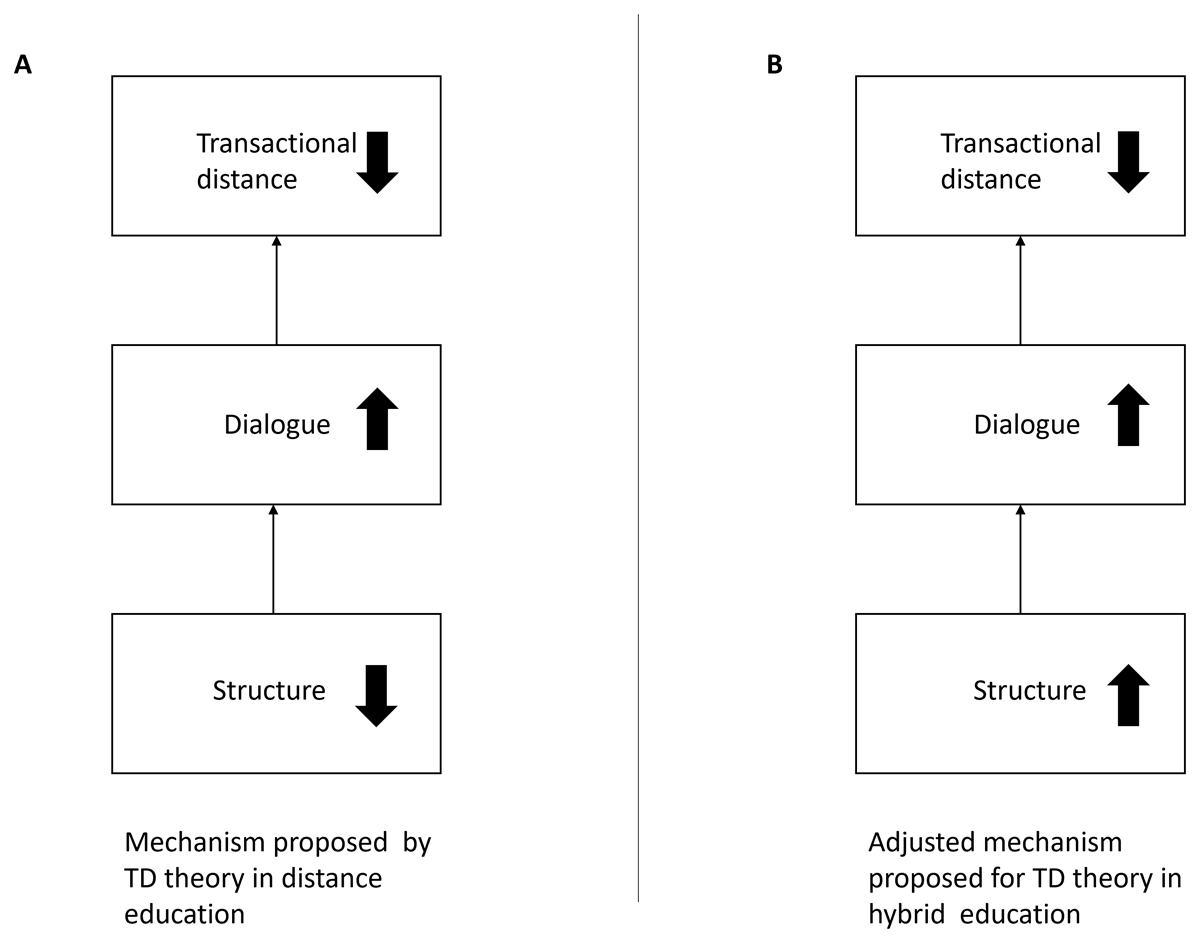
Figure 2
Mechanism within TD in distance education versus mechanism within TD in hybrid education. In Figure 2A the mechanism of the inverse relation between the variables dialogue and structure is present as it was originally proposed within TD theory. When structure goes down, the dialogue increases, and students perceive less transactional distance. In 2B, the proposed mechanism adjustment is visible for hybrid education. When structure increases, dialogue also increases, and the perceived transactional distance will decrease.
In conclusion, while Moore’s transactional distance theory remains a foundational framework for distance education, hybrid education introduces new nuances that the theory may not fully address, as it was originally developed with fully remote or online education contexts in mind. The assumption that flexibility increases dialogue, thus reducing TD, may not apply in a hybrid setting. Moreover, our review highlights a surprising lack of rigorous application and engagement with TD theory in current hybrid education research, indicating that the theory’s potential remains underexplored. Therefore, research is needed to explore how TD theory can be better adapted to reflect the realities of hybrid education and whether our proposed mechanism would more accurately reflect the situation in a hybrid learning environment.
Data Accessibility Statement
The data supporting the findings of this systematic review are derived from publicly available publications, as outlined in Table 1 of the manuscript. These publications can be accessed through their respective publishers or repositories, subject to subscription or open-access terms. Specific details, including DOI links and references, are provided in the manuscript for transparency.
If additional information regarding the review process or selection criteria is required, the authors are happy to share upon reasonable request.
Competing Interests
The author has no competing interests to declare.