
Table 1
Descriptive Statistics of Experimental Groups.
| LITERARY FICTION | POPULAR FICTION | |||||||
|---|---|---|---|---|---|---|---|---|
| GERMAN | ENGLISH | GERMAN | ENGLISH | |||||
| VARIABLE | M | SD | M | SD | M | SD | M | SD |
| Unknown words and phrases | 2.04 | 1.33 | 3.36a | 1.60 | 1.44 | 1.09 | 3.13a | 1.48 |
| Recommendation to a friend | 2.96a | 1.37 | 3.14a | 1.36 | 4.19b | 1.53 | 4.43b | 1.38 |
| Literary quality | 4.51a | 1.06 | 4.46a | 1.05 | 4.48a | 1.14 | 4.71a | 0.95 |
| Literary quality – Writing style | 4.27a | 1.36 | 4.51a | 1.25 | 4.91 | 1.42 | 5.30 | 1.13 |
| Story Comprehension | 3.66 | 1.51 | 4.13 | 1.52 | 6.11a | 1.00 | 5.96a | 1.09 |
| Influence on (self-)reflection | 3.64a | 1.65 | 3.78a,c | 1.57 | 4.29b | 1.57 | 4.07b,c | 1.62 |
| Influence on own life | 1.90a | 1.11 | 1.94a | 1.10 | 2.54b | 1.38 | 2.48b | 1.42 |
| Influence on attitudes | 2.13a | 1.23 | 2.28a | 1.25 | 2.75b | 1.49 | 2.77b | 1.48 |
| Narrative Engagement | 3.70a | 1.11 | 3.72a | 1.13 | 5.03b | 1.00 | 5.01b | 0.97 |
| Transportation | 3.83a | 1.19 | 3.87a | 1.29 | 5.09b | 1.16 | 5.12b | 1.10 |
| Identification | 2.36a | 0.60 | 2.42a | 0.61 | 3.00b | 0.73 | 3.07b | 0.69 |
| Reading the Mind in the Eyes Test Score | 26.27a | 3.61 | 26.11a | 3.56 | 26.42a | 3.30 | 26.33a | 3.00 |
| Interpersonal Reactivity Index – Trait Empathy | 3.84a | 0.44 | 3.85a | 0.51 | 3.90a | 0.49 | 3.87a | 0.50 |
[i] Note. Participants were randomly assigned to read the literary or the popular fiction short story in either their native language (German) or a foreign language (English). Means sharing a common subscript are not significantly different at α = .05 according to Tukey’s Honestly Significant Difference procedure (Tukey, 1949). All scores of variables assessing story perception range from 1 to 7. Narrative Engagement and Transportation scores range from 1 to 7. Identification scores range from 1 to 5. Reading the Mind in the Eyes Test scores range from 0 to 36. Interpersonal Reactivity Index scores range from 1 to 5.
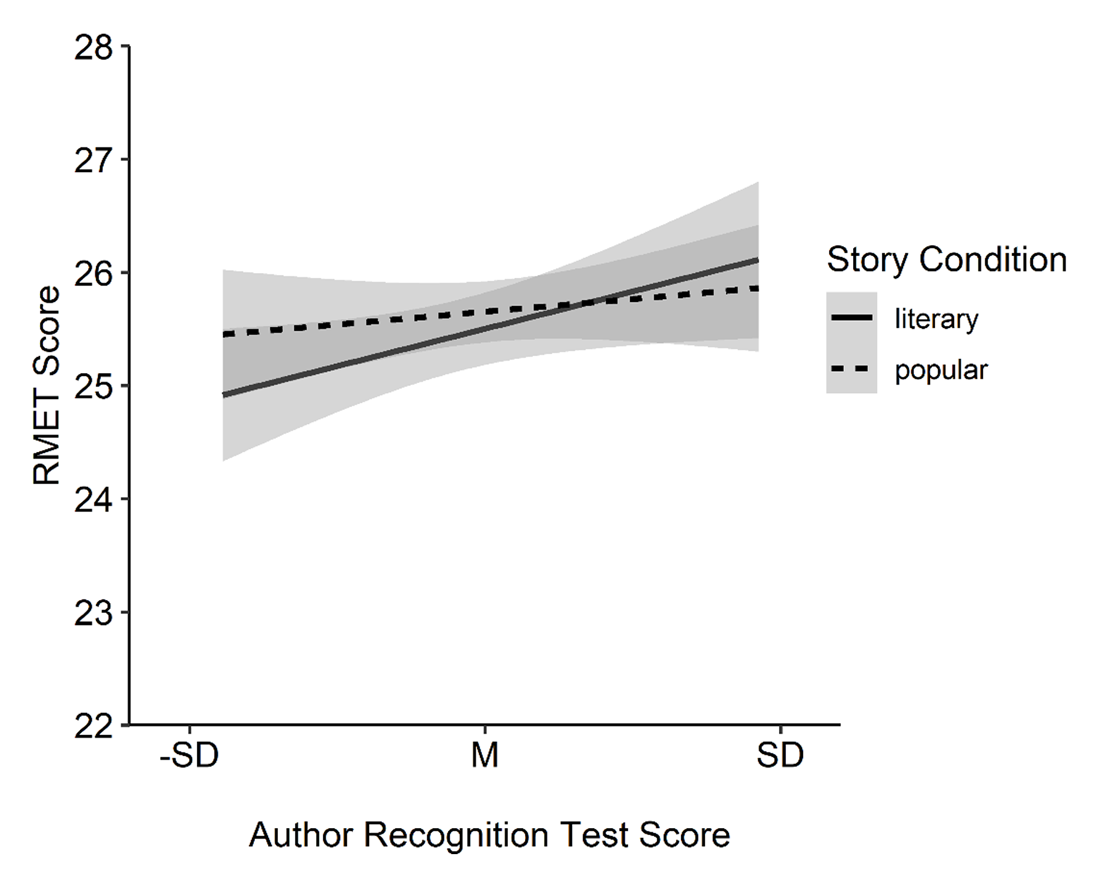
Figure 1
Interaction of Story Condition (Literary vs. Popular Fiction) and Cumulative Reading Exposure on Mentalizing Performance (Reading the Mind in the Eyes Test).
Note. The interaction of transportation and story condition on RMET scores is shown for a range of ± 1 SD around the mean value (shaded areas visualize the standard error).
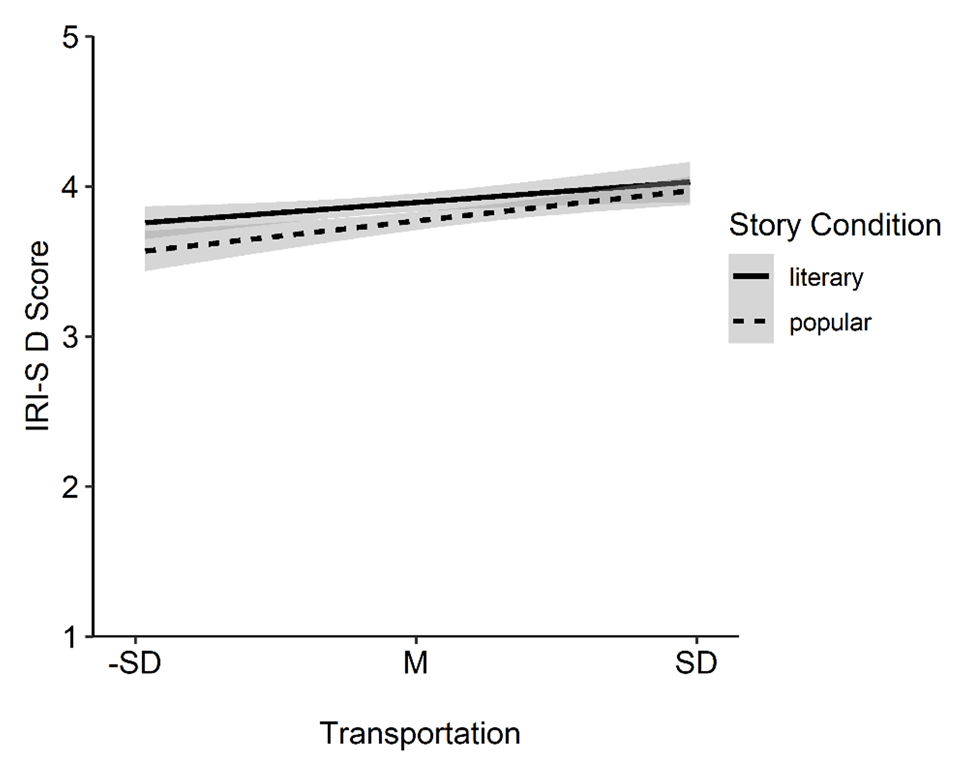
Figure 2
Interaction of Story Condition (Literary vs. Popular Fiction) and Transportation on Empathy (Interpersonal Reactivity Index).
Note. The interaction of transportation and story condition on IRI-S D scores is shown for a range of ± 1 SD around the mean value (shaded areas visualize the standard error).