
Reading is a common leisure activity for many children, adolescents, and adults. Apart from the positive effects of reading on language and academic skills (Mol & Bus, 2011), a number of authors propose that stories might also influence personality and social cognition (Hakemulder, 2000; Koopman & Hakemulder, 2015; Mar, 2018). Effects of stories on social-cognitive skills, such as mentalizing and empathy (e.g., Kidd & Castano, 2013; van der Kleij et al., 2022) and their downstream consequences, such as prosocial behavior and social adjustment (e.g., Lenhart et al., 2023; Mak & Fancourt, 2020), have especially received increasing attention. Although recent meta-analyses on experimental studies (Dodell-Feder & Tamir, 2018) and correlational studies (Mumper & Gerrig, 2017) show small effects of story exposure on social-cognitive skills, the authors also point to substantial heterogeneity between the studies, and they neglected aspects of stories that might be (particularly) effective to improve social-cognitive skills.
Literariness is discussed as a feature that is potentially crucial for stories to have positive effects on social-cognitive skills. Some researchers assume that the literariness of a story is a central (Kidd & Castano, 2013) or at least an important aspect of their impact (Koopman & Hakemulder, 2015), whereas others disagree (e.g., Mar, 2018). The empirical evidence on the importance of literariness for social-cognitive story effects is decidedly mixed. Some studies have found evidence for a superiority of literary fiction (e.g., Kidd & Castano, 2013), whereas others found no differences between literary and popular fiction (e.g., Panero et al., 2016) or found differences only when narrative processes, such as transportation and identification, were included as moderators (e.g., Schwerin & Lenhart, 2022).
A limitation of previous research is that literary and popular fiction stories used as text material often differed not only in their literariness but also with regard to story content. In the present study, we addressed this limitation by comparing the short-term effects of a literary and a popular fiction story, which were matched on story content. In addition, we extended previous research by examining effects of language familiarity (reading in native vs. foreign tongue) for narrative experience and social-cognitive story effects. In the following sections, we provide a short overview on literariness and its proposed importance for social-cognitive story effects. Then we turn to correlational and experimental studies that have examined differential effects of popular and literary fiction. Finally, we discuss the role of language familiarity (i.e., reading in one’s native versus a foreign tongue) for the narrative experience of stories.
Literariness and Its Importance for Social-Cognitive Effects of Stories
Defining literariness and distinguishing between literary and popular fiction is not easy (Koopman, 2016; Schwerin & Lenhart, 2022), and different aspects have been proposed as features that define literariness. Among these features are high levels of so-called foregrounding, that is, a use of language that deviates from day-to-day language, which may occur on a phonetic (e.g., alliteration, rhyme), grammatical (e.g., inversion, ellipsis), or semantic level (e.g., metaphor, irony) (Miall & Kuiken, 1994). Foregrounded features are theorized to defamiliarize the reader, thereby prompting reflection and reinterpretation of the text (Miall & Kuiken, 1999). Stories high in literariness may also contain a polyphony of perspectives (Bakhtin, 2013), characters with high psychological complexity (Kidd & Castano, 2013), complex lexical and syntactical structures (Castano et al., 2023), or meaningful gaps that need to be filled to make sense of the story (Bruner, 1986). Thus, literary fiction is hypothesized to exhibit greater complexity. It tends to avoid the use of conventional language or genre-specific formulas, resulting in characters’ actions and story outcomes that are largely unexpected for readers, and may thus promote conscious and effortful processing of the text and its characters. While greater complexity may stand in the way of reading for pleasure, the unconventional and unexpected elements focal to literary fiction may also be enjoyed by readers.
In contrast, popular fiction is often characterized by a lower degree of literariness and is generally described as being more “simple, sensuous, exaggerated, exciting, and formulaic” (Schneider-Mayerson, 2010, p. 22). It is frequently associated with specific genres (e.g., romance, crime) that adhere to distinct conventions regarding plot structure, story progression, and resolution. Readers, who typically have prior knowledge of these genres, bring corresponding expectations to their reading experience (Zwaan, 1994), which contributes to the more predictable nature of popular fiction. These features may make popular fiction particularly enjoyable for readers, just as the term already suggests.
The story features associated with literariness also explain why some authors argue that literariness is central or at least important for social-cognitive effects of stories. For example, Kidd and Castano (2013) have assumed that more mentalizing effort is required in literary stories because of the higher number of complex characters. Mentalizing effort should in turn improve real-life social-cognitive skills. Accordingly, Kidd and Castano expected literary but not popular fiction to have beneficial effects on social-cognitive skills. In Koopman and Hakemulder’s (2015) framework, literariness is defined through foregrounding (i.e., striking textual features) and is hypothesized to be important in addition to narrativity for real-life impact of story reading. In their framework, narrativity is assumed to permit role taking in stories. Narrative role taking should then influence narrative empathy and mentalizing. In addition, literariness in terms of foregrounding is assumed to lead readers to become unsettled, to pause, and to start thinking (i.e., defamiliarization), which should influence self-reflection, heightened self-awareness, and self-change. Koopman and Hakemulder (2015) assumed that literariness also contributes indirectly to role taking by leading readers to pause and to take their time to consider several options for appropriate mental inferences, which should augment mentalizing ability. Popular fiction, on the one hand, may predominantly engage the role-taking pathway in Koopman and Hakemulder’s (2015) model to enhance social-cognitive skills. In contrast, literary fiction also activates the defamiliarization pathway, suggesting that it may be more effective in fostering social-cognitive abilities than popular fiction.
Empirical Research on Differences Between Literary and Popular Fiction
The question of whether literary fiction stories might be better suited than popular fiction stories to foster social-cognitive skills has been targeted in a number of correlational and experimental studies. In one set of correlational studies by Castano and colleagues, familiarity with authors of literary fiction was associated with better mentalizing performance, whereas no association was found between familiarity with authors of popular fiction (Castano et al., 2020; Kidd & Castano, 2017, 2019). In addition, using data from a representative sample of German adolescents, Lenhart et al. (2023) found that exposure only to modern classical literature but not to leisure reading in general or exposure to other genres predicted later prosocial behavior and social adjustment.
The evidence is mixed for experimental studies. Kidd and Castano (2013) found across several studies that only literary but not popular fiction had a positive short-term effect on social-cognitive skills. This finding has been replicated only in a few studies since then (e.g., Kidd et al., 2016; van Kuijk et al., 2018). However, several other studies have reported no effect (e.g., De Mulder et al., 2017; Panero et al., 2016; Pino & Mazza, 2016; Samur et al., 2018) or reported mixed results (e.g., Kidd & Castano, 2019; Pino & Mazza, 2016). To further complicate the matter, studies suggest that the differential effects of literary versus popular fiction might depend on individual differences such as previous reading experience (Kidd & Castano, 2019) and narrative experiences such as transportation into the story and identification with its characters (Schwerin & Lenhart, 2022).
Kidd and Castano (2019), for example, found that individuals with more previous reading experience showed higher mentalizing performance after reading literary fiction than those reading popular fiction, whereas no differences were observed for individuals with lower previous reading experience. They hypothesized that greater reading experience could enhance readers‘ ability to anticipate characters based on their genre knowledge, enabling greater flexibility in adopting different characters‘ perspectives (Kidd & Castano, 2019; see also Gavaler & Johnson, 2018). However, this finding was not replicated in Experiments 2 and 3, nor did it emerge in a moral judgment task, which was used to measure the extent to which participants inferred and prioritized actors’ intentions.
In Schwerin and Lenhart’s (2022) study, German students read one of two literary or one of two popular fiction short stories in their original English versions taken from the Kidd and Castano (2013) study. They reported no main effect of story type (literary versus popular) on self-reported empathy and mentalizing performance. However, they found that individuals who reported stronger narrative engagement showed higher mentalizing performance after reading literary fiction than after reading popular fiction, whereas no differences were observed for individuals who reported low narrative engagement. Given that participants in Schwerin and Lenhart’s (2022) study read the stories in English and not in their native tongue (German) and that emotional experiences are reportedly richer when reading in one’s native language (Hsu et al., 2015), examining story language as an additional factor in the relationship between literariness, narrative engagement, and enhanced mentalizing performance could be fruitful.
Finally, some studies (e.g., Koopman, 2016; Schwerin & Lenhart, 2022) examined the influence of literariness on narrative experiences that are assumed to mediate or to be associated with social-cognitive story effects. Koopman (2016), for example, randomly assigned participants to read one of three versions of an excerpt from a literary novel about the loss of a child. The original literary version contained a high level of semantic, phonetic, and grammatical foregrounding, whereas the literariness of the other versions was reduced by removing semantic foregrounding (without imagery) or all three types of foregrounding (without foregrounding). Although participants reading the original version high in foregrounding also perceived the most foregrounding in the text, and readers who read the text without foregrounding reported less empathic understanding after reading than those who read the original literary version, Koopman found no significant differences in transportation, identification, and self-reflection.
Schwerin and Lenhart (2022) used a different methodological approach by selecting two literary (Corrie and The Vandercook) and two popular (Space Jockey and Too Many Have Lived) stories from the Kidd and Castano (2013) study. They found that readers judged literary fiction to be of higher literary quality, to stimulate more (self-)reflection, and to be more influential on one’s own life. The readers in this study also reported stronger transportation for the literary than for the popular fiction stories. This finding challenges established theories, which often assume that literariness—characterized by high density of foregrounding—and narrative absorption may be mutually exclusive (e.g., Kuijpers et al., 2014). Foregrounding, by definition, unsettles readers and prompts them to actively construct meaning from the text, potentially disrupting their immersion in the story world. In contrast, popular fiction, with its use of familiar language and adherence to genre conventions, may facilitate higher processing fluency and is thus thought to more easily transport readers into the narrative. Other researchers, though, have weakened this idea by proposing that foregrounding and absorption may also be co-occurring (e.g., Balint et al., 2016). Based on these theoretical perspectives, we explored in the present study whether literary and popular fiction differed in how they caused transportation in readers.
Additionally, the readers in Schwerin and Lenhart’s (2022) study indicated that the popular fiction stories were more difficult to understand and contained more unknown words. This result may reflect a second language issue, as popular fiction, compared with literary fiction, more often contains jargon or street language, which are typically harder to understand in a foreign language. Also, depending on genre, popular fiction may require knowledge of very specific vocabulary: For example, one of the popular fiction stories Schwerin and Lenhart (2022) employed, Space Jockey, is a science fiction story, which probably contains many technical terms that might be unfamiliar, especially when the story is read in a foreign language.
Language Familiarity: Reading in the Native Versus a Foreign Tongue
As indicated in the previous section, language familiarity (i.e., reading in the native versus a foreign tongue) might influence the reading experience and thus affect social-cognitive effects of stories. An explanation might be that text comprehension in a second language requires more resource allocation of cognitive resources on lower-level language processes and thus allows only for limited resources for discourse-level processes (Morishima, 2013). However, sufficient resources for discourse-level processes might be important for investing mentalizing effort to understand characters, especially when they are psychologically complex as has been proposed for literary fiction (Kidd & Castano, 2013). In addition, as seen from Koopman and Hakemulder’s (2015) framework, limited resources for discourse-level processes might also affect narrative experiences such as transportation and identification and impair the ability to detect and react to foregrounding. Another explanation might be that language processing in a foreign tongue is less associated with emotions (Caldwell-Harris, 2014; Pavlenko, 2012) and mental imagery (Hayakawa & Keysar, 2018) than language processing in the native tongue. These findings are typically based on simple stimulus material. Thus, they might not transfer to more complex story processing. Accordingly, participants in Hsu et al.’s (2015) study read negative, positive, and neutral passages from Harry Potter books in their native language (German) or their second language (English), and fMRI were used to contrast emotional responses. Although all participants had adequate English proficiency in their second language, reading emotion-laden texts in the native language resulted in a stronger and more differentiated emotional experience than reading the same texts in a second language. Contrary to this result, Chung-Fat-Yim et al. (2019) found no effect of language familiarity (native versus foreign language) on reported transportation in stories presented as text, audio, or short films. However, a noteworthy point is that the stories in this study were “simply written” (Chung-Fat-Yim et al., 2019, p. 238) and might therefore not have required too much proficiency in the second language.
The Current Study
The current study addressed three questions: First, whether literary and popular fiction differ in how that they are perceived and experienced by readers (Research Question 1), whether reading literary fiction (compared with reading popular fiction) improves social-cognitive skills in terms of a short-term effect (Research Question 2), and whether the effects of literary and popular fiction depend on whether readers receive the stories in their native language or a foreign language (Research Question 3). To do so, we took care to match the popular and literary fiction story concerning the topic because the heterogeneity of experimental research findings might in part be explained by the different story content used for both conditions in many previous studies (e.g., Schwerin & Lenhart, 2022).
The first two research questions were based on theoretical accounts that assume literary fiction is better suited than popular fiction for stimulating mentalizing (Kidd & Castano, 2013), for mental inferences in narrative role-taking, and for (self-)reflection (Koopman & Hakemulder, 2015). Given that literary fiction is theorized to be rich in foregrounding (Miall & Kuiken, 1994), to be linguistically complex (Castano et al., 2023), and to feature complex characters (Kidd & Castano, 2013), we expected the readers to judge the literary story to be of higher literary quality, to be better written, and to be more difficult to understand than the popular fiction story (Hypotheses 1a–c). In addition, as literary fiction may be especially suited to stimulating reflection processes (Koopman & Hakemulder, 2015), we expected that readers would be more inclined to reflect on the content of literary fiction and perceive it to be more influential to their attitudes and their lives than popular fiction (Hypotheses 2a–c). Turning to the differential short-term effects of reading literary versus popular fiction on social-cognitive abilities (e.g., Kidd & Castano, 2013), we expected higher performance on the mentalizing task and higher self-reported empathy after reading the literary story (Hypotheses 3a and 3b). Finally, we examined whether we could replicate the findings of Kidd and Castano’s (2019) Study 1 and Schwerin and Lenhart (2022), which indicated that prior reading exposure and narrative engagement (transportation and identification) might act as moderator variables on the relation between literary reading and social-cognitive improvements (Hypotheses 4 to 6).
Research Question 3 that concerned effects of reading in a foreign versus one’s mother tongue was motivated by findings that reading in a foreign language might reduce cognitive resources for discourse-level processes (Morishima, 2013), attenuate emotional experiences (Hsu et al., 2015; Pavlenko, 2012), and reduce mental imagery (Hayakawa & Keysar, 2018). Accordingly, we explored whether language familiarity (reading in the native versus a foreign language) influenced story perception, narrative experiences, and social-cognitive effects of literary versus popular fiction. In particular, we examined if reading in a foreign language mitigated any differences between literary and popular fiction.
Method
Detailed information about the data, the analysis script, as well as the supplemental materials can be found on OSF (https://osf.io/dbw39/).
Participants
A total of 901 people participated in the online study. Participants were recruited via the university’s participant management system. Before analyzing the data, several exclusion criteria were applied: Participants were excluded if they did not complete the online study, if they gave an incorrect answer to more than one control question, if they indicated a comprehension skill for the language of their story condition below B1 level in line with the Common European Framework of References for Languages (CERF; Council of Europe, 2023), or if their reading time for the assigned short story exceeded 650 words per minute, suggesting scanning rather than reading (Carver, 1992).
This procedure resulted in a final sample of 744 participants (83% of the initial sample), of which 83.5% of the participants identified as female (n = 621), 15.7% as male (n = 117), and the remaining 0.8% as diverse (n = 4) or chose not to indicate their gender (n = 2). The mean age was 21.05 years (SD = 3.71). Given that the sample consisted of university students, educational level was high, with the participants having either obtained a university entrance qualification (n = 586) or a university degree (n = 158). A sensitivity analysis with G*Power (version 3.1.9.7; Faul et al., 2009) indicated that the final sample was sufficient to detect small effects (f ≥ 0.10) in an ANOVA with fixed, main and interaction effects; α = .05, 1–β = .80, numerator df = 1, number of groups = 4). The project was approved by the ethics committee of the University of Würzburg.
Experimental Stimuli
Two short stories that were also employed by Kidd and Castano (2013) were selected for the present study: Corrie by Alice Munro (2010; German translation by Zerning, 2013) for the literary fiction condition, and Lalla by Rosamunde Pilcher (1985; German translation by Längsfeld & Altrichter, 1994) for the popular fiction condition. The short stories were each implemented in the original English-speaking text and a German translation, resulting in a total of four possible reading conditions to which the participants were randomly assigned. After reading the respective story, participants were given three simple single-choice questions with four options each about the plot to confirm that they had read the text attentively until the end.
The four short stories were similar in length (Corrie: 5,763 words in the English version and 5,603 words in the German translation; Lalla: 5,559 words in the English version and 5,769 words in the German translation). The readability of the short stories was determined with the Flesch Kincaid Reading Ease Scale (Kincaid et al., 1975). For the German texts, the adaptation of the Reading Ease Scale by Amstad (1978) was used. The English text of Corrie had a Flesh-Kincaid score of 82, the German translation 70, the English text of Lalla 83, and the German translation of Lalla 73. The participants rated the language complexity as containing significantly more unknown words and phrases for the English version compared to the German short stories (B = 0.75, SE = 0.05, t(740) = 14.84, p < .001, d = 1.09), and the literary fiction stories compared to the popular fiction stories (B = 0.21, SE = 0.05, t(740) = 4.08, p < .001, d = 0.30). The interaction, however, was not statistically significant (B = –0.09, SE = 0.05, t(740) = –1.79, p = .074. d = –0.26).
Measures
Sociodemographics
Participants indicated their gender, their age in years, and their current highest level of education. They were also asked to provide an estimation of their German and English text comprehension skills in line with the CERF levels.
Reading Habits and Preferences
Participants were asked to estimate how often they read books of different genres (nonfiction, crime/thriller, classical literature, romance, science fiction, high and dark fantasy, biographies, historical, and young adult) on a 5-point Likert scale (1 = almost never to 5 = on a daily basis) and also rated how much they generally enjoyed reading in their free time on a 7-point Likert scale (1 = not at all to 7 = very much). Additionally, the participants completed checklist B of the German Author Recognition Test (ART; Grolig et al., 2020) to obtain an objective index of reading exposure. The ART consists of a list of 75 names that includes 50 names of fiction authors (26 authors of literary fiction and 24 authors of popular fiction), as well as 25 foil items. Participants were asked to check every author they recognized on the list and were advised not to guess because fake names were included in the list. Generally, participants barely selected any of the foil authors (M = 0.20, SD = 0.56, range = 0–4). Scores were calculated by summing the number of real authors selected. The scale showed excellent internal consistency (McDonald’s Ω = .90).
Linguistic Complexity, Literary Quality, and Enjoyment
On a 7-point Likert scale (1 = very low to 7 = very high), participants were asked to rate the linguistic complexity of the short story they had just read. Additionally, they judged the comprehensibility of the text and whether it contained many unknown words and phrases on a 7-point Likert scale (1 = not at all to 7 = very much). Participants were also asked how highly they would rate the literary quality of the text on a 7-point Likert scale (1 = very low to 7 = very high) and if they had perceived the narrative as well written (1 = absolutely not to 7 = absolutely). In addition, participants indicated how interesting they found the short story on a 7-point Likert scale (1 = very low to 7 = very much) and whether they would recommend it to a friend (1 = absolutely not to 7 = absolutely).
Personal Relevance and (Self-)Reflection
Participants responded to three single items on how much they felt having read the respective short story would influence their lives as well as their attitudes and whether its contents had prompted them to reflect. The ratings were given on a 7-point Likert scale (1 = not at all to 7 = very much).
Transportation
The degree of self-reported transportation into the story world was measured with the German version of the Transportation Scale – Short Form (TS-SF; Appel et al., 2015). Cognitive, emotional, and imaginative facets of transportation into narratives are assessed with six items on a 7-point Likert scale (1 = not at all to 7 = very much). In the present study, however, the last two items that referred to two specific characters of a story were combined into one single item that asked about the story characters in general. The transportation score was obtained by calculating the mean value. The internal consistency of the scale was good (McDonald’s Ω = .88).
In addition, we used a German translation of the Narrative Engagement Scale (Busselle & Bilandzic, 2009) with the subscales narrative understanding, attentional focus, narrative presence, and emotional engagement with the story. Each of the subscales has three items that are answered on a 7-point Likert scale (1 = does not apply at all to 7 = applies completely). The overall narrative engagement score was obtained by calculating the mean value of all items. The internal consistency of the scale was excellent (McDonald’s Ω = .94).
Identification
To assess identification with the characters of the story, we used a German translation of the Identification with Characters Scale (EDI; Igartua & Páez, 1998). The EDI consists of 14 items that assess the experience of becoming the story character, loss of self-awareness, and cognitive and emotional empathic reactions to the characters (Igartua, 2010) that are answered on a 5-point Likert scale (1 = not at all to 5 = very much). An identification score was obtained by calculating the mean value over all items. The internal consistency of the scale was excellent (McDonald’s Ω = .93).
Empathy
The Saarbrücker Persönlichkeitsfragebogen (IRI-S D, v7.0; Paulus, 2019) is a personality questionnaire measuring trait empathy, which is based on Davis’s (1980) Interpersonal Reactivity Index (IRI). The IRI-S D comprises a set of 16 items with descriptions about certain feelings and behaviors. Participants indicate on a 5-point Likert scale (1 = never to 5 = always) how often these feelings and behaviors occur. The IRI-S D contains the subscales Perspective Taking, Empathic Concern, Fantasy, and Personal Distress with four items each. Following the procedure in Mumper and Gerrig’s (2017) meta-analysis, a score for trait empathy was computed by calculating the mean value of the items on the Perspective Taking and the Empathic Concern subscales, excluding those items in the Fantasy and the Personal Distress subscale, which were kept in the present study to retain the original structure of the questionnaire. The internal consistency of the trait empathy scale was good (McDonald’s Ω = .81). The individual subscales had good to acceptable internal consistencies (Empathic Concern: Ω = .71; Perspective Taking: Ω = .81; Personal Distress: Ω = .77; Fantasy: Ω = .72).
Mentalizing
We used a German translation of the Reading Mind in the Eyes Test (RMET; Baron-Cohen et al., 2001; German version: Bölte, 2005) to assess mentalizing ability. In this test, participants are shown 36 photos of different sets of eyes and are asked to indicate which one out of four given terms about emotional and mental states best matches the expression in the model’s eyes. An overall score is attained by summing all correct answers chosen. The RMET showed low internal consistency (McDonald’s Ω = .46).
Design and Procedure
The study was conducted online on SoSci Survey (www.soscisurvey.de). At the start of the study, participants received information on the study as well as data protection and anonymity and indicated their consent with the terms before proceeding with the study. They were then asked a set of questions on sociodemographic variables, their reading habits, and preferences, and then they completed the Author Recognition Test. After that, they were randomly assigned to one of the two short stories (Corrie or Lalla) in their native (German) or a foreign language (English). Thus, the design was an experimental 2 × 2 between-subjects design with the experimental factors story type (literary vs. popular fiction) and text language (English vs. German). After reading the story, the participants answered the three story-specific control questions and provided their judgements on linguistic complexity, literary quality, narrative enjoyment, personal relevance, and (self-)reflection before completing the transportation, identification, and narrative engagement scales and then the empathy questionnaire and mentalizing task. At the end of the study, the participants were debriefed and given further information on receiving course credits.
Data Preparation and Statistical Analyses
Data preparation and analyses were conducted in R (R Core Team, 2023, version 4.2.2) using the lme4 (version 1.1–31; Bates et al., 2015), emmeans (version 1.8.5; Lenth, 2023), psych (version 2.2.9; Revelle, 2022), agricolae (version 1.3–7; Mendiburu, 2023), and TOSTER (version 0.8.3; Caldwell, 2022) packages. The experimental factors story type and text language and their interaction were included as fixed effects in a linear model. Categorical variables were effect-coded and continuous variables were mean-centered for moderation analyses to avoid non-essential multicollinearity. Scores on the Author Recognition Test were positively skewed, which was adjusted by using a square root transformation. We also inspected the means and standard deviations of the dependent variables and found no indication of floor or ceiling effects. Tables A1 and A2 in the Online Supplement provide an overview of bivariate correlations and means and standard deviations of the variables.
Directional hypotheses were tested one-tailed at a significance level of .05. All other tests were conducted two-tailed. For readability, the results of main effect language condition within the linear models are reported in the Online Supplement. Additionally, we adhered to the guidelines by Lakens et al. (2018) to perform equivalence tests between conditions. Employing the small-telescopes approach by Simonsohn (2015) to establish the equivalence bounds, we tested against an effect size of d = 0.37. This particular effect size corresponds to the average effect size that could have been detected with 33% statistical power (d33%) in Experiment 3 by Kidd and Castano (2013), which, among four other short stories, employed the same stories used in the present study (Corrie for the literary fiction condition, and Lalla for the popular fiction condition).
Results
Preliminary Analyses
In the final sample, 365 participants read the literary fiction story (175 read the English-speaking text and 190 the German translation) and 379 the popular fiction story (180 read the English-speaking text and 199 the German translation). No differences were found between the experimental groups in the distribution of gender (F(3, 740) = 1.57, p = .196, = .01), age (F(3, 740) = 2.56, p = .054, = .01), their current highest level of education (F(3, 740) = 0.42, p = .740, = .002), how much they enjoyed reading in their leisure time (F(3, 740) = 0.29, p = .834, = .001), and their scores on the Author Recognition Test (F(3, 740) = 2.54, p = .055, = .01).
We also examined whether reading in a foreign language mitigated narrative experiences (i.e., narrative engagement, transportation, identification). We found no significant main effect of language condition on narrative engagement (B = 0.001, SE = 0.04, t(740) = 0.03, p = .980, d = 0.002), transportation (B = 0.02, SE = 0.04, t(740) = 0.42, p = .673, d = 0.03), or identification (B = 0.03, SE = 0.02, t(749) = 1.23, p = .218, d = 0.09).
Readers’ Perception and Experience of the Stories
The means and standard deviations of all story-perception variables for the different story conditions as well as post-hoc tests of all single comparisons are depicted in Table 1.
Table 1
Descriptive Statistics of Experimental Groups.
| LITERARY FICTION | POPULAR FICTION | |||||||
|---|---|---|---|---|---|---|---|---|
| GERMAN | ENGLISH | GERMAN | ENGLISH | |||||
| VARIABLE | M | SD | M | SD | M | SD | M | SD |
| Unknown words and phrases | 2.04 | 1.33 | 3.36a | 1.60 | 1.44 | 1.09 | 3.13a | 1.48 |
| Recommendation to a friend | 2.96a | 1.37 | 3.14a | 1.36 | 4.19b | 1.53 | 4.43b | 1.38 |
| Literary quality | 4.51a | 1.06 | 4.46a | 1.05 | 4.48a | 1.14 | 4.71a | 0.95 |
| Literary quality – Writing style | 4.27a | 1.36 | 4.51a | 1.25 | 4.91 | 1.42 | 5.30 | 1.13 |
| Story Comprehension | 3.66 | 1.51 | 4.13 | 1.52 | 6.11a | 1.00 | 5.96a | 1.09 |
| Influence on (self-)reflection | 3.64a | 1.65 | 3.78a,c | 1.57 | 4.29b | 1.57 | 4.07b,c | 1.62 |
| Influence on own life | 1.90a | 1.11 | 1.94a | 1.10 | 2.54b | 1.38 | 2.48b | 1.42 |
| Influence on attitudes | 2.13a | 1.23 | 2.28a | 1.25 | 2.75b | 1.49 | 2.77b | 1.48 |
| Narrative Engagement | 3.70a | 1.11 | 3.72a | 1.13 | 5.03b | 1.00 | 5.01b | 0.97 |
| Transportation | 3.83a | 1.19 | 3.87a | 1.29 | 5.09b | 1.16 | 5.12b | 1.10 |
| Identification | 2.36a | 0.60 | 2.42a | 0.61 | 3.00b | 0.73 | 3.07b | 0.69 |
| Reading the Mind in the Eyes Test Score | 26.27a | 3.61 | 26.11a | 3.56 | 26.42a | 3.30 | 26.33a | 3.00 |
| Interpersonal Reactivity Index – Trait Empathy | 3.84a | 0.44 | 3.85a | 0.51 | 3.90a | 0.49 | 3.87a | 0.50 |
[i] Note. Participants were randomly assigned to read the literary or the popular fiction short story in either their native language (German) or a foreign language (English). Means sharing a common subscript are not significantly different at α = .05 according to Tukey’s Honestly Significant Difference procedure (Tukey, 1949). All scores of variables assessing story perception range from 1 to 7. Narrative Engagement and Transportation scores range from 1 to 7. Identification scores range from 1 to 5. Reading the Mind in the Eyes Test scores range from 0 to 36. Interpersonal Reactivity Index scores range from 1 to 5.
Perception of Literary versus Popular Fiction
We expected literary fiction to receive higher ratings on perceived literary quality than popular fiction (Hypothesis 1a). However, no significant main effect of genre condition (literary vs. popular) emerged (B = –0.05, SE = 0.04, t(740) = –1.39, p = .917, d = –0.10). Language familiarity did not act as a moderator as indicated by the non-significant interaction between genre and language condition (B = –0.07, SE = 0.04, t(716) = –1.82, p = .069, d = –0.27).
Contrary to Hypothesis 1b, the overall writing style of the literary short story did not receive higher ratings than the popular fiction short story (B = –0.36, SE = 0.05, t(740) = –7.52, p = .999, d = –0.55). A two-tailed post-hoc test indicated the opposite was the case (p < .001), with popular fiction short stories being rated as better written (M = 5.10, SE = 0.07) than the literary short stories (M = 4.38, SE = 0.07). Language familiarity did not act as a moderator, as indicated by the non-significant interaction between genre and language condition (B = –0.04, SE = 0.05, t(740) = –0.76, p = .448, d = –0.11).
We expected literary fiction to be rated as more complex than popular fiction (Hypothesis 1c). In line with this hypothesis, the main effect of genre was significant (B = –1.07, SE = 0.05, t(740) = –22.42, p < .001, d = –1.65). The plot of the literary story was rated as significantly more difficult to comprehend (M = 3.88, SE = 0.08) than the plot of the popular fiction story (M = 6.04, SE = 0.05). Language familiarity did act as a moderator, as indicated by the significant interaction between genre and language condition (B = 0.15, SE = 0.05, t(740) = 3.24, p < .001, d = 0.48). Follow-up post hoc tests revealed a significant main effect of genre in favor of the popular fiction story in both the foreign language (B = –1.83, SE = 0.14, t(740) = –13.27, p < .001, d = –1.41) and native language (B = –2.45, SE = 0.13, t(740) = –18.67, p < .001, d = –1.88). However, this effect was more pronounced in the native language (d = –1.88) compared with the foreign language (d = –1.41).
(Self-)Reflection and Influence on Attitudes and Life
Contrary to Hypothesis 2a, reading a literary short story did not stimulate the readers to reflect more on the content (B = –0.24, SE = 0.06, t(740) = –4.02, p = .999, d = –0.30). A two-tailed post hoc test revealed a significant main effect of genre (p < .001), with popular fiction receiving higher ratings on reflection (M = 4.19, SE = 0.08) than literary fiction (M = 3.71, SE = 0.08). Language familiarity did not act as a moderator as indicated by the non-significant interaction between genre and language condition (B = 0.09, SE = 0.06, t(740) = 1.51, p = .132, d = 0.22).
We additionally predicted that readers would judge the literary fiction stories to be more influential to their own beliefs and attitudes (Hypothesis 2b). However, this comparison was not significant (B = –0.28, SE = 0.05, t(740) = –5.54, p = .999, d = –0.41). A two-tailed post-hoc test revealed a significant main effect of genre in the opposite direction (p < .001), with popular fiction stories receiving higher ratings of perceived influence on personal attitudes (M = 2.76, SE = 0.08) than the literary fiction stories (M = 2.20, SE = 0.06). Language familiarity did not act as a moderator, as indicated by the non-significant interaction between genre and language condition (B = 0.03, SE = 0.05, t(740) = 0.65, p = .519 d = 0.09).
Likewise, contrary to Hypothesis 2c, literary fiction did not receive higher ratings on the extent that readers felt the stories would influence their lives than popular fiction (B = –0.30, SE = 0.05, t(740) = –6.37, p = .999, d = –0.47). Again, a two-tailed post-hoc test indicated a significant main effect of genre in the opposite direction (p < .001), with popular fiction being perceived as more influential to participants’ lives (M = 2.51, SE = 0.08) than literary fiction (M = 1.92, SE = 0.06). Language familiarity did not act as a moderator, as indicated by the non-significant interaction between genre and language condition (B = 0.03, SE = 0.05, t(740) = 0.55, p = .583, d = 0.08).
Finally, we explored whether the literary and popular fiction stories differed regarding the likelihood participants would recommend the stories. The main effect of genre was significant (B = –0.63, SE = 0.05, t(740) = –12.12, p < .001, d = –0.89). Participants indicated a significantly higher likelihood that they would recommend the popular fiction story to a friend (M = 4.30, SE = 0.08) than the literary fiction story (M = 3.04, SE = 0.07). Language familiarity did not act as a moderator, as indicated by the non-significant interaction between genre and language condition (B = –0.02, SE = 0.05, t(740) = –0.30, p = .763, d = –0.04).
Short-Term Effects of Literary vs. Popular Fiction on Social-Cognitive Skills
Hypothesis 3a proposed that reading a literary short story would lead to a higher short-term performance on a mentalizing task (measured by the Reading the Mind in the Eyes Test) than reading a popular fiction short story. As the main effect of genre condition was not statistically significant, (B = –0.07, SE = 0.12, t(740) = –0.55, p = .291, d = –0.04), the results did not support the hypothesis. A follow-up test of equivalence (d = 0.37) was significant for the comparison of the literary and popular fiction short story condition (lower-bound: p < .001; upper bound: p < .001), indicating statistical equivalence of the conditions. Language familiarity did not act as a moderator as indicated by the non-significant interaction between genre and language condition (B = 0.01, SE = 0.12, t(740) = 0.05, p = .962, d = 0.01).
Similarly, we had predicted that reading a literary short story would lead to higher self-reported trait empathy (Hypothesis 3b). The main effect of genre condition was again not significant (B = –0.02, SE = 0.02, t(740) = –1.12, p = .133, d = –0.08), which did not support the hypothesis. The test of equivalence (d = 0.37) was significant for the comparison of the literary vs. popular fiction group (lower bound: p < .001; upper bound: p < .001), indicating statistical equivalence in empathy ratings between the participants who read the literary versus the popular fiction short story. Language familiarity did not act as a moderator as indicated by the non-significant interaction between genre and language condition (B = 0.01, SE = 0.02, t(740) = 0.45, p = .652, d = 0.07). We additionally conducted the analyses separately for the four subscales of the Interpersonal Reactivity Index, which also yielded no significant effects of genre, language condition or their interaction on empathy ratings (see Table A3 in the Online Supplement).
Cumulative Reading Experience, Transportation, and Identification as Moderator Variables of Effects of Literariness on Social-Cognitive Skills
Cumulative reading experience, transportation, and identification were examined as potential moderators of genre on mentalizing performance and self-reported empathy. Accordingly, the two-way interactions between text condition and the proposed moderator variables are reported in this section (Hypotheses 4 to 6). Since we explored whether language familiarity mitigated any effects, we also report the three-way interactions with language condition. The full analyses, including the other two-way-interactions, are reported in the Online Supplement (Tables A4 to A7). In line with a reviewer’s suggestion, we additionally conducted all moderation analyses for cumulative reading experiences with a corrected score of the Author Recognition Test (which is achieved by subtracting the number of real authors selected by the number of foil authors selected), that yielded the same results as the uncorrected score and is reported in the Online Supplement.
Cumulative Reading Experience as a Moderator
We examined cumulative reading experiences as a moderator variable (Hypothesis 4). There was a significant two-way interaction between text condition and cumulative reading experience for mentalizing (B = 0.25, SE = 0.13, t(736) = 2.01, p = .022), Follow-up analyses indicated that the difference between the literary and popular fiction story was significant at –1 SD (B = –0.63, SE = 0.35, t(736) = –1.80, p = .036, d = –0.19), but not at the mean (B = –0.13, SE = 0.25, t(736) = –0.52, p = .301, d = –0.04) or at +1 SD (B = 0.37, SE = 0.35, t(736) = 1.06, p = .144, d = 0.11). When readers had low cumulative reading experiences, scores on the Reading the Mind in the Eyes Test were substantially lower after reading the literary fiction (see Figure 1). The three-way interaction including language condition was not significant, as were the two- and three-way interactions for self-reported trait empathy (see Table A5).
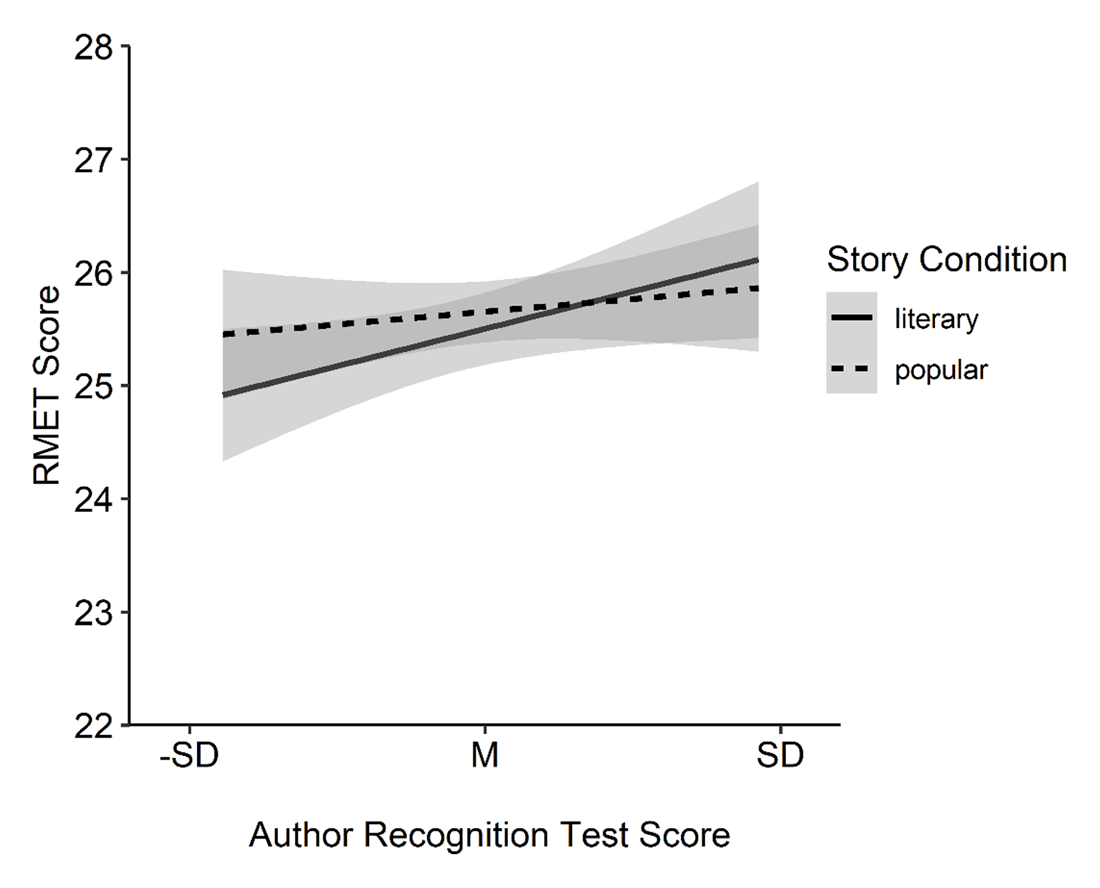
Figure 1
Interaction of Story Condition (Literary vs. Popular Fiction) and Cumulative Reading Exposure on Mentalizing Performance (Reading the Mind in the Eyes Test).
Note. The interaction of transportation and story condition on RMET scores is shown for a range of ± 1 SD around the mean value (shaded areas visualize the standard error).
Transportation as a Moderator
Next, we examined transportation (measured via the Transportation Scale – Short Form; Appel et al., 2015) as a possible moderator variable (Hypothesis 5). The interaction between text condition and transportation, as well as the three-way interaction of text condition, language, and transportation were not statistically significant for mentalizing (see Table A6). The analysis of self-reported trait empathy revealed a significant two-way interaction between text condition and transportation (B = –0.05, SE = 0.01, t(736) = –3.47, p < .001). Follow-up tests indicated that this difference between literary and popular fiction was significant at –1 SD (B = 0.24, SE = 0.06, t(736) = 4.21, p < .001, d = 0.50), and at the mean (B = 0.10, SE = 0.04, t(736) = 2.58, p = .005, d = 0.21), but not at +1 SD, (B = –0.03, SE = 0.05, t(736) = –0.65, p = .259, d = –0.08). Accordingly, differential effects in favor of literary fiction on self-reported empathy emerged only when readers reported low or average levels of transportation (see Figure 2). The three-way interaction fell short of significance for self-reported trait empathy (see Table A6).
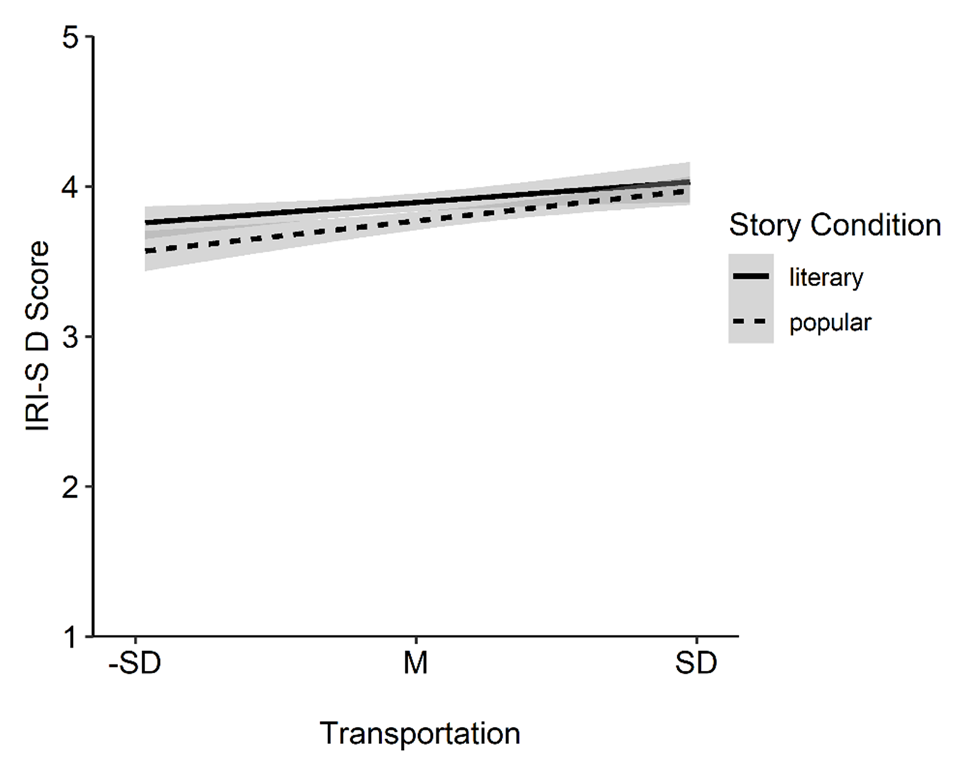
Figure 2
Interaction of Story Condition (Literary vs. Popular Fiction) and Transportation on Empathy (Interpersonal Reactivity Index).
Note. The interaction of transportation and story condition on IRI-S D scores is shown for a range of ± 1 SD around the mean value (shaded areas visualize the standard error).
Identification as a Moderator
Finally, we examined identification as a moderator variable (Hypothesis 6). For both mentalizing and self-reported trait empathy, the two-way interactions and the three-way interactions were not significant (see Table A7).
Discussion
The present study pursued three main aims. First, we examined whether literary and popular fiction were perceived and experienced differently by readers. Second, we examined whether reading literary fiction, in comparison with popular fiction, led to superior performance in a mentalizing task and higher levels of self-reported empathy and whether cumulative reading exposure, transportation and identification moderated this relationship. Third, we investigated whether language familiarity (native versus a second language) influenced any of those story effects.
We expected the literary fiction story to be judged to be of higher literary quality and complexity (Hypotheses 1a–c) and to be more relevant and influential to the readers’ personal attitudes and lives (Hypotheses 2a–c). Our results, however, consistently pointed in the opposite direction. While there was no difference between the stories in literary quality perception, the popular fiction story in either language was perceived as better written, and to be more influential to readers’ lives, beliefs and attitudes. However, consistent with our hypothesis, we found that the literary fiction story was perceived as more difficult to understand than the popular fiction story (Hypothesis 1c). In line with our predictions, this effect was smaller when the story was read in a foreign language. An explanation for this might be that popular fiction can pose linguistic challenges for second-language speakers due to its use of slang, jargon, and colloquial expressions. For example, this might also explain–besides other aspects (e.g., differences in genre and publication year)–why the readers in Schwerin and Lenhart’s (2022) study rated to popular fiction stories to be harder to understand than the literary fiction stories. However, this effect was probably not pertinent in the present study because we used a relatively modern romance (Lalla) in the popular condition that made very little use of such linguistic expressions.
In contrast to our hypotheses, we found no significant main effects of story condition on mentalizing performance or self-reported empathy (Hypotheses 3a and b). We additionally used equivalence tests (Lakens et al., 2018), which revealed that outcomes for literary versus popular fiction were statistically equivalent. Therefore, our results do not agree with findings reported by Kidd and Castano (2013, 2019), despite implementing short stories that were used in their studies. Indeed, our results correspond with those of many other experimental studies that found no differences between reading literary and popular fiction (e.g., Panero et al., 2016; Samur et al., 2018; Schwerin & Lenhart, 2022).
However, Schwerin and Lenhart (2022) found that reading literary fiction resulted in superior mentalizing performance compared to popular fiction (on the Reading the Mind in the Eyes Test) when the participants reported high degrees of narrative engagement in the story and with the story characters. They interpreted high degrees of narrative engagement as indicator of whether readers’ make use of learning opportunities provided in stories, with literary fiction presumably offering better stimuli for social-cognitive learning (e.g., Kidd & Castano, 2013; Koopman & Hakemulder, 2015). Moreover, some studies suggest that greater individual reading volume may pronounce differential short-term effects of literary fiction in particular, as more experienced readers may adopt story characters’ perspectives easier (e.g., Kidd & Castano, 2019). Therefore, we additionally examined transportation, identification with story characters and cumulative reading exposure as moderator variables (Hypotheses 4 to 6).
In the present study, readers who were strongly transported in the popular fiction story reported higher empathy, whereas self-reported empathy was to a lesser amount associated with the degree of transportation in the literary fiction story. Thus, narrative engagement as the proximal psychological outcome of well-written stories high in narrativity (Koopman & Hakemulder, 2015) might play a more important role in enhancing narrative empathy in particular for popular fiction. Literary fiction, in contrast, may be less dependent on narrativity and may also draw upon defamiliarization processes initiated by foregrounded features to influence social-cognitive skills (Koopman & Hakemulder, 2015). However, it has to be noted that this assumption conflicts with the findings of Schwerin and Lenhart’s (2022) study in which higher narrative engagement did not moderate effects on self-reported empathy but was positively associated with mentalizing performance after reading literary fiction. In light of these contradictory findings, it is difficult to gauge the role and importance of narrative engagement to explain differences between literary and popular stories.
Additionally, we found that cumulative reading experience (measured via the Author Recognition Test) emerged as a moderator in predicting mentalizing performance. High cumulative reading experience was associated with better performance on the RMET after reading literary fiction. This effect was less pronounced after reading popular fiction. Only at high cumulative reading experience was there a trend toward higher scores on the RMET for readers of the literary fiction story compared to readers of the popular fiction story. These findings support Kidd and Castano’s (2019) idea that predominantly more experienced readers might profit from a short-term reading experience of literary fiction. They also invite questioning whether a minimum of prior reading experience is actually necessary to profit more from literary fiction, and whether readers can be “trained” to make use of social-cognitive learning opportunities provided by complex literary fiction stories (e.g., Kidd & Castano, 2019).
Overall, making sense of the inconsistent research findings on the effects of literariness on social-cognitive abilities and empathy is difficult. One source of the divergent experimental results might be the particular short stories chosen for the literary and the popular conditions. The short stories used by Kidd and Castano (2013) and subsequent studies (e.g., Schwerin & Lenhart, 2022) differ in many ways beyond the assumed differences in their degree of literariness. Taking the recent study by Schwerin and Lenhart (2022) as an example, the popular fiction stories were typical for specific genres (Space Jockey, a science fiction story, and Too Many Have Lived, a crime story) and published in the first half of the 20th century, whereas the literary fiction stories (The Vandercook and Corrie) represent contemporary narrative realism. Their finding that narrative engagement and perceived personal relevance was higher for literary fiction may result from differences in topics and sociocultural content but not from the differences in presumed literariness (see also the discussion in Schwerin & Lenhart, 2022). In the present study, we aimed to reduce this heterogeneity by selecting two stories that contained similar plots, were published around the same time, and were comparable in length (Corrie and Lalla). In both stories, the protagonists were young women who experienced the vicissitudes of an intimate relationship. These measures were taken to increase the likelihood that any differences could be attributed to distinct features of literary fiction stories.
Our approach in matching the literary and popular fiction story has a methodological advantage over previous studies using popular and literary fiction stories. However, the popular and the literary fiction stories in the present study differed in some aspects other than presumed literariness. An exploratory sentiment analysis of the emotional valence in the literary (Corrie) and the popular fiction short story (Lalla), using the syuzhet package (version 1.0.4; Jockers, 2015) in R with the emotion dictionary by Remus et al. (2010), revealed that despite following a similar plot, the literary and the popular fiction story begin with a different valence and follow different emotional arcs. Most notably, the short stories end with a completely different emotional valence. Lalla, typical for the romance genre, ends on a very positive note and in a classic “and they lived happily ever after” way. Corrie, in contrast, reaches the most negative valence at its end after the main character learns that the man she had an affair with for many years was intimately involved with her to benefit from her wealth (see Figures A1 and A2 in the Online Supplement). This is also not unexpected, as literary fiction often exhibits a more negative valence overall. In light of these differences between the stories, however, we cannot exclude the possibility that emotion induction effects occurred and influenced the posttest measures and decreased ratings in the literary condition (see also, Green et al., 2012) because participants’ emotional states were not assessed before and after reading.
In addition, from the participants’ perspective, the plot of the literary fiction story (Corrie) was significantly more difficult to understand than the plot of the popular fiction story (Lalla), which might also have contributed to the differences we found in favor of the popular fiction story. If the plot of Corrie was too difficult to grasp for many readers, that is, fully occupying their cognitive capacities in trying to figure out what was happening in the story, this difficulty might have impeded not only the experience of narrative absorption but also the appreciation of literary characteristics. Thus, it might have been interesting to also assess cognitive engagement with the stories, as differences between the short stories may have emerged in favor of the more complex literary fiction story (Black et al., 2022). This explanation also raises the question of whether literary features, such as foregrounding, need to be identified and understood by the readers to develop their full potential for fostering social-cognitive skills and stimulating (self-)reflection (Harash, 2022).
Apart from comparing differential effects of literary and popular fiction, we also investigated whether reading in a foreign language affects reading experiences such as transportation or identification. We found no differences between stories presented in participants’ native language (German) or their second language (English). This finding is consistent with the study by Chung-Fat-Yim et al. (2019) who found that stories can be just as narratively absorbing in a second language, and it extends their findings to identification. For other aspects of story perception, exploratory analyses yielded no significant main effects of or interactions with language condition other than the finding that the English short stories were rated to contain more unknown words and to be better written. Taken together, the results of the current study indicate that stories read in one’s native tongue versus a second language have no differential effects on readers – at least if these readers are sufficiently proficient in the second language.
Limitations and Future Directions
The present study has several limitations that need to be addressed. Firstly, we used only two short stories, with one representing each condition (literary and popular fiction). While these stories serve as exemplars, which is a common approach in this line of research, this design limits the generalizability of our findings to other short stories within these categories. As a result, any observed effects may be specific to these particular stories rather than broadly characteristic of literary versus popular fiction as a whole. This limitation raises the possibility of a fixed-effects fallacy (e.g., Clark, 1973), where inferences drawn from a small, fixed set of stimuli are mistakenly generalized to the entire population of potential stories. To address this concern, extensive research employing a larger and more diverse sample of naturalistic texts would be required. However, it needs to be noted that the stories implemented in the current study were selected based on their categorization in previous studies that report significant results in line with our hypotheses (e.g., Kidd & Castano, 2013).
Another limitation already noted is that despite matching in length, content, and publishing period, the stories differed in aspects other than differences in assumed literariness. For example, the results could have been influenced by differences in the emotional valence at the end of the stories. Future studies should therefore include an assessment of the participants’ emotional state before and after reading to control for this possibility. Generally, methods should be designed to ensure that the stories in the popular and literary fiction conditions are similar in all other aspects (ceteris paribus), though it remains to be seen to what extent this is possible given the complexity of narratives.
A third limitation is the low internal consistency of the Reading the Mind in the Eyes Test (Ω = .46), an issue that has also occurred in many other studies (e.g., Lenhart & Richter, 2022; Mar et al., 2006; Schwerin & Lenhart, 2022). The low reliability brings into question the usefulness of the RMET in capturing social-cognitive effects of story exposure. Although the RMET has established itself as the standard for measuring advanced mentalizing in correlational (for a meta-analysis, see Mumper & Gerrig, 2017) and experimental research (for a meta-analysis, see Dodell-Feder & Tamir, 2018), it has been criticized conceptually (e.g., Black et al., 2021). Apart from the low internal consistency, the question of whether attributing emotional states to eyes shown on photographs represents advanced mentalizing ability or an emotion recognition task remains controversial. Even more problematic, the RMET is designed to distinguish people diagnosed with autism spectrum disorder from other people. Therefore, the RMET might not be sensitive to differences at higher levels of social cognition, which has been demonstrated in an IRT analysis of the test with a large sample of neurotypical adults (Black, 2018). Additionally, the RMET shows substantial correlations with verbal ability (Eekhof et al., 2022). Future research should therefore include other measures of advanced mentalizing ability.
Another limitation is that only trait empathy was assessed but not state empathy. Although theories (e.g., Mar & Oatley, 2008) argue that engaging with narratives might temporarily enhance one’s own perceptions of trait empathy and foster empathic growth through repeated exposure, including a measure of state empathy in future research might be fruitful. In addition to both trait and state empathy, which are usually assessed via self-report, including a measure of prosocial behavior, such as making donations or spontaneous helping behavior, might not only contribute to a more objective measure but also add a possible proximal outcome of increased empathy after reading (see also, Johnson, 2012).
Of course, reading a short story might not equate to the experience of reading an entire book or cumulative leisure reading. Moreover, participants in the present study could not freely choose what to read, which is inconsistent with leisure reading, and could have affected intrinsic motivation and narrative engagement. It is also worth noting that some of the measures used to assess literary quality perception and its influence on personal attitudes and (self-)reflection were single-item and not psychometrically validated, raising concerns about the reliability and validity of these particular findings. Nonetheless, these items were designed to address relatively straightforward concepts and were intentionally chosen to minimize participant burden. Finally, even though we were able to recruit a large sample for the present study, our participants were mostly young and well-educated female adults. Future studies should aim to recruit more heterogeneous samples, as there is tentative evidence that effects may be stronger in males (e.g., Wimmer et al., 2024).
Conclusion
The present study contributes to a growing body of research on the effects of exposure to works of literary fiction on social-cognitive abilities. In contrast to our hypotheses, readers did not judge literary fiction stories to be more literary and we found no differences in self-reported empathy ratings and mentalizing performance after reading the literary versus popular fiction stories. In our view, the decidedly mixed and inconsistent findings from our and other studies aiming to replicate Kidd and Castano’s (2013) seminal study raise concerns regarding the simple categorization of stories as literary and popular fiction. Moreover, the prevalent use of the Reading the Mind in the Eyes Test may be an obstacle for consistent findings, given its repeatedly shown low reliability. Future research should test alternative ways of assessing mentalizing improvements and turn towards a cleaner experimental manipulation of literariness to reduce other sources of variability, for example by closely matching text stimuli, altering specific textual characteristics, or providing paratextual information on literariness.
Data Accessibility Statement
The data, the analysis script and the Online Supplement are available in the Open Science Framework repository under this link: https://osf.io/dbw39/.
Competing Interests
The authors have no competing interests to declare.