
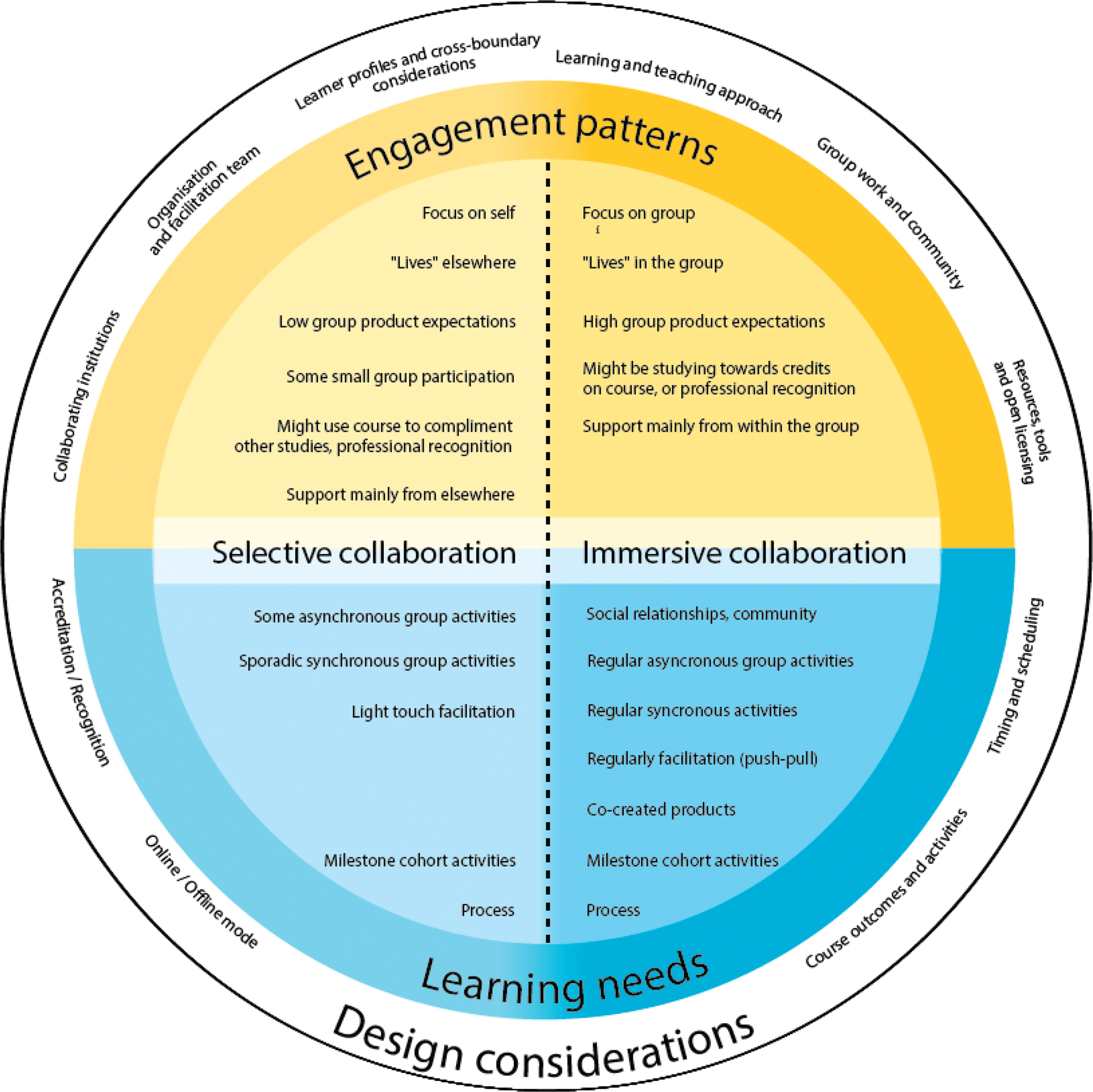
Figure 1
Framework for cross-boundary collaborative open learning
| Commonalities of cases | Case studies | Case study 1: FDOL132 University of Salford, Karolinska Institutet and Manchester Met | Case study 2: CreativeHE Manchester Met, London Metropolitan University, University of Macedonia, Creative Academic and Lifewide Education networks |
|---|---|---|---|
| Duration in weeks | 12 | 8 |
| Dates | Sep – Dec 2013 | Sep – Nov 2015 | |
| Collaborative design characteristics | Optional, in small groups using PBL | Optional, in small groups or pairs using a variety of pedagogical approaches agreed with learners | |
| Course development | Collaborative: University of Salford and Karolinska Institutet | Manchester Met | |
| Recognition for open learners | Certificate of participation | Open badges for participation | |
| Formal study option | At the University of Salford: approved Flexible, Distance and Online learning module at postgraduate level as part of the PgCert in Academic Practice. At Karolinska Institutet: Part of study towards the accredited development courses 2-weeks or 5-weeks. | At Manchester Met: Part of the Creativity for Learning module, option to also use work towards FLEX 15 or FLEX 30 modules. All three are part of the MA in HE. University of Macedonia: part of MA in Lifelong Learning | |
| Study linked to further local engagement opportunities | n/a | London Metropolitan University: part of Take5 initiative. | |
| Languages | English and Swedish | English and Greek |
| Pool of Meanings | Categories of description | Variations | Codes used in the outcome space (shown in Appendix 3) |
|---|---|---|---|
| 5.2 Pool 1: Course | Open learning as course organisation |
| C1.1 |
| Open learning as an activity-based experience |
| C1.2 | |
| Open learning as a facilitated experience |
| C1.3 | |
| Open learning as designed for collaboration |
| C1.4 | |
| 5.3 Pool 2: Boundary crossing | Cross-boundary learning through modes of participation |
| C2.1 |
| Cross-boundary learning through time, places and space |
| C2.2 | |
| Cross-boundary learning through culture and language |
| C2.3 | |
| Cross-boundary learning through diverse professional contexts |
| C2.4 | |
| 5.4 Pool 3: Collaboration | Collaboration as engagement in learning |
| C3.1 |
| Collaboration as a means to shared product creation |
| C3.2 | |
| Collaboration as relationship building |
| C3.3 |