
Introduction
During this rapid technological advancement period, the need for effective digital leadership has become ever more important since it can improve the performance of all ODDE higher educational institutions (Onan, 2024; Obied, 2025). The strategic application of digital technology by leaders to create innovative solutions, facilitate adaptability, and enhance efficiencies in the manner in which education is delivered is commonly known as “digital leadership” (Liu, 2025; Anwar & Saraih, 2024). Within the context of ODDE, digital leadership is expressed through transformational leadership characteristics whereby leaders can develop and communicate a digital vision; support innovation; enable and facilitate institutional adaptation to the newly constructed digitally based learning environments (Maheshwari et al., 2024; Weber et al., 2022; Loglo, 2024). Institutional Performance will be evaluated by measuring employees’ subjective evaluations, as opposed to objective archival indicators.
In order to offer a wide range of learning opportunities to students from various geographic areas, ODDE schools employ virtual platforms as a key component of their operations. There were no comparable institutional performance data points available for the participating institutions throughout the data collection procedure. Due to the inconsistency in how performance assessment indicators (such as platform uptime, service responsiveness, retention, and graduation) were measured between institutions, institutional performance evaluations were inaccurate. Institutional Performance in ODDE may be reflected in outcomes such as student retention, graduation rates, resource optimisation, and stakeholder satisfaction (Ali & Amin, 2025; Pu et al., 2024). Stronger institutional performance may also help ODDE institutions expand access to higher-quality education for non-traditional learners and contribute to reducing socioeconomic and geographical barriers. The sector’s ability to respond successfully to rising lifelong learning needs in a digital economy may be constrained by subpar institutional performance in ODDE.
Globally, current issues and trends in ODDE Institutional Performance reflect a post-pandemic shift toward hybrid models and AI-driven personalisation (Olabiyi et al., 2025).
In distance education (ODDE), there is growing concern about data-driven decision-making and digital information delivery models, but this trend is not uniform across contexts. Research by Khurniawan et al. (2024) shows that in some regions of Asia and Africa, the number of learners enrolled in mobile learning has increased, but uneven infrastructure has hampered results. There is not much research that has examined and validated the link between digital leadership skills and ODDE tool performance indicators, such as virtual engagement indicators, while most studies still focus on university communication systems (Qayyum et al., 2025). Evidence of time constraints in school environments also has a limited resource regime, which reduces the ability to self-empower.
The performance of ODDE organisations continues to face challenges such as the digital divide in the workplace, increasing inequality, leadership responsiveness to technologized work, and inadequate performance assessment frameworks in a rapidly changing context (Arham et al., 2024), leading to suboptimal analysis of supplementary resources and a lack of connectivity for learners.
The findings may inform more inclusive digital policy and support institutional efforts to strengthen leadership development and resilience in ODDE settings. These changes may also have indirect implications for staff upskilling, job satisfaction, efficiency, and students’ learning, academic progress, and career outcomes. These issues suggest that understanding the role of digital leadership may help explain how ODDE institutions can strengthen performance under conditions of digital change.
This study advances both research and practice in ODDE education in three important ways. It advances the ODL leadership literature by explaining how leadership behaviours translate into Institutional Performance through Organisational Agility, a capability that is particularly critical in digitally mediated and geographically dispersed learning environments. Rather than conceptualising leadership as a direct performance driver, the findings indicate that leadership effectiveness in ODDE contexts is largely realised through the organisation’s capacity to sense emerging learner needs, adapt academic and support processes, and reconfigure digital infrastructures. This study expands on current leadership models to more accurately represent the operational realities of ODDE by examining Organisational Agility as a crucial mechanism between leadership behaviours and Institutional Performance in ODDE institutions.
The study clarifies which leadership behaviours facilitate agile organisational responses and offers practical insights for ODDE leadership and administration, particularly in relation to digital transformation, learner support systems, and institutional performance.
Literature Review
Underpinning Theory
This study draws on Transformational Leadership Theory (Bass & Avolio, 1994) and Dynamic Capabilities Theory (Teece et al., 1997) to explain how digital leadership may shape Institutional Performance in ODDE settings. Transformational Leadership Theory views leadership as a pattern of behaviours through which leaders set direction, motivate followers, encourage new ways of thinking, and support individual development. In digitally mediated education, these dimensions help explain how leaders communicate a shared digital vision, encourage innovation, support staff in adapting to new technologies, and model the values needed for organisational change.
Leadership behaviours alone may not be sufficient to explain performance in settings marked by ongoing technological and organisational change. Dynamic Capabilities Theory offers a useful extension by shifting attention from leadership behaviour itself to the organisation’s ability to sense emerging opportunities, respond to them, and reconfigure its resources accordingly (Teece, 2007).
Within this study, Organisational Agility is positioned as the mechanism through which leadership behaviours are translated into performance outcomes.
The Connection Between Individualised Consideration, Organisational Agility & Institutional Performance
Prior research indicates that Individualised Consideration can support Institutional Performance, particularly when its effect operates through Organisational Agility (Awashreh, 2025). Leaders who provide personal guidance, show empathy, and attend to employees’ developmental needs are more likely to build a committed and capable workforce (Alhosani & Ahmad, 2024). In turn, this form of support can strengthen the institution’s ability to adapt, learn, and respond to change, which are central features of Organisational Agility (Jaafar et al., 2025; Ozan & Özarslan, 2025). The contribution of Individualised Consideration to Institutional Performance may therefore depend less on immediate performance gains and more on its role in shaping organisational conditions that support responsiveness and resilience.
In digitally changing higher education settings, Organisational Agility therefore provides a plausible mechanism through which a leader’s attention to individual growth may be translated into improved institutional outcomes, including student success and operational effectiveness (Osman et al., 2025a).
H1: There is a relationship between Individualised Consideration and Institutional Performance in ODDE higher institutions.
H2: There is a relationship between Individualised Consideration and Organisational Agility towards Institutional Performance in ODDE higher institutions.
H3: There is a mediating effect of Organisational Agility on the relationship between Individualised Consideration and Institutional Performance in ODDE higher institutions.
The Connection Between Idealised Influence, Organisational Agility & Institutional Performance
The literature indicates that Idealised Influence is associated with Institutional Performance, particularly when it strengthens Organisational Agility (Samodien et al., 2024; Dimple & Tripathi, 2024). In higher education settings, leaders who act as credible role models can strengthen shared purpose and reinforce commitment to institutional direction, including the digital future of the institution (Tayyab & Sharif, 2025). This kind of credibility may be particularly important in periods of change, when staff are required to accept uncertainty, adopt new practices, and engage with innovation. A trusting and cohesive environment can make it easier for employees to take calculated risks and support changes that enhance organisational adaptability (Mohamed Alzeyoudi & Nik Abdullah, 2025). The contribution of Idealised Influence to Institutional Performance appears to operate largely through Organisational Agility. When leadership strengthens trust, alignment, and openness to change, the organisation may become better able to respond to technological shifts and pedagogical demands.
In ODDE institutions, where adaptation is central to continued effectiveness, Organisational Agility thus provides a plausible mechanism linking Idealised Influence to performance outcomes such as operational effectiveness and student success (Osman et al., 2025b).
H4: There is a positive and significant relationship between idealised influence and Institutional Performance in ODDE higher institutions.
H5: There is a positive and significant relationship between idealised influence and Organisational Agility towards Institutional Performance in ODDE higher institutions.
H6: There is a positive and significant mediating effect of Organisational Agility on the relationship between idealised influence and Institutional Performance in ODDE higher institutions.
The Connection Between Inspirational Motivation, Organisational Agility & Institutional Performance
Inspirational Motivation has been proved that may contribute to stronger performance in higher education, with Organisational Agility providing an important pathway through which this effect can occur (Litsulitsa et al., 2024; Dimple & Tripathi, 2024). Leaders who display Inspirational Motivation tend to communicate a clear and compelling sense of direction, which can help staff align with institutional goals and move beyond individual interests in support of shared objectives (Umar et al., 2025; Mahmutoğlu et al., 2025). Such communication may strengthen a collective sense of purpose and encourage the proactive and adaptive behaviours associated with Organisational Agility (Musundire, 2025; Antwi-Boampong et al., 2025).
The role of Inspirational Motivation may extend beyond boosting morale, as it can also help institutions become more responsive to technological change, pedagogical innovation, and shifting external demands. For ODDE institutions, Organisational Agility therefore appears to be a plausible mechanism through which a motivating vision is translated into performance outcomes such as student success, operational effectiveness, and longer-term institutional competitiveness.
H7: There is a positive and significant relationship between Inspirational Motivation and Institutional Performance in ODDE higher institutions.
H8: There is a positive and significant relationship between Inspirational Motivation and Organisational Agility towards Institutional Performance in ODDE higher institutions.
H9: There is a positive and significant mediating effect of Organisational Agility on the relationship between Inspirational Motivation and Institutional Performance in ODDE higher institutions.
The Connection Between Intellectual Stimulation, Organisational Agility & Institutional Performance
Prior research has identified Intellectual Stimulation (IS) as a leadership behaviour that can enhance Institutional Performance, particularly in contexts that require innovation and adaptation (Sazly et al., 2025; Goraya et al., 2024). Leaders who demonstrate IS tend to question assumptions, encourage new ideas, and support experimentation among faculty and staff, thereby fostering a culture of critical thinking and innovation (Musundire, 2025; Mohamad & Osman, 2025; Karunanayaka et al., 2021). Such an environment, marked by intellectual curiosity and psychological safety, can strengthen the dynamic capabilities associated with OA. It encourages employees to reflect critically on existing practices, recognise emerging educational trends and technological change, and develop responses to complex challenges (Alnasser et al., 2025; Soomro & Soomro, 2024). In this context, OA helps explain how Intellectual Stimulation is linked to stronger performance outcomes. By supporting a more adaptive and responsive organisation, IS may contribute to educational quality, operational resilience, and continued relevance in a changing digital higher education environment.
H10: There is a positive and significant relationship between Intellectual Stimulation and Institutional Performance in ODDE higher institutions.
H11: There is a positive and significant relationship between Intellectual Stimulation and Organisational Agility towards Institutional Performance in ODDE higher institutions.
H12: There is a positive and significant relationship between Organisational Agility and Institutional Performance in ODDE higher institutions.
H13: There is a positive and significant mediating effect of Organisational Agility on the relationship between Intellectual Stimulation and Institutional Performance in ODDE higher institutions.
Methods
Research Method
This study examines how academic and non-academic staff perceive the direct and indirect effects of Inspirational Motivation, Individualised Consideration, Intellectual Stimulation, and Idealised Influence on Institutional Performance, with Organisational Agility acting as a mediator in ODDE higher institutions. A quantitative cross-sectional survey design was adopted. The study follows an explanatory and predictive approach to test the relationships among the research constructs. Partial Least Squares Structural Equation Modelling (PLS-SEM) was used to examine the hypotheses and evaluate the proposed model. Data were collected through a survey instrument adapted from established studies identified through a comprehensive literature review.
Research Design or Model
Figure 1 presents the research model. Notes: IM = Inspirational Motivation; IC = Individualised Consideration; IS = Intellectual Stimulation; II = Idealised Influence; OA = Organisational Agility; IP = Institutional Performance.
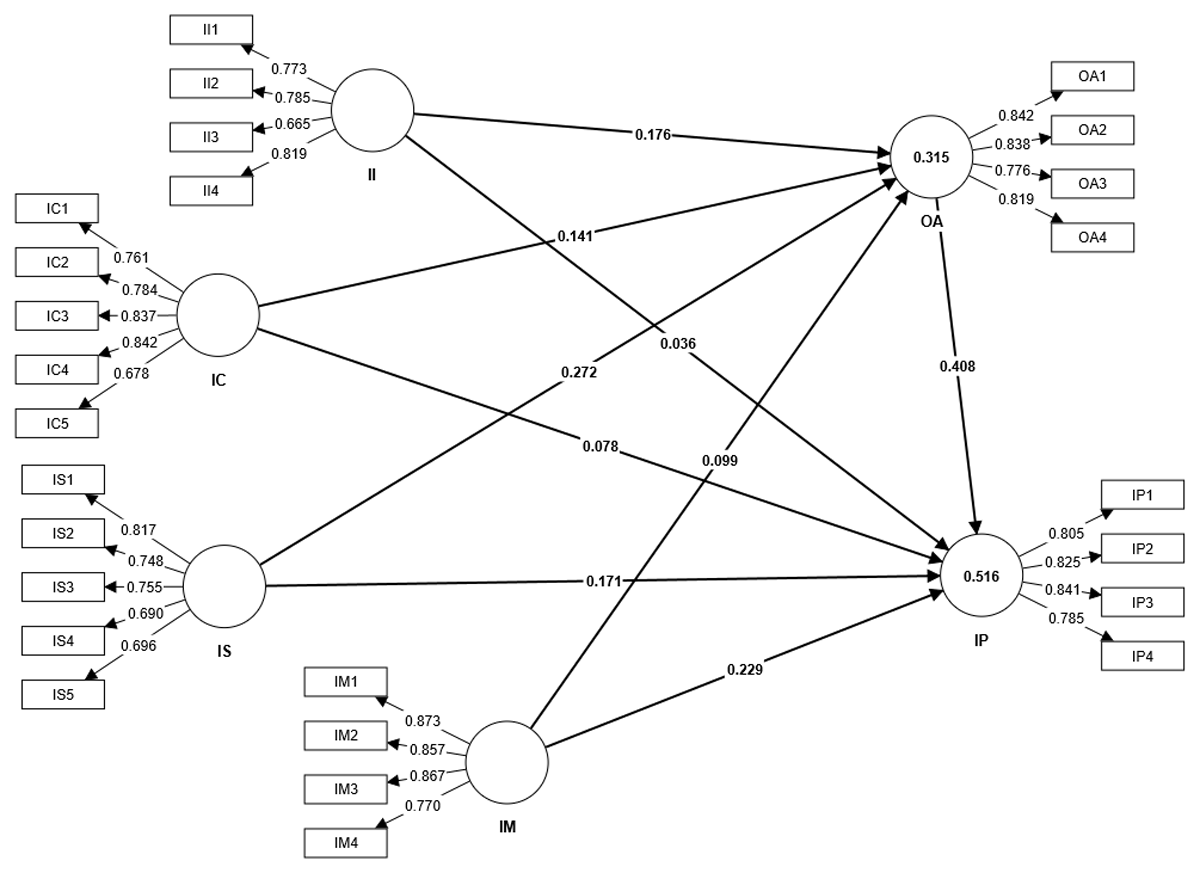
Figure 1
Research Model.
Data Collection Tools
Digital leadership was represented through four transformational leadership behaviours adapted from Bass and Avolio (1994): Inspirational Motivation (4 items), Individualised Consideration (5 items), Intellectual Stimulation (5 items), and Idealised Influence (4 items). In the ODDE context, digital leadership refers to leaders’ ability to communicate a shared digital vision, encourage innovation, provide individualised support, and model values that help the organisation adapt to digitally mediated environments. Organisational Agility (OA), the mediator, was measured using four items developed for this study on the basis of Dynamic Capabilities Theory (Teece et al., 1997). The dependent variable, Institutional Performance (IP) in ODDE, was measured using four items adapted from Richard et al. (2009) to capture employees’ overall assessments of institutional effectiveness. Institutional Performance was assessed through employees’ perceptions rather than archival data, as comparable KPI records were not consistently available across the participating ODDE institutions in Malaysia. Differences in reporting systems and the lack of standardised indicators across institutions made perceptual measures an appropriate way to capture staff views of institutional effectiveness in this context.
All constructs were measured on a five-point Likert scale ranging from strongly disagree to strongly agree. The questionnaire is presented in Appendix A.
Sampling or Research Group
Three ODDE higher education institutions in Malaysia including Open University Malaysia (OUM), Wawasan Open University (WOU), and Asia e-University, were purposively selected because they are established providers operating in digitally mediated teaching, learning, and administrative settings relevant to this study. The participants were academic and non-academic staff who were currently employed at these institutions and involved in institutional processes within the ODDE context. As a complete population list was unavailable, the survey was distributed by email to eligible employees through organisational channels, and participation was voluntary. This sampling approach was used to reach informed respondents who were directly relevant to the research objectives, as random sampling was not feasible in this setting (Creswell & Creswell, 2018; Etikan et al., 2016; Patton, 2015). All respondents provided informed consent before completing the survey. Of the 551 questionnaires distributed, 439 were returned, for a response rate of 79.7%. After data screening, cases with substantial missing data, formulaic responses, or irregular completion were excluded. This left 413 valid responses for final analysis, sufficient for PLS-SEM.
In terms of demographics, 60.0% (n = 248) of the survey participants were male and 40.0% (n = 165) were female. The majority of participants were between 31 and 60 years old, accounting for 84.7% of the total sample. The oldest age group was 41–50 years old (41.6%, n = 172), followed by 31–40 years old (22.3%, n = 92) and 51–60 years old (20.8%, n = 86). Participants under 30 years old accounted for 6.8% (n = 28), while those over 60 years old accounted for 8.5% (n = 35). Consistent with age characteristics, survey participants reported significant work experience, with nearly 60% having 11 to 20 years of experience (11–15 years: 31.0%, n = 128; 16–20 years: 28.3%, n = 117). Smaller proportions reported 6–10 years (14.5%, n = 60) or 21–25 years (12.3%, n = 51), while those with less than 5 years (5.6%, n = 23) or more than 26 years (8.3%, n = 34) accounted for a relatively small proportion. In terms of professional roles, lecturers constituted the majority in the survey sample (67.6%, n = 279), while non-teaching staff accounted for 32.4% (n = 134), ensuring representation from both teaching and administrative functions within the organisation.
Research Procedures
The data analysis used a well-organised, multi-step methodology. The measurement model was initially assessed for internal consistency reliability, convergent validity, and discriminant validity. The structural model was then assessed to examine the hypothesised direct and indirect relationships through bootstrapping. Next, predictive performance was analysed using PLSpredict and the Cross-Validated Predictive Ability Test (CVPAT). To provide additional managerial insight, Importance–Performance Map Analysis (IPMA) was also conducted to identify areas requiring greater managerial attention. All analyses were carried out in SmartPLS 4, which is well suited to complex predictive models and has been widely applied in PLS-SEM research (Ringle et al., 2022).
Validity and Reliability Measures
Following the procedure recommended by Kock (2015), full collinearity variance inflation factor (VIF) values were assessed. All inner VIF values reported in Table 1 were below the prudential cutoff threshold of 3.3, suggesting that general methodological bias is unlikely to be a significant concern in this study.
Table 1
Full Collinearity (VIF).
| IP | II | IC | IS | IM | OA | |
|---|---|---|---|---|---|---|
| IP | 2.046 | 2.039 | 1.416 | 1.900 | 1.643 | |
| II | 1.772 | 1.538 | 1.769 | 1.737 | 1.743 | |
| IC | 2.248 | 1.957 | 1.992 | 2.248 | 2.251 | |
| IS | 2.024 | 2.064 | 1.692 | 2.062 | 2.052 | |
| IM | 1.325 | 1.398 | 1.422 | 1.416 | 1.428 | |
| OA | 1.439 | 1.762 | 1.788 | 1.769 | 1.793 |
As shown in Table 2, the measurement model demonstrates acceptable reliability and convergent validity in accordance with the thresholds suggested by Hair et al. (2019). All constructs achieved satisfactory internal consistency, as both Cronbach’s alpha and composite reliability values exceeded 0.70. Although a few indicators recorded loadings slightly below the commonly preferred threshold of 0.70, they were retained because construct-level convergent validity remained satisfactory. For these constructs, composite reliability and AVE still met the recommended thresholds, so the items were retained to preserve content coverage relevant to the ODDE context. All constructs also recorded AVE values above 0.50. Discriminant validity was then assessed using the Heterotrait–Monotrait (HTMT) ratios reported in Table 3, following Henseler et al. (2015).
Table 2
Constructs Reliability, Validity and Item Loadings.
| CONSTRUCTS | ITEMS | LOADINGS | CA | CR | AVE |
|---|---|---|---|---|---|
| Individualised Consideration (IC) | IC1 | 0.761 | 0.841 | 0.858 | 0.613 |
| IC2 | 0.784 | ||||
| IC3 | 0.837 | ||||
| IC4 | 0.842 | ||||
| IC5 | 0.678 | ||||
| Idealised Influence (II) | II1 | 0.773 | 0.758 | 0.760 | 0.581 |
| II2 | 0.785 | ||||
| II3 | 0.665 | ||||
| II4 | 0.819 | ||||
| Inspirational Motivation (IM) | IM1 | 0.873 | 0.863 | 0.865 | 0.710 |
| IM2 | 0.857 | ||||
| IM3 | 0.867 | ||||
| IM4 | 0.770 | ||||
| Institutional Performance (IP) | IP1 | 0.805 | 0.831 | 0.834 | 0.663 |
| IP2 | 0.825 | ||||
| IP3 | 0.841 | ||||
| IP4 | 0.785 | ||||
| Intellectual Stimulation (IS) | IS1 | 0.817 | 0.796 | 0.798 | 0.552 |
| IS2 | 0.748 | ||||
| IS3 | 0.755 | ||||
| IS4 | 0.690 | ||||
| IS5 | 0.696 | ||||
| Organisational Agility (OA) | OA1 | 0.842 | 0.837 | 0.841 | 0.671 |
| OA2 | 0.838 | ||||
| OA3 | 0.776 | ||||
| OA4 | 0.819 |
[i] Notes: CR = Composite Reliability; CA = Cronbach Alpha; AVE = Average Variance Extracted.
Structural Model
Following Hair et al. (2017), the structural model was evaluated based on path coefficients (β), coefficients of determination (R2), and the significance of the hypothesised relationships. A bootstrapping procedure with 5,000 subsamples was then used to test both direct and indirect effects in the model. Table 4 presents the results for all hypotheses, including the path coefficients, t-values, p-values, and confidence intervals, indicating that the four leadership dimensions are linked to institutional outcomes through both direct and indirect paths.
Table 4
Hypothesis Testing Results.
| HYPOTHESES | BETA | T-STATISTICS | P-VALUES | 2.50% | 97.50% | DECISION |
|---|---|---|---|---|---|---|
| H1: IC –> IP | 0.078 | 1.336 | 0.182 | –0.033 | 0.194 | Rejected |
| H2: IC –> OA | 0.141 | 2.069 | 0.039 | 0.003 | 0.269 | Accepted |
| H3: IC –> OA –> IP | 0.057 | 2.059 | 0.040 | 0.003 | 0.113 | Accepted |
| H4: II –> IP | 0.036 | 0.703 | 0.482 | –0.062 | 0.138 | Rejected |
| H5: II –> OA | 0.176 | 3.214 | 0.001 | 0.067 | 0.280 | Accepted |
| H6: II –> OA –> IP | 0.072 | 2.800 | 0.005 | 0.026 | 0.126 | Accepted |
| H7: IM –> IP | 0.229 | 4.766 | 0.000 | 0.128 | 0.317 | Accepted |
| H8: IM –> OA | 0.099 | 2.116 | 0.034 | 0.006 | 0.189 | Accepted |
| H9: IM –> OA –> IP | 0.040 | 2.106 | 0.035 | 0.004 | 0.081 | Accepted |
| H10: IS –> IP | 0.171 | 2.987 | 0.003 | 0.060 | 0.283 | Accepted |
| H11: IS –> OA | 0.272 | 4.402 | 0.000 | 0.152 | 0.388 | Accepted |
| H12: OA –> IP | 0.408 | 8.805 | 0.000 | 0.317 | 0.497 | Accepted |
| H13: IS –> OA –> IP | 0.111 | 4.004 | 0.000 | 0.062 | 0.170 | Accepted |
[i] Notes: Significant < 0.05.
Individualised Consideration did not have a significant direct effect on Institutional Performance (H1: β = 0.078, t = 1.336, p = 0.182, CI [–0.033, 0.194]), but it showed a significant positive effect on Organisational Agility (H2: β = 0.141, t = 2.069, p = 0.039, CI [0.003, 0.269]) and a significant indirect effect on Institutional Performance through Organisational Agility (H3: β = 0.057, t = 2.059, p = 0.040, CI [0.003, 0.113]).
Idealised Influence did not have a significant direct effect on Institutional Performance (H4: β = 0.036, t = 0.703, p = 0.482, CI [–0.062, 0.138]), but it showed a significant positive effect on Organisational Agility (H5: β = 0.176, t = 3.214, p = 0.001, CI [0.067, 0.280]) and a significant indirect effect on Institutional Performance through Organisational Agility (H6: β = 0.072, t = 2.800, p = 0.005, CI [0.026, 0.126]).
Inspirational Motivation showed significant direct and indirect effects on Institutional Performance, with a significant direct path to Institutional Performance (H7: β = 0.229, t = 4.766, p < 0.001, CI [0.128, 0.317]), a significant effect on Organisational Agility (H8: β = 0.099, t = 2.116, p = 0.034, CI [0.006, 0.189]), and a significant indirect effect through Organisational Agility (H9: β = 0.040, t = 2.106, p = 0.035, CI [0.004, 0.081]).
Intellectual Stimulation showed a positive direct effect on Institutional Performance (H10: β = 0.171, t = 2.987, p = 0.003, CI [0.060, 0.283]) and the strongest effect on Organisational Agility among the four leadership dimensions (H11: β = 0.272, t = 4.402, p < 0.001, CI [0.152, 0.388]). Organisational Agility also exerted a strong positive effect on Institutional Performance (H12: β = 0.408, t = 8.805, p < 0.001, CI [0.317, 0.497]), while the indirect effect through Organisational Agility was also supported (H13: β = 0.111, t = 4.004, p < 0.001, CI [0.062, 0.170]).
The model explained 31.5% of the variance in Organisational Agility (R2 = 0.315) and 51.6% of the variance in Institutional Performance (R2 = 0.516), indicating a moderate level of explanatory power overall, with stronger explanatory strength for Institutional Performance. Organisational Agility also emerged as the key mechanism in the model, as it directly affected Institutional Performance and transmitted the effects of the four leadership dimensions to institutional outcomes. The mediation is full for Individualised Consideration and Idealised Influence, but partial for Inspirational Motivation and Intellectual Stimulation.
Effect Sizes (F2)
Effect sizes (f2) were interpreted based on Cohen’s (1992) criteria, with 0.02, 0.15, and 0.35 indicating small, medium, and large effects, respectively. The results in Table 5 show that Organisational Agility (OA) has a medium effect on Institutional Performance (IP) (f2 = 0.236). Intellectual Stimulation (IS) has a small effect on OA (f2 = 0.056), while Inspirational Motivation (IM) has a small effect on IP (f2 = 0.082). The direct effects of Individualised Consideration (IC) and Idealised Influence (II) on Institutional Performance are negligible (f2 = 0.005 and f2 = 0.001, respectively). This suggests that their contribution to performance is not primarily direct, but operates mainly through Organisational Agility, which is consistent with the significant indirect effects reported in Table 4.
PLSpredicts
Following the PLSpredict procedure proposed by Shmueli et al. (2016, 2019), the model’s out-of-sample predictive performance was assessed. All Q2predict values were above zero, indicating predictive relevance. When compared to the standard linear model (LM), the PLS-SEM model yielded lower RMSE values for six of the eight indicators, while the LM model performed slightly better for IP1 and IP4. These results in Table 6 suggest the model has average predictive ability rather than superior predictive accuracy across all indicators.
Cross-validated Predictive Ability Test (CVPAT)
According to Hair et al. (2022) and Liengaard et al. (2021), CVPAT was conducted to test the model’s out-of-sample predictive ability. Specifically, the negative average loss differences reported for Institutional Performance (IP: –0.152), Organisational Agility (OA: –0.101), and the overall model (–0.127) show that the PLS-SEM model yields lower prediction error than the standard benchmark. The significance of the reported t-values and p-values (p < 0.001) supports the model’s predictive validity in this ODDE context. The CVPAT results are presented in Table 7.
Importance-performance Map Analysis (IPMA)
Organisational Agility (OA) was the most important predictor of Institutional Performance, with the highest total effect (0.408), yet it recorded the lowest performance score (62.284). This suggests that OA should be treated as the main area for improvement. Intellectual Stimulation (IS) and Inspirational Motivation (IM) also showed relatively high importance (0.282 and 0.270, respectively), while their performance levels were moderately high.
Idealised Influence (II), showed the lowest importance (0.108) and a moderate performance score (67.003), suggesting that its current contribution to Institutional Performance is more limited in this setting.
A more relevant approach would be to strengthen the connection between II and the model’s key mediator, Organisational Agility. In practice, this may involve leaders more visibly demonstrating digital transformation behaviours, such as actively using new teaching technologies and showing clear commitment to the institution’s digital vision. The IPMA results are presented in Table 8.
Discussion
Organisational Agility emerges as the strongest direct predictor of Institutional Performance. In digitally mediated higher education, performance depends not only on leadership itself but also on the institution’s ability to respond quickly, adjust routines, and reallocate resources as conditions change.
This result is consistent with Dynamic Capabilities Theory, which views organisational success in turbulent environments as depending on the ability to sense, seize, and reconfigure resources rather than rely on stable routines alone. This finding is also consistent with earlier studies that identify Organisational Agility as an important route through which leadership and organisational capabilities shape performance outcomes (Alhosani & Ahmad, 2024; Dimple & Tripathi, 2024; Jaafar et al., 2025). In the ODDE context, institutions face continuing pressure to adjust delivery modes, student support systems, and internal processes in response to technological change and changing learner expectations (Loglo, 2024; Antwi-Boampong et al., 2025).
Inspirational Motivation and Intellectual Stimulation both show direct and indirect effects on Institutional Performance. This pattern indicates partial mediation, meaning that these two leadership dimensions contribute not only to agility but also directly to performance. This pattern is consistent with studies linking digital leadership to vision-setting, experimentation, knowledge sharing, and innovation-oriented behaviour in higher education (Anwar & Saraih, 2024; Arham et al., 2024; Pu et al., 2024; Liu, 2025).
The two dimensions, however, appear to operate somewhat differently. Inspirational Motivation seems more directly connected to Institutional Performance, perhaps because a clear sense of direction can strengthen collective commitment and align staff with institutional priorities. Intellectual Stimulation seems to work more strongly through agility by encouraging staff to question routines, try new approaches, and engage in adaptive problem-solving. This is consistent with the view that intellectually stimulating leadership helps create conditions under which organisations become more responsive and innovative over time. Inspirational Motivation seems to strengthen institutional alignment, whereas Intellectual Stimulation contributes more to adaptive capacity.
Individualised Consideration and Idealised Influence show a different pattern. Neither dimension has a significant direct effect on Institutional Performance, but both have significant indirect effects through Organisational Agility. This suggests full mediation rather than partial mediation. These two leadership dimensions seem to contribute to Institutional Performance only through their role in strengthening organisational agility. In ODDE institutions, supportive and role-modelling behaviours may matter less for immediate performance gains than for strengthening the conditions that support responsiveness, coordination, and adaptability. This interpretation is also consistent with the very small direct effect sizes of Individualised Consideration and Idealised Influence on Institutional Performance, suggesting that their role is more closely related to capability building than to immediate performance gains. This pattern is also consistent with recent higher education studies showing that staff support, developmental leadership, and trust-based influence matter most when they strengthen broader institutional readiness and adaptive capacity (Ozan & Özarslan, 2025; Maheshwari et al., 2024).
Leadership should not be viewed as a uniformly direct driver of Institutional Performance. Its effect depends on which leadership behaviours are enacted and on the organisational mechanisms through which they operate. Organisational Agility appears to be the key institutional capability through which leadership is translated into performance in digitally intensive education environments.
This extends prior leadership research by showing that the four dimensions of transformational leadership do not operate through the same pathways. This is particularly relevant for ODDE institutions, where resilience and relevance depend on how effectively leadership is converted into agile organisational action rather than symbolic commitment alone. The link between leadership and Institutional Performance is therefore not simply direct, but depends on the institution’s capacity to act with agility.
Theoretical Implications
A key theoretical contribution of this study is the integration of Transformational Leadership Theory (Bass & Avolio, 1994) and Dynamic Capabilities Theory (Teece et al., 1997), which together offer a more coherent explanation of leadership in digital educational settings. In particular, the study identifies Organisational Agility as an important mediating mechanism between leadership behaviours and Institutional Performance.
The findings support the view that leadership contributes to organisational adaptation by shaping higher-order capabilities. They also refine Transformational Leadership Theory by showing that its four dimensions do not contribute in the same way to the development of agility. Instead, the results suggest a more differentiated interpretation in which different leadership behaviours may support different capability-building processes. Behaviours that challenge assumptions may be more closely related to sensing capabilities, whereas vision-oriented behaviours may play a stronger role in seizing activities.
This perspective goes beyond broad leadership constructs by focusing on how specific leader behaviours at the micro level connect with organisational outcomes at the macro level. Bringing these two theories together also offers a clearer way to understand how leadership operates during digital transformation. In this sense, the study confirms the relevance of dynamic capabilities in educational settings and clarifies the leadership conditions that may support their development. The framework developed here may therefore provide a useful basis for future research on the behavioural antecedents of dynamic capabilities across different cultural and institutional contexts, while also offering implications for leadership development in ODDE education.
Practical Implications
ODDE institutions may improve performance by developing digital leadership in ways that strengthen Organisational Agility. This may help institutions respond better to the needs of diverse learners, improve the accessibility and timeliness of support services, and create more favourable conditions for student success, including retention and graduation.
Institutions that adapt more quickly are more likely to streamline administrative processes, reduce inefficiencies, and direct resources more effectively towards innovation and student-centred priorities. This can strengthen institutional reputation and competitiveness by improving how ODDE providers respond to technological change, evolving learner expectations, and external pressures over time.
Institutions may therefore link leadership development and agility initiatives to indicators such as student retention, graduation rates, digital platform uptime, service responsiveness, and learner satisfaction. This would show whether perceived improvements in Institutional Performance are reflected in observable institutional results.
Limitations and Future Research
Institutional Performance was measured through employee perceptions rather than objective KPI data. This was due to the lack of comparable institutional records across the participating ODDE institutions. While perceptual measures were appropriate in this context, they may not fully reflect actual institutional performance. The cross-sectional design captures the relationships at one point in time only, so it cannot show how digital leadership, Organisational Agility, and Institutional Performance change as institutions respond to ongoing technological disruption.
Future research should combine perceptual measures with objective indicators such as digital infrastructure uptime, service responsiveness, student retention, and graduation rates. This would strengthen the assessment of Institutional Performance in ODDE. Research conducted over time could show whether the effects observed here remain stable or shift as digital conditions evolve.
The model should also be examined in other institutional and cultural settings, as the present findings are drawn from a specific ODDE context. Broader evidence could show whether the same pattern holds elsewhere. Future research may also examine other processes through which leadership influences performance, including digital culture and innovation capacity. Qualitative inquiry could be especially helpful here, as it may reveal more clearly how leadership behaviours are enacted in everyday practice and how they support agility in ODDE institutions.
Conclusion
The results show that digital leadership is associated with Institutional Performance in ODDE, although its influence is not limited to a direct effect on performance. Much of its contribution appears to come from strengthening institutions’ ability to respond with agility to the demands of digitally mediated and distributed learning environments.
The findings also show a differentiated mediation pattern. Organisational Agility fully mediates the effects of Individualised Consideration and Idealised Influence on Institutional Performance, while partially mediating the effects of Inspirational Motivation and Intellectual Stimulation. This indicates that digital leadership does not shape Institutional Performance through a single common pathway. The leadership dimensions operate through distinct pathways, with Organisational Agility emerging as the principal mechanism linking leadership to institutional outcomes in ODDE.
The findings point to a more nuanced view of leadership in ODDE. The leadership dimensions contribute to Institutional Performance in different ways, and Organisational Agility remains central to this process.
Additional File
The additional file for this article can be found as follows:
Data Accessibility Statement
The datasets used and/or analysed during the current study are available from the corresponding author on reasonable request.
Sustainable Development Goals (SDGs)
This study is linked to the following SDG(s): Quality education (SDG 4).
Author Notes
Based on Academic Integrity and Transparency in AI-assisted Research and Specification Framework (Bozkurt, 2024), the authors of this paper acknowledge the use of ChatGPT (OpenAI, version as of 2026) in facilitating language refinement and academic editing during the preparation of this manuscript. All AI-assisted content was critically reviewed, edited, and validated by the human authors to ensure academic rigor, ethical compliance, and accuracy. The final content, interpretations, and conclusions are the sole responsibility of the authors.
Ethics and Consent
Ethical approval was not required for this study as it involved an anonymous survey of adult participants and posed no foreseeable risk. Participation was voluntary, and informed consent was obtained from all respondents prior to data collection.
Author Contributions (CRediT)
Zahir Osman: Conceptualization, methodology, investigation, data curation, formal analysis, software, validation, writing – original draft, writing – review and editing, supervision.
Huong-An Thi Nguyen: Conceptualization, methodology, interpretation of results, writing – original draft, writing – review and editing, project administration.
All authors have read and agreed to the published version of the manuscript.