
Introduction
Engagement in online learning environments is critical to the effectiveness of learning processes. Especially with the COVID-19 pandemic, the transition to online learning methods has further increased the importance of engagement. Engagement generally refers to the active involvement of students in learning processes. Engagement is theoretically described by the student engagement (SE) framework. This framework includes cognitive, emotional, and behavioral dimensions directly affecting learning outcomes (Baloran et al., 2021). Each of these dimensions has different dynamics that affect learning processes and have been an important focus in educational research.
SE has three main components: behavioral, cognitive, and emotional (Fredricks et al., 2004). Behavioral engagement involves students’ active participation, such as accessing course materials, participating in discussions, and completing assignments (Dixson, 2015). It directly impacts achievement and knowledge acquisition (Lei et al., 2018). Xu (2023) found that higher behavioral engagement significantly improves learning outcomes. Cognitive engagement refers to the mental effort put into understanding and internalizing learning materials, enhancing the depth of learning (Burke et al., 2024). Emotional engagement relates to students’ emotional responses and is crucial for their commitment and motivation in online learning. Positive emotional interactions can boost engagement and commitment (Wang et al., 2024).
Interaction and presence are other important concepts associated with SE in online learning environments. Interaction refers to the communication and collaboration between students and other elements in online learning environments (Starr-Glass, 2013). Students also interact with the interface, content, teacher, student, and environment (Gökoğlu et al., 2024). Moore (1993) explained these concepts using the transactional distance (TD) theory. According to Moore, interaction plays an important role in reducing TD. TD is the psychological and communication gap students may experience in an online learning environment (Moore, 1993). When TD is high, students feel isolated, disconnected, unmotivated, and disengaged (Fabian et al., 2022). The opposite is that when engagement increases, TD decreases, and students are more likely to feel connected, supported, and engaged in the learning process (Dharmadjaja & Tiatri, 2021).
Another significant concept associated with SE in online settings is presence. Presence pertains to the sensation of connection and being present (McCreery et al., 2013). For students to actively engage in their courses, it is essential for them to feel a sense of presence (Shea & Bidjerano, 2009). Presence is intricately linked to SE and satisfaction, and it positively impacts learning outcomes (Hajibayova, 2017). Presence is a fundamental element of the community of inquiry (CoI). CoI is a theoretical framework highlighting the significance of three types of presence in promoting meaningful learning experiences in online educational contexts: cognitive, teaching, and social (Swan et al., 2009). Cognitive presence involves learners developing and validating meaning through reflection, discussion, and exploring ideas. Teaching presence pertains to the planning, facilitation, and guidance of instruction in online courses, including teaching strategies, feedback, and instructor support. Social presence emphasizes the interactions and the sense of belonging among members of an online learning community (Garrison, 2007).
Within the landscape of online learning, interaction, CoI, and SE serve as fundamental frameworks for explaining pedagogical effectiveness. Extensive empirical research consistently demonstrates a positive correlation between these constructs, with a particular emphasis on how social and cognitive presences influence learner outcomes. For instance, Kucuk and Richardson (2019) and Choo et al. (2020) established that high levels of teaching, social, and cognitive presence are significant predictors of both student engagement and course satisfaction. This consensus is further supported by Edumadze and Govender (2024) and Khammat Al-iessa et al. (2024), who identified CoI perceptions as primary drivers of engagement in diverse settings such as blended MOOCs and language learning.
Regarding the impact of interaction, scholars generally agree that mitigating perceived distance is essential for fostering participation and achievement. Fabian et al. (2022) and Leem (2023) concluded that enhanced interaction levels correlate directly with higher academic achievement and more active student participation. Similarly, Karaoglan-Yilmaz et al. (2024) and Doo et al. (2021) identified interaction as a critical factor influencing satisfaction and self-regulation in flipped learning environments. More recent studies have also explored the role of specific interaction modalities; for example, Zhang et al. (2024) found that real-time ‘danmaku’ interactions significantly enhance SE, while Shehzad and Charles (2023) highlighted the vital role of instructor social presence in increasing emotional and cognitive involvement. Collective evidence from these studies, including the multi-dimensional analyses by Gökoğlu et al. (2024) and Xiao et al. (2024), suggests that the synergy between enhanced interaction and a robust CoI framework is the most reliable predictor of deep student engagement. However, there is a limited number of studies in which all three models are evaluated holistically. This study aims to explore the primary relationships between interaction, CoI, and SE and the relationships between the sub-dimensions of these frameworks.
Relationship Between Interaction and Presence
The link between interaction and presence in online learning is key to enhancing learning quality. Consequently, the relationship between interaction and CoI—models rooted in these concepts—has been widely studied. Shaw and Chen (2012) found that enhanced interaction promotes teaching presence by making student-teacher dialogue more dynamic and interactive. This, in turn, enhances students’ perceptions of social, cognitive, and cultural presence, fostering CoI. Similarly, Starr-Glass (2013) reported that enhancing interaction strengthens perceptions of social, cognitive, and instructional presence, effectively supporting CoI.
Miao and Ma (2022) found that online interaction enhances social presence, boosting learning engagement and enhancing interaction. Chen (2023) also linked interaction and CoI through engagement and social presence, noting that higher interaction encourages active participation in CoI. Bulando et al. (2024) reported that limited interaction lowers presence and student satisfaction. Gao et al. (2024) emphasized the interdependence of social interaction, social presence, and engagement in improving online learning outcomes. Increased interaction leads to stronger presence and engagement, enhancing learning effectiveness. Bali et al. (2024) showed that interaction—especially with instructors and peers—improves social presence and learning experiences for non-traditional students. Kandemir and Çakmak (2024) found that maintaining high dialogue, regardless of structural format, enhances interaction and strengthens perceptions of social, cognitive, and instructional presence, thereby supporting CoI.
The studies listed above show a positive linear relationship between interaction and CoI. Therefore, the following hypotheses are formulated for interaction and CoI in online learning environments:
H1: TD positively affects the community of inquiry in online learning environments.
Transactional Distance and Student Engagement
Various studies have confirmed the relationship between interaction and engagement in online learning environments (Chen, 2023; Keengwe & Schnellert, 2012; Muzammıl et al., 2020). Interaction is considered a factor that positively affects students’ learning processes and increases SE.
Keengwe and Schnellert (2012) highlighted that interaction in online learning enhances the learning experience and deepens student engagement, with student-instructor, student-student, and student-content interactions boosting cognitive engagement. Muzammıl et al. (2020) found that such interactions positively impact student engagement (SE) and satisfaction. Similarly, Ong and Quek (2023) reported that increased teacher-student interaction meets students’ social needs, enhancing engagement.
Karaoglan-Yilmaz et al. (2024) found that in flipped learning, perceptions of interaction significantly affect SE, with five TD interaction types positively linked to SE. Enhancing interaction in this context can enhance engagement. Similarly, Gökoğlu et al. (2024) showed during the COVID-19 pandemic that lowering TD—especially in student-teacher and student-content interactions—increases behavioral engagement in online learning.
The studies listed above show a positive linear relationship between interaction and SE. Therefore, the following hypotheses are formulated:
H2: TD positively affects cognitive engagement in online learning environments.
H3: TD positively affects emotional engagement in online learning environments.
Although behavioral engagement is a core dimension of the SE framework, the present study focuses specifically on cognitive and emotional engagement. Behavioral engagement is excluded due to measurement limitations observed in the PLS-SEM model.
Community of Inquiry and Student Engagement
The CoI framework provides a robust theoretical lens for understanding how cognitive, social, and teaching presences collectively foster various dimensions of student engagement. To understand these dynamics, it is essential to examine how each presence contributes to behavioral, emotional, and cognitive engagement.
Behavioral engagement, often manifested through active participation and task completion, is significantly influenced by teaching and social presence. Teaching presence provides the necessary structure and instructional clarity that drives student involvement. For instance, Vo and Ho (2024) found that course clarity and teacher support significantly enhance behavioral engagement by reducing ambiguity in online settings. Similarly, Su et al. (2024) and Ma et al. (2025) highlighted that teaching presence directly encourages active student engagement by reinforcing the perceived value of the course. Furthermore, social presence acts as a catalyst for behavioral engagement; as noted by Li et al. (2024), teacher support that reduces learner anxiety encourages students to engage more frequently in online discussions and collaborative activities.
The affective dimension of engagement, characterized by a sense of belonging and motivation, is primarily rooted in social and teaching presences. Social presence creates a supportive environment where students feel connected to their peers and the instructor. Minosky et al. (2024) demonstrated that social presence enhances SE by increasing students’ emotional connection and satisfaction with the learning process. This is further supported by Kong et al. (2025), who reported that emotional support from teachers acts through social presence to boost students’ sense of belonging. When students perceive an intense social atmosphere, their motivation increases, leading to higher levels of emotional persistence throughout the course.
Cognitive engagement involves the psychological investment in deep learning and complex problem-solving, which is the core output of cognitive presence. Supported by effective teaching presence, cognitive presence enables students to move from basic information exchange to high-level knowledge construction. Lai et al. (2019) found that active participation within online inquiry communities facilitates deeper cognitive reflection and achievement. According to Kucuk and Richardson (2019), cognitive presence provides students with the mental scaffolding necessary to engage in deep learning activities. Teaching presence supports this process by providing timely feedback and guiding discussions, ensuring that social interaction translates into meaningful cognitive development.
The above-mentioned studies show a positive linear relationship between CoI and SE. Therefore, the following hypotheses are formulated:
H4: Community of inquiry positively affects cognitive engagement in online learning environments.
H5: Community of inquiry positively affects emotional engagement in online learning environments.
Figure 1 presents the study’s conceptual model. The arrows indicate positive effects.
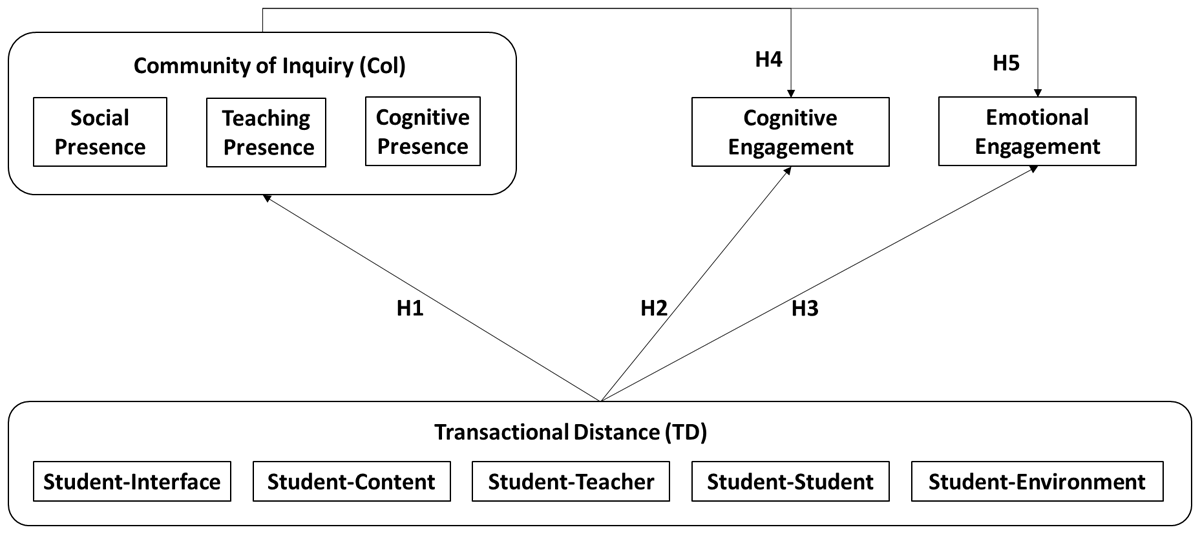
Figure 1
Hypothesized research model.
Methods
This section describes the main steps followed while implementing the research. First, the participants’ demographic information is presented. Then, the instruments used for data collection are introduced, and the data collection process is explained. Finally, the data analysis methods are detailed.
Participants Demographics
The participants were 1558 undergraduate students at a state university in Türkiye. Since presence, engagement, and interaction in online learning environments are not specific to a particular discipline, students from as many different disciplines as possible were included in the study. Accordingly, students from eight faculties participated randomly and voluntarily. Table 1 summarizes the demographics and online learning experience of the participants.
Table 1
Demographics and experience of the participants
| PARTICULARS | FREQUENCY | PERCENT | PARTICULARS | FREQUENCY | PERCENT |
|---|---|---|---|---|---|
| Faculty | Grade | ||||
| Civil Aviation | 169 | 10.8% | First-year | 140 | 9.0% |
| Economics and Administrative Sciences | 167 | 10.7% | Second-year | 597 | 38.3% |
| Education | 326 | 20.9% | Third-year | 585 | 37.5% |
| Engineering and Architecture | 248 | 15.9% | Fourth-year | 236 | 15.1% |
| Fine Arts and Design | 96 | 6.2% | Online learning experience | ||
| Sport Sciences | 205 | 13.2% | 1 year | 566 | 36.3% |
| Theology | 253 | 16.2% | 2 years | 912 | 58.5% |
| Tourism | 94 | 6.0% | 3 years | 69 | 4.4% |
| Gender | 4 years | 6 | 0.4% | ||
| Male | 869 | 55.8% | 5 years and above | 5 | 0.3% |
| Female | 689 | 44.2% | Age (Mean ± SD) | 21.1 ± 1.6 |
Data Collection
The research data was collected using the paper-and-pencil method by administering three scales (TD, CoI, and SE). The TD scale measures students’ perceptions of TD towards online learning environments. The scale developed by Zhang (2003) and adapted into Turkish by Yılmaz and Keser (2015) was employed to measure interaction. Although this scale was originally conceptualized under the framework of TD, its dimensions (student–student, student–instructor, student–content, student–interface, and student–environment) specifically operationalize levels of active interaction. To ensure theoretical consistency with Moore’s (1993) original definition of TD as a ‘gap’ to be minimized, this study treats these dimensions as indicators of ‘Interaction Perception’ rather than distance. The scale’s construct validity was examined using confirmatory factor analysis (CFA). The CFA results for the five-factor model were χ2(357) = 2360.91, (sd = 655, p = 0.000); χ2/sd = 3.60, RMSEA = 0.086, RMR = 0.11, SRMR = 0.086, GFI = 0.74, AGFI = 0.71, IFI = 0.93, CFI = 0.93, NFI = 0.90 and NNFI = 0.92. Cronbach’s alpha coefficient of the scale was found to be 0.92. A high score on the scale indicates that the individual’s perception of TD is low; in other words, the perceptions of interactions (student interface, student-content, student-teacher, student-student, and student environment) are high.
The CoI scale measures students’ perceptions of social, cognitive, and teaching presence in online learning environments. The scale developed by Arbaugh et al. (2008) was adapted into Turkish by Öztürk (2012). The construct validity of the scale was examined with CFA. As a result of CFA, the fit indices were χ2 = 996.25 (sd = 524, p < 0.001), (χ2/sd) = 1.90, RMSEA = 0.081, S-RMR = 0.072, NNFI = 0.80, CFI = 0.81, GFI = 0.70, and AGFI = 0.66. Cronbach’s alpha coefficient of the scale was calculated as 0.97.
The SE scale measures students’ behavioral, cognitive, and emotional engagement in online learning environments. The scale developed by Sun and Rueda (2012) was adapted into Turkish by Ergün and Koçak Usluel (2015). The scale’s construct validity was tested with first and second-level CFA. As a result of the analyses, goodness of fit values were found as χ2(84, N = 393) = 453.93, p < 0.000; RMSEA = 0.072, S-RMR = 0.059, GFI = 0.89, AGFI = 0.86, CFI = 0.96, NNFI = 0.96, IFI = 0.96. The Cronbach Alpha internal consistency coefficient of the scale, which consists of behavioral (5 items), cognitive (8 items), and emotional (6 items) engagement factors, was calculated as 0.90.
This study was conducted in accordance with the principles outlined in the Declaration of Helsinki. Ethical approval was obtained from the Kastamonu University Social and Human Sciences Research and Publication Ethics Committee (Decision Date: 02.11.2021, No: 6/4). Before data collection, the authors provided all participants with an informed consent form detailing the study’s objectives and the confidentiality of their data. It was clearly stated that participation was voluntary, and participants provided their consent before proceeding with the scale.
Data Analysis
The PLS-SEM was used to explore the possible relationship among the TD, CoI, and SE. Figure 1 shows the tested model. All computational results are obtained by the ‘seminr’ package of the R software. The PLS-SEM model has two main components. These are the measurement and structural parts of the model. Both model parts should be tested and implemented carefully to get statistically significant results. One may visit the work of Hair et al. (2021) to understand the implementation steps of the PLS-SEM in R.
There are two main approaches used in SEM. These are PLS-SEM and covariance-based SEM, shortly, CB-SEM. Two important studies have been done to compare the effectivities of these two models. Dash and Paul (2021) showed that PLS-SEM outperforms the CB-SEM according to the reliability and validity measures. Also, Dash and Paul (2021) stated that the PLS-SEM should be preferred instead of the CB-SEM for composited-based models. Hair et al. (2019) made a list of situations where the PLS-SEM model should be used. According to Hair et al. (2019), the PLS-SEM method should be used when the structural model is complex and the data are not normally distributed. Also, the statistical power of the PLS-SEM model is higher than those of the CB-SEM model. For these reasons, PLS-SEM is selected against the CB-SEM model.
The validity of the measurement model is tested by indicator reliability, internal consistency, convergent validity, indicator collinearity, and discriminant validity. The indicator reliability requires all square values of the item loadings should be greater than 0.708. If the square value of the item loading is less than 0.708, it should be deleted from the measurement model. Composite reliability (CR), Cronbach’s alpha (CA), and rho_A are used to check the internal consistency. The threshold for these measures is 0.70. Average variance extracted (AVE) is the measure of the convergent validity. The threshold for the AVE is 0.50. As seen from Table 2, all AVE measures of the indicators are greater than 0.50. Therefore, the convergent validity also holds for the measurement model. Indicator collinearity is tested by VIF values. Here, the threshold value is 5. Finally, the discriminant validity is tested by the heterotrait-monotrait ratio (HTMT) of correlations (see Henseler et al., 2015). If the HTMT values are greater than 0.90, the discriminant validity problem occurs. Finally, the model’s explanatory power is assessed using adjusted R2 and R2.
Table 2
Item reliability and internal consistency results of the PLS-SEM model.
| ITEMS | LOADINGS | VIF | CA | CR | AVE | rho_A |
|---|---|---|---|---|---|---|
| TD | 0.840 | 0.886 | 0.611 | 0.858 | ||
| EE | 0.938 | 0.953 | 0.802 | 0.939 | ||
| EE_1 | 0.879 | 3.070 | ||||
| EE_2 | 0.905 | 3.692 | ||||
| EE_3 | 0.890 | 3.251 | ||||
| EE_4 | 0.915 | 4.057 | ||||
| EE_5 | 0.888 | 3.254 | ||||
| CE | 0.879 | 0.906 | 0.581 | 0.881 | ||
| CE_1 | 0.779 | 1.533 | ||||
| CE_2 | 0.766 | 1.934 | ||||
| CE_3 | 0.810 | 2.188 | ||||
| CE_4 | 0.801 | 2.208 | ||||
| CE_5 | 0.817 | 2.267 | ||||
| CE_6 | 0.729 | 1.764 | ||||
| CE_7 | 0.722 | 1.663 | ||||
| SI | 0.766 | 0.840 | 0.513 | 0.772 | ||
| SI_1 | 0.725 | 1.496 | ||||
| SI_2 | 0.730 | 1.343 | ||||
| SI_3 | 0.726 | 1.333 | ||||
| SI_4 | 0.697 | 1.553 | ||||
| SI_5 | 0.712 | 1.580 | ||||
| SC | 0.821 | 0.883 | 0.654 | 0.821 | ||
| SC_1 | 0.710 | 1.302 | ||||
| SC_2 | 0.824 | 1.956 | ||||
| SC_3 | 0.853 | 2.311 | ||||
| SC_4 | 0.848 | 2.136 | ||||
| ST | 0.846 | 0.891 | 0.621 | 0.849 | ||
| ST_1 | 0.728 | 1.549 | ||||
| ST_2 | 0.727 | 1.551 | ||||
| ST_3 | 0.846 | 2.273 | ||||
| ST_4 | 0.818 | 2.188 | ||||
| ST_5 | 0.814 | 1.934 | ||||
| SS | 0.913 | 0.928 | 0.591 | 0.915 | ||
| SS_1 | 0.731 | 1.894 | ||||
| SS_2 | 0.793 | 2.522 | ||||
| SS_3 | 0.808 | 2.705 | ||||
| SS_4 | 0.754 | 1.993 | ||||
| SS_5 | 0.747 | 1.837 | ||||
| SS_6 | 0.786 | 2.186 | ||||
| SS_7 | 0.775 | 2.372 | ||||
| SS_8 | 0.742 | 2.083 | ||||
| SS_9 | 0.777 | 2.038 | ||||
| SE | 0.859 | 0.895 | 0.587 | 0.863 | ||
| SE_1 | 0.717 | 1.616 | ||||
| SE_2 | 0.801 | 1.922 | ||||
| SE_3 | 0.748 | 1.763 | ||||
| SE_4 | 0.784 | 1.989 | ||||
| SE_5 | 0.817 | 2.091 | ||||
| SE_6 | 0.727 | 1.576 | ||||
| CoI | 0.846 | 0.907 | 0.764 | 0.851 | ||
| TP | 0.928 | 0.938 | 0.558 | 0.929 | ||
| TP_1 | 0.799 | 2.628 | ||||
| TP_2 | 0.724 | 2.815 | ||||
| TP_3 | 0.739 | 2.156 | ||||
| TP_4 | 0.749 | 2.036 | ||||
| TP_5 | 0.774 | 2.217 | ||||
| TP_6 | 0.779 | 2.254 | ||||
| TP_7 | 0.791 | 2.328 | ||||
| TP_8 | 0.770 | 2.136 | ||||
| TP_9 | 0.729 | 1.982 | ||||
| TP_10 | 0.763 | 2.152 | ||||
| TP_11 | 0.724 | 2.147 | ||||
| TP_12 | 0.718 | 2.014 | ||||
| SP | 0.902 | 0.923 | 0.630 | 0.902 | ||
| SP_1 | 0.756 | 1.876 | ||||
| SP_2 | 0.806 | 2.543 | ||||
| SP_3 | 0.817 | 2.665 | ||||
| SP_4 | 0.816 | 2.447 | ||||
| SP_5 | 0.791 | 2.194 | ||||
| SP_6 | 0.789 | 2.243 | ||||
| SP_7 | 0.782 | 2.079 | ||||
| CP | 0.932 | 0.941 | 0.571 | 0.932 | ||
| CP_1 | 0.773 | 2.399 | ||||
| CP_2 | 0.792 | 2.675 | ||||
| CP_3 | 0.749 | 2.104 | ||||
| CP_4 | 0.711 | 1.863 | ||||
| CP_5 | 0.747 | 2.077 | ||||
| CP_6 | 0.747 | 2.019 | ||||
| CP_7 | 0.784 | 2.343 | ||||
| CP_8 | 0.794 | 2.408 | ||||
| CP_9 | 0.744 | 1.995 | ||||
| CP_10 | 0.725 | 1.910 | ||||
| CP_11 | 0.744 | 2.170 | ||||
| CP_12 | 0.752 | 2.162 | ||||
Results
Evaluation of Measurement Model
As stated in the data analysis section, the measurement model’s validity is tested by indicator reliability, internal consistency, convergent validity, indicator collinearity, and discriminant validity. The indicator reliability requires all square values of the item loadings should be greater than 0.708. If the square value of the item loading is less than 0.708, it should be deleted from the measurement model. During the evaluation of the measurement model, the behavioral engagement dimension was entirely excluded from the final analysis because the square values of all associated item loadings were below the required threshold of 0.708. This exclusion was statistically necessary to ensure the indicator reliability and internal consistency of the measurement model, allowing for a more robust analysis of the remaining cognitive and emotional dimensions.
Although behavioral engagement is a theoretically well-established dimension of SE and demonstrated acceptable construct validity in prior CFA-based studies, its items exhibited consistently low loadings in the PLS-SEM measurement model. Rather than interpreting this result as a theoretical invalidation of behavioral engagement, the construct was excluded from the final structural model to preserve the integrity and theoretical coherence of the measurement model. The model focuses on cognitive and emotional engagement, which demonstrated adequate reliability and validity.
Furthermore, it is essential to note that high scores on the TD scale represent low perceived distance (high interaction). Consequently, positive path coefficients involving interaction in the subsequent structural model analysis should be interpreted as the positive impact of increased interaction (reduced distance) on the dependent variables. As given in Table 2, all the square values of the item loadings are greater than 0.708. So, the item reliability is valid for the measurement model.
As seen from Table 2, all AVE measures of the indicators are greater than 0.50. Therefore, the convergent validity also holds for the measurement model. Indicator collinearity is tested by VIF values, and no value has been reported higher than the threshold value for any of the items of the measurement model. The HTMT results are given in Table 3, and there are no values greater than 0.90. Since Col is modeled as a higher-order construct composed of TP, SP and CP, HTMT values between CoI and its lower-order dimensions are not reported. Discriminant validity is assessed only among constructs specified at the same hierarchical level. Also, TD is modeled as a higher-order construct of SI, SC, ST, SS and SE. Therefore, the HTMT values of the TD with its lower-order dimensions are removed.
Table 3
Discriminant validity by HTMT criteria.
| INDICATORS | TD | COI | EE | CE | SI | SC | ST | SS | SE | TP | SP | CP |
|---|---|---|---|---|---|---|---|---|---|---|---|---|
| TD | . | . | . | . | . | . | . | . | . | . | . | . |
| CoI | 0.848 | . | . | . | . | . | . | . | . | . | . | . |
| EE | 0.685 | 0.682 | . | . | . | . | . | . | . | . | . | . |
| CE | 0.659 | 0.659 | 0.545 | . | . | . | . | . | . | . | . | . |
| SI | 0.840 | 0.611 | 0.527 | 0.488 | . | . | . | . | . | . | . | . |
| SC | 0.858 | 0.703 | 0.605 | 0.543 | 0.696 | . | . | . | . | . | . | . |
| ST | 0.877 | 0.663 | 0.349 | 0.455 | 0.56 | 0.537 | . | . | . | . | . | . |
| SS | 0.853 | 0.655 | 0.459 | 0.442 | 0.484 | 0.536 | 0.496 | . | . | . | . | . |
| SE | 0.838 | 0.841 | 0.704 | 0.629 | 0.660 | 0.743 | 0.636 | 0.678 | . | . | . | . |
| TP | 0.740 | 0.875 | 0.458 | 0.501 | 0.492 | 0.552 | 0.657 | 0.511 | 0.651 | . | . | . |
| SP | 0.758 | 0.778 | 0.672 | 0.500 | 0.544 | 0.594 | 0.463 | 0.590 | 0.741 | 0.624 | . | . |
| CP | 0.757 | 1.016 | 0.581 | 0.652 | 0.501 | 0.619 | 0.548 | 0.545 | 0.719 | 0.747 | 0.728 | . |
Figure 2 graphically summarizes the reliability values of the measurement model. The explanatory power of the model is assessed using adjusted R2 and R2. These values differ between 0.370–0.580 (see Table 4). So, the explanatory power of the model is evaluated as moderate.
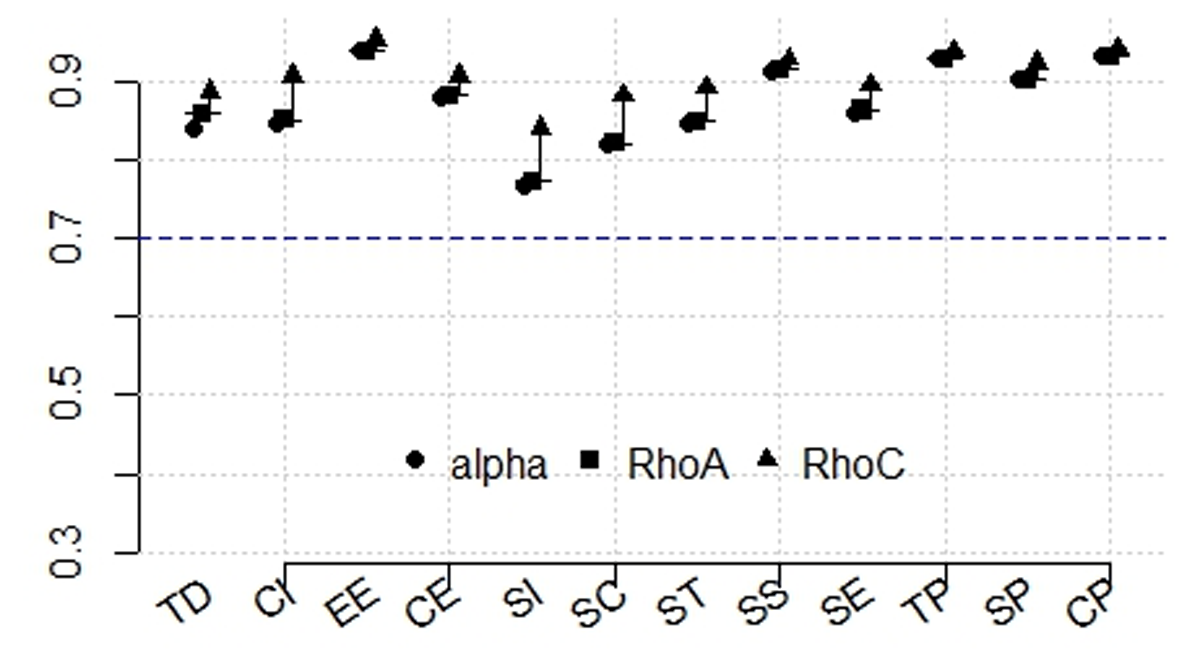
Figure 2
Reliability measures of the PLS-SEM model.
Effect sizes (f2) are examined to assess the impact of the structural relationships. The results indicate that TD has a very large effect on CoI (f2 = 0.481), suggesting that CoI is mainly explained by TD. In contrast, the effects of TD on EE (f2 = 0.102) and cognitive engagement CE (f2 = 0.072) are small to moderate. Similarly, CoI exhibits small effect sizes on both EE (f2 = 0.081) and CE (f2 = 0.068).
Evaluation of Structural Model
The structural model is tested by using bootstrap methodology. The bootstrap sample is selected as 5,000. The hypotheses in Table 5 are tested, and the results are given in Table 6. According to the results in Table 5, all tested hypotheses are supported. Also, Figure 3 displays the path diagram of the model.
Table 5
Tested hypotheses.
| HYPOTHESIS | DECISION |
|---|---|
| Interaction effects community of inquiry positively | Supported |
| Interaction effects cognitive engagement positively | Supported |
| Interaction effects emotional engagement positively | Supported |
| Community of inquiry effects the cognitive engagement positively | Supported |
| Community of inquiry effects the emotional engagement positively | Supported |
Table 6
Results of the hypothesis tests.
| HYPOTHESIS | ESTIMATE | BOOT. MEAN | BOOT. SD | t-value | p-value |
|---|---|---|---|---|---|
| TD->CoI | 0.762 | 0.762 | 0.012 | 63.438 | <0.001 |
| TD->EE | 0.371 | 0.371 | 0.030 | 12.266 | <0.001 |
| TD->CE | 0.328 | 0.329 | 0.036 | 9.230 | <0.001 |
| CoI->EE | 0.33 | 0.330 | 0.031 | 10.567 | <0.001 |
| CoI->CE | 0.321 | 0.320 | 0.038 | 8.425 | <0.001 |
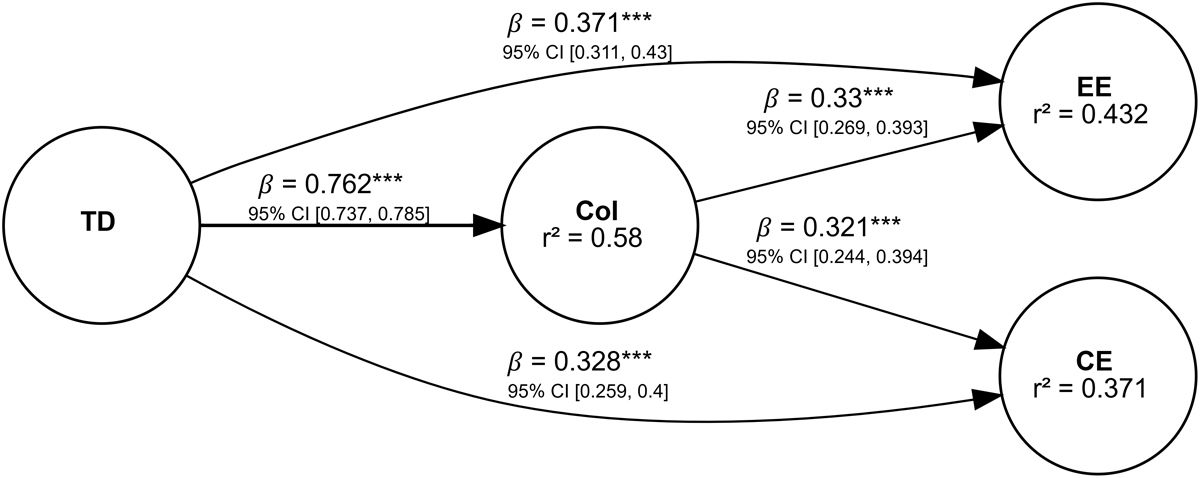
Figure 3
Path diagram of the PLS-SEM model.
Discussion and Conclusions
Employing PLS-SEM, this study investigated the structural relationships between interaction, CoI, and SE within online learning contexts. The results demonstrate that interaction exerts a significant positive influence on CoI; notably, bootstrap analysis revealed that this effect was more pronounced than the impact of interaction on SE. Such a finding implies that the perception of presence is substantially enhanced as interactivity increases. This alignment is consistent with recent evidence (Bali et al., 2024; Bulando et al., 2024; Gökoğlu et al., 2024), which suggests that mitigating transactional distance through high levels of interaction fosters a more immersive sense of presence. Consequently, by engaging deeply with the interface, content, instructors, and peers, learners achieve a higher degree of situatedness, thereby consolidating a more robust CoI framework.
The findings indicate that interaction exerts a nuanced, partial positive influence on SE; specifically, while it enhances cognitive and emotional dimensions, it appears to have no significant impact on behavioral engagement. This result presents a complex relationship compared to the generally posited linear link between interaction and SE found in prior research (Gökoğlu et al., 2024; Karaoglan-Yilmaz et al., 2024; Ong & Quek, 2023). While some studies, such as Gökoğlu et al. (2024), identify interaction as a significant driver of behavioral commitment, our evidence suggests that interaction alone is insufficient to elicit such participation. Conversely, the observed positive effect on cognitive engagement resonates with established literature. For instance, Kim et al. (2025) demonstrated that metaverse-based environments enhance interaction through immersive experiences, thereby promoting memory recall and cognitive involvement. Similarly, Kayode (2018) and Joo et al. (2014) emphasize that structured interaction and effective communication tools mitigate perceived distance, which in turn fosters deeper cognitive engagement. Notably, this study addresses a critical gap in the literature by establishing a link between interaction and emotional engagement—a relationship that has remained largely unexamined—thereby offering a novel contribution to the field.
The findings indicate that CoI exerts a nuanced, partial influence on SE; specifically, while it fosters cognitive and emotional engagement, it appears to have no significant impact on the behavioral dimension. This result presents a compelling juxtaposition to a considerable body of literature that underscores a robust, positive link between CoI components and behavioral participation. For instance, recent studies by Lyu (2024) and Ang et al. (2024) have highlighted teaching presence as a primary driver of student involvement. Similarly, Li et al. (2021) and Yang et al. (2021) argue that the social and emotional climate inherent in the CoI framework is critical for cultivating behavioral engagement. Furthermore, the theoretical framework proposed by Kucuk and Richardson (2019) suggests that cognitive presence facilitates the knowledge-construction processes necessary for more substantial behavioral commitment. Unlike these previous studies, which often confirm these relationships through practical or process-oriented testing, the current study examined this link in a process-independent manner, revealing a distinct divergence in the behavioral outcomes.
The robust positive nexus between CoI and the cognitive dimension of SE is widely substantiated in contemporary literature. For instance, Mazzeo et al. (2025) demonstrated that the synergy between teaching and social presence not only catalyzes cognitive engagement but also yields higher academic achievement—a perspective echoed by Ang et al. (2024) and Lyu (2024), who position CoI as a fundamental precursor to cognitive presence. However, this relationship encompasses certain complexities; as Xiao et al. (2024) observe, while teaching presence directly facilitates deep cognitive engagement through pedagogical support, the impact of social presence remains nuanced. While it can stimulate knowledge construction, intense social interaction may paradoxically induce anxiety in some learners, potentially hindering their cognitive processes. Despite these variances, the prevailing consensus underscores the importance of a balanced CoI framework. Studies by Ozogul et al. (2022) and Yang et al. (2021) highlight that a supportive social-emotional atmosphere, coupled with effective instructional feedback, is essential for fostering deep reflection. Furthermore, as emphasized by Prestridge and Cox (2021) and Kay et al. (2019), it is this very scaffolding of social interaction and instructional guidance that enables students to navigate the complex phases of knowledge construction. Ultimately, this aligns with the foundational view of Kucuk and Richardson (2019), who argue that cognitive presence within the CoI provides the critical opportunities necessary for profound problem-solving and deep learning.
The findings showed that CoI positively affected emotional engagement. This result overlaps with a few studies in the literature examining the relationship between CoI and emotional engagement. In one of these studies, Duha et al. (2022) showed that emotional engagement increased with increased social presence. As students’ perceptions of social presence increase in online courses, their emotional engagement also increases. This suggests that social presence contributes to students’ sense of emotional belonging in the online environment and that social presence is linked to emotional expressions. Kucuk and Richardson (2019) observed that social presence increased emotional interaction between students, strengthening social bonds within the group. High levels of social presence led to increased open communication and emotional expression among students, promoting emotional engagement.
Contrary to established literature, which posits that fostering interaction (Bolliger & Halupa, 2018) and reinforcing teaching presence (Kangwa et al., 2024; Wang, 2024) inherently foster behavioral engagement, our empirical evidence fails to substantiate these relationships. This divergence is likely attributable to the specific temporal and situational context of the study. For learners whose online experience was limited to the 1–2 year period of emergency remote teaching, behavioral engagement may have been dictated by institutional compliance and academic necessity rather than a perceived sense of presence. Consequently, within such transitional environments, the phenomenon of ‘mechanical participation’ appears to supersede the theoretical influence of pedagogical and relational constructs on student behavior.
Ultimately, contextualizing these results requires a careful consideration of the participants’ limited online learning experience. Since most students had only one to two years of exposure, their feedback was primarily shaped by the exigencies of emergency remote instruction. Such a background suggests that their navigation of interaction and sense of presence were products of a specific transitional phase rather than established digital habits. In this regard, behavioral engagement likely reflects forced adaptation, distinguishing it from the proactive participation seen in experienced online learners. Therefore, rather than being universal, the relationships observed between interaction, CoI, and SE provide a critical snapshot of a specific cohort during a transformative era in the higher education landscape.
Limitations and Implications for Future Research
Although this study attempted to explain the relationships among interaction, CoI, and SE using a powerful and increasingly widely used statistical approach such as PLS-SEM, there are some limitations. The study’s findings were obtained by analyzing the data obtained and distributing the data collection tools to the students. In other words, a snapshot of the relationship among interaction, CoI, and SE was taken. Research results in the literature are generally based on the interpretation of data obtained due to applied processes. In this framework, future studies can be designed to examine interaction, CoI, and SE and their subcomponents based on the process.
A substantial and growing body of research has focused on interaction, CoI, and SE as key frameworks for understanding online learning dynamics. In addition, the results of the existing studies may contradict each other. This situation indicates that these frameworks for online learning should be investigated further. The finding that interaction positively affects emotional engagement, which emerged from this research, is new and proves that the research on these frameworks has not reached sufficient saturation.
Despite its strengths, this study has certain limitations related to the demographic distribution of online experiences. A significant majority of the sample reported only one to two years of online learning, which limits the generalizability of the findings to more seasoned or veteran online learners who have spent years in fully online degree programs. The homogeneity of this experience level may have masked potential variations in how experience moderates the relationship between presence and engagement. Future research should aim to conduct comparative analyses between novice online learners and expert online learners to determine if the impact of transactional distance on student engagement remains consistent as students gain more experience. Additionally, longitudinal studies could track how these perceptions evolve as students transition from situational online learning to more established, planned online education contexts.
A notable limitation of this study is the exclusion of the behavioral engagement dimension due to low indicator reliability. While this was statistically necessary to ensure model validity, it means that the study focuses primarily on the cognitive and emotional aspects of SE. Future research should utilize different or adapted scales to capture the behavioral nuances of students in post-pandemic online learning environments.
This research hypothesis assessed the relationships among interaction, CoI, and SE in a limited way. In future studies, the mutual influence of each sub-component of each frame can be examined from a broader perspective. This research supports existing findings on the relationships among interaction, CoI, and SE and presents new findings. In particular, the innovations offered by this research are the absence of any relationship between interaction and CoI and behavioral engagement and the positive impact of interaction on emotional engagement. In future studies, these findings can be tested with applied research.
Data Accessibility Statement
The datasets used and/or analysed during the current study are available from the corresponding author on reasonable request.
Sustainable Development Goals (SDGs)
This study is linked to the following SDG: Quality education (SDG 4).
Ethics and Consent
The authors declare that all experiments on human subjects were conducted in accordance with the Declaration of Helsinki and that all procedures were carried out with the adequate understanding and written consent of the subjects.
Author Contributions (CRediT)
Seyfullah Gökoğlu: Conceptualization, methodology, investigation, data curation, visualization, writing, review, and editing; Emrah Altun: Conceptualization, methodology, formal analysis, investigation, visualization, writing. All authors have read and agreed to the published version of the manuscript.