
Introduction
A student carer is someone who looks after [carer for] a family member (unpaid), partner or friend who needs help because of their illness, frailty, disability, a mental health problem or any other reason (National Health Service [NHS] England, n.d.; The Scottish Government, 2021). They face unique and multifaceted challenges that hinder their academic success, including academic-related, financial, social, and emotional dimensions. While distance learning provides unique and flexible learning schedules that enable students juggling multiple roles such as parents and caregivers, to fit studies around their caregiving (Bressington et al., 2025; Waterhouse et al., 2022), there is a lack of understanding on how the challenges can affect this group of learners.
Student carers, especially young carers, have been identified by the Office for Students (OfS, 2024) as one of the groups likely to experience inequality in accessing and succeeding in higher education through its Equality of Opportunity Risk Register (EORR). The Open University (OU)’s UK internal data shows that student carers indeed have lower academic outcomes compared to those without caregiving responsibilities. A presence of such gap is also suggested at other universities that have identified student carers as a priority group in their Access and Participation Plans (APPs) (University of East Anglia, n.d.; University College London, n.d.; University of Manchester, n.d.). Xue et al. (2023) found that those providing over 35 hours of care per week are 86% less likely to graduate than their peers. Additionally, there are intersections between being a student carer and other groups at risk, such as students with mental health conditions and those residing in areas of high deprivation. Both are prioritised by the EORR.
However, we do not have a full understanding of student carers’ study experience. Research that does exist does not always focus on those in distance learning whose study experience can vary significantly from those in in-person learning environments. With the growing part-time distance learning sector, older students with complex needs are joining higher education. As of academic year 2024/25, the OU enrolled 22,000 student carers (12% of students). Lacking a full understanding of the challenges that these students face, leads to an absence of support or support that is not fit for purpose. If higher education (HE) providers do not invest in research to better understand how to best support student carers in distance learning, there is risk of persisting negative outcomes in terms of access to HE, retention, continuation, and progression.
This research aims to fill in the existing knowledge gap and provide recommendations to eliminate these differences in academic outcomes by answering, ‘What are the challenges that student carers face in distance learning higher education institutions and how do these challenges impact their studies?’ with the following research questions.
What are the specific academic, financial, social, and emotional challenges faced by student carers at the Open University?
How do these challenges influence the academic outcomes of student carers?
What are the best practices for supporting student carers in distance learning institutions?
Literature
There has been a significant increase in the uptake of distance learning across the globe which has substantially ‘expanded access’ to higher education for students (Arhin et al, 2025). Student from non-traditional backgrounds is some of the biggest beneficiaries of this ‘proliferation’ including those with caregiving responsibilities. This increased uptake can be attributed to the flexibility and accessibility it offers (Ranasinghe et al., 2025). In the UK, there is no definitive nationwide data due to inconsistent disclosure and changing circumstances, though estimates suggest that carers may comprise around 6% of the student population (Office for Students, 2020) (Kettell, 2018). This review explores the key barriers experienced by student carers in UK distance learning, drawing from wider, more predominant literature from traditional higher education settings.
Social Barriers
While flexibility of distance learning is appealing to student carers, it can also intensify social isolation. Students who provide care for others often discuss feeling “alone” during their academic journeys (Larkin et al., 2019). Since meaningful peer connection is crucial for academic engagement and emotional resilience, the remote nature of online learning restricts the spontaneous, relationship-building interactions found in face-to-face settings (Li & Yang, 2025). During the COVID-19 epidemic, the transition to online learning heightened loneliness among more vulnerable students (Bevens et al., 2024), contributing to stress, sadness, and reduced academic performance.
The unpredictable nature of caregiving often prevents students from participating in group activities or networking opportunities. The reluctance to participate in group work or social events is seen by many as “unnecessary demands” on their limited time (Larkin et al., 2019). Consequently, learning becomes a solitary endeavour, stripping students of the sense of belonging that often supports persistence and satisfaction in higher education. Although asynchronous communication tools are widely used in distance education, they often lack the spontaneity and emotional connectivity needed to foster a strong learning community (Li & Yang, 2025).
Physical and Emotional Wellbeing
Student carers experience higher rates of mental health issues than their non-carer peers. Including insomnia, sadness, anxiety, and elevated stress. Broader research shows that more than half of carers feel stressed or anxious, particularly when thinking about their financial situation and balancing work and care (Carers UK, 2025). The absence of traditional social and emotional support, combined with academic pressure, deepens psychological distress (Larkin et al., 2019). These mental health challenges reduce academic engagement and student satisfaction.
Burnout, defined as a prolonged response to emotional and interpersonal stressors (Maslach & Leiter, 2016), is particularly prevalent among student carers. It is characterised by overwhelming exhaustion, a sense of cynicism, and a persistent feeling of ineffectiveness and can lead to health impairments such as chronic fatigue, headaches, sleep disorders, and compromised immune function. (Public Health England, 2016). A recent study found distance learners particularly susceptible due to compounded isolation and workload (Li & Yang, 2025).
Financial Pressures
Financial challenges present another barrier for student carers. Many come from financially disadvantaged backgrounds and live in areas marked by high levels of deprivation, thereby increasing the economic challenges associated with caregiving (Xue et al., 2023). Government financial support is often insufficient to cover the cumulative costs of caregiving and study-related expenses, which often results in carers being caught in a cycle of economic hardship, hindering their ability to advance academically (National Union of Students, 2013). The rising cost of living in the UK exacerbates this economic vulnerability.
Many student carers are forced to balance paid employment alongside academic and caregiving duties which often proves unsustainable and severely limits their capacity for part-time or full-time employment. Young adult carers in particular, often experience a trade-off between generating essential income and providing necessary care, which diminishes their long-term employment prospects (Treneman et al., 2025; Xue et al., 2023).
While some financial support measures exist for student carers, availability is inconsistent. Full-time students in most parts of the UK are generally ineligible for Carer’s Allowance, whereas Scotland offers a Carer Support Payment that, when combined with the Carer’s Allowance Supplement, provides over £4,900 annually (The Scottish Government, 2025). In addition to state benefits, several universities provide bursaries and hardship funds specifically for carers (The Open University, 2025; Universities and Colleges Admissions Service [UCAS], 2025). However, the patchy nature of this support creates a “postcode lottery” wherein access to sufficient aid largely depends on the student’s location and level of study. Many students do not identify as carers and thus never seek the help they are eligible for.
Lack of centralised and accessible information severely limits student carers’ ability to access financial aid. Research shows that 69% of young adult carers were unaware of any support offered by their university, while 21% who knew about it struggled to locate or understand how to apply for it (Treneman et al., 2025).
Institutional Support Structures
In recognition of the unique challenges faced by student carers, many UK higher education institutions now offer a range of policies and support services. Common measures include scholarships, bursaries, academic extensions, workload management strategies, and specialised mental health support tailored to carers (The Open University, 2025; UCAS, 2025; University of Lancashire, 2025; Universities UK, n. d., Carers Trust, 2015). Some universities have introduced dedicated contact points such as Carer Passports and peer support initiatives (Larkin et al., 2019). When effectively used, the flexibility inherent in distance learning, can enhance both wellbeing and academic success for student carers.
Despite these initiatives, several systemic challenges remain. Identifying student carers is a major barrier. A significant proportion of student carers avoid disclosing their caregiving roles due to stigma and/or misunderstanding. They believe their responsibilities are not valid or fear discrimination (University of Lancashire, 2025). This reluctance to disclose can prevent access to essential support services, leaving carers ‘hidden’ within the system (Morgan, 2019). Additionally, institutional policies frequently lack the flexibility required to accommodate carers’ irregular schedules or fluctuating responsibilities (Treneman et al., 2025). Furthermore, inconsistent training and a general lack of awareness among staff about the unique challenges of student carers exacerbate these issues, suggesting the need for both formal policy revisions and localised, sympathetic policy implementation (Morgan, 2019).
Methods
Research Design
To investigate the challenges faced by student carers at the OU, the study adopted a mixed-methods approach. Mixed-methods was selected due to the complex and multifaceted nature of barriers experienced by student carers. Most are balancing not only caring responsibilities and studies, but also wellbeing and employment, among other things. By combining quantitative and qualitative design, the research can capture both the breadth and depth of student carers’ experiences.
For this purpose, exploratory sequential design was adopted (Creswell & Plano Clark, 2018). Given the limited body of research in this area, qualitative research was first used to map out the challenges faced by student carers in a distance learning university. Informed by participants’ perspectives and experiences, the subsequent quantitative design was developed. This is in line with Greene et al.’s (1989) purposes of using mixed methods to develop the next phase’s design and complement the qualitative results. Both results were triangulated to capture a complete picture of student carers’ experiences.
Data Collection, Analysis and Procedure
Research approvals were received from Student Research Project Panel (SRPP), Data Protection, and Human Research Ethics Committee (HREC) prior to commencement of both qualitative and quantitative data collection. A submission to the SRPP team is required any time a research project deals with students to check for appropriateness of the methodology, research questions, and language use. Data protection teams check for conformity with data storage and information rights of research participants. Lastly, HREC checks for any ethical considerations relating the Open University research involving human participants. Invitation emails with the participant information sheet, containing details about the research and data protection, were sent out to the selected sample. Attached in the email was the consent form containing the rights of the participants. For data collection, invitations to participate were sent out to current students who had self-declared to the university that they are carers. To ensure that all participants fit this definition, an eligibility check question was included prior to participation.
In the first part of the research, student carers were invited to take part in Semi-Structured Interviews. This method was selected as interviews are often used to explore and understand participants’ perspectives and how they ascribe meaning to their experience (Creswell & Creswell, 2018). Therefore, it is appropriate to answer the research questions. Through interviews, the study aimed to understand specific challenges that the student carers are experiencing, their perceived impact on academic outcomes, and what support is deemed helpful. 69 students were invited to participate in a one-hour online interview conducted through MS Teams, of which 23 were interviewed (33%). The students were carers who took part in the previous Carers and Care Experienced Bursary evaluation and indicated preference to be contacted for further research.
The interview questions were divided into five sections: (1) Introduction and Background (2) Academic Challenges (3) Financial Challenges (4) Social and Emotional Wellbeing (5) Support Systems and Recommendations. The first section was used to understand students’ personal circumstances related to and outside of caring responsibilities. Through this section, the researchers confirmed that the students fit the definitions of carers at the time of the interview. Data of students who were not carers were excluded from the analysis. Sections 2–4 discuss various aspects of challenges that students may have faced. The questions focus on understanding nature and the extent of the challenges that may affect their experience in higher education. Section 5 focuses on students’ perceptions of current support and what they would like to have.
The interviews were audio-recorded, anonymised, transcribed, and analysed using thematic analysis (Braun & Clarke, 2006) in NVivo. This is a method for identifying themes and connections within data. A focus was placed on challenges that the students face as a result of their caring responsibilities. Both deductive and inductive coding methods were employed, with some pre-defined themes linked to challenges identified in the literature. The study also accounted for emerging themes including strategies that student carers used for managing their study with caring responsibilities.
The themes of the qualitative analysis formed a basis of the survey design in the next phase. While the interviews focused on understanding the nature of the challenges, the quantitative survey was intended to validate the findings with a larger sample of student carers and understand prioritisation and support needs. The survey was distributed to 7,000 students who identify as carers at the OU via Qualtrics in March – April 2025. Of this, 984 responses were recorded. Retaining only complete responses, those passing eligibility checks, and consenting to taking part, 790 responses were used in the final analysis (11%). For reporting, this figure (N = 790) was used unless stated otherwise (including cases of logic or filtering questions). Instances where percentages sum to greater than 100% are because some questions allow for multiple responses. In some cases, small figures are excluded, and percentages may total less than 100%.
The survey questions focused on the same key areas as the interview questions. To understand participants’ background, a series of demographic questions were adopted (including age, gender, and ethnicity) as well as questions related to the nature of their caring responsibilities. The survey also included additional questions for participants to rank the relative impact of their challenges. Where possible, the survey questions mirrored the questions asked in the Survey of Adult Carers in England (SACE) 2023–2024 (NHS England, 2024). This is a national survey of adult carers in England aged 18 or over. By aligning the questionnaires, the study’s survey utilised the validated measures and enabled comparison between student carers and general carer populations.
Descriptive statistical analyses and pairwise comparisons were conducted on the anonymised survey data using the analytical tools within Qualtrics. After which, results were triangulated to answer the research questions.
The survey instrument incorporated selected items adapted from SACE’s national survey on carers, a validated scale widely used to capture carers’ experiences. The inclusion of these items provided partial validation of the survey by anchoring key constructs to an established and tested measure. However, the full survey instrument was not subject to pilot testing or formal reliability analysis (e.g., internal consistency testing), and therefore the psychometric properties of the adapted instrument cannot be fully established. Qualitative analysis was conducted by a single researcher, without the use of inter-coder agreement or member checking procedures. Quantitative analysis was undertaken using statistical software.
Findings
Respondents’ Background
The final quantitative sample includes 790 student carers, with their characteristics presented in Table 1. The questions used to capture demographics and details of the person they cared for mirror those of the Survey of Adult Carers in England (SACE) (NHS England, 2024)), a validated scale asked to the general population of carers in England.
Table 1
Quantitative survey participants’ characteristics (N = 970).
| CHARACTERISTIC | n | % | CHARACTERISTIC | n | % |
|---|---|---|---|---|---|
| Age | Primarily caring for | ||||
| 18–24 | 63 | 8% | Child(ren) | 415 | 52.5% |
| 25–34 | 145 | 18.4% | Parent(s) | 175 | 22.2% |
| 35–44 | 296 | 37.5% | Spouse/partner | 110 | 13.9% |
| 45–54 | 180 | 22.8% | Other(s) | 90 | 11.4% |
| 55–64 | 82 | 10.4% | Condition of person caring for | ||
| 65 or above | 24 | 3% | A learning difficulty or disability | 365 | 46.2% |
| Gender | A physical disability | 309 | 39.1% | ||
| Male | 151 | 78.4% | A mental health condition | 259 | 32.8% |
| Female | 619 | 19.1% | Long-standing illness | 212 | 26.8% |
| Other (non-binary or prefer not to say) | 20 | 2.5% | Problems connected to ageing | 121 | 15.3% |
| Ethnicity | Other1 | 256 | 32.4% | ||
| White | 692 | 87.6% | Time spent caring | ||
| Black (African, Caribbean, British) | 20 | 2.5% | Less than 1 year | 26 | 3.3% |
| Asian | 28 | 3.5% | 1–2 years | 61 | 7.7% |
| Mixed | 31 | 3.9% | 2–3 years | 72 | 9.1% |
| Other or prefer not to say | 19 | 2.5% | 3–4 years | 62 | 7.8% |
| Employment status | 4–5 years | 57 | 7.2% | ||
| Not in paid work | 268 | 33.9% | More than 5 years | 512 | 64.8% |
| Employed full-time | 169 | 21.4% | Hours spent caring per week | ||
| Employed part-time | 160 | 20.3% | 0–9 hours | 30 | 3.8% |
| Self-employed | 66 | 8.3% | 10–19 hours | 71 | 9% |
| Doing voluntary work | 46 | 5.8% | 20–34 hours | 98 | 12.4% |
| Retired | 33 | 4.2% | 35–49 hours | 159 | 20.1% |
| Other | 48 | 6.1% | 50–74 hours | 72 | 9.1% |
| 75–99 hours | 55 | 7% | |||
| 100 or more hours | 198 | 25.1% | |||
| Varies – under 20 hours | 18 | 2.3% | |||
| Varies – 20 hours or more | 76 | 9.6% | |||
| Other | 13 | 1.6% |
[i] 1. Includes sight or hearing loss, dementia, alcohol or drug dependency, or not sure. The total tallies up to more 100% as the respondents could select multiple options.
Because most carers look after children, they are more likely to be supporting someone with a learning difficult or disability (46%). The age of respondents appears to influence caregiving responsibilities. Younger respondents (aged 25–44) are more likely to care for their children, whereas older respondents (aged 65 and above) are more commonly responsible for caring for their parents. A notable proportion (25%) dedicate over 100 hours per week to caregiving. Although these figures are substantial, data from the SACE survey indicate an even higher proportion (36%) spending more than 100 hours per week on caregiving responsibilities.
Data suggests a correlation between employment status and time spent caring, with respondents not in paid work being more likely to provide intensive caregiving. 34% of those not in paid work reported providing 100 or more hours of care per week, compared to 15% of full-time workers and 20% of part-time workers. Those in employment are also more likely to provide fewer hours of care.
Academic Challenges and Time Management
Most student carers’ study routines were interrupted by their caregiving responsibilities. The majority of respondents (45%) reported that caregiving responsibilities often interrupted their study routine, with this trend increasing among those providing over 50 hours of care per week. Only 2% said caregiving never interrupts their studies, with higher rates of uninterrupted study among those offering less than 20 hours of care weekly. The proportion of students reporting always being interrupted rises significantly with higher caregiving hours, peaking at 24% for those reporting caring for 100 or more hours per week. This resonates with the qualitative findings where many student carers reported that the unpredictability inherent in caregiving disrupts any attempt to adhere to a structured academic schedule and consistent study routines. One student explained that even with a strict timetable and multiple calendar reminders, their day was often upended by a caregiving emergency: a call in the middle of the night or an urgent hospital visit.
The interruption is further compounded by the need to switch between multiple roles. The mental burden of toggling from a caregiver to a student requires constant refocusing of attention. Interview participants reported that even when they manage to carve out time for studying, their minds remain engaged in caregiving concerns. One student mentioned, “Even when I have time to study, my mind is constantly preoccupied with caregiving responsibilities, making it hard to focus.”
While interruptions in study routine are prevalent for student carers, fewer reported an impact on actual submissions, as seen in Table 2. As caregiving hours increase, the percentage of students experiencing moderate to severe impact rises, with a noticeable 32%–41% in the “moderate impact” range for those providing 50+ hours of care weekly. Only 7% of all respondents reported a severe impact, but this jumps to 11% and 13% in the 75–99 and 100+ hours caregiving groups respectively, highlighting growing academic strain with increased caregiving duties. As one carer highlighted: “I’ve had to ask for multiple deadline extensions, and while my tutors are understanding, the pressure of constantly catching up is exhausting.”
Table 2
Caregiving impact on assignment submission.
| IMPACT ON ASSIGNMENT SUBMISSION | n | % |
|---|---|---|
| No impact – I can complete and submit assignments on time and to the best of my ability | 90 | 11.4% |
| Minimal impact – I can complete and submit assignments, but caregiving sometimes affects the quality of my work. | 273 | 34.6% |
| Moderate impact – I struggle to either complete assignments on time OR the quality of my work is affected. | 256 | 32.4% |
| Significant impact – I struggle to both complete assignments on time AND the quality of my work is affected. | 118 | 14.9% |
| Severe impact – I frequently cannot complete assignments and/or must submit work that does not reflect my true ability. | 53 | 6.7% |
On average, student carers perceive moderate caregiving impact on academic performance with the majority of the respondents saying there is no impact (8%), slight impact (34%), or moderate impact (33%). This combined with the previous on impact on assignment submissions indicates that while students face significant challenges in their caregiving role, they seem to have found a balance that enables them to meet their academic obligations. In qualitative interviews, participants mentioned many strategies they use to balance study with caregiving including having a timetable or finding pockets of time to study.
Data also shows that caregiving responsibilities impact on academic performance varies across ethnic groups. Black and Asian respondents reported notable impact, with 30% and 29% respectively experiencing significant or extreme effects, compared to 24% of White students.
Emotional and Physical Wellbeing
Caregiving impact on ability to look after own health and wellbeing
Caregiving affects student carers’ ability to care for themselves. Only 1 in 5 respondents feel they can look after themselves (see Table 3). This is considerably less than SACE, where 47% of carers said they look after themselves.
Table 3
Caregiving responsibilities impact on health and wellbeing.
| OUR SURVEY OF OU STUDENT CARERS | SACE 2023–24 | |||
|---|---|---|---|---|
| n | % | n | % | |
| I feel I am neglecting myself | 260 | 32.9% | 8,286 | 20.2% |
| Sometimes I can’t look after myself well enough | 363 | 45.9% | 13,578 | 33.1% |
| I look after myself | 167 | 21.1% | 19,156 | 46.7% |
A higher proportion of women (36%) feel they are neglecting their health due to caregiving responsibilities compared to men (22%). While 31% of men report being able to look after themselves, only 19% of women say the same, suggesting a gender disparity in health impacts.
In terms of specific health issues, student carers were affected both mentally and physically due to their caregiving role. The most common issues experienced in the past 12 months, as highlighted in Table 4 below, are feeling tired (85%), general stress (77%), and disturbed sleep (71%). These three issues are mirrored as the ones with the most significant impact as reported in SACE. Only 4% reported no impact. Qualitative interviews show the toll of caregiving on physical and emotional health is profound. Many student carers reported chronic sleep deprivation and physical fatigue, conditions that leave them with diminished energy levels for academic work. One interviewee said that “I barely get four hours of sleep some nights, and by the time I sit down to study, I’m too drained to absorb anything”.
Table 4
Caregiving responsibilities impact on specific health issues.
| MENTIONED2 | TOP 3 | |
|---|---|---|
| Feeling tired | 85% | 61% |
| General feeling of stress | 77% | 50% |
| Disturbed sleep | 71% | 43% |
| Feeling depressed | 52% | 28% |
| Short tempered/irritable | 49% | 17% |
| Physical strain (e.g. back) | 32% | 8% |
| Made an existing condition worse | 25% | 11% |
| Had to see my own GP | 24% | 2% |
| Loss of appetite | 18% | 3% |
| Developed my own health condition | 14% | 5% |
| None of these | 4% | N/A |
| Other | 3% | 2% |
[i] 2. ‘Mentioned’ means respondent experienced the issue (multiple selection allowed). If they had selected more than three options, a follow-up question was asked to select up to three issues with the most significant impact.
Emotional exhaustion is another critical aspect. Carers described feelings of overwhelm and burnout as they struggled to balance the emotional demands of their caregiving roles with the pressure of academic deadlines. Several participants admitted that, at times, they felt emotionally “drained” to the point where even mundane tasks became hard to do. For example, one student shared, “Sometimes I love my family, but I feel completely emotionally drained. It’s hard to juggle both responsibilities without feeling overwhelmed”.
Caregiving and seeking mental health support
A significant 61% of carers have considered seeking mental health (MH) support as a result of their caregiving responsibilities. Of this, 40% have accessed mental health support while 21% have not. 35% of carers reported to not having considered seeking mental health support at all.
There is correlation between respondents’ ability to care of themselves and their likelihood of seeking mental health support. Among those who feel they are neglecting themselves, over half (51%) have accessed professional MH support, while only 23% of those who feel they look after themselves well have done the same. Additionally, 58% of those who said they can look after themselves have never considered seeking support, compared to just 19% among those who feel they are neglecting themselves. This suggests that as self-care becomes more compromised, the perceived need for mental health support significantly increases. Figure 1 below indicates that, for those who have considered accessing it, lack of time and financial constraints are the primary drivers for not accessing mental health support.
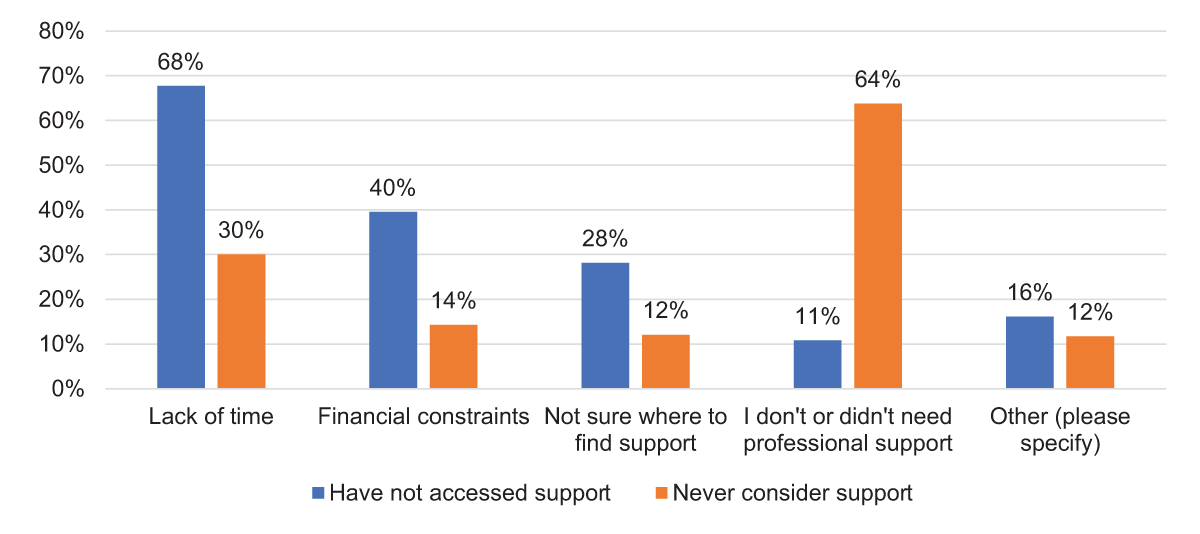
Figure 1
Student carers’ primary reasons for not accessing support.
Financial and Employment Constraints
Impact on employment
Caregiving impacts upon student carers’ employment in various ways. More than half of the respondents either left work (30%) or are working reduced hours (26%). Additionally, 2 in 5 respondents reported struggling to advance their careers or find work, a pattern that points to systemic challenges designed without the responsibilities of student carers in mind. In fact, only 19% of the respondents said their employment was unaffected by their caregiving responsibilities showing how rare it is to combine caregiving with work without interruption. A student carer noted in an interview that, “I had to quit my job because my caregiving responsibilities meant I couldn’t commit to regular work shifts”.
The impact on employment is greater for those providing higher hours of care weekly. The most common outcome is leaving employment entirely, reported by 30% of respondents and peaking at 43% among those providing 100+ hours of care. Conversely, respondents providing fewer than 10 hours of care per week were most likely to report no impact on employment (60%). Respondents in part-time roles could also indicate a reduction in number of working hours to undertake caregiving responsibilities, rather than being an active choice. 70% of respondents who are working part-time reported that they had to work fewer hours as a result of caregiving (compared to 26% on average).
Institutional Support
Awareness of and access to support services available
When asked whether they are aware of support services for carers at the OU, a majority of student carers said they were not aware (77%). Beyond carer-specific support, however, student carers benefit from other support including academic extensions, which is available for all students.
41% of student carers have requested academic adjustments or extensions as a result of their caregiving role. Among those, most respondents found the process of seeking academic adjustments relatively easy (57%) with very few respondents finding the process difficult (11%). Having academic adjustments is partly the explanation of why students perceive less academic impact despite caregiving affecting their study routines. Knowing that extensions can be requested easily provides students that safety net when life gets in the way.
Similar with academic adjustments, recorded lectures play a great role in helping student carers juggle their busy lives and routines. 88% of the respondents found recorded lectures effective when their caregiving responsibilities were taken into consideration. As one interviewee stated, “I rely heavily on recorded lectures because attending live sessions is rarely an option for me”.
Perceived value of institutional support
When asked what support would be most beneficial; flexible employment options and targeted financial support were most requested, both seen as very or extremely beneficial by over 67% of respondents (see Figure 2). Free or low-cost counselling, self-care initiatives, and better advice on financial/non-financial support also scored highly, with the majority rating them as moderately to extremely beneficial. In contrast, respite care services and peer support groups received more mixed responses, with over 30% rating them as not or only slightly beneficial. The responses on peer support groups mirror the responses on participation in support network, with about half showing no interest in joining one.
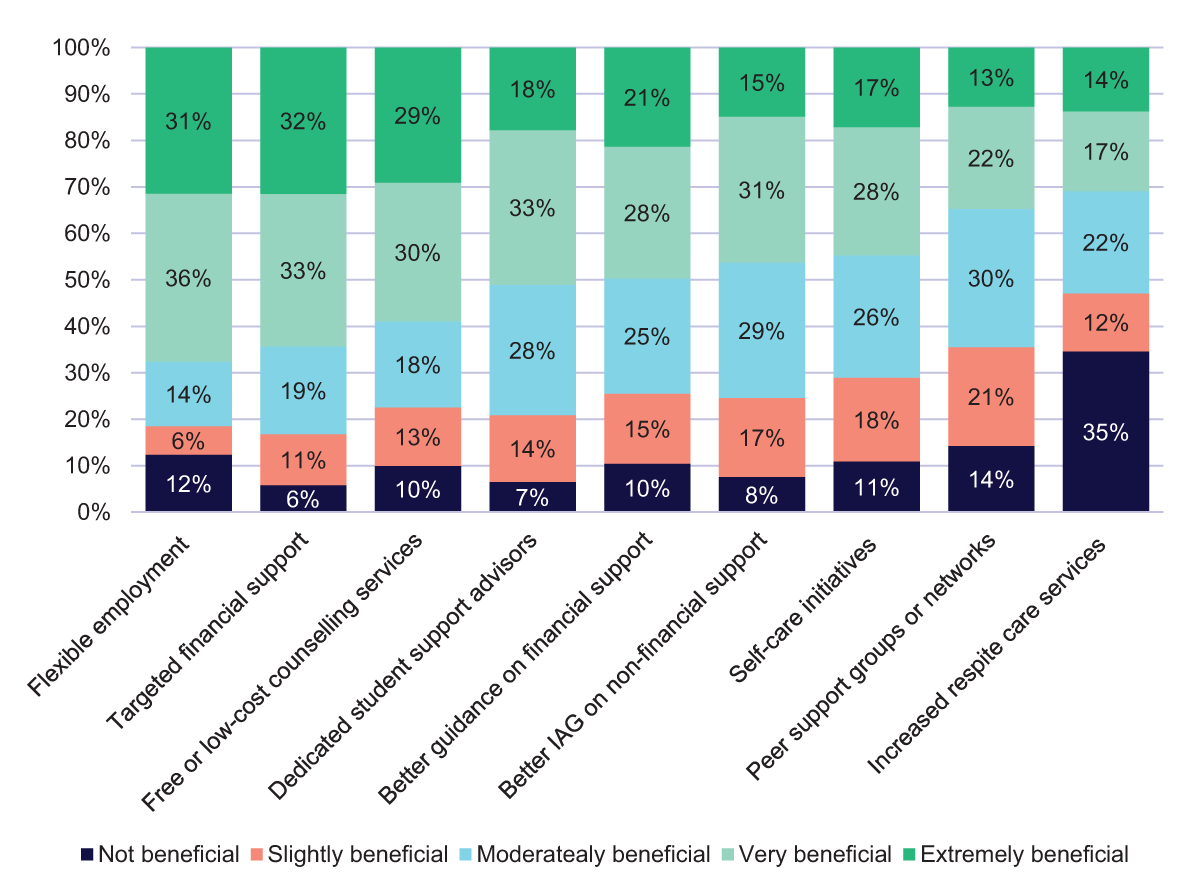
Figure 2
Support student carers most valued.
Discussion
This study sought to examine and understand the experiences of student carers in distance learning in the UK using the Open University as a case study. Analysis of both quantitative and qualitative data sets reveal key themes that together drive how these groups of students experience higher education while juggling their caring responsibilities.
Survey findings identified time management as the most pressing challenge for student carers. Similarly, interviews underscored the unpredictable nature of caregiving, with students describing emergency hospital visits or care crises that disrupted even the most structured academic plans. As one participant shared, “Even with reminders and a strict schedule, one call can throw my whole day off.” These findings support Larkin et al. (2019), who noted that student carers often struggle to maintain consistent academic routines, and that distance learning, while flexible, can fail to account for the “unplannable” aspects of caregiving. Similarly, National Union of Students (2013) reported that most student carers are more likely to feel they are not able to balance their study commitments, compared to non-carers.
Interestingly, while the impact on academic performance appeared moderate in the survey, the interviews revealed that this came at a cost. Students frequently reported using extensions and recorded lectures as survival mechanisms, indicating that institutional scaffolding can buffer negative engagement outcomes. However, several participants admitted to submitting work under stress or “just getting by,” suggesting performance metrics may mask underlying strain, an issue echoed in research by Runacres et al. (2024) showing that student carers often experience hidden academic pressure despite outward indicators of progress. Following time management, wellbeing is another area with great potential for impact. The toll that caregiving puts on emotional and physical wellbeing aligns with research from the Carers UK (2025), which shows that most carers suffer from psychological distress. Many students described feelings of guilt and emotional distress, especially when unable to meet either their caregiving and/or academic expectations. The emotional burden, particularly among women (who were more likely to report health neglect), mirrors gendered stress pathways identified by Public Health England (2016). The qualitative findings also revealed reluctance to access mental health support, not only due to time constraints, but also due to stigma and perceived futility. This reinforces Li and Yang’s (2025) conclusions that emotional exhaustion among distance learners, particularly those without robust social support, often leads to disengagement and deteriorating wellbeing.
Many student carers reported significant social isolation, with only 9% participating in any form of carer support group. In the interviews, many students described feeling invisible, disconnected from peers, and excluded from academic community-building. Both quantitative and qualitative data indicate that student carers find it difficult to maintain as much social contact as they desire. Students’ avoidance of live tutorials or group work mirrors concerns in Bevens et al. (2024) about how asynchronous learning environments can reinforce loneliness rather than alleviate it. This aligns with wider evidence showing that social isolation is prevalent among university students, with loneliness increasingly recognised as a structural challenge within higher education (Lovell & Webber, 2024). Additionally, scoping reviews of student carers highlight that caring responsibilities intensify feelings of isolation and reduce opportunities for meaningful peer engagement (Runacres et al., 2024). Coupled with the lack of opportunities for involvement in flexible, organised social groups, there is a genuine risk of further isolation for an already secluded group Many student carers reported significant social isolation, with only 9% participating in any form of carer support group. In the interviews, many students described feeling invisible, disconnected from peers, and excluded from academic community-building. Both quantitative and qualitative data indicate that student carers find it difficult to maintain as much social contact as they desire. Students’ avoidance of live tutorials or group work mirrors concerns in Bevens et al. (2024) about how asynchronous learning environments can reinforce loneliness rather than alleviate it. Coupled with the lack of opportunities for involvement in flexible, organised social groups, there is a genuine risk of further isolation for an already secluded group.
These findings highlight a critical wellbeing crisis among student carers in distance learning environments. The overwhelming majority of respondents reporting emotional and physical wellbeing impact is not just a statistical concern, it signals an urgent need for institutional intervention. Chronic exhaustion and emotional depletion, particularly among female respondents, suggest that caregiving responsibilities are not only compromising students’ academic engagement but also deepening gendered health inequalities. These outcomes echo broader patterns of psychological impact identified by national bodies (Public Health England, 2016; Carers UK, 2025), underscoring that this is not an isolated issue but part of a systemic failure to support carers in education. The reluctance to seek mental health support points to a dual burden of care and silence, where students are both overwhelmed and unsupported. Without targeted support systems, universities risk losing some of their most vulnerable learners to burnout and disengagement.
Next, caregiving responsibilities also impact on finances and employment. Survey data showed that most students had reduced work hours or left jobs due to caregiving, and many needing to choose between essential living expenses and study costs. Interviews contextualised these figures, revealing how job loss and erratic schedules forced students into economic precarity. These insights support Xue et al.’s (2023) findings that student carers are significantly less likely to graduate due to compounded economic and time poverty. The trade-offs between paid work, caregiving, and academic performance also align with literature from the National Union of Students (2013), which identifies student carers as structurally disadvantaged in both income and educational attainment. Treneman et al. (2025) also highlight financial struggles faced disproportionately by carers compared to non-carers.
Employment constraints also impact long-term career prospects. Many student carers find that their work experience becomes fragmented due to frequent interruptions, reducing their competitiveness in the job market, an issue mirrored in wider evidence showing that young adult carers experience significant barriers to balancing study, employment, and caring responsibilities. (Kettel, 2018). This can lead to a cycle where financial insecurity forces them to continue prioritising caregiving over career development, perpetuating a state of vulnerability, a pattern also highlighted in scoping reviews documenting the financial strain and reduced economic opportunities faced by student carers (Runacres et al., 2024). Furthermore, the qualitative findings highlight that financial aid, when available, is often complex to access or regionally limited, reinforcing the postcode lottery theme described in UCAS (2025). Students in Scotland fared better than their peers elsewhere due to the availability of the Carer Support Payment, suggesting national inconsistency in support provision. Without targeted and intentional reforms, especially within the employment sector, financial inequality will continue to undermine the educational future of student carers.
Despite these issues, student carers seem to perceive that the support provided by the OU is relatively sufficient. Existing adjustments such as recorded lectures and deadline extensions were seen as hugely beneficial by the students. Therefore, these provisions should continue to be offered even though students don’t see these as carer-specific support. Interviewees also described support as inconsistent, often relying on the goodwill of individual staff rather than systematic provision. The absence of a designated carer advisor emerged as a key concern, with students highlighting the need for having one point of contact for them. These findings point to a gap between the availability of support and its accessibility, reinforcing Morgan’s (2019) call for integrated, proactive systems that meet carers’ needs without requiring them to constantly advocate for themselves.
Without support, these challenges and barriers affect students’ experience and academic outcomes. While many students reported only moderate impacts on grades, this came with emotional costs and adaptive compromises. Qualitative reports of burnout, disrupted focus, and rushed submissions contrast with the resilience implied by numeric data. The OU’s internal data also confirms statistically significant gaps in retention and progression between carers and non-carers. Health fatigue, emotional strain, employment instability, and academic disruption create a web of attrition risk factors, as also highlighted in Treneman et al. (2025) and Carers UK (2025). Without sustained intervention, these students are at a higher risk of dropout despite demonstrating high resilience.
Conclusion and Recommendations
This study examined the experiences of student carers in distance learning higher education, guided by the central question: What challenges do student carers face in distance learning institutions, and how do these affect their academic journeys? Using the OU as a case study, the research explored academic, financial, emotional, and social challenges, their impact on academic performance and wellbeing, and the adequacy of current support systems. A mixed-methods design provided both breadth and depth. Quantitative data established the scale and urgency of the issue, while qualitative narratives offered insights into students’ lived experiences.
One limitation of the study is that our sample relied on students’ self-identification as carers. This approach excludes those who chose not to disclose their status and may include individuals whose circumstances differ from the study’s definition. Additionally, only. 10% of the quantitative participants identified as Black, Asian or from Minority Ethnic backgrounds limiting the ability to draw statistically significant comparisons across groups. Future research could investigate the experiences of these groups in more depth.
Findings indicate that student carers face substantial academic pressures, especially related to time management and frequent care-giving related interruptions. Balancing academic responsibilities with caregiving duties creates an ongoing mental strain, often leaving students feeling overwhelmed. Many participants reported chronic fatigue, high levels of stress, poor sleep, and an inability to care for their own health, compounded by barriers to accessing mental health support. Financial stress was also common, with reduced work hours or job loss affecting the ability to meet both academic and living costs. Social isolation was frequently reported, with a significant number feeling disconnected from peers and the broader university community.
These challenges contribute to persistent disparities in retention, completion, and pass rates at the OU. Although student carers show a high degree of resilience, frequently relying on academic extensions and recorded lectures, these tools function more as short-term coping mechanisms rather than long-term solutions. While the OU offers valuable adjustments such as extensions and recorded content, many students are unaware of additional support services. A recurring theme in the data is a perceived lack of institutional understanding of carers’ circumstances which may limit the effectiveness of existing support.
Based on the study’s findings this report proposes evidence-informed recommendations for distance learning higher education institutions to better address the core challenges faced by student carers, including social isolation, exhaustion, and financial vulnerability. Rather than relying on role-based support alone, institutions should adopt a coordinated model in which effective identification of student carers enables timely access to integrated academic, wellbeing, and financial support, delivered through a Carer Hub. Establishing a Student Carer Advisor role is recommended to coordinate student access to services and ensure consistent institutional responses.
Universities should also establish structured, primarily virtual peer support groups tailored to distance learners, with optional local or regional networking, to reduce isolation and enhance peer connections. In addition, clearer and more efficient pathways to academic adjustments, aligned with existing disability support processes, should be implemented to reduce administrative burden and accommodate fluctuating caring demands. Mandatory staff training on student carers’ experiences is advised to ensure adjustments are applied consistently and empathetically across the institution.
Many of the challenges experienced by student carers extend beyond the remit of higher education institutions and require coordinated action from external stakeholders. Recommended measures, include the expanding and standardising of government financial support for carers, encouraging employers to offer flexible working arrangements and paid carer leave, increasing funding for carer-specific mental health services, improving signposting to higher education support through carer organisations, and sustaining charitable and government investment in respite care. Collectively, these actions would help address the broader structural and socio-economic pressures faced by student carers and enhance their capacity to engage more fully in higher education.
Overall, the findings highlight that supporting student carers is both a matter of equity and a strategic priority for improving retention and success in distance learning. Persistent awarding gaps reflect systemic shortcomings that cannot be addressed by individual resilience alone. Coordinated, institution-wide and policy-level action is required to prevent ongoing disadvantage. Future research should evaluate the long-term effects of these interventions.
Data Accessibility Statement
The data that support the findings of this study are available from the Open University, but restrictions apply to the availability of these data, which were used under license for the current study, and so are not publicly available. Anonymised data is, however, available from the authors upon reasonable request and with permission from the ethics and data protection teams at the Open University.
Sustainable Development Goals
This paper is linked to the following SDGs: Quality education and Decent Work and Economic Growth.
Ethics and Consent
Ethical approvals were received from all relevant boards (Ethics, Data Protection and Student Research Project Panels) within the university before the commencement of the research. All participants signed the consent form prior to both the interview and survey.
Acknowledgements
We are grateful for Christine Ward and Yoseph Araya at the Open University for their help with student interviews.
Author Contributions
Yohana Kibe: Conceptualisation, Methodology, Funding acquisition, Investigation, Data curation, Formal analysis, Visualisation, Project administration, Writing – original draft, Writing – review & editing. Sirin Tangpornpaiboon: Supervising, Methodology, Investigation, Data curation, Formal analysis, Writing – review & editing. Both authors have read and agreed to the published version of the manuscript.