
Introduction
Quiet quitting has emerged as a prevalent behavior in contemporary workplaces. Hamouche et al. (2023) observed that this phenomenon is not entirely novel nor wholly old; rather, several scholars (Aydın & Azizoğlu, 2022; Hiltzik, 2022) contend that it represents a rebranding of an old reality. Concerning its temporal origins, Galanis et al. (2023) posit that quiet quitting gained prominence during the COVID-19 pandemic. Quiet quitting is conceptualised as a withdrawal from work-related objectives (Atalay & Dağıstan, 2024) coupled with emotional disengagement from one’s role (Karadas & Çevik, 2025). Individuals who adopt this posture confine their effort to duties explicitly specified in their job descriptions (Lu et al., 2023) and exhibit low affective commitment and reduced work engagement (Boy & Sürmeli, 2023). Put differently, quiet quitters perform only the minimum required to retain their positions and demonstrate an unwillingness to exceed their prescribed duties (Formica & Sfodera, 2022). Quiet quitting functions as a “Plan B” when resignation is not feasible, particularly for individuals who, despite lacking commitment, remain bound to their roles by financial necessity (Nimmi et al., 2024). Quiet Quitting is basically work-to-rule. Someone can be adept at their work, and happy to do it, but still refuse to go above and beyond what their job description or contract says. What underlies quiet quitting is essentially a breach in trust between employer and employee stemming from harder work/work ethic not being rewarded as one might have imagined at the beginning of the working relationship.
Burnout, by contrast, is a work-related syndrome arising from chronic, unsuccessfully managed job stress. In the International Classification of Diseases (ICD-11), it is characterised by three dimensions: (i) energy depletion/exhaustion, (ii) increased mental distance from one’s job or negativism/cynicism, and (iii) reduced professional efficacy (World Health Organization, 2019). According to Maslach and Leiter (2016), burnout is a psychological syndrome emerging as a prolonged response to chronic interpersonal stressors on the job. The three key dimensions of this response are an overwhelming exhaustion, feelings of cynicism and detachment from the job, and a sense of ineffectiveness and lack of accomplishment. In educational settings, burnout commonly presents as persistent fatigue, depersonalisation toward students/colleagues, slowed feedback cycles, diminished initiative and extra-role helping, irritability and errors, and patterns of absenteeism/presenteeism. These are outcomes that harm individuals’ health and reduce instructional quality, collegial climate, and retention (Maslach & Leiter, 2016).
Research on quiet quitting has increasingly focused on identifying the factors that drive this phenomenon. A key perspective suggests that quiet quitting arises as a response to burnout (Galanis et al., 2023). Expanding on this, Hamouche et al. (2023) propose that employees engage in quiet quitting as a way to cope with job-related distress, disengagement, and challenges in maintaining work-life balance. Among the various contributing factors, job burnout stands out as the most widely recognized precursor to quiet quitting, with multiple studies supporting this link (Galanis et al., 2023; Lu et al., 2023; Xueyun et al., 2023). For instance, Galanis et al. (2023) found that job burnout, conceptualized as a multidimensional construct, significantly increases the likelihood of quiet quitting. Similarly, Lu et al. (2023) demonstrated that burnout strongly predicts employees’ intentions to quietly quit, while Xueyun et al. (2023) confirmed a consistent positive relationship between the two. Collectively, these findings underscore the robust connection between job burnout and quiet quitting across different workplace and cultural environments. This relationship also highlights the global relevance of Sustainable Development Goal (SDG) 3, which emphasizes promoting mental health and well-being by reducing work-related stressors such as burnout. To make this causal relationship explicit at the outset, we posit two pathways: a direct effect of engaging leadership on burnout and quiet quitting, and indirect (mediated) effects operating through reduced role stress (lower conflict/ambiguity) and enhanced sense of community (greater belonging/support); we test both pathways in the present study.
Given that high levels of burnout intensify quiet quitting intentions, a critical question arises: How can institutional leaders foster employee engagement to reduce burnout and its associated withdrawal behaviors? More specifically, what leadership behaviors effectively fulfill employees’ basic needs to prevent disengagement? This study focuses on engaging leadership, a style that remains underexplored despite its potential to enhance work engagement (Firouznia et al., 2021). Engaging leaders inspire their teams by articulating a compelling vision and reinforcing each member’s sense of competence and impact. They also empower employees by granting autonomy, delegating thoughtfully, and fostering a supportive work environment, which are key factors in preventing burnout and sustaining engagement (Schaufeli, 2015). Beyond its impact on wellbeing, such leadership is also central to SDG 4 (Quality Education), since sustaining tutors’ motivation and resilience is critical to teaching quality and retention in higher education. Certain leadership styles can, however, have detrimental effects. Ergen et al. (2025) contend that some approaches increase workplace stress, reduce job satisfaction, and intensify perceptions of unfairness (Den Hartog & De Hoogh, 2009). These conditions promote disengagement, a defining characteristic of quiet quitting which manifests as emotional withdrawal and performance limited to the minimum formally required (Klotz & Bolino, 2022).
Amidst the importance of engaging leadership in reducing burnout and quiet quitting intentions, it is hypothesized that role stress and sense of community can act as a buffer in the relationship between engaging leadership and burnout. Extant research indicates that role stress is associated with lower job satisfaction, poorer mental health, and an elevated risk of burnout and occupational exit (Brackett et al., 2010; Wang et al., 2015). Goddard and Goddard (2006) identify a robust relationship between teacher burnout and intentions to leave, which helps explain high attrition rates among teachers worldwide. Engaging leadership, characterised by behaviours that inspire, empower, and connect followers, supports tutors’ basic psychological needs for autonomy, competence, and relatedness, thereby attenuating role stress and reducing burnout (Schaufeli, 2015). From another perspective, sense of community, defined by Aryee (2021) as a feeling of belonging that extends beyond situational workplace relationships, is hypothesized to strengthen the impact of engaging leadership in mitigating burnout among course tutors. When engaging leaders foster an environment where members interact meaningfully, derive shared identity, offer social support, and contribute collectively toward common goals, they strengthen the positive influence of engaging leadership on reducing tutor burnout. In this way, the study contributes to both SDG 3 (ensuring wellbeing through lower stress and burnout) and SDG 4 (strengthening tutor commitment and teaching quality in higher education).
Study Context and Gaps
The associations among role stress, sense of community, engaging leadership, and burnout have been widely investigated in Western educational settings (Aydın & Levent, 2025; Carroll et al., 2022; Ishaq & Mahmood, 2017; Bălănescu, 2019; Yu et al., 2015; Zhao et al., 2022) and African educational context (Yisa et al., 2024; Agyapong et al., 2023; Baidoo et al., 2023). The issue of quiet quitting is however a novel phenomenon in the Ghanaian context as a whole. Identified studies on quiet quitting have predominantly focused on Western Educational context (e.g., Aydın & Levent, 2025; Memiş & Tabancalı, 2024; Barath, 2024; Klotz & Bolino, 2022). Nonetheless, the applicability of those findings to non-Western settings, particularly Ghana is unclear. While much work has focused on Western and European educational systems, there is a paucity of evidence examining whether engaging leadership reduces burnout and quiet quitting in Ghanaian contexts via the mediating roles of role stress and sense of community. Some studies related to quiet quitting in the Ghanaian context have emphasised on employee disengagement (Okyere et al., 2024), which is seen as a psychological state in which an employee feels disconnected from their work, team, or organization. In essence, when course tutors are disengaged, it can be reflected in their level of enthusiasm towards their duties and a diminished affective and cognitive connection to one’s work, team, or organization. We therefore distinguish disengagement (an attitudinal state) from quiet quitting (a behavioural pattern of minimal in-role effort that meets core expectations without discretionary contribution), clarifying their positions within the nomological network.
Tutors with quiet quitting intentions may however remain physically present and meeting core job expectations (Aydın & Levent, 2025). For clarity, in this study “course tutor” refers to contracted teaching staff engaged by distance-education study centres to facilitate and teach assigned course modules (typically during weekend contact sessions), guide learning activities, assess and grade continuous assessment and examinations, provide feedback and academic support, invigilate, and liaise with study-centre coordinators on administrative and pastoral issues. Unlike the U.S, these tutors function as instructional staff responsible for a specific cohort/section, which is more akin to Open-University “associate lecturers” and often operate under part-time/short-term arrangements with substantial travel between centres.
Findings on quiet quitting from Western contexts may not apply to Ghana, emphasising the need for context-specific research on how engaging leadership reduces burnout and quiet quitting via role stress and sense of community. Ghana’s expanding tertiary sector, particularly the College of Distance Education at the University of Cape Coast, which manages 95 study centres across 10 administrative regions relies on course tutors who work weekend-long, travel-heavy schedules under precarious contracts, heavy workloads, and limited institutional support. This profile parallels U.S. “adjunct/contingent” faculty arrangements where non-tenure-track instructors who often teach large shares of courses under lower pay and benefits, limited institutional support, and multi-campus commuting—conditions linked to heightened stress and constrained engagement (GAO, 2017). Prior research links excessive demands and role ambiguity to teacher burnout (Fye et al., 2018). Thus, unchecked burnout can precipitate quiet quitting. Engaging leadership and a strong sense of community are therefore critical levers for tutor wellbeing, discretionary effort, and preventing behavioural withdrawal (Gün et al., 2025). The scarcity of Ghana-specific studies hampers development of culturally appropriate interventions and policies. This study addresses that gap by testing relationships among engaging leadership, role stress, sense of community, burnout, and quiet quitting in Ghanaian higher education to produce evidence that can inform institutional strategies to sustain tutors’ commitment.
Beyond contextual replication, we advance theory by refining the Job Demands–Resources (JD–R) account in three ways: (i) we specify a dual-path process in which engaging leadership (a job resource) simultaneously reduces role stress (hindrance demands) and builds sense of community (resources), thereby lowering burnout and subsequent quiet quitting; (ii) we extend the quiet-quitting literature to a non-Western higher-education labour regime, offering cross-cultural evidence on its JD–R-consistent antecedents and outcomes; and (iii) we delineate contextual boundary conditions that potentially amplify demands and attenuate resources, indicating when engaging leadership is most protective. Collectively, these contributions position the study as theory-informing that clarify mechanisms, outcomes, and contingencies rather than a mere replication.
Literature
Theoretical Underpinnings of the Study
The study is grounded in the Job Demands–Resources (JD–R) model (Demerouti et al., 2001), which contends that occupational outcomes are principally shaped by two domains: job demands and job resources. Job demands are work characteristics that require sustained physical or cognitive effort and thus entail physiological or psychological costs which include excessive workload, interpersonal conflict, and job insecurity (Demerouti et al., 2001). Job resources are the supportive aspects of work that (a) facilitate goal attainment, (b) buffer the strain of demands, and (c) promote personal and professional development. Schaufeli (2017) argues that elevated demands combined with insufficient resources precipitate burnout, whereas work engagement is primarily driven by the availability of resources rather than by reductions in demands. Accordingly, enhancing resources (social support, autonomy, constructive feedback) both prevents burnout and fosters engagement, while strategies that solely reduce demands may alleviate burnout without necessarily increasing engagement. In this study, engaging leadership and a strong sense of community are treated as key job resources that reduce burnout and deter quiet quitting among course tutors. Engaging leaders reduce role stress by aligning supports and streamlining procedures, monitor qualitative and quantitative demands, provide development opportunities, and foster peer collaboration, thereby strengthening sense of community. By both lowering excessive demands and enhancing resources, engaging leadership reduces burnout and suppresses quiet-quitting intentions.
Hypothesis Development
Research consistently indicates that engaging leadership is negatively associated with role stress, particularly in educational settings (Harms et al., 2017; Diebig et al., 2016; Tims et al., 2011). Engaging leaders clarify expectations, provide constructive feedback, and foster participation in decision-making, all of which reduce ambiguity and conflict—two central components of role stress. For instance, Tims et al. (2011) reported that teachers who regarded their supervisors as empowering and supportive experienced reduced role ambiguity and conflict. However, the general leadership literature is mixed: some studies depict leaders as buffers against work stressors (Schmidt et al., 2014), while others identify them as significant sources of subordinate stress (Rajah, Song, & Arvey, 2011). This divergence highlights the pivotal influence of leadership on employees’ role stress. Based on this, it is hypothesised that:
H01: Engaging Leadership will negatively predict role stress among course tutors.
Empirical evidence also links engaging leadership to a stronger sense of community (Firouznia et al., 2021, Saari et al., 2017). It is emphasised that leaders who encourage collaboration, foster interpersonal trust, and create opportunities for collective decision-making enhance feelings of belonging and mutual support among staff. According to Saari et al., (2018), engaging leadership might have a positive impact on work engagement via creating a sense of attachment to career. This sense of community acts as a resource that mitigates the isolating effects of heavy workloads and improves tutors’ resilience against occupational stress. Barrenechea et al., (2022) relates sense of community to mattering and indicated that the concept has to do with the importance of being needed, being important to others and feeling that others are interested in what individuals say and do. Engaging leadership is therefore hypothesised to foster sense of community. It is therefore hypothesised that:
H02: Engaging leadership will positively predict sense of community among course tutors.
Kelly and Hearld (2020) noted that leadership style is widely recognized as a mechanism for reducing burnout. However, the relative effectiveness of different leadership approaches in mitigating burnout remains uncertain. This study therefore considers engaging leadership as a style of leadership that that can negatively influence burnout among course tutors. In a study by Kaiser and Thompson (2021), they revealed that teachers are more likely to stay and thrive when they feel supported by their leaders. Plethora of studies have also confirmed that effective leadership can reduce burnout of teachers (Dishari & AlAfnan, 2024; Mitchell, 2021; Perrone et al., 2019). It however appeared that none of these identified studies focused on engaging leadership as a predictor of burnout among course tutors. It is therefore hypothesized that:
H03: Engaging leadership will negatively predict burnout among course tutors.
Empirical studies have shown that elevated stress and burnout among educators undermine their overall job performance, diminish productivity, and erode their capacity to foster effective professional relationships (Agyapong et al., 2022; Cancio et al., 2018; Antoniou et al., 2013). Wong et al. (2017) further conceptualize burnout as the long-term consequence of persistent stress exposure. Consequently, when course tutors confront intensified role stress, they become increasingly vulnerable to burnout. Research across various regions has documented high levels of burnout among teachers (Rionda-Arjona & Mares Cárdenas, 2012; Ratto Dattoli et al., 2015). Shukla & Trivedi (2008) further observed that burnout in professions such as teaching often arises from excessive demands on individuals’ energy, strength, and resources. When tutors experience role stress, it leads to burnout where tutors tend to withdraw emotionally from the demands of the job (Shukla & Trivedi 2008). Based on this, it is hypothesized that:
H04: Role stress will positively predict burnout among course tutors.
A robust sense of community among tutors serves as a vital buffer against the development of burnout. This phenomenon occurs because tutors who perceive themselves as valued members of a cohesive professional community characterized by interpersonal trust, mutual respect, and transparent communication, demonstrate greater capacity to access critical instrumental resources. These resources include collaborative lesson planning support, instructional materials, and peer mentoring opportunities, which collectively enhance their professional efficacy. Research has found a negative relationship between sense of community and burnout. For instance, Aryee (2021) found out that sense of community was a significant negative predictor of burnout. Fang (2025) also indicated that strong emotional connectedness may reduce tutor’s burnout since it serves as a resource that buffers conflict-related stress. In as much as sense of community serves as important resource in the job-demand resource model, it hasn’t been discussed extensively in both local and western literature. As such, its usefulness in predicting burnout remains scanty. Based on this, it is hypothesised that:
H05: Sense of community will negatively predict burnout among course tutors.
Burnout and quiet quitting represent sequential stages in the employee withdrawal process, with burnout serving as a critical precursor to the behavioral restraint inherent in quiet quitting (Gün et al, 2025). When work demands intensify, employees often encounter heightened stress, which can prompt shifts in attitudes and behaviors aimed at reducing those demands (von Hippel et al., 2019). One such strategy is “quiet quitting,” whereby individuals limit their efforts to formal job requirements to lessen workloads, mitigate stress, and forestall burnout (Serenko, 2024). Early evidence suggests that as many as 80% of those who quietly quit report experiencing job burnout (Thu Trang et al., 2024). This phenomenon functions as a coping mechanism for chronic exhaustion and sustained overwork, yet it is also linked to broader patterns of disengagement and counterproductive work behaviors (Wallace & Coughlan, 2023). Empirical studies by Galanis et al. (2023), Lu et al. (2023), and Xueyun et al. (2023) further corroborate the strong association between burnout and the adoption of quiet quitting behaviors. Based on this, it is hypothesized that:
H06: Burnout will positively predict quiet quitting among course tutors.
Cemaloğlu (2011) reported that certain leadership behaviours of school administrators may contribute to teachers’ professional burnout by generating intense stress. When leaders provide clear goals, regular feedback, and involvement in decision-making, they reduce role ambiguity. Such lowered role stress, in turn, diminishes the chronic strain that precipitates emotional exhaustion and depersonalization (Maslach & Leiter, 2016). Although there is empirical evidence that suggests a direct effect of engaging leadership on employee burnout (Khan et al., 2025; Kelly & Hearld, 2020; Dishari & AlAfnan, 2024; Mitchell, 2021; Perrone et al., 2019), it appears that no empirical study has been done on the indirect effect of role stress in the link between engaging leadership and burnout. Based on this, it is hypothesised that:
H07: Role stress will mediate the relationship between engaging leadership and burnout.
Engaging leadership cultivates a strong sense of community by fostering trust, collaboration, and mutual support, which in turn mitigates burnout. According to Schaufeli (2015), When leaders model open communication, encourage peer interaction, and facilitate shared problem solving, they strengthen the social bonds among tutors, enhancing collective efficacy and belonging which can help reduce burnout (Baidoo et al., 2023). Also, Federici and Skaalvik (2012) found that work-related burnout is especially prevalent in higher education institutions, where it diminishes employees’ productivity, self-esteem, and job satisfaction, thereby increasing the likelihood of turnover. Since it has been established in the literature that sense of community reduces burnout (Aryee, 2021; Fang, 2025) and engaging leadership reduces burnout, it is hypothesized that:
H08: Sense of community will mediate the relationship between engaging leadership and burnout.
Conceptual Framework
Figure 1 portrays relationship among the study variables. We hypothesised here that role stress and sense of community will mediate the relationship between engaging leadership and burnout which will in turn predict quiet quitting among course tutors.
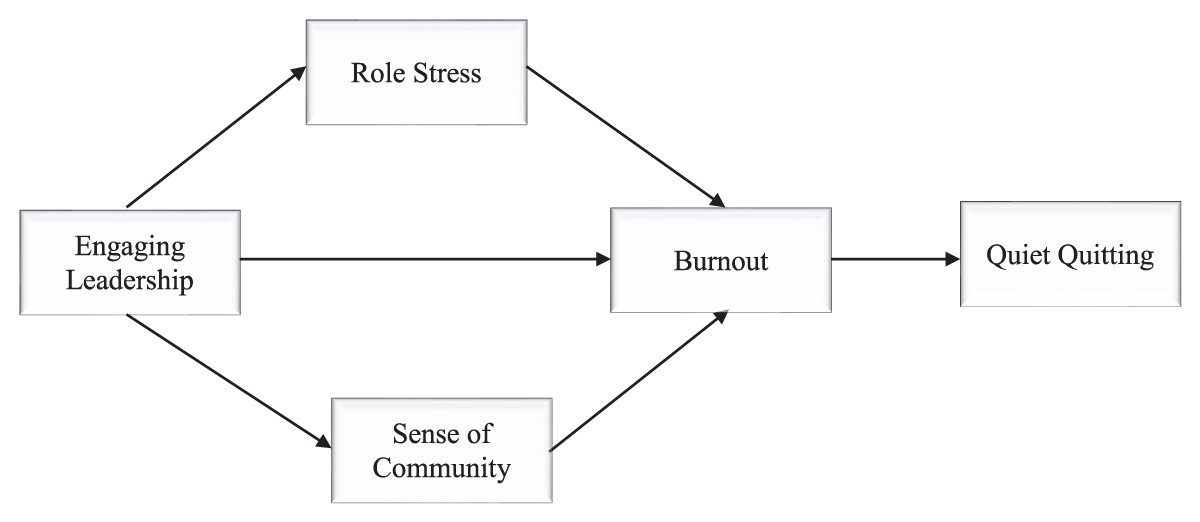
Figure 1
Conceptual Model of the Study.
Methods
Research design or model
This study employed an explanatory research design, as it examines the cause-and-effect relationships between key variables—engaging leadership, role stress, sense of community, burnout and quiet quitting. As Coy (2019) emphasises, explanatory research facilitates a thorough investigation of a subject by developing and rigorously testing hypotheses. The design was chosen to identify relationships among variables and also to uncover the reasons behind these connections, enabling predictions about future quiet quitting based on established causal links. It is predicted within the study’s framework that engaging leadership behaviours of study centre coordinators will not significantly predict quiet quitting among course tutors in distance education.
Sampling or research group
The study population consisted of all 1,972 course tutors from CoDE programme at the University of Cape Coast, based on data from the 2023 CoDE Payroll Office. The 95 study centres were grouped into three geographical zones: Northern (14 centres), Middle (35 centres), and Southern (46 centres). A stratified sampling method was employed, selecting 50% of the centres with the highest enrolments in each zone. This resulted in the inclusion of 7 centres from the Northern Zone, 18 from the Middle Zone, and 23 from the Southern Zone, making a total of 48 centres. From these centres, 997 course tutors were eligible to participate in the study, with 923 completing the questionnaire through the google form, yielding a response rate of 92.6%. Within the selected centres, we employed purposive sampling as a role-specific census of all active course tutors (on the CoDE payroll, teaching during the study period, and with valid contacts). This was appropriate because (i) the research questions target experiences that only current CoDE tutors can meaningfully report; (ii) the complete, centralised payroll roster made the eligible population identifiable and reachable through official channels; and (iii) inviting all eligible tutors maximised coverage and statistical power while reducing site-level selection bias.
Data collection tools
The study used four validated instruments for data collection. First, engaging leadership scale was adopted from Schaufeli (2021) to measure the engaging leadership style of study centre coordinators. The instrument consisted of 12 items with a reliability of 0.85 measured on a five-point Likert scale from completely disagree to completely agree. The second instrument, role stress scale was adopted to measure the level of tutors’ role stress. The next instrument, sense of community scale was adopted from Peterson et al., (2008) to measure tutors’ sense of community. This consisted of five items and was measured on a five-point Likert scale from strongly disagree to strongly agree. The scale has a reliability of 0.892. Furthermore, a burnout scale was adopted from Schaufeli et al., (2020) with a reliability of 0.92 and also measured on a five-point Likert scale. Finally, quite quitting scale was adopted to measure course tutors’ intentions to quit. This scale was adopted from Galanis et al., (2023), consisting of 8 items with a reliability of 0.803. The scale was also measured on a five-point Likert scale ranging from strongly disagree to strongly agree.
Research procedures
Following ethical approval from the University of Cape Coast Institutional Review Board (ID: UCCIRB/EXT/2024/013), a formal permission letter was obtained from the Provost of CoDE and distributed to all selected study centres. The research team visited each selected centre prior to data collection to build rapport, clarify logistics, and ensure local cooperation. Participants were informed about the study’s aims, their rights, and the voluntary nature of participation. A written informed consent was secured before the questionnaires were administered. Data were securely stored and restricted to authorized personnel under the supervision of the principal investigator.
Data Processing and Analysis
The data analysis followed two main phases. In the first phase, descriptive and correlational statistics of the study variables were conducted. IBM SPSS Statistics version 27.0 was employed to generate frequencies (f) and percentages (%) of the demographic characteristics, while SMARTPLS 4 was applied to examine the relationships among variables within the measurement model. Assessment of the reflective measurement model was guided by standard criteria, including convergent validity, discriminant validity, and internal consistency reliability (Hair et al., 2017). In addition, model fit was evaluated using covariance-based structural equation modelling (CB-SEM) through PLS, considering indices such as CMIN/df, Tucker–Lewis Index (TLI), Comparative Fit Index (CFI), Root Mean Square Error of Approximation (RMSEA), and Standardised Root Mean Residual (SRMR). The second phase involved structural equation modelling (SEM) to test the hypothesised relationships through PLS CB-SEM. Bootstrapping with 5,000 resamples and 95% bias-corrected confidence intervals (CIs) was applied to determine the statistical significance of the effects.
Findings and Discussion
Findings
Descriptive Statistics
The demographic and professional characteristics of the study participants are presents in Table 1. A total of 923 respondents participated in the study. The majority were male (n = 768, 83.2%), while females constituted 16.8% (n = 155). Most participants fell within the 41–50 years age bracket (45.2%) whiles a small proportion aged 21–30 years (2.4%). Regarding teaching experience, most participants (34.6%) had 6–10 years of experience with a smaller percentage having over 20 years (0.7%) of teaching experience. In terms of academic qualification, an overwhelming majority held a Master’s degree (95.8%), with only 4.2% possessing a PhD. The data were adequate in employing structural equation modeling.
Table 1
Descriptive Statistics.
| PERSONAL CHARACTERISTICS | CATEGORIES | FREQUENCY (n) | PERCENTAGE (%) |
|---|---|---|---|
| Sex | Male | 768 | 83.2% |
| Female | 155 | 16.8% | |
| Age bracket (Years) | 21–30 | 22 | 2.4% |
| 31–40 | 260 | 28.2% | |
| 41–50 | 417 | 45.2% | |
| Above 50 | 224 | 24.3% | |
| Teaching experience (Years) | Less than 5 | 276 | 29.9% |
| 6–10 | 319 | 34.6% | |
| 11–15 | 204 | 22.1% | |
| 16–20 | 118 | 12.8% | |
| Above 20 | 6 | 0.7% | |
| Academic qualification | Masters | 884 | 95.8% |
| PhD | 39 | 4.2% | |
| Total | 923 | 100 |
[i] Source: Field Data.
Evaluation of the Measurement Model
The initial phase of assessing the outer model entails scrutinizing the measurement model using PLS CB-SEM through the statistical software Smart PLS 4. All criteria are presented in detailed below.
Assessing the Model Fit Indices
The study’s goodness of fit was assessed based on the recommendations of Henseler et al. (2016) and this is presented in Table 2. Although results in Table 2 showed that the model nearly fitted the data, some of the AVEs (Figure 2) of the measured constructs did not meet the accepted the threshold of > .5 recommended by Hair et al. (2017). A second order model was therefore tested after few items were deleted (Figure 3) and this improved the model fit indices as presented in Table 2.
Table 2
Model Fit Indices.
| RECOMMENDED VALUE | INITIAL ESTIMATED MODEL | FINAL SOLUTION AFTER INDICATOR DELETION | |
|---|---|---|---|
| Chi-square | – | 1888.287 | 768.327 |
| Degrees of freedom | – | 584.000 | 220.000 |
| P value | – | .000 | .000 |
| CMIN/df | < 5 | 3.233 | 3.492 |
| RMSEA | ≥ .05 | .049 | .052 |
| RMSEA LOW 90% CI | – | .047 | .048 |
| RMSEA HIGH 90% CI | – | .052 | .056 |
| GFI | > .90 | .889 | .930 |
| AGFI | ≥ .80 | .873 | .912 |
| SRMR | ≤ .08 | .042 | .036 |
| NFI | ≥ .90 | .874 | .932 |
| TLI | ≥ .90 | .902 | .943 |
| CFI | ≥.95 | .909 | .950 |
[i] Source: Field Study.
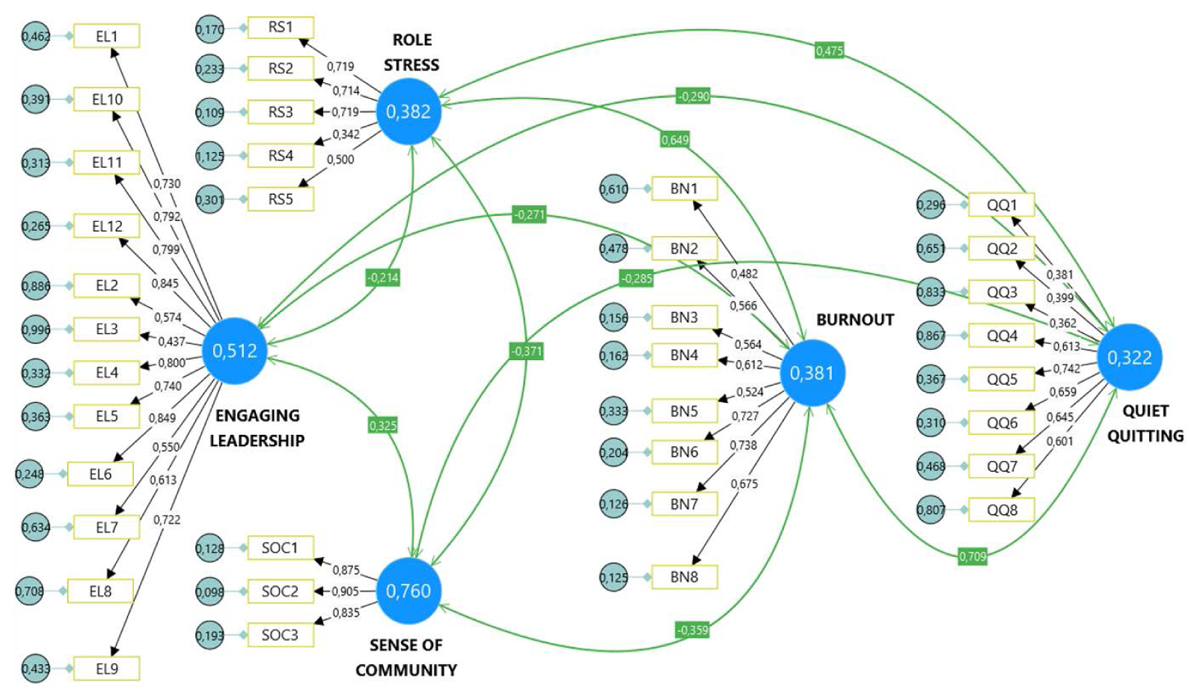
Figure 2
First Order Model.
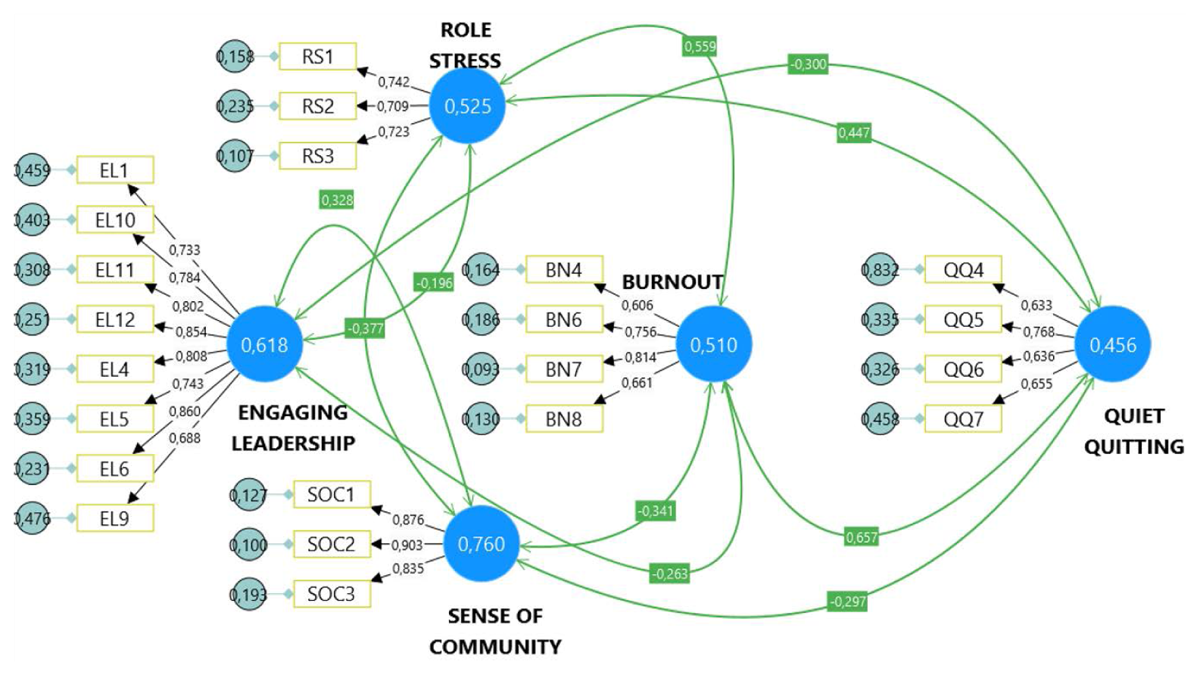
Figure 3
Second Order Model.
Assessing the Construct Reliability and Validity
The indicator loadings in this study were assessed using PLS-SEM, with detailed values presented in Table 3. Although a few indicators still did not meet the recommended threshold of > .708 (Mukminin et al., 2020) after the initial deletion, they were retained because of content validity and removing them wouldn’t have improved the AVE values (Hair et al., 2017). As a result, twenty-two indicators proceeded to the next stage of the PLS-SEM analysis (Figure 3).
Table 3
Reflective indicator loadings and internal consistency.
| ITEMS | OUTER LOADINGS | CRONBACH’S ALPHA (STANDARDIZED) | COMPOSITE RELIABILITY (rho_c) | AVERAGE VARIANCE EXTRACTED (AVE) | |
|---|---|---|---|---|---|
| Burnout | BN4 | .606 | .800 | .808 | .510 |
| BN6 | .756 | ||||
| BN7 | .814 | ||||
| BN8 | .661 | ||||
| Engaging Leadership | EL1 | .733 | .927 | .928 | .618 |
| EL10 | .784 | ||||
| EL11 | .802 | ||||
| EL12 | .854 | ||||
| EL4 | .808 | ||||
| EL5 | .743 | ||||
| EL6 | .860 | ||||
| EL9 | .688 | ||||
| Quiet Quitting | QQ4 | .633 | .763 | .762 | .456 |
| QQ5 | .768 | ||||
| QQ6 | .636 | ||||
| QQ7 | .655 | ||||
| Role Stress | RS1 | .742 | .769 | .763 | .525 |
| RS2 | .709 | ||||
| RS3 | .723 | ||||
| Sense of Community | SOC1 | .876 | .904 | .903 | .760 |
| SOC2 | .903 | ||||
| SOC3 | .835 |
Further, internal consistency reliability, which evaluates the statistical coherence among indicators, was examined via Cronbach’s alpha (α) and Composite Reliability (CR) following the guidelines of Hair et al. (2019), who recommend α > .700 and CR > .708. Table 3 detailed these measures: Cronbach’s alpha values ranged from .763 to .927, and Composite Reliability values ranged from .762 to .928, indicating that all constructs demonstrated satisfactory internal consistency. In addition, the study’s convergent validity was assessed. To evaluate this, we reported the AVE for each construct, calculated via the PLS-SEM algorithm in SmartPLS. An AVE of at least 0.50 is recommended, indicating that a construct explains 50% or more of its items’ variance. In the present study, every construct achieved an AVE above 0.50 with the exception of Quiet Quitting. This was maintained because both Cronbach alpha and composite reliability of the construct were achieved.
Discriminant Validity
Discriminant validity issues arise when HTMT values exceed 0.900, as this suggests that constructs may not be sufficiently distinct. An HTMT value above 0.900 indicates a lack of discriminant validity (Hair et al., 2019). As reported in Table 4, all HTMT values fell below this threshold, and each was significantly less than 1.
Structural Model Path Coefficient
The structural model’s path coefficients were examined through bootstrapping with 5,000 subsamples and two-tailed testing at the 0.05 significance level. Table 5 summarizes the path coefficients, bootstrapped means, standard deviations, t-statistics, 95% bias-corrected confidence intervals, and significance decisions of hypothesis 1–6. The results showed that all the 6 hypothesized relationship achieved statistical significance. Specifically, Engaging Leadership was found to significantly reduce Role Stress (β = –0.203, t = 4.652, 95% CI [–0.289, –0.116]) while simultaneously enhancing Sense of Community (β = 0.332, t = 8.248, 95% CI [0.255, 0.414]) among course tutors. In turn, higher Role Stress was associated with greater Burnout (β = 0.498, t = 5.697, 95% CI [0.322, 0.660]), whereas a stronger Sense of Community corresponded to lower Burnout (β = –0.163, t = 2.469, 95% CI [–0.298, –0.042]). Beyond these direct pathways, Engaging Leadership also exerted a direct negative effect on Burnout (β = –0.137, t = 3.008, 95% CI [–0.232, –0.054]). Finally, Burnout emerged as a powerful antecedent of Quiet Quitting, with a highly significant positive relationship (β = 0.672, t = 11.534, 95% CI [0.553, 0.776]). All confidence intervals exclude zero, and each path achieves significance at p < .05, thus rejecting the six null hypotheses and affirming the proposed structural model. The result is further depicted in Figure 4. Furthermore, the effect size (f2), which quantifies the strength of a predictor’s influence on an outcome construct was further examined. Six inter-construct effect sizes were computed. The path from Sense of Community to Burnout exhibited the smallest effect (f2 = 0.021), whereas the path from Burnout to Quiet Quitting demonstrated the largest effect (f2 = 0.415). Notably, the direct relationship between Engaging Leadership and Burnout did not yield a calculable f2.
Table 5
Path Coefficient.
| PATHS | BETA | MEAN | STD. DEV. | T-VALUE | 2.5% | 97.5% | SIGNIFICANCE |
|---|---|---|---|---|---|---|---|
| EL -> RS | –0.203 | –0.203 | 0.044 | 4.652 | –0.289 | –0.116 | Yes |
| EL -> SoC | 0.332 | 0.332 | 0.040 | 8.248 | 0.255 | 0.414 | Yes |
| RS -> BNT | 0.498 | 0.501 | 0.087 | 5.697 | 0.322 | 0.660 | Yes |
| SoC-> BNT | –0.163 | –0.162 | 0.066 | 2.469 | –0.298 | –0.042 | Yes |
| EL -> BNT | –0.137 | –0.132 | 0.045 | 3.008 | –0.232 | –0.054 | Yes |
| BNT -> QQ | 0.672 | 0.666 | 0.058 | 11.534 | 0.553 | 0.776 | Yes |
[i] Note: EL-Engaging Leadership, RS-Role Stress, BNT-Burnout, SoC-Sense of Community, QQ-Quiet Quitting.
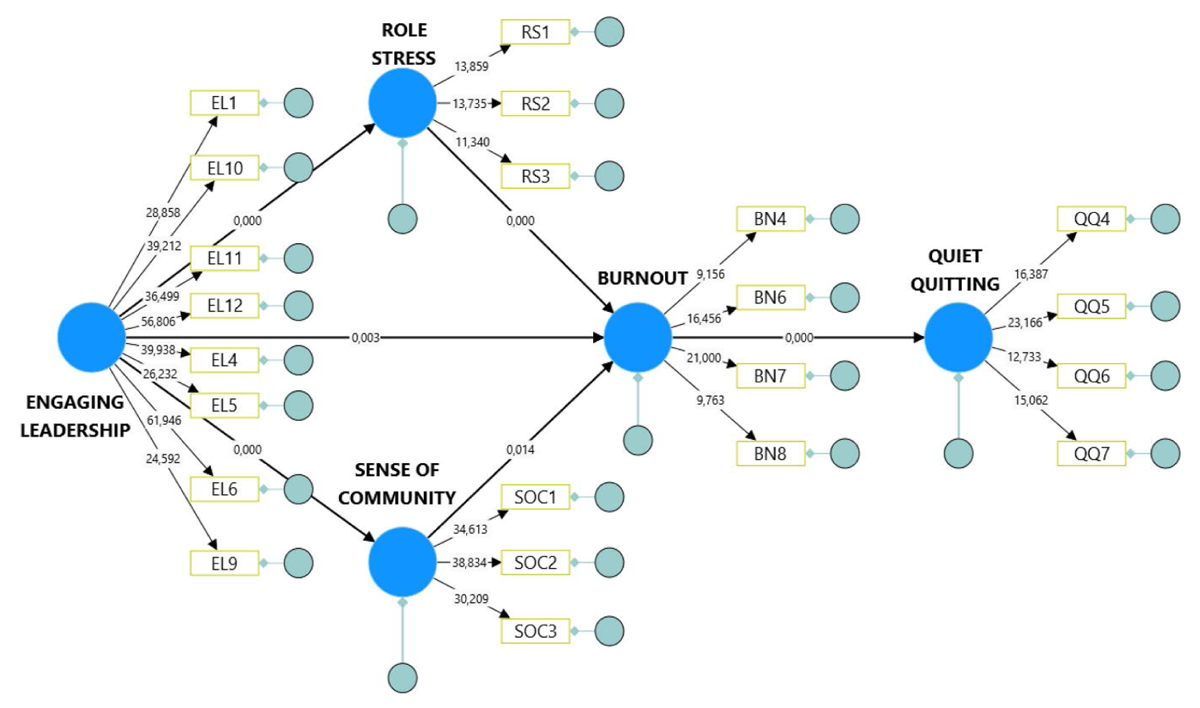
Figure 4
Structural Model.
Coefficient of Determination
The coefficient of determination (R2) represents the proportion of variance in an endogenous construct that is accounted for by its exogenous predictors. Serving as an index of a model’s explanatory and predictive capability, R2 is calculated as the squared correlation between an endogenous variable and its predictor set. Its values range from 0 to 1, with higher figures indicating stronger predictive accuracy: values of 0.75, 0.50, and 0.25 are typically interpreted as substantial, moderate, and weak levels of explanatory power, respectively (Hair et al., 2019). From the result in Table 6, 29.3% of the variance in quiet quitting can be explained by its predictors and this indicates a moderate explanatory power. However, 24.3%, 3.0% and 9.7% of the variances in burnout, role stress and sense of community are accounted for by its predictors respectively- indicating low predictive powers.
Predictive Relevance (Q2)
The out-of-sample predictive performance of the model was evaluated using Q2predict for each endogenous construct (Table 8). This is assessed via the Stone–Geisser criterion and reflects a model’s ability to accurately predict the observed data points (Hair et al., 2019). Following Hair et al. (2019), Q2 benchmarks of 0.02, 0.15, and 0.35 correspond to small, medium, and large predictive relevance, respectively. In Table 7, all Q2predict values exceed zero, confirming that the model holds predictive relevance for all outcomes. Specifically, Sense of Community achieved the highest Q2predict (0.092), indicating modest medium-level relevance, followed by Burnout (0.048) and Quiet Quitting (0.047), both reflecting small predictive relevance. Role Stress demonstrated the lowest yet still positive predictive relevance (0.025).
Table 7
Predictive Relevance (Q2).
| Q2PREDICT | PREDICTIVE RELEVANCE | |
|---|---|---|
| Burnout | 0.048 | Small |
| Quiet Quitting | 0.047 | Small |
| Role Stress | 0.025 | Small |
| Sense of Community | 0.092 | Small – medium |
Table 8
Direct Effect, Indirect Effect and Total Effect.
| EFFECT | MEAN | STD DEV | T STATISTICS | BootLLCI (2.5%) | BootULCI (97.5%) | |
|---|---|---|---|---|---|---|
| Direct Effect | ||||||
| EL -> BNT | –0.137 | –0.132 | 0.045 | 3.008 | –0.232 | –0.054 |
| Indirect Effect | ||||||
| EL-> SoC -> BNT | –0.054 | –0.054 | 0.023 | 2.350 | –0.105 | –0.014 |
| EL -> RS -> BNT | –0.101 | –0.103 | 0.032 | 3.213 | –0.170 | –0.048 |
| Total Effect | ||||||
| EL -> BNT | –0.292 | –0.288 | 0.045 | 6.561 | –0.380 | –0.208 |
[i] Source: Field Data, p < .05.
Mediation Analysis
Mediation analysis was performed to test hypothesis 7 and 8. The results demonstrated that Engaging Leadership (EL) exerts both direct and indirect influences on Burnout (BNT). Specifically, EL retained a significant direct effect on BNT (β = –.137, SE = .045, t = 3.01, 95% CI [-.232, –.054]), indicating that higher levels of engaging leadership are associated with lower burnout even when mediators are accounted for. Two specific indirect effects were also significant: EL → Sense of Community (SoC) → BNT (β = –.054, SE = .023, t = 2.35, 95% CI [-.105, –.014]) and EL → Role Stress (RS) → BNT (β = –.101, SE = .032, t = 3.21, 95% CI [-.170, –.048]). The total effect of EL on BNT was β = –.292, SE = .045, t = 6.56, 95% CI [-.380, –.208]. Because the direct path from EL to BNT remains significant alongside significant indirect paths through both SoC and RS, the pattern of results reflects partial mediation. In other words, engaging leadership reduces burnout both directly and indirectly by strengthening sense of community and by alleviating role stress but does not do so solely through these mediators. Both hypothesis 7 and 8 were therefore rejected for the null hypothesis. The result is summarised on Table 8.
Discussions
The study explored the relationships among engaging leadership, role stress, sense of community, burnout, and quiet quitting among course tutors. In addition, it assessed the direct effects and mediating roles of role stress and sense of community in the link between engaging leadership and burnout.
Engaging Leadership, role stress, sense of community and burnout among course tutors
The findings of this study demonstrated that engaging leadership has a significant direct effect on reducing role stress and burnout among course tutors, while also positively enhancing their sense of community, supporting hypothesis 1, 2 and 3. Research consistently indicates that engaging leadership is negatively associated with role stress, particularly in educational settings (Harms et al., 2017; Diebig et al., 2016; Tims et al., 2011) while other empirical evidence also links engaging leadership to a stronger sense of community (Firouznia et al., 2021, Saari et al., 2018). Similarly, plethora of study have also confirmed that effective leadership can reduce burnout of teachers (Dishari & AlAfnan, 2024; Mitchell, 2021; Perrone et al., 2019). As the current findings resonate with empirical evidence, engaging leadership of study centre coordinators within distance education must be emphasised and extensively practice to ensure esprit de corps and reduced burnout. These results further align with the JD-R model which posits that job resources, such as supportive and engaging leadership, play a crucial role in mitigating the negative impact of job demands and stressors. In this case, engaging leadership serves as a vital resource that helps tutors manage their workload and role-related pressures more effectively, thereby lowering the risk of burnout. Our findings, however, come with a crucial caveat: the advantages of engaging leadership are not universal. In certain contexts, such as high power-distance cultures or those strained by limited resources, attempts to empower staff can paradoxically fail. Employees may perceive it as managerial withdrawal, leading to greater role ambiguity and strain. This is particularly relevant in Ghana’s distance-education context, where precarious work contracts and intensive weekend travel are the norm. Here, the aspects of leadership that foster community and define responsibilities are likely more protective against burnout than autonomy alone, which is a testable boundary for future research.
Role stress, Sense of community and burnout among course tutors
The study further highlights the essential role of role stress and sense of community in influencing burnout among course tutors. Firstly, the study showed that role stress positively predicted burnout, supporting hypothesis 4. This implies that elevated levels of role stress among course tutors will result in burnout. This finding resonates with the Job Demands-Resources (JD-R) model, which suggests that high job demands such as excessive workload or unclear responsibilities deplete individuals’ energy, leading to strain and eventually burnout (Demerouti et al., 2001). The result is also consistent with Shukla & Trivedi (2008), who found that burnout among professionals such as teachers can result from excessive demands on their energy, strength, and resources. In tandem with this, other empirical studies have shown that elevated stress and burnout among educators undermine their overall job performance, diminish productivity, and erode their capacity to foster effective professional relationships (Agyapong et al., 2022; Cancio et al., 2018; Antoniou et al., 2013). Furthermore, the study found that sense of community negatively impacted burnout among course tutors, supporting hypothesis 5. Within the JD-R framework, sense of community functions as a valuable social resource that provides emotional support, belonging, and collective efficacy, thereby counteracting the negative effects of job demands. This finding is consistent with previous research that showed that a negative relationship exists between sense of community and burnout (Aryee, 2021; Fang, 2025). For instance, Fang (2025) indicated that strong emotional connectedness may reduce tutor burnout since it serves as a resource that buffers conflict-related stress. While consistent with global literature, the potent protective effect of sense of community in our study suggests that in environments with precarious work contracts and travel-intensive workloads, the community-building function of leadership may be a more critical buffer than other resources, such as autonomy-granting. This highlights the JD-R model by indicating that not all resources are equally effective across all contexts.
Burnout and quiet quitting among course tutors
The study also revealed the critical role of burnout in influencing quiet quitting among course tutors. Specifically, burnout exerted a significant positive effect on quiet quitting, thereby validating Hypothesis 6. From the perspective of the Job Demands–Resources (JD-R) model, prolonged exposure to excessive job demands without sufficient resources depletes individuals’ psychological reserves and precipitates burnout, which in turn motivates energy-conserving coping strategies such as psychological withdrawal and reduction to minimum-role prescriptions. In this context, burnout drives tutors to limit their efforts to the minimum required tasks, withdraw from extra-role responsibilities, and reduce overall commitment rather than pursue immediate turnover. This interpretation is supported by Thu Trang et al. (2024), who reported that up to 80% of those who quietly quit experienced job burnout, and aligns with conceptualizations of quiet quitting as a coping response to chronic exhaustion that is nevertheless associated with wider disengagement and counterproductive outcomes (von Hippel et al., 2019). Complementary empirical evidence from Galanis et al. (2023), Lu et al. (2023), and Xueyun et al. (2023) further corroborates the strong link between burnout and the adoption of quiet-quitting behaviours.
Mediating roles of sense of community and role stress on engaging leadership and burnout
The study found that both role stress and sense of community partially mediate the relationship between engaging leadership and burnout among course tutors, subsequently contributing to a reduction in quiet quitting and thereby supporting Hypotheses 7 and 8. Concretely, engaging leaders who clarify expectations, distribute tasks fairly, and provide timely feedback reduce role ambiguity and overload, which in turn diminishes the chronic strain that fosters emotional exhaustion and depersonalization (Maslach & Leiter, 2016). Conversely, when role stress remains high, the salutary effect of engaging leadership on burnout (and downstream quiet-quitting behaviours) is attenuated. In contrast, an enhanced sense of community functions synergistically with engaging leadership, thus, leaders who model open communication, encourage peer interaction, and facilitate collective problem-solving help build social cohesion and collective efficacy, thereby amplifying leadership’s buffering effect against burnout and behavioral withdrawal. These findings echo Cemaloğlu (2011), who showed that certain leadership behaviours can increase teacher burnout under intense stress, and Schaufeli (2015), who found that leaders who model open communication and encourage peer interaction strengthen social bonds and collective efficacy, reducing burnout. Anchored in the JD–R model, engaging leadership is a key job resource that replenishes tutors’ psychological reserves and indirectly lowers job demands especially role stress, thereby reducing burnout. Sense of community is an additional social resource that amplifies leadership’s protective effects, while persistent role stress erodes resources and increases strain.
Conclusion, Implications and Suggestions
Conclusions
The findings of this study highlight the central role of engaging leadership as an important organizational resource for course tutors. Tutors who experienced higher levels of engaging leadership reported lower role stress and burnout, as well as a stronger sense of community, supporting Hypotheses 1–3. At the same time, the study showed that role stress acts as a key job demand that increases the likelihood of burnout (Hypothesis 4), while a strong sense of community serves as a valuable resource that helps protect tutors from burnout (Hypothesis 5). Burnout, in turn, was found to be a critical outcome that drives behavioral withdrawal in the form of quiet quitting, thereby validating Hypothesis 6. The partial mediation effects of both role stress and sense of community (Hypotheses 7 and 8) further suggest that engaging leadership reduces burnout not only by lowering stress but also by strengthening social ties among tutors, while still exerting a direct influence on well-being. Taken together, these results illustrate a clear demand–resource process in which leadership shapes tutors’ psychological experiences and subsequent engagement.
Implications
Theoretical Implications
The findings provide important theoretical contributions by extending the Job Demands–Resources (JD-R) model to the context of course tutors. The results confirm that engaging leadership functions as a critical job resource that not only exerts a direct protective effect on burnout but also operates indirectly through the reduction of role stress and the enhancement of a sense of community. By demonstrating that burnout mediates the link between work experiences and quiet quitting, the study highlights burnout as a pivotal health-impairment mechanism connecting demands and resources to behavioral withdrawal. These results enrich the JD-R framework by illustrating the dual pathways, that is demand reduction and resource enhancement through which engaging leadership influences both psychological outcomes and work-related behaviors, thereby offering a more vital understanding of how leadership contributes to employee well-being and engagement.
Practical Implications
From a practical perspective, the study shows the importance of cultivating engaging leadership within educational institutions as a means of supporting tutors’ well-being and reducing disengagement behaviors such as quiet quitting. Accordingly, teacher training should embed engaging-leadership micro-skills in both pre-service and in-service programmes, covering role-clarity routines, autonomy-supportive communication, and community-building practices and these should be reinforced through coaching and mentoring. The results suggest that leadership practices that emphasize clarity of roles, regular feedback, and participatory decision-making can significantly lower role stress, while behaviors that promote communication, collaboration, and peer support foster a stronger sense of community. Together, these leadership strategies help minimize burnout and sustain tutors’ engagement by balancing job demands with adequate resources. Institutions that intentionally develop and support engaging leadership practices are therefore more likely to create work environments where tutors experience reduced stress, stronger social bonds, and greater resilience against burnout-driven withdrawals. Also, institutions may also consider implementing organizational policies that proactively monitor and address role stress while simultaneously investing in initiatives that build social connectedness among tutors.
At the policy level, inclusive education frameworks should codify standardised tutor role descriptions, set fair workload and travel caps for distance delivery, stabilise contracting and remuneration timelines, and guarantee access to psychosocial supports and reasonable accommodations. Such measures will not only help to mitigate burnout but will also reduce the risk of quiet quitting by promoting sustained commitment and engagement. Together, these teacher-training and inclusive-policy create enabling conditions that balance demands with resources, thereby strengthening tutor well-being, instructional continuity, and student learning outcomes. Future work could adopt mixed-methods designs to explain mechanisms behind the quantitative paths. For instance, a sequential explanatory design where interviews/focus groups with tutors and coordinators contextualise why engaging leadership lowers role stress and burnout, followed by joint displays that integrate effect sizes with themes.
Strengths and limitations
This study integrates engaging leadership, role stress, sense of community, burnout, and quiet quitting into a single framework, clarifying how leadership, psychological strain, and behavioral withdrawal interact. The application of the Job Demands–Resources (JD-R) model further strengthens the theoretical contribution by demonstrating how leadership functions both as a resource that mitigates role stress and as a driver of social connectedness. Methodologically, the use of Covariance-Based Structural Equation Modeling (CB-SEM) represents another important strength, as it enabled rigorous testing of complex direct, indirect, and mediation relationships simultaneously, thereby enhancing the robustness and validity of the findings. Despite these contributions, some limitations should be acknowledged. First, reliance on self-reported data raises the potential for common method bias and social desirability effects. second, the study focused on course tutors within a specific educational setting, which may limit the generalizability of the findings to other professional groups or organizational contexts. Further, although most fit indices met conventional guidelines, RMSEA was borderline, which cautions against over-interpretation and suggests scope for model refinement (e.g., revisiting item wording, adding theoretically justified indicators, and testing alternative specifications) in future research. Despite these limitations, they do not invalidate the findings of the study but rather provide avenues for future research to build upon and extend its contributions.
Questionnaire
| ENGAGING LEADERSHIP | ||||||
|---|---|---|---|---|---|---|
| MY STUDY CENTRE COORDINATOR…… | STRONGLY DISAGREE | DISAGREE | NEITHER AGREE OR DISAGREE | AGREE | STRONGLY AGREE | |
| EL1 | …encourages facilitators to develop their talents as much as possible. | |||||
| EL4 | …encourages collaboration among course facilitators. | |||||
| EL5 | …actively encourages course facilitators to aim for the same goals | |||||
| EL6 | …promotes course facilitators’ spirit. | |||||
| EL9 | …recognizes ownership of course facilitators’ contributions. | |||||
| EL10 | …is able to enthuse course facilitators with his/her plans. | |||||
| EL11 | …makes course facilitators feel that they contribute to something important | |||||
| EL12 | …is inspiring | |||||
| QUIET QUITTING | NEVER | RARELY | SOMETIMES | OFTEN | ALWAYS | |
|---|---|---|---|---|---|---|
| QQ4 | I feel there is a lack of opportunities to learn and grow in my work with the study centre. | |||||
| QQ5 | I feel there is lack of meaningfulness in my work with the study centre. | |||||
| QQ6 | I feel I lack interest in attending meetings at the study centre | |||||
| QQ7 | I feel there is a lack of passion and enthusiasm in me to work above and beyond. |
| BURNOUT | NEVER | RARELY | SOMETIMES | OFTEN | ALWAYS | |
|---|---|---|---|---|---|---|
| BN4 | At the study centre, I have trouble staying focused. | |||||
| BN6 | During my work at the study centre, I become irritable when things don’t go my way | |||||
| BN7 | I struggle to find any enthusiasm for my work at the study centre | |||||
| BN8 | I feel a strong aversion towards my job at the study centre |
| ROLE STRESS | NEVER | RARELY | SOMETIMES | OFTEN | ALWAYS | |
|---|---|---|---|---|---|---|
| RS1 | I am not sure what is expected of me | |||||
| RS2 | The requirement of my work at the study centre is not always clear. | |||||
| RS3 | I often don’t know what is expected of me at work. | |||||
| RS4 | I have to deal with competing demands at the study centre. |
| SENSE OF COMMUNITY | NEVER | RARELY | SOMETIMES | OFTEN | ALWAYS | |
|---|---|---|---|---|---|---|
| SOC1 | Is there a good atmosphere between you and your colleagues at this study centre. | |||||
| SOC2 | Is there good co-operation between the colleagues at this study centre. | |||||
| SOC3 | Do you feel part of a community at this study centre. |
Data Accessibility Statement
The datasets used and/or analysed during the current study are available from the corresponding author on reasonable request.
Sustainable Development Goals
This study is linked to the following SDG(s): Good health and well-being (SDG 3) Quality education (SDG 4).
Ethics and Consent
This study received an ethical approval from Institutional Review Board of University of Cape Coast with an approval ID: UCCIRB/EXT/2024/013).
Author Contributions (CRediT)
Samuel Yaw Ampofo: Conceptualisation, investigation; methodology; project administration; validation; visualization; writing – review & editing. Vera Arhin: Investigation; writing-original draft; supervision; methodology; writing-review & editing. Michael Boakye-Yiadom: Methodology; visualization; writing-review & editing. Samuel Oppong: Data curation; formal analysis; investigation; software; validation; visualization; writing– final draft. All authors have read and agreed to the published version of the manuscript.
Author Notes
Based on Academic Integrity and Transparency in AI-assisted Research and Specification Framework (Bozkurt, 2024), the authors of this paper acknowledge that the paper was reviewed and refined with the assistance of ChatGPT (Version 5), complementing the human editorial process. The human authors critically assessed and validated the content to maintain academic rigor. The authors also assessed and addressed potential biases inherent in the AI-generated content. The final version of the paper is the sole responsibility of the human authors.