
Introduction
Artificial Intelligence Generated Content (AIGC) is an emerging technology that enables the automatic creation of learning materials such as text, images, audio, and video. It relies on advanced techniques, including Natural Language Processing (NLP), Computer Vision (CV), and deep learning (Jin et al., 2024). In the field of education, AIGC offers tools to support personalized, scalable, and interactive learning environments (Guo et al., 2024). Well-known platforms such as Khan Academy, Duolingo, and QuillBot have begun using AIGC to provide adaptive learning content and feedback (Amyatun & Kholis, 2023; DiCerbo, 2021; Vega et al., 2025). These applications are made possible by improvements in cloud computing, high-speed networks, and AI processing power (Liang et al., 2024).
Beyond general applications, researchers have also examined AIGC’s specific benefits for teaching and learning. Recent studies show that AIGC can reduce teachers’ preparation workload and support students through personalized and interactive content (Lu et al., 2024). It also allows students to explore content more independently and creatively (Guo et al., 2024). In addition, AIGC has been used to support intelligent tutoring systems, personalized curricula, and immersive learning environments (Huang et al., 2024; Lu et al., 2024).
Despite its potential, AIGC remains underused in early childhood education. Most existing studies focus on higher education (Sharma & Srivastava, 2020) or vocational settings (Antonietti et al., 2022), which differ significantly from preschool environments in terms of learners’ developmental needs and teaching strategies. Preschool teachers often face distinct challenges when adopting emerging technologies. These include limited access to technical infrastructure, inadequate support platforms, and insufficient training tailored to early learning contexts (Dai et al., 2023).
Beyond these barriers, scholars have raised increasing concerns about the ethical and privacy implications of using AIGC with young children (Ma et al., 2024). These concerns are especially pressing in preschool contexts, where children are more susceptible to biased, inaccurate, or developmentally inappropriate content. Recent research suggests that generative AI systems often reflect the implicit biases and values encoded in their training data and design objectives (Bozkurt et al., 2024). These ethical risks are further intensified by the lack of institutional policies or formal guidance on responsible AI use. Van den Berg (2024) reported that teachers across multiple educational levels had received little to no official instruction on integrating generative AI in the classroom. In such a policy vacuum, educators are left to manage ethical dilemmas on their own. Without algorithmic transparency and clear ethical standards, trust in AIGC systems may be difficult to establish (Aksoy & Kursun, 2024). For preschool teachers, these concerns are particularly consequential. They must carefully balance the educational benefits of AIGC with their responsibility to protect children’s developmental needs, privacy, and autonomy.
In addition to these ethical and institutional challenges, there are important pedagogical implications. When biased or inaccurate content is generated during classroom activities such as storytelling or play-based learning, it may interrupt the teacher’s flow experience. Flow refers to a state of deep engagement that supports effective teaching with technology (Nakamura & Csikszentmihalyi, 2009). This state depends on the smooth, uninterrupted delivery of meaningful content. When AI outputs are inconsistent or inappropriate, the immersive experience is disrupted. As a result, the teacher’s focus may shift from teaching to troubleshooting. This interference reduces both the emotional quality of interaction and the practical usefulness of the tool. Understanding what shapes preschool teachers’ willingness to continue using AIGC is therefore essential for its effective integration into early childhood education.
To explore this issue, the study draws on three theoretical models commonly used in educational technology research: The Technology Acceptance Model (TAM), the Expectation Confirmation Model (ECM), and Flow Theory. TAM focuses on perceived usefulness and ease of use as key predictors of adoption (Davis, 1989). ECM explains users’ continued intention through satisfaction and expectation alignment (Bhattacherjee, 2001). Flow theory adds an emotional dimension by capturing the immersive and enjoyable experience of technology use, which may be especially relevant in preschool settings. While some studies have combined TAM and ECM in the context of online and mobile learning (Al-Nuaimi & Al-Emran, 2021), few have included Flow Theory, and even fewer have applied all three in combination to study AIGC adoption in early childhood education.
In addition to theoretical integration, this study also adopts a dual-method approach to analyze data. This study applied Partial Least Squares Structural Equation Modeling (PLS-SEM) and Fuzzy Set Qualitative Comparative Analysis (fsQCA). PLS-SEM helps to find linear relationships between variables, while fsQCA provides a configurational perspective that reveals multiple causal pathways (Al-Rahmi et al., 2022; Zheng et al., 2023). This combination helps capture both dominant and alternative configurations of influencing factors, reflecting the complexity of technology adoption in preschool contexts. Therefore, the purpose of this study is to investigate the behavioral, cognitive, and emotional determinants of preschool teachers’ continuous intention to use AIGC technologies. It aims to answer two questions: (1) What factors influence preschool teachers’ continuous intention to use AIGC? and (2) How do these factors interact to shape different patterns of continued use?
Literature Review
This study integrates three established models, including the Expectation Confirmation Model (ECM), Technology Acceptance Model (TAM), and Flow Theory, to examine preschool teachers’ continuous intention to use AIGC. Each model contributes a unique perspective: ECM explains satisfaction-based post-use behavior, TAM addresses rational acceptance, and Flow Theory incorporates emotional immersion. Together, they provide a comprehensive understanding of sustained technology use in early childhood education.
Expectation Confirmation Model
Originally used in consumer behavior research, ECM has been widely applied to study users’ post-adoption behavior in information systems (Xia & Chae, 2021). It suggests that when users’ actual experience with a system matches or exceeds their initial expectations, they feel satisfied, which reinforces their intention to continue using the system (Vafaei-Zadeh et al., 2024). In educational contexts, studies show that confirmation enhances both perceived usefulness and satisfaction (Ma, 2025). For teachers using AIGC, confirmation may reflect the extent to which these tools meet pedagogical needs and improve classroom efficiency. Recent studies have applied ECM to examine generative AI adoption in educational settings. For instance, Ngo et al. (2024) investigated university students’ continued use of ChatGPT. They found that expectation confirmation significantly influenced both perceived usefulness and satisfaction, supporting the core propositions of the ECM framework. Although their study focused on learners, it demonstrates the applicability of ECM for understanding sustained engagement with AI tools in education. Therefore, ECM helps explain how experience shapes long-term attitudes toward AIGC in real teaching environments.
Technology Acceptance Model
TAM is a foundational model for predicting user adoption of technology, emphasizing perceived usefulness (PU) and perceived ease of use (PEOU) as core predictors (Davis, 1989). In education, numerous studies have validated TAM in various settings, from e-learning platforms to AI-driven tutoring systems, highlighting its adaptability (Shiau & Chau, 2016; Xiong et al., 2024). PU reflects teachers’ beliefs about how AIGC enhances teaching quality or reduces workload, while PEOU captures how simple the system is to learn and use. Some scholars have extended TAM by integrating emotional and contextual variables, especially in settings involving complex users like older adults or low-tech users (Eraslan Yalcin & Kutlu, 2019). Recent research on generative AI adoption has reaffirmed the centrality of PU and PEOU while also revealing contextual variations in their relative influence. For instance, Zhang et al. (2023) found that PU strongly predicted pre-service teachers’ intention to adopt AI in classrooms, while PEOU had a weaker effect. Similarly, W. Li et al. (2024) reported that students’ acceptance of ChatGPT was shaped primarily by PU and PEOU. These findings suggest that while TAM’s core constructs remain robust, their relative importance may vary across user groups and educational contexts. In preschool settings, teachers often have limited technical experience and must prioritize developmentally appropriate pedagogy. Therefore, both perceived usefulness and ease of use are likely to play critical roles in AIGC adoption.
The Flow Theory
Flow Theory addresses users’ emotional and motivational states when interacting with a system. Flow occurs when users are deeply focused, enjoy the experience, and feel a sense of control (Michailidis et al., 2018). In education, flow is often used to explain engagement and satisfaction in immersive learning environments, such as gamified platforms or intelligent tutoring systems (Chiu & Chen, 2023; Yang, 2024). For preschool teachers, the flow may emerge when they find AIGC tools both engaging and useful in designing creative lessons. Studies suggest that flow not only enhances enjoyment but also increases positive attitudes and behavioral intentions (Hoffman & Novak, 2009). Thus, flow bridges cognitive effort and emotional commitment, offering a complementary perspective to TAM and ECM. In preschool contexts, where real-time, interactive activities are central, sustaining flow is especially important for continued use. However, this immersive state is easily disrupted when AIGC-generated content is inaccurate, biased, or developmentally inappropriate. Such interruptions can break immersion, diminish engagement, erode trust, and weaken teachers’ intention to continue. Recent studies further suggest that with generative AI in education, personalized and context-sensitive content is more likely to sustain flow (Zwoliński & Kamińska, 2024). Therefore, understanding how flow is maintained or disrupted in preschool teachers’ use of AIGC provides essential insights into their long-term adoption behavior.
Model Conceptualization and Hypotheses Development
This study proposes an integrated framework that combines the Expectation Confirmation Model (ECM), Technology Acceptance Model (TAM), and Flow Theory to explain preschool teachers’ continuous use of AIGC. ECM highlights how teachers’ experiences with AIGC, when aligned with their initial expectations, can increase their satisfaction and perceived value of the technology. TAM captures the cognitive evaluations of usefulness and ease of use that shape attitudes and behavioral intentions. Flow Theory adds an emotional dimension, emphasizing the role of enjoyment and deep engagement in shaping sustained use. By integrating these three models, the framework offers a comprehensive view that includes post-use evaluation, rational judgment, and emotional immersion, key elements for understanding long-term technology adoption in early childhood education.
Confirmation
Confirmation reflects the extent to which teachers feel AIGC tools meet their initial expectations. It strengthens both their belief in the tool’s value and their emotional satisfaction.
H1: Confirmation (CON) positively influences preschool teachers’ perceived usefulness (PU).
H2: Confirmation (CON) positively influences preschool teachers’ satisfaction (SAT).
Flow Theory
Flow represents the psychological state of full immersion and enjoyment. When teachers experience flow while using AIGC, they are more likely to develop favorable attitudes and intentions to keep using the tool.
H3: Flow experience (FLO) positively influences preschool teachers’ continuous intention to use (CITU).
H4: Flow experience (FLO) positively influences preschool teachers’ attitudes (AT).
Attitude
Attitude reflects teachers’ overall evaluation of AIGC use. A positive attitude builds trust and encourages sustained use behavior.
H5: Attitude (AT) positively influences preschool teachers’ continuous intention to use (CITU).
Perceived Usefulness and Perceived Ease of Use
PU influences both teachers’ attitudes toward AIGC and their intention to keep using it. PEOU shapes PU and attitude by making the technology easier to learn and apply in classroom settings.
H6: Perceived ease of use (PEOU) positively influences preschool teachers’ attitude (AT).
H7: Perceived ease of use (PEOU) positively influences preschool teachers’ perceived usefulness (PU).
H8: Perceived usefulness (PU) positively influences preschool teachers’ continuous intention to use (CITU).
H9: Perceived usefulness (PU) positively influences preschool teachers’ attitude (AT).
H10: Perceived usefulness (PU) positively influences preschool teachers’ satisfaction (SAT).
Satisfaction
Satisfaction is the positive emotional response to using AIGC tools. It reinforces trust and increases teachers’ willingness to continue use.
H11: Satisfaction (SAT) positively influences preschool teachers’ continuance intention to use (CITU).
Methodology
Sample Selection and Collection
This study adopted a quantitative approach using a questionnaire survey. The target participants were in-service preschool teachers in China who had basic digital literacy and were familiar with AIGC technology. Participation was entirely voluntary for all respondents. The questionnaire was distributed via Google Forms, and data were collected online between May and June 2025. To ensure sample relevance and data quality, purposive sampling was applied. Teachers were recruited through professional networks, administrative mailing lists, and teacher communities on social media.
Inclusion criteria required current preschool employment, basic digital literacy, and prior exposure to AIGC. A power analysis using G*Power determined a minimum of 146 responses (effect size 0.15, α = .05, power = .95, six predictors). A total of 500 invitations were distributed, and 433 valid questionnaires were collected after excluding incomplete submissions (valid response rate = 86.6%). Responses with more than 20% missing on core items or blank submissions were deemed invalid and removed. The sample included 59.8% female and 40.1% male participants, with ages ranging from 20 to over 50. Educational levels ranged from bachelor’s to doctoral degrees. Additional demographics included years of teaching experience, institution type (public/private), and region. Provinces were grouped into four macro-regions following the National Bureau of Statistics convention (East, Central, West, Northeast). Urban–rural status was not systematically recorded at the respondent level. Therefore, this study reports regional coverage but not the urban–rural split. The demographic profile is shown in Table 1.
Table 1
Profile of respondents.
| DEMOGRAPHIC FACTORS | CATEGORIES | FREQUENCY | PERCENTAGE (%) |
|---|---|---|---|
| Gender | Female | 259 | 59.8 |
| Male | 174 | 40.1 | |
| Age | 20–29 | 50 | 11.5 |
| 30–39 | 344 | 79.4 | |
| 40–49 | 24 | 5.5 | |
| Above 50 | 15 | 3.4 | |
| Educational level | Bachelor | 253 | 58.4 |
| Master | 146 | 33.7 | |
| PhD | 34 | 7.8 | |
| Type of institution | Public | 276 | 63.7 |
| Private | 157 | 36.3 | |
| Teaching experience | Less than 5 years | 102 | 23.6 |
| 5–10 years | 168 | 38.8 | |
| 11–15 years | 95 | 21.9 | |
| More than 15 years | 68 | 15.7 | |
| Region | East | 216 | 50 |
| Central | 95 | 22 | |
| West | 87 | 20 | |
| Northeast | 35 | 8 |
The recruitment strategy prioritized teachers with prior AIGC exposure. This may have introduced sampling bias toward more technology-engaged individuals. The resulting gender distribution deviates from the typical female-dominated composition of preschool teaching globally. Several factors may explain this pattern. First, the online recruitment channels, professional networks, and social media communities focused on educational technology may have reached a demographically distinct subset of the preschool workforce. Second, the inclusion criterion required prior AIGC familiarity. Teachers meeting this criterion may differ from the general preschool population in characteristics that correlate with gender distribution. For example, they may work in technologically advanced institutions or have participated in recent professional development programs. Third, the sample likely overrepresents well-resourced settings where workforce composition differs from rural or traditional preschools. While this distribution limits generalizability to the broader preschool workforce, it is appropriate for investigating AIGC continuance intention among teachers who have already begun using these technologies.
The regional distribution indicates that half of the respondents were from eastern China (50%), which reflects both the higher concentration of preschool institutions and greater digital infrastructure in coastal provinces. Central (22%), western (20%), and northeastern (8%) regions were also represented, though with smaller proportions. However, urban–rural status was not recorded. Given the recruitment channels (online platforms, professional networks) and the requirement for AIGC familiarity, the sample likely skews toward urban or suburban settings with better technological access.
Prior to completing the survey, participants viewed an information page describing the study purpose, procedures, potential risks and benefits, and researcher contacts. Informed consent was obtained by checking an agreement box before starting the questionnaire. Participation was anonymous, and personally identifiable information (e.g., names, IP addresses) was not retained in the research dataset. All data were stored on secure, password-protected servers with access restricted to the research team.
Instrument
This study used a questionnaire to assess preschool teachers’ continuance intention to use AIGC and its determinants. The instrument had two sections. Section 1 collected demographics (age, gender, educational level, years of teaching experience, and institution type). Section 2 measured seven constructs on a five-point Likert scale (1 = strongly disagree, 5 = strongly agree): Perceived Ease of Use (PEOU), Perceived Usefulness (PU), Attitude (AT), Confirmation (CON), Satisfaction (SAT), Flow Experience (FLO), and Continuance Intention to Use (CITU).
The study examines post-adoption continuance rather than initial adoption. The research model integrates the Expectation Confirmation Model (ECM) and the Technology Acceptance Model (TAM). ECM constructs (confirmation, satisfaction) capture post-use evaluations. The core TAM pathway (perceived ease of use, perceived usefulness, attitude) represents utility-oriented drivers of continued use. Flow experience is included to reflect affective engagement and immersion, which is salient in preschool teaching and theoretically linked to sustained technology use. To maintain parsimony and avoid conceptual overlap with flow and satisfaction, the model excludes broader contextual constructs such as social influence and facilitating conditions, as well as additional affective variables such as enjoyment and perceived risk/trust.
All items were adapted from validated scales in previous research. PEOU and PU were based on Davis (1989), while AT items came from Teo et al. (2009). FLO was adapted from Jackson and Marsh (1996). Items for CON and CITU were drawn from Bhattacherjee (2001), and SAT was measured using items from Spreng and Olshavsky (1993). These scales have demonstrated strong reliability and validity in prior educational technology studies. To ensure content validity for the AIGC preschool context, adapted items underwent expert review. Three experts were consulted: a teacher of early childhood education with over 15 years of research experience, an educational technology researcher specializing in AI applications in teaching, and a preschool principal with practical experience in digital tool integration. Following Grant and Davis (1997), three experts independently rated each adapted item on relevance, clarity, and contextual appropriateness for the preschool/AIGC setting using a 4-point scale (1 = not, 4 = highly). The item-level content validity index (I-CVI) was calculated as the proportion of experts rating an item as acceptable (≥3). The scale-level content validity index (S-CVI/Ave) was computed as the average of all I-CVIs. Results indicated strong content validity: S-CVI/Ave was 1.000 for relevance, 0.952 for clarity, and 0.968 for contextual appropriateness, all exceeding the recommended threshold of 0.90. I-CVI ranges were 1.00–1.00 for relevance, 0.67–1.00 for clarity, and 0.67–1.00 for contextual appropriateness.
Three items (PEOU3, FLO1, CON2) received lower ratings from one expert on specific dimensions, resulting in I-CVI = 0.67. Based on expert feedback, minor wording refinements were made. For example, PEOU3 was revised from “does not require brainpower” to “requires little mental effort…” to enhance clarity and professionalism. The questionnaire consisted of 21 items, and the items are listed in Table 2.
Table 2
Measurement items.
| CONSTRUCTS | ITEMS | INSTRUMENT | SOURCES |
|---|---|---|---|
| Perceived ease of use | PEOU1 | I find it easy to master and use AIGC technology in teaching activities | (Davis, 1989) |
| PEOU2 | The user interface of AIGC technology is intuitive and easy for me | ||
| PEOU3 | Using AIGC technology in teaching requires little mental effort | ||
| Perceived usefulness | PU1 | Using AIGC technology in teaching makes it easier for me to create instructional materials | (Davis, 1989) |
| PU2 | Using AIGC technology has enhanced my teaching skills and educational knowledge | ||
| PU3 | AIGC technology can save my time and improve efficiency in teaching | ||
| Attitude | AT1 | AIGC technology makes teaching more interesting | (Teo et al., 2009) |
| AT2 | Teaching with AIGC technology is fun | ||
| AT3 | I like using AIGC technology | ||
| Satisfaction | SAT1 | I am satisfied with my experience using AIGC technology in education | (Spreng & Olshavsky, 1993) |
| SAT2 | I am satisfied with the functions of AIGC technology in education | ||
| SAT3 | I am satisfied with the overall use of AIGC technology in education | ||
| Continuance intention to use | CITU1 | I intend to use AIGC technology frequently in my future teaching | (Bhattacherjee, 2001) |
| CITU2 | I plan to use AIGC technology regularly in my teaching practice in the future | ||
| CITU3 | I would strongly recommend AIGC technology in education to others | ||
| Flow experience | FLO1 | Using AIGC technology in education makes me fully immersed in the activity. | (Jackson & Marsh, 1996) |
| FLO2 | When using AIGC in education, I become so engaged that I lose track of time | ||
| FLO3 | When I use AIGC in teaching, I feel deeply focused and absorbed | ||
| Confirmation | CON1 | AIGC technology in education performed better than expected | (Bhattacherjee, 2001) |
| CON2 | AIGC technology in education is more interesting than I expected | ||
| CON3 | AIGC technology in education met my expectations |
Data Analysis
Data were analyzed using a dual-method approach combining Partial Least Squares Structural Equation Modeling (PLS-SEM) and Fuzzy Set Qualitative Comparative Analysis (fsQCA). PLS-SEM was conducted using SmartPLS to test the proposed model’s measurement and structural components. Reliability and validity of constructs were assessed, followed by path analysis to evaluate the strength and significance of relationships between variables. To complement this, fsQCA was used to identify combinations of factors that jointly influence continuance intention. Unlike PLS-SEM, which assumes linear and symmetric relationships, fsQCA explores causal complexity by identifying multiple configurations that lead to the same outcome (Ho et al., 2016; Kaya et al., 2020). This study combines PLS-SEM and fsQCA to explore both linear effects and causal complexity. While PLS-SEM shows which variables individually predict continued use, fsQCA reveals how different configurations of factors jointly lead to high continuance intention.
Findings
Symmetric Analysis
Measurement model assessment
According to Sarstedt et al. (2014), the outer model needs to be tested when building the model. The main indicators for assessing the outer model are Composite Reliability (CR), factor loadings, and Average Variance Extracted (AVE). In this study, all outer loadings are above the recommended value of 0.7, CR is above 0.8, and AVE exceeds 0.5, meeting the standard requirements (Purwanto & Sudargini, 2021). The specific values for loadings, CR, and AVE are shown in Table 3.
Table 3
Measurement model assessment.
| CONSTRUCTS | ITEMS | LOADINGS | CR | AVE |
|---|---|---|---|---|
| Perceived ease of use | PEOU1 | 0.895 | 0.896 | 0.742 |
| PEOU2 | 0.840 | |||
| PEOU3 | 0.847 | |||
| Perceived usefulness | PU1 | 0.857 | 0.895 | 0.739 |
| PU2 | 0.840 | |||
| PU3 | 0.881 | |||
| Attitude | AT1 | 0.884 | 0.915 | 0.781 |
| AT2 | 0.897 | |||
| AT3 | 0.871 | |||
| Satisfaction to use | SAT1 | 0.922 | 0.944 | 0.850 |
| SAT2 | 0.924 | |||
| SAT3 | 0.920 | |||
| Continuance intention to use | CITU1 | 0.901 | 0.935 | 0.828 |
| CITU2 | 0.907 | |||
| CITU3 | 0.922 | |||
| Flow experience | FLO1 | 0.795 | 0.894 | 0.739 |
| FLO2 | 0.911 | |||
| FLO3 | 0.868 | |||
| Confirmation | CON1 | 0.923 | 0.938 | 0.835 |
| CON2 | 0.899 | |||
| CON3 | 0.920 |
According to Henseler et al. (2015), the HTMT method was used to further assess discriminant validity. Therefore, this study applied the approach to test discriminant validity. As shown in Table 4, all HTMT values are below the threshold of 0.85, indicating no issues with discriminant validity among the constructs.
Table 4
Discriminant validity (HTMT).
| DISCRIMINANT VALIDITY (HTMT) | |||||||
|---|---|---|---|---|---|---|---|
| CITU | CON | FLO | AT | PEOU | PU | SAT | |
| CITU | |||||||
| CON | 0.719 | ||||||
| FLO | 0.589 | 0.581 | |||||
| AT | 0.684 | 0.724 | 0.467 | ||||
| PEOU | 0.198 | 0.355 | 0.092 | 0.409 | |||
| PU | 0.621 | 0.640 | 0.413 | 0.784 | 0.375 | ||
| SAT | 0.669 | 0.573 | 0.560 | 0.623 | 0.202 | 0.579 | |
A covariance-based confirmatory factor analysis (CFA) was conducted to confirm the measurement structure (see Table 5). The model showed good fit, χ2 (168) = 385.44, p < .001, χ2/df = 2.29, CFI = .964, TLI = .955, RMSEA = .055 (90% CI [.048, .062]), and SRMR = .053. All indices met or exceeded recommended thresholds (Hu & Bentler, 1999), confirming the factorial validity of the measurement model.
Table 5
CFA model fit indices.
| FIT INDEX | VALUE | RECOMMENDED THRESHOLD | EVALUATION |
|---|---|---|---|
| χ2 | 385.44 | – | – |
| df | 168 | – | – |
| χ2/df | 2.29 | <3.0 | Excellent |
| CFI | 0.964 | >0.95 | Excellent |
| TLI | 0.955 | >0.95 | Excellent |
| RMSEA | 0.055 | ≤0.06 | Close fit |
| SRMR | 0.053 | <0.08 | Good |
[i] Note: CFI = Comparative Fit Index; TLI = Tucker-Lewis Index; RMSEA = Root Mean Square Error of Approximation; SRMR = Standardized Root Mean Square Residual.
Structural model assessment
For R2, the highest value is 1, indicating complete explanation, while the lowest is 0. According to Cheah et al. (2018), R2 values of 0.26, 0.13, and 0.02 represent significant, moderate, and weak explanatory power, respectively. As shown in Table 6, the R2 values of the endogenous variables in this study reflect the model’s predictive capability.
In this study, the R2 value of continuous intention to use (CITU) indicates that the predictors in the model explain approximately 51.8% of the variance in continued use intention, demonstrating strong explanatory power. The R2 value of attitude (AT) is 0.500, further confirming the model’s strong predictive power for this variable. Additionally, the R2 values for perceived usefulness (PU) and satisfaction (SAT) also indicate significant explanatory power.
Before evaluating the structural model, a collinearity test is required to ensure that collinearity does not bias the regression results (Dormann et al., 2013). The Variance Inflation Factor (VIF) is calculated using the latent variable scores of predictor structures in partial regression. High correlations between two or more predictors may cause multicollinearity, leading to redundant information in the model. Lower VIF values indicate less correlation between variables. If VIF values are below 3.3, the model is generally considered free from severe multicollinearity (Kock, 2015).
Collinearity was assessed at both the measurement level (outer VIF) and structural level (inner VIF). At the measurement level, all outer VIF values for indicators were below 3.3 (see Table 7). At the structural level, all inner VIF values for structural paths were below 3.3 (see Table 8). Therefore, it can be confirmed that there are no multicollinearity issues in either the measurement or structural models of this study. Therefore, it can be confirmed that there are no multicollinearity issues in the structural model of this study.
Table 7
Outer VIF results.
| VARIABLES | ITEMS | VIF |
|---|---|---|
| CITU | CITU1 | 2.511 |
| CITU2 | 2.735 | |
| CITU3 | 3.076 | |
| CON | CON1 | 3.098 |
| CON2 | 2.516 | |
| CON3 | 3.042 | |
| FLO | FLO1 | 2.225 |
| FLO2 | 2.977 | |
| FLO3 | 1.711 | |
| AT | AT1 | 2.062 |
| AT2 | 2.426 | |
| AT3 | 2.149 | |
| PEOU | PEOU1 | 2.185 |
| PEOU2 | 1.892 | |
| PEOU3 | 1.727 | |
| PU | PU1 | 1.836 |
| PU2 | 1.767 | |
| PU3 | 2.008 | |
| SAT | SAT1 | 3.134 |
| SAT2 | 3.224 | |
| SAT3 | 2.953 |
Table 8
Results of hypotheses testing.
| HYPOTHESES | RELATIONSHIPS | PATH COEFFICIENTS | T VALUES | P VALUES | INNER VIF | F2 | EFFECT SIZE | DECISION |
|---|---|---|---|---|---|---|---|---|
| H1 | CON→PU | 0.505 | 10.935 | 0.000 | 1.106 | 0.343 | Large | Supported |
| H2 | CON→SAT | 0.349 | 6.341 | 0.000 | 1.440 | 0.128 | Medium | Supported |
| H3 | FLO→CITU | 0.223 | 5.196 | 0.000 | 1.387 | 0.075 | Medium | Supported |
| H4 | FLO→AT | 0.220 | 5.559 | 0.000 | 1.154 | 0.084 | Medium | Supported |
| H5 | AT→CITU | 0.262 | 4.457 | 0.000 | 2.060 | 0.069 | Medium | Supported |
| H6 | PEOU→AT | 0.161 | 4.405 | 0.000 | 1.109 | 0.047 | Small | Supported |
| H7 | PEOU→PU | 0.156 | 3.507 | 0.000 | 1.106 | 0.033 | Small | Supported |
| H8 | PU→CITU | 0.139 | 2.610 | 0.009 | 1.867 | 0.021 | Small | Supported |
| H9 | PU→AT | 0.530 | 12.652 | 0.000 | 1.270 | 0.442 | Large | Supported |
| H10 | PU→SAT | 0.309 | 5.708 | 0.000 | 1.440 | 0.100 | Medium | Supported |
| H11 | SAT→CITU | 0.280 | 5.457 | 0.000 | 1.693 | 0.096 | Medium | Supported |
To address potential common method bias from self-reported data, this study conducted Harman’s single-factor test. Unrotated exploratory factor analysis showed the first factor explained 41.03% of variance (below 50% threshold). Additionally, this study also compared a single-factor model with our seven-factor model: the seven-factor model fit significantly better (CFI = 0.964, RMSEA = 0.055) than the single-factor model (CFI = 0.637, RMSEA = 0.164), Δχ2 (21) = 2004.30, p < .001. Combined with VIF < 3.0 and HTMT < 0.85, these results indicate CMB is not a major concern.
To examine the path coefficients in the proposed model, this study used a bootstrap method to estimate t-values and determine path significance (Streukens & Leroi-Werelds, 2016). Path coefficient values range from –1 to +1, with values closer to +1 indicating a stronger positive relationship, and values closer to –1 indicating a stronger negative relationship. Therefore, the significance level for path coefficients was set at 0.05.
As shown in Table 8, all hypotheses proposed in this study are supported, indicating the overall validity of the model. Specifically, path coefficient analysis reveals that confirmation (CON) has a significant positive effect on perceived usefulness (PU) (β = 0.505, p < 0.01) and satisfaction (SAT) (β = 0.349, p < 0.01), showing that preschool teachers’ sense of confirmation can significantly enhance their perception of AIGC’s usefulness and satisfaction. Additionally, flow experience (FLO) significantly impacts continued use intention (CITU) (β = 0.223, p < 0.01) and attitude (AT) (β = 0.220, p < 0.01), highlighting the important role of immersion in promoting continued use intentions.
The model results further indicate a positive effect of attitude (AT) on continuous intention to use (CITU) (β = 0.262, p < 0.01), a significant positive effect of perceived ease of use (PEOU) on attitude (AT) (β = 0.161, p < 0.01) and perceived usefulness (PU) (β = 0.156, p < 0.01), and a significant effect of perceived usefulness (PU) on continuous intention to use (CITU) (β = 0.139, p < 0.01). Besides, perceived usefulness (PU) also positively influences attitude (AT) (β = 0.530, p < 0.01) and satisfaction (SAT) (β = 0.309, p < 0.01), suggesting that perceived usefulness not only strengthens preschool teachers’ attitudes toward using AIGC in education but also increases satisfaction. Finally, satisfaction (SAT) has a significant positive effect on continuous intention to use (CITU) (β = 0.280, p < 0.01).
Effect sizes were classified according to Cohen’s standards as small (0.02), medium (0.15), and large (0.35) (Lorah, 2018). According to the results, perceived usefulness (PU)’s effect on attitude (AT) and confirmation (CON)’s effect on perceived usefulness (PU) are large, while perceived ease of usefulness (PEOU)’s effect on attitude (AT) and perceived usefulness (PU), as well as perceived usefulness (PU)’s effect on continuous intention to use (CITU), are small. The remaining paths show medium effects.
To assess model quality, this study evaluated model fit using the Standardized Root Mean Square Residual (SRMR) and the Normed Fit Index (NFI). An SRMR value below 0.08 indicates a good model fit, calculated by subtracting the model-implied correlation matrix from the observed correlation matrix (Molwus et al., 2013). Shi and Maydeu-Olivares (2020) proposed SRMR as a measure for assessing model fit in PLS-SEM to prevent model misspecification. The NFI is used to compare the chi-square value of the proposed model with that of a baseline model, where an NFI value above 0.8 is generally acceptable (Ramlall, 2016).
In this study, the SRMR value for the saturated (measurement) model is 0.053, which is below the 0.08 standard. Meanwhile, the SRMR value for the structural (estimated) model is 0.080, which is within the acceptable range. For the NFI, the saturated model shows an NFI of 0.839, and the estimated model shows an NFI of 0.834, both reaching the 0.8 threshold, indicating an acceptable model fit. The model fit and test results are illustrated in the final research model shown in Table 9 and Figure 1.
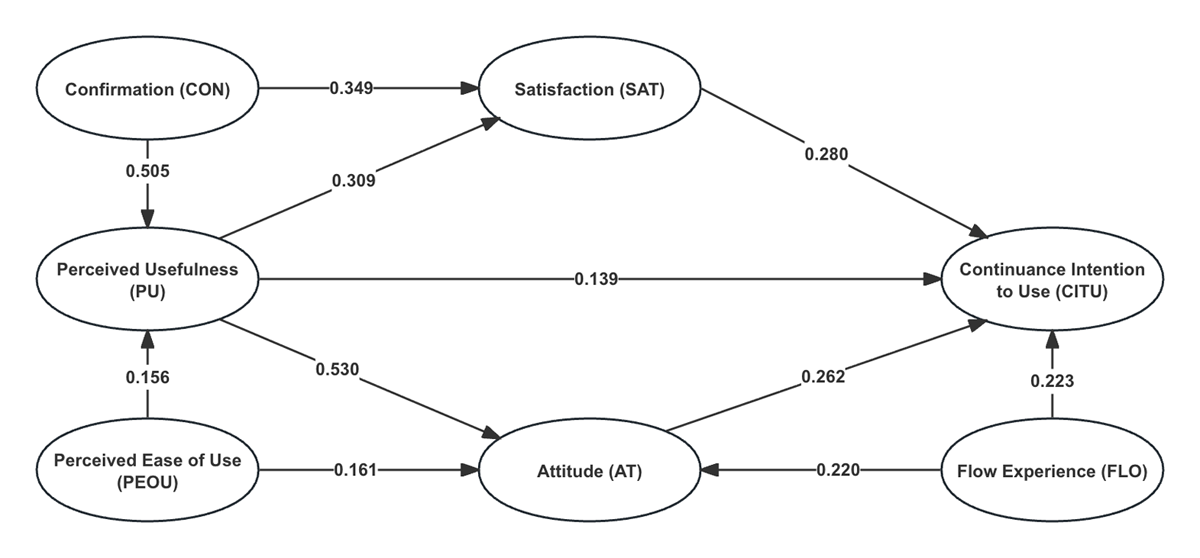
Figure 1
The research model (symmetric model).
Asymmetric analysis
To analyze from different perspectives, this study used the fsQCA method. PLS-SEM is based on symmetrical assumptions and aims to explore the net effects between variables in the model, while fsQCA examines the complex and asymmetrical relationships between causal factors and outcomes, generating multiple pathways (Rasoolimanesh et al., 2021). FsQCA supports both inductive and deductive reasoning, making it well-suited for testing, constructing, and interpreting theories by revealing how multiple combinations of conditions affect the outcome variable (Salonen et al., 2021). Given the complex causal relationship patterns between independent and dependent variables in this study, using fsQCA allows for a more comprehensive understanding of the underlying causes, uncovering hidden relationships.
Calibration
In this study, calibration was the initial stage of the fsQCA analysis, following the standard procedure outlined by Ragin (2008). To convert ordinal scale data into fuzzy set membership scores, this study used the calibration function in fsQCA 4.0 to transform the variable scores from the PLS-SEM into fuzzy set scores. On the fuzzy set scale, scores range from 0 to 1, where 0 indicates full non-membership, 1 indicates full membership, and 0.5 serves as the threshold for the cross-over point (or intermediate set) (Burrough, 1989). Given that this study used a 5-point Likert scale, the three key calibration thresholds were set at 5 (full membership), 3.5 (cross-over point), and 1 (non-membership) (Zhang et al., 2022).
To enhance the robustness of the fsQCA analysis, sensitivity checks were conducted on calibration thresholds and consistency cutoffs as recommended by Ragin (2008). First, alternative calibration methods were tested. Specifically, this study used percentile-based anchors (67th/50th/33rd and 80th/50th/20th for full membership/crossover/non-membership) that were compared with the original thresholds (5/3.5/1). Second, consistency cutoffs were varied (0.80, 0.85, 0.90) to assess the stability of identified pathways. Results showed that the three core configurations (Path 1, 2, and 3) remained stable across all specifications, with core conditions (AT, CON, SAT, PU, FLO) consistently appearing in the identified pathways. These sensitivity analyses confirm that the sufficient configurations reported in Table 11 are robust to different analytical choices.
Configurations
According to Dul (2016), a necessity analysis should be conducted first. After analyzing each potential causal condition, this study found that the highest consistency was around 0.91, slightly above the necessity threshold of 0.90. Thus, perceived ease of use (PEOU), perceived usefulness (PU), and attitude (AT) were identified as necessary conditions for high continuous intention to use (CITU) among preschool teachers, while ~FLO was a necessary condition for low CITU.
Then, a truth table was generated using fsQCA 4.0. Following Pappas et al. (2020), a frequency threshold of 3 was applied. For smaller samples (around 100), a frequency threshold of 2 is appropriate, while for larger samples (>150), a threshold of 3 or higher is recommended. The results of the necessary conditions for CITU are in Table 10.
Table 10
Analysis of necessary condition for CITU.
| HIGH CITU | LOW CITU | |||
|---|---|---|---|---|
| ANTECEDENTS | CONSISTENCY | COVERAGE | CONSISTENCY | COVERAGE |
| PEOU | 0.903 | 0.621 | 0.784 | 0.711 |
| ~PEOU | 0.579 | 0.670 | 0.582 | 0.888 |
| PU | 0.911 | 0.701 | 0.680 | 0.692 |
| ~PU | 0.600 | 0.587 | 0.707 | 0.913 |
| AT | 0.914 | 0.740 | 0.642 | 0.686 |
| ~AT | 0.612 | 0.564 | 0.757 | 0.921 |
| SAT | 0.782 | 0.845 | 0.500 | 0.712 |
| ~SAT | 0.733 | 0.526 | 0.891 | 0.844 |
| FLO | 0.690 | 0.860 | 0.443 | 0.729 |
| ~FLO | 0.782 | 0.516 | 0.914 | 0.795 |
| CON | 0.896 | 0.797 | 0.575 | 0.675 |
| ~CON | 0.634 | 0.531 | 0.827 | 0.913 |
In fsQCA analysis, the three main solution types are the parsimonious solution, complex solution, and intermediate solution. This study chose the intermediate solution due to its advantages in interpretability and model completeness (Chuah et al., 2021). The results indicate that three distinct configurations can lead to high continuous use intention (CITU). When interpreting fsQCA results, consistency and coverage are two key criteria for evaluating the model. Consistency measures the accuracy of a configuration in predicting the outcome, while coverage assesses the importance of the configuration in explaining the outcome. In this study, each configuration shows high levels of consistency (ranging from 0.933 to 0.967) and raw coverage (ranging from 0.573 to 0.705). Specifically, the overall consistency of the three configurations is 0.918, and the coverage is 0.764, indicating that these configurations sufficiently explain the observed results (see Table 11, left panel).
Table 11
Sufficient configurations for CITU and ~CITU.
| CITU | ~CITU | |||||
|---|---|---|---|---|---|---|
| CONFIGURATION | PATH 1 | PATH 2 | PATH 3 | PATH 1 | PATH 2 | |
| PEOU | ⦁ | ~PEOU | • | |||
| PU | ⦁ | • | ~PU | • | • | |
| AT | • | ⦁ | • | ~AT | ⦁ | • |
| SAT | • | • | ~SAT | • | • | |
| FLO | • | ⦁ | ~FLO | • | • | |
| CON | • | ⦁ | • | ~CON | ⦁ | |
| Consistency | 0.933 | 0.945 | 0.967 | 0.825 | 0.810 | |
| Raw coverage | 0.705 | 0.632 | 0.573 | 0.005 | 0.005 | |
| Unique coverage | 0.122 | 0.049 | 0.009 | 0.003 | 0.003 | |
| Overall consistency | 0.918 | 0.815 | ||||
| Overall coverage | 0.764 | 0.009 | ||||
[i] Note: •denotes the presence of a condition, ⦁denotes the marginal presence of a condition. Blank spaces indicate the condition may be either present or absent.
Raw coverage = outcome share explained by a configuration, unique coverage = outcome share exclusively explained by a configuration.
To address causal asymmetry, a core principle of fsQCA (Fiss, 2011), this study also analyzed configurations leading to low continuance intention (~CITU). Two distinct configurations were identified (see Table 11, right panel). The overall consistency of 0.815 indicates moderately high predictive accuracy, while the overall coverage of 0.009 reflects the dispersed nature of dropout mechanisms.
Discussion
This study aimed to identify the determinants influencing preschool teachers’ continuous intention to use AIGC technologies by integrating the Technology Acceptance Model (TAM), the Expectation Confirmation Model (ECM), and Flow Theory. Using both PLS-SEM and fsQCA, the study explored linear relationships and configurational patterns among key cognitive and affective constructs. The findings emphasize the significance of perceived usefulness, perceived ease of use, confirmation, flow experience, satisfaction, and attitude in shaping teachers continued use of AIGC, while also revealing diverse causal configurations.
PLS-SEM analysis revealed that confirmation (CON) plays a central role in influencing both perceived usefulness and satisfaction. This is in line with the ECM framework (Bhattacherjee, 2001), which posits that users’ post-adoption experiences, particularly whether their initial expectations are met, significantly influence ongoing usage decisions. In the context of preschool education, confirmation reflects whether teachers perceive that AIGC tools are as effective as anticipated. This finding is consistent with Khan and Saleh (2023), Rahi et al. (2023), and Thong et al. (2006), who also highlighted confirmation as a key determinant of satisfaction and continued use. Notably, confirmation had a stronger effect on perceived usefulness than perceived ease of use, suggesting that practical alignment with expectations matters more than initial simplicity. However, the path coefficient from confirmation to perceived usefulness (β = 0.505) is moderately higher than that reported by Y. Hu et al. (2025) for graduate students using AIGC in research (β = 0.442). This difference may reflect distinct user characteristics. Graduate students typically possess higher digital literacy and evaluate technologies across multiple dimensions. By contrast, preschool teachers often have limited AI experience and rely more heavily on initial expectation validation. The high-stakes nature of early childhood education, where tool reliability directly affects children’s developmental outcomes, may further heighten confirmation’s importance. Despite these differences, the comparable effect sizes suggest that confirmation remains a robust predictor of perceived usefulness across educational contexts.
Perceived usefulness (PU) emerged as another central factor, influencing satisfaction, attitude, and continued use intention. This finding supports the foundational logic of TAM (Davis et al., 1989), wherein users’ belief that technology improves task performance leads to favorable attitudes and behavioral intentions. Teachers who view AIGC tools as helpful in managing classroom activities or tailoring instruction are more likely to adopt them over the long term. As Cullen and Greene (2011) also suggested, when educators perceive that a system enhances their performance, their motivation to integrate it increases significantly. This result also mirrors findings from Runhaar (2017) in related education contexts, but its confirmation in early childhood education adds novelty to the literature. The influence of PU in this study may reflect the practical orientation of preschool teachers. These educators work under considerable time and resource constraints while addressing diverse developmental needs, behavioral dynamics, and family expectations. In such contexts, technologies must demonstrate clear pedagogical value to be adopted.
Although perceived ease of use (PEOU) had a smaller effect size (f2 = 0.047 on attitude, f2 = 0.033 on perceived usefulness), its indirect influence through PU and attitude remains important. This pattern suggests that preschool teachers prioritize functional outcomes over usability when adopting AIGC tools. Teachers with limited prior digital literacy tend to focus on “whether the tool works for teaching” rather than “how easily it works.” Once teachers confirm that AIGC tools meet their pedagogical needs (as evidenced by the CON→PU effect, f2 = 0.343), perceived usefulness becomes the dominant driver of attitudes, overshadowing the direct influence of ease of use. Previous research has shown that while ease of use may not directly impact long-term intention, it plays a critical role in the early stages of technology adoption (Alshammari & Babu, 2025; Hamid et al., 2016). In this study, the indirect effect of PEOU suggests that simplifying interfaces and reducing operational barriers remain important to promote initial engagement. This is particularly relevant for preschool teachers, who may have less access to professional digital training. In preschool education, where teachers may not always be tech-savvy, the simplicity and intuitiveness of AIGC tools can lower adoption barriers and facilitate initial engagement (Brito & Dias, 2017). This confirms earlier findings by Svetsky and Moravcik (2019), who found that reducing technological friction improves user experience and long-term viability.
Flow experience (FLO) was found to significantly influence both attitude and continuance intention, confirming the role of emotional engagement in technology use. According to Flow Theory, when users are immersed in a task and find it intrinsically enjoyable, their commitment deepens (Guo et al., 2012). This study demonstrates that teachers who experienced flow during their interaction with AIGC tools, such as feeling focused, creative, and in control, were more likely to view the technology positively and continue using it. This aligns with Tseng et al. (2022), who argued that emotional engagement significantly enhances technology adoption in education. Moreover, this emotional pathway provides a complementary lens to the emphasis of TAM and ECM, suggesting that affective involvement is as crucial as cognitive evaluation in shaping long-term behavior. The path coefficient from flow to continuance intention (β = 0.223) is moderately stronger than that found in other technology contexts. For instance, Cheng (2021) reported β = 0.185 for flow’s effect on robo-advisory service adoption among highly educated users. This difference may reflect the inherently creative and interactive nature of preschool teaching. It involves improvisation, storytelling, and hands-on activities that naturally align with flow states, compared to more efficiency-oriented uses of financial technology.
Attitude (AT) was another significant predictor of continuance intention, influenced directly by PU, PEOU, and flow experience. This reaffirms TAM’s notion that favorable user attitudes mediate between beliefs and behavior (Kim et al., 2009; López-Bonilla & López-Bonilla, 2017). The particularly strong path from PU to attitude indicates that instrumental beliefs are critical, while flow contributes to attitudinal shifts by increasing emotional involvement. This dual pathway highlights the value of combining cognitive and experiential perspectives to understand user behavior, particularly in emotionally rich settings like preschool education.
Satisfaction (SAT) played a mediating role in the model, influenced by both confirmation and perceived usefulness. The path analysis showed moderate and significant effects, indicating that teachers’ satisfaction is shaped by both their initial expectations and the practical utility of AIGC tools. This aligns with Philip and Moon (2013) and Spreng and Olshavsky (1993), who emphasized that satisfaction results from the comparison between expectations and perceived performance. In the context of preschool education, confirmation reassures teachers that AIGC meets their anticipated instructional value, while perceived usefulness reinforces the belief that the tools enhance teaching effectiveness. Together, these factors contribute to a sense of contentment and confidence, which in turn strengthens teachers’ commitment to continued use. The dual influence of cognitive evaluation and expectation alignment on satisfaction is consistent with findings by Chen (2011) and Wu et al. (2010) demonstrated that satisfaction is not only an emotional response but also an indicator of perceived system reliability and pedagogical compatibility. Given its significant direct impact on continuance intention, satisfaction emerges as a critical construct linking both rational judgment and emotional assurance.
The fsQCA analysis provided additional insights beyond those uncovered by PLS-SEM. Three configurations were identified as sufficient for high continuance intention. The first path, characterized by attitude, satisfaction, and confirmation as core conditions, suggests that positive affect and validated expectations can drive sustained usage even when perceived usefulness is only peripheral. This finding supports X. Li et al. (2024), who highlighted the role of user belief in forming robust behavioral outcomes.
The second path featured perceived usefulness and flow experience as core conditions, with attitude and confirmation as supportive elements. This suggests that when AIGC is perceived as both effective and enjoyable, sustained use can occur even without high satisfaction. This configuration reflects the importance of simultaneous rational and emotional engagement, expanding prior work on user immersion and sustained behavior in digital settings (Salloum et al., 2023; Wu et al., 2022).
The third configuration showed that even when PEOU and flow experience are peripheral, the combination of confirmation, satisfaction, and attitude remains sufficient to predict continued use. This indicates that while emotional and usability-related factors may play supporting roles, cognitive evaluations and affective trust are central drivers. Such findings are consistent with prior fsQCA studies (Song et al., 2024; Tyagi & Krishankumar, 2024) and affirm that there is no single route to technology adoption, different teachers may reach the same outcome through different motivational structures.
In summary, these three fsQCA configurations combine different core and peripheral conditions, supporting the general trend found in PLS-SEM analysis and further demonstrating diverse paths to achieving high continuous intention to use (CITU) in education. These new findings suggest that fostering teachers’ continued use of AIGC technology does not only rely on a single factor with the greatest impact. Rather, multiple effective combinations can achieve the goal. Finally, the importance and influence of each characteristic vary in different configurations, suggesting that a mix-and-match strategy should be adopted in different environments to achieve optimal outcomes.
Beyond identifying pathways to high continuance intention, the fsQCA analysis also revealed configurations leading to discontinuation. Two barrier patterns emerged from the negated outcome analysis. Both paths shared three absent conditions: perceived usefulness, satisfaction, and flow experience. The first configuration featured the absence of PEOU alongside these three core deficiencies. The second configuration included absent confirmation as an additional element.
The consistent presence of ~PU, ~SAT, and ~FLO across both paths indicates that these deficiencies form a critical barrier cluster. When teachers perceive AIGC tools as neither useful nor satisfying and experience no emotional engagement, discontinuation becomes likely. The prominence of absent flow experience is particularly noteworthy. It appeared as a core condition in both discontinuation configurations. This suggests that lack of emotional engagement serves as a necessary element in the abandonment process, not merely a supplementary factor.
These findings reveal asymmetry in adoption pathways. Multiple diverse configurations can lead to successful continuance. In contrast, discontinuation follows more uniform patterns characterized by compounded absences. For practice, this indicates that preventing dropout requires simultaneous attention to functional value, user satisfaction, and emotional engagement. Deficiency in these dimensions, particularly when combined, can trigger abandonment even when other conditions remain neutral.
Implications
Theoretical Implications
This study provides several theoretical contributions. First, this study introduces a hybrid model that integrates the Technology Acceptance Model (TAM), Expectation Confirmation Model (ECM), and Flow Theory to predict preschool teachers’ continuous intention to use AIGC technologies. While prior research on AIGC has primarily focused on higher education, its application in early childhood education has been largely overlooked. This integrated framework captures both cognitive and emotional dimensions of technology adoption, thereby offering a more comprehensive explanation of behavioral intention in the preschool context.
While UTAUT and its variants (e.g., UTAUT2) consider both hedonic and cognitive factors across many technologies (Acosta-Enriquez et al., 2024; Grassini et al., 2024), the present model differs in three ways. First, UTAUT models mainly explain initial adoption. This study focuses on continuance after adoption and integrates ECM to capture confirmation and satisfaction that arise from actual use. Second, UTAUT2 treats hedonic motivation as a single factor. Guided by flow theory, this study models intrinsic motivation as concentration, enjoyment, and control, which offers finer insight into how immersive engagement sustains use of AIGC. Third, the model is tailored to AIGC in preschool education, where pedagogical appropriateness and developmental needs extend beyond the typical scope of UTAUT extensions. Overall, the framework is not a simple addition of variables but a theory-driven integration tailored to continuance in this context.
Furthermore, the findings challenge the cognitive dominant assumptions prevalent in many UTAUT-based studies. Specifically, the path coefficients for flow experience and satisfaction exceed that of perceived usefulness by 0.08 and 0.14, respectively. The f2 effect sizes further reinforce this pattern. Additionally, in the fsQCA configurations, perceived usefulness needs to be matched with flow experience to serve as the core condition. These results underscore the critical role of affective engagement in driving sustained use, suggesting that emotional factors may outweigh purely functional evaluations in shaping long-term adoption. The study also identifies confirmation, satisfaction, and flow experience as key factors that enhance teachers’ perceived usefulness and continuous intention to use. Among them, confirmation emerged as the strongest predictor of perceived usefulness, while flow experience significantly shaped positive attitudes, enriching the theoretical understanding of motivational mechanisms behind AIGC use.
Moreover, this study advances beyond the variance based linear logic that dominates UTAUT research. Methodologically, the combined application of PLS-SEM and fsQCA enhances the analytical depth by addressing both symmetric and asymmetric relationships. PLS-SEM clarifies the net effects and directional strengths between variables, while fsQCA identifies multiple sufficient configurations leading to high continuance intention. This dual approach reveals that different combinations of cognitive, emotional, and experiential factors can yield similar behavioral outcomes. It demonstrates equifinality, a principle rarely examined in traditional UTAUT extensions that assume singular, universal pathways to adoption. The study thus demonstrates the value of integrating variance-based and set-theoretic methods to better capture the multifaceted nature of technology adoption in education.
Practical Implications
The results also provide actionable recommendations for stakeholders aiming to foster the sustainable use of AIGC in preschool education. First, confirmation is pivotal for enhancing perceived usefulness. Educational technology providers should prioritize mechanisms that support expectation alignments, such as offering real-time feedback, usage analytics, and teacher training resources. These can help educators experience early success with AIGC, thereby reinforcing its perceived instructional value.
Furthermore, satisfaction significantly drives continuance intention. To enhance satisfaction, AIGC systems should offer preschool-specific functionalities that align with daily classroom routines. For example, quick-generate tools for visual schedules, emotion cards for circle time discussions, or customizable name tags and classroom labels can streamline preparation. One-click templates for thematic units (e.g., seasons, animals, community helpers) save valuable planning time, while voice-to-image features allow teachers to create resources while supervising children. These context-appropriate tools can promote positive user experiences and long-term commitment.
Moreover, flow experience plays a key role in shaping both attitude and intention. This is particularly salient in preschool contexts where teachers juggle multiple roles (e.g., caregiver, educator, and behavior manager). Developers are encouraged to design interactive features that foster immersion, tailored to preschool teaching practices. For instance, AIGC tools for creating sensory play materials (e.g., textured pattern cards, sound-matching visuals), interactive story props, or personalized social-emotional learning scenarios can enhance engagement. Features like drag-and-drop storyboard builders, auto-generated puppet show characters, or AI-assisted song lyric adaptations enable teachers to quickly produce developmentally appropriate, hands-on learning resources. Given preschoolers’ limited attention spans and need for sensory-rich experiences, AIGC outputs should prioritize tactile-visual combinations, movement-based activities, and culturally diverse character representations that teachers can effectively incorporate into play-based learning. These elements can enhance user engagement and emotional involvement, which are particularly important in the affect-rich context of early childhood education.
From a pedagogical perspective, preschool educators should integrate AIGC strategically into developmentally appropriate practices. For instance, AIGC can generate customized visual aids for sensory bins (e.g., themed sorting cards), create personalized social stories for children with special needs, or produce multilingual labels for dramatic play centers. AI-assisted lesson planning can help teachers design scaffolded activities that address individual learning paces. For example, it could generate progressively complex pattern sequences for math readiness or tailored fine motor practice sheets. Professional development programs should emphasize not only technical skills but also pedagogical reasoning. Specifically, it should help teachers critically evaluate when and how AIGC enhances learning outcomes versus traditional methods. Given the unique needs of 3-6-year-olds (e.g., concrete thinking, hands-on learning), training should focus on using AIGC as a complement to play-based and teacher-child interactions.
The fsQCA findings suggest that different teachers may reach sustained adoption through different pathways. Thus, education administrators and platform designers should adopt differentiated support strategies tailored to varying combinations of user needs and experiences (e.g., satisfaction, confirmation, or flow engagement). By drawing on both PLS-SEM and fsQCA insights, decision-makers can develop flexible, evidence-based interventions that accommodate diverse motivational profiles and teaching environments, ultimately enhancing the effective integration of AIGC in early learning contexts.
At the policy level, preschool governance should set clear standards for ethical and age-appropriate AIGC use. Guidance should cover data privacy, developmental suitability, content safety, and practical limits on screen time. Moreover, funding should secure equitable access to tools, infrastructure, and teacher training so resource-constrained preschools are not left behind. Meanwhile, curriculum frameworks need updates that show how AIGC aligns with early learning standards and assessment practices. Policymakers should also convene educators, technology developers, and researchers to conduct ongoing evaluations of AIGC’s impact and to use the results for continuous improvement.
Limitations and Future Research
Despite offering meaningful insights, this study has several limitations that should be addressed in future research. First, the data were collected at a single point in time, which limits the ability to capture temporal changes in teachers’ perceptions and behaviors. As teachers accumulate experience with AIGC tools, their attitudes and usage intentions may evolve. Future studies could adopt longitudinal designs to explore how these variables shift over time, thereby providing a more dynamic understanding of adoption behavior.
Second, the sample consisted exclusively of Chinese preschool teachers. This limits cross-cultural generalizability. Cultural and policy contexts may shape technology acceptance differently from other settings. Examples include collectivist orientations and state-led edtech initiatives. The gender distribution in this study is more balanced than is typical in early childhood education worldwide. This pattern suggests possible over-representation of urban or more technologically proficient teachers. As a result, estimates for confirmation, perceived usefulness, satisfaction, and flow may be higher than they would be in under-resourced or rural schools. Future research should report recruitment coverage by urban versus non-urban settings and conduct multi-country replications to test generalizability across cultural and institutional contexts.
Third, reliance on self-reported Likert-scale measures introduces potential social desirability bias, particularly regarding technology competence and usage intentions. Teachers may overreport positive attitudes toward AIGC adoption due to perceived institutional expectations or professional norms. Future studies could triangulate survey data with behavioral analytics (e.g., actual usage logs) or classroom observations to mitigate this limitation.
Fourth, while the current model integrates TAM, ECM, and Flow Theory, it does not account for other influential variables such as social influence, facilitating conditions, or performance expectancy. Future studies could extend the model by incorporating additional theoretical frameworks, such as the Unified Theory of Acceptance and Use of Technology (UTAUT), to capture a more comprehensive range of determinants influencing AIGC adoption.
Finally, the quantitative approach is valuable for identifying sufficient configurations, but it cannot explain why particular combinations emerge or how contextual factors shape these pathways. Mixed-methods designs that integrate interviews, focus groups, and case studies can reveal the mechanisms behind the fsQCA configurations. In addition, longitudinal fsQCA with panel data can track whether configurations persist or shift over time and test their sensitivity to changes in training, resources, and policy. These directions would deepen theoretical understanding and increase practical relevance for policymakers and practitioners seeking to foster AIGC integration in early childhood education.
Conclusion
This study developed and tested an integrated model combining the Technology Acceptance Model (TAM), Expectation Confirmation Model (ECM), and Flow Theory to investigate the cognitive, emotional, and behavioral determinants of Chinese preschool teachers’ continuous intention to use Artificial Intelligence Generated Content (AIGC) technologies. Based on survey data from 433 teachers and dual-method analysis using Partial Least Squares Structural Equation Modeling (PLS-SEM) and Fuzzy Set Qualitative Comparative Analysis (fsQCA), the findings reveal several key insights.
PLS-SEM results demonstrate that confirmation and perceived usefulness are the strongest cognitive drivers, with confirmation exerting a large effect on perceived usefulness (β = 0.505, f2 = 0.343) and satisfaction (β = 0.349), while perceived usefulness directly influences attitude (β = 0.530, f2 = 0.442) and indirectly shapes continued use intention. Satisfaction, which is jointly shaped by both confirmation and usefulness, shows a significant direct effect on continuance intention (β = 0.280). In contrast, perceived ease of use has a relatively minor role, operating mainly through indirect pathways. Flow experience, representing emotional immersion, is found to significantly influence both attitude and continuance intention, highlighting the importance of affective engagement in preschool contexts. Altogether, these results validate the theoretical model, supporting all eleven proposed hypotheses and explaining 51.8% of the variance in continuance intention.
Complementing these findings, the fsQCA results identify three distinct sufficient configurations that lead to high continuance intention. These include combinations centered on (1) attitude, satisfaction, and confirmation, (2) perceived usefulness and flow experience, and (3) confirmation, satisfaction, and attitude, even when flow and ease of use are peripheral. These asymmetrical insights emphasize that no single factor dominates across all users; instead, different combinations of cognitive trust, emotional engagement, and experiential alignment jointly shape sustained technology use.
These findings offer the understanding of how Chinese preschool teachers develop sustained behavioral intention toward AIGC, grounded in both rational assessment and emotional resonance. This contributes to both theoretical advancement and practical guidance for AIGC adoption among preschool teachers, with potential relevance to similar early childhood educational contexts. The current findings point to several specific directions for future research. First, because confirmation emerged as the strongest predictor, studies should test which early experiences or training designs most effectively build realistic expectations and foster confirmation among novice AIGC users. Second, the three configurational pathways indicate that preschool teachers may adopt AIGC through different routes. Future work can examine whether teacher characteristics align with particular adoption patterns and use this evidence to design more targeted implementation strategies. Third, flow experience is a significant driver of continuance intention, yet the processes that elicit and sustain immersion in preschool teaching remain unclear. Research should assess how concrete design features, task structures, and usage scenarios influence flow during pedagogical activities. These steps would strengthen post-adoption theory and support sustained AIGC integration in preschool educational settings.
Data Accessibility Statement
The datasets used and/or analysed during the current study are available from the corresponding author on reasonable request.
Ethics and Consent
An information sheet was presented on the first page of the online questionnaire, and participants (adult preschool teachers) provided informed consent by clicking “I agree” before proceeding. Participation was voluntary; no minors or vulnerable populations were involved. No identifying personal data was collected; responses were anonymized and analyzed in aggregate, stored on secure servers, and reported in accordance with institutional policies and the Declaration of Helsinki.
Competing Interests
The author has no competing interests to declare.
Author Contributions (CRediT)
Yuxin Zhang: Conceptualization, methodology, investigation, data curation, software, validation, writing—original draft, writing—review and editing.
Author Notes
Based on Academic Integrity and Transparency in AI-assisted Research and Specification Framework (Bozkurt, 2024), the authors of this paper acknowledge that for the translation and localization of content, ChatGPT (GPT-4, May 2025) was employed. Human translators subsequently reviewed and adjusted the translations to ensure accuracy, cultural appropriateness, and contextual relevance. The final text was thoroughly reviewed and approved by the authors to ensure it accurately reflects the intended research outcomes and ethical standards. The authors also assessed and addressed potential biases inherent in the AI-generated content. The final version of the paper is the sole responsibility of the human authors.