
Introduction
The proliferation of distance learning across the globe has significantly expanded access to higher education, particularly for non-traditional learners who are constrained by geography, employment, or personal obligations (Adade et al., 2025; Arhin et al., 2021; Faridah et al., 2021). This growth reflects a broader global shift towards more flexible, inclusive, and technology-mediated modes of education that cater for diverse learner needs and circumstances. It also aligns with Sustainable Development Goal 4 (SDG 4) of the global agenda, which emphasizes inclusive, equitable, and high-quality education, as well as the promotion of lifelong learning opportunities for everyone (Sdg, 2019). In particular, it supports Target 4.3 of SDG 4, which seeks to guarantee that all women and men have equal access to affordable, high-quality technical, vocational, and tertiary education, including university-level studies.
This global trend is equally reflected in many parts of Africa, including Ghana, where distance education has emerged not merely as an alternative but as a strategic tool to achieve SDG 4 in the face of local challenges. In particular, the increasing demand for tertiary education, coupled with limited infrastructural capacity in conventional universities, has made distance education a pivotal mode of instruction (Amini & Oluyide, 2016). Public universities and other institutions have thus expanded their distance learning portfolios to accommodate the growing and diversifying student population, including marginalized and underserved groups who might otherwise be excluded from higher education.
However, despite its accessibility and alignment with global development goals, distance learners often juggle academic responsibilities with work, family, and social commitments (Agyekum, 2023; Shikulo & Lekhetho, 2020), which can impede their academic adjustment (Alkan, 2025; Mittelmeier et al., 2019), engagement (Kuluşaklı, 2025), and overall academic performance (Kazondovi et al., 2022). The flexibility of distance learning, while advantageous, also places greater demands on students to be self-regulated, technologically adept, and psychologically resilient-skills and attributes that are not evenly distributed across all learners. Without adequate support services that ensure educational equity and empowerment, the promise of SDG 4.3 and 4.5 risks being undermined by persistent gaps in learner readiness, digital inclusion, and psychosocial support. These challenges can heighten academic struggles and highlight the need for effective student support services (Ampofo & Somuah, 2021).
Existing literature suggests that support services in distance education encompass academic, administrative, technological, and psychosocial provisions (such as academic advising, tutorials, counseling, library access, and ICT support) that help learners achieve their goals (Ampofo & Somuah, 2021; Arhin et al., 2017; Johnson et al., 2022; Shabani & Maboe, 2021; Theurel et al., 2022). Support services are especially vital in most contexts, where infrastructural and personal challenges hinder persistence, and have been shown to reduce attrition, foster belonging, and enhance self-regulation and resilience (Aluko, 2021; Tait, 2024). Support services also influence motivational pathways (autonomy, competence, and relatedness), through which external resources translate into sustained effort and engagement, as explained by Self-Determination Theory (Deci et al., 2017). These motivational pathways support academic adjustment, or the ability to adapt to academic demands through effective study habits, time management, stress coping, and integration into institutional culture (Ahmad & Rana, 2023; Mittelmeier et al., 2019). Poor adjustment often leads to disengagement, stress, and dropout.
Academic engagement reflects the cognitive, emotional, and behavioral investment students make in their learning (Chwiłkowska-Kubala et al., 2024). Engaged students demonstrate sustained attention, active participation, and enthusiasm for learning tasks. In the distance learning context, engagement is crucial because of the absence or limited face-to-face interactions and the need for self-initiated participation. Academic achievement is widely recognized as a multidimensional concept, encompassing various domains of learning (Arhin & Amoako, 2019). In educational systems, these domains often translate into cognitive goals that cut across subjects, such as critical thinking, and others that are specific to particular disciplines, such as mathematics, science, or history. Although academic achievement serves as a key indicator of academic success, it is shaped by a dynamic interplay of learner characteristics, institutional conditions, and motivational processes (Kazondovi et al., 2022).
Therefore, this study examines how student support services serve as contextual enablers that promote the satisfaction of distance learners’ basic psychological needs, thereby enhancing students’ academic adjustment and improving outcomes such as academic engagement and academic achievement. Unlike many earlier studies that rely on one-time surveys, this study used a two-wave time-lagged design. Data were gathered through two different questionnaires, completed at two separate times. This way, the outcome variables could not influence the independent variables, which makes the findings more reliable and gives a clearer sense of cause and effect. By focusing on distance education students in a higher institution in Ghana, it adds insights from an African context perspective that is often overlooked in global research. Together, the design and setting make the study both rigorous and fresh, offering new evidence on how student support services shape adjustment, engagement, and achievement in distance learning. Drawing on the perspective of the SDT as a theoretical lens to investigate how institutional support services influence academic adjustment and outcomes among distance learners at the University of Cape Coast, the following research hypotheses were formulated.
H01: Support services will not influence the academic adjustment of distance learners.
H02: Support services will not influence the relatedness of distance learners.
H03: Support services will not influence the competence of distance learners.
H04: Support services will not influence the autonomy of distance learners.
H05: Relatedness will not influence the academic adjustment of distance learners.
H06: Competence will not influence the academic adjustment of distance learners.
H07: Autonomy will not influence the academic adjustment of distance learners
H08: Academic adjustment will not influence academic outcomes of distance learners.
H09: Autonomy will not mediate the effect of support services on academic outcomes of distance learners.
H010: Competence will not mediate the effect of support services on academic outcomes of distance learners.
H011: Relatedness will not mediate the effect of support services on academic outcomes of distance learners.
Literature
Theoretical Framework
This study is anchored in two complementary psychological theories: Self-Determination Theory (SDT) by Deci and Ryan (1985), and Social Cognitive Theory (SCT) by Bandura (1986). These theories together offer a robust foundation for understanding how support services influence distance learners’ adjustment and academic outcomes, particularly through the mediating role of motivational pathways.
Self-Determination Theory (SDT) is a widely recognized framework for understanding human motivation, highlighting how social and environmental contexts influence individuals’ engagement, persistence, and psychological well-being. At its core, SDT posits that all people have three fundamental innate psychological needs; autonomy, competence, and relatedness, which are vital for optimal functioning, intrinsic motivation, and personal development. Autonomy is the sense of acting with choice and self-direction. Competence refers to feeling capable and effective in dealing with one’s environment while relatedness involves the need to feel a sense of connection and support from others.
In the context of distance learning, where students often face significant challenges such as limited face-to-face interaction, increased responsibility for self-regulation, and balancing academic work with personal or professional obligations, the role of support services becomes increasingly vital. Services such as academic advising, counseling, and tutor communication can facilitate the satisfaction of these basic psychological needs. When these needs are adequately satisfied, students are more likely to experience intrinsic motivation, persist on the programme, and obtain academic success. Conversely, unmet needs can lead to demotivation, disengagement, and poor academic outcomes.
To enrich this perspective, the study also incorporates Bandura’s Social Cognitive Theory (SCT), which highlights the dynamic interplay between personal factors, behavior, and environmental conditions. A key construct within SCT is self-efficacy which is an individual’s belief in their capacity to plan, organize, and carry out actions necessary to effectively handle future situations. From this perspective, learners’ behavior (such as their level of engagement or adjustment) is not shaped solely by internal motivation but also by external influences and self-beliefs.
In a distance learning environment, support services function as environmental enablers that help shape learners’ experiences and build their self-efficacy. When students are supported through counseling, academic guidance, and timely feedbacks, they are more likely to develop stronger confidence in their ability to succeed. In particular, distance learners, who often enroll with higher expectations and a strong sense of agency, require structured yet flexible environments that reinforce their self-beliefs and capacity for success. Taken together, SDT and SCT provide a comprehensive theoretical lens through which support services influence learners’ adjustment and learning outcomes, thus, providing a novel framework for interpreting learner adjustment in a blended distance learning context.
Student Support Services and Academic Outcomes
Several studies have investigated the link between student support services and academic performance across different contexts. Johnson et al. (2022) reported a significant association between the availability of student services and student success. They explained that when students encounter challenges and seek help from institutional sources, consistent mentoring from university programs contributes to better performance over time. Shabani and Maboe (2021) also acknowledged this link but noted a scarcity of literature directly connecting the effectiveness of support services to academic outcomes. In a distance learning context, Shikulo and Lekhetho (2020) found that inadequate support services can delay graduation, underscoring the need for robust institutional assistance.
Support Services and Motivational Pathways
Research further suggests that student support services influence motivational pathways—specifically relatedness, autonomy, and competence. For example, relatedness is strengthened when students feel connected to peers and faculty (Compare et al., 2024; Fotiadis et al., 2019). Autonomy is fostered when learners are encouraged to take ownership of their studies (Borg & Alshumaimeri, 2019; Young-Jones et al., 2021). Competence grows when students receive guidance and feedback that help them master academic tasks (Cordeiro et al., 2016; Baard et al., 2004).
Motivational Pathways and Academic Adjustment
Motivational pathways, in turn, play a central role in learners’ adjustment. Autonomy helps students identify their strengths and weaknesses, refine learning strategies, and take proactive responsibility for their education (Namaziandost et al., 2024; Susanti et al., 2023; Rahimi & Yadollahi, 2017). Relatedness, built through emotional and social support from peers, instructors, and the wider academic community, fosters resilience and smoother adaptation to challenges (Vansteenkiste et al., 2006; Knoster & Goodboy, 2020). Competence development through skill-building and consistent progress monitoring further supports adjustment. Overall, learners’ adjustment fosters a sense of belonging and motivation, leading to improved academic performance (Singh & Singh, 2024; Da Costa et al., 2018).
Conceptual Framework
The framework as shown in Figure 1 converges on the central role of motivation and adjustment in determining academic outcomes. Thus, when support systems are responsive and holistic, they do not only meet students’ motivational and academic needs but also enhance students’ ability to adjust to the demands of distance education. Adjustment, in this context, serves as a foundational process that enables students to develop positive learning habits, maintain motivation, and actively participate in academic activities. Conversely, poor adjustment may result in disengagement, procrastination, and feelings of isolation, factors that ultimately compromise academic engagement and academic achievement.
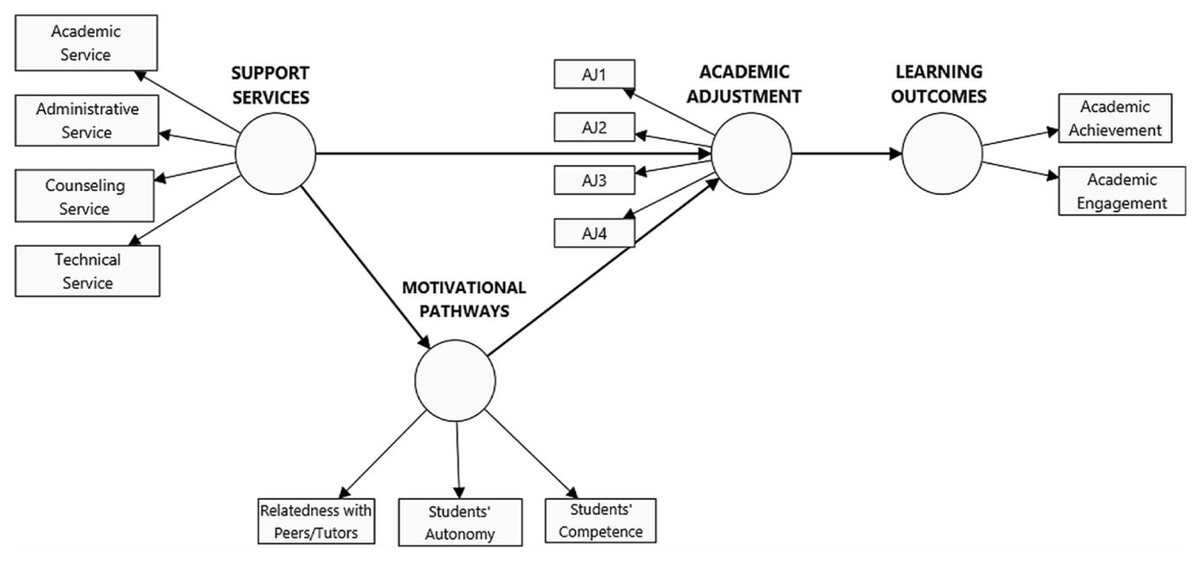
Figure 1
A Conceptual Framework Linking Support Services and Motivational Pathways to Students’ Adjustment and Learning Outcomes.
Methods
Research Design
This study adopted a quantitative research approach within the positivist paradigm. It employed a time-lagged study design to assess the causal relationships between student support services, motivational pathways, academic adjustment, and academic outcomes among distance learners. By collecting data at two different time points, the design helped mitigate common method bias and enhanced the validity of causal inferences (Podsakoff et al., 2012). This temporal ordering allowed us to model indirect effects with clearer time sequencing than a cross-sectional design, while retaining the observational, non-experimental character of the study.
Population and Sampling Procedure
The research was conducted in Ghana, specifically at the College of Distance Education (CoDE) of the University of Cape Coast (UCC). According to the Students’ Records Management Unit (2024), UCC currently serves 21,902 distance learners across 94 study centres in the ten administrative regions of the College. The target population for this study comprised 6,600 second-year undergraduate distance learners who were enrolled during the first semester of the 2023/2024 academic year. This group was selected because they had completed at least one year of study and were therefore familiar with institutional support systems, yet still early enough in their academic journey to be adjusting to the demands of distance education.
A multi-stage sampling technique comprising; cluster, purposive, and simple random sampling was employed. First, the ten administrative regions were categorized into two groups based on location: Geographical Location A (GLA), where the College has administrative facilities, and Geographical Location B (GLB), where the College operates through study centres only. In each region, one study centre was selected from both GLA and GLB. Selection was purposive when a study centre had the largest population, and simple random sampling was used when two or more study centres had equal populations. This yielded 20 study centres with a sampling frame of 3,513 second-year students. Based on Krejcie and Morgan’s (1970) sample size determination table, a minimum of 1,068 respondents was needed for a 95% confidence level and a ±2.5% margin of error. A proportionate-to-size sampling technique was then used to allocate this sample size across the selected centres.
Inclusion and Exclusion Criteria
Only second-year distance learners were included in the study because they were seen as optimally positioned, since they had enough exposure to assess support services meaningfully, yet were still in an active adjustment phase. First-year students were excluded due to limited experience with the academic system and support services. Third and final-year students were also excluded, as their responses could be influenced by long-term coping mechanisms or disengagement from support services.
Data Collection Tools
The data collection instrument included both standardized and researcher-adapted scales, depending on the availability of validated tools. Student Support Services were measured based on provisions outlined in the CoDE Students’ Handbook. Four dimensions; academic, counselling, tutoring, and technical services were rated on a five-point Likert scale ranging from 0 (not available) to 4 (available and accessible). Academic Adjustment was assessed using the Academic Adjustment subscale under Student Adaptation to College Questionnaire Short Form (SACQ-SF) developed by Liga et al. (2022). This subscale, consist of 4 items, and its responses recorded on a four-point Likert scale (1 = strongly disagree, 4 = strongly agree) was used. Motivational Pathways were measured using an adapted version of the Basic Needs Satisfaction Scale for Students (BNSSS) by Fedesco et al., (2019). However, only three key dimensions of the scale: Autonomy (4 items), Competence (3 items), and Relatedness (5 items) were used with each rated on a seven-point Likert scale (1 = strongly disagree, 7 = strongly agree). Academic Engagement was measured using Academic Learning scale under Higher Education Student Engagement Scale (HESES) developed by Zhoc et al. (2019), which included four items rated on a five-point Likert scale. Academic Achievement was assessed using a five-item Likert-type scale developed by Stadler et al., (2021), which measured students’ academic achievement relative to their personal goals, invested effort, and peers’ achievement.
Validity and Reliability Measures
Although most of the scales used in this study had already been validated in earlier research, Tavakol and Dennick (2011) remind us that it is still important to check an instrument’s internal consistency within the specific population being studied. In line with this, a pilot test was carried out with 107 participants (10% of the final sample size), consistent with Connelly’s (2008) recommendation for pilot studies. These participants were drawn from two study centres that were not part of the main research sites, ensuring that the pilot did not overlap with the main sample. The reliability analysis from the pilot produced the following Cronbach’s alpha values (initial values from the original validation studies where available are shown in parentheses) Support Services = .69; Academic Adjustment = .73; Motivational Pathway = .77; Academic Engagement (Academic Learning Scale) = .76 (.71); and Academic Achievement = .79 (.82). According to Streiner (2003), values of .70 or higher are generally considered acceptable for research purposes. However, slightly lower values, such as the .69 for Support Services, can still be acceptable, especially in exploratory research or when the scale contains a small number of items.
To make sure the instruments were valid for this study, three experts in educational psychology and distance education reviewed the adapted scales. They helped refine the wording of items so they were clear, culturally appropriate, and relevant to the context of distance learning in Ghana. We also checked construct validity by running an exploratory factor analysis (EFA) during the pilot phase, which confirmed that the items grouped as expected, with all factor loadings above the recommended .40 threshold (Hair et al., 2021). Finally, to ensure face validity, we asked the pilot participants whether the items were clear, easy to understand, and relevant to their learning experiences, and they confirmed that they were.
Research Procedure
Following ethical approval from the University of Cape Coast Institutional Review Board (ID: UCCIRB/CoDE/2024/01), a formal permission letter was obtained from the Provost of CoDE and distributed to all selected study centres. The research team visited each selected centre prior to data collection to build rapport, clarify logistics, and ensure local cooperation. The data collection was executed in two waves, spaced four weeks apart, consistent with the time-lagged design. At Time 1, data were collected on support services, and motivational pathway variables. At Time 2, data were gathered on academic adjustment, academic outcome variables. To link responses across waves without revealing identities, each participant was given a unique ID code. Participants were informed about the study’s aims, their rights, and the voluntary nature of participation. A written informed consent was secured before the questionnaires were administered. Data were securely stored and restricted to authorized personnel under the supervision of the principal investigator.
Findings and Discussion
Findings
A total of 1,007 participants who provided valid and consistent responses in Wave 1 were retained for inclusion in the Wave 2 data collection. Following data cleaning and screening of the Wave 2 responses, 818 responses representing approximately 77% of the initial 1,068 sampled participants were deemed reliable (Tabachnick & Fidell, 2019) and subsequently included in the final analysis.
Although demographic information was not a core focus of the study’s research objectives, it is presented in Table 1 to offer a detailed profile of the participants. Including this information enhances the study’s transparency and enables readers to better understand the context and relevance of the findings, thereby strengthening the overall credibility and interpretability of the results.
Table 1
Learners’ Demographics.
| ITEMS | CATEGORY | FREQUENCY (N) | PERCENTAGE (%) |
|---|---|---|---|
| Programme of study | Education | 699 | 85.5 |
| Business | 119 | 14.5 | |
| Gender | Male | 323 | 39.5 |
| Female | 495 | 60.5 | |
| Age (Years) | Below 21 | 19 | 2.3 |
| 21–25 | 470 | 57.5 | |
| 26–30 | 183 | 22.4 | |
| 31–35 | 90 | 11.0 | |
| Above 35 | 56 | 6.8 | |
| Marital Status | Married | 177 | 21.6 |
| Single | 641 | 78.4 |
[i] Source: Field Data.
The study participants were drawn from two academic programmes of the College: Education and Business. Those enrolled in the Education programme constituted the majority, representing 85.5% of the sample, while Business students accounted for 14.5%. Female participants predominated, with 495 individuals making up 60.5% of the total sample. In terms of age distribution, the 21–25 age group had the highest representation, also totaling 495 participants. Notably, participants aged 26–30 and 31–35 constituted 22.4% and 11.0% of the sample, respectively, while 6.8% were above 35 years. These figures reflect the adult composition of some of the participants, which is further evidenced by marital status—21.6% (177 participants) reported being married. Given this demographic profile, the provision of diverse support services is essential to effectively address the needs of distance learners. The result is shown in Table 1.
Descriptive Statistics
Availability and Utilization of Support Services among Distance Learners
Before testing the main research hypotheses, preliminary descriptive analyses were conducted to explore the extent to which various support services were available and utilized by distance learners. This initial analysis provides a contextual understanding of the learning environment and the support structures accessible to participants. Specifically, the analysis examined students’ perceptions of four key categories of support services: Academic, Administrative, Counselling, and Technical using mean scores and corresponding percentages derived from a 6-point Likert scale. A cut-off mean score of 3.0 was established as the threshold for determining adequate availability. The result is depicted in Figure 2.
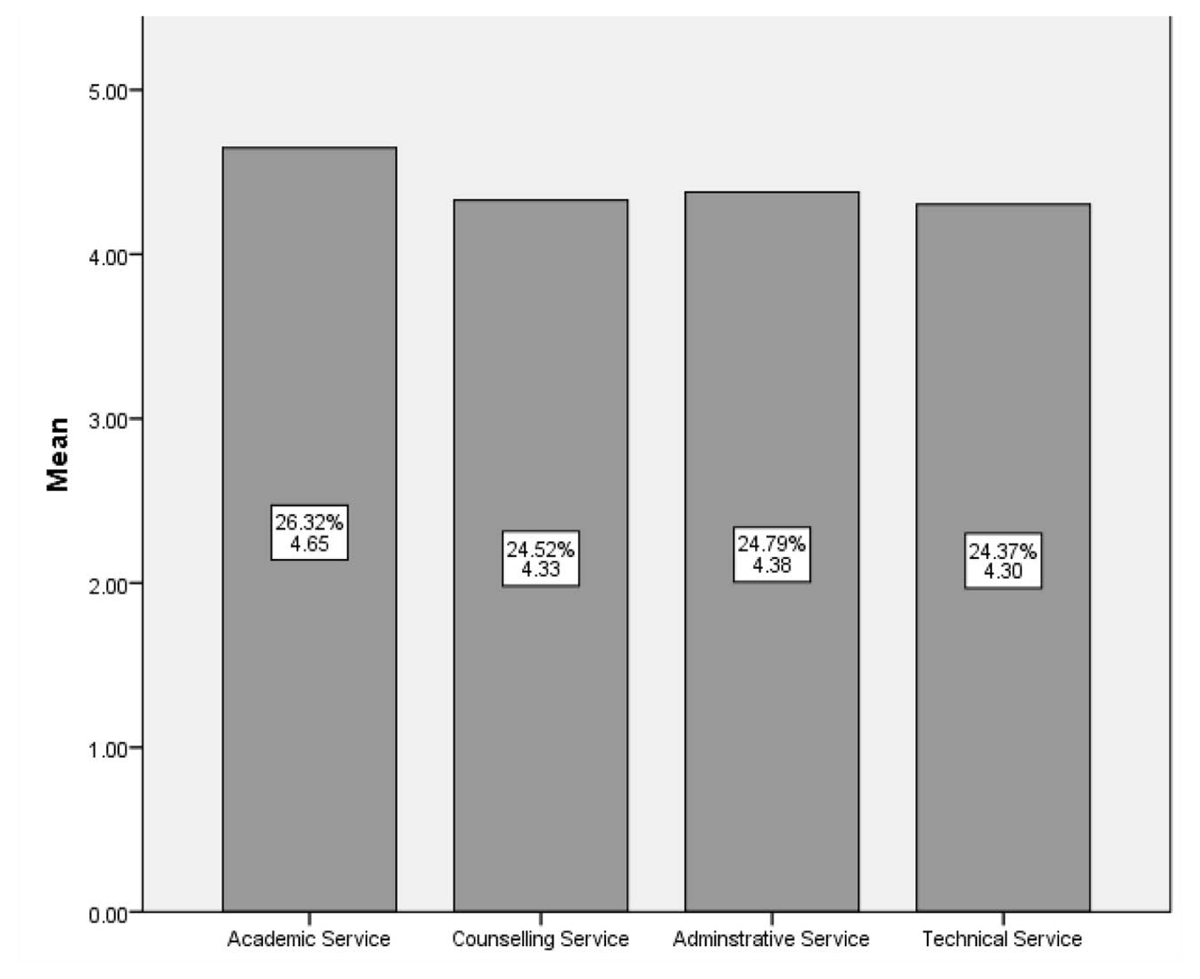
Figure 2
Means and Percentages of Support Services.
As illustrated in Figure 2, all four support services recorded mean scores above the cut-off point, indicating that they were generally accessible to distance learners. Among them, academic services received the highest rating (M = 4.65, 26.32%), followed by administrative services (M = 4.38, 24.79%). The relatively close mean scores across all four categories suggest a generally uniform perception of their availability and utilization among the respondents.
Hypotheses Testing
A total of eleven hypotheses were tested using Partial Least Squares Structural Equation Modeling (PLS-SEM). The analysis proceeded in two stages: first, the measurement model was assessed, followed by evaluation of the structural model.
Reflective Measurement Model Evaluation
Hair et al., (2021) recommend evaluating a reflective measurement model by assessing indicator reliability, internal consistency, convergent validity and discriminant validity. Specifically on the indicator reliability, they recommended that outer loadings should ideally be above 0.708, but values above 0.5 are acceptable if other criteria are met. Hair et al., (2022) however indicated that indicators with very low loadings (below 0.40) should always be eliminated from the measurement model. From Figure 3, it was found that most of the indicator loadings achieved value greater than 0.708 as recommended by Hair et al (2022) with few of them being above the minimum threshold.
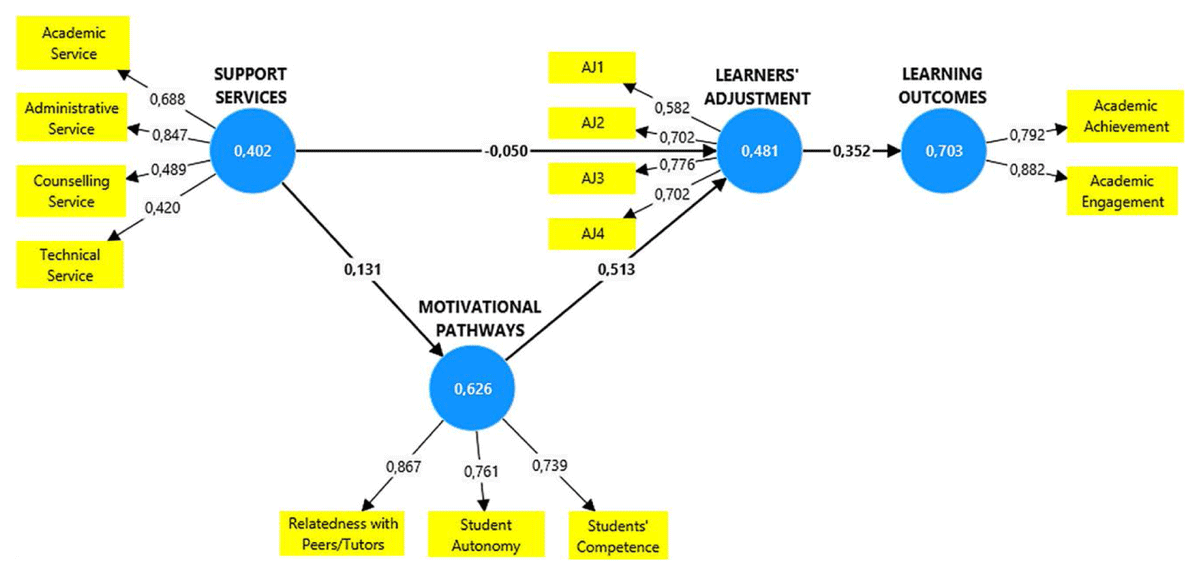
Figure 3
Measurement Model.
Assessment of Internal Consistency and Convergent Validity
The next step, following Hair et al. (2021), is to assess internal consistency reliability and convergent validity. A commonly used index of internal consistency in PLS-SEM is Jöreskog’s (1971) composite reliability (rho_c), with values between 0.70 and 0.90 regarded as acceptable. As shown in Table 3, rho_c values ranged from 0.734 to 0.833, indicating satisfactory reliability (Hair et al., 2021). Convergent validity evaluates how well a construct accounts for the variance in its indicators, typically measured by the average variance extracted (AVE). According to Hair et al., (2022), an AVE of 0.50 or higher is the cutoff, meaning the construct explains at least 50% of the variance in its indicators. From Table 2, it was revealed that support services and learners’ adjustment had AVEs below the recommended threshold. These items were however retained because their composite reliabilities were achieved and also removing items will affect the content reliability of the instrument. Further, Additional diagnostics such as item loadings and full-collinearity VIFs were examined to ensure that retained items functioned as intended.
Table 2
Reflective indicator loadings and internal consistency.
| ITEMS | INDICATOR LOADINGS | CRONBACH’S ALPHA | COMPOSITE RELIABILITY (RHO_A) | COMPOSITE RELIABILITY (RHO_C) | AVERAGE VARIANCE EXTRACTED (AVE) | VIF | |
|---|---|---|---|---|---|---|---|
| Support Services | Academic Service | 0.688 | 0.654 | 0.718 | 0.734 | 0.402 | 1.177 |
| Administrative Service | 0.847 | 1.195 | |||||
| Counseling Service | 0.489 | 1.084 | |||||
| Technical Service | 0.420 | 1.149 | |||||
| Academic Adjustment | AJ1 | 0.582 | 0.636 | 0.648 | 0.786 | 0.481 | 1.152 |
| AJ2 | 0.702 | 1.315 | |||||
| AJ3 | 0.776 | 1.408 | |||||
| AJ4 | 0.702 | 1.228 | |||||
| Motivational Pathway | Relatedness with Peers/Tutors | 0.867 | 0.705 | 0.750 | 0.833 | 0.626 | 1.451 |
| Students’ Autonomy | 0.761 | 1.362 | |||||
| Students’ Competence | 0.739 | 1.339 | |||||
| Learning Outcomes | Academic Achievement | 0.792 | 0.683 | 0.708 | 0.825 | 0.703 | 1.204 |
| Academic Engagement | 0.882 | 1.204 |
[i] Source: Field Study.
Common Method Bias
To minimize potential biases associated with the use of a single data source (questionnaire), common method bias (CMB) was assessed using two established approaches (Jordan & Troth, 2020). First, collinearity diagnostics were conducted through variance inflation factor (VIF) analysis, a widely recognized method for detecting multicollinearity (Baumgartner & Weijters, 2021). Following Hair et al. (2019), VIF values below 3.3 indicate no substantial CMV; in this study, all VIF values were below 3.3 (see Table 2), suggesting minimal risk of CMB. Second, Harman’s single-factor test revealed that the first factor accounted for 32.412% of the variance, which is well below the 40% criterion (Fuller et al., 2016), providing further evidence that CMB was not a concern in this study.
Discriminant Validity
Henseler et al. (2015) recommend using the heterotrait–monotrait ratio (HTMT) to evaluate discriminant validity, noting that Fornell–Larcker criterion can be unreliable especially when indicator loadings across constructs are similar. They suggest an HTMT cutoff of 0.90 to indicate adequate discriminant validity. Results in Table 3 showed that all values were within the acceptable threshold thereby, supporting the constructs’ discriminant validity.
Structural Model Analysis
The structural model tested eight direct effects (H01–H08) using bootstrapped path estimates (5,000 subsamples, two-tailed tests, α = 0.05). Table 4 presents path coefficients, bootstrapped means, standard deviations, t-statistics, 95% bias-corrected confidence intervals, and hypothesis decisions. H01 showed that the direct effect of support services on academic adjustment was non-significant (β = –0.049, t = 1.441, 95% CI [–0.111, 0.022]), indicating that support services do not directly produce immediate improvements in adjustment. However, support services significantly predicted all three motivational pathways: relatedness with peers/tutors (β = 0.089, t = 2.284, 95% CI [0.021, 0.172]), competence (β = 0.108, t = 2.358, 95% CI [0.018, 0.197]), and autonomy (β = 0.110, t = 2.777, 95% CI [0.037, 0.190]). In turn, each motivational dimension positively predicted learners’ adjustment, with relatedness having the largest effect (β = 0.269, t = 6.000, 95% CI [0.185, 0.362]), followed by competence (β = 0.233, t = 5.787, 95% CI [0.151, 0.307]) and autonomy (β = 0.151, t = 3.897, 95% CI [0.083, 0.235]). Finally, academic adjustment strongly predicted learning outcomes (β = 0.352, t = 9.948, 95% CI [0.283, 0.422], p < .001). Collectively, these results indicate that the effects of support services on outcomes operate indirectly via motivational pathways rather than via a direct effect on adjustment. The result is further illustrated in Figure 4.
Table 4
Path Coefficient.
| HYPOTHESIS | PATHS | BETA (β) | MEAN (M) | STD. DEVIATION | T STATISTICS | BOOT95% CI | |
|---|---|---|---|---|---|---|---|
| LLCI | ULCI | ||||||
| H01 | SS -> L. Adj | –0.049 | –0.046 | 0.034 | 1.441 | –0.111 | 0.022 |
| H02 | SS -> Rel. | 0.089 | 0.098 | 0.039 | 2.284 | 0.021 | 0.172 |
| H03 | SS -> Comp. | 0.108 | 0.116 | 0.046 | 2.358 | 0.018 | 0.197 |
| H04 | SS -> Aut. | 0.110 | 0.117 | 0.040 | 2.777 | 0.037 | 0.190 |
| H05 | Rel. -> L. Adj | 0.269 | 0.271 | 0.045 | 0.269 | 0.185 | 0.362 |
| H06 | Comp-> L. Adj | 0.233 | 0.230 | 0.040 | 5.787 | 0.151 | 0.307 |
| H07 | Aut. -> L. Adj | 0.151 | 0.158 | 0.039 | 3.897 | 0.083 | 0.235 |
| H08 | L. Adj -> LO | 0.352 | 0.355 | 0.035 | 9.948 | 0.283 | 0.422 |
| Indirect Effect | |||||||
| H09 | SS -> Rel -> L. Adj | 0.024 | 0.027 | 0.012 | 2.054 | 0.005 | 0.050 |
| H010 | SS -> Aut -> L. Adj | 0.017 | 0.018 | 0.008 | 2.106 | 0.005 | 0.035 |
| H011 | SS -> Comp -> L. Adj | 0.024 | 0.027 | 0.011 | 2.191 | 0.004 | 0.049 |
| Total Effect | |||||||
| SS -> L. Adj | 0.016 | 0.026 | 0.038 | 0.434 | –0.052 | 0.095 | |
[i] Note: SS-Support Services, Rel-Relatedness, Comp-Competence, Aut-Autonomy L. Adj-Learners’ Adjustment, LO-Learning Outcomes.
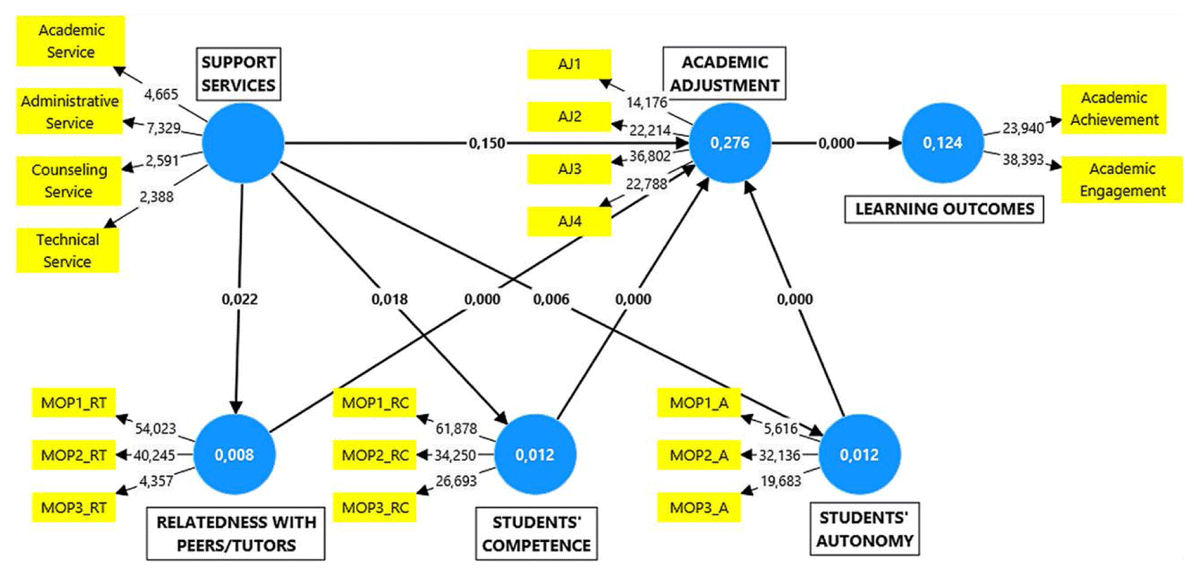
Figure 4
Structural Model.
Furthermore, the f-square values reveal that the strongest effect in the model is learners’ adjustment on learning outcomes (f2 = 0.142), which approaches Cohen’s “medium” threshold and indicates a substantively meaningful contribution to explaining variance in outcomes. The three motivational-pathway predictors of adjustment-relatedness (f2 = 0.071), competence (f2 = 0.047), and autonomy (f2 = 0.023) all yield small effects, confirming their modest but non-trivial roles. In contrast, the direct contributions of support services to each mediator and to adjustment itself are negligible (all f2 < 0.02), suggesting that support services primarily operate indirectly via motivational pathways rather than exerting unique incremental variance.
Model’s Explanatory Power
The coefficient of determination (R2) of the endogenous constructs was assessed to gauge how much variance in each mediator and outcome is explained by the model. Following Hair et al. (2011), R2 values of 0.75, 0.50, and 0.25 indicate substantial, moderate, and weak explanatory power, respectively. As shown in Table 5, the model explains a substantial portion of learners’ adjustment (R2 = 0.276), indicating that roughly 28% of the variability in adjustment is accounted for by the three motivational-pathway dimensions (relatedness, competence, autonomy) and support services. Learners’ adjustment itself explains 12.4% of the variance in learning outcomes (R2 = 0.124), demonstrating a meaningful but more modest impact on outcomes. In contrast, support services have virtually no direct explanatory power for each motivational need (R2 values between 0.008 and 0.012), indicating that their effects operate almost entirely through the motivational pathways rather than as standalone predictors.
Predictive Relevance
The Stone–Geisser blindfolding procedure was used to assess the model’s out-of-sample predictive relevance (Q2predict), with results shown in Table 6. Q2predict values above zero indicate that the model has out-of-sample predictive relevance for a given construct. Table 6 revealed that learning outcomes (Q2predict = 0.004), relatedness (0.003), autonomy (0.006), and competence (0.006) all exceed zero, albeit modestly, signalling small but positive predictive relevance. By contrast, learners’ adjustment yields a slightly negative Q2predict (–0.004), implying that the model predicts this construct no better than a simple baseline. This further suggested a weaker predictive relevance. RMSE values for all constructs hover near 1, suggesting that prediction errors are roughly on par with the variability of the outcome scales.
Important Performance Map Analysis (IPMA)
The Importance-Performance Map Analysis (IPMA) results (Figure 5) show that learners’ adjustment stands out as the single most critical driver (importance = 0.352) but also exhibits the lowest performance score (43.05), highlighting it as a prime target for intervention. Students’ competence, while less influential (importance = 0.082), performs exceptionally well (74.84), indicating current strategies here are effective and should be sustained. Learning outcomes occupy a moderate position in both importance (0.095) and performance (66.68), suggesting acceptable but improvable levels. Students’ autonomy shows modest importance (0.053) paired with middling performance (57.42), marking it as a secondary area for enhancement. Finally, relatedness with peers/tutors, with very low importance (0.006) yet high performance (69.19) appears well managed but may not warrant additional resource allocation relative to higher-impact constructs.
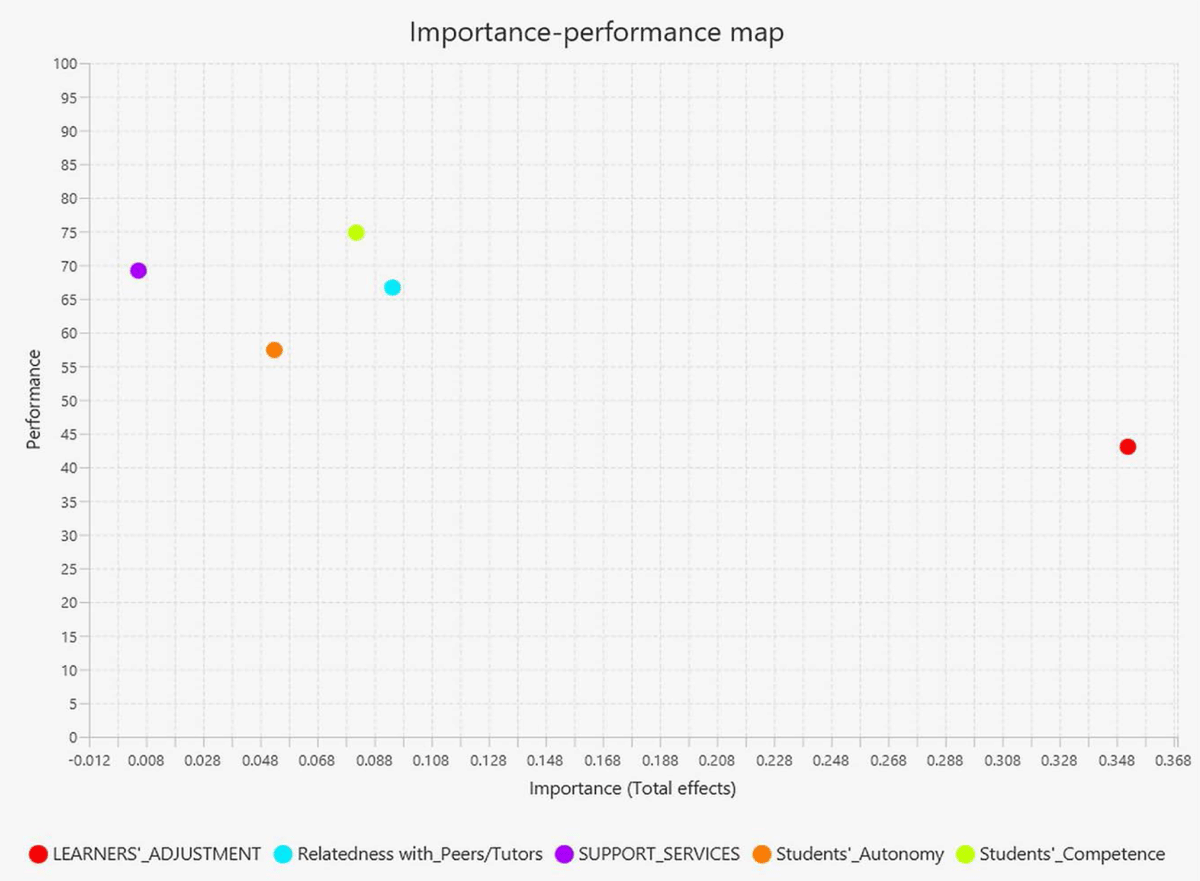
Figure 5
Importance Performance Map Analysis.
Mediation Analysis
Hypotheses 9–11 were tested through a bias-corrected bootstrap mediation analysis (5,000 resamples). This was conducted to test whether support services influence learners’ adjustment indirectly via the motivational pathways (relatedness, autonomy, competencies). As shown in Table 4, the mediation analysis revealed that support services exert no significant direct influence on learners’ adjustment (β = –0.049, t = 1.441, 95% CI [–0.111, 0.022]); however, support services significantly affect adjustment indirectly through each motivational pathway. Specifically, support services enhance learners’ adjustment via relatedness with peers/tutors (β = 0.024, t = 2.054, 95% CI [0.005, 0.050]), students’ competence (β = 0.024, t = 2.191, 95% CI [0.004, 0.049]) and students’ autonomy (β = 0.017, t = 2.106, 95% CI [0.005, 0.035]). The total effect of support services on adjustment was also non-significant (β = 0.016, t = 0.434, 95% CI [–0.052, 0.095]), confirming that support services influence learners’ adjustment exclusively through the motivational-pathway mediators. Thus, indicating that the influence of support services on learners’ adjustment is fully mediated by the motivational pathways.
Discussions
The study examined the associations between support services, motivational pathways, learners’ adjustment, learning outcomes among distance learners. It also investigated the direct and mediating roles of motivational pathways (relatedness, autonomy, competencies) in the relationship between support services and learners’ adjustment.
Support services and academic adjustment
The study examined the direct effect of students’ support services on learners’ adjustment and found a statistically non-significant effect of support services on learners’ adjustment (H01). Although literature has confirmed that effective support services can mitigate the adverse effects associated with distance education (Johnson et al., 2022; Shabani & Maboe, 2021), the current support services provided to distance learners at the College do not directly lead to learners’ adjustment. It may be that support services exert their strongest influence indirectly through other intervening variables rather than having an immediate, direct impact on adjustment. This might also stem from the fact that the support services provided are inadequate to ensure learners’ adjustment (Michubu et al., 2017). This outcome further aligns with the work of other researchers (Muola & Mwania, 2013; Gatua, 2012) who reported that many universities are yet to establish robust academic support systems to guide students through their studies. These studies highlight that insufficient support services may contribute to learners withdrawing from their studies when faced with academic challenges. Similarly, another study found that distance learners often struggle to graduate on time due to inadequate support services (Shikulo & Lekhetho, 2020).
Support services, learners’ autonomy, relatedness and competencies
The study shows the essential role of support services in improving learners’ autonomy, relatedness and competencies. These findings offer insights into how student support services contribute to motivational pathways. First, support services significantly influenced relatedness, supporting H02. This highlights the central role of support services in fulfilling students’ basic psychological needs for connection and belonging. This aligns with findings by Compare et al. (2024), who reported that positive interactions and supportive environments enhance intrinsic motivation and well-being. Similarly, Fotiadis et al. (2019) found that psychological relatedness plays a crucial role in supportive workplace settings where interpersonal closeness and social engagement are valued. These findings suggest that when academic advisors and support staff establish trusting, ongoing dialogues, they model authentic care and foster social bonds that extend beyond the transactional exchange of information. Furthermore, the study found that student support services significantly impacted autonomy, supporting H03. This finding is consistent with previous research that indicates that institutions who support autonomy foster students’ sense that they are the true agents of their actions and empower them to make well-informed choices by encouraging them to follow their own decisions and interests (Borg & Alshumaimeri, 2019; Young-Jones et al., 2021). Counseling helps learners articulate personal goals and navigate challenges, while tutoring builds their confidence and mastery of subject matter. Also, administrative support removes bureaucratic obstacles whiles technical services ensure that students can engage with resources on their own terms. Together, these services create an environment in which students feel both empowered and equipped to make informed decisions about their academic paths, strengthening their sense of ownership over their learning journey. In addition, student support services positively affect learners’ competencies, confirming H04. These findings corroborate Fotiadis et al. (2019), who reported that psychological competence tends to boost individuals’ self-efficacy and sense of mastery, as well as strengthens core competencies especially in workplace contexts that support a good work–life balance.
Similarly, Cordeiro et al. (2016) and Baard et al. (2004) found that higher competence levels are positively associated with psychological well-being. From SDT perspective, academic advising, counseling, and technical support help students feel they belong (relatedness), they have control over their learning (autonomy), and they can succeed at what they are doing (competence).
Learners’ autonomy, relatedness, competencies and learners’ academic adjustment
The study further highlights the critical role of learners’ autonomy, relatedness and competencies in influencing learners’ academic adjustment. First, the study showed that learners’ autonomy positively predicted learners’ academic adjustment, supporting H05. This implies that when students feel they have genuine choice and control over their learning processes, they develop a stronger sense of agency. This sense of agency not only fuels intrinsic motivation but also equips learners with the confidence and resilience needed to navigate new challenges. The finding is in tandem with other previous studies (Namaziandost et al., 2024). Susanti et al. (2023) also indicate that by having learner autonomy, students can identify their assets and weaknesses and make adjustments to their learning strategies accordingly. When students adjust, it encourages them to take an active role in shaping their learning experiences (Rahimi & Yadollahi, 2017). Moreover, relatedness significantly impacts learners’ adjustment, validating H06. This is emphasized in the self-determination theory by Deci and Ryan (2000) that when learners feel emotionally and socially supported by peers, instructors, and the wider academic environment, they are more likely to experience a smoother and more positive adjustment process. The finding is consistent with other previous study (Vansteenkiste et al., 2006). The findings further align with Knoster and Goodboy’s (2020) claim that peer influence is vital in developing the character of university students and that peers influence each other in their survival within a learning environment. To add up, learners’ competencies positively predicted learners’ adjustment, supporting H07. This finding indicates that when students perceive themselves as competent, they are more likely to engage actively in learning, manage stress, and persist through difficulties, all of which contribute to smoother adjustment. These results echo Fotiadis et al. (2019), indicating that competence in educational settings tends to strengthen individuals’ self-efficacy and sense of mastery while promoting the development of core competencies. From SCT perspective, autonomy helps students set their own strategies, relatedness offers encouragement and role models, and competence comes from building skills and seeing progress. Together, these make adjustment not just possible, but sustainable.
Academic adjustment and learning outcomes
The study further revealed a vital role of learners’ adjustment in improving learning outcomes. Specifically, the study found a significant effect of learners’ adjustment on learning outcomes (academic engagement and academic achievement), thereby validating H08. This outcome is consistent with prior research showing that learners’ positive school adjustment fosters a sense of belonging and motivation, leading to improved academic performance (Singh & Singh, 2024; Da Costa et al., 2018). The outcome further resonates with Raza et al. (2021) that academic adjustment is affected by psychological, motivational and behavioral factors and in turn influences the outcomes of success. Therefore, when learners are well-adjusted, they are more likely to feel secure, focused, and motivated, which directly contributes to higher levels of learning engagement (active participation, persistence, and enthusiasm) and learning achievement (academic performance and mastery).
Mediating roles of motivational pathways (relatedness, autonomy and competencies)
The study found motivational pathways (relatedness, autonomy, and competence) to fully mediate the relationship between student support services and academic adjustment, which led to an increase in learning outcomes, thereby supporting H09, H010 and H011 respectively. These outcomes reveal that the impact of student support services on learners’ academic adjustment is not direct, but rather operates through the fulfillment of core psychological needs. Drawing on Self-Determination Theory (Ryan & Deci, 2000), this result suggests that when support services are designed to foster a sense of relatedness (social connection), autonomy (a sense of control and self-direction), and competence (feeling effective and capable), they indirectly but powerfully enhance students’ capacity to adjust academically. Once adjustment is achieved, learners are more likely to engage with their studies and attain higher levels of achievement. This full mediation implies that support services alone are not sufficient unless they actively contribute to satisfying these three psychological needs. SCT adds that these needs translate directly into stronger self-efficacy, and once students believe they can manage their learning, they are far more likely to adjust well and achieve their goals.
Conclusion, Implications and Suggestions
In short, our findings show that support services help distance learners most when they build a sense of autonomy, competence, and relatedness. These motivational pathways make it easier for students to adjust academically, and that adjustment, in turn, leads to better learning outcomes. Simply offering services is not enough, what matters is how those services connect to students’ psychological needs. For distance education providers, the implication is clear; support systems should be designed in ways that would truly empower and connect learners to thrive both personally and academically.
Taken together, these findings show that support services in distance education are most effective when grounded in the principles of Self-Determination Theory and designed to meet students’ core needs for autonomy, relatedness, and competence. Theoretically, the study demonstrates that these motivational drivers are just as important in online and blended learning as they are in traditional classrooms. Practically, it highlights concrete ways to embed these needs into support services so that students not only overcome immediate learning challenges but also develop greater confidence, connection, and capability over time.
The findings suggest that not all support services are equally impactful; rather, their effectiveness depends on the extent to which they activate motivational pathways. Distance-education providers should therefore prioritize services that explicitly foster learners’ basic psychological needs. For instance, digital counseling and academic advising can enhance relatedness by providing timely and personalized interactions with tutors and support staff. Peer mentoring initiatives and structured study groups can strengthen competence by creating opportunities for collaborative problem-solving and academic skill development. Likewise, responsive technical support and user-friendly digital platforms can promote autonomy by enabling learners to independently manage their study processes. By focusing on these forms of support, institutions can more effectively translate service provision into improved adjustment, engagement, and learning outcomes. Although the present data are drawn from a single university, the findings hold broader relevance for cross-institutional and multi-country contexts.
It is therefore recommended that distance-education institutions across different settings design support interventions that deliberately foster learners’ autonomy, competence, and relatedness. In practice, this can be achieved through digital counseling, peer mentoring, and technical support, while also allowing for local adaptation and evaluation using comparable measures to determine whether the motivational mediation observed here generalizes across contexts.
Like any research, this study has its strengths and limitations. While the findings offer valuable insights into how support services influence motivation, adjustment, and outcomes for distance learners, a few limitations should be noted. The use of self-reported data may introduce bias, and the time-lagged design, though helpful for causal interpretation, cannot fully capture long-term effects. In addition, focusing on one institution limits how far the results can be generalized. Future research could address these limitations by using experimental or longitudinal designs and also include learners from multiple institutions or cultural contexts.
Data Accessibility Statement
The datasets used and/or analyzed during the current study are available from the corresponding author on reasonable request.
Sustainable Development Goals (SDGs)
This study is linked to Sustainable Development Goal 4 (SDG 4), which champions inclusive, equitable, and quality education for all, as well as lifelong learning. In particular, it supports Target 4.3 by working to make affordable, high-quality technical, vocational, and tertiary education equally accessible to everyone, and Target 4.5 by helping break down gender gaps and ensuring that vulnerable groups, such as people with disabilities, indigenous communities, and others in difficult circumstances can access learning opportunities at every level.
Ethics and Consent
Ethical approval from the University of Cape Coast Institutional Review Board (ID: UCCIRB/CoDE/2024/01),
Acknowledgements
We gratefully acknowledge the support of the Directorate of Research, Innovation and Consultancy (DRIC) of the University of Cape Coast for funding this study. We also extend our sincere appreciation to the students who willingly participated and shared their experiences, making this research possible.
Competing Interests
The authors have no competing interests to declare.
Author Contributions (CRediT)
Vera Arhin: Conceptualization; supervision; methodology; writing-original draft; writing-review & editing. Samuel Ampofo; investigation; Data curation; software; formal analysis; validation; visualization. Rebecca Kaedabi-Donkor; project management; investigation; methodology; visualization; writing-review & editing. Paul Nyagorme; investigation; data curation; visualization; writing-original draft. John Ekow Laryea; Investigation; methodology; writing-review & editing. All authors have read and agreed to the published version of the manuscript.
Author Notes
Based on Academic Integrity and Transparency in AI-assisted Research and Specification Framework (Bozkurt, 2024), the authors of this paper acknowledge that this paper was proofread, edited, and refined with the assistance of OpenAI’s GPT- 5 (Version as of July 25, 2025), complementing the human editorial process. The human author critically assessed and validated the content to maintain academic rigor. The author also assessed and addressed potential biases inherent in the AI-generated content. The final version of the paper is the sole responsibility of the human authors.