
Introduction
Universities are increasingly moving online in fully distance or hybrid ways. There is a need to balance asynchronous and synchronous work in such a way that supports these students. Research in asynchronous study (a self-paced form of education) underexplores the idea of attention, and how it sits within the larger attention economy in society. This is particularly relevant today as attention is becoming increasingly monetised and commodified, with implications for the quality and equity of learning experiences (Bakhtiar, 2022).
The research questions behind this inquiry ask: What do student accounts reveal about the construction of attention in online asynchronous study? And what do these accounts reveal about the positioning of the online student within a broader context? These questions address the current paradox of digital learning environments promoting engagement whilst also fostering distraction. This research is critical particularly as Artificial Intelligence (AI) threatens to flood online education with poor understanding of how students conceptualise attention. This paper, then, invites the reader to rethink attention, moving beyond transactional and reductive interpretations of attention in education. Its contribution is to advance a nuanced understanding of attention in educational contexts, acknowledging how its complexity has power to disrupt education research and practice. This is a currently under-addressed area within the field, with important implications for our broader understanding of attention in a rapidly evolving digital education context.
Currently most likely associated with the notion of intense concentration, attention forms a central if not the defining aspect of Csikszentmihalyi’s (1990) theory of “flow” or “the flow state”, and is known more generally as effortlessly being “in the zone”. This study, however, is less concerned with the attentional processes as part of the intensity of a mental state, but rather the lived experiences of attention as a relational process. Considered to be “the gateway between information and learning” (Keller et al., 2020, p. 1), attention as a relational process allows an alternative understanding of the term, highlighting the complexities of individual online study contexts. This research comes at a time when students are increasingly able to negotiate their own learning spaces with the mediation of digital technologies (Lamb et al., 2022). This aligns with the growing popularity of online asynchronous study (Fensie et al., 2023), reflecting the wider scaling up of the online higher educational provision (Aitken & Hayes, 2021). The exploration of experiences of attention from the student perspective is significant as visual feedback associated with student attention is less applicable for the online instructor.
By supporting a nuanced perspective of the term, this study actively supports the application of how theoretical knowledge of attention can be leveraged to inform how we understand online student practices in the real world. In line with the statement from The Manifesto for Teaching Online (Bayne et al., 2020),“There are many ways to get it right. ‘Best practice’ neglects context”, this research on attention contributes to a better understanding of how teaching may navigate the complexity of digital education “as a collective, emergent, political endeavor achieved in specific contexts involving very different arrays of pedagogies, people, and technologies” (p. 24). By adopting a relational theoretical lens, then, and reflecting Wellner’s (2016) interpretation of attention as “flexible, liquid and dynamic” (p. 89), this study seeks to avoid any presupposition that attention is quantifiable or one-dimensional.
The results of this study highlight three themes that underpin students’ construction of attention: familiarity, continuous practice, and goal orientation. Each theme highlights how, through micro-interactions with technologies, the student is part of a complex and transformative dynamic.
Literature
The word attention comes from the Latin “attendere” – “to stretch toward” (Harper, n.d.) – and reflects Husserl’s (1970) interpretation of the phenomenon as a directing of consciousness toward the world, or “intentionality”. This intentionality is also considered by Merleau-Ponty (1962) who emphasizes the importance of embodiment, whereby the physical body responds and adapts to the invitation of the world in ways which are unexplained by cognitive processes alone. The concept of attention, therefore, is underpinned by this connection to the surrounding environment, and can be considered a relational process (Rytzler, 2021). Any implication, then, that attention is an entirely rational and conscious capacity is problematic (Crogan & Kingsley, 2012). In an educational context, Rytzler (2021) describes teaching as always teaching “about something, ideas, values, events, or objects, [and] it both draws and forms the attention of the students” (p. 108). If “paying attention” is to “pursue those relations and to activate and explore the transformative potential of the teaching event (Rytzler, 2021, p. 108), attention can be defined as the activation and exploration of teaching’s transformative potential, and more generally, education’s transformative potential. Based on this definition, attention is not “an individual capacity of the student or an expected student behaviour” (Rytzler, 2021, p.108). Rather, it is a “continuously evolving relation” that “comes to life (or not) in the lived practice of teaching” (Rytzler, 2021, p. 108), or more generally, through education.
Research on attention in educational contexts is often driven by the cognitive neuroscientific paradigm where it “deals with the allocation of cognitive resources to prioritize incoming information” (Rytzler, 2021, p. 13). This is underpinned by the knowledge that “humans have only limited neural resources to process the complexity of the surrounding environment” (Lodge & Harrison, 2019, p. 23). Quantitative methods for measuring attention from within this paradigm include monitoring electrical activity of the brain, as well as eye-gaze and/or mouse-tracking in laboratory-based studies to detect and predict attention (Mancas & Ferrera, 2016). Attention in educational contexts is similarly conceptualised as something detectable and measurable in terms of data, which are considered useful for learning and teaching analytics (Elbawab & Henriques, 2023). Research on student attentiveness, then, can be associated with the search to enhance educational practices, driving forward educational efficiency (Elbawab & Henriques, 2023), aligning with the growing application of AI in education. Within educational narratives surrounding student attention, or rather inattention, educational concerns can be considered from a perspective of deficit, and can often problematically draw upon psychological and behavioural approaches turning them into medical concerns (Rytzler, 2017).
Qualitative research on student attention offers alternative insights into its applicability in real-life educational contexts. Following the emergency pivot from face-to-face to online learning due to the COVID-19 pandemic, much research focuses on the engagement of adult learners in distance learning programmes within higher education. Whilst many such studies are notably comparative (with face-to-face provision) and/or are framed within a predominantly performative context, others seek to prioritise the richness in data in first-person accounts. Aligning with the rationale for researching attention through a non-reductive lens, Bayne et al. (2014) explore the complexity of relationships between distance students and the educational institutions to which they belong. Additionally, valuing thick descriptions in research, involving an appreciation of meanings, interpretations, and cultures (Fawns & Sinclair, 2022) goes beyond surface-level observations, towards seeking a fuller picture, and can “help us to make sense of complex phenomena and dynamic contexts” (p. 94).
This review incorporates findings underpinned by postphenomenologically-informed research – an interdisciplinary perspective within contemporary educational inquiry (Rosenberger & Verbeek, 2015) – which is based on an anti-essentialist relational ontology that is “never about the absolute foundations of reality or knowledge, and never about the ‘essence’ of an object of study” (p. 1). Rather, postphenomenology offers alternative qualitative approaches for exploring “the learning process vis-à-vis machines” and the direct connections between man-machine relations” (Ihde, 1975 p. 201). The distinction has much significance for understanding the plurality of current-day experiences of attention in online study mediated by digital technologies. This elevates the significance of the richness of data from first-person insights, allowing us to move beyond the reductive binaries of “attention” and “inattention” for the digital education context.
Beyond Pointing Things Out
Mollenhauer (2014) states that the process of “pointing out” is the fundamental way in which children’s attention is both guided and shaped. “Pointing out” in an educational context, then, implies a context-dependent and co-constitutive interaction between instructor and student. In online learning, where there is a shift towards a culture of tutor-led but typically self-directed learning, the student is understood as “co-constructor of their own understanding of the world” (Lewin, 2016, p. 255). Whilst online learning reinforces some elements of “learnification” (a shift in educational discourse towards learning that assumes that the learner can independently make informed judgements about their own educational experience; Biesta, 2010), Lewin (2016) maintains that “it is the role of the institution to offer the structure and support that is not infinitely flexible or able to meet the whimsical preferences of the student-as-consumer” (p. 264). In this way, educational institutions can maintain their role in shaping good education (Lewin, 2016), and can be seen as agents within a practice that Stiegler (2010) calls “attention formation” (p. 72). In the online study provision, then, attention as a co-constitutive dynamic extends to include the educational institution and technologies, alongside the instructor and student. This highlights an entanglement between attention and the human and the non-human in today’s digitally-mediated higher education provision.
With a sensitivity for this complex human–non-human entanglement, attention can be considered in terms that go beyond the unilateral, literal, and figurative gestures of pointing out, simply to be received by another. Attention, rather, can be considered as part of a network – itself situated, dynamic, and responsive.
Hayles’ (2007) work outlines a generational divide and trend across all stages of education: from “deep attention” to “hyper attention” – deep attention “characterized by concentrating on a single object for long periods”; hyper attention “characterized by switching focus rapidly among different tasks” (p. 187). This shift towards a preference for operating with multiple information streams, seeking a high level of stimulation, and exhibiting a low threshold for boredom, is attributed to the increasing role of media in daily life (Hayles, 2007). Hayles maintains that hyper attention resembles symptoms of Attention Deficit/Hyperactive Disorder (AD/HD) which the Diagnostic and Statistical Manual of Mental Disorders (5th ed., text rev.; DSM-5-TR) defines as a persistent pattern of inattention and/or hyperactivity-impulsivity “sufficiently severe that it interferes with functioning or development” (American Psychiatric Association, 2022, p. 47). Whilst acknowledging this resemblance, Hayles also argues that hyper attention may offer adaptive advantages in a modern society. Stiegler (2010) discusses attention through evolutions that become collective and importantly transgenerational, yet with the prevalence of digital information and communication technologies in the lives of youngsters, Stiegler refers to hyper attention as a “mutation” of attention (p. 73) emerging alongside digital communication technologies. Stiegler further identifies a “global attention deficit disorder” (p. 57) attributing its rise to the demands of neoliberal capitalism. The dynamism of attention, therefore, can be considered against a larger backdrop of economic and political complexity.
Attention as Part of Human-Technology Dynamics
Ingold (2007) invites us to consider the movements and gestures of humans and non-human actors as a “meshwork of interwoven lines” (p. 103). Through these “energetic movements, out of which the forms of things are continually emerging” (p. 66), we better understand what technologies are doing. As humans navigate through the meshwork through improvisation and negotiation, they participate in acts of co-response (Ingold, 2017). In terms of attention, such momentary acts of co-response can be seen to refer to the act of attending to one thing or another dependent on the emergent energetic lines and movements within individual contexts.
Ihde (1990) classifies human-technology configurations into four primary relations: embodiment, hermeneutic, alterity, and background. These dynamics are expressed through a series of parentheses and arrows that illustrate how technologies form unities involving the human, the technology, and the world. Ihde emphasizes that these relational configurations are culturally embedded, which has broader implications for how technologies shape experiences. This is significant as it presents a non-neutral backdrop for acts of co-response or attentional practices to unfold.
The Influence of Things on Attention
In what many refer to as the “Age of Information” – and subsequently the “Age of Interruption” – due to the advent of digital technologies and the Internet (Rose, 2010), learning activities are often positioned in competition with online distractions, supporting claims of technology’s negative influence on attention. As such, attention in education is frequently reported to be in tension with technologies themselves. “Anti-distraction” strategies that seek to “combat” or “eliminate” distraction rely on the assumption that it is possible to “neatly contain the energies of digital things”, a claim that Adams and Thompson (2016) challenge as problematic (p. 85). Crary (2001) similarly argues that attention and distraction are not polar opposites, but exist on a continuum ceaselessly flowing into one another and subject to “the same imperatives and forces” (p. 51). In this way, as things invite “possible interactions between people and the environment” (Norman, 2013, p. 19), they can be understood as actively shaping how attention is constructed.
The multitude of uses afforded by digital things – named “multistability” in postphenomenology (Ihde, 1990) – illustrates how “any technology can be put to multiple purposes and can be meaningful in different ways to different users” (Rosenberger & Verbeek, 2015, p. 25). This is significant for understanding attention as it reveals a plurality of ways in which technological objects can inform the construction of attention in online study contexts.
The Allure of the Digital Gateway
Aagaard (2017) discusses educational technologies as offering a potential gateway to the world through twin dynamics of bringing in and escaping educationally relevant information into the space, which he refers to as “outside-in” and “inside-out” (p. 1127). Wellner’s (2016) concept of the “wall-window” – primarily in relation to the screen of media technologies as the interface affording such movement – describes a similar “dislocation” or “displacement of attention to other places … while our physical body remains in full engagement with the surrounding/s” (p. 96). Wellner maintains that media technologies “ensure this ‘magic’ always happens” alluding to a redirection of attention through their invitational quality (p. 96). This is echoed in Aagaard’s (2015) findings in a college setting where “laptops are experienced as endowed with an attractive allure that ‘pulls you in’” (p. 90). This aligns with Ihde’s (1990) notion of “transparency” (p. 73), where the technologies no longer become the focus but withdraw into the background, allowing the specific activity to step forward through what Rosenberger (2020) calls “field of awareness” (p. 3).
Whilst artefacts invite a particular act of engagement, they also “address us in the situated context of our own personal, social, and cultural horizons of meaning and significances” (Adams & Thompson, 2016, p. 42). That is to say, the educational practice of online study allows the user to enter a technology-mediated immersion into the world of the student. Specifically exploring distance students’ experiences of “nearness” to their educational institution, Ross et al. (2013) discuss how the continuous assembly of “nearness” through an emotional and intellectual “arrival” is most significant to students’ engagement in an online programme (p. 51). The digital gateway, then, enables the practical pursuit of educational goals but can also help enact a purposeful student identity.
The Force of Habits
As students are positioned increasingly at this gateway to the world in technology-mediated educational contexts, Rosenberger (2009) describes such whole-body engagement, which can develop over time as “deeply-sedimented habits” (p. 178). Dewey’s (1922) work on habits proposed that a large part of human conduct is based on habits – “affections, that all have projectile power”, entailing an “immensely more intimate and fundamental part of ourselves than are vague, general, conscious choices” (p. 25). This perspective which considers habits as “dominating ways of acting” (p. 25) offers a distinct contrast to views that frame a student’s search for stimulation as an isolated act. Whilst “digital cyberslacking” (off-task activity involving a digital device) is often reported in response to boredom, Aagaard (2015) introduces the concept of “mediated impatience”, where boredom arises “to a certain extent because technological alternatives are constantly available and ready to be utilized at a whim” (p. 81, original emphasis). Attentional practices can thus be seen as shaped by the dominant force of habit.
The notion of “continuous partial attention” (Rose, 2010, p. 42) – involving continuously paying partial attention in a state of hyperawareness – is relatedly said to be driven by students not wanting to miss anything within online environments, and renders them reluctant to attend fully to one single task. Liao and Sundar (2022) emphasize how it is the absence of sound or vibration cues indicating incoming notifications that is significantly associated with increased device use due to fear of missing out (FOMO) and a psychological need to belong. Relatedly, Aagaard (2015) refers to “habitual distraction” rooted in “deeply sedimented bodily habits which are demonstrated by a ‘pre-reflective attraction’ towards specific websites” (p. 90).
Considering Attention from within an Ecology
The ‘‘‘always-on’ state of potential educational engagement” (Castañeda & Selwyn, 2018, p. 7) positions today’s student within a “neoliberal ideal of the entrepreneurial consumer engaging with education on a flexible and self-motivated basis” (Castañeda & Selwyn, 2018). Within this framework, attention is contextualised as part of an “attention economy” where it is treated as a scarce commodity (Crogan and Kinsley, 2012). In educational contexts, Massive Open Online Courses (MOOCS) are situated in this space, having developed alongside mass media (Citton, 2017). Similarly, micro-learning in higher education leverages the affordances of digital technologies offering the instructional benefit of “chunking content into manageable parts” (Fensie et al., 2023, p. 33). Whilst such approaches are associated with providing students more control over their pacing (Fensie et al., 2023), the wider context reveals the critical role of online education in the economic growth of the higher education sector (Fawns et al., 2019), revealing the positioning of student attention within the economic arena. Williams (2018) writes of the tension between the goals of technology in an attention economy misaligning with our own goals stating that “it’s a machine designed to harvest our attention wantonly and in wholesale” (p. 87). The term “paying attention”, then, whilst reinforcing the analogy of currency, misleadingly implies an act of deliberate choice.
Citton (2017) contributes to our understanding of this complexity by proposing the principle of “collective enthralment”, which argues that “human attention tends to fall on objects whose forms it recognizes, under the spellbinding influence of the direction taken by the attention of others” (p. 33, original emphasis). This principle encourages a re-evaluation of the extent to which individuals act as autonomous agents when selecting material online, especially in contexts shaped by AI-generated recommendations and algorithmically curated content.
Underpinning Citton’s (2017) principle is his concept of the ecology of attention, which offers a broader perspective than the attention economy by positioning attention within multiple environments, rather than limiting it to narrow economic frameworks. Citton describes attention as existing across multiple layers, ranging from collective attention (shaped by media or organisations) to individual attention (what individuals attend to), highlighting the importance of context and relationality over individual autonomy. This broader lens allows us to reframe distraction, not as a lack of attention, but as attention directed elsewhere – often influenced by external authority (Citton, 2017). From this perspective, attention within an ecology must be understood as both an individual act (such as not answering the phone whilst studying), and one conditioned by a wider situatedness (Citton, 2017). Selwyn’s (2011) exploration of the (in)flexibilities of international distance learning revealed students’ such struggles to gain control over their learning, with many “striving to develop rigid procedures and fixed routines of studying” (p. 381). The efforts were shaped by social structures such as gender, class, and familial and professional responsibilities (Selwyn, 2011).
Rethinking (In)Attention
In an educational context, Citton (2017) argues that “good attentional health” involves more than knowing how to concentrate; it requires asking how to modulate attention to “discover the new in (or at the borders of) what is already known” (p. 181, original emphasis). This focus on discovering the new aligns with Ingold’s (2023) concept of the education of attention, which emphasizes the educational value for allowing a student’s ongoing responsiveness. The online student, then, can readily experience what Ingold calls “emancipatory distraction” (p. 117) – an opportunity to step back, gain perspective, and create space for serendipitous encounters, or to “reconsider [a] problem in a new way” (p. 122). Lewin (2016) similarly argues that it is the recognition of this “power to disrupt: to bring about fresh attention” (p. 264, original emphasis) that is most significant in education.
Whilst online study can support the time and space to bring about “fresh attention”, the realities of online study for others may leave little room for an appreciation of the emancipatory distraction of which Citton (2017) speaks. Postgraduate accounts of online study often include pressures of combining life commitments with academic endeavours (Selwyn, 2011). As Citton’s (2017) notion of “free-floating attention”, therefore, may sit uncomfortably for online students bounded by social structures and wider neoliberal ideals, it follows that if the original digital divide disenfranchised those who could not access information, a new digital divide disenfranchises those who cannot pay attention (Williams, 2018). With significant implications for online students, this new digital divide becomes increasingly an educational concern, but even more so an individual concern, in terms of having to “bring one’s own boundaries” in a so-called “Age of Attention” (Williams, 2018, p. 17).
Recent research by Zeng and Xin (2025) shows that whilst time management skills are important for both synchronous and asynchronous learning, students’ autonomous academic motivation plays a more significant role in sustaining engagement and learning persistence, especially when both modalities are used together. Looking across disciplines, Zeng and Luo (2024) discover that mathematics courses, particularly at the K-12 level, benefit more significantly from asynchronous instruction than other subjects. These findings raise further interest in how the two online modalities may be leveraged to support student learning experiences, as well as the potential for cross-disciplinary and cross-cultural comparisons in the field.
Although there is a growing body of research on attention in an educational context, a significant gap remains in qualitative research on real-time attentional experiences in asynchronous study, and particularly in research that accounts for the diversity of online learners rather than treating them as a homogenous group. Gani and Van Wyk’s (2024) framework for cultivating awareness across institutional, instructor, and learner levels highlights the importance of understanding the complex conditions that enable sustained learning effectiveness in online environments. This study, then, addresses such gaps by focusing on postgraduate students – typically balancing professional and/or familial responsibilities – and explores their real-time accounts of attentional experiences despite the practical access constraints. In doing so, this research elevates methods beyond eye-tracking or webcam analytics, more commonly used to support attentional research in synchronous environments. By advancing a nuanced and complex view of attention, this research supports future longitudinal inquiries into how attentional experiences might change over time across diverse environments online learning contexts.
Methods
Research Design
The research design follows a postphenomenologically-informed qualitative approach. As the main tenet of postphenomenology is that technologies mediate our being-in-the-world (Ihde, 1990) – taking departure from embodied experience with material artefacts, grounded in a relational ontology (Rosenberger & Verbeek, 2015) – a postphenomenologically-informed qualitative approach allows a sensitive inquiry into how this relation is taking place in an educational context.
Research Method
The research method involved semi-structured interviews supported by participant-created digital artefacts (photographs) of students’ study spaces. Reflexive Thematic Analysis (Braun & Clarke, 2020) was used to generate meanings across the data set. The intention during the interview process was to invoke a variety of relations between the students and their study experiences and/or practices via technologies, based on Ihde’s (1990) four relations. The questions were also informed by Adams and Thompson’s (2016) heuristics for “interviewing things”, which supported the idea of “giving things a voice”, and including them as participants in the inquiry (p. 10). The interview questions are provided in Appendix A.
Sampling
Purposeful and convenience sampling was used to qualify participant involvement in the study. Eleven postgraduate students from a higher education institution in the UK, from one fully online course, were recruited via an established MS Teams channel for the programme. This method of recruitment ensured that all students on the programme had an equal chance of participating. Every student who showed interest and who completed the Participant Consent Form was recruited.
Research Procedures
The interviews were conducted online through MS Teams, transcribed electronically, and reviewed and edited manually for accuracy by myself as researcher, forming the basis of the qualitative analysis conducted on the digital software NVivo. The interview phase lasted 23 days between 10th May and 2nd June 2023.
Validity and Reliability Measures
The researcher’s shared role as a student on the same programme fostered cooperative interactions, built trust, and allowed deeper insight into participants’ experiences. This positionality enabled shared understanding but may have also influenced a certain curation of responses.
The study maintained a reflexive approach. The research process highlighted how the research focused not on attention itself but on participants’ narrated experiences of attention as constructed through interviews. Visual artefacts supported both the interview process and member-checking, whilst also highlighting the limitations of language as a direct reflection of experience. The data analysis prioritised relevance over prevalence to capture the keyness of a theme. Numerical references are included for transparency purposes, rather than for statistical generalisability.
Ethical clearance was obtained from the Ethics Review Committee of the institution where the study was conducted. The datasets used and/or analysed during the current study are available from the corresponding author on reasonable request.
Findings and Discussion
Table 1 details the characteristics of the eleven participants, including gender, professional and familial profiles. Figure 1 presents the thematic map of the construction of attention. Organised according to themes and sub-themes, the data indicate that attention is constructed according to familiarity, continuous practice, and goal orientation.
Table 1
Characteristics of eleven participants.
| PSEUDONYM | YEAR OF STUDY | LOCATION | PROFILE |
|---|---|---|---|
| Bernice | 3 | UK | F/FT/N |
| Eleanor | 3 | Africa | F/Y |
| Eva | 3 | UK | F/PT/Y |
| Fergus | 3 | Asia | M/N |
| Hugo | 3 | UK | M/FT/Y |
| Kenny | 3 | UK | F/FT/N |
| Loretta | 3 | UK | F/FT/Y |
| Maria | 4 | UK | F/FT/N |
| Oliver | 3 | Europe | M/FT/N |
| Tanya | 3 | UK | F/PT/Y |
| Zachary | 1 | UK | M/FT/N |
[i] F – female; M – male.
FT – in full-time work; PT – in part-time work.
N – no dependents; Y – yes dependents.
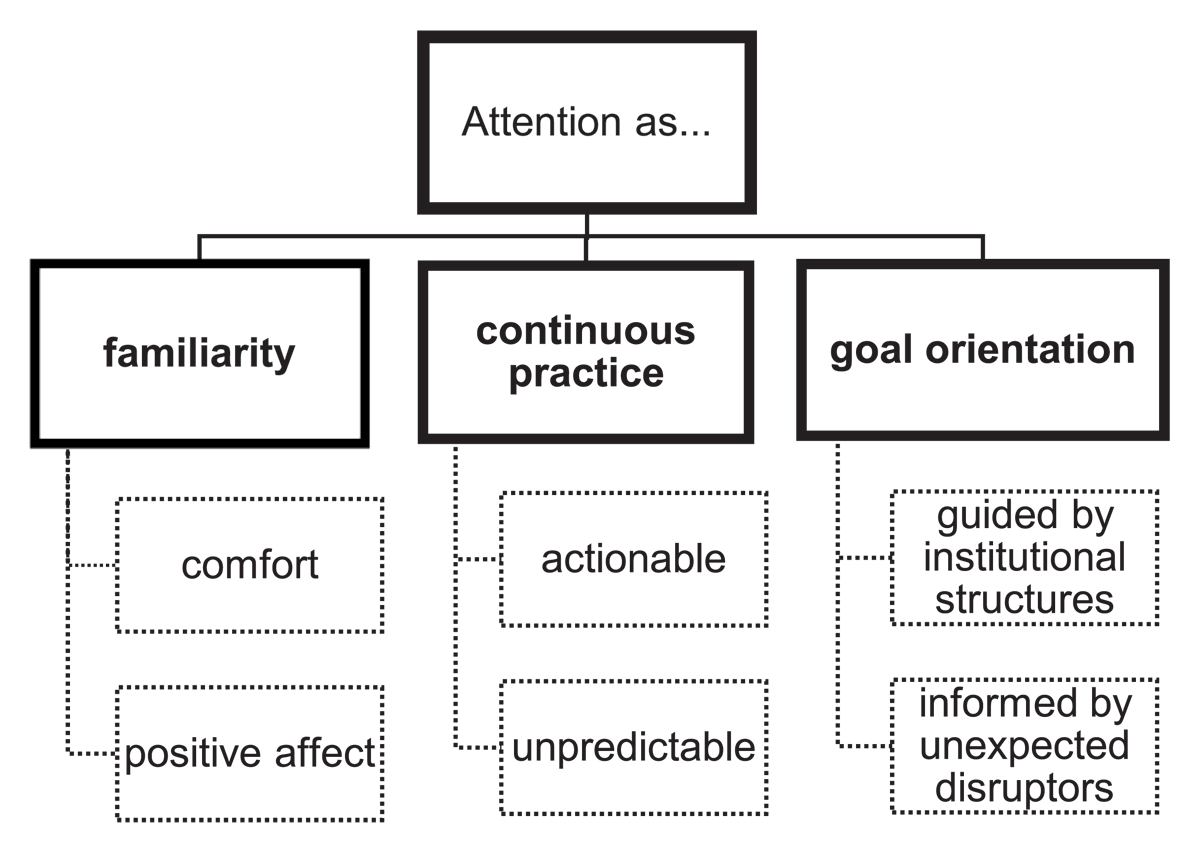
Figure 1
Thematic map: the construction of attention.
Attention as Familiarity
Familiarity with online study and digital devices is a key factor in all student accounts. As Bernice (F/FT/N) claims, “I don’t think I would have taken on a Masters online if I hadn’t already had some familiarity”. She also mentions how she considers “good proficiency with a computer” makes online study feel much more “accessible”. Relatedly, Hugo (M/FT/Y) describes himself as “pro-digital” and “a sucker for gadgets”.
Accounts suggest that exposure to and experience of digital tools over time enable students to attend to online study on a practical level, some of whom now also identifying explicitly with the digital. This theme addresses how familiarity – in terms of comfort through ease, and in some cases, enjoyment – is significant in students’ construction of attention.
Comfort
Seven of the students allude to the comfort factor in attending to online study. They describe the significance of using one digital device over another, notably the laptop, “I’m just using the laptop … maybe because on the phone it’s not as comfortable for me” (Oliver; M/FT/N). Loretta (F/FT/Y) states that if more PDFs would shrink to fit her screen, she would be “more likely to … just curl up with a phone and scroll through”.
The significance of the physical size of the screen is described further by five students who operate from two screens to facilitate the number of items that they can have visually available to them at the same time. Hugo (M/FT/Y) describes having a “nice big screen” at the office where he can have several things up simultaneously. He emphasizes the importance of “having that kind of screen real-estate to manage things”. As a result of having two screens, Tanya (F/PT/Y) mentions that she is no longer “minimising. I find that quite jarring on my attention – to keep minimising”.
In line with Ihde’s (1990) Embodiment Relation, the second screen affords an extension of the visual capabilities of the student through the possibility to project a multiplicity of materials. Similarly (associated more with ease), digital functionalities can be seen to afford the capacities of the memory of the student. Loretta (F/FT/Y) describes how she sometimes uses a digital document as space for a “brain dump” so that she doesn’t forget things.
Maria (F/FT/N) expresses how she appreciates and benefits from the convenience of having access to multiple resources on her device all in one place, and being able to make connections “very quickly [and] very efficiently” without having to get up from her seated position. Hugo (M/FT/Y) describes in positive terms how his tablet device with stylus is “key” in supporting his creativity through different digital functionalities:
If I created something like a pattern that I want to use again, I could select it, copy it, paste it again over here.
In such cases, the student’s attention aligns with Ihde’s (1990) Hermeneutic Relations, where a particular scaffold “shapes our thinking habits and structures how knowledge is held” (Adams & Thompson, 2016, p. 62). The terms selecting, copying, and pasting illustrate how conventions require interpretation on the part of the user, revealing how the student is not only attending to study in terms of the physical comfort involved in using a device, but also the comfort involved in operating within a world of signals.
The “infinite canvas” available on Hugo’s tablet which supports his attention, can, however, also be problematic. He finds that he can end up taking “so many notes of anything that interests him, thinking he could reuse it, leaving him with “just so much content”. He subsequently recognises how he would like to be “a bit more critical, … focused and logical” about the notes he takes.
There is a sense, then, that technologies not only provide the practical means for a student to attend to study comfortably with technologies, but they also play a significant role in forming particular ways in which students attend to online study.
Positive Affect
Positive affect is also apparent amongst participant accounts. These feelings are afforded by either the functionality of technologies, or the mobility of the digital device.
Bernice (F/FT/N) explains how she likes listening to Korean pop or German songs as she studies during her train commute, accessed on the digital music service Spotify:
I’ll just search ‘study’ and it’ll have: animé, study music, classical study music, and I’ll just have that on in the background… and then I’ll read with that.
Bernice additionally explains how she likes the sound of her keyboard:
It’s this really nice kind of clicking, … a really gentle sound. And I think there’s something about working on something which is lovely. … It’s quite reassuring.
Contrastingly, Tanya (F/PT/Y) states how headphones have made “a massive difference” for her as she listens to “white noise” to block out external noises.
According to student accounts, the reasons for liking certain conditions may or may not be self-evident. Bernice (F/FT/N) states her preference for using the trackpad for study compared with using the mouse for work:
I don’t know why I do that, but I think it’s because it’s a much smaller space. … I think I feel slightly more intimate. … It just seems closer. I like that.
Fergus (M/N) mentions the importance of having a natural study environment. He alludes to “plants, lots of green things, natural beauty”, referring to a “mini oasis” on his balcony at home where he usually sits for study.
Digital devices enact a comfortable physicality with the human body on an individual level; but beyond this, digital codes, or signals act as an established interface of ease between student and the study materials, and ultimately the world of the student. Idiosyncrasies guide and shape student attention. Paradoxically, through a growing sense of familiarity with digital technologies, a gradual transformation of the student occurs.
Attention as Continuous Practice
Individual accounts reflect a strong focus on deliberately structuring time, space and device use, to support attention in online study. Maria (F/FT/N) describes her home word-space as “an ideal environment” as it is “peaceful, very comfortable and free of distractions”. She adds:
I’ve got no excuse not to be very highly focused and to dedicate an absolute unwavering attention to my work.
However, a contrasting thread reveals that attention cannot always be controlled with some students acknowledging its unpredictability. As Loretta (F/FT/Y) explains:
I think you can’t make yourself focus. … If you’re not in that headspace, or mood, you just have to go with it sometimes.
This theme explores the tension between attention as actionable through the deliberate assembly of devices and surroundings and attention as a dynamic force in turn, driving a reassembly of student practices.
Actionable
Most students describe structuring study sessions to boost productivity and efficiency, and ultimately to “maximise the time” Tanya; F/PT/Y). Bernice (F/FT/N) systematically blocks out “40 minutes’ solid work” through a timer on her phone, followed by routine breaks. In such examples, attention is constructed through a deliberate setup orchestrated by the student, and enacted by the student-machine entanglement.
Alongside decisions for managing routines, students also make finer decisions to assemble their attention according to their individual circumstances. Regarding the mobile phone, Kenny (M/FT/N) says he always keeps it “on silent [which] helps a lot”. In contrast, Eva (F/PT/Y) keeps it on because she says, “my children are very accident prone, so there’s always phone calls about them falling over and … I’ve had to come and pick them up from school”. Hugo (M/FT/Y) mentions how he get pop-up notifications about football results, where he admits he’s “choosing to be distracted”, and so he’ll “have a quick look”. Hugo adds that he’s “probably not the most disciplined”, so despite turning notifications off, after an hour or two, he finds himself turning them “back on [to] have a look at something”.
Differences in individual attentional preferences can be seen in Zachary’s (M/FT/N) and Maria’s (F/FT//N) contrasting views about a similar setup – having a window directly opposite the desk: Zachary refers to how the view over neighbouring gardens from his current dedicated home office is part of his “contemplative space” which he considers to be “quite integral” for his focus and concentration; Maria, however, has developed a preference for not being sat directly in front of a window, as is the case with her current setup at home. She says:
I can’t see out of that window, so it’s quite good for maintaining concentration. Looking ahead, there’s nothing to look at other than the wall and my laptop and my work. … When I stay with my mum, the position of the desk is facing a window, so it’s easy for your gaze to wander.
These differences in attentional practices reaffirm the significance of personal and cultural contexts. Despite such differences, there remains a sense that attention: (1) can be organised to a certain extent through the deliberate choices and actions of students; (2) is correlated with perceptions of having “that self-discipline” (Oliver; M/FT/N) or “mental discipline” (Zachary; M/FT/N); and (3) can be somewhat activated on-demand, under specific conditions, with digital technologies playing an integral role.
This third point relating to the suggestion that attention may be activated on-demand is mostly made possible due to the affordances of a device’s physical mobility. Zachary explains that one of his two laptops “doesn’t tend to leave [his] building”, yet he explains that his other “more compact and robust laptop’ allows him to “grab those moments in other locations”. Studying on the work commute to work is the most evident illustration in student accounts of grabbing such moments beyond the home. The assembly of Zachary’s routine, therefore, is dependent on the physical mobility of the laptop, as well as the connectivity afforded by Google Drive.
Within the vicinity of even just one room, Bernice (F/FT/N) describes her varied study setups, often using a laptop at a desk, but also from a sofa, or the floor with the laptop on a footstool. Eva (F/PT/Y) studies from what she calls a “liminal area … where people come and go”. She explains, “it drives me nuts because it means I’ve got to shut everything down and put it away and zip it up in the laptop case so the kids don’t end up jumping on it or doing something terrible. … It’s always a bit hodgepodge”. One Sunday, Eva was delighted to be “squirreled away” in her husband’s study, not “bounded by the 9 to 3 pick-up/drop-off times, and it meant [she] had a whole day of working and … did so much”.
Whilst the role of mobile digital devices is significant in forming routines for student convenience, the rarity of ideal study moments in student accounts suggests that it is ultimately the social structures of work and family that frame the assembly of student attention. Eva describes the tension that she experiences with her mobile phone as “fighting that attention thing”, explaining that she occasionally checks her phone or is drawn by the notification light, particularly when she has previously unexpectedly had to pick up her children from school. Although Eva speaks openly of frustrations and pressures, she also expresses joy when recounting a day “cloistered off” in her husband’s study, which she refers to as a “gift”. She says:
I’ve just got to focus on a day like that. … I had to take advantage of it … and not let myself get distracted.
For Eleanor (F/Y), who states “it’s a lot of money, so I have to make it work”, attending to study is less about a forming a routine, and more about just finding a way. She explains:
I’m actually constantly in and out, so I don’t have set times when I sit down to work, so I work when I can fit it in.
Students’ attention, then, is shaped not only by individual preferences and schedules but also by broader social structures, such as work and family commitments, which influence their ability to attend to online study routines.
Unpredictable
Although attention is mostly sought to be assembled through the individual orchestration of devices and surroundings as part of productive and efficient routines, attention can also be unpredictable. Unpredictable because, at times, you may be “full of good intentions … and then it doesn’t happen” (Loretta; F/FT/Y), or contrastingly, you may not expect to be able to attend to study, but then actually be pleasantly surprised. Maria (F/FT/N) describes such a scenario at a local coffee shop:
I’ve actually found that I’ve been able to concentrate quite well in that environment with the sort of low level of hum of conversation going on around me, which I wasn’t sure would work very well. But it seems to me to work.
Bernice (F/FT/N) describes how on one occasion she took advantage of time when visiting her poorly sister, and was surprised to have been able to study despite “kids running around” and being in “a bit of a chaotic environment”. She says:
It would be great if I could just always say: ‘I’m always able to do it at this time’.
Reaffirming this unpredictability of attention, three students speak of how they sense their attention has changed over time. Those who mention such changes allude to their age, and/or previous study experiences from the past. Zachary (M/FT/N) questions whether he even has the attention span nowadays “to block out an entire weekend to really cram an assignment”. Eva (F/PT/Y) explains how she finds the light of a message notification “quite distracting nowadays, which [she] didn’t used to”. Bernice (F/FT/N) mentions how she feels the COVID-19 lockdowns could be part of the reason why her attentional practices have changed over time. She states:
When I was younger, I needed to have silence, and now I’m the opposite.
As students attempt to organise the conditions for attention by navigating and negotiating practices to best suit their current circumstances, attention itself emerges as the driver for the reassembly of those practices, highlighting its unpredictability and dynamism. The continuous practice of dynamic negotiations transforms the student in return.
Attention as Goal Orientation
All student accounts frame their attention to the online study as instrumental and goal-oriented, driven by professional aspirations and the expectation of future pay-off. This theme explores how such a transactional view of attention is shaped by disruptors, and what this may reveal about the broader positioning of the student.
Guided by Institutional Structures
Institutional or programme-related structures feature as a welcome disruptor from the students’ point of view in the sense that they point student attention in the direction of programme completion. Structures such as scheduling and synchronous sessions are all mentioned in positive terms. Maria (F/FT/N) mentions how she focuses on the endpoint to gain a sense of perspective, and to apply herself most productively for the duration of the programme:
Just constantly reminding myself that this is a temporary project and a temporary time commitment, and so for as long as I have to do it, let’s just give it everything.
Notions of keeping on track also feature in student accounts. Loretta (F/FT/Y) talks of contact points such as the synchronous sessions as “checkpoints” indicating “where you need to be”. The significance of assessments, assignments and deadlines is particularly apparent in shaping students’ attention. Loretta mentions that as assignments would often coincide with Easter and October holidays, she would simultaneously study and travel in her mobile home, “end[ing] up feeling travel sick” whilst staring at her screen.
The university, therefore, holds disruptive power to point out the direction of study for a cohort of online students. However, given, the “neoliberal drive currently dominant in higher education that sees institutions competing in a global marketplace illustrated by the proliferation and marketisation of online postgraduate programmes” (Aitken & Hayes, 2021, p. 145), the attention of the online student can be seen as situated within broader economic context. In this regard, the collective attention of the online student is shaped by structures not only at an institutional level, but also by the commercial and political systems in which the university itself operates.
Informed by Unexpected Disruptors
All student accounts feature unexpected and unplanned situations where attention is shaped in less structured ways. Eleanor (F/Y) expresses how disruptions “can change the flow of things”, and how they can “even alter what you actually end up saying in the end”.
Disruptions such as mobile phone notifications can both help and hinder online study. Whilst Kenny (M/FT/N) says they “really get your head spinning”, Eva (F/PT/Y) experiences moments of useful serendipity describing how for her it is “those moments of interruption that force reflection”. However, even beneficial interruptions can lead to frustration as they blur the line between purposeful engagement and aimless distraction. Eva refers to one study session where she found her attention frustratingly redirected by an albeit useful Twitter notification.
Maria’s (F/FT/N) account highlights how social media can shift from being a source of inspiration to a distraction, illustrating how the same disruptor can have both positive and negative impacts depending on context:
In the initial stages of the dissertation, that’s useful: getting ideas, getting inspiration. Then it became a distraction because I knew I needed to settle on a topic. … I had to leave that alone for a while.
Viewed in line with the principle of collective enthralment (Citton, 2017), “selecting” what others have previously likely selected – whilst on one level involving a practice of “choosing and filtering that is central to the functioning of attention” (Citton, 2017, p. 43) – also exists within a broader sphere of capitalism that governs the infrastructure of communication networks. As Maria, then, views online material from within a domain controlled by a capitalist infrastructure, her attention is informed by the complexity of unexpected disruptors.
Overall, goal orientation – whilst instrumental in outlook, and embedded within neoliberal structures – still ensures the transformation of the online student. The goal comes in the form of qualification, but also through being part of an emergent, creative, and serendipitous study process.
Conclusions, Implications and Suggestions for Praxis
The research questions underlying this study asked: What do student accounts reveal about the construction of attention in online asynchronous study? And what do these accounts reveal about the positioning of the online student within a broader context? These questions respond to the tension in digital learning environments that both encourage engagement whilst also enabling distraction. This research is critical particularly in an era of advancing AI that risks oversimplifying students’ attentional experiences.
Based on data from eleven postgraduate students in a fully online postgraduate programme, the study identifies three key themes in students’ construction of attention: familiarity, continuous practice, and goal orientation. These attentional experiences emerge at the intersection of physical, digital, and structural environments, situating the student within a broader attention ecology. Explored from the student perspective, online attentional practices are characterised by expressions of satisfaction due to harmonious and/or serendipitous situations, alongside frustrations expressed due to a seeming lack of individual choice. This tension between unwanted or welcome intrusion, and ultimately the ability to seclude oneself from interruption may signal a form of privilege.
This study is not about competing definitions, but about acknowledging and raising the profile of nuanced positions of attention, and the implications of this in digital education. The nuanced position of attention that is being advanced allows an exploration of online study which elevates the significance and richness of online student experiences – an alternative to attention in online study being considered in quantifiable terms. Studies from this perspective challenge assumptions and judgements about attention in binary form, i.e., how attention in online study is more than focusing or not focusing, or how attention and inattention are more complex than positive and negative states. These nuanced views of attention are crucial for education as they enable a deeper understanding of how digital education can be more fully realised. The implications for online teaching include fostering metacognitive conversations to help students better understand attention in general, and in individual contexts; recognising the diversity of online students and ensuring multiple pathways for active engagement; and supporting students in developing their own strategies according to their unique attentional needs.
This study highlights the importance of understanding attention in digital education, encouraging future research into the responsibilities and ethical dimensions of attention formation. It suggests that a nuanced and relational approach can inform both theory and practice, and recommends expanding future inquiries with larger and more diverse participant samples.
Data Accessibility Statement
The datasets used and/or analysed during the current study are available from the corresponding author on reasonable request.
Sustainable Development Goals (SDGs)
This study is linked to the following SDG: Quality education (SDG 4).
Limitations
This study uses purposive and convenience sampling and has a small sample size. Although every effort was made to ensure variety in participant selection, the study is confined to the sample group.
Additional File
The additional file for this article can be found as follows:
Ethics and Consent
Ethical approval was obtained from Moray House School of Education and Sport at The University of Edinburgh, following the ethical guidelines outlined by the British Educational Research Association (BERA) (2018); Ethical guidelines for educational research fourth edition.
Competing Interests
The author has no competing interests to declare.
Author Contributions (CRediT)
Tina Postalian: Conceptualization, methodology, formal analysis, investigation, data curation, writing—original draft preparation, visualization, writing—review and editing.